

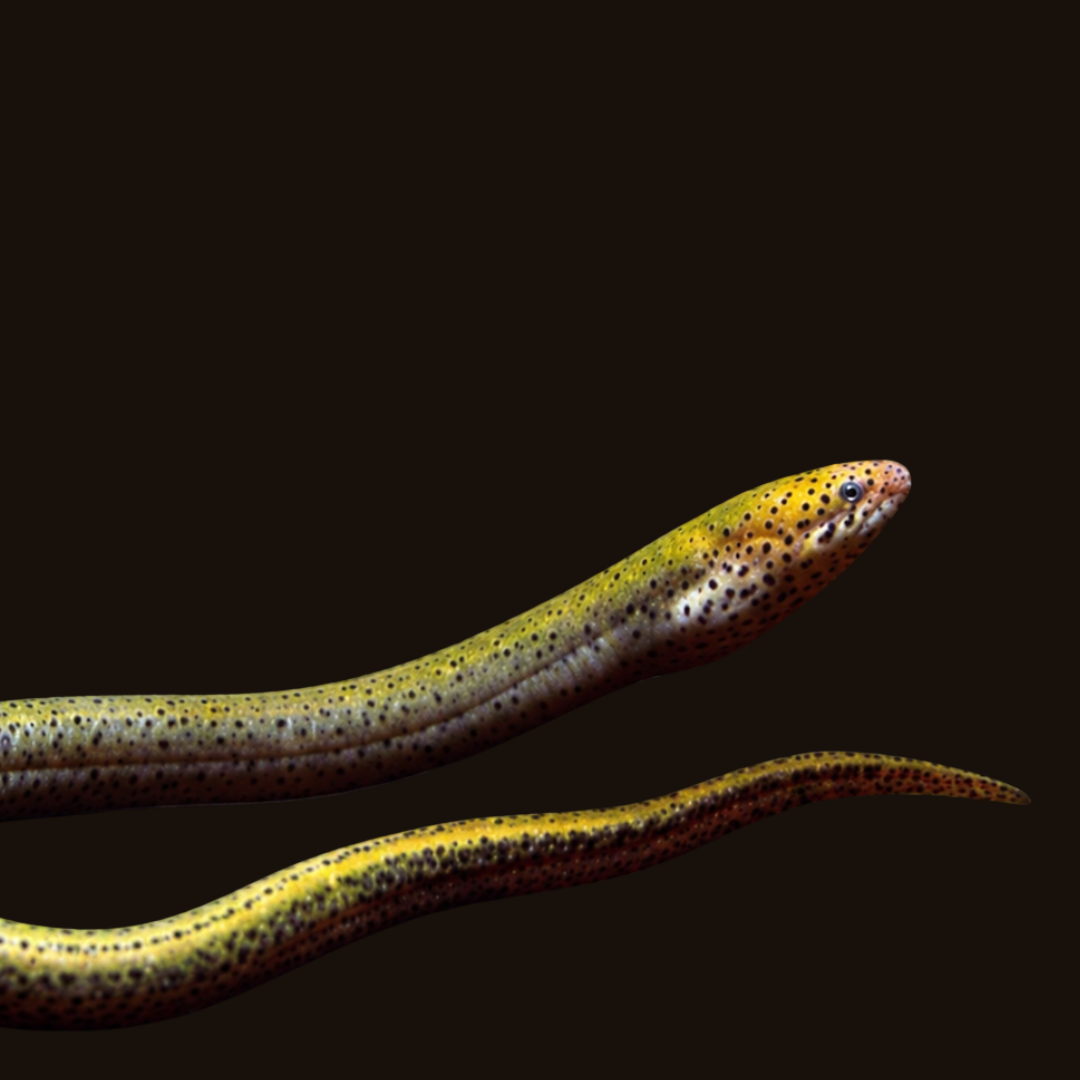
解説 / Description
日本の観賞魚市場で「南米タウナギ」「シンブランクス」などの名で流通する魚は、ウナギに似た細長い体と小さな鰭を持つ、タウナギ科の大型魚です。成魚には胸鰭と腹鰭がなく、背鰭と臀鰭も鰭条を持たない低い皮褶へ退化しています。鱗と鰾も欠き、滑らかな体表は、泥底や水草の間へ入り込む生活に適しています。 Fish sold in Japan as the South American swamp eel or Synbranchus are large members of the swamp-eel family with elongate, eel-like bodies. Adults lack pectoral and pelvic fins, while the dorsal and anal fins are reduced to low, rayless folds. They also lack scales and a swim bladder, and their smooth bodies are well suited to moving through mud and dense aquatic vegetation.
口腔、咽頭、鰓周辺の血管に富む組織を利用して空気中の酸素を取り込めることが、本種群の大きな特徴です。ただし、Synbranchus marmoratusは水中でも鰓や皮膚を使って呼吸する「条件的空気呼吸魚」であり、空気呼吸だけに依存する魚ではありません。低酸素時には空気呼吸の重要性が高まるため、飼育下では常に水面へ自由に到達でき、フタの下に新鮮な空気が保たれる環境が必要です。また、従来S. marmoratusとされた広域個体群には複数種が含まれる可能性が高く、流通個体の正確な種同定には産地情報や専門的な検討が必要です。 A defining feature of this group is the ability to take up atmospheric oxygen through highly vascularized tissues in the mouth, pharynx, and branchial region. Synbranchus marmoratus is nevertheless a facultative air-breather rather than a fish that depends exclusively on air; it also respires aquatically through the gills and skin. Because aerial respiration becomes increasingly important under hypoxia, captive fish must always have unobstructed access to the surface and a ventilated air space beneath the lid. The name S. marmoratus has also been applied historically to a very broad range of populations that may include several species, so the exact identity of aquarium imports often requires locality data and specialist examination.
基本情報 / Basic Information
| 学名 / Scientific Name | Synbranchus marmoratus (Bloch, 1795) 観賞魚流通では、外見が似たSynbranchus属の別系統にもこの学名が暫定的に用いられることがあります。In the aquarium trade, this name may be applied provisionally to other, similar-looking lineages of Synbranchus. |
|---|---|
| 通称 / Common Name | 南米タウナギ、シンブランクス、アナコンダ・シンブランクス(いずれも流通名)South American swamp eel, Synbranchus, Anaconda Synbranchus (trade names) |
| 分類 / Family | タウナギ目・タウナギ科・タウナギ属Order Synbranchiformes, family Synbranchidae, genus Synbranchus |
| 英名 / English Name | Marbled swamp eel |
| 分布 / Distribution | 従来は、メキシコから中米を経てアルゼンチン北部に至る広域分布種として扱われてきました。しかし、分子系統学、染色体研究、近年の分類整理により、この広域概念には複数種が含まれる可能性が高いと考えられています。現在の名義種S. marmoratusは、ギアナ盾状地とブラジル北部を中心とする系統として、より狭く扱われる見解があります。そのため、ペルーやコロンビアなどから輸入された個体を、産地情報だけで名義種に確定することはできません。The species was traditionally reported from Mexico through Central America to northern Argentina. Molecular, cytogenetic, and recent taxonomic work indicates that this broad concept probably contains multiple species. The nominal S. marmoratus is now treated by some current taxonomic resources as a more restricted lineage centered on the Guiana Shield and northern Brazil. Aquarium fish imported from countries such as Peru or Colombia therefore cannot be assigned securely to the nominal species from country of origin alone. |
| 最大体長 / Max Size | 従来の広義のS. marmoratusには、全長約150cmという最大記録があります。ただし、この数値には複数の系統が含まれている可能性があり、すべての流通個体が同じ大きさになるとは限りません。種同定が不確かな個体では、少なくとも50〜80cm級まで成長する可能性を見込み、余裕のある設備を準備するのが安全です。A maximum total length of about 150 cm has been reported under the traditional broad concept of S. marmoratus. Because that concept may include several lineages, not every aquarium specimen should be expected to reach the same size. For an incompletely identified import, it is prudent to plan for a fish capable of reaching at least the 50–80 cm range. |
| 寿命 / Lifespan | 飼育下の寿命を示す信頼性の高い統計は見当たらず、明確な年数は不明です。大型化し、長期飼育になる可能性が高いため、購入時から終生飼育を前提に設備と管理計画を立てる必要があります。Reliable statistics for captive lifespan are not available, and a definite figure cannot be given. Because these fish can become large and may require many years of care, housing and management should be planned as a lifelong commitment from the outset. |
飼育環境 / Aquarium Environment
| 水槽サイズ / Tank Size | 全長15〜20cmほどの小型個体は、60cm規格水槽(約57L)で一時的に管理できますが、長期飼育用としては早い段階で90cm規格水槽(約150L)以上へ移します。全長30cmを超える個体では90cm以上、50〜80cm級の成魚には120cm規格水槽または120cmワイド水槽(おおむね200〜300L以上)を基本とし、床面積と隠れ家の大きさを重視します。大型化が予想される個体には、150cm級以上の特注水槽や大型容器が必要です。Small specimens around 15–20 cm can be held temporarily in a standard 60 cm aquarium of about 57 L, but they should be moved early to at least a standard 90 cm aquarium of about 150 L for longer-term care. Fish over 30 cm need a 90 cm or larger tank, while adults in the 50–80 cm range are best provided with a standard or wide 120 cm aquarium, generally 200–300 L or more, with emphasis on floor area and shelter size. Individuals likely to grow larger may require a custom tank or large indoor system of 150 cm or more. |
|---|---|
| 水温 / Temperature | 家庭飼育では24〜28℃を実用的な目安とし、急変を避けて安定させます。野外記録にはこれより幅の広い水温域が含まれますが、流通個体の産地と系統が不明な場合、低温耐性を期待して無加温で管理するのは適切ではありません。日本の冬季は、カバー付きヒーターと温度計を使用してください。 A stable 24–28°C is a practical captive target. Wild records span a broader thermal range, but an aquarium specimen of uncertain origin should not be assumed to tolerate prolonged cold. In Japanese winters, use a reliable heater with a guard and monitor temperature with a thermometer. |
| 水質 / Water Quality | 弱酸性〜中性のpH 6.5〜7.5は、家庭水槽で管理しやすい目安です。ただし、これは厳密な生理的最適値ではなく、流通個体の由来によって適応範囲は異なる可能性があります。数値を急に動かすよりも、水温と水質を安定させ、アンモニアと亜硝酸が検出されない状態を保つことを優先します。低酸素に耐える性質があっても、汚れた水を好むわけではありません。Slightly acidic to neutral water, around pH 6.5–7.5, is a manageable practical target rather than a proven physiological optimum. Tolerance may differ among imported lineages. Stability is more important than forcing an exact number, and ammonia and nitrite should remain undetectable. Tolerance of hypoxia does not mean that the fish benefits from polluted water. |
| レイアウト / Layout | 体が完全に収まる太めの塩化ビニール管、土管、倒れにくい流木などを隠れ家として用意します。底床を使う場合は、皮膚を傷つけにくい細かな砂を薄く敷き、鋭い石や尖った装飾は避けます。水位を極端に浅くする必要はありませんが、水面までの経路を流木や機材で塞がないようにします。フタと水面の間には空気層を残し、その空気がこもらないよう通気を確保してください。Provide a shelter large enough to contain the entire fish, such as a wide PVC pipe, ceramic tube, or securely placed driftwood. If substrate is used, choose a thin layer of fine sand and avoid sharp stones or pointed decorations that can damage the scaleless skin. The water does not need to be extremely shallow, but the route to the surface must remain unobstructed. Leave an air space beneath the lid and ensure that this space is ventilated. |
| 注意点 / Precautions | 脱走防止は最重要項目です。コード穴、配管周辺、フタの角など、小さな隙間にも頭を差し込み、体を押し出すことがあります。フタは重さだけに頼らず、ロックやクリップで確実に固定し、隙間は通気を保てる素材で塞ぎます。空気層まで密閉してはいけません。ヒーターには保護カバーを付け、吸水口にはスポンジを装着します。持ち運びは網だけで追わず、太い管やフタ付き容器へ誘導すると、魚体の擦れと作業者のけがを減らせます。飼育個体を野外へ放すことはせず、譲渡を含めて責任ある終生管理を行います。Escape prevention is the highest priority. The fish may insert its head into small openings around cables, plumbing, or lid corners and force the rest of its body through. Do not rely on weight alone; secure the lid with locks or clips and block gaps with material that preserves ventilation. Never seal off the air space. Fit heaters with guards and cover filter intakes with sponge. When moving the fish, guide it into a wide tube or lidded container rather than pursuing it with a net alone, reducing skin abrasion and injury to the handler. Never release a captive specimen outdoors, and arrange responsible lifelong care or transfer. |
餌と給餌 / Feeding
| 餌の種類 / Diet | 肉食性で、水生昆虫、甲殻類、魚類などを捕食します。小型個体には冷凍赤虫、イトミミズ、細かく切ったエビなどを与え、成長に合わせてエビ、貝肉、ミミズ、魚肉、沈下性の肉食魚用人工飼料へ広げます。栄養の偏りを避けるため、一種類の切り身だけに固定せず、複数の餌を組み合わせます。哺乳類や鳥類の肉を常食にするのは避けます。This is a carnivorous fish that takes aquatic insects, crustaceans, fishes, and similar prey. Small specimens can be offered frozen bloodworms, aquatic worms, and finely cut shrimp. As they grow, the diet can be expanded to shrimp, mollusk meat, earthworms, fish flesh, and sinking pellets formulated for carnivorous fishes. Avoid relying on a single type of fillet, and do not use mammal or poultry meat as a staple. |
|---|---|
| 給餌のポイント / Feeding Tips | 視覚だけでなく嗅覚を頼りに餌を探すため、照明を落とした後、隠れ家の入口付近へピンセットや給餌棒で餌を置くと確認しやすくなります。幼魚は少量をこまめに与え、成魚は体格、腹部の張り、活動量を見ながら週2〜3回程度から調整します。給餌量は固定せず、肥満や痩せを観察して変更してください。残餌は速やかに取り除きます。人工飼料へ慣らす際は、食べ慣れた冷凍餌と併用し、無理な長期絶食は避けながら段階的に切り替えます。Because the fish relies on smell as well as sight, food is often easier to monitor when placed near the shelter entrance with tongs after the lights are dimmed. Feed juveniles small portions more often. For adults, two or three meals per week can be used as a starting point, then adjusted according to body condition, abdominal fullness, and activity. Remove uneaten food promptly. When introducing pellets, combine them with familiar frozen foods and make the transition gradually without prolonged forced fasting. |
性格と混泳 / Temperament and Tank Mates
| 性格 / Temperament | 日中は隠れ家で休み、夕方から夜間に動きやすい底生性の捕食魚です。普段はゆっくりして見えますが、餌へ向かう瞬間や驚いた際には素早く動き、強く体をくねらせます。個体差があるため、穏やかに見える個体でも、口に入る生体を安全な同居相手とはみなせません。It is a benthic predator that commonly rests in shelter during the day and becomes more active toward evening and night. Although it often appears slow, it can strike quickly at food and thrash powerfully when startled. Individual behavior varies, but even a calm specimen should not be considered safe with animals small enough to swallow. |
|---|---|
| 混泳の相性 / Compatibility | 単独飼育が最も確実です。小型魚や甲殻類は捕食される可能性が高く、同程度の大きさの魚でも噛み傷を負うことがあります。同種間では隠れ家の取り合いや接触による負傷が起こり得ます。一方、素早い魚との混泳では、本種が給餌に遅れて痩せることがあります。大型水槽、十分な隔離空間、個別給餌、緊急時の分離設備を用意できない場合は、混泳を避けてください。A single-specimen aquarium is the safest choice. Small fishes and crustaceans are likely to be treated as prey, and even similarly sized fishes can receive bite injuries. Conspecifics may compete for shelter or injure one another through close contact. Conversely, fast tank mates can prevent this slower feeder from obtaining enough food. Mixed housing should be avoided unless the keeper can provide a very large system, separate refuges, individual feeding, and immediate separation when necessary. |
病気と対策 / Diseases and Prevention
| かかりやすい病気 / Common Diseases | 家庭飼育下で頻発する本種固有の病気は、十分に整理されていません。実際の管理では、輸送時の擦れ傷に続く細菌感染、低温や急な水質変化による体調不良、有機物の蓄積に伴う皮膚の白濁や粘液異常が問題になります。流通個体の多くは野生採集魚と考えられるため、外部寄生虫や内部寄生虫を持ち込む可能性もあります。Species-specific diseases commonly seen in home aquaria have not been well documented. In practice, likely problems include bacterial infection following shipping abrasions, deterioration after chilling or rapid water-quality changes, and cloudy skin or abnormal mucus associated with organic buildup. Because many traded specimens are believed to be wild-caught, external or internal parasites are also possible. |
|---|---|
| 対策と予防 / Prevention | 新規導入個体は別水槽で4週間前後を目安に観察し、食欲、呼吸行動、皮膚、排泄物を確認します。主水槽では、水温を安定させ、尖った装飾を避け、十分な濾過と定期換水によって有機物を蓄積させないことが基本です。塩分や薬剤に対する安全域は、流通個体の系統や状態によって判断しにくいため、症状だけを見て高濃度の薬浴を行わないでください。可能であれば、魚類を診療できる獣医師または経験豊富な専門店へ相談します。飼育水や器具に触れた後は手を洗い、飼育水を口に入れないよう衛生管理を徹底します。Observe new arrivals in a separate aquarium for about four weeks, monitoring appetite, breathing behavior, skin condition, and feces. In the main aquarium, prevention depends on stable temperature, smooth furnishings, adequate filtration, and regular water changes that prevent organic accumulation. Safe concentrations of salt and medications are difficult to predict for an incompletely identified import, so avoid strong treatments based on symptoms alone. Whenever possible, consult an aquatic veterinarian or an experienced specialist retailer. Wash hands after contact with aquarium water or equipment and never allow aquarium water to enter the mouth. |
増やし方(繁殖) / Breeding
| 雌雄の判別 / Sexing | 外見だけで確実に判別する方法は確立されていません。S. marmoratusとして研究された一部個体群では、雌から雄へ変わる雌性先熟と、生まれつき雄として成熟する一次雄、雌から性転換した二次雄が共存する二形性雄が確認されています。一次雄と二次雄は生殖腺の構造で区別できますが、生きた個体の体長や模様だけで判定することはできません。流通個体には別系統が含まれる可能性があるため、この繁殖様式をすべての個体へ一律に当てはめることも避けます。No reliable method of external sexing has been established. In populations studied under the name S. marmoratus, protogyny and diandry have been documented: primary males mature directly as males, while secondary males develop after functioning as females. The two male types can be separated by gonadal anatomy, but not reliably from body length or pattern in a living fish. Because aquarium imports may include other lineages, this reproductive system should not be assumed for every specimen without qualification. |
|---|---|
| 繁殖形態 / Reproduction | 古典的な観察では、泥中の巣穴や泡を含む巣で産卵し、雄が卵や仔魚を守る行動が記載されています。孵化直後の仔魚に大きな胸鰭があり、水流を起こして皮膚での酸素取り込みを助けるという報告もあります。雄の皮膚から巣内へ酸素が移動し、仔魚の呼吸環境を支える可能性を示した文献もありますが、これらは限られた観察や特定個体群の研究に基づくため、流通するすべてのSynbranchus属魚類で同じ行動が確認されているわけではありません。Classical observations describe spawning in burrows or foam-containing nests, followed by male guarding of eggs and larvae. Newly hatched larvae have also been reported with enlarged pectoral fins that create water flow and support cutaneous oxygen uptake. Some literature further suggests that oxygen can diffuse from the guarding male’s skin into nest water. These observations are based on limited records and particular populations, and the same behavior has not been verified for every Synbranchus lineage found in the aquarium trade. |
| 繁殖のポイント / Breeding Tips | 家庭水槽で再現性よく繁殖させる方法は確立されていません。営巣できる広い底面、泥状の基質、季節的な水位や環境変化、相性の合う雌雄など、複数の条件が関係すると考えられます。性別を外見で選べず、複数飼育には負傷と脱走の危険もあるため、一般家庭での繁殖目的の群れ飼育は推奨できません。試みる場合は、研究設備に近い広さ、個体をすぐに分離できる構造、継続的な観察体制が必要です。No repeatable home-aquarium breeding method has been established. Reproduction may depend on extensive floor area, mud-like nesting substrate, seasonal changes in water level or other environmental cues, and compatible males and females. Because sex cannot be selected externally and group housing carries substantial risks of injury and escape, breeding groups are not recommended for ordinary home aquaria. Any attempt requires research-scale space, immediate separation options, and continuous observation. |
雑学と豆知識 / Trivia and Fun Facts
| 1. 一つの流通名に複数の系統が含まれる可能性 / 1. Several Lineages May Share One Trade Name | かつてS. marmoratusは、メキシコからアルゼンチン北部まで分布する一種として広く扱われていました。しかし、染色体数が42、44、46と異なる集団や、遺伝的に大きく分化した系統が報告され、外見だけでは区別しにくい種複合体であることが示されています。近年の分類資料では、名義種の分布をギアナ盾状地とブラジル北部へ絞り、他地域の個体は別種である可能性を指摘しています。日本で見られる「南米タウナギ」の色や体形に幅がある場合、単なる個体差だけでなく、異なる系統が同じ流通名で扱われている可能性も考える必要があります。Synbranchus marmoratus was once treated as a single species extending from Mexico to northern Argentina. Cytogenetic studies have since reported populations with 42, 44, and 46 chromosomes, together with deeply divergent genetic lineages that are difficult to separate by external appearance. Recent taxonomic resources restrict the nominal species to the Guiana Shield and northern Brazil and suggest that swamp eels elsewhere may represent other species. Variation in color and body form among Japanese imports may therefore reflect different lineages as well as ordinary individual variation. |
|---|---|
| 2. 空気を吸うが、水中呼吸もできる / 2. It Breathes Air but Also Respires in Water | 「水面へ出られないと必ず溺れる魚」と紹介されることがありますが、この説明は単純化しすぎています。S. marmoratusは、酸素が十分な水では鰓と皮膚によって水中呼吸を行い、水中の酸素が減るにつれて空気呼吸を増やす条件的空気呼吸魚です。実験では、低酸素水中で代謝に必要な酸素を空気呼吸から得ることが示されています。したがって、水面へのアクセスは常に確保すべきですが、空気呼吸だけで生きる魚と考えるのも正しくありません。The species is sometimes described as a fish that inevitably drowns if it cannot reach the surface, but that wording is too simple. In well-oxygenated water, S. marmoratus respires aquatically through the gills and skin, increasing aerial respiration as water oxygen declines. Experiments have shown that it can meet its metabolic oxygen requirement through air-breathing in hypoxic water. Surface access must therefore always be provided, but the fish should not be described as relying exclusively on air. |
| 3. 自然の夏眠と実験的な半夏眠は同じではない / 3. Natural Aestivation and Experimental Semi-aestivation Are Not Identical | 乾季に水場が縮小すると、タウナギ類が湿った泥や巣穴へ入り、活動を抑えて生き延びることは古くから知られています。一方、代謝研究の多くは、実験室で餌と水分条件を調整した「半夏眠」を対象としており、自然下の完全な夏眠をそのまま再現したものではありません。これらの研究では、長期絶食に伴うエネルギー利用の変化や、尿素・尿酸を含む窒素性化合物の変動が調べられています。過酷な乾季への適応を理解する重要な手がかりですが、一定期間なら水も管理も不要という意味ではなく、飼育下で夏眠を再現する必要もありません。Swamp eels have long been known to retreat into wet mud or burrows and reduce activity as habitats shrink during the dry season. Many metabolic studies, however, examined laboratory-induced semi-aestivation under controlled food and moisture conditions rather than a complete reproduction of natural aestivation. These experiments investigated changes in energy use during prolonged fasting and shifts in nitrogenous compounds including urea and urate. The findings help explain dry-season survival, but they do not mean that a captive fish can be left without water or management, and aestivation should not be deliberately induced in an aquarium. |
| 4. 雌から雄へ変わる個体と、生まれつきの雄 / 4. Sex-changing Males and Primary Males | S. marmoratusとして調べられた個体群では、生まれつき雄として成熟する一次雄と、雌として成熟した後に雄へ変わる二次雄が確認されています。二次雄の精巣には、かつての卵巣の構造を反映した特徴が残るため、生殖腺を調べると両者を区別できます。この二形性雄は淡水魚では特に興味深い繁殖戦略ですが、外見だけから現在の性や過去の性を判断することはできません。また、種複合体に含まれるすべての系統で、同じ割合や成長過程が確認されているわけではありません。Populations studied as S. marmoratus contain primary males that mature directly as males and secondary males that change sex after functioning as females. Secondary male testes retain structural evidence of their ovarian origin, allowing the two male types to be distinguished through gonadal examination. This diandric system is especially intriguing among freshwater fishes, but neither current sex nor sexual history can be determined reliably from external appearance. The same proportions and developmental pattern have not been confirmed in every lineage within the broader species complex. |
| 5. 成魚にはない胸鰭を仔魚が持つ / 5. Larvae Possess Pectoral Fins Missing in Adults | 成魚には胸鰭がありませんが、S. marmoratusの古典的な発生記載では、仔魚に大きな胸鰭が存在すると報告されています。この胸鰭は、薄く血管の多い体表へ新しい水を送り、皮膚呼吸を助ける構造と解釈されてきました。成長とともに成魚型の呼吸器官が発達すると胸鰭は失われます。同様の現象は近縁のタウナギ類でも詳しく研究されていますが、流通個体の種同定が不確かな場合、発生時期や形態の細部まで同じと断定することはできません。Adults lack pectoral fins, yet classical developmental accounts of S. marmoratus describe enlarged pectoral fins in the larvae. These fins have been interpreted as structures that move fresh water across the thin, vascularized body surface and support cutaneous respiration. They disappear as the adult respiratory system develops. Similar mechanisms have been studied in related swamp eels, but the precise timing and morphology should not be assumed to be identical in every incompletely identified aquarium lineage. |
| 6. 古代アマゾンの漁期を伝える椎骨 / 6. Vertebrae Reveal Ancient Amazonian Fishing Seasons | ボリビアのロマ・サルバティエラ遺跡では、回収された魚類遺存体の70%以上をS. marmoratusとして同定されたタウナギ類が占めます。研究者は、現生個体の椎骨に形成される成長帯と水文季節の関係を調べ、そのモデルを遺跡出土骨へ応用しました。結果は、古代の人々が乾季だけでなく雨季にもタウナギ類を捕獲していたことを示し、湿地の変化を利用した通年漁労の可能性を支持しました。細長い魚の小さな椎骨が、先史時代の暮らしと季節利用を読み解く資料になった例です。At Loma Salvatierra in Bolivia, swamp-eel remains identified as S. marmoratus account for more than 70% of the recovered fish assemblage. Researchers established how growth bands in modern vertebrae correspond to the hydrological seasons, then applied that model to archaeological bones. The results indicate capture in both wet and dry periods and support the possibility of year-round fishing adapted to changing wetland conditions. The small vertebrae of an elongate fish thus became evidence for the seasonal organization of prehistoric life. |
| 7. 丈夫さを過信しないことが飼育と自然を守る / 7. Respecting Its Hardiness Protects Both Fish and Environment | 空気呼吸、湿った場所での移動、長期絶食への耐性は、変化の大きい湿地で生きるための能力です。しかし、水槽内で丈夫に見えることは、汚れた水、低温、長期放置に耐え続けられることを意味しません。また、脱走した個体がどの程度生き残るかは、系統や環境によって異なり、事前に断定できません。強固なフタ、安定した飼育環境、野外へ出さない管理を徹底することが、個体の健康と地域生態系の双方を守ります。Air breathing, movement through wet ground, and tolerance of prolonged fasting are adaptations to highly variable wetlands. Apparent toughness in an aquarium does not mean that the fish can remain healthy indefinitely in dirty water, cold conditions, or neglect. Survival after escape would vary with lineage and local environment and cannot be predicted safely in advance. A secure lid, stable husbandry, and strict prevention of release protect both the captive animal and the surrounding ecosystem. |
まとめ / Conclusion
南米タウナギとして流通する魚は、細長い姿の珍しさだけでなく、鰓、皮膚、口腔・咽頭の組織を使い分ける呼吸、泥底環境への適応、一部個体群で確認された性転換など、熱帯湿地で育まれた複雑な生理と生活史を備えています。一方、従来のS. marmoratusという学名には複数の系統が含まれる可能性があり、流通名だけでは最終体長や性質を正確に予測できません。産地情報と個体の状態を確認し、想定より大きくなる場合にも対応できる設備を選ぶことが大切です。 Fish traded as South American swamp eels are notable not only for their unusual elongate form, but also for a complex physiology and life history shaped by tropical wetlands: respiration through the gills, skin, and buccopharyngeal tissues, adaptation to muddy habitats, and sex change documented in some populations. At the same time, the traditional name S. marmoratus may encompass several lineages, so trade names alone cannot predict final size or behavior accurately. Locality information and the condition of the individual should be checked, and housing should allow for growth beyond initial expectations.
長期飼育の基盤となるのは、十分な床面積、安定した加温、清浄な水、妨げのない水面への経路、体を休められる隠れ家、そして確実な脱走防止です。混泳は無理をせず、単独飼育を基本とすることで、負傷と給餌不足の危険を抑えられます。終生維持できる環境が整っていれば、水面へ静かに浮上する呼吸や、薄暗い時間に見せる探索行動を、この魚ならではの落ち着いた魅力として長く観察できます。 Long-term care depends on ample floor area, stable warmth, clean water, an unobstructed route to the surface, a shelter large enough for the fish to rest in, and dependable escape prevention. Solitary housing is the safest default and reduces the risks of injury and inadequate feeding. In a system that can be maintained for the animal’s full life, its quiet trips to the surface and nocturnal exploration can be observed as the distinctive, understated behavior of a highly specialized wetland fish.

気になる道具や飼い方を見つけてみませんか?
 アイのアクアグッズ案内テトラミンって、こんなにあるの? アイとコタロウのごはん探究旅道具の特徴や使い方、選ぶときのポイントをアイが紹介します。記事はコチラ →
 アイのアクアグッズ案内海水魚の底砂の選び方|サンゴ砂・ライブサンドとおすすめ商品道具の特徴や使い方、選ぶときのポイントをアイが紹介します。記事はコチラ →
さまざまな飼育テーマをご紹介。リンク先の記事には広告・商品紹介が含まれます。
案内・紹介記事一覧へ →分布マップ
従来はメキシコから中米を経てアルゼンチン北部まで分布する広域種とされてきましたが、現在の名義種はギアナ盾状地とブラジル北部を中心に、より狭く扱う見解があります。この地図では、現在の名義種について想定される中心地域を概略表示しています。
※地図上の円と代表地点は、記事の分布記述を視覚化するための概略表示です。実際の採集地点や厳密な生息範囲を示すものではありません。また、「南米タウナギ」として流通する個体には、別種または別系統が含まれる可能性があります。
参考文献・根拠資料
本文の分類、分布、生息環境、呼吸生理、繁殖、疾病管理に対応する資料を、査読論文、公的・学術データベース、専門獣医資料から選定しています。店舗、通販サイト、個人ブログ、まとめサイトは参照していません。
飼育条件の読み方: 本文中の「24〜28℃」「pH 6.5〜7.5」「規格水槽の寸法」「週2〜3回程度の給餌」などは、本種だけを対象とした比較試験で確立された絶対的な最適値ではありません。野外の環境記録、成魚サイズ、空気呼吸と低酸素耐性に関する研究、一般的な観賞魚医療・衛生管理を組み合わせた実用上の目安です。とくに流通個体は種同定が不確かな場合があるため、個体の状態を観察しながら調整する必要があります。
分類・分布・種複合体
-
学術データベース
Fricke, R., Eschmeyer, W. N. & Fong, J. D. (eds.). 2026. Eschmeyer’s Catalog of Fishes: Synbranchus marmoratus Bloch, 1795. California Academy of Sciences. 閲覧日:2026年7月16日。
本文との対応:有効学名、タウナギ科への所属、名義種の分布をギアナ盾状地およびブラジル北部中心とする現在の整理、他地域個体が別種である可能性。
資料を確認する -
査読論文・種固有
Utsunomia, R., Pansonato-Alves, J. C., Costa-Silva, G. J., Mendonça, F. F., Scacchetti, P. C., Oliveira, C. & Foresti, F. 2014. Molecular and cytogenetic analyses of cryptic species within the Synbranchus marmoratus Bloch, 1795 grouping: species delimitations, karyotypic evolution and intraspecific diversification. Neotropical Ichthyology, 12(4): 903–911.
本文との対応:2n=42、44、46の核型差、ミトコンドリア遺伝子に基づく大きな系統分化、隠蔽種を含む種複合体として扱う根拠。
DOI:10.1590/1982-0224-20140039
生息環境・形態・呼吸・飼育条件の基礎
-
学術モノグラフ
Boujard, T., Pascal, M., Meunier, J.-F. & Le Bail, P.-Y. 1997. Poissons de Guyane: guide écologique de l’Approuague et de la réserve des Nouragues. INRA Éditions, Paris, 219 pp.
本文との対応:ギアナ地域の淡水魚相、生息場所、季節変化、夜行性、泥底や巣穴を利用する生態を検討する際の基礎資料。
FAO AGRISの書誌情報 -
補助データベース
Froese, R. & Pauly, D. (eds.). 2026. FishBase. Species summary: Synbranchus marmoratus. 閲覧日:2026年7月16日。
本文との対応:最大体長の既報値、淡水・汽水環境、底生性、夜行性、肉食性、野外水温記録の補助確認。分布情報は広義の旧来概念を含むため、分類と分布については上記のCatalog of Fishesを優先しています。
資料を確認する -
査読論文・種固有
Graham, J. B. & Baird, T. A. 1984. The transition to air breathing in fishes: III. Effects of body size and aquatic hypoxia on the aerial gas exchange of the swamp eel Synbranchus marmoratus. Journal of Experimental Biology, 108(1): 357–375.
本文との対応:鰓および口腔・咽頭周辺組織を使う空気呼吸、通常水中での鰓・皮膚呼吸、低酸素時に空気呼吸へ移行する条件的空気呼吸、水面への経路を確保する必要性。
DOI:10.1242/jeb.108.1.357 -
査読論文・種固有
Svendsen, M. B. S., Johansen, J. L., Bushnell, P. G., Skov, P. V., Norin, T., Domenici, P., Steffensen, J. F. & Abe, A. S. 2019. Are all bony fishes oxygen regulators? Evidence for oxygen regulation in a putative oxygen conformer, the swamp eel Synbranchus marmoratus. Journal of Fish Biology, 94(1): 178–182.
本文との対応:低酸素下の酸素消費調節を再検討し、「低酸素に強い」ことと「水質管理が不要」であることを区別するための生理学的根拠。
DOI:10.1111/jfb.13861 -
査読論文・種固有
Moraes, G., Altran, A. E., Avilez, I. M., Barbosa, C. C. & Bidinotto, P. M. 2005. Metabolic adjustments during semi-aestivation of the marble swamp eel (Synbranchus marmoratus, Bloch 1795)—a facultative air breathing fish. Brazilian Journal of Biology, 65(2): 305–312.
本文との対応:実験的な半夏眠と長期絶食時の中間代謝・窒素代謝の変化。自然下の完全な夏眠と実験条件を同一視しないための根拠。
DOI:10.1590/S1519-69842005000200015
繁殖・性転換・仔魚
-
査読論文・種固有
Lo Nostro, F. L. & Guerrero, G. A. 1996. Presence of primary and secondary males in a population of the protogynous Synbranchus marmoratus. Journal of Fish Biology, 49(5): 788–800.
本文との対応:雌性先熟、一次雄と二次雄が共存する二形性雄、生殖腺構造による両雄型の識別、外見だけでは確実に判別できないこと。
DOI:10.1111/j.1095-8649.1996.tb00079.x -
査読論文・種固有
Ravaglia, M. A. & Maggese, M. C. 2002. Oogenesis in the swamp eel Synbranchus marmoratus (Bloch, 1795) (Teleostei; Synbranchidae): ovarian anatomy, stages of oocyte development and micropyle structure. BIOCELL, 26(3): 325–337.
本文との対応:単一の袋状卵巣、卵巣壁の筋層、卵形成過程、雌性先熟を理解するための生殖腺形態学的資料。
DOI:10.32604/biocell.2002.26.325 -
査読論文・同属比較
Favorito, S. E., Zanata, A. M. & Assumpção, M. I. 2005. A new Synbranchus from ilha de Marajó, Pará, Brazil, with notes on its reproductive biology and larval development. Neotropical Ichthyology, 3(3): 319–328.
本文との対応:巣構造、雄による保護、仔魚の大きな胸鰭と呼吸適応など、Synbranchus属の繁殖・初期発生を比較検討する資料。記載対象は別種であるため、流通個体すべてへ直接適用せず、同属比較として使用しています。
DOI:10.1590/S1679-62252005000300001
病気・検疫・管理上の注意
-
査読論文・種固有
Mathews Delgado, P. D., Mertins, O., Espinosa, L. L., Cenci Aguiar, J. & Milanin, T. 2023. First report of a histozoic Henneguya (Cnidaria, Endocnidozoa) infecting a synbranchid potamodromous fish from South America: morphostructural and biological data. Zoosystematics and Evolution, 99: 391–397.
本文との対応:ペルー産のSynbranchus marmoratusとして同定された個体の皮膚から確認された粘液胞子虫。野生採集個体では寄生生物の持ち込みを想定し、導入時に観察期間を設ける根拠の一例。
DOI:10.3897/zse.99.105770 -
専門獣医資料・一般魚類
Petty, B. D., Francis-Floyd, R. & Yanong, R. P. E. 2024. “Overview of Aquarium Fish,” “Management of Aquarium Fish,” and “Bacterial Diseases of Fish.” Merck Veterinary Manual, Professional Version.
本文との対応:新規導入魚の隔離観察、輸送・擦れ傷・水質悪化・有機物負荷・急な温度変化を疾病の誘因として扱う考え方、診断なしの予防的投薬を避ける方針、薬浴より先に環境条件を見直す原則。種固有資料ではなく、観賞魚医療全般の標準的な管理資料です。
Overview of Aquarium Fish Management of Aquarium Fish Bacterial Diseases of Fish
注:同じ「Synbranchus marmoratus」名で発表された過去の研究には、現在では別種とみなされる可能性のある地域個体群が含まれます。そのため、分類・分布は最新のCatalog of Fishesを優先し、生理・繁殖研究は採集地と研究対象集団を意識して解釈しています。




コメント