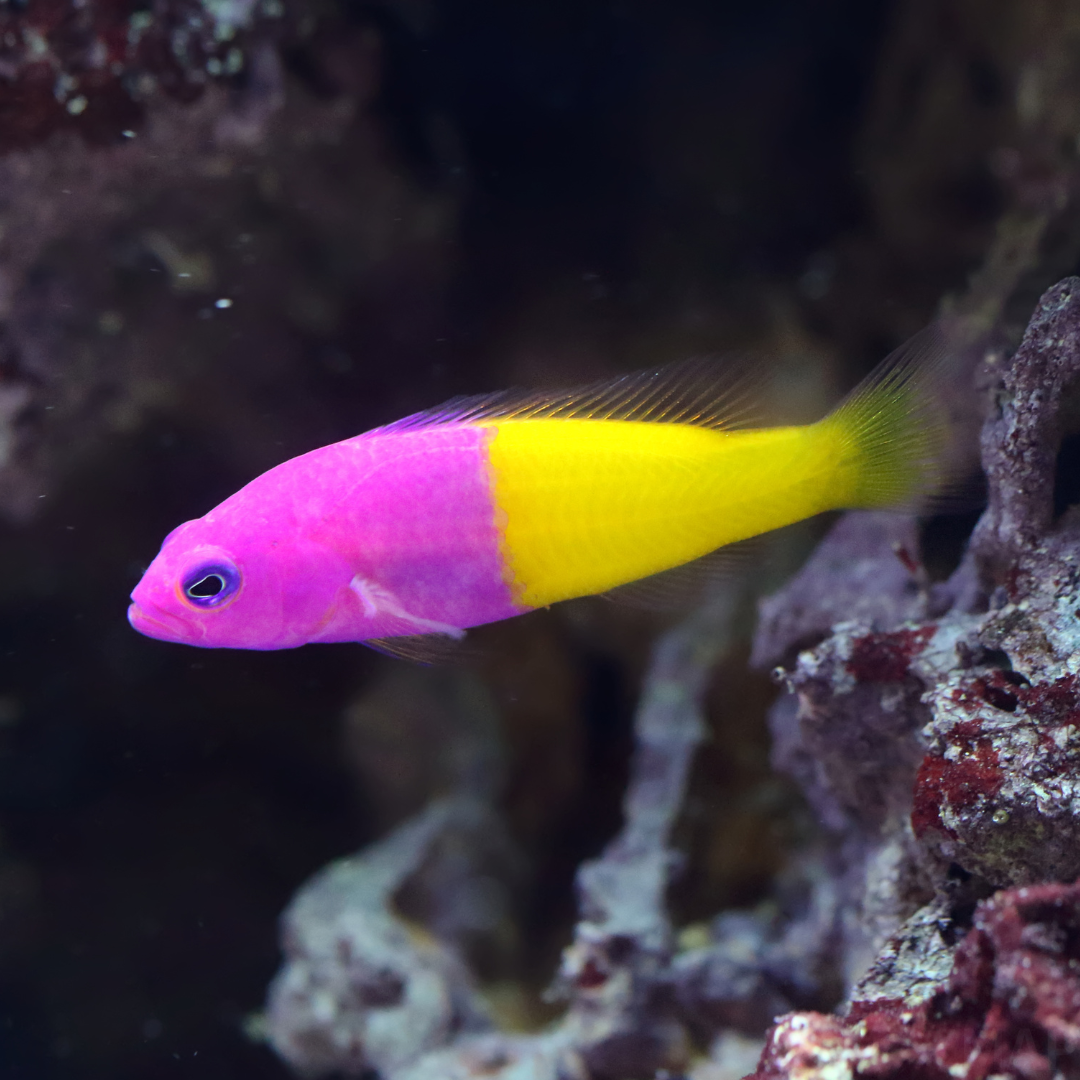
体の前半部が鮮烈なマゼンタ(紫色)、後半部が明瞭な黄色に二分されるという、極めて特徴的な外観を持つ小型の海洋魚類です。インド太平洋の熱帯サンゴ礁を代表する種として広く知られており、強健な体質を持ち飼育が比較的容易であることから、日本国内の観賞魚市場においても常に安定した人気を誇っています。しかし、その愛らしい外見とは裏腹に、自身の体長をはるかに凌駕するほどの苛烈な縄張り意識と攻撃性を内包しており、水槽内での混泳には高度な知識と計画性が要求されます。大西洋に生息するロイヤルグラマとの外見的な酷似は、進化生物学における興味深いトピックとしても有名です。The Bicolor Dottyback is a small marine fish characterized by its extremely distinctive appearance, with the front half of its body a striking magenta (purple) and the rear half a vivid yellow. Widely known as a representative species of Indo-Pacific tropical coral reefs, it consistently enjoys stable popularity in the aquarium market due to its hardy constitution and relative ease of care. However, contrary to its charming looks, it harbors a fierce territoriality and aggressiveness that far exceeds its small size, requiring a high degree of knowledge and planning for successful community tank keeping. Its striking resemblance to the Royal Gramma from the Atlantic Ocean is also famous as a fascinating topic in evolutionary biology.
基本情報 / Basic Information
学名 / Scientific Name
Pictichromis paccagnellae
通称 / Common Name
バイカラードティーバックBicolor dottyback
分類 / Family
ギンポ目 メギス科 メギス亜科 Pictichromis属Order Blenniiformes, Family Pseudochromidae, Subfamily Pseudochrominae, Genus Pictichromis
英名 / English Name
Bicolor dottyback, False gramma
分布 / Distribution
インドネシア、バヌアツ、パラオ、パプアニューギニア、ソロモン諸島、オーストラリア北西部など、インド太平洋の広範な熱帯海域。主に水深15メートル以浅の浅い沿岸サンゴ礁やドロップオフに生息します。Widespread across the tropical Indo-Pacific, including Indonesia, Vanuatu, Palau, Papua New Guinea, the Solomon Islands, and northwestern Australia. It primarily inhabits shallow coastal coral reefs and drop-offs at depths of 15 meters or less.
最大体長 / Max Size
約7cmApproximately 7 cm (2.8 inches)
寿命 / Lifespan
自然界での明確なデータは乏しいですが、飼育下では適切な環境を維持することで数年(おおむね3年から5年程度)の飼育が可能です。While precise data in the wild is scarce, they can be kept for several years (generally around 3 to 5 years) in captivity under proper conditions.
飼育環境 / Aquarium Environment
水槽サイズ / Tank Size
単独飼育であれば30cmキューブ水槽などの小型水槽でも可能ですが、他魚と混泳させる場合は生態的なストレスを軽減しテリトリーを安定させるため、最低でも総水量100リットル程度のシステム(60cmワイド水槽や90cm規格水槽など)が推奨されます。While solitary keeping is possible in a small tank like a 30cm cube, for a community setup, a system with a total volume of at least 100 liters (such as a 24-inch wide or 36-inch standard tank) is recommended to reduce ecological stress and stabilize territories.
水温 / Temperature
24度から26度24°C – 26°C (75°F – 79°F)
水質 / Water Quality
一般的な海水魚の飼育水質(比重1.020から1.025)。水質変動に対する寛容性は高いです。Standard marine aquarium water quality (specific gravity 1.020 – 1.025). They are highly tolerant of water quality fluctuations.
レイアウト / Layout
多孔質で複雑なライブロックの配置が最も重要です。完全に姿を隠せる暗がりや、通り抜けられる穴を多数構築してください。隠れ家が不足すると極度のストレスを感じ、他魚への攻撃性がさらに激化する危険があります。Arranging highly porous and complex live rock is crucial. Construct numerous dark hiding places and holes they can swim through. A lack of hiding spots causes extreme stress, which can critically escalate their aggression towards other fish.
注意点 / Precautions
サンゴを食害しないためリーフタンクへの導入は可能ですが、水槽内に自然発生するヨコエビなどの微小な甲殻類や、ペパーミントシュリンプなどの小型の観賞用エビは確実に捕食対象となります。While considered reef-safe as they do not harm corals, naturally occurring micro-crustaceans like amphipods, as well as small ornamental shrimp like peppermint shrimp, will undoubtedly become their prey.
餌と給餌 / Feeding
餌の種類 / Diet
自然界では微小捕食者(マイクロプレデター)であり、底生性の小型甲殻類や動物プランクトンを食べます。飼育下では人工飼料(海水魚用の顆粒やフレーク)から、冷凍のホワイトシュリンプ、生餌(アサリのむき身やイサザアミなど)まで幅広く食べます。In the wild, they are micropredators, feeding on small benthic crustaceans and zooplankton. In captivity, they eat a wide variety of foods, from artificial diets (marine pellets and flakes) to frozen mysis shrimp and live foods (such as chopped clams or mysid shrimp).
給餌のポイント / Feeding Tips
食に関しては非常に貪欲で、餌付けは極めて容易です。健康と鮮明な色彩を長期間維持するためには、単一の餌に頼らず、人工飼料をベースにしつつ冷凍飼料などをローテーションして与えることが望ましいです。1日に1から2回、数分間で食べ切れる量を与えます。They are voracious eaters and very easy to wean onto prepared foods. To maintain health and vibrant colors long-term, it is best not to rely on a single food source, but to rotate artificial diets with frozen foods. Feed an amount they can consume within a few minutes, once or twice a day.
性格と混泳 / Temperament and Tank Mates
性格 / Temperament
非常に凶暴で、自らの体長をはるかに凌駕するほどの強烈なテリトリー意識と排他性を持ちます。自分の縄張りに侵入する者は、自分より大きな相手であっても果敢に攻撃を仕掛けます。Extremely aggressive, possessing intense territoriality and exclusivity that far exceeds their body size. They will boldly attack any intruder into their territory, even fish much larger than themselves.
混泳の相性 / Compatibility
混泳の難易度は非常に高いです。自身と似た細長い体型(ハゼ類、ギンポ類など)や、体色に紫色や黄色を含む魚には特に強い闘争心を燃やします。混泳を成功させる絶対の鉄則は「一番最後に水槽に導入すること」です。また、相手には体高のあるヤッコ類や、遊泳層が異なる魚種を選ぶ必要があります。色が似ているからといって、温和なコミュニティ水槽に本種を入れてしまうと水槽内が崩壊する原因となります。Compatibility is very challenging. They exhibit particularly strong hostility towards fish with similar slender body shapes (such as gobies and blennies) or those featuring purple or yellow in their coloration. The absolute ironclad rule for a successful community tank is to “introduce this fish last.” Tank mates should be deeper-bodied fish like angelfish or species occupying different swimming zones. Introducing this species into a peaceful community tank simply because “the colors match” will cause the tank’s environment to collapse.
病気と対策 / Diseases and Prevention
かかりやすい病気 / Common Diseases
本種特有のかかりやすい病気は少なく、非常に強健な魚ですが、導入初期の白点病など、一般的な海水魚の疾患には注意が必要です。While this is a very hardy fish with few species-specific common diseases, caution is required regarding general marine fish ailments, such as Marine Ich (Cryptocaryon irritans) during the initial introduction phase.
対策と予防 / Prevention
水質変動には強いものの、安定した水温と良好な水質の維持が基本の予防策です。また、隠れ家となるライブロックの不足は極度のストレスとなり、免疫力の低下や他魚への過剰な攻撃を引き起こす原因となるため、レイアウトの工夫が健康維持に直結します。Although highly tolerant of water fluctuations, maintaining stable temperature and good water quality is the fundamental preventative measure. Furthermore, a lack of live rock for hiding causes extreme stress, leading to a compromised immune system and excessive aggression towards other fish. Thus, thoughtful aquascaping directly impacts their health maintenance.
増やし方(繁殖) / Breeding
雌雄の判別 / Sexing
外見から雌雄を判別することは事実上不可能です。本種は「雌性先熟の雌雄同体」であり、すべての個体は初期に雌として機能し、群れの中で最も優位に立った個体や体格が最大の個体が雄へと性転換を遂げます。さらに、環境に応じて再び雌に戻る「双方向の性転換」が可能であることも示唆されています。It is virtually impossible to distinguish males from females by external appearance. This species is a “protogynous hermaphrodite”; all individuals initially function as females, and the most dominant or largest individual in a group undergoes sex change to become a male. Furthermore, recent studies suggest they are capable of “bi-directional sex change,” reverting to female depending on environmental needs.
繁殖形態 / Reproduction
雄がテリトリー内の岩の裏などに巣を用意し、そこに雌が卵を産み付ける底生卵型です。産卵後、雄は卵が孵化するまでの間、新鮮な水を送り続け、外敵から卵を保護する役割を担います。They are oviparous (egg-laying) spawners. The male prepares a nest under a rock within his territory, where the female lays her eggs. After spawning, the male takes on the role of guarding the eggs, continuously fanning them with fresh water until they hatch.
繁殖のポイント / Breeding Tips
海外の養殖施設などでは人工繁殖(ブリーディング)が商業ベースで行われています。しかし最大の難関はペア形成時の致死的闘争です。外見で性別が分からない任意の2匹を同居させると激しく殺し合うため、性転換プロセスが完了し絆が形成されるまで、高度な隔離と監視の技術が不可欠となります。Captive breeding is conducted on a commercial scale at overseas aquaculture facilities. However, the greatest hurdle is the lethal aggression during pair formation. Placing two randomly selected individuals (whose sex is visually indistinguishable) together often results in fierce fighting to the death. Advanced isolation and monitoring techniques are essential until the sex-change process is complete and a bond is formed.
雑学と豆知識 / Trivia and Fun Facts
1. 学名と分類の変遷の歴史 / 1. History of Scientific Name and Classification
バイカラードティーバックは1973年、著名な魚類学者Herbert R. Axelrodによって記載されました。種小名の「paccagnellae」は、タイプ標本を提供したイタリアの観賞魚卸売業者、パッカネラファミリーへの献名です。長らくPseudochromis属に分類されていましたが、2004年にAnthony C. Gill博士による大規模な再編が行われ、ラテン語の「塗られた(pictus)」とスズメダイ科などの語幹「Chromis」を組み合わせた新属「Pictichromis属」へと移されました。この属名は、まるで絵の具で塗り分けたかのような彼らの鮮明な生体色を見事に表現しています。The Bicolor Dottyback was described in 1973 by the renowned ichthyologist Herbert R. Axelrod. The specific name “paccagnellae” is an eponym honoring the Paccagnella family, Italian aquarium wholesalers who provided the type specimen. Long classified in the genus Pseudochromis, it was moved to a new genus during a major taxonomic revision by Dr. Anthony C. Gill in 2004. The new genus, “Pictichromis,” combines the Latin “pictus” (painted) and “Chromis” (a root often used in fish names), perfectly capturing their vivid, as-if-painted coloration.
2. 擬態ではない?収斂進化の神秘 / 2. Not Mimicry, but the Mystery of Convergent Evolution
大西洋カリブ海には、本種と驚くほどそっくりな「ロイヤルグラマ」という魚が生息しています。科も生息地も全く違う両者が同じ配色を持つことは、よく「擬態」と誤解されますが、互いに出会うことのない海域に住んでいるため、これは擬態ではありません。サンゴ礁の岩陰という似たような環境で生き抜くために、別々の進化を辿りながらも同じ色彩の最適解(カモフラージュと仲間へのアピール)に行き着いた「収斂進化」の最も美しい例の一つとして、進化生物学の世界でも頻繁に引用されています。In the Atlantic Caribbean Sea, there lives a fish called the “Royal Gramma” that looks astonishingly similar to this species. While often misunderstood as “mimicry” because these unrelated fish from completely different habitats share the same coloration, it is not mimicry since they never encounter each other. It is actually one of the most beautiful examples of “convergent evolution”—where different species, facing similar environmental pressures in the shadows of coral reefs, independently arrived at the same optimal color solution for camouflage and signaling.
3. 色彩を生み出す細胞と境界線 / 3. Color-Producing Cells and the Boundary Line
この鮮烈なツートンカラーは、「エリトロ・イリドフォア」と呼ばれる特殊な色素細胞によって生成されています。この細胞は、光の当たり方によって金属的な反射を生み出し、複雑な光のサンゴ礁において縄張りの主張や求愛のシグナルとして機能します。ちなみに、そっくりなロイヤルグラマは紫と黄色の境界部分が網目状のグラデーションになることが多いですが、バイカラードティーバックの境界線は定規で引いたようにスパッと直線的に分かれているのが見分けるポイントの一つです。This striking two-tone color is produced by specialized pigment cells called “erythro-iridophores.” These cells create metallic reflections depending on how the light hits them, functioning as territorial claims and courtship signals in the complex light environment of a coral reef. Incidentally, while the similar-looking Royal Gramma often has a mesh-like gradient at the boundary between purple and yellow, a distinguishing feature of the Bicolor Dottyback is that its color boundary is sharply and vertically divided, as if drawn with a ruler.
4. 複雑なコミュニケーション・ディスプレイ / 4. Complex Communication Displays
彼らはただ激しく攻撃するだけでなく、精巧なボディランゲージ(ディスプレイ)を持っています。例えば、相手の正面に向かって体をS字に波打たせながら突進する「正面ディスプレイ」や、自らの側面を最大に見せて威嚇する「側面ディスプレイ」、そして雄が雌に対して巣穴の存在をアピールするために岩に体をこすりつける「S字ディスプレイ」などです。これらの行動は、水槽内でもペアリングや縄張り争いの際に観察することができます。They don’t just blindly attack; they possess intricate body language (displays). For example, a “Frontal Display” involves undulating their body in an S-shape while charging at an opponent’s front; a “Lateral Display” maximizes their side profile for intimidation; and a “Sigmoid Display” where the male presses his undulating body against a rock to advertise his nest to a female. These behaviors can be observed in the aquarium during pairing or territorial disputes.
5. 日本への輸入と厳格な生態系保護 / 5. Importation to Japan and Strict Ecosystem Protection
バイカラードティーバックは主にインドネシアなどから空輸で日本にやってきます。その際、未知の病原菌から日本の生態系を守るため、非常に厳格なプロセスを踏みます。輸入業者は動物検疫や都道府県の指導機関と連携し、輸送に使われた海水を日本の海や川、下水道に直接流すことは絶対に禁止されています。強力な殺菌処理を行ってから廃棄するという見えない努力によって、安全な観賞魚の流通が支えられているのです。Bicolor Dottybacks primarily arrive in Japan via air freight from places like Indonesia. During this process, extremely strict procedures are followed to protect Japan’s ecosystem from unknown pathogens. Importers work with animal quarantine and prefectural agencies, and it is strictly forbidden to discharge the transport seawater directly into Japanese seas, rivers, or sewers. The safe distribution of ornamental fish is supported by the unseen effort of treating this water with powerful sterilization before disposal.
まとめ / Conclusion
バイカラードティーバックは、その絵画のように鮮やかな色彩で水槽に強烈なアクセントを与えてくれる、サンゴ礁のダイナミズムを体現したような魅力的な海水魚です。餌付けも容易で非常に丈夫なため、単独飼育であれば初心者にも十分にお勧めできる種類です。The Bicolor Dottyback is a fascinating marine fish that embodies the dynamism of the coral reef, providing a striking accent to any aquarium with its vibrant, painterly colors. Being very hardy and easy to feed, it is highly recommended even for beginners, provided it is kept alone.
しかし、その美しい姿に隠された「サンゴ礁の暴君」と呼ぶべき凶暴性を忘れてはいけません。混泳を計画する場合は、適切な水槽サイズと、複雑なライブロックによる緻密な隠れ家の構築が不可欠です。そして何より、「水槽導入は一番最後に」という鉄則を守り、彼らの性質を深く理解して付き合うことで、長期にわたりその美しさを堪能することができるでしょう。However, one must never forget the ferocity—fitting of a “tyrant of the reef”—hidden beneath its beautiful appearance. If planning a community tank, an appropriate tank size and the construction of elaborate hiding places using complex live rock are indispensable. Above all, by strictly following the rule of “introducing this fish last” and deeply understanding their nature, you will be able to enjoy their beauty for many years to come.
Gill, A. C. (2004). Revision of the Indo-Pacific dottyback fish subfamily Pseudochrominae (Perciformes: Pseudochromidae). Smithiana Bulletin, 1, 1-213. (Pictichromis属の新設およびメギス亜科の分類学的再編に関する主要論文)
Axelrod, H. R. (1973). A colorful new pseudochromid fish with a new generic name. Tropical Fish Hobbyist. (バイカラードティーバックの原記載およびPaccagnellaファミリーへの献名に関する文献)
Michael, S. W. (2001). Marine Fishes: 500+ Essential-To-Know Aquarium Species. Microcosm Ltd. (自然界の生態およびアクアリウムにおける飼育環境、混泳の注意点について)
Wittenrich, M. L. (2007). The Complete Illustrated Breeder’s Guide to Marine Aquarium Fishes. T.F.H. Publications. (メギス科魚類の雌雄同体メカニズムおよび人工繁殖におけるペアリングの課題について)



 アイのアクアグッズ案内バルブの仲間に合わせる飼育用品|チェリーバルブ・スマトラ・中型種の水槽とろ過道具の特徴や使い方、選ぶときのポイントをアイが紹介します。記事はコチラ →
 アイのアクアグッズ案内水槽のコケ掃除|道具の選び方とお掃除生体の得意・不得意道具の特徴や使い方、選ぶときのポイントをアイが紹介します。記事はコチラ →



コメント