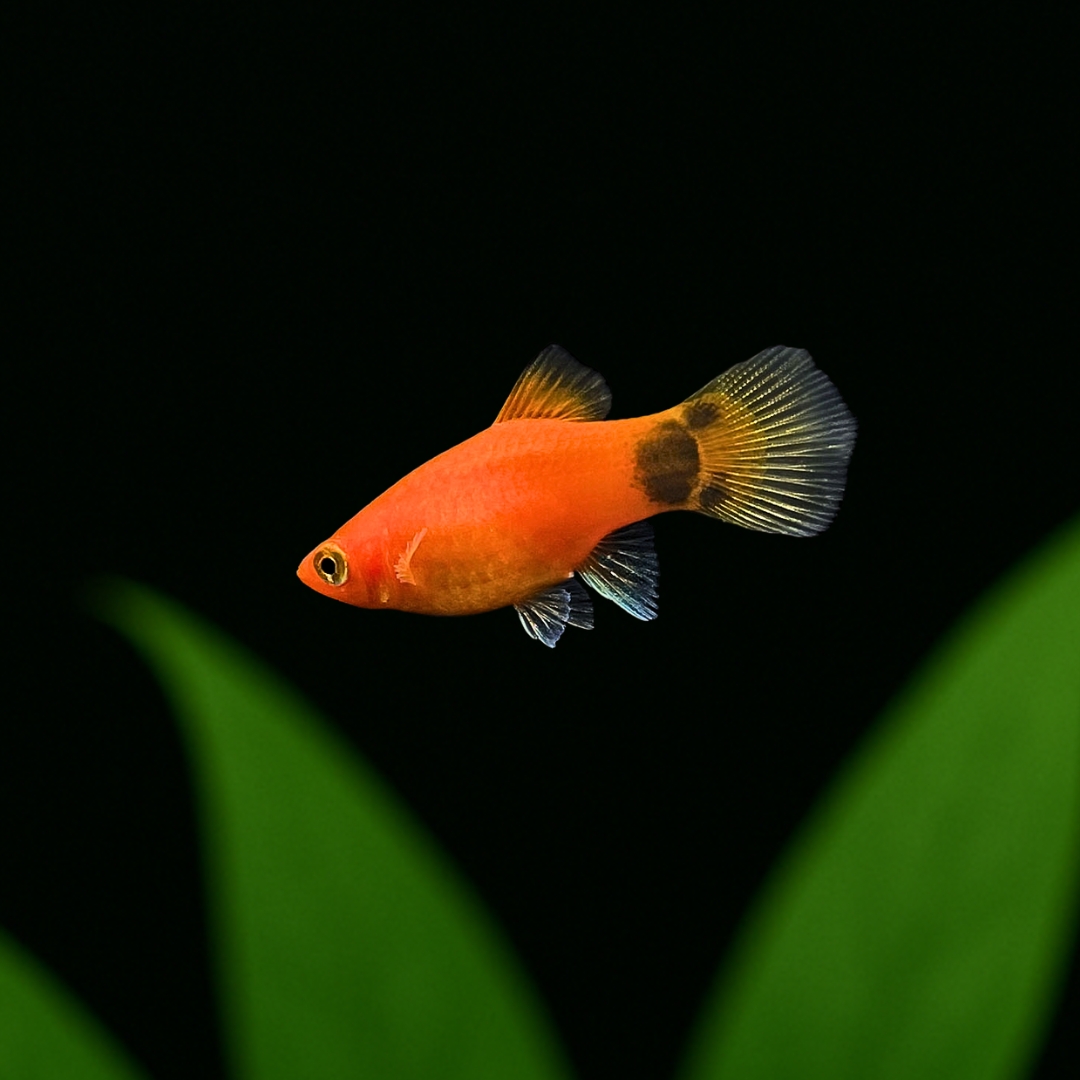
レッドミッキーマウス・プラティは、赤〜オレンジ系の明るい体色と、尾びれの付け根に入る黒いミッキーマウス型の模様が特徴的なプラティの改良品種です。原種であるサザンプラティフィッシュの斑紋多型を背景に、観賞魚として見栄えのよい体色や模様が選抜されてきた系統と考えると理解しやすい魚です。小型で丈夫、人工飼料にも慣れやすく、性格も比較的穏やかなため、はじめて熱帯魚を飼う方にも親しまれてきました。体型は丸みがあり、群れで泳ぐ姿にも愛らしさがあるため、水草水槽やコミュニティタンクの差し色としても扱いやすい魚です。The Red Mickey Mouse Platy is a domestic platy variety known for its bright red to orange body color and a black Mickey Mouse-like marking at the base of the tail. It is best understood as a selectively bred aquarium form based on the natural color and tail-spot polymorphism of the southern platyfish. It is small, hardy, readily accepts prepared foods, and is generally peaceful, making it a familiar choice for beginner aquarists. Its rounded body and active swimming also make it an attractive accent fish in planted and community aquariums.
原種のサザンプラティフィッシュは、メキシコのベラクルス周辺からベリーズ北部にかけての大西洋側水系に分布します。現在流通する本品種は、主に養殖下で維持される改良品種です。The wild southern platyfish is native to Atlantic-draining waters from around Veracruz, Mexico, to northern Belize. This aquarium variety is a domesticated form maintained mainly through captive breeding.
最大体長 / Max Size
約4〜6cm。雌のほうがやや大きくなりやすい傾向があります。About 4 to 6 cm. Females tend to grow slightly larger than males.
寿命 / Lifespan
一般的には約2〜3年前後が目安です。水温や水質が安定し、過密や病気を避けられた環境では、より長く飼育できることもあります。Generally around 2 to 3 years. Individuals may live longer when temperature and water quality are stable and overcrowding or disease is avoided.
飼育環境 / Aquarium Environment
水槽サイズ / Tank Size
少数飼育なら45cm規格水槽から可能ですが、混泳や繁殖を考える場合は60cm規格水槽以上が扱いやすいです。繁殖力が高いため、稚魚が増える前提で余裕のある水量を確保しておくと安心です。A small group can be kept in a standard 45 cm aquarium, but a 60 cm standard aquarium or larger is easier for community keeping or breeding. Because this fish reproduces readily, providing extra water volume is recommended.
水温 / Temperature
20〜26℃前後が目安です。一般的な熱帯魚水槽では24〜26℃前後で管理しやすく、急激な変化は体調を崩す原因になります。冬はヒーター、夏は冷却ファンなどで極端な高温を避けることが大切です。Around 20 to 26°C is suitable, and it is often easy to manage at about 24 to 26°C in a typical tropical aquarium. Sudden changes can cause stress. Use a heater in winter and cooling measures such as a fan in hot seasons when necessary.
水質 / Water Quality
中性〜弱アルカリ性、やや硬度のある水を好みます。pHはおおむね7.0〜8.0前後を目安にすると管理しやすいです。日本の水道水でも飼育しやすい魚ですが、極端な軟水や酸性寄りに傾いた水では調子を落とすことがあるため、定期的な水換えとろ過の安定を意識することが重要です。Neutral to slightly alkaline water with moderate hardness is preferred. A pH of roughly 7.0 to 8.0 is a practical target. It is usually easy to keep in treated tap water, but very soft or acidic conditions may cause stress, so stable filtration and regular water changes are important.
レイアウト / Layout
遊泳スペースを残しつつ、マツモ、アナカリス、ウィローモス類、浮草などを入れると落ち着きやすくなります。細かい葉の水草は稚魚の隠れ家にもなり、繁殖を楽しみたい場合に役立ちます。Leave open swimming space while adding plants such as hornwort, anacharis, mosses, or floating plants. Fine-leaved plants also provide shelter for fry and are useful when breeding is desired.
注意点 / Precautions
丈夫な魚ですが、過密飼育と水質悪化には弱くなります。特に繁殖が進むといつの間にか個体数が増えるため、飼育数の管理が必要です。導入直後は輸送ストレスを受けていることがあるため、水合わせを丁寧に行い、数日は餌を控えめにして様子を見ると安心です。Although hardy, it can suffer under overcrowded or polluted conditions. Population control is important because breeding can increase numbers quickly. Newly introduced fish may be stressed from transport, so careful acclimation and light feeding for the first few days are recommended.
餌と給餌 / Feeding
餌の種類 / Diet
人工飼料を中心に、フレーク、顆粒、細かな浮上性・沈下性フードをよく食べます。補助的に冷凍アカムシ、ブラインシュリンプ、植物質を含む餌を与えると、栄養の偏りを避けやすくなります。It readily eats prepared foods such as flakes and small granules, including floating and sinking diets. Frozen bloodworms, brine shrimp, and plant-based foods can be offered as supplements for a balanced diet.
給餌のポイント / Feeding Tips
1日1〜2回、数分で食べ切れる量を与えます。食欲が強く、与えればよく食べますが、食べ残しは水質悪化につながります。腹部が常に大きく張るほどの給餌は避け、少量を安定して与えることが大切です。Feed once or twice a day, offering only what they can finish within a few minutes. They are eager feeders, but leftover food quickly affects water quality. Avoid overfeeding and provide small, consistent meals.
性格と混泳 / Temperament and Tank Mates
性格 / Temperament
活発で人前にも出やすく、比較的温和な性格です。雄同士で追い合うことはありますが、十分なスペースと複数の隠れ場所があれば大きな問題になりにくい魚です。It is active, visible, and generally peaceful. Males may chase one another, but this is less likely to become a serious issue when adequate space and hiding places are provided.
混泳の相性 / Compatibility
同程度の大きさで温和な魚と相性がよく、コリドラス、小型テトラ、ラスボラ、オトシンクルスなどと混泳しやすいです。ヒレをかじる魚、大型魚、強く縄張りを主張する魚との混泳は避けたほうが無難です。雌への追尾が強くなることがあるため、雌雄を混ぜる場合は雄1匹に対して雌2匹以上を目安にすると負担を分散しやすくなります。It is compatible with peaceful fish of similar size, such as Corydoras, small tetras, rasboras, and Otocinclus. Avoid fin nippers, large predatory fish, and highly territorial species. When keeping both sexes, a ratio of one male to two or more females helps reduce pressure on individual females.
病気と対策 / Diseases and Prevention
かかりやすい病気 / Common Diseases
白点病、尾ぐされ病、水カビ病、輸送後の衰弱などに注意します。プラティは丈夫な印象がありますが、水温の急変、過密、餌の与えすぎによる水質悪化が重なると病気が出やすくなります。Watch for ich, fin rot, fungal infections, and weakness after transport. Although platies are hardy, sudden temperature changes, overcrowding, and poor water quality from overfeeding can trigger disease.
対策と予防 / Prevention
導入時の水合わせ、定期的な水換え、ろ過の安定、適正な飼育密度が予防の基本です。白点病は白点虫による寄生性の病気で、水温低下や急変のあとに出やすいため、季節の変わり目は特に注意します。異常が見られた個体は早めに隔離し、症状に合った薬浴を検討することが必要です。Careful acclimation, regular water changes, stable filtration, and proper stocking density are the foundations of prevention. Ich is a parasitic disease that often appears after temperature drops or sudden changes, so seasonal transitions require extra care. Affected fish should be isolated early and treated according to the symptoms.
増やし方(繁殖) / Breeding
雌雄の判別 / Sexing
雄は臀びれが棒状の交接器であるゴノポディウムに変化し、雌は臀びれが扇状で体つきもややふっくらします。成長すると雌のほうが大きく、腹部に丸みが出やすい傾向があります。Males have a modified anal fin called a gonopodium, while females have a fan-shaped anal fin and a fuller body. Mature females are usually larger and more rounded in the abdomen.
繁殖形態 / Reproduction
卵胎生です。雌の体内で卵が発生し、泳げる状態の稚魚として産み落とされます。妊娠期間はおおむね4週間前後で、環境や個体の状態によって産仔数は変わります。若い雌では少数、よく成熟した雌ではまとまった数の稚魚を産むことがあります。It is a livebearing fish. Eggs develop inside the female, and fully formed, free-swimming fry are born. The gestation period is generally around four weeks, and brood size varies with condition and environment. Young females may produce only a small brood, while well-developed females can give birth to a larger number of fry.
繁殖のポイント / Breeding Tips
繁殖は容易ですが、親が稚魚を食べることがあります。稚魚を多く残したい場合は、産卵箱を使うか、ウィローモスやマツモなどの隠れ家を多めに入れます。稚魚には細かく砕いた人工飼料、稚魚用フード、ブラインシュリンプ幼生などを少量ずつ与えると育てやすいです。増えすぎを防ぐため、繁殖後の飼育スペースもあらかじめ考えておくことが重要です。Breeding is easy, but adults may eat the fry. To raise more young, use a breeding box or provide dense shelter such as mosses and hornwort. Fry can be fed finely crushed prepared food, fry food, or newly hatched brine shrimp in small amounts. Plan for additional space before breeding becomes excessive.
雑学と豆知識 / Trivia and Fun Facts
1. ミッキーマウス模様はどこから来たのか / 1. Where the Mickey Mouse Pattern Comes From
尾びれの付け根にある黒い模様は、中央の大きな斑点と上下の小さな斑点が組み合わさることで、ミッキーマウスのシルエットのように見えます。この呼び名は学術名ではなく、観賞魚流通の中で定着した親しみやすい名称です。Xiphophorus属の魚では尾筒部の斑紋に多様な型が知られ、サザンプラティフィッシュは色彩や斑紋の多型が非常に豊かな魚として研究されてきました。店頭で見るかわいらしい模様の背景には、人が作った商品名だけでなく、もともとこの仲間が持っていた斑紋の多様性が関わっていると考えると、より奥行きのある見方ができます。The black marking at the base of the tail resembles the silhouette of Mickey Mouse because a larger central spot is combined with smaller upper and lower spots. The name is not a scientific term, but a familiar trade name established in the aquarium hobby. In the genus Xiphophorus, diverse tail-spot patterns are known, and the southern platyfish has been studied as a fish with exceptionally rich color and pattern polymorphism. This means the charming pattern seen in shops reflects not only a commercial name but also the natural diversity of markings within this group.
2. 赤い体色は選択交配で磨かれてきた魅力 / 2. The Red Color Refined by Selective Breeding
レッドミッキーマウス・プラティの赤い体色は、単純に一つの要素だけで決まるものではなく、もともとの色素形質に加えて、長年の選択交配によって見栄えのよい個体が残されてきた結果と考えられます。市販個体では、純粋な野生型そのものというより、観賞魚として扱いやすい体型や発色が重視されてきました。赤色は水質、餌、成熟度、ストレス状態によっても見え方が変わるため、購入時の色だけでなく、飼育後にどれだけ安定した環境を作れるかも発色維持の大切な要素です。なお、研究用の系統で解明された遺伝子の働きが、すべての市販個体にそのまま当てはまるとは限りません。The red body color of the Red Mickey Mouse Platy is not determined by a single factor alone. It is best understood as the result of inherited pigment traits refined over many generations of selective breeding. Commercial fish are usually selected for attractive color, body shape, and suitability for aquarium keeping rather than being pure wild forms. Because red coloration can also be influenced by water quality, diet, maturity, and stress level, maintaining a stable environment is just as important as the color seen at the time of purchase. Findings about particular genes in research strains do not necessarily apply to every commercial fish.
3. 小さな観賞魚でありながら、研究でも重要な魚 / 3. A Small Aquarium Fish with Scientific Importance
プラティを含むソードテール属の魚は、観賞魚としてだけでなく、遺伝学や色彩パターン、腫瘍研究のモデルとしても知られています。特にXiphophorus属では、近縁種間の交雑によって色素細胞の増殖や腫瘍形成が研究されてきました。もちろん、家庭で飼うレッドミッキーマウス・プラティが特別に危険な魚という意味ではありません。むしろ、身近で丈夫な熱帯魚の背後に、進化や遺伝の研究史が重なっている点が、この仲間の非常に面白いところです。Fishes of the genus Xiphophorus, including platies and swordtails, are known not only as aquarium fish but also as models in genetics, color-pattern studies, and tumor research. In particular, interspecific hybrids in this genus have been used to study pigment-cell growth and tumor formation. This does not mean that aquarium Red Mickey Mouse Platies are dangerous in any special way. Rather, it highlights how a familiar and hardy tropical fish is connected to a much broader history of evolutionary and genetic research.
4. 日本の水槽で飼いやすい理由 / 4. Why It Is Well Suited to Japanese Aquariums
プラティは中性から弱アルカリ性の水を好むため、極端な酸性水を作らない一般的な飼育環境では比較的管理しやすい魚です。また、人工飼料への適応力が高く、混泳水槽にも取り入れやすいことから、日本のアクアリウム市場では長く定番種として扱われてきました。ただし「丈夫」という言葉に頼りすぎると、過密や水質悪化を見落としがちです。丈夫だからこそ、基本を守れば美しさと繁殖の楽しさをしっかり見せてくれる魚だと考えると扱いやすい魚です。Platies prefer neutral to slightly alkaline water, so they are relatively easy to manage in ordinary aquariums that are not kept strongly acidic. Their willingness to accept prepared foods and their suitability for community tanks have made them a long-standing staple in the Japanese aquarium market. However, relying too heavily on the word hardy can lead to overcrowding or neglected water quality. They are best appreciated as fish that reward good basic care with vivid color and the enjoyment of breeding.
まとめ / Conclusion
レッドミッキーマウス・プラティは、赤い体色と尾筒の黒い模様がわかりやすく、初心者にも親しみやすい卵胎生魚です。丈夫で餌付きやすく、温和な混泳魚として扱いやすい一方、増えやすい魚でもあるため、飼育数と水質の管理を意識することが大切です。The Red Mickey Mouse Platy is an approachable livebearing fish with an easy-to-recognize red body and black tail-base marking. It is hardy, feeds readily, and works well in peaceful community aquariums, but because it breeds easily, population and water quality management are important.
中性〜弱アルカリ性の安定した水、適度な水量、隠れ家になる水草を用意すれば、発色や繁殖の楽しさを感じやすい魚です。見た目のかわいらしさだけでなく、Xiphophorus属が持つ斑紋多様性や遺伝研究との関わりにも目を向けると、定番種でありながら奥深い魅力を持つプラティだといえます。With stable neutral to slightly alkaline water, adequate tank volume, and plant cover for shelter, this fish can show good color and rewarding breeding behavior. Beyond its cute appearance, its connection to the pattern diversity and genetic research history of the genus Xiphophorus makes it a familiar yet surprisingly fascinating platy variety.
Borowsky, R. Tailspots of Xiphophorus and the Evolution of Conspicuous Polymorphism. Evolution, 35(2), 1981, pp. 345-358.
https://www.jstor.org/stable/2407843 Xiphophorus属に見られる尾筒斑紋の多型と進化的背景を確認し、ミッキーマウス模様を「観賞魚名」と「斑紋多型」の両面から説明するために参照しました。
Lampert, K. P., Schmidt, C., Fischer, P., Volff, J. N., Hoffmann, C., Muck, J., Lohse, M. J., Ryan, M. J., and Schartl, M. Determination of onset of sexual maturation and mating behavior by melanocortin receptor 4 polymorphisms. Current Biology, 20(19), 2010, pp. 1729-1734.
https://pubmed.ncbi.nlm.nih.gov/20850326/ Xiphophorus属が行動、成熟、遺伝形質の研究対象として用いられてきた背景を補助的に確認するために参照しました。
Schartl, M. Evolution of Xmrk: an oncogene, but also a speciation gene? BioEssays, 30(9), 2008, pp. 822-832.
https://pubmed.ncbi.nlm.nih.gov/18693268/ Xiphophorus属の腫瘍研究で重要視されるxmrk遺伝子の背景を確認するために参照しました。



 アイのアクアグッズ案内エンゼルフィッシュの飼育用品|高さのある水槽・ろ過・水草・餌の選び方道具の特徴や使い方、選ぶときのポイントをアイが紹介します。記事はコチラ →
 アイのアクアグッズ案内あい先生のアクアグッズ深堀り!|泡で汚れを取り出す? プロテインスキマーの歴史と仕組み道具の特徴や使い方、選ぶときのポイントをアイが紹介します。記事はコチラ →




コメント