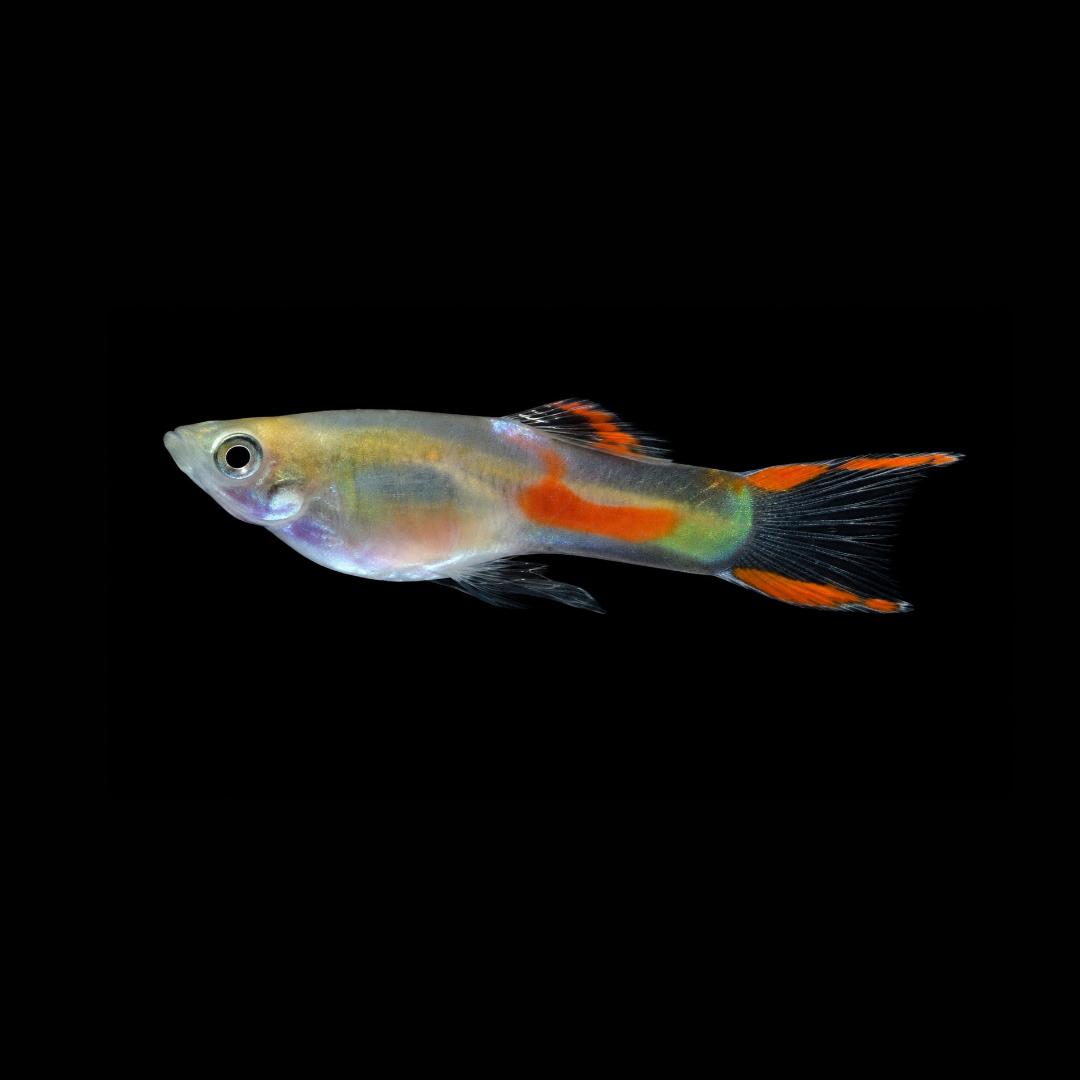
エンドラーズ・ライブベアラー・ゴールデンは、南米ベネズエラ北東部原産の小型卵胎生メダカ、エンドラーズ・ライブベアラー(Poecilia wingei)の系統に、体表の黒色素胞を小さくする潜性遺伝子(bb)を組み込んだ品種で、明るい黄白色の体が特徴です。黒みが抑えられた透明感のある地肌に、オスのオレンジや赤、メタリックグリーンの斑紋がくっきりと浮かび、小さな体ながら水槽の中でよく目立ちます。日本で流通している個体の多くは、ブラックバー系のエンドラーズとゴールデン(ブロンド)体色のグッピーを交配して作られたハイブリッドで、スリランカなど海外の養殖場で繁殖され、オスだけで販売されることがよくあります。ただし、純血系統の中から突然変異としてゴールデン体色が現れたという報告もあり、その素性は一言では語れません。一般的なグッピーよりヒレが短くて泳ぎが達者なうえ、丈夫で繁殖も容易なため、初心者からブリーダーまで幅広く楽しめる熱帯魚です。その一方で、野生の原種は原産地で絶滅が心配されており、純血系統と区別して扱うことが大切な魚でもあります。The Golden Endler’s Livebearer is a variety of the Endler’s livebearer (Poecilia wingei), a small livebearer native to northeastern Venezuela, into which a recessive gene (bb) that shrinks the skin’s black pigment cells has been introduced, giving it a bright yellowish-white body. Against this translucent, less dusky background, the male’s orange, red and metallic green markings stand out sharply, making this tiny fish highly visible in the aquarium. Most specimens sold in Japan are hybrids produced by crossing black-bar Endler’s with golden (blond) guppies; they are bred on overseas farms in places such as Sri Lanka and are often sold as males only. However, golden coloration has also been reported to arise as a spontaneous mutation within pure lines, so its background cannot be summed up in a single word. With shorter fins and stronger swimming ability than ordinary guppies, plus hardiness and easy breeding, it appeals to everyone from beginners to serious breeders. At the same time, the wild species is a cause for concern in its native range, which makes it important to keep this fish distinct from pure lines.
基本情報 / Basic Information
学名 / Scientific Name
Poecilia reticulata × Poecilia wingei
通称 / Common Name
エンドラーズ・ゴールデン、ゴールデン・エンドラーズ、エンドラーズ・グッピー・ゴールデン、ブロンド・エンドラーズGolden Endler’s, Blond Endler’s, Golden Endler’s Guppy
分類 / Family
カダヤシ目 カダヤシ科 ポエキリア属(エンドラーズとグッピーの交雑品種)Cyprinodontiformes, Poeciliidae, genus Poecilia (hybrid between Endler’s livebearer and guppy)
英名 / English Name
Golden Endler’s Livebearer / Blond Endler’s Livebearer
分布 / Distribution
原種のエンドラーズは、ベネズエラ北東部スクレ州の沿岸部(クマナ周辺やカンポマ周辺)のごく限られた水域に分布します。ゴールデンは観賞用に作出された品種のため自然分布はなく、流通している個体はスリランカなど海外の養殖場や国内のブリーダーによって繁殖されたものです。The wild Endler’s livebearer occurs only in a very limited area of coastal waters in Sucre State, northeastern Venezuela (around Cumaná and Campoma). The golden form is an ornamental variety with no natural range; fish on the market are bred on overseas farms such as those in Sri Lanka or by domestic breeders.
最大体長 / Max Size
オス約2〜3cm、メス約3.5〜4.5cm(メスの方がひと回り大きくなります)Males about 2–3 cm, females about 3.5–4.5 cm (females grow noticeably larger)
寿命 / Lifespan
約2〜3年。やや低めの水温で落ち着いた環境を保つと、4年近く生きることもあります。About 2–3 years. In a calm environment kept at slightly cooler temperatures, they may live close to 4 years.
飼育環境 / Aquarium Environment
水槽サイズ / Tank Size
オスだけを数匹観賞するのであれば、30cm規格水槽(約12L)から飼育できます。群泳や繁殖まで楽しむ場合は、45cm規格水槽(約35L、15匹前後が目安)から60cm規格水槽(約57L、30匹前後が目安)を用意すると水質が安定し、増えた稚魚にも対応しやすくなります。If you only want to keep a few males for display, a 30 cm standard tank (about 12 L) is sufficient. To enjoy a school or breed them, a 45 cm standard tank (about 35 L, roughly 15 fish) to a 60 cm standard tank (about 57 L, roughly 30 fish) keeps water quality more stable and makes it easier to cope with growing numbers of fry.
水温 / Temperature
適温は24〜28℃です(耐えられる範囲はおよそ18〜30℃)。17℃以下になると動きが鈍り、病気にもかかりやすくなるため、冬場はヒーターが欠かせません。22〜26℃とやや低めに管理すると、長生きしやすい傾向があるといわれています。The ideal range is 24–28°C (they tolerate roughly 18–30°C). Below 17°C they become sluggish and more prone to disease, so a heater is essential in winter. Keeping them slightly cooler, at 22–26°C, is said to help them live longer.
水質 / Water Quality
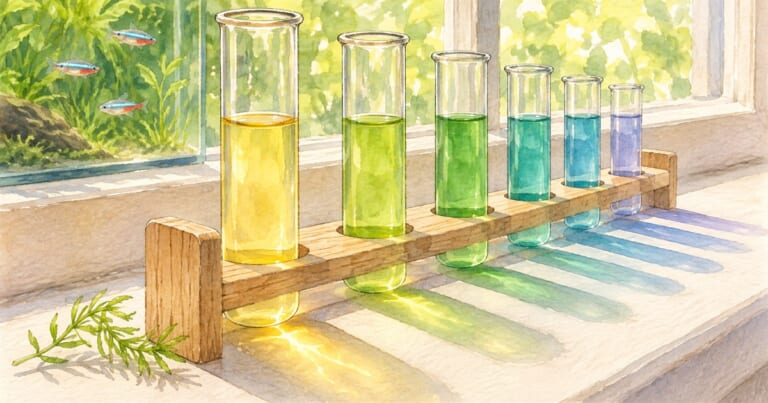
中性〜弱アルカリ性(pH7.0〜8.0)、総硬度8〜20dGH程度の中硬水〜硬水を好みます。原産地はミネラル豊富な硬水域ですが、日本の水道水は全国平均で約3dGHとかなりの軟水です。国内で繁殖された個体はある程度軟水にも慣れていますが、弱酸性の極端な軟水で長く飼うと金属光沢がくすみ、体調を崩しやすくなります。底床に大磯砂を使ったり、ろ材にサンゴ砂を少量加えたりして、水質試薬で確かめながら硬度とpHを少しずつ引き上げると安定します。サンゴ砂は入れすぎるとpHが急に上がるので注意してください。アンモニアと亜硝酸は常にゼロに保ち、週1回、水量の20〜30%を換水するのが目安です。They prefer neutral to slightly alkaline water (pH 7.0–8.0) that is moderately hard to hard, around 8–20 dGH. Their native habitat is mineral-rich hard water, whereas Japanese tap water is quite soft, averaging only about 3 dGH nationwide. Domestically bred fish are somewhat used to soft water, but long-term keeping in acidic, extremely soft water dulls their metallic sheen and makes them more prone to illness. Using Oiso gravel as substrate or adding a small amount of coral sand to the filter media, while checking with test kits, raises hardness and pH gradually to a stable level. Be careful not to add too much coral sand, as it can raise pH abruptly. Keep ammonia and nitrite at zero at all times, and as a guideline change 20–30% of the water once a week.
レイアウト / Layout
原産地は流れの穏やかな水域なので、スポンジフィルターや底面フィルター、水流の弱い外掛け式フィルターが向いています。吸水口にスポンジを付けておくと、稚魚が吸い込まれる心配がありません。マツモ、ウィローモス、アヌビアス・ナナ、浮草など、中性〜弱アルカリ性でも育つ水草を多めに植えると、稚魚の隠れ家やオスに追われたメスの避難場所になり、葉の表面に付く微生物は格好のおやつにもなります。底床は水質を弱酸性に傾けるソイルを避け、大磯砂や中性の砂利を選ぶとよいでしょう。Since their native waters are calm, sponge filters, undergravel filters or hang-on-back filters with gentle flow are well suited. Fitting a sponge over the intake prevents fry from being sucked in. Planting generously with species that grow in neutral to slightly alkaline water, such as hornwort, willow moss, Anubias nana and floating plants, gives fry places to hide and females a refuge from chasing males, while microorganisms on the leaves make a welcome snack. For substrate, avoid soils that acidify the water and choose Oiso gravel or neutral gravel instead.
注意点 / Precautions
グッピーや他系統のエンドラーズと簡単に交雑するため、純血系統と同じ水槽で飼うことは避けてください。雌雄で飼うと数か月で数が大きく増え、ろ過が追いつかずに水質が悪化することがあるため、増えた個体を飼うスペースや引き取り先をあらかじめ考えておくことが大切です。また、交雑元のグッピーは沖縄や各地の温泉排水などで野生化しており、環境省の生態系被害防止外来種リストにも掲載されています。増えすぎたとしても川や池、用水路には決して放さず、最後まで水槽の中で責任をもって飼育してください。They hybridize easily with guppies and other Endler’s lines, so avoid keeping them in the same tank as pure strains. When kept as mixed sexes, their numbers can rise sharply within a few months, overwhelming the filter and degrading water quality, so plan ahead for extra tanks or people who can take surplus fish. In addition, the guppy, one of the parent species, has become naturalized in Okinawa and in hot-spring outflows in various areas, and is listed on the Ministry of the Environment’s list of invasive alien species that threaten ecosystems. Even if they multiply too much, never release them into rivers, ponds or irrigation channels; care for them responsibly in the aquarium to the end.
餌と給餌 / Feeding
餌の種類 / Diet
雑食性で、小型魚用の人工飼料や細かく砕いたフレークフードをよく食べます。これらを主食にして、ブラインシュリンプ、冷凍ミジンコ、細かく刻んだ冷凍アカムシなどの動物性の餌や、スピルリナ入りの植物性飼料を組み合わせると、栄養のバランスが整い、発色もよくなります。They are omnivorous and readily accept small-fish pellets and finely crushed flakes. Using these as the staple and adding animal foods such as brine shrimp, frozen daphnia and finely chopped frozen bloodworms, along with plant-based foods containing spirulina, balances their nutrition and improves their coloration.
給餌のポイント / Feeding Tips
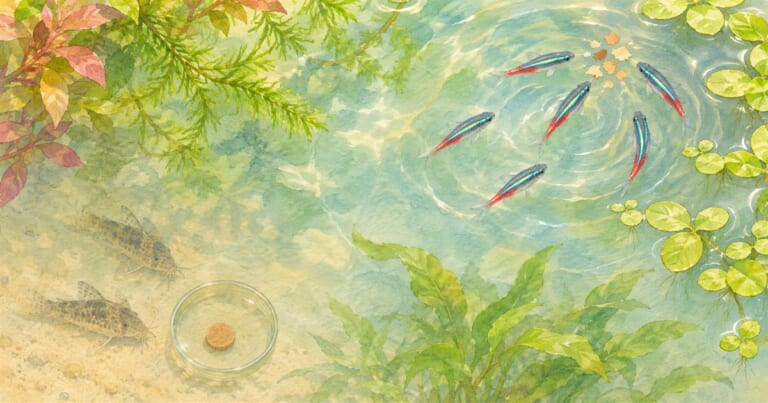
体も胃も小さいため、1日2〜3回、2〜3分で食べ切れる量を少しずつ与えるのが向いています。口が小さいので、粒の大きな餌は砕いてから与えてください。食べ残しは水質悪化の原因になるので、与えすぎには注意しましょう。繁殖を狙う時期や稚魚を育てる時期には、生きたブラインシュリンプを加えると成長がよくなります。With small bodies and small stomachs, they do best on small portions two or three times a day, in amounts they can finish within two to three minutes. Their mouths are tiny, so crush larger foods before feeding. Leftover food fouls the water, so be careful not to overfeed. During breeding periods or while raising fry, adding live brine shrimp improves growth.
性格と混泳 / Temperament and Tank Mates
性格 / Temperament
温和で活発な性格です。オス同士はヒレを広げて盛んに見せ合いますが、水草や十分な空間があれば、大きなけがにつながることはまれです。オスにはメスをしつこく追いかける習性があるため、メスが疲れないよう雌雄の比率に気を配ると、落ち着いた水槽になります。They are peaceful and active. Males flare their fins at one another in lively displays, but with plants and enough space, serious injuries are rare. Males tend to chase females persistently, so paying attention to the sex ratio to keep females from being worn out results in a calmer tank.
混泳の相性 / Compatibility
似た水質を好む小型で温和な魚や、ミナミヌマエビなどの小型エビとは混泳しやすいでしょう。ただし稚エビは食べられることがあるため、エビも増やしたい場合はウィローモスなどを密に植えておくと安心です。一般的なグッピーや他系統のエンドラーズとは交雑してしまうので、混泳は避けてください。ヒレをかじる魚や口の大きな肉食魚、弱酸性の軟水を好む魚との組み合わせにも向きません。They mix well with small, peaceful fish that prefer similar water and with small shrimp such as Neocaridina species. However, baby shrimp may be eaten, so if you also want the shrimp to multiply, plant willow moss or similar densely. Avoid keeping them with ordinary guppies or other Endler’s lines, as they will interbreed. They are also unsuitable for tanks with fin-nippers, large-mouthed predators or fish that prefer acidic, soft water.
病気と対策 / Diseases and Prevention
かかりやすい病気 / Common Diseases
丈夫な魚ですが、急な水温の低下や過密による水質悪化、輸送のストレスなどが重なると病気になりやすくなります。代表的なのは、体やヒレに白い粒が付く白点病、ヒレの先が白く濁って溶けるように傷む尾ぐされ病、傷口に綿のようなものが付く水カビ病です。Although hardy, they become susceptible to disease when sudden temperature drops, poor water quality from overcrowding and transport stress pile up. The most common problems are white spot disease, in which white dots appear on the body and fins; fin rot, in which fin tips turn cloudy white and appear to dissolve; and fungal infections that leave cotton-like growths on wounds.
対策と予防 / Prevention
予防の基本は、適温の維持、過密を避けること、そして定期的な換水です。発症した場合は、水草やろ過バクテリアのいる本水槽ではなく、エアレーションをした隔離容器で治療しましょう。白点病にはメチレンブルー系の薬剤が使われ、水温を少しずつ28〜30℃まで上げると回復の助けになります。尾ぐされ病にはグリーンFゴールド顆粒などの抗菌剤が有効です。水カビ病や軽い体調不良には、0.5%の塩水浴(カルキを抜いた水10Lに食塩50g)が補助的に役立ちます。体長2〜3cmほどの小さな魚なので、薬は説明書をよく確認して慎重に使い、塩水浴も1週間以内を目安にしてください。活性炭は薬の成分を吸着してしまうため、治療中は取り外しておきます。The basics of prevention are maintaining proper temperature, avoiding overcrowding and changing water regularly. If disease appears, treat the fish in an aerated quarantine container rather than in the main tank with its plants and filter bacteria. Methylene blue–based medications are used for white spot, and gradually raising the temperature to 28–30°C helps recovery. Antibacterials such as Green F Gold granules are effective against fin rot. For fungal infections or mild malaise, a 0.5% salt bath (50 g of salt per 10 L of dechlorinated water) can help as a supportive measure. Because these fish are only about 2–3 cm long, read the medication instructions carefully, dose cautiously, and limit salt baths to about a week. Remove activated carbon during treatment, as it absorbs medication.
増やし方(繁殖) / Breeding
雌雄の判別 / Sexing
オスは体が小さく細身で、オレンジや赤、メタリックな斑紋を持ち、尻ビレが交尾器(ゴノポディウム)と呼ばれる細長い棒状に変化しています。メスはひと回り大きくふっくらとした体つきで、尻ビレは扇形のままです。ゴールデン体色はオスにもメスにも現れるため、メスも地味な灰色ではなく、淡い黄白色に透ける明るい体色をしています。成熟したメスでは、腹部の後方に妊娠斑と呼ばれる色の濃い部分が見られることがあります。Males are smaller and slender, bearing orange, red and metallic markings, and their anal fin is modified into a slender rod-shaped copulatory organ called a gonopodium. Females are larger and plumper, and their anal fin remains fan-shaped. Because golden coloration appears in both sexes, females are not drab gray but a light, translucent yellowish white. In mature females, a darker area called the gravid spot may be visible toward the rear of the abdomen.
繁殖形態 / Reproduction
メスのお腹の中で卵をかえし、稚魚の姿で産む卵胎生です。妊娠期間は水温によって変わりますが、おおむね23〜30日ほどです。1回に産む数は、若いメスで数匹、成熟した大きなメスでは20匹前後になることもあります。生まれた稚魚は体長7〜8mmほどで、すぐに泳ぎ出して餌を食べ始めます。メスは1回の交尾で受け取った精子を体内に蓄えておけるため、オスと離した後も数か月にわたって出産を続けることがあります。They are livebearers: eggs hatch inside the female and the young are born as free-swimming fry. Gestation varies with temperature but is roughly 23–30 days. Young females produce only a few fry per brood, while large mature females may give birth to around 20. Newborn fry are about 7–8 mm long and start swimming and feeding right away. Because females can store sperm from a single mating, they may keep giving birth for several months even after being separated from males.
繁殖のポイント / Breeding Tips
メスの負担を減らすため、オス1匹に対してメス2〜4匹の割合で飼うのがおすすめです。ゴールデン体色は常染色体上の潜性遺伝なので、ゴールデン同士を交配すれば、生まれる子はすべてゴールデンになります。一方、ノーマル体色の魚と交配すると子(F1)はすべてノーマルの見た目になり、そのF1同士を交配すると、約4分の1の割合でゴールデンが再び現れます。オスの斑紋の多くは父親から息子へ受け継がれるため、特定のオスの柄を残したい場合は、生後3〜5週の未成熟なうちに雌雄を分けて育てた、まだ交尾していないメスを使うことが大切です。ゴールデン同士だけで何世代も交配を重ねると、発色や体格が衰えることがあります。そのため、血縁の遠いノーマル体色の個体をいったん交配に加え、その子を再びゴールデンと掛け合わせる「戻し交配」で発色と活力を取り戻す方法も知られています。親魚は稚魚を食べることがあるので、水草を茂らせるか、産卵箱や別の水槽で稚魚を守りましょう。To ease the burden on females, a ratio of one male to two to four females is recommended. Golden coloration is an autosomal recessive trait, so mating two golden fish produces all-golden offspring. When a golden fish is crossed with a normal-colored one, all first-generation (F1) offspring look normal, and when those F1 fish are bred together, about one quarter of their young will be golden again. Since most of the male’s markings pass from father to son, if you want to preserve a particular male’s pattern, it is important to use unmated females that were separated from males while still immature at three to five weeks of age. Breeding golden to golden for many generations can lead to faded color and a weaker build. Breeders therefore sometimes bring in a distantly related normal-colored fish and then cross the offspring back to golden fish, a method called backcrossing, to restore color and vigor. Adults may eat their fry, so protect the young with dense plants, a breeding box or a separate tank.
雑学と豆知識 / Trivia and Fun Facts
1. 「ゴールデン」と「ブロンド」、呼び名のねじれ / 1. “Golden” versus “Blond”: A Tangle of Names
この魚の体色を語るうえでいちばんややこしいのが、呼び名の違いです。日本や北米で「ゴールデン」と呼ばれる明るい黄白色の体色は、ヨーロッパでは「ブロンド」と呼ばれており、遺伝子記号に b が使われているのもそのためです。ところがヨーロッパで「ゴールデン」と呼ばれる体色は、鱗の縁が黒く網目のように縁取られる、まったく別の変異を指しています。分子遺伝学の研究によって、この2つは原因となる遺伝子そのものが異なることが明らかになりました。日本でいうゴールデン(ヨーロッパでいうブロンド)は adcy5 という遺伝子の変異によるもので、黒い色素を作れなくなるのではなく、黒い色素を持つ細胞が小さくなることで体の暗さが抑えられていると考えられています。つまり、黒が控えめになったぶん、黄色や赤、虹色に光る細胞の色が前に出てくるわけで、これがゴールデン・エンドラーズならではの透き通るような明るさを生んでいます。同じ「金色」という言葉の裏に、別々の遺伝子の物語が隠れているというのは、なんとも興味深い話です。The trickiest part of discussing this fish’s color is the naming. The bright yellowish-white body called “golden” in Japan and North America is called “blond” in Europe, which is why the gene symbol b is used. Yet what Europeans call “golden” refers to an entirely different mutation in which the scale edges are outlined in a dark, net-like pattern. Molecular genetic research has shown that the two are caused by different genes altogether. The Japanese “golden” (European “blond”) results from a mutation in a gene called adcy5; rather than losing the ability to make black pigment, the fish is thought to have smaller black pigment cells, which tones down the body’s darkness. In other words, with the black held back, the yellow, red and iridescent cells come to the fore, producing the translucent brightness unique to the Golden Endler’s. It is fascinating that the same word for “gold” hides the stories of two separate genes.
2. 純血か交雑か、クラス分類という考え方 / 2. Pure or Hybrid: The Idea of Class Classification
エンドラーズはグッピーと簡単に交雑し、生まれた子もふつうに繁殖できます。そのため世界の愛好家たちは、魚の素性をはっきりさせるための区分を設けてきました。原産地での採集記録までさかのぼれる純血系統は「クラスN」、見た目は純血らしいものの証明が不十分なものは「クラスP」、グッピーなどとの交配歴が分かっているハイブリッドは「クラスK」と呼ばれます。日本でゴールデン・エンドラーズとして売られている魚の多くはクラスKにあたり、ブラックバー系エンドラーズとブロンドのグッピーを掛け合わせた系統が、2000年代半ば頃から欧米で流通し始めたとされています。ただし、純血系統の「ブルースター」の中からブロンド個体が突然変異として現れたという報告もあり、ゴールデンだから必ず交雑種だとは言い切れません。それでも、出自の証明がない個体は交雑系の観賞品種として扱い、純血系統とは水槽を分けて管理するのが、世界のエンドラーズ愛好家が大切にしているマナーです。Endler’s livebearers hybridize easily with guppies, and the offspring are fully fertile. For this reason, hobbyists worldwide have set up categories to clarify each fish’s ancestry. Pure lines traceable to collection records in the native habitat are called “Class N,” those that look pure but lack sufficient proof are “Class P,” and hybrids with a known history of crossing with guppies or other species are “Class K.” Most fish sold as Golden Endler’s in Japan fall into Class K, and lines produced by crossing black-bar Endler’s with blond guppies are said to have entered the Western hobby around the mid-2000s. However, there are reports of blond individuals arising as spontaneous mutations within the pure “Blue Star” line, so golden does not automatically mean hybrid. Even so, treating fish without proven ancestry as hybrid ornamental varieties and keeping them in separate tanks from pure lines is an etiquette that Endler’s enthusiasts around the world hold dear.
3. 40年眠っていた標本と、本人の知らない命名 / 3. Specimens Asleep for 40 Years, and a Name Its Namesake Didn’t Know About
エンドラーズの歴史は、少し不思議な形で始まりました。最初の採集記録は1937年、ベネズエラのクマナ近郊で集められた標本ですが、ふつうのグッピーとしてアメリカの博物館に収められたまま、約40年もの間注目されることはありませんでした。転機は1975年、進化生物学者のジョン・エンドラー博士が、クマナ近郊の潟湖ラグナ・デ・ロス・パトスでこの魚を再発見したことです。博士から生体を託された研究者たちを通じて愛好家に広まり、正式な学名がないまま「エンドラーズ・ライブベアラー」の名で親しまれるようになりました。この名前は、魚を受け取った研究者が本人に知らせずに付けたものとされ、エンドラー博士自身は1980年、ドイツの学会会場で自分の名を冠した熱帯魚がいることを初めて知ったという逸話が語り継がれています。新種として正式に記載されたのは、再発見から30年後の2005年のことでした。The history of the Endler’s livebearer began in a rather curious way. The earliest collection record dates to 1937, when specimens were gathered near Cumaná, Venezuela, but they were stored in an American museum as ordinary guppies and went unnoticed for about forty years. The turning point came in 1975, when evolutionary biologist Dr. John Endler rediscovered the fish in Laguna de Los Patos, a lagoon near Cumaná. Through the researchers to whom he entrusted live fish, it spread among hobbyists and became known as “Endler’s livebearer” even without a formal scientific name. The name is said to have been given by a researcher who received the fish without telling Endler, and the story goes that Dr. Endler first learned a popular aquarium fish bore his name at a conference in Germany in 1980. It was formally described as a new species in 2005, thirty years after its rediscovery.
4. 学名 wingei に込められた敬意 / 4. The Tribute Behind the Name wingei
通称にはエンドラー博士の名が付いていますが、2005年に与えられた学名 Poecilia wingei の「wingei」は、別の人物にちなんだものです。その人物とは、デンマークの生物学者オイヴィン・ヴィンゲ博士。20世紀前半に、グッピーの色や模様がどのように遺伝するのか、とりわけオスの色彩がY染色体を通じて父から息子へ受け継がれる仕組みを研究した先駆者の一人です。オスの華やかな斑紋の多くがY染色体とともに受け継がれるこの魚に、その研究の礎を築いた学者の名前が贈られたのは、とてもふさわしい巡り合わせと言えるでしょう。なお、エンドラーズを独立した種とみなすか、グッピーの一地域集団とみなすかについては今も研究者の間で議論が続いていますが、主要な国際データベースでは独立した種として扱われています。While the common name honors Dr. Endler, the “wingei” in the scientific name Poecilia wingei, given in 2005, honors someone else: the Danish biologist Dr. Øjvind Winge. In the early twentieth century, he was one of the pioneers who studied how guppy colors and patterns are inherited, especially how male coloration passes from father to son via the Y chromosome. It seems a fitting twist of fate that a fish whose flamboyant male markings are largely inherited along with the Y chromosome should bear the name of a scientist who laid the groundwork for that research. Researchers still debate whether the Endler’s livebearer should be treated as a distinct species or as a regional population of the guppy, but major international databases treat it as a separate species.
5. 派手さと危険のせめぎ合い、エンドラー博士の進化研究 / 5. Flashiness Versus Danger: Dr. Endler’s Evolutionary Research
エンドラー博士は、熱帯魚の発見者としてだけでなく、進化生物学の教科書にも登場する研究者として知られています。1980年に発表された有名なグッピーの研究では、オスの派手な色彩が、メスを引きつけるには有利な一方で、捕食者にも見つかりやすくなるという、相反する力のバランスの中で形作られていることが示されました。捕食者の多い場所から少ない場所へグッピーを移した野外実験では、わずか2年ほど、世代にしておよそ15世代のうちに、オスの体色がより派手な方向へ変化したと報告されています。つまり、身を守る必要が薄れると、魚の色は目に見える速さで「見せる」方向へ進化しうるということです。同じような傾向は日本でも調べられており、沖縄で野生化したグッピーの研究では、原産地よりも天敵の種類が少ない環境にいることが明らかにされ、天敵からの解放と色彩の変化が定着の成功に関わっている可能性が示唆されています。水槽の中でゴールデン・エンドラーズが鮮やかな色を存分に見せてくれるのも、捕食者のいない環境だからこそなのかもしれません。Dr. Endler is known not only as the discoverer of an aquarium fish but also as a researcher featured in evolutionary biology textbooks. His famous guppy study published in 1980 showed that males’ flashy colors are shaped by a balance between opposing forces: they help attract females but also make males easier for predators to spot. In a field experiment in which guppies were moved from a predator-rich site to one with fewer predators, male coloration was reported to become more conspicuous within only about two years, roughly 15 generations. In other words, when the need to hide is relaxed, a fish’s colors can evolve toward display at a visibly rapid pace. Similar trends have been studied in Japan as well: research on feral guppies in Okinawa found that they encounter fewer kinds of predators than in their native range, and suggested that this release from predators and changes in coloration may have contributed to their successful establishment. Perhaps the Golden Endler’s can show off its vivid colors so freely in the aquarium precisely because no predators are there.
6. 見せる側を選ぶ?左右で違う求愛ダンス / 6. Choosing Which Side to Show: The Asymmetric Courtship Dance
エンドラーズのオスは、メスの前で体をS字にくねらせる「シグモイド・ディスプレイ」と呼ばれる求愛ダンスを見せます。チェコの研究チームは、オスの体側の模様が左右で少しずつ異なり、しかもその違いが成魚になってからも変化していくことに注目しました。研究では、オスがこの左右の違いを利用して、より目立つ側をメスに向けて見せる傾向があると報告されています。さらに、周りのオスとメスの比率によって、求愛の仕方そのものが変わることも示されています。メスの多い環境ではオスはダンスでじっくりと求愛し、オスの多い競争の激しい環境では、ダンスを省いて強引に交尾しようとする行動が増えたというのです。水槽でメスを多めにしておくと、メスの負担が減るだけでなく、オス本来の優雅な求愛ダンスをじっくり観察できるかもしれません。Male Endler’s livebearers perform a courtship dance called the sigmoid display, curving their bodies into an S shape in front of females. A Czech research team noticed that the patterns on the two sides of a male’s body differ slightly, and that these differences keep changing even in adulthood. The study reported that males tend to use this asymmetry, turning their more striking side toward females. It has also been shown that the courtship style itself changes with the surrounding sex ratio: in female-rich settings males court carefully with dances, while in male-heavy, highly competitive settings they skip the dance and attempt forced matings more often. Keeping more females than males in the aquarium not only eases the burden on females but may also let you watch the male’s graceful courtship dance at leisure.
7. 水槽ではおなじみ、でも野生では絶滅の危機 / 7. Familiar in Aquariums, Endangered in the Wild
ショップの水槽に手頃な価格で並ぶ姿からは想像しにくいのですが、野生のエンドラーズは深刻な危機にあります。自然の分布はベネズエラ北東部のごく狭い沿岸地域に限られ、IUCNレッドリストでは絶滅危惧(EN)と評価されています。1975年に再発見の舞台となったラグナ・デ・ロス・パトスでは、ゴミ処分場や生活排水による汚染、埋め立てなどが進み、元の個体群はすでに姿を消した可能性が高いと考えられています。さらに干ばつによる水路の干上がり、外来魚との競合、放されたグッピーとの交雑なども重なり、現在は人工の水路などにわずかに残るのみとされています。水槽でゴールデン・エンドラーズと純血系統をきちんと分けて飼うことは、単なるこだわりではなく、野生で失われつつある遺伝的な多様性を守ることにもつながっているのです。It is hard to imagine from the affordable fish lined up in shop tanks, but wild Endler’s livebearers face a serious crisis. Their natural range is limited to a very small coastal area of northeastern Venezuela, and they are assessed as Endangered (EN) on the IUCN Red List. At Laguna de Los Patos, where the fish was rediscovered in 1975, pollution from landfills and household wastewater and land reclamation have advanced, and the original population is thought likely to have already vanished. Drying channels caused by drought, competition with introduced fish and hybridization with released guppies add to the pressure, and the species is now said to survive only in small numbers in places such as man-made channels. Keeping Golden Endler’s and pure lines properly separated in the aquarium is not mere fussiness; it also helps protect genetic diversity that is disappearing in the wild.
まとめ / Conclusion
エンドラーズ・ライブベアラー・ゴールデンは、黄金色に透ける体にオスの鮮やかな斑紋が映える、小さくても存在感のある熱帯魚です。丈夫で飼いやすく、小型水槽でも群れで泳ぐ姿や求愛ダンスを楽しめ、繁殖も容易なことから、毎日の観察に尽きない楽しみを与えてくれます。日本の軟水に合わせて水質を少し整えてあげれば、その輝きはいっそう引き立つでしょう。The Golden Endler’s Livebearer is a small yet striking tropical fish, its translucent golden body setting off the male’s vivid markings. Hardy and easy to keep, it lets you enjoy schooling and courtship dances even in a small tank, and because it breeds readily, it offers endless enjoyment in everyday observation. Simply adjusting the water a little to suit Japan’s soft tap water will make its brilliance shine all the more.
その輝きの背景には、遺伝子の不思議と、野生で数を減らしつつある原種の物語が重なっています。交雑を防ぎ、増えた命を自然に放さず、最後まで責任をもって見守ること。その心がけがあれば、この小さな金色の魚は、水槽の中で長く穏やかに彩りを添え続けてくれるはずです。Behind that brilliance lie the wonders of genetics and the story of a wild species whose numbers are dwindling. Preventing hybridization, never releasing surplus fish into nature, and caring for every life responsibly to the end: with that commitment, this little golden fish will keep adding color to the aquarium, calmly and for a long time.
Poeser, F. N., Kempkes, M. & Isbrücker, I. J. H. (2005). Description of Poecilia (Acanthophacelus) wingei n. sp. from the Paría Peninsula, Venezuela, including notes on Acanthophacelus Eigenmann, 1907 and other subgenera of Poecilia Bloch and Schneider, 1801 (Teleostei, Cyprinodontiformes, Poeciliidae). Contributions to Zoology, 74(1/2): 97–115. https://repository.naturalis.nl/pub/214343/
Schories, S., Meyer, M. K. & Schartl, M. (2009). Description of Poecilia (Acanthophacelus) obscura n. sp., (Teleostei: Poeciliidae), a new guppy species from western Trinidad, with remarks on P. wingei and the status of the “Endler’s guppy”. Zootaxa, 2266: 35–50.
Herdegen, M., Nadachowska-Brzyska, K., Konarzewski, M. & Radwan, J. (2014). Population structure of guppies in north-eastern Venezuela, the area of putative incipient speciation. BMC Evolutionary Biology, 14: 28.
IUCN. The IUCN Red List of Threatened Species: Poecilia wingei(評価日:2021年3月8日、カテゴリー:絶滅危惧 EN). https://www.iucnredlist.org/
体色の遺伝
Kottler, V. A., Künstner, A., Koch, I., Flötenmeyer, M., Langenecker, T., Hoffmann, M., Sharma, E., Weigel, D. & Dreyer, C. (2015). Adenylate cyclase 5 is required for melanophore and male pattern development in the guppy (Poecilia reticulata). Pigment Cell & Melanoma Research, 28(5): 545–558. https://doi.org/10.1111/pcmr.12386
Kottler, V. A., Fadeev, A., Weigel, D. & Dreyer, C. (2013). Pigment pattern formation in the guppy, Poecilia reticulata, involves the Kita and Csf1ra receptor tyrosine kinases. Genetics, 194(3): 631–646.
Winge, Ö. (1922). One-sided masculine and sex-linked inheritance in Lebistes reticulatus. Journal of Genetics, 12: 145–162.
進化・行動生態
Endler, J. A. (1980). Natural selection on color patterns in Poecilia reticulata. Evolution, 34(1): 76–91.
Řežucha, R. & Reichard, M. (2014). The effect of social environment on alternative mating tactics in male Endler’s guppy, Poecilia wingei. Animal Behaviour, 88: 195–202. https://doi.org/10.1016/j.anbehav.2013.12.010
Řežucha, R. & Reichard, M. (2015). Strategic exploitation of fluctuating asymmetry in male Endler’s guppy courtship displays is modulated by social environment. Journal of Evolutionary Biology, 28.
Hori, M., Shozugawa, K., Sugimori, K. & Watanabe, Y. (2021). A survey of monitoring tap water hardness in Japan and its distribution patterns. Scientific Reports, 11. https://doi.org/10.1038/s41598-021-92949-8
Hori, M., Shozugawa, K., Takizawa, T. & Watanabe, Y. (2024). Distribution of inorganic compositions of Japanese tap water: a nationwide survey in 2019–2024. Scientific Reports, 14. https://doi.org/10.1038/s41598-024-65013-4







コメント