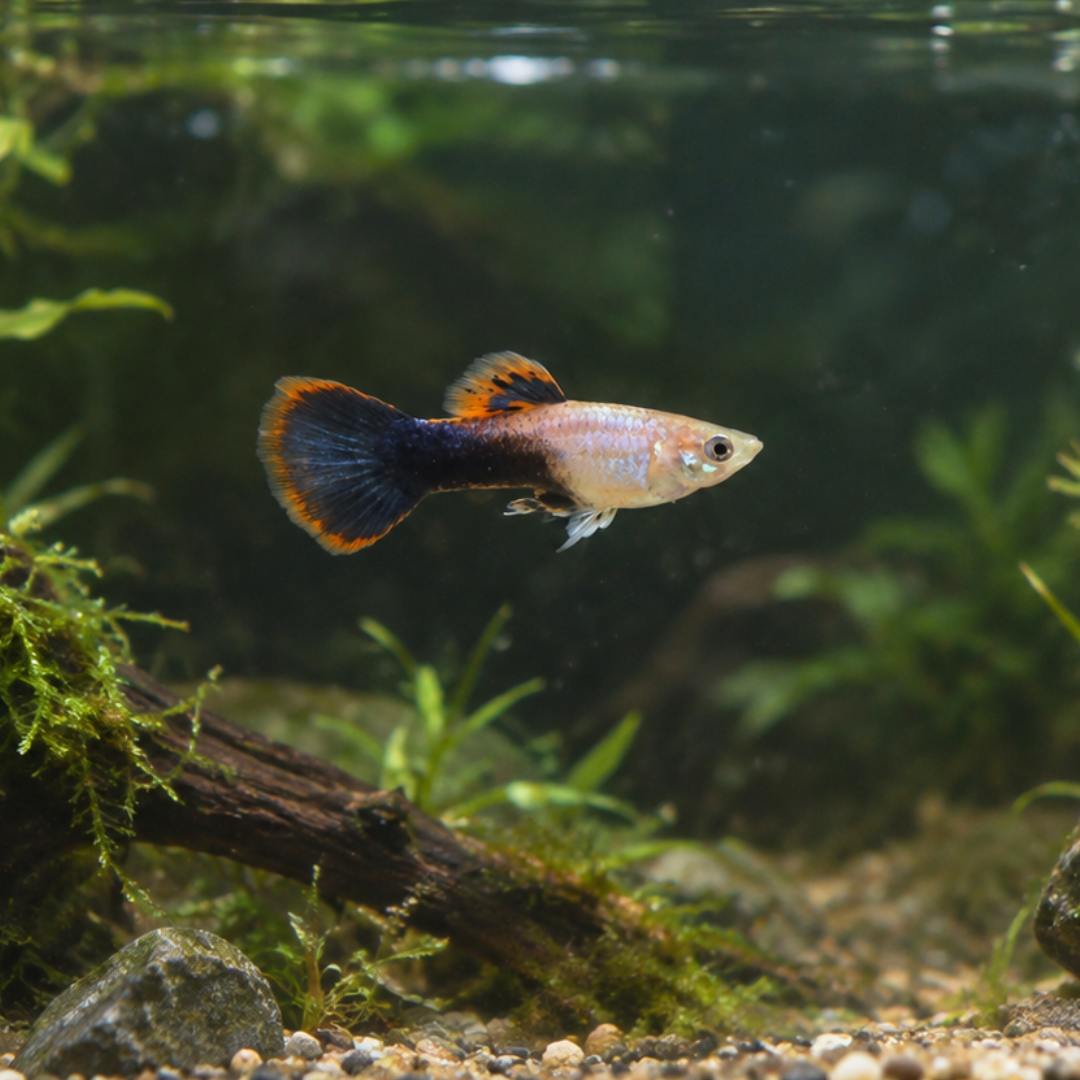
ピンクタキシードグッピーは、体の後半を黒く染める「タキシード」模様にピンクの発色を組み合わせた改良グッピーです。ただし、この名前はひとつの固定品種を指すものではなく、国内で見かける個体は大きく三つの系統にまたがっています。ひとつ目は、ホームセンターや通販で手頃に手に入る東南アジア産の外国産タイプです。マゼンタ系の遺伝子にタキシードを重ねた系統と考えられており、メタリックな光沢を帯びたピンクと紫が混ざり合って、光の角度によって色合いが変わって見えます。ふたつ目は、常染色体上の劣性遺伝子「ピンク(ピングー)」とタキシード遺伝子の組み合わせで生まれる系統です。頭部がメタルやシルバーに輝き、尾筒の後半が淡いピンクに染まるタイプで、国内のブリーダーによって大きな尾ビレへと改良が重ねられてきました。三つ目は、海外のコンテストで「ハーフブラック・パステル」と呼ばれる系統のうち、淡いピンクを帯びたタイプです。濃い黒の下半身に、均一なパステルカラーの大きな尾ビレが広がります。流通の面では、外国産はオスのみの数匹セット、国産は専門店やブリーダーによるペアやトリオでの販売が中心で、慣れている水質も少し異なります。外国産と国産を同じ水槽に入れず、網などの器具も分けて扱うことは、日本でこの魚を楽しむうえで欠かせない約束ごとです。The Pink Tuxedo Guppy is a fancy guppy that combines the “tuxedo” pattern, which darkens the rear half of the body, with pink coloration. The name does not refer to a single fixed strain, however; fish sold under it in Japan broadly belong to three lines. The first is the imported type bred in Southeast Asia and sold inexpensively at home centers and online shops. It is thought to be a magenta-type strain overlaid with the tuxedo pattern, showing a metallic blend of pink and purple whose hue shifts with the angle of the light. The second line comes from combining the recessive autosomal “Pink” (Pingu) gene with the tuxedo gene. These fish have a metallic or silver head and a soft pink rear caudal peduncle, and Japanese breeders have refined them toward large tails. The third is the pinkish form of what international shows call the “Half-Black Pastel”: a deep black lower body paired with large, evenly colored pastel tail and dorsal fins. Imported fish are usually sold as sets of males only, while domestic fish are mainly sold in pairs or trios by specialist shops and breeders, and the two are accustomed to slightly different water conditions. Keeping imported and domestic guppies in separate tanks and never sharing nets or other equipment between them is an essential rule for enjoying this fish in Japan.
基本情報 / Basic Information
学名 / Scientific Name
Poecilia reticulata
通称 / Common Name
ピンクタキシードグッピー、ピンクタキシード、ピングー・タキシード、メタルピンクタキシード、コーラルピンクタキシード(国産上級系統の呼称)などPink Tuxedo Guppy, Pink Tuxedo, Pingu Tuxedo, Metal Pink Tuxedo, Coral Pink Tuxedo (a name used for high-grade Japanese lines), etc.
分類 / Family
カダヤシ目 カダヤシ科 ポエキリア属(改良品種)Cyprinodontiformes, Poeciliidae, genus Poecilia (ornamental strain)
英名 / English Name
Pink Tuxedo Guppy / Half-Black Pink Guppy
分布 / Distribution
原種はベネズエラ、ガイアナ、ブラジル北部などの南米北東部と、トリニダード・トバゴや小アンティル諸島の島々に分布します。本品種は改良品種のため自然界には存在せず、外国産はシンガポールやスリランカなどの養殖場で、国産は国内のブリーダーによって生産されています。The wild species is native to northeastern South America, including Venezuela, Guyana and northern Brazil, as well as Trinidad and Tobago and islands of the Lesser Antilles. As an ornamental strain, this variety does not occur in the wild. Imported fish are produced on farms in countries such as Singapore and Sri Lanka, while domestic fish are bred by Japanese breeders.
最大体長 / Max Size
オスは尾ビレを含めて約3〜4cm、メスは約5〜6cmです。Males reach about 3–4 cm including the tail; females about 5–6 cm.
寿命 / Lifespan
1〜2年ほどが一般的で、環境が良ければ3年近く生きることもあります。尾ビレの大きなオスは、メスより早く衰える傾向があります。Typically 1–2 years, occasionally close to 3 years under good conditions. Males with large tails tend to decline earlier than females.
飼育環境 / Aquarium Environment
水槽サイズ / Tank Size
オス数匹を観賞するだけなら、30cm規格水槽(約12L)から飼育できます。繁殖や群泳を楽しみたい場合は、水質が安定しやすい45cm規格水槽(約35L)や60cm規格水槽(約57L)がおすすめです。本格的に系統を維持するなら、親魚用、稚魚の育成用、オスとメスの分離用など、複数の水槽が必要になります。A 30 cm standard tank (about 12 L) is enough for simply enjoying a few males. For breeding or keeping a school, a 45 cm standard tank (about 35 L) or a 60 cm standard tank (about 57 L) is recommended because water conditions stay more stable. Serious line maintenance requires several tanks for breeders, fry rearing, and keeping males and females apart.
水温 / Temperature
発色と食欲が安定する目安は23〜26℃で、稚魚の育成や繁殖を重視する場合は24〜28℃が適しています。13℃前後まで耐えるといわれますが、20℃を下回ると出産が止まり、病気も出やすくなります。そのため日本では、水温が20℃を切る前の秋口からヒーターが欠かせません。夜間に暖房を切る部屋では、適合水量より一段階大きなワット数のヒーターを選ぶと安心です。夏は水温が30℃を超えないよう、エアコンや水槽用クーラー、冷却ファンで対策しましょう。23–26°C keeps color and appetite stable, and 24–28°C suits fry rearing and breeding. Guppies are said to tolerate around 13°C, but below 20°C females stop giving birth and disease becomes more likely. In Japan, a heater is therefore essential from early autumn, before the water drops below 20°C. In rooms where the heating is turned off at night, choose a heater one step more powerful than the rated tank size. In summer, use air conditioning, an aquarium chiller or cooling fans to keep the water below 30°C.
水質 / Water Quality
pH6.5〜7.5前後の中性から弱アルカリ性が目安です。外国産は弱アルカリ性寄り、国産は日本の水道水に近い中性寄りの水に慣れていることが多いようです。日本の水道水はカルキを抜けばおおむねそのまま使えますが、大切なのは数値を合わせることよりも、急に変化させないことです。総硬度(GH)は国内では5〜9程度が扱いやすい目安とされ、極端な軟水ではヒレが傷みやすいともいわれます。グッピーは酸素を多く必要とするため、エアレーションやスポンジフィルターで酸素を確保しながら、大きな尾ビレの負担にならないよう水流は弱めにしてください。Aim for neutral to slightly alkaline water around pH 6.5–7.5. Imported fish tend to be used to slightly alkaline water, while domestic fish are often used to neutral water closer to Japanese tap water. Japanese tap water can generally be used once dechlorinated, but avoiding sudden changes matters more than hitting exact numbers. In Japan, a general hardness (GH) of about 5–9 is considered easy to manage, and very soft water is said to make fins more prone to damage. Guppies need plenty of oxygen, so provide aeration or a sponge filter while keeping the current gentle to spare their large tails.
レイアウト / Layout
流木や水草を使ったナチュラルな水草水槽によく映えます。アナカリスやマツモ、ウィローモスなどを茂らせておくと、メスの休み場や稚魚の隠れ家にもなります。底床は大磯砂やソイルなど一般的なもので問題ありませんが、ソイルは水を酸性に傾けやすいため、定期的な水換えで調整しましょう。落ち着いた暗めの背景にすると、黒とピンクのコントラストがいっそう引き立ちます。They look wonderful in a natural planted tank with driftwood. Dense plants such as Egeria, hornwort or willow moss provide resting spots for females and shelter for fry. Ordinary substrates such as river gravel or aqua soil are fine, though aqua soil tends to lower pH, so keep it in balance with regular water changes. A calm, dark background makes the contrast between black and pink stand out even more.
注意点 / Precautions
外国産と国産、また異なるブリーダー産の個体は、同じ水槽で飼わないでください。通称「グッピーエイズ」と呼ばれる致死率の高い症状は、外国産の個体が症状を見せないまま持ち込む場合があると考えられており、網やスポイト、水換えホースの共用でも広がるおそれがあります。また、尾ビレの大きな個体はとがった石や硬い流木の角でヒレを傷めやすいため、レイアウト素材の形にも気を配りましょう。Do not keep imported fish, domestic fish, or fish from different breeders in the same tank. The highly fatal condition known in Japan as “guppy AIDS” is thought to be brought in at times by imported fish that show no symptoms, and it may spread even through shared nets, pipettes or water-change hoses. Fish with large tails also tear their fins easily on sharp rocks or hard driftwood edges, so choose layout materials with care.
餌と給餌 / Feeding
餌の種類 / Diet
雑食性で、グッピー専用の人工飼料をよく食べます。繁殖や体格づくりを狙う場合は、冷凍アカムシやブラインシュリンプ幼生を組み合わせると効果的です。稚魚には、生まれてすぐは稚魚用の粉末フードを与え、その後は孵化したてのブラインシュリンプ幼生に切り替えていきます。Omnivorous and eagerly accepts guppy-specific prepared foods. When aiming for breeding or a stronger build, adding frozen bloodworms or baby brine shrimp works well. Feed newborn fry a powdered fry food at first, then switch to freshly hatched brine shrimp.
給餌のポイント / Feeding Tips
1日2〜3回、数分で食べきれる量を与えます。気をつけたいのが色揚げ用のフードです。アスタキサンチンなどのカロテノイドを含む飼料には赤やオレンジ、黄色を強める働きがあります。赤紫の色味を濃く出したい外国産のマゼンタ系では役立つ場面がある一方、淡く澄んだパステルピンクや、白みを帯びたピングー系では色調を濁らせる原因になることがあります。繊細な色合いを守りたい系統には、通常の育成用飼料とブラインシュリンプを中心に与えるのが無難です。Feed two or three times a day, only as much as they finish within a few minutes. Take care with color-enhancing foods. Feeds containing carotenoids such as astaxanthin intensify red, orange and yellow. They can help bring out the reddish purple of imported magenta types, but may muddy the clear pastel pink or whitish tones of Pingu-type fish. For lines whose delicate color you want to preserve, it is safest to rely mainly on standard growth foods and brine shrimp.
性格と混泳 / Temperament and Tank Mates
性格 / Temperament
温和で、ほかの魚を攻撃することはほとんどありません。オスはメスを見つけるとヒレを大きく広げ、体をくねらせる求愛ダンスを繰り返します。その姿も観賞の楽しみのひとつです。ただし、メスの数が少ないとしつこく追い回されて疲れてしまうため、繁殖させる場合はメスを多めにするとよいでしょう。Peaceful and rarely aggressive toward other fish. When a male spots a female, he spreads his fins and repeatedly performs a shimmying courtship display, which is one of the joys of keeping them. If there are too few females, however, they become exhausted from constant chasing, so keep more females than males when breeding.
混泳の相性 / Compatibility
コリドラスやオトシンクルス、小型のカラシン類、ミナミヌマエビなど、温和な生き物とは相性が良好です。一方、スマトラのようにヒレをかじる性質のある魚との混泳は避けてください。同じグッピー同士でも、リボンやRREAなど泳ぎの苦手な品種と、尾ビレが小さく機敏な系統を一緒にすると、泳ぎの苦手な側が消耗しやすくなります。そして何より、外国産と国産を混ぜないことが重要です。They get along well with gentle tank mates such as Corydoras, Otocinclus, small tetras and Neocaridina shrimp. Avoid fin-nipping fish such as Tiger Barbs. Even among guppies, mixing poor swimmers like ribbon or RREA strains with small-tailed, agile lines tends to wear down the weaker swimmers. Above all, never mix imported and domestic guppies.
病気と対策 / Diseases and Prevention
かかりやすい病気 / Common Diseases
最も警戒したいのは、通称「グッピーエイズ」と呼ばれる症状です。胸ビレの曇りやヒレをたたむ様子から始まり、体表のただれや腐れへと進んで、早い場合は数日で水槽内の多くの魚が死んでしまうこともあります。原因となる病原体は特定されておらず、確立された治療法もありません。このほか、カラムナリス菌による尾ぐされ病(ヒレの先が白く濁り、やがて溶けるように崩れる)、尾ビレが針のように細くすぼまる症状(ハリ病)、テトラヒメナなどの繊毛虫による急速に広がる寄生虫症も見られます。The most serious concern is the condition called “guppy AIDS” in Japan. It begins with cloudy pectoral fins and clamped fins, progresses to skin lesions and rotting, and can kill many fish in a tank within days. The causative pathogen has not been identified, and no established treatment exists. Other problems include fin rot caused by Columnaris bacteria (fin tips turn cloudy white and then disintegrate), a condition in which the tail narrows into a spike (known in Japan as “needle disease”), and fast-spreading parasitic infections caused by ciliates such as Tetrahymena.
対策と予防 / Prevention
グッピーエイズを防ぐには、外国産と国産を混ぜないこと、器具を分けること、水質の急変や過密といったストレスを避けること、この三つを徹底するのが現実的な方法です。発症した個体はすぐに隔離し、水質を安定させて様子を見ます。塩浴や薬浴を行っても、回復や感染の拡大防止が保証されるわけではありません。尾ぐされ病は、初期であれば別容器で0.5%の塩水浴(水1Lに塩5g)を1週間ほど行い、進行している場合は観パラDやグリーンFゴールド顆粒などの市販の魚病薬を使います。塩や薬は水草を傷めるため、治療は必ず隔離容器で行ってください。新しく迎えた魚は、しばらく別の水槽で様子を見てから本水槽に移すと安心です。The realistic way to prevent “guppy AIDS” is to strictly follow three rules: never mix imported and domestic fish, keep equipment separate, and avoid stress such as sudden water changes or overcrowding. Isolate affected fish immediately and keep water conditions stable. Salt baths and medication do not guarantee recovery or stop the spread. For early fin rot, give a 0.5% salt bath (5 g of salt per liter) in a separate container for about a week; for advanced cases, use commercial fish medications sold in Japan, such as Kanpara D or Green F Gold Granules. Salt and medicine harm aquatic plants, so always treat fish in a separate container. Quarantining newcomers in another tank for a while before adding them to the main tank is a good safeguard.
増やし方(繁殖) / Breeding
雌雄の判別 / Sexing
オスは体が小さく、尾ビレや背ビレが大きく色鮮やかです。見分ける決め手は、尻ビレが棒状に変化した交接器(ゴノポディウム)です。メスは体が大きく腹部がふっくらしていて、ヒレは比較的小さめです。稚魚は、早ければ生後3週間を過ぎたころから見分けられるようになります。Males are smaller with large, colorful tails and dorsal fins. The decisive feature is the gonopodium, an anal fin modified into a rod-shaped copulatory organ. Females are larger with a fuller belly and relatively small fins. Fry can be sexed as early as a little over three weeks after birth.
繁殖形態 / Reproduction
メスのお腹の中で卵をかえし、稚魚を直接産む卵胎生です。交尾からおよそ4週間で出産し、産仔数は初産で10〜20匹ほど、成熟したメスでは30〜50匹になることもあります。出産が近づくと腹部が角張り、肛門付近の黒い斑紋(妊娠マーク)が濃くなって、稚魚の目が透けて見えることもあります。メスは受け取った精子を体内に蓄えておけるため、オスと離しても数回続けて出産することがあります。Guppies are livebearers: the eggs hatch inside the female, and she gives birth to free-swimming fry. Birth occurs about four weeks after mating, with 10–20 fry in a first brood and sometimes 30–50 from a mature female. As birth approaches, the belly becomes boxy, the dark gravid spot near the vent darkens, and the eyes of the fry may be visible through the body. Because females can store sperm, they may give birth several more times even after being separated from males.
繁殖のポイント / Breeding Tips
親魚は稚魚を食べてしまうため、水草を茂らせるか産卵箱を使って稚魚を守ります。狙った組み合わせで交配したい場合は、生後1か月ほどで雌雄を分け、まだ交尾していない処女メスを確保しておくことが欠かせません。選別は急がないのがコツです。パステル系やピンク系は尾ビレの色が仕上がるまでに時間がかかるため、生後4〜5か月まで待ってから判断しましょう。同じ血統だけで代を重ねると、ヒレが薄くなったり尾筒に黄ばみが出たりしやすくなります。複数のラインを並行して維持したり、信頼できるブリーダーから別系統を取り入れたりして、血を入れ替えることが大切です。また、交配相手に並グレードのドイツイエロータキシードを使うと、ピンクがクリームイエローに褪せてしまうことがあります。美しいピンクを保つには、特にメスの選別に妥協しないことが鍵になります。Adults eat their fry, so protect the young with dense plants or a breeding box. To make planned crosses, separate the sexes at about one month of age to secure virgin females. Do not rush selection: pastel and pink types take longer for tail color to develop, so wait until four to five months of age before judging. Breeding within a single line for many generations tends to thin the fins or cause yellowing at the caudal peduncle. Maintaining several parallel lines, or bringing in unrelated stock from a trusted breeder, helps refresh the bloodline. Crossing with average-grade German Yellow Tuxedos can also fade the pink to cream yellow, so being uncompromising when selecting females is the key to keeping the pink beautiful.
雑学と豆知識 / Trivia and Fun Facts
1. 「グッピー」の名を残した博物学者 / 1. The Naturalist Whose Name Became “Guppy”
グッピーに学名 Poecilia reticulata を与えたのは、ドイツの動物学者ヴィルヘルム・ペータースです。1859年、ベネズエラ産の標本をもとに記載されました。一方、世界中で親しまれる「グッピー」という呼び名は、トリニダード島に住んでいた博物学者ロバート・ジョン・レクメア・グッピーに由来します。彼が大英博物館へ送った標本を、魚類学者アルバート・ギュンターが新種と考え、1866年に送り主にちなんだ学名を付けたのです。のちに、この魚はペータースが先に名付けていた種と同じだと分かり、その学名は使われなくなりました。それでも愛称としての「グッピー」だけは残り、いまや世界で最も有名な熱帯魚の名前のひとつになっています。日本へは大正時代に渡来したとされ、昭和初期には百貨店の店頭に並ぶ高級魚でした。広く普及したのは戦後のことです。The guppy was given its scientific name, Poecilia reticulata, by the German zoologist Wilhelm Peters, who described it in 1859 from Venezuelan specimens. The familiar name “guppy,” however, comes from Robert John Lechmere Guppy, a naturalist living in Trinidad. The ichthyologist Albert Günther believed the specimens Guppy sent to the British Museum represented a new species and, in 1866, named it after him. The fish later turned out to be the same species Peters had already named, so Günther’s name fell out of use. Yet “guppy” survived as a common name and is now one of the best-known aquarium fish names in the world. The fish is said to have arrived in Japan in the Taisho era, was a luxury item displayed in department stores in the early Showa period, and became widely popular after the Second World War.
2. 「タキシード」と「ハーフブラック」、そしてズボンとオーバーコート / 2. Tuxedo, Half-Black, Trousers and Overcoats
体の後半が黒く染まる模様を紳士の礼服に見立てて「タキシード」と呼ぶのは、日本や欧州の一部で定着した呼び方です。北米のコンテストや英語圏の専門書では、見たままに「ハーフブラック(HB)」と呼ばれます。この模様を生む遺伝子は、1959年の研究で優性遺伝子「Ni(ニグロカウダトゥス)」として記載されました。欧州のグッピー遺伝学の解説には、模様の重なりを服にたとえるユニークな説明があります。タキシードの黒やピングーのピンクは下半身に履く「ズボン」、マゼンタやモスクワのように下地の色を覆い隠す遺伝子は厚手の「オーバーコート」というわけです。このたとえに当てはめると、外国産のピンクタキシードは「黒いズボンの上にマゼンタのコートを羽織った魚」。光の角度で色が複雑に揺らめく理由が、少し身近に感じられるのではないでしょうか。Calling the dark rear-body pattern a “tuxedo,” after formal menswear, is a custom established in Japan and parts of Europe. North American shows and English-language books simply call it “Half-Black” (HB). The gene responsible was described in a 1959 study as the dominant gene “Ni” (Nigrocaudatus). European explanations of guppy genetics sometimes compare layered patterns to clothing: the black of the tuxedo or the pink of Pingu is a pair of “trousers” on the lower body, while genes such as magenta or Moscow that cover the base color are a thick “overcoat.” By this analogy, the imported Pink Tuxedo is “a fish wearing a magenta coat over black trousers,” which makes it easier to picture why its colors shimmer so intricately with the light.
3. ピンクを生む遺伝子はひとつではない / 3. There Is More Than One Way to Make Pink
同じ「ピンク」でも、その裏側にある遺伝の仕組みはさまざまです。ピングー系のピンクは常染色体上の劣性遺伝子によるもので、父と母の両方から受け継いだときに初めて表に現れます。興味深いことに、この遺伝子はタキシードと組み合わさらないとピンクとして見えにくく、単独ではむしろ白っぽく見えるといわれています。また、名前のよく似た「ピンクホワイト」という別の変異も知られており、こちらは性染色体上にある優性遺伝子だと報告されています。さらに、オレンジ色の色素細胞をピンクや紫がかった色調に変える「パープルボディ」遺伝子の働きも明らかになってきました。マゼンタ系に見られる、ピンクと紫の中間のような独特の光沢は、こうした複数の遺伝子が重なり合って生まれていると考えられています。The same “pink” can rest on very different genetics. Pingu pink comes from a recessive autosomal gene that only shows when inherited from both parents. Interestingly, this gene is said to be hard to see as pink unless combined with the tuxedo gene; on its own, it looks closer to white. A separate mutation with a confusingly similar name, “Pink White,” is also known and has been reported to be a dominant gene on the sex chromosomes. In addition, the role of the “Purple Body” gene, which shifts orange pigment cells toward pink or purplish tones, has been coming to light. The distinctive sheen between pink and purple seen in magenta-type fish is thought to arise from several such genes overlapping.
4. 日本で大きな尾ビレを手に入れたピンク / 4. How the Pink Gained Its Grand Tail in Japan
国内のブリーダーの記録によれば、かつてアメリカから日本に届いたピンクタキシードの原型は、頭部がメタリックに輝き、尾筒が鮮やかなピンクに染まる一方で、尾ビレは野生のグッピーのように小さかったといいます。日本の愛好家たちはこの個体に優良なドイツイエロータキシードを繰り返し交配し、ピンクの色を保ったまま大きなデルタテールへと育て上げていきました。ところが同じころ、並グレードのドイツイエローと交配された系統では、尾筒のピンクがクリームイエローに褪せてしまったそうです。いま「ピンクタキシード」と「ピングー」の姿のイメージに揺らぎがあるのは、こうした改良の分かれ道があったためとも考えられています。また、このアメリカ系統にはヒレを大きく発達させる性質があったとされ、ほかの品種の背ビレを大きくする改良にも使われたと伝えられています。According to records kept by Japanese breeders, the original Pink Tuxedo stock that arrived from the United States had a metallic head and a vivid pink caudal peduncle, but a small tail like that of a wild guppy. Japanese hobbyists repeatedly crossed these fish with high-grade German Yellow Tuxedos, developing them into large delta tails while keeping the pink. Around the same time, however, lines crossed with average-grade German Yellows reportedly saw their pink fade to cream yellow. This fork in breeding history is thought to be one reason why the images of “Pink Tuxedo” and “Pingu” still vary today. The American line is also said to have carried a trait that enlarged fins, and it was reportedly used to develop larger dorsal fins in other strains.
5. 色が薄くなったのは病気?色素胞のふしぎ / 5. Faded Color? The Secret of Chromatophores
朝に照明を点けた直後や水換えの後、ピンクタキシードの色が白っぽく見えて驚くことがあります。多くの場合、これは異常ではありません。グッピーの皮膚には、黒いメラニンを持つ黒色素胞、黄色や赤の色素を持つ黄色素胞や赤色素胞、光を反射して金属的な輝きを生む虹色素胞などが層をなしています。細胞の中の色素の粒は、神経やホルモンの働きによって中心に集まったり、細胞全体に広がったりします。驚いたときや眠っているとき、ストレスを感じているときには色素が集まって色が淡くなり、反対に体調が良く、メスに求愛して興奮しているときには色素が広がって、黒とピンクのコントラストが最も鮮やかになります。しばらくして色が戻るなら心配はいりませんが、色が長く戻らないときは、水質や混泳相手を見直すサインかもしれません。Right after the lights come on in the morning or after a water change, you may be surprised to see your Pink Tuxedo looking pale. In most cases, nothing is wrong. Guppy skin contains layers of pigment cells: melanophores with black melanin, xanthophores and erythrophores with yellow and red pigments, and iridophores that reflect light to create a metallic sheen. Under nervous and hormonal control, the pigment granules inside each cell either gather at the center or spread throughout it. When the fish is startled, asleep or stressed, the pigment gathers and the color fades; when it is healthy and excitedly courting a female, the pigment spreads and the black-and-pink contrast is at its most vivid. If the color returns after a while, there is no need to worry, but if it stays pale for a long time, it may be a sign to review water quality or tank mates.
6. オスだけが華やかなのはなぜ? / 6. Why Are Only the Males So Colorful?
グッピーは、体色の遺伝子が性染色体と結びついて受け継がれることが早くから示された魚として知られています。1920年代、シュミットやウィンゲらの研究によって、オスの模様の一部がY染色体を通じて父から息子へ受け継がれることが明らかになりました。近年の研究では、オスの華やかな発色は性染色体上の遺伝子だけで決まるのではなく、性染色体上で「スイッチ役」を担う遺伝子と、ほかの染色体にある色づくりの遺伝子とが連携して生まれると考えられています。オスの体色が現れ始める時期の遺伝子の働きを調べた研究でも、メラニンを作る遺伝子がメスよりオスで活発に働いていることが報告されました。さらに、グッピーを含む多くの硬骨魚の祖先は、進化の過程でゲノム全体が倍になる出来事を経験しており、色素細胞の形成に関わる遺伝子を複数コピー持っています。つまり、ひとつのコピーが変異しても別のコピーが働きを補えるため、色の変異が生まれやすく残りやすいのです。こうした遺伝的な「余白」が、ピンクタキシードをはじめとする多彩な改良品種を支える土台のひとつになっていると考えられています。The guppy is known as a fish in which color genes were shown early on to be inherited together with the sex chromosomes. In the 1920s, studies by Schmidt and Winge revealed that some male patterns pass from father to son via the Y chromosome. More recent research suggests that male coloration is not determined by sex-chromosome genes alone, but arises from cooperation between “switch” genes on the sex chromosomes and color-producing genes on other chromosomes. A study of gene activity at the age when male coloration begins to appear also reported that melanin-producing genes are more active in males than in females. In addition, the ancestors of most bony fishes, guppies included, underwent an event in which the entire genome was doubled, leaving multiple copies of genes involved in pigment cell development. In other words, when one copy mutates, another can cover its function, so color variants arise and persist more easily. This genetic “extra room” is thought to be one foundation for the many ornamental strains, the Pink Tuxedo among them.
まとめ / Conclusion
ピンクタキシードグッピーは、黒い礼服のような後半身にピンクの輝きをまとった、上品さと華やかさをあわせ持つグッピーです。光の角度で表情を変える外国産のメタリックピンク、淡い桜色を宿した国産のピングー系、大きなパステルの尾ビレが映えるハーフブラック系と、同じ名前の中にいくつもの個性が息づいています。手頃な外国産のオスを群れで泳がせて水槽を彩るのも、国産のペアから色と形を次の世代へつないでいくのも、この魚ならではの楽しみ方です。The Pink Tuxedo Guppy pairs a rear body like a black formal suit with a glow of pink, combining elegance and brilliance. Several personalities live under the one name: the imported metallic pink that changes with the light, the domestic Pingu types with their soft cherry-blossom hue, and the half-black lines with grand pastel tails. Brightening a tank with a school of affordable imported males and passing color and form on to the next generation from a domestic pair are both pleasures unique to this fish.
長く美しさを楽しむためのいちばんのコツは、水温と水質を急に変えないこと、そして外国産と国産をきちんと分けて飼うことです。落ち着いた水槽で調子を整えたオスがヒレをいっぱいに広げてメスに求愛するとき、黒とピンクのコントラストは最も鮮やかに輝きます。その瞬間は、日々の世話を重ねてきた飼い主にとって、何よりのごほうびになるはずです。The key to enjoying their beauty for years is to avoid sudden changes in temperature and water quality, and to keep imported and domestic fish strictly apart. When a male in good condition, settled in a calm tank, spreads his fins wide to court a female, the contrast of black and pink shines at its brightest. For a keeper who has cared for them day after day, that moment is sure to be the finest reward.
Peters, W. (1859). Eine neue vom Herrn Jagor im atlantischen Meere gefangene Art der Gattung Leptocephalus, und über einige andere neue Fische des Zoologischen Museums. Monatsberichte der Königlichen Preussischen Akademie der Wissenschaften zu Berlin, 1859.
Günther, A. (1866). Catalogue of the Fishes in the British Museum. Vol. 6. London: Trustees of the British Museum.
Magurran, A. E. (2005). Evolutionary Ecology: The Trinidadian Guppy. Oxford: Oxford University Press.
Houde, A. E. (1997). Sex, Color, and Mate Choice in Guppies. Princeton: Princeton University Press.
体色の遺伝・改良品種
Schmidt, J. (1920). Racial investigations. IV. The genetic behaviour of a secondary sexual character. Comptes-Rendus des Travaux du Laboratoire Carlsberg, 14(8).
Winge, Ö. (1922). One-sided masculine and sex-linked inheritance in Lebistes reticulatus. Journal of Genetics, 12, 145–162.
Dzwillo, M. (1959). Genetische Untersuchungen an domestizierten Stämmen von Lebistes reticulatus (Peters). Mitteilungen aus dem Hamburgischen Zoologischen Museum und Institut, 57.
Lindholm, A. & Breden, F. (2002). Sex chromosomes and sexual selection in poeciliid fishes. The American Naturalist, 160(S6), S214–S224.
Kottler, V. A., Fadeev, A., Weigel, D. & Dreyer, C. (2013). Pigment pattern formation in the guppy, Poecilia reticulata, involves the Kita and Csf1ra receptor tyrosine kinases. Genetics, 194(3), 631–646.
Dick, C., Reznick, D. N. & Hayashi, C. Y. (2018). Sex-biased expression between guppies varying in the presence of ornamental coloration. PeerJ, 6, e5782. https://doi.org/10.7717/peerj.5782
Meyer, A. & Van de Peer, Y. (2005). From 2R to 3R: evidence for a fish-specific genome duplication (FSGD). BioEssays, 27(9), 937–945.
Shaddock, P. Guppy Color Strains: A Practical Guide to Color Genetics.
International Fancy Guppy Association (IFGA). IFGA Judging Standards.
体色変化・病気
Sugimoto, M. (2002). Morphological color changes in fish: regulation of pigment cell density and morphology. Microscopy Research and Technique, 58(6), 496–503.
Declercq, A. M., Haesebrouck, F., Van den Broeck, W., Bossier, P. & Decostere, A. (2013). Columnaris disease in fish: a review with emphasis on bacterium-host interactions. Veterinary Research, 44, 27.
Leibowitz, M. P. & Zilberg, D. (2009). Tetrahymena sp. infection in guppies, Poecilia reticulata Peters: parasite characterization and pathology of infected fish. Journal of Fish Diseases, 32(10), 845–855.









コメント