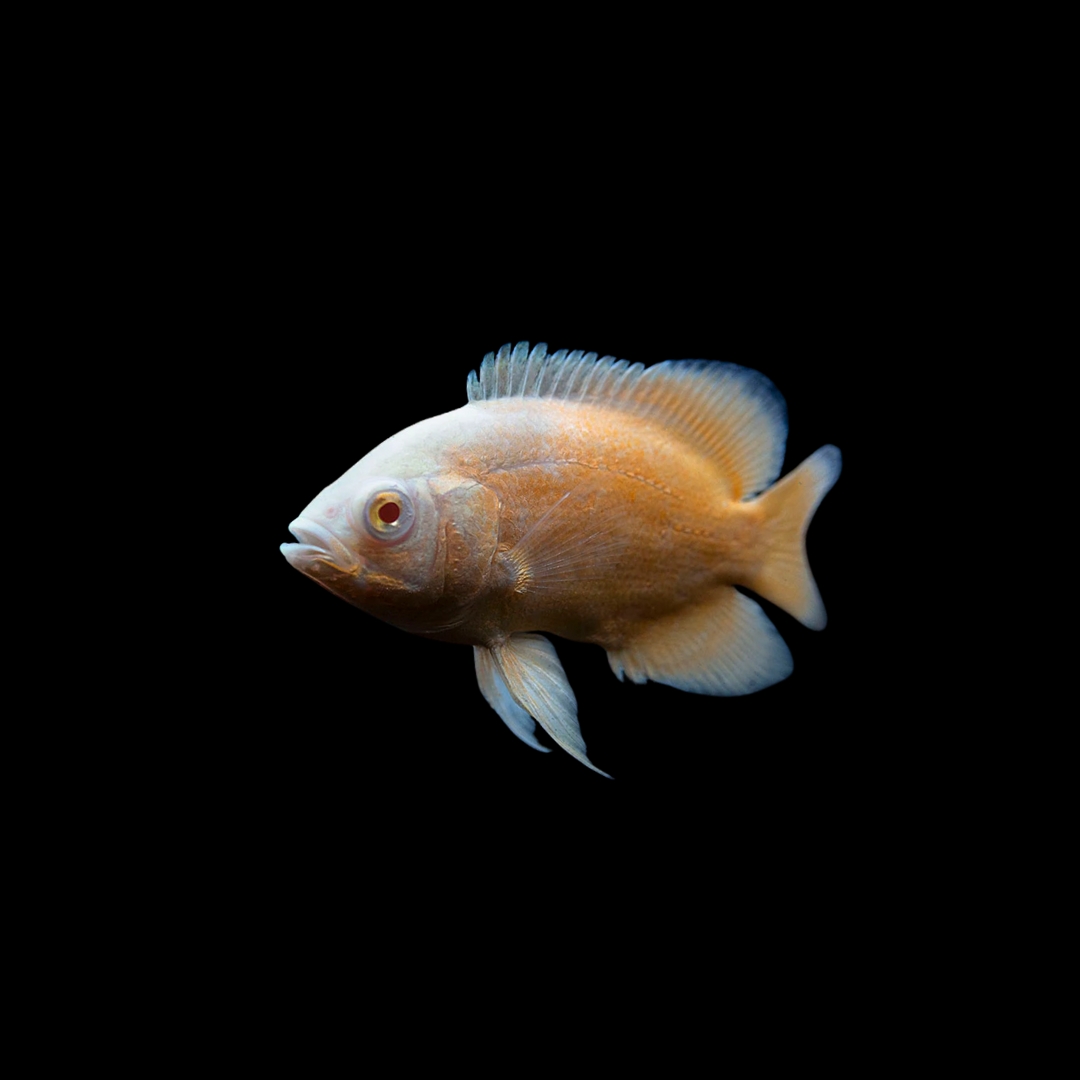
アルビノ・レッドオスカーは、南米原産の大型シクリッドであるオスカーを基に作出された改良品種です。黒色色素がほとんど見られない白からクリーム色の体に、赤からオレンジの色彩が広く乗る姿はとても印象的で、成長とともに発色の面積や濃さが変化していく過程も大きな魅力です。飼育者を覚えて餌をねだったり、水槽内の流木や石を自分好みに動かしたりする行動から、日本の愛好家にも「水槽の犬」のような存在として親しまれてきました。一方で、成魚は30cmを超えることが多く、野生個体ではさらに大型化する記録もあるため、強い濾過能力、大型水槽、長期的な飼育計画が欠かせません。稚魚の可愛らしさだけで迎えるのではなく、10年以上をともに過ごす大型のコンパニオンフィッシュとして向き合いたい魚です。The Albino Red Oscar is a selectively bred form of the Oscar, a large South American cichlid. Its white to cream body, with little visible black pigment, is overlaid with broad red to orange coloration, and the way that color develops as the fish matures is one of its greatest attractions. Because Oscars often recognize their keeper, beg for food, and rearrange wood or stones in the aquarium, they have long been loved by aquarists as water-dog-like companion fish. At the same time, adults commonly exceed 30 cm, and wild individuals have been recorded at even larger sizes. Strong filtration, a large aquarium, and a long-term plan are therefore essential. This is not a fish to choose only for its cute juvenile appearance, but one to welcome as a large companion fish that may live with its keeper for more than a decade.
基本情報 / Basic Information
学名 / Scientific Name
Astronotus ocellatus(Agassiz, 1831)を基にした改良品種として扱われます。アルビノ・レッドオスカー自体は独立した種名ではありません。(Agassiz, 1831), treated in the aquarium hobby as a selectively bred form. The Albino Red Oscar is not a separate scientific species.
通称 / Common Name
アルビノ・レッドオスカー、レッドアルビノオスカー、アルビノレッドAlbino Red Oscar, Red Albino Oscar
分類 / Family
硬骨魚綱、カワスズメ目、シクリッド科、アストロノータス属。古い資料ではスズキ目として扱われることもあります。Class Actinopterygii, order Cichliformes, family Cichlidae, genus Astronotus. Older references may place cichlids within Perciformes.
英名 / English Name
Albino Red Oscar
分布 / Distribution
原種として扱われるオスカーは南米の西部アマゾン水系およびオリノコ水系などに分布するとされます。ただし、アストロノータス属は分類の再検討が続いており、オリノコ水系の一部個体群は近年別種として記載されています。アルビノ・レッドオスカーは野生採集個体ではなく、主に東南アジアなどの養殖場で繁殖される観賞魚です。The wild Oscar has been reported from South America, including the western Amazon and Orinoco basins. However, taxonomy within Astronotus continues to be revised, and some Orinoco populations have recently been described as a separate species. The Albino Red Oscar is not a wild-caught natural form; it is a captive-bred ornamental strain produced mainly in fish farms such as those in Southeast Asia.
最大体長 / Max Size
飼育下では30〜35cm前後が一般的な目安です。野生個体を含む記録では40cmを超える最大記録もあるため、余裕ある水槽設計が必要です。In aquaria, about 30 to 35 cm is a common practical expectation. Records including wild fish exceed 40 cm, so generous tank planning is important.
寿命 / Lifespan
一般的に10〜15年ほど。水質、栄養、ストレス管理が良好であれば、さらに長く生きる例もあります。Commonly about 10 to 15 years. With excellent water quality, nutrition, and stress management, some individuals may live longer.
飼育環境 / Aquarium Environment
水槽サイズ / Tank Size
稚魚期は60cm規格水槽でも一時飼育できますが、成長が非常に速いため、終生飼育には単独でも90cm規格水槽以上、できれば90cmワイド水槽以上を推奨します。理想的には120cm規格水槽、混泳やペア飼育を考える場合は120cmワイド水槽以上が安心です。目安として、単独飼育で約150L以上、混泳では240L以上を確保したい魚です。Juveniles can be kept temporarily in a standard 60 cm tank, but they grow very quickly. For lifelong care, a standard 90 cm tank is the practical minimum for a single fish, while a wider 90 cm tank or larger is preferable. A standard 120 cm tank is ideal, and a 120 cm wide tank or larger is safer for pairs or tank mates. As a guide, provide at least about 150 L for a single fish and 240 L or more for community setups.
水温 / Temperature
24〜27℃前後を安定して維持します。原種のデータでは22〜25℃程度の範囲も示されますが、家庭水槽では急変を避け、消化と免疫が落ちにくい温度を安定させることが大切です。Keep the water stable at around 24 to 27°C. Species data also indicate a range around 22 to 25°C, but in home aquaria it is more important to avoid rapid changes and maintain a temperature that supports digestion and immunity.
水質 / Water Quality
弱酸性から中性付近の軟水を好みますが、適応力は比較的高く、pH6.0〜8.0前後、硬度5〜19dH程度の範囲に適応します。重要なのは数値を無理に動かすことではなく、アンモニアと亜硝酸を0に保ち、硝酸塩と有機汚れを換水で低く維持することです。They prefer soft, slightly acidic to neutral water, but are fairly adaptable, tolerating about pH 6.0 to 8.0 and roughly 5 to 19 dH. Rather than chasing exact numbers, the priority is to keep ammonia and nitrite at zero and control nitrate and organic waste through regular water changes.
レイアウト / Layout
遊泳スペースを広く取り、倒されにくい大きな流木や石を少数配置する程度が向いています。底砂を掘り返したり、装飾品を移動させたりするため、水草レイアウトには不向きです。管理性を重視する場合はベアタンクも有効です。アルビノ個体は強すぎる照明で落ち着かないことがあるため、照明は控えめにし、必要に応じて浮草や調光機能を利用します。Provide broad swimming space with only a few large, stable pieces of driftwood or stone. Oscars often dig and move decor, so planted aquascapes are usually unsuitable. A bare-bottom tank can be a practical option for easier maintenance. Because albino individuals may be unsettled by very strong lighting, use moderate lighting, floating plants, or dimming where appropriate.
注意点 / Precautions
成長速度が速く排泄量も多いため、大容量の外部式フィルターや上部フィルター、オーバーフロー濾過などで生物濾過を強化します。週1回を基本に、汚れ具合に応じて30〜50%程度の換水を行います。飛び出し防止のフタ、ヒーターカバー、動かされにくい器具配置も重要です。活性炭については、海水魚の頭部・側線びらん症で関連を示した研究がありますが、オスカーで同じ因果関係が完全に確定しているわけではありません。それでも粉塵の多い化学濾過材の常用に頼りすぎず、十分にすすぐこと、必要時だけ使うこと、生物濾過と換水を基本にすることが安全です。They grow quickly and produce heavy waste, so reinforce biological filtration with large canister filters, overhead filters, sump filtration, or a similarly robust system. As a baseline, change about 30 to 50 percent of the water weekly, adjusting to the actual waste load. A tight lid, heater guard, and secure equipment placement are also important. Activated carbon has been linked to head and lateral line erosion in marine fish studies, but the same direct causal relationship has not been fully established for Oscars. Even so, it is safer not to rely heavily on dusty chemical media as routine filtration; rinse it thoroughly, use it only when needed, and base maintenance on biological filtration and water changes.
餌と給餌 / Feeding
餌の種類 / Diet
主食は大型シクリッド用の高品質な人工ペレットが最適です。副食として、冷凍アカムシ、クリル、イサザアミ、無塩のエビや白身魚の小片、人工繁殖されたコオロギなどを少量ずつ組み合わせます。小赤などの金魚や一部のコイ科餌魚は、チアミナーゼによるビタミンB1不足のリスクが指摘されます。また、活餌全般には寄生虫や病原菌の持ち込み、栄養の偏りという問題があるため、常用の主食にはしないでください。A high-quality pellet formulated for large cichlids is the best staple. Supplement sparingly with frozen bloodworms, krill, mysid shrimp, small pieces of unsalted shrimp or white fish, and captive-bred insects such as crickets. Feeder goldfish and some other cyprinid feeder fish are associated with thiaminase-related vitamin B1 deficiency risk. Live feeder fish in general may also introduce parasites or pathogens and create nutritional imbalance, so they should not be used as a routine staple.
給餌のポイント / Feeding Tips
幼魚は少量を1日2回程度、成長後は1日1回または隔日を目安に、数分で食べ切る量を与えます。大食漢ですが、与えすぎは肥満、脂肪肝、水質悪化につながります。発色を高めたい場合も活餌に頼るのではなく、カロテノイド類を含む良質なペレットを中心に、栄養の幅を持たせることが大切です。牛ハツなど哺乳類由来の脂肪分が多い餌は長期常用を避けます。Feed juveniles small portions about twice daily. Adults can usually be fed once daily or every other day, only as much as they finish within a few minutes. Although they are eager eaters, overfeeding can cause obesity, fatty liver problems, and poor water quality. For better coloration, rely on quality pellets containing carotenoids and varied supplements rather than frequent feeder fish. Avoid long-term routine use of fatty mammalian foods such as beef heart.
性格と混泳 / Temperament and Tank Mates
性格 / Temperament
非常に知的で人によく慣れる一方、縄張り意識が強く、個体差も大きい魚です。飼育者に近寄って餌をねだる愛嬌を見せることもあれば、レイアウト変更や水槽内の変化に反応して一時的にすねるような行動を見せることもあります。They are intelligent and often become responsive to their keeper, but they are also territorial and highly individual. Some individuals beg for food at the glass, while others may react to layout changes or tank disturbances by sulking temporarily.
混泳の相性 / Compatibility
口に入るサイズの魚やエビは捕食対象になります。混泳させる場合は、同程度以上のサイズで丈夫な大型シクリッド、大型ナマズ類、大型カラシンなどが候補になりますが、相性は個体差が大きく、十分な水槽サイズと隠れ場所、隔離手段が必要です。アルビノ・レッドオスカーを主役にした単独飼育は、事故が少なく魅力も引き出しやすい方法です。Any fish or shrimp small enough to fit in the mouth may be eaten. Possible tank mates include similarly sized robust large cichlids, large catfish, or large characins, but compatibility varies greatly. A large aquarium, visual barriers, and a backup separation plan are essential. Keeping a single Albino Red Oscar as the centerpiece is often the safest and most rewarding approach.
病気と対策 / Diseases and Prevention
かかりやすい病気 / Common Diseases
白点病、尾ぐされ病、外傷、消化不良に加え、オスカーで特に注意したいのが頭部穴あき病です。頭部や目の周辺、側線に沿って小さなくぼみや白っぽい穴が目立つようになる症状で、単一の原因だけでなく、栄養不足、慢性的な水質悪化、ストレス、二次感染などが複合的に関与すると考えて管理します。Watch for ich, fin rot, injuries, digestive problems, and especially hole-in-the-head disease. This condition appears as small pits or pale erosions around the head, eyes, and lateral line. Rather than assuming a single cause, manage it as a problem that may involve nutritional deficiency, chronic poor water quality, stress, and secondary infection in combination.
対策と予防 / Prevention
予防の基本は、強い生物濾過、定期的な換水、過密回避、バランスのよい餌です。頭部穴あき病が疑われる場合は、まず水質を確認し、換水頻度を上げ、活餌中心の給餌を見直し、人工ペレット中心の栄養管理へ切り替えます。化学濾過材を使っている場合は、粉塵や長期常用の影響を避けるため、いったん外して経過を見ます。寄生虫や細菌の二次感染が疑われる場合のみ、症状を見極めて薬剤を検討します。薬だけで治そうとするより、原因になりやすい環境と餌を整えることが重要です。Prevention depends on strong biological filtration, regular water changes, avoiding overcrowding, and balanced food. If hole-in-the-head is suspected, first check water quality, increase water-change frequency, review any feeder-fish-based diet, and shift to nutritionally complete pellets. If chemical filter media are in use, remove them temporarily to avoid possible dust or long-term overuse issues. Medication should be considered only when secondary parasites or bacterial infection are likely. Correcting the environment and diet is more important than relying on medication alone.
増やし方(繁殖) / Breeding
雌雄の判別 / Sexing
外見だけでの雌雄判別は非常に困難です。体型や発色の違いが語られることはありますが、確実性は高くありません。繁殖期に産卵管や輸精管の形状を確認する方法が比較的有効です。Sexing by appearance alone is very difficult. Body shape and coloration are sometimes used as clues, but they are not highly reliable. Observing the breeding tubes during spawning condition is a more useful method.
繁殖形態 / Reproduction
平らな石や水槽底面などを掃除して卵を産み付ける基質産卵型です。ペアは卵と稚魚を守る二親性保護を行い、産卵期には縄張り意識がさらに強くなります。They are substrate spawners, cleaning a flat stone, tank bottom, or similar surface before laying eggs. The pair provides biparental care for the eggs and fry, and territorial behavior intensifies during breeding.
繁殖のポイント / Breeding Tips
確実なペアを得るには、複数の若魚を育てて自然に形成されたペアを見つける方法が一般的です。ただし、オスカー同士の衝突は激しくなることがあるため、120cmワイド水槽以上の広さと、仕切り板などの隔離手段を用意します。産卵床には平らで安定した石やタイルを使い、水質を清潔に保つことが大切です。The common approach is to raise several juveniles and allow a compatible pair to form naturally. However, Oscar aggression can be intense, so a 120 cm wide tank or larger and a divider or other separation plan are important. Use a stable flat stone or tile as the spawning site and keep the water very clean.
雑学と豆知識 / Trivia and Fun Facts
1. 名前に残る眼状斑の記憶 / 1. The eyespot remembered in the name
オスカーの種小名である ocellatus は、小さな目のような斑点を思わせる言葉に由来します。野生型オスカーの尾柄部には、捕食者の攻撃を頭部からそらす役割を持つと考えられる眼状斑があり、この特徴が学名に刻まれました。ところが、アルビノ・レッドオスカーでは白い地色と赤い発色を重視した選抜が進んだ結果、その野生のサインは目立ちにくくなっています。つまり、この品種の美しさの背後には、自然界で身を守るための模様が、観賞魚としての色彩美へ置き換わっていった歴史が隠れています。The species name ocellatus evokes a small eye-like spot. Wild Oscars have an eyespot near the caudal peduncle, which is thought to help divert predator attacks away from the head. This feature became part of the scientific name. In the Albino Red Oscar, however, selective breeding for a pale base and strong red coloration has made this wild signal far less visible. Behind the beauty of this variety lies a history in which a survival marking was gradually transformed into ornamental color.
2. レッドオスカーの品種史は慎重に読む / 2. Reading the history of the Red Oscar carefully
観賞魚史の中では、1960年代末にタイの育種家が赤の強い個体を選び、現在のレッドオスカーの系統を広めたと語られることがあります。ただし、この話は趣味家向けの資料に多く残る伝承的な要素も含むため、学術論文と同じ確度で断定するより、「観賞魚文化の中で広く語られてきた系譜」として扱うのが自然です。アルビノ・レッドオスカーは、その赤い表現にアルビノの明るい地色が重なった品種で、黒い背景に赤が浮かぶ通常のレッドオスカーとは違い、白いキャンバスに赤を描くような華やかさを見せます。In aquarium history, it is often said that a Thai breeder selected strongly red individuals in the late 1960s and helped establish the Red Oscar strain known today. However, this story is mostly preserved in hobbyist literature, so it is better treated as a widely told aquarium-culture lineage rather than as a fully documented academic fact. The Albino Red Oscar combines that red expression with a pale albino base. Unlike the normal Red Oscar, where red stands out against a dark background, this variety looks as though red has been painted onto a white canvas.
3. アストロノータス属は今も研究が進む魚 / 3. Astronotus is still being studied
古いアクアリウム資料では、オスカーは一種だけで語られることが多くありました。しかし近年は、地域個体群の違いを形態や遺伝の両面から見直す研究が進み、オリノコ川やパリア湾水系の個体群が別種として記載されるなど、分類の解像度が上がっています。アルビノ・レッドオスカーは A. ocellatus 系の改良品種として流通していますが、野生のアストロノータス属の分類には、まだ整理が続いている部分があります。Older aquarium literature often treated the Oscar as if it were a single simple species. In recent years, however, researchers have re-examined regional populations using morphology and genetics, and some populations from the Orinoco River and Gulf of Paria basins have been described as a separate species. The Albino Red Oscar is traded as a captive-bred A. ocellatus-type strain, while the taxonomy of wild Astronotus continues to be refined.
4. 水槽の犬と呼ばれる理由 / 4. Why Oscars are called water dogs
オスカーが水槽の犬と呼ばれるのは、単に大型で目立つからではありません。飼育者の動きに反応し、餌の時間を覚え、ガラス面の前でこちらを見上げるような行動を見せるためです。もちろん魚の感情を人間と同じように断定することはできませんが、少なくとも視覚的な学習能力と記憶力が高いことは、日々の飼育で強く感じられます。レイアウトを勝手に動かす行動も、困った癖であると同時に、自分の生活空間を能動的に作り替えるシクリッドらしい賢さの表れです。Oscars are called water dogs not simply because they are large and noticeable, but because they respond to their keeper, remember feeding routines, and often approach the front glass as if looking up at a familiar person. We should not claim that fish emotions are identical to human feelings, but their visual learning and memory are very evident in daily care. Their habit of rearranging decor can be troublesome, yet it also reveals the active, intelligent nature typical of many cichlids.
5. 頭部穴あき病は水槽全体から読み解く / 5. Read hole-in-the-head through the whole aquarium
オスカー飼育で恐れられる頭部穴あき病は、かつては寄生虫だけが主因のように語られることが多くありました。しかし実際の管理では、栄養、換水、濾過、ストレス、二次感染の可能性をまとめて点検する必要があります。活性炭についても、海水魚の頭部・側線びらん症で関連を示した研究がある一方、淡水のオスカーにそのまま同じ結論を当てはめることはできません。だからこそ、「活性炭は絶対悪」と決めつけるのではなく、粉塵を出さない、長期常用に頼らない、必要時だけ使うという慎重な姿勢が、図鑑として最も実用的な案内になります。Hole-in-the-head disease in Oscars was once often explained mainly as a parasite problem. In practical husbandry, however, nutrition, water changes, filtration, stress, and the possibility of secondary infection should all be checked together. Activated carbon has been linked to head and lateral line erosion in marine fish studies, but that conclusion cannot be applied directly and completely to freshwater Oscars. For this reason, the most useful guide is not to label carbon as absolutely bad, but to avoid dust, avoid long-term overuse, and use it only when needed.
6. アルビノ個体ならではの光への配慮 / 6. Light care unique to albino individuals
アルビノ・レッドオスカーの透明感ある目と明るい体色は、この品種の大きな魅力です。一方で、メラニンが少ないため、強すぎる照明を苦手とする個体もいます。観賞魚としては明るく照らしたくなりますが、魚にとって快適な明るさは人間の見た目の華やかさとは一致しません。少し落ち着いた照明、水面の陰、暗く休める場所を用意すると、白と赤の美しさを保ちながら、より自然な振る舞いを引き出しやすくなります。The translucent eyes and bright body of the Albino Red Oscar are among its greatest attractions. At the same time, reduced melanin means that some individuals may be uncomfortable under very strong lighting. Aquarists may want to illuminate the fish brightly, but the most visually impressive lighting for people is not always the most comfortable for the fish. Moderate light, shaded surface areas, and places to rest in dimmer conditions can help preserve both the fish’s beauty and its natural behavior.
まとめ / Conclusion
アルビノ・レッドオスカーは、白い体に赤い発色が映える華やかな改良品種でありながら、原種オスカーが持つ力強さ、知性、縄張り意識をしっかり受け継いだ大型シクリッドです。成長につれて色彩は深まり、行動には個性が表れ、飼育者との距離も少しずつ近づいていきます。その変化を長い時間をかけて味わえることこそ、この魚を飼う大きな楽しみです。The Albino Red Oscar is a brilliant selectively bred form with red coloration set against a pale body, yet it fully retains the strength, intelligence, and territorial nature of the wild Oscar. As it grows, its colors deepen, its personality becomes clearer, and its relationship with the keeper often feels closer. Experiencing those changes over many years is one of the greatest pleasures of keeping this fish.
この図鑑で最も大切な要点を一つにまとめるなら、アルビノ・レッドオスカーは「大きくなってから考える魚」ではなく、「大きくなることを前提に迎える魚」です。90cm規格水槽以上を基準にした住まい、力強い生物濾過、清潔な水、人工ペレットを中心にした栄養管理を整えれば、その鮮やかな赤と堂々とした姿は、水槽の中で長く主役であり続けます。美しさだけでなく、命の重みごと向き合ったとき、この魚は単なる観賞魚を超えた、頼もしい水中の相棒になってくれるでしょう。If this guide can be reduced to one essential point, it is this: the Albino Red Oscar is not a fish to think about only after it becomes large, but a fish to welcome with its future size already in mind. With a home based on at least a standard 90 cm aquarium, strong biological filtration, clean water, and a pellet-centered balanced diet, its vivid red color and commanding presence can remain the centerpiece of the tank for many years. When kept with respect not only for its beauty but also for the weight of its life, this fish can become more than an ornamental fish; it can become a dependable aquatic companion.
Fricke, R., Eschmeyer, W. N. & Van der Laan, R. eds. Eschmeyer’s Catalog of Fishes: Astronotus ocellatus. California Academy of Sciences. 用途:学名、原記載、シノニム、分類上の位置づけ、淡水魚であることの確認。 参照ページを開く
Froese, R. & Pauly, D. eds. FishBase: Astronotus ocellatus, Oscar. 用途:分類、分布、最大体長、水温・pH・硬度、生息環境、食性、繁殖行動の基礎情報。 参照ページを開く
Robins, R. H. Oscar, Astronotus ocellatus. Florida Museum of Natural History, Discover Fishes. 用途:学名の由来、原記載時の分類史、眼状斑、生息場所、低水温への弱さ、外来個体群に関する補足。 参照ページを開く
U.S. Geological Survey. Nonindigenous Aquatic Species Database: Oscar, Astronotus ocellatus Species Profile. 用途:南米における原産範囲、導入地域、外来種としての扱い、成魚サイズの補足。 参照ページを開く
Perez Lozano, A., Lasso-Alcalá, O. M., Bittencourt, P. S., Taphorn, D. C., Perez, N. & Farias, I. P. 2022. A new species of Astronotus (Teleostei, Cichlidae) from the Orinoco River and Gulf of Paria basins, northern South America. ZooKeys 1113: 111–152. 用途:Astronotus属の分類再検討、オリノコ川・パリア湾水系個体群の扱い、Astronotus mikoljiiの新種記載に関する確認。 参照ページを開く
Animal Diversity Web. Astronotus ocellatus Marble cichlid. University of Michigan Museum of Zoology. 用途:雌雄による産卵床の清掃、卵の性質、孵化、二親性保護など繁殖行動の補足。 参照ページを開く
Petty, B. D., Francis-Floyd, R. & Yanong, R. P. E. Management of Aquarium Fish. Merck Veterinary Manual, Professional Version. 用途:観賞魚の水質管理、診断、治療時の注意、バイオセキュリティ、側線器官と魚病管理の一般的な獣医学的背景。 参照ページを開く
Fracalossi, D. M., Allen, M. E., Nichols, D. K. & Oftedal, O. T. 1998. Oscars, Astronotus ocellatus, have a dietary requirement for vitamin C. The Journal of Nutrition 128: 1745–1751. 用途:オスカーにおけるビタミンC要求性、人工飼料を中心とした栄養管理の重要性。 参照ページを開く
Rowland, F. E. et al. 2023. Evolutionary and ecological correlates of thiaminase in fishes. Scientific Reports 13. 用途:魚類におけるチアミナーゼの分布と、捕食魚がチアミナーゼを含む餌魚を継続摂取する際のビタミンB1リスクを説明する基礎資料。 参照ページを開く
Peyghan, R., Boloki, A. & Ghorbanpour, M. 2010. Case Report and Treatment of Hole in the Head in Oscar, Astronotus ocellatus. Iranian Journal of Veterinary Science and Technology 2: 39–44. 用途:オスカーで確認された頭部穴あき症状、細菌・原虫の関与、栄養強化と治療を組み合わせた症例報告。 参照ページを開く
Paull, G. C. & Matthews, R. A. 2001. Spironucleus vortens, a possible cause of hole-in-the-head disease in cichlids. Diseases of Aquatic Organisms 45: 197–202. 用途:シクリッド類の頭部穴あき病におけるSpironucleus vortens関与の可能性を示す資料。頭部穴あき病は、この生物だけでなく複数の要因との関係にも注意が必要です。 参照ページを開く
Hemdal, J. F. & Odum, R. A. 2011. The Role of Activated Lignite Carbon in the Development of Head and Lateral Line Erosion in the Ocean Surgeon. North American Journal of Aquaculture 73: 489–492. 用途:活性炭とHLLEの関連を検討した研究。海水魚を対象とした研究であり、オスカーへ直接断定適用するのではなく、粉塵の出やすい化学濾過材の長期常用に注意する補助資料として参照。 参照ページを開く



 アイのアクアグッズ案内水草用ソイルの選び方|土・砂の違いとおすすめ商品道具の特徴や使い方、選ぶときのポイントをアイが紹介します。記事はコチラ →
 アイのアクアグッズ案内水槽ライトの選び方|魚の見え方・水草・海水で選ぶおすすめ照明道具の特徴や使い方、選ぶときのポイントをアイが紹介します。記事はコチラ →



コメント