

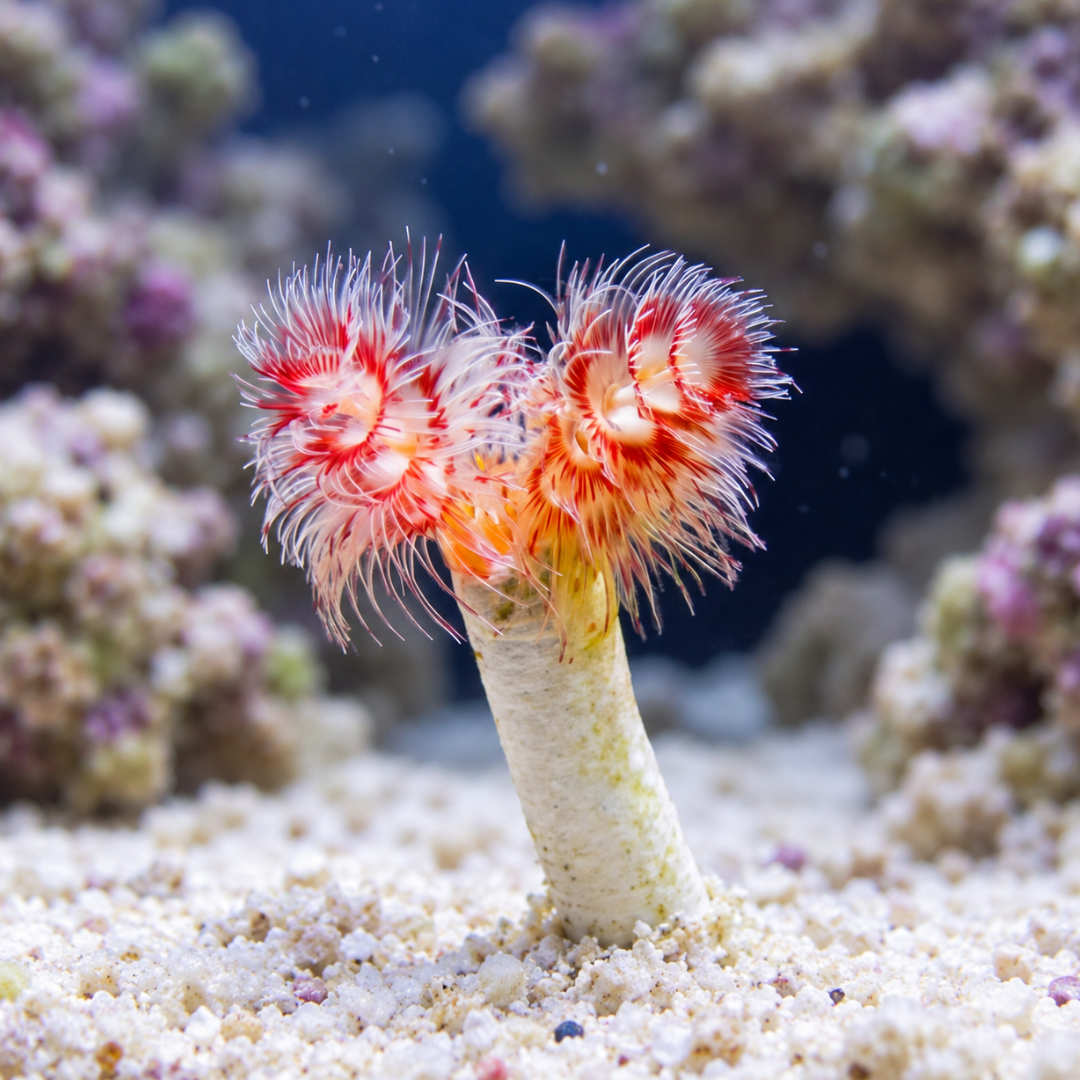
解説 / Description
ハードチューブは、日本の海水アクアリウムで主にカンザシゴカイ科Protula属の管棲性多毛類に用いられる流通名です。代表的にはProtula bispiralisとして扱われる個体が知られていますが、流通名や鰓冠の色だけで種を確定できない場合があります。白い石灰質の棲管から広がる繊細な鰓冠は、観賞のための飾りではなく、呼吸とろ過摂食を担う重要な器官です。水中を漂う微細なプランクトンや有機粒子を捕らえて利用し、光合成に依存しないため、長期飼育では安定した海水環境と適切な微細餌の供給が重要になります。 Hard Tube Worm is a trade name used in Japanese marine aquariums mainly for tube-dwelling serpulid polychaetes of the genus Protula. Specimens sold as Protula bispiralis are representative of the trade, but a trade name or crown color alone may not be sufficient for species-level identification. The delicate crown emerging from the white calcareous tube is not merely ornamental: it is an important organ for respiration and suspension feeding. These worms capture fine plankton and suspended organic particles from the water and do not depend on photosynthesis, so long-term care requires stable seawater conditions and a suitable supply of fine suspended food.
基本情報 / Basic Information
| 学名 / Scientific Name | Protula spp.(流通上は Protula bispiralis とされる個体が代表的) |
|---|---|
| 通称 / Common Name | ハードチューブ、ハードチューブワームHard Tube Worm, Coco Worm |
| 分類 / Family | 環形動物門・多毛類・ケヤリムシ目・カンザシゴカイ科(Serpulidae)・Protula属Phylum Annelida, polychaete annelids, order Sabellida, family Serpulidae, genus Protula |
| 英名 / English Name | Hard Tube Worm / Coco Worm |
| 分布 / Distribution | Protula属は複数の海域に分布し、種によって分布域が異なります。代表的な流通種として扱われるProtula bispiralisはインド洋から西太平洋の熱帯海域で記録されています。流通名だけでは種や産地を厳密に特定できない場合があります。Species of Protula occur in multiple marine regions, and their distributions differ by species. Protula bispiralis, commonly treated as a representative aquarium species, is recorded from tropical waters of the Indian Ocean and western Pacific region. Trade names alone are often insufficient for precise species or locality identification. |
| 最大体長 / Max Size | 種や個体差が大きく、流通名「ハードチューブ」全体に一律の最大値を当てはめることはできません。観賞上は鰓冠の直径と棲管の長さで扱われることが多く、購入時には実個体のサイズ確認が確実です。Maximum size varies substantially among species and individuals, so a single value cannot be applied reliably to all animals sold as Hard Tube Worms. In the aquarium trade, crown diameter and tube length are often more practical measurements, and the actual specimen should be checked before purchase. |
| 寿命 / Lifespan | 種別の正確な飼育寿命データは乏しく、流通個体の年齢も通常は不明です。安定した水質と十分な給餌を維持できれば長期飼育が期待できますが、慢性的な飢餓や急激な水質変化では急速に衰弱します。Reliable species-specific aquarium lifespan data are limited, and the age of imported specimens is usually unknown. Long-term maintenance is possible under stable conditions with adequate feeding, while chronic starvation or sudden water-quality changes can cause rapid decline. |
飼育環境 / Aquarium Environment
| 水槽サイズ / Tank Size | 本種に対する科学的な最小水槽サイズは確立していませんが、水温や塩分濃度の急変を抑えやすい60cm規格水槽以上を、実用上の目安にすると管理しやすくなります。複数個体やサンゴと一緒に長期維持する場合は、90cm規格水槽以上のように総水量に余裕のある成熟したリーフタンクがより安定します。水槽の寸法だけでなく、濾過能力と水質の安定性を重視してください。A scientifically defined minimum tank size has not been established for this animal, but a standard 60 cm aquarium or larger is a practical starting point because temperature and salinity are easier to keep stable. For multiple worms or long-term maintenance in a reef community, a mature standard 90 cm aquarium or a system with similar water volume provides greater stability. Filtration capacity and stable water chemistry matter more than dimensions alone. |
|---|---|
| 水温 / Temperature | 23〜26℃前後を飼育の目安とし、急激な変化を避けます。流通個体の種や産地が一定とは限らないため、この範囲を種固有の限界値と考えるのではなく、安定した水温を保つことを優先してください。 Maintain approximately 23-26°C as a practical aquarium target and avoid rapid fluctuations. Because trade specimens are not always identified to species or locality, this range should not be treated as a species-specific tolerance limit; stable temperature is the priority. |
| 水質 / Water Quality | 比重1.023〜1.026、pH 8.1〜8.4、KH 8〜11 dKH、カルシウム400〜450 mg/L、マグネシウム1300〜1400 mg/Lは、安定したリーフタンクを維持するための実用的な管理目安です。これらはハードチューブだけに固有の必須値として確立されたものではなく、数値を追い込むことより急変を避けることが重要です。アンモニアと亜硝酸は検出されない状態を保ち、硝酸塩やリン酸塩の過度な蓄積を避けます。石灰質の棲管を形成するため、pH、KH、カルシウムが慢性的に低い状態には注意が必要です。Specific gravity 1.023-1.026, pH 8.1-8.4, alkalinity 8-11 dKH, calcium 400-450 mg/L, and magnesium 1300-1400 mg/L are practical reef-aquarium management targets rather than species-specific physiological thresholds for Hard Tube Worms. Stability is more important than chasing exact numbers. Ammonia and nitrite should remain undetectable, excessive nitrate or phosphate accumulation should be avoided, and chronically low pH, alkalinity, or calcium is undesirable for an animal that maintains a calcareous tube. |
| レイアウト / Layout | 強い直線的な水流が鰓冠へ直接当たらず、穏やかに水が入れ替わる場所へ棲管を安定させます。鰓冠が無理なく展開でき、微細な餌が水流に乗って通過する程度の流れが適しています。強い照明は必要なく、岩組みの中腹から下部のやや陰になる場所でも飼育できます。棲管は破損しやすいため、無理に岩へ押し込んだり、先端だけをつかんで移動させたりしないでください。Place the tube where water is gently renewed without strong, direct flow striking the crown. The current should be sufficient to carry fine suspended food across the radioles while still allowing the crown to remain fully extended. Strong lighting is unnecessary, and shaded areas among rockwork are suitable. The calcareous tube can be damaged, so avoid forcing it into crevices or handling it only by the tip. |
| 注意点 / Precautions | 急激な比重・pH・水温変化、長期の栄養不足、強すぎる水流、混泳魚からの執拗な突きは、鰓冠を開かなくなることや鰓冠の脱落につながる場合があります。導入時は十分に時間をかけて水合わせを行い、棲管を乾かしたり鰓冠や軟体部を直接傷つけたりしないよう丁寧に扱います。銅を含む魚病薬は海産無脊椎動物に強い毒性を示すため、本種を収容した水槽では使用しないでください。Rapid changes in salinity, pH, or temperature, prolonged nutritional deficiency, excessive flow, and repeated nipping can lead to persistent retraction or loss of the crown. Acclimate the animal slowly and handle it carefully so that the tube does not dry out and the crown or soft tissues are not damaged. Copper-based fish medications are highly toxic to marine invertebrates and should not be used in a display tank containing this worm. |
餌と給餌 / Feeding
| 餌の種類 / Diet | 植物プランクトン製剤、微細なサンゴ用パウダーフード、微小な動物プランクトンを含む無脊椎動物用フードなど、鰓冠で捕捉できる細かな懸濁餌を用います。自然下ではプランクトンや微細な有機粒子をろ過摂食しており、大粒の餌を直接与えるタイプではありません。Offer fine suspended foods that can be captured by the branchial crown, including phytoplankton products, finely powdered coral foods, and invertebrate foods containing very small zooplankton. In nature these worms suspension-feed on plankton and fine organic particles; they are not adapted to taking large food items directly. |
|---|---|
| 給餌のポイント / Feeding Tips | 鰓冠へスポイトで勢いよく吹き付けると引っ込んでしまうため、餌は少し上流側へ静かに放ち、水流に乗せて鰓冠を通過させます。給餌時にプロテインスキマーや強い造波ポンプを一時停止すると、微細餌がすぐに除去されるのを抑えられます。給餌量と頻度は水槽内の餌量や水質を見ながら調整し、過剰給餌による硝酸塩・リン酸塩の上昇を避けてください。鰓冠を長期間開かない場合は、水流、水質、混泳相手からの刺激、栄養状態を順に確認します。Do not blast food directly onto the crown with a pipette, as the worm may retract immediately. Instead, release a small cloud slightly upstream and let the current carry it naturally across the radioles. Temporarily pausing the protein skimmer or strong circulation pumps can reduce the immediate removal of fine food. Adjust feeding amount and frequency to the food already available in the system and to water quality, avoiding excess nutrient accumulation. If the crown remains withdrawn for an extended period, evaluate flow, water quality, disturbance from tank mates, and nutritional condition. |
性格と混泳 / Temperament and Tank Mates
| 性格 / Temperament | 他の生体を追い回すことのない温和な定在性生物です。一方で、外敵から逃げて移動できないため、影、振動、急な接近、強い水流などの刺激には敏感です。危険を感じると鰓冠を瞬時に棲管内へ引き込みます。This is a peaceful, sessile animal that does not chase or attack tank mates. However, because it cannot simply swim away from danger, it is sensitive to shadows, vibration, sudden movement, and excessive current. When threatened it retracts the branchial crown rapidly into its tube. |
|---|---|
| 混泳の相性 / Compatibility | おとなしい小型魚や多くのサンゴとは共存しやすい一方、チョウチョウウオ類、大型ヤッコ類、フグ類、モンガラカワハギ類など、管棲ゴカイや柔らかい無脊椎動物をついばむ可能性がある魚は避けます。カニや大型ヤドカリなど、鰓冠や棲管を傷つけるおそれのある甲殻類にも注意が必要です。混泳相手が興味を示して繰り返しつつくだけでも、慢性的な閉じこもりと摂餌不足につながります。They are generally compatible with peaceful small fish and many corals, but should not be housed with species known to nip tube worms or soft invertebrates, including many butterflyfishes, larger angelfishes, puffers, and triggerfishes. Caution is also warranted with crabs and large hermit crabs that may damage the crown or tube. Even repeated exploratory nipping can cause chronic retraction and starvation. |
病気と対策 / Diseases and Prevention
| かかりやすい病気 / Common Diseases | 観賞魚の白点病のように、ハードチューブで一般的な病名として確立した疾患情報は多くありません。飼育下で問題になりやすいのは、鰓冠を開かない、鰓冠の脱落、棲管の劣化、長期的な衰弱といった環境性・栄養性の不調です。これらは水質の急変、栄養不足、物理的な刺激、混泳相手からの攻撃など、複数の要因が関係して現れることがあります。Unlike common aquarium-fish diseases such as marine ich, there are few well-established disease syndromes specifically associated with Hard Tube Worms in the aquarium literature. More common problems are environmental or nutritional, including persistent retraction, loss of the crown, deterioration of the tube, and gradual decline. These signs can be associated with several factors, such as unstable water quality, nutritional deficiency, physical stress, or repeated attacks by tank mates. |
|---|---|
| 対策と予防 / Prevention | 予防の中心は、成熟した水槽で水温、比重、pH、KH、カルシウムを安定させ、適切な微細餌を継続して供給することです。鰓冠を失っても棲管内の本体が生存していれば再生する場合があるため、すぐに廃棄せず、水質、給餌、水流、混泳相手からの刺激を見直し、落ち着いた環境で経過を観察します。Prevention centers on maintaining mature, stable water conditions and providing consistent fine-particle nutrition. If the crown is lost, the animal may still survive inside the tube and can sometimes regenerate it, so do not discard the specimen immediately. Reassess water quality, feeding, flow, and disturbance from tank mates, then observe it in a calm environment. |
増やし方(繁殖) / Breeding
| 雌雄の判別 / Sexing | 外見から確実に雌雄を判別する方法は一般的ではありません。通常の観賞状態では軟体部の多くが棲管内にあり、鰓冠の色や大きさだけで性別を判断することはできません。There is no practical, reliable method for sexing aquarium specimens externally. Most of the body remains inside the tube, and sex cannot be determined from crown color or size alone. |
|---|---|
| 繁殖形態 / Reproduction | カンザシゴカイ科では雌雄が分かれ、体外受精を行う種が多く知られていますが、繁殖様式には種差があり、配偶子を水中へ放出する種だけでなく、卵や胚を管内や管口付近で保護する種もあります。Protula属についても流通名だけから繁殖様式を一律に断定することはできません。発生後はトロコフォア型の幼生期を経て、適した基質へ定着し棲管を形成します。Many serpulids have separate sexes and reproduce by external fertilization, but reproductive strategies vary among species. Some release gametes into the water, while others retain or brood eggs or embryos in or near the tube. The reproductive mode of a trade specimen cannot therefore be assigned with certainty from the name Protula alone. Development includes a trochophore-type larval stage followed by settlement on suitable substrate and tube formation. |
| 繁殖のポイント / Breeding Tips | 家庭水槽で安定して世代更新させる方法は確立していません。繁殖を試みる場合は、まず飼育個体の種と繁殖様式をできる限り確認し、配偶子や幼生を強い濾過で失わない専用環境を用意する必要があります。通常のリーフタンクでは、仮に放卵・放精が起きても、プロテインスキマーや物理濾過によって初期発生段階が除去されやすく、定着まで育つ例は限られます。A reliable method for completing the life cycle in home aquariums is not established. Anyone attempting breeding should first identify the species and its reproductive mode as far as possible, then use a dedicated system that does not immediately remove gametes or larvae. In ordinary reef tanks, protein skimmers and mechanical filtration can remove early developmental stages, so successful settlement is uncommon even when gamete release is observed. |
雑学と豆知識 / Trivia and Fun Facts
| 1. 「ハード」の正体は石灰質の棲管 / 1. The “Hard” in Hard Tube Worm | ハードチューブの白い管は、砂粒を固めただけの巣ではありません。カンザシゴカイ科は海水中のカルシウムや炭酸系成分を利用し、炭酸カルシウムを主成分とする頑丈な棲管を自ら形成します。近縁のケヤリムシ科には粘液や細粒物を利用した柔らかい管をつくる仲間が多いため、この硬い管は見た目だけでなく、分類群の生活戦略を象徴する構造でもあります。水槽内でpHやKH、カルシウムの安定が重視されるのは、この「住まい」そのものが生体鉱物として作り続けられているからです。The white tube is not simply a shelter made by gluing together sand grains. Serpulid worms actively construct a robust tube dominated by calcium carbonate, using dissolved components from seawater. Many related sabellid feather duster worms instead build softer tubes from mucus and fine particles, so the rigid calcareous tube reflects a fundamentally different life strategy. This is why stable pH, alkalinity, and calcium matter in captivity: the animal is continually maintaining a mineralized home of its own making. |
|---|---|
| 2. Protula属は「ふた」を持たない / 2. Protula Lacks a Protective Operculum | カンザシゴカイ科には、危険を感じて管の中へ引っ込んだあと、入り口を殻蓋で閉じる仲間がいます。ところがProtula属では、この殻蓋を欠くことが大きな特徴です。つまり、硬い棲管は強力な防壁でありながら、その入口を完全に塞ぐ「扉」はありません。この構造は、鰓冠を素早く引っ込める反射行動の重要性を高めると同時に、鰓冠をついばむ魚との混泳に弱い理由にもつながっています。Many serpulid worms can retreat into the tube and seal the entrance with an operculum. Protula, however, is notable for lacking this protective lid. Its calcareous tube is therefore a strong shelter without a door that can completely close the entrance. This makes rapid withdrawal of the crown especially important and helps explain why repeated nipping by fish can be so damaging. |
| 3. 鰓冠は「花」ではなく精密なろ過装置 / 3. The Crown Is a Precision Filter, Not a Flower | 水槽で最も目を引く鰓冠は、細い主軸と羽枝が何重にも広がることで大きな捕捉面をつくります。その表面では繊毛と粘液が働き、水中の微細な粒子を捕捉して口へ運びます。大きすぎる粒子や利用しにくい異物は選別されるため、単に餌を近づければよいわけではありません。飼育では「何を与えるか」と同じくらい、「どの粒径の餌を、どの水流で通過させるか」が重要になります。The spectacular crown is actually a highly efficient suspension-feeding apparatus. Repeated branches and pinnules create a large capture surface, while mucus and cilia collect fine particles and move suitable material toward the mouth. Oversized or unsuitable particles can be rejected, so successful feeding is not simply a matter of placing food nearby. In captivity, particle size and the way water carries food across the crown are as important as the food itself. |
| 4. 人の影に反応する小さな眼 / 4. Tiny Eyes That Detect Passing Shadows | カンザシゴカイ科では、鰓冠の放射状の枝に光を感じる眼点や光受容器を持つ種が知られており、Protula属でもProtula tubulariaとして研究された個体などで放射眼が詳しく調べられています。こうした器官は魚の眼のように景色を鮮明に見るためというより、光量の急変を察知する仕組みとして働きます。水槽の前を人が横切った瞬間に鰓冠を引っ込める反応も、定着生活を送るカンザシゴカイ類の捕食者回避行動として理解できます。In serpulid worms, some species possess radiolar eyespots or photoreceptors, and these structures have been studied in specimens identified as Protula tubularia and related taxa. Rather than forming detailed images like a fish eye, they are suited to detecting changes in light intensity. The rapid withdrawal of the crown when a shadow passes over the aquarium can therefore be understood as part of the predator-avoidance behavior of a sessile animal. |
| 5. 鰓冠の自切は「死」とは限らない / 5. Losing the Crown Does Not Always Mean Death | 飼育下では、強い環境変化、栄養不足、過剰な水流、他の生体からの刺激などが重なったときに鰓冠を失うことがあります。水槽内に鰓冠が落ちていても、棲管の奥に本体が生きていれば再生する場合があります。ただし、鰓冠の脱落だけから原因を一つに決めつけることはできません。水質、給餌、水流、混泳相手、設置場所を順に見直すきっかけとして捉えるのが適切です。In captivity, the crown may be lost when strong environmental changes, nutritional deficiency, excessive flow, or repeated disturbance occur. Even if the detached crown is found in the aquarium, the worm may still be alive inside the tube and can sometimes regenerate it. Crown loss alone does not identify a single cause, so it is best treated as a reason to review water quality, feeding, flow, tank mates, and placement. |
| 6. サンゴ礁では小さな「生態系エンジニア」 / 6. Small Ecosystem Engineers on Reefs | カンザシゴカイ科の石灰質棲管は、一個体の隠れ家で終わらないことがあります。種類や環境によっては多数の棲管が集まり、凹凸の多い立体構造をつくることで、小型甲殻類やさまざまな底生生物の住み場所を増やします。動物が自分の体を守るためにつくった構造が、周囲の生物に新しい空間を提供するという点で、カンザシゴカイ類は海底の微小な地形をつくる「生態系エンジニア」としても興味深い存在です。A serpulid tube can become more than a shelter for a single worm. In some species and habitats, many tubes accumulate into complex three-dimensional structures that create hiding spaces and settlement surfaces for small crustaceans and other benthic organisms. A structure built for one animal’s protection can therefore reshape the local habitat, making serpulids fascinating examples of small-scale ecosystem engineers. |
| 7. 海洋酸性化を映し出す石灰化生物 / 7. A Calcifier Sensitive to Ocean Acidification | ハードチューブの棲管は炭酸カルシウムでできているため、海水のpH低下と無関係ではいられません。酸性化が進むと、石灰化に必要な化学的条件が変化し、棲管の形成や維持に負担がかかることが研究で示されています。この現象は自然海だけの話ではなく、水槽でも室内の二酸化炭素濃度が高いとpHが下がることがあります。鰓冠の美しさだけでなく、白い棲管の状態にも目を向けると、水槽全体の炭酸系バランスを考えるきっかけになります。Because the tube is made of calcium carbonate, Hard Tube Worms are inherently affected by seawater chemistry. Research on serpulids has shown that lower pH can make calcification and tube maintenance more difficult. The same principle matters in aquariums, where elevated indoor carbon dioxide can depress tank pH. Watching not only the crown but also the condition of the white tube can therefore provide a useful reminder to consider the aquarium’s carbonate chemistry as a whole. |
| 8. 名前だけでは種を断定できない奥深さ / 8. Trade Names Can Hide Taxonomic Complexity | 「ハードチューブ」は便利な流通名ですが、それだけで種を確定することはできません。色彩や棲管の太さには個体差や地域差があり、古い文献や流通名で別種のように扱われた名称が、現在の分類では同種のシノニムとして整理されている例もあります。たとえばProtula magnificaという名称は古い組み合わせとして知られますが、現在はProtula bispiralisのシノニムとして扱われています。鮮やかな色だけでなく、分類の変遷までたどると、目の前の一匹が長い研究史の中にいることが見えてきます。“Hard Tube Worm” is a useful trade name, but it does not identify a species by itself. Crown color and tube form vary among individuals and localities, and names once treated as separate species may later be placed into synonymy as taxonomy is revised. One example is the historical name Protula magnifica, which is currently treated as a synonym of Protula bispiralis. Looking beyond color and into this taxonomic history reveals that every aquarium specimen is also part of a long scientific story. |
まとめ / Conclusion
ハードチューブは、硬い石灰質の棲管と繊細な鰓冠をあわせ持つ、定在性の海洋無脊椎動物です。鰓冠を使って呼吸とろ過摂食を行いながら暮らすため、長期飼育では急変の少ない海水、鰓冠を無理なく広げられる水流、つつく生体を避けた混泳環境、そして微細な懸濁餌を継続して得られることが大切です。 Hard Tube Worms combine a rigid calcareous tube with a delicate branchial crown and spend their adult lives fixed in place. Because the crown is used for respiration and suspension feeding, long-term care depends on stable seawater, flow that allows the crown to extend normally, protection from persistent nipping, and continued access to fine suspended food.
華やかな見た目とは対照的に、その暮らしは水流や水質、餌の状態に強く左右されます。鰓冠の開閉や棲管の状態を日々観察し、無理に触れたり環境を頻繁に変えたりせず、安定を優先して付き合うことが、この生体本来の美しさを長く楽しむことにつながります。 Its delicate appearance belies a strong dependence on flow, water quality, and suspended food. By watching the crown and the condition of the tube, avoiding unnecessary handling, and prioritizing environmental stability over frequent adjustments, aquarists can maintain the animal in a way that best preserves its natural beauty.

気になる道具や飼い方を見つけてみませんか?
 アイのアクアグッズ案内海水魚初心者の必需品|水槽・人工海水・比重計・水質検査道具の特徴や使い方、選ぶときのポイントをアイが紹介します。記事はコチラ →
 アイのアクアグッズ案内水槽ライトの選び方|魚の見え方・水草・海水で選ぶおすすめ照明道具の特徴や使い方、選ぶときのポイントをアイが紹介します。記事はコチラ →
 アイのアクアグッズ案内水草用ソイルの選び方|土・砂の違いとおすすめ商品道具の特徴や使い方、選ぶときのポイントをアイが紹介します。記事はコチラ →
 アイのアクアグッズ案内水槽用ヒーターの選び方|固定式・温度調節式と、水量に合うW数の考え方水槽の魚は冬に寒くない? アイとコタロウが水温計から固定式・温度調節式・分離式ヒーターまで比較。水量と室温に合うW数、設置場所、水換えや交換の注意点を、国内メーカーの商品とともに紹介します。記事はコチラ →
さまざまな飼育テーマをご紹介。リンク先の記事には広告・商品紹介が含まれます。
案内・紹介記事一覧へ →分布マップ
ハードチューブとして流通するProtula属は複数の海域に分布し、種によって分布域が異なります。代表的な流通種として扱われるProtula bispiralisは、インド洋から西太平洋にかけての熱帯海域で記録されています。
この地図は、記事中の分布情報をもとにインド洋から西太平洋の熱帯海域を広く示した概略表示です。地図上のマーカーは分布域を把握しやすくするために設定した代表地点であり、実際の採集地点や特定個体の産地を示すものではありません。また、「ハードチューブ」という流通名だけでは種や産地を厳密に特定できない場合があります。
参考文献
-
分類・学名
WoRMS Editorial Board. Protula bispiralis (Savigny, 1822). World Register of Marine Species. WoRMS taxon record -
分類・形態・分布
ten Hove, H. A. & Kupriyanova, E. K. (2009). Taxonomy of Serpulidae (Annelida, Polychaeta): The state of affairs. Zootaxa, 2036(1), 1–126. https://doi.org/10.11646/zootaxa.2036.1.1 -
分布・分類
Pillai, T. G. (2009). Descriptions of new serpulid polychaetes from the Kimberleys of Australia and discussion of Australian and Indo-West Pacific species of Spirobranchus and superficially similar taxa. Records of the Australian Museum, 61(2), 93–199. https://doi.org/10.3853/j.0067-1975.61.2009.1489 -
生息環境・摂食・生態
Capa, M., Kupriyanova, E., Nogueira, J. M. de M., Bick, A. & Tovar-Hernández, M. A. (2021). Fanworms: Yesterday, Today and Tomorrow. Diversity, 13(3), 130. https://doi.org/10.3390/d13030130 -
鰓冠・感覚・行動
Bok, M. J., Porter, M. L., ten Hove, H. A., Smith, R. & Nilsson, D.-E. (2017). Radiolar Eyes of Serpulid Worms (Annelida, Serpulidae): Structures, Function, and Phototransduction. The Biological Bulletin, 233(1), 39–57. https://doi.org/10.1086/694735 -
繁殖・幼生・定着
Kupriyanova, E. K., Nishi, E., ten Hove, H. A. & Rzhavsky, A. V. (2001). Life-history patterns in serpulimorph polychaetes: ecological and evolutionary perspectives. Oceanography and Marine Biology: An Annual Review, 39, 1–101. Australian Museum publication record -
石灰質棲管・pH
Díaz-Castañeda, V., Cox, T. E., Gazeau, F., Fitzer, S., Delille, J., Alliouane, S. & Gattuso, J.-P. (2019). Ocean acidification affects calcareous tube growth in adults and reared offspring of serpulid polychaetes. Journal of Experimental Biology, 222(13), jeb196543. https://doi.org/10.1242/jeb.196543 -
飼育条件・水質管理
Krol, L., Melton, B., Delbeek, J. C., Dunker, F. H. & Shepherd, B. (2023). The Iconic Philippine Coral Reef at Steinhart Aquarium: The Husbandry, Welfare, Behavior, and Veterinary Care Considerations of a Large Multi-Taxa Living Coral Reef System. Journal of Zoological and Botanical Gardens, 4(4), 738–750. https://doi.org/10.3390/jzbg4040052 -
薬剤・注意点
Yanong, R. P. E. (2010). Use of Copper in Marine Aquaculture and Aquarium Systems: FA165/FA165, 12/2009. EDIS, 2010(2). University of Florida IFAS Extension. https://doi.org/10.32473/edis-fa165-2009




コメント