

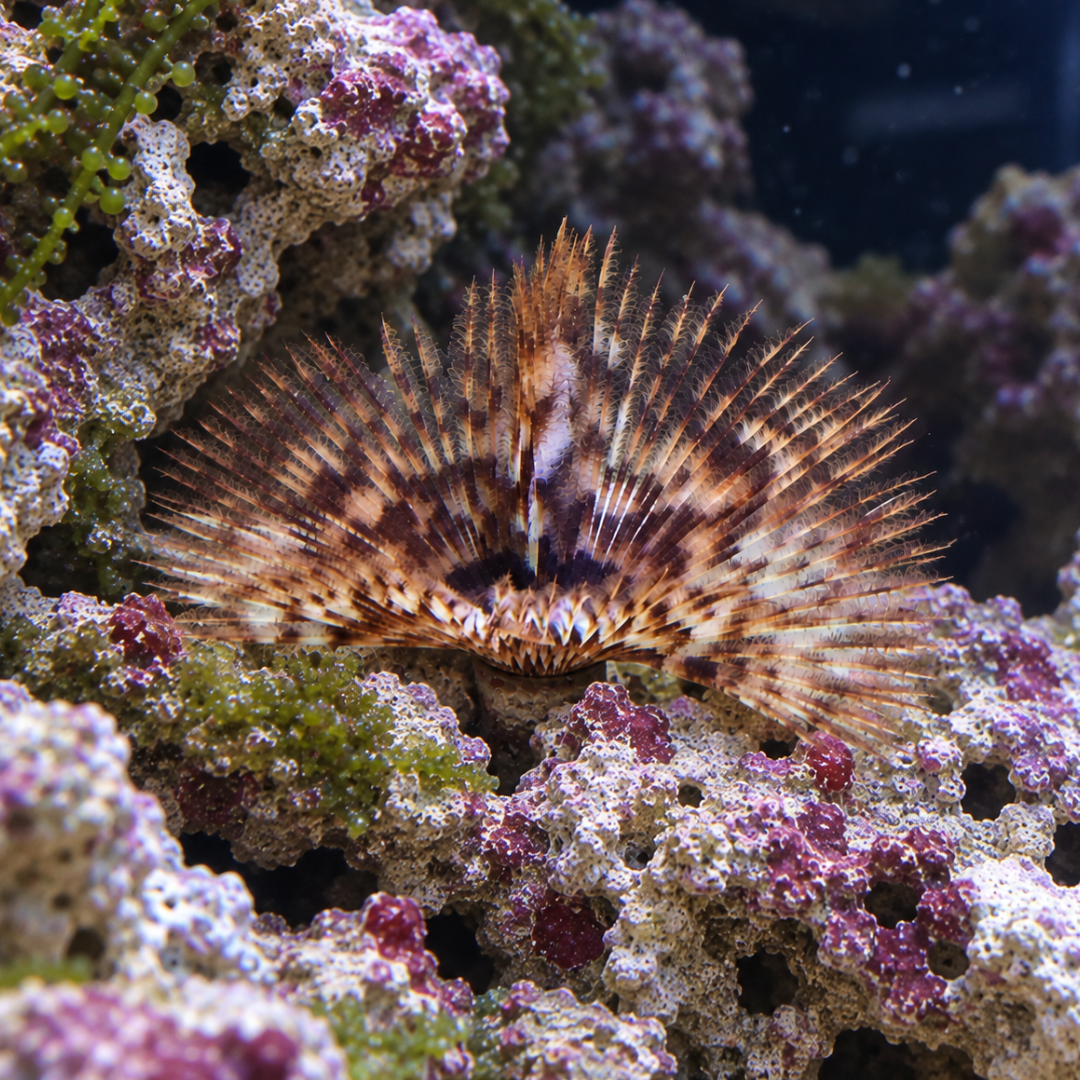
解説 / Description
インドケヤリは、海水水槽で「羽毛の花」のような鰓冠を広げるケヤリムシ科の定在性環形動物です。柔らかな棲管の中に細長い体を収め、外へ伸ばした多数の鰓糸を使って呼吸すると同時に、水中を漂う微細なプランクトンや有機懸濁物を集めて食べます。刺激を感じると一瞬で棲管へ引き込む動きも見どころですが、長期飼育では、安定した海水環境、強すぎない水流、そして微細な餌を継続的に得られることが重要です。なお、日本の流通名「インドケヤリ」だけでは種を確定できず、S. sanctijosephi などの学名が慣用的に添えられることがあります。分類学上も、S. spectabilis などの名称をめぐって長い整理の経緯があります。そのため、販売名と学名を一対一で対応させない方が適切です。 The Indo feather duster worm is a sedentary marine annelid of the family Sabellidae, admired in aquaria for a branchial crown that opens like a feathery flower. Its elongated body remains inside a flexible tube while numerous radioles extend into the water, serving both in gas exchange and in collecting microscopic plankton and suspended organic matter. Its rapid withdrawal into the tube is also striking to watch, but successful long-term care depends on stable seawater conditions, flow that is not excessively strong, and a continuing supply of fine suspended food. The Japanese trade name “Indo feather duster” does not by itself establish a species, even though names such as S. sanctijosephi are often attached to traded specimens. The names surrounding S. spectabilis and related taxa have a long and complicated taxonomic history, so the trade name should not be treated as a one-to-one match with a single scientific name.
基本情報 / Basic Information
| 学名 / Scientific Name | Sabellastarte sp. |
|---|---|
| 通称 / Common Name | インドケヤリ、ケヤリムシIndo feather duster worm, feather duster worm, fan worm |
| 分類 / Family | 環形動物門・ケヤリムシ目・ケヤリムシ科(Sabellidae)・Sabellastarte 属Phylum Annelida, order Sabellida, family Sabellidae, genus Sabellastarte |
| 英名 / English Name | Feather Duster Worm / Fan Worm |
| 分布 / Distribution | 「インドケヤリ」は、主にインド太平洋産の大型 Sabellastarte 属に用いられる流通名です。S. sanctijosephi の模式産地はジブチです。2003年の属再検討では、従来 S. indica と呼ばれてきたインド太平洋産個体群に S. spectabilis を用いる整理が示され、現在の WoRMS でも S. indica は S. spectabilis の異名として扱われています。一方、2020年の再検討では、この命名整理には再検証すべき点があると指摘されています。そのため、販売名だけから特定種の自然分布をそのまま当てはめることはできません。“Indo feather duster” is a trade name used mainly for large Sabellastarte worms from the Indo-Pacific. The type locality of S. sanctijosephi is Djibouti. A 2003 revision applied S. spectabilis to much of the Indo-Pacific material historically called S. indica, and WoRMS currently treats S. indica as a synonym of S. spectabilis. A 2020 taxonomic review, however, pointed out that parts of this nomenclatural history still require re-examination. The natural distribution of a single species therefore should not be assigned solely from the aquarium trade name. |
| 最大体長 / Max Size | 流通名に複数の同定候補があるため、「インドケヤリ」全体の最大体長を一律には示せません。参考として S. spectabilis では体長80mm以上に達する記載があります。鰓冠を広げたときや棲管を含めた占有範囲は体そのものより大きくなるため、設置時は周囲に余裕を取ります。A single maximum body length cannot be assigned to all animals sold as “Indo feather dusters” because the trade name may cover more than one identification. As a reference, S. spectabilis has been reported to reach 80 mm or more in body length. The space occupied by the extended crown and tube is greater than the body length alone, so leave adequate room around the animal. |
| 寿命 / Lifespan | 自然下・飼育下ともに、標準的な寿命を示す信頼できる数値情報は乏しく、明確な平均寿命は不明です。飼育では年数だけで判断せず、鰓冠を継続して展開できているか、鰓冠の喪失を繰り返していないかなど、日々の状態変化を健康管理の手掛かりにします。Reliable data defining a standard natural or captive lifespan are scarce, so no firm average lifespan can be given. In captivity, health is better judged from day-to-day condition, such as whether the crown continues to extend normally and whether repeated crown loss occurs, rather than from a nominal lifespan figure. |
飼育環境 / Aquarium Environment
| 水槽サイズ / Tank Size | 種固有の最低水量を示す研究値はありません。実用上は、水質と塩分を安定させやすい60cm規格水槽(約60L前後)以上が扱いやすい目安です。魚やサンゴと組み合わせ、微細な餌を定期的に与える場合は、60cmワイド水槽から90cm規格水槽(およそ100〜180L前後)ほどの水量があると、給餌と栄養塩管理を両立しやすくなります。No experimentally established species-specific minimum tank volume is available. As a practical guideline, a Japanese 60 cm standard aquarium, around 60 L, or larger is easier to keep stable in salinity and water quality. In a mixed reef system receiving regular fine suspended foods, a 60 cm wide to 90 cm standard aquarium, roughly 100–180 L, provides more water volume for balancing feeding with nutrient control. |
|---|---|
| 水温 / Temperature | 種固有の最適温度として確立された値ではありませんが、熱帯性リーフ水槽の目安として23〜26℃程度を安定して維持します。短時間のわずかなずれより急な変化の方が負担になりやすいため、換水時や導入時は温度差を小さくしてください。 Although no species-specific optimum has been established for all animals sold under this name, a stable tropical reef range of about 23–26°C is a practical target. Rapid changes are more concerning than small short-term deviations, so minimize temperature differences during water changes and acclimation. |
| 水質 / Water Quality | 種固有の最適値として確立された数値ではありませんが、一般的なリーフ水槽の安定した海水条件を目安にします。比重1.023〜1.026、pH8.1〜8.4程度を保ち、アンモニアと亜硝酸は検出されない状態を維持します。急な塩分変化を避け、蒸発分は真水で補い、導入時は水温と塩分差を確認しながら慎重に水合わせします。海産無脊椎動物なので、銅を含む魚病薬を本水槽へ投与しないでください。These figures are not established as species-specific optima, but stable reef-aquarium seawater conditions are an appropriate practical target. Maintain a specific gravity of about 1.023–1.026 and pH around 8.1–8.4, with ammonia and nitrite undetectable. Avoid abrupt salinity changes, replace evaporation with fresh water, and acclimate new specimens carefully while checking temperature and salinity differences. As a marine invertebrate, the worm should not be exposed to copper-based fish medications in the display tank. |
| レイアウト / Layout | 棲管を折ったり強くつまんだりせず、ライブロックの根元やサンゴ砂・細かな礫がある安定した場所に横倒しにならないよう設置します。棲管の基部は砂に軽く埋めても構いませんが、開口部と鰓冠が出る側は完全に露出させます。水流は餌を運ぶ程度の穏やかな間接流が適し、ポンプの強い直撃や激しい乱流は避けます。光合成生物ではないため照明強度は最重要条件ではありません。Do not bend, crush, or tightly grip the tube. Place it securely near the base of live rock or in an area with sand and fine rubble so it cannot roll over. The lower tube may be lightly supported or partly buried, but the opening and crown must remain fully exposed. Gentle indirect flow that carries suspended food is ideal; avoid direct pump jets and violent turbulence. Because the worm is not photosynthetic, lighting intensity is not a primary requirement. |
| 注意点 / Precautions | 急な引っ込みは正常な防御反応ですが、長時間まったく開かない、鰓冠を失うことが続く、といった変化が見られる場合は、水質、水流、給餌、周囲からのつつきを順に見直します。通販到着直後は輸送水を本水槽へ入れず、水温と塩分差を確認しながら慎重に導入してください。可能であれば、別の検疫水槽で状態と不要な付着生物の有無を観察してから本水槽へ移すと管理しやすくなります。Rapid retraction is a normal defensive response, but if the worm remains closed for prolonged periods or repeatedly loses its crown, review water quality, flow, feeding, and possible harassment by tank mates. After shipping, avoid adding transport water to the display aquarium and acclimate carefully while checking temperature and salinity differences. When practical, observation in a separate quarantine tank can make it easier to assess condition and unwanted hitchhikers before transfer to the display. |
餌と給餌 / Feeding
| 餌の種類 / Diet | 微細なプランクトンや有機懸濁物、無脊椎動物向けの細かな液状・微粒子フードなどを利用する濾過摂食者です。ケヤリムシ科では、鰓冠で集めた粒子を大きさに応じて摂食、棲管材料、排除へ振り分ける仕組みが知られています。ただし、取り込める粒径は種や個体の大きさなどで変わるため、「インドケヤリ」すべてに共通する固定のμm値を設けることはできません。粗い餌だけに頼らず、十分に細かく水中へ分散する餌を選びます。These worms are suspension feeders that use fine plankton, suspended organic particles, and suitably fine liquid or particulate foods formulated for marine invertebrates. In sabellid worms, particles collected by the crown are known to be sorted by size into material that is ingested, used in tube construction, or rejected. Exact usable particle sizes vary with species and individual size, so a single fixed micrometre cutoff should not be applied to every animal sold as an “Indo feather duster.” Choose foods that disperse into genuinely fine suspended particles rather than relying on coarse foods alone. |
|---|---|
| 給餌のポイント / Feeding Tips | 成熟した水槽でも、強力なスキマーや物理濾過を使う環境では自然の懸濁餌が不足することがあります。種固有の給餌頻度に確立した標準はないため、微小餌を少量ずつ定期的に与え、栄養塩と個体の反応を見ながら量と回数を調整します。スポイトで鰓冠へ強く吹き付けるのではなく、少し上流へ希釈した餌を流し、鰓冠全体へ自然に届かせます。給餌中だけスキマーや強い循環を短時間弱める場合は、終了後に通常運転へ戻してください。Even in a mature aquarium, strong skimming and mechanical filtration can leave little suspended food available. There is no well-established species-specific feeding frequency for all traded forms, so offer small amounts of fine food regularly and adjust quantity and frequency according to nutrient levels and the worm’s response. Do not blast food directly into the crown; instead, release diluted food slightly upstream so it reaches the radioles naturally. If skimming or strong circulation is reduced briefly during feeding, return the system to normal operation afterward. |
性格と混泳 / Temperament and Tank Mates
| 性格 / Temperament | 非常におとなしい定在性の濾過摂食者で、自分から魚やサンゴを攻撃することはありません。危険を感じると鰓冠を素早く棲管へ収納して身を守ります。サンゴを食害しないため一般にはリーフセーフですが、鰓冠が隣接するサンゴの長い触手や強い刺胞に触れ続ける配置は避けます。It is a very peaceful, sedentary suspension feeder and does not attack fish or corals. When threatened, it protects itself by rapidly withdrawing the crown into the tube. It is generally reef safe because it does not feed on corals, but avoid positioning it where the crown is repeatedly contacted by long sweeper tentacles or strongly stinging corals. |
|---|---|
| 混泳の相性 / Compatibility | 温和なハゼ類、テンジクダイ類、小型のスズメダイ類、ハナダイ類など、定在性無脊椎動物をつつきにくい魚とは合わせやすい傾向があります。一方、チョウチョウウオ類、フグ類、モンガラカワハギ類、一部のヤッコ類や大型ベラ類など、ゴカイ類や付着性無脊椎動物をついばむ性質のある魚は避けた方が安全です。大型のカニや肉食性の強い甲殻類にも注意し、個体差があるため導入後の観察を重視します。Peaceful gobies, cardinalfishes, small damselfishes, anthias, and other fish that usually ignore sessile invertebrates are often suitable tank mates. By contrast, butterflyfishes, puffers, triggerfishes, and some angelfishes or larger wrasses may pick at polychaetes and other attached invertebrates and are safer to avoid. Large crabs and strongly predatory crustaceans can also be problematic. Individual behavior varies, so close observation after introduction is essential. |
病気と対策 / Diseases and Prevention
| かかりやすい病気 / Common Diseases | 観賞魚の白点病のように、インドケヤリで一般化された特定の「病名」は十分に整理されていません。飼育下で目立つ問題は、餌不足による痩せ、長期の引きこもり、鰓冠の自切、棲管の損傷や崩れ、水質急変後の衰弱などです。鰓冠の自切そのものは再生可能な反応ですが、繰り返す場合は慢性的なストレスの可能性があります。Unlike common fish diseases such as marine ich, there is no well-established list of specific aquarium diseases routinely diagnosed in Indo feather duster worms. The more common captive problems are gradual wasting from insufficient food, prolonged withdrawal, crown shedding, tube damage or deterioration, and decline after abrupt water-parameter changes. Crown autotomy can be followed by regeneration, but repeated episodes suggest ongoing stress. |
|---|---|
| 対策と予防 / Prevention | 塩分と水温を安定させ、アンモニア・亜硝酸を出さず、鰓冠へ直接強い水流を当てないことが基本です。給餌不足を防ぎつつ、過剰な液状フードで水を急激に汚さないよう少量給餌と測定を両立します。魚用の銅治療薬は海産無脊椎動物に有害なので、本水槽では使わず、魚の治療は別水槽で行います。新規個体は可能であれば検疫水槽で観察し、棲管表面の不要な付着生物も確認します。Prevention centers on stable salinity and temperature, undetectable ammonia and nitrite, and avoiding strong direct flow against the crown. Provide enough suspended food to prevent starvation while using small feedings and water testing to avoid sudden nutrient pollution. Copper medications intended for fish are harmful to marine invertebrates and should be used only in a separate fish-treatment system, never in the display tank with the worm. When possible, quarantine new specimens and inspect the tube for unwanted hitchhikers. |
増やし方(繁殖) / Breeding
| 雌雄の判別 / Sexing | 外見だけでの判別は困難です。近縁で流通上しばしば混同される S. spectabilis のハワイ個体群では、組織学的調査で多くの個体が一種類の配偶子を持つ一方、約15%の個体に卵と精子の両方が確認され、サイズ構成から雄性先熟型の雌雄同体が示唆されています。したがって、見た目の色や鰓冠形状から雄雌を決めることはできません。Reliable sexing from external appearance is not possible. In Hawaiian populations of the closely related and frequently confused S. spectabilis, histological work found that most individuals contained one gamete type, while about 15% contained both eggs and sperm; size patterns were consistent with protandrous sequential hermaphroditism. Color and crown shape therefore cannot be used to determine sex. |
|---|---|
| 繁殖形態 / Reproduction | S. spectabilis では、水中へ卵と精子を放出する放卵放精型の有性生殖が研究されています。受精後は遊泳幼生となり、飼育実験では産卵後6〜7日ほどで着底が始まり、6〜8日ほどで変態が進みました。流通名「インドケヤリ」に含まれる全個体が同一の繁殖様式・周期を持つと断定はできませんが、Sabellastarte 属を理解する上で重要な参考になります。In S. spectabilis, reproduction has been studied as broadcast spawning, with eggs and sperm released into the water column. The fertilized embryos become swimming larvae; in culture experiments, settlement began about 6–7 days after spawning and metamorphosis progressed over roughly days 6–8. Because the trade name “Indo feather duster” may include more than one taxon, identical timing cannot be assumed for every specimen, but the work provides an important model for the genus. |
| 繁殖のポイント / Breeding Tips | 家庭水槽での計画的な繁殖は難易度が高く、成体の成熟、同調した放卵放精、受精卵の確保、浮遊幼生の維持、着底基質の準備までを分けて管理する必要があります。S. spectabilis の研究では、後部約1cmを切除する侵襲的な方法で産卵を誘発した例がありますが、研究目的の手法であり、家庭飼育で再現する方法としては推奨できません。また、同種の幼生は飼育実験で卵黄栄養型とされ、約6〜8日の浮遊期には外部の餌を摂ることより、安定した海水環境を維持し、適切な着底基質を用意することが重要です。Planned breeding in a home aquarium is difficult because adult maturation, synchronized gamete release, collection of fertilized eggs, maintenance of planktonic larvae, and settlement substrates must all be managed separately. In research on S. spectabilis, spawning was induced by the invasive removal of about 1 cm from the posterior end of adults; this was a research method and is not recommended for hobby replication. The larvae in those experiments were lecithotrophic, relying on yolk reserves during their roughly 6–8 day planktonic period, so stable seawater conditions and suitable settlement substrates are more important than providing larval food during that stage. |
雑学と豆知識 / Trivia and Fun Facts
| 1. 「インドケヤリ」という名前の奥にある分類の迷路 / 1. The Taxonomic Maze Behind the Trade Name | インドケヤリの学名を調べると、S. sanctijosephi、S. indica、S. spectabilis など複数の名前に出会います。2003年の Sabellastarte 属再検討では、S. indica という名称に先取同名の問題があるとして、インド太平洋の「indica 型」に S. spectabilis を用いる整理が示され、現在の WoRMS も S. indica を S. spectabilis の異名として扱っています。しかし、2020年の分類学的研究では、その先取同名の前提自体に再検証が必要だと指摘され、S. indica と S. spectabilis の扱いにはなお検討の余地があるとされました。一方、S. sanctijosephi はジブチを模式産地とする別の有効種として扱われています。つまり、古い名前が単純に一つの新しい名前へ置き換わった、と考えるだけでは十分ではありません。観賞魚流通では慣用名も残るため、「インドケヤリ」という販売名から学名を断定せず、cf. が付く場合も「その種に似るが、確定には比較検討が必要」という慎重な意味で受け取るのが適切です。Looking up the scientific name of an “Indo feather duster” can lead to S. sanctijosephi, S. indica, and S. spectabilis. A 2003 revision of Sabellastarte treated the name S. indica as affected by homonymy and applied S. spectabilis to the Indo-Pacific “indica” concept; WoRMS currently follows this treatment by listing S. indica as a synonym of S. spectabilis. A 2020 taxonomic study, however, argued that the premise behind that homonymy requires re-examination and that the relationship between S. indica and S. spectabilis still warrants further study. S. sanctijosephi, meanwhile, is treated as a separate valid species with a type locality in Djibouti. The history is therefore more complex than a simple replacement of one old name by one new name. Trade names can preserve older usage, and the qualifier cf. should be understood cautiously: it indicates resemblance to the named species while signalling that firm identification requires comparison. |
|---|---|
| 2. 花びらのような鰓冠は、呼吸器であり食事道具でもある / 2. The crown is both a respiratory organ and a feeding machine | 水槽で最も目を引く「花」の部分は、実際には多数の鰓糸が集まった鰓冠です。一本一本の鰓糸にはさらに細かな羽枝が並び、その表面の繊毛が水を動かしながら粒子を捕らえます。捕らえられた粒子は鰓糸の溝へ集められ、口の方向へ運ばれていきます。同じ構造が海水とのガス交換にも使われるため、鰓冠は見た目の装飾ではなく、生きるための中心装置です。だからこそ、ポンプの直撃で鰓冠が常に押し曲げられている環境は、単に姿が悪いだけでなく、摂食と呼吸の両方を邪魔しかねません。The conspicuous “flower” is actually a branchial crown made of many radioles. Each radiole carries rows of much smaller pinnules, whose cilia move water and capture suspended particles. The particles are transferred into grooves and transported toward the mouth. The same crown also participates in gas exchange, making it far more than a decorative plume. This is why a pump jet that constantly bends the crown is not merely unattractive; it can interfere with both feeding and respiration. |
| 3. 餌は鰓冠で「仕分け」される / 3. The Crown Sorts What It Collects | ケヤリムシ科の摂食で面白いのは、鰓冠で集めた粒子がすべてそのまま食べられるわけではないことです。古典的な研究では、鰓糸の繊毛と溝によって粒子が大きさに応じて振り分けられ、小さな粒子は口へ運ばれ、別の粒子は棲管づくりに回され、大きすぎるものは排除されることが示されています。ただし、その境界となる粒径はすべてのケヤリムシで同じではありません。種や個体サイズなどによって変わるため、飼育では特定の数値を絶対条件にするより、「十分に細かく、水中に長く漂う餌を届ける」という考え方の方が実用的です。One of the most interesting aspects of sabellid feeding is that not every particle collected by the crown is automatically eaten. Classic studies have shown that cilia and grooves on the radioles sort particles by size: smaller material can be carried toward the mouth, other particles may be diverted for tube construction, and material that is too large can be rejected. The size boundaries are not identical in every fan worm, however, and can vary with species and individual size. In aquarium care, it is therefore more useful to focus on providing food that is genuinely fine and remains suspended than to treat one micrometre value as an absolute rule. |
| 4. 棲管は石灰の筒ではなく、自作の柔らかな「家」 / 4. Its tube is a flexible self-built home, not a limestone pipe | 同じケヤリムシ目でも、イバラカンザシなどカンザシゴカイ科の仲間は硬い石灰質の棲管を作ります。一方、ケヤリムシ科の Sabellastarte は、粘液性の分泌物に砂や泥、細かな有機物などを取り込み、革や羊皮紙のような柔軟な棲管を作ります。水槽内で棲管表面が少し泥っぽく見えるのは「汚れている」からとは限らず、その生活様式の一部です。棲管を無理に洗ったり、表面をこすって美しくしようとしたりすると、かえって生体を傷める可能性があります。Not all tube-dwelling sabellid relatives build the same kind of home. Serpulid worms such as Christmas tree worms construct hard calcareous tubes, whereas Sabellastarte in the family Sabellidae builds a flexible, parchment-like tube by combining secretions with fine sediment and organic particles. A slightly muddy-looking tube is therefore not necessarily “dirty”; it reflects the worm’s natural construction method. Scrubbing or aggressively cleaning the tube for appearance can do more harm than good. |
| 5. 鰓冠を失っても再生できる。ただし原因は一つとは限らない / 5. A Lost Crown Can Regrow, but the Cause Is Not Always the Same | ケヤリムシ類には高い再生能力があり、Sabellastarte 属でも切断後に頭部側の構造や鰓冠を再形成できることが実験で確認されています。水槽でも、鰓冠を失った個体が再び小さな冠を伸ばすことがあります。そのため、一度の鰓冠喪失だけで死亡と判断する必要はありません。一方、飼育下で鰓冠を失う背景には、水質の悪化、物理的な刺激、捕食やつつき、栄養状態など複数の要因が関係し得ます。外見だけから原因を一つに決めつけず、喪失が繰り返される場合は、水質、水流、給餌、混泳相手を順に確認するのが安全です。Fan worms have substantial regenerative capacity, and experiments with Sabellastarte have shown that anterior structures and the branchial crown can be rebuilt after cutting. In aquaria, a worm that has lost its crown may likewise grow a smaller new crown, so a single episode of crown loss does not by itself mean the animal is dead. The underlying cause in captivity is not necessarily one specific problem: poor water conditions, physical disturbance, predation or picking by tank mates, and nutritional condition may all be relevant. Rather than diagnosing the cause from appearance alone, repeated crown loss should prompt a systematic review of water quality, flow, feeding, and tank mates. |
| 6. 2026年、Sabellastarte 属に染色体レベルのゲノム地図が加わった / 6. In 2026, Sabellastarte gained a chromosome-scale genomic map | 2026年には、香港で採集された Sabellastarte sp. h YS-2021 という未記載候補個体について、染色体レベルのゲノム解析が公表されました。ゲノム総長は約1,786 Mbで、その約97.94%が14本の染色体相当配列へまとめられています。興味深いのは、この個体が当初 S. japonica に似ると考えられながら、DNAバーコードでは日本産 S. japonica と大きな遺伝距離を示し、暫定的な未同定種として扱われた点です。つまり、見た目がよく似た Sabellastarte を外形だけで確定する難しさが、最新のゲノム研究からも浮かび上がっています。なお、このゲノムは S. sanctijosephi や S. spectabilis のゲノムそのものではないため、数値をインドケヤリへ直接置き換えることはできません。In 2026, a chromosome-scale genome was published for a Hong Kong specimen provisionally named Sabellastarte sp. h YS-2021. The assembly spans about 1,786 Mb, with approximately 97.94% assigned to 14 chromosome-scale pseudomolecules. The specimen is especially instructive because it was initially thought to resemble S. japonica, yet DNA barcoding showed a substantial genetic distance from Japanese S. japonica, so it was retained as an unidentified Sabellastarte lineage. Modern genomics therefore reinforces how difficult it can be to identify visually similar fan worms from external appearance alone. This genome does not belong directly to S. sanctijosephi or S. spectabilis, so its numerical details should not be transferred to the aquarium animal as if they were species-specific facts. |
| 7. 繁殖研究では、見た目からは分からない性の変化が見えてきた / 7. Breeding studies revealed a hidden complexity in sex | S. spectabilis のハワイ個体群を調べた研究では、調査個体の多くが卵か精子のどちらか一方を持っていましたが、約15%では両方が確認されました。さらに小型・中型個体で雄が多く、大型個体では雌雄比が近づき、大型ほど雌雄同体個体が増える傾向があったことから、雄として成熟した後に雌へ移る雄性先熟型の連続的雌雄同体が示唆されています。別の飼育研究では、受精卵から遊泳幼生を経ておよそ6〜7日で着底が始まる過程も記録されました。静かに棲管から鰓冠を広げるだけに見える動物の内側では、成長に伴う性の変化と短い浮遊幼生期という、意外に動的な生活史が進んでいます。Studies of Hawaiian S. spectabilis found that most examined worms contained either eggs or sperm, but about 15% contained both. Smaller and medium worms were disproportionately male, while the sex ratio became more even in larger worms and hermaphrodites were more common among the largest size class. These patterns were consistent with protandrous sequential hermaphroditism, in which individuals tend to mature first as males and later shift toward female function. Separate culture work followed fertilized eggs through swimming larval stages, with settlement beginning after roughly six to seven days. Beneath the calm appearance of a worm extending its crown from a tube lies a surprisingly dynamic life history involving changing sexual roles and a brief planktonic larval phase. |
まとめ / Conclusion
インドケヤリは、花のような鰓冠の美しさと、繊毛で水中の微粒子を集めて仕分ける精巧な暮らし方を同時に楽しめる海水性無脊椎動物です。安定した塩分と水温、鰓冠を押しつぶさない強すぎない水流、そして微細な餌を継続的に届けられる環境が整うほど、本来の開閉行動と豊かな鰓冠を保ちやすくなります。 The Indo feather duster worm combines the beauty of a flower-like branchial crown with a remarkably refined way of collecting and sorting suspended particles using cilia. Stable salinity and temperature, flow that does not overpower the crown, and a continuing supply of fine suspended food help the animal maintain its characteristic extension behavior and a healthy crown.
危険を感じて一瞬で棲管へ引き込む反応や、失った鰓冠を再び作り直す力は、この動物が定着生活を続けるための大切な仕組みです。その一方で、鰓冠の喪失が繰り返される、長く開かないといった変化が続くときは、水槽環境を見直す手掛かりになります。水質、水流、給餌、混泳相手を丁寧に整えることで、リーフタンクの中で静かに水を濾しながら、独特の存在感を長く見せてくれます。 Its instant retreat into the tube and its ability to rebuild a lost crown are important adaptations for a sedentary life. At the same time, repeated crown loss or prolonged failure to extend can be useful signs that aquarium conditions deserve review. With careful attention to water quality, flow, feeding, and tank mates, the worm can remain a distinctive and quietly active presence in a reef aquarium.

気になる道具や飼い方を見つけてみませんか?
 アイのアクアグッズ案内水槽のコケ掃除|道具の選び方とお掃除生体の得意・不得意道具の特徴や使い方、選ぶときのポイントをアイが紹介します。記事はコチラ →
 アイのアクアグッズ案内水槽ライトの選び方|魚の見え方・水草・海水で選ぶおすすめ照明道具の特徴や使い方、選ぶときのポイントをアイが紹介します。記事はコチラ →
 アイのアクアグッズ案内ローチの仲間に合わせる飼育用品|クーリー・流水性・ボーシャの水槽と底砂道具の特徴や使い方、選ぶときのポイントをアイが紹介します。記事はコチラ →
 アイのアクアグッズ案内水槽のろ材の選び方|ウール・リング・活性炭の違いとおすすめ商品フィルターの中の綿や石は何をしている? アイとコタロウが、ウール・スポンジ・セラミック・焼結ガラス・活性炭・ゼオライトを比較。機種との相性、入れ方、洗い方と交換まで商品とともに紹介します。記事はコチラ →
さまざまな飼育テーマをご紹介。リンク先の記事には広告・商品紹介が含まれます。
案内・紹介記事一覧へ →分布マップ
国内で「インドケヤリ」として流通する個体は、主にインド太平洋産のSabellastarte属として扱われています。ただし、流通名だけでは種を確定できないため、下の地図ではインド洋から西太平洋にかけての地域を概略的に表示しています。
この地図は「インドケヤリ」という流通名から読み取れるインド太平洋の分布地域を広く示した概略図です。表示範囲は特定種の厳密な分布境界を示すものではありません。また、地図上のマーカーは分布域を把握しやすくするために設定した代表地点であり、実際の採集地点や標本記録地点を示すものではありません。
参考文献
-
分類・分布
Knight-Jones, P. & Mackie, A. S. Y. (2003). A revision of Sabellastarte (Polychaeta: Sabellidae). Journal of Natural History, 37(19), 2269–2301.
https://doi.org/10.1080/00222930110120629 -
分類・棲管・分布
Tovar-Hernández, M. A., ten Hove, H. A., Vinn, O., Zatoń, M., de León-González, J. A. & García-Garza, M. E. (2020). Fan worms (Annelida: Sabellidae) from Indonesia collected by the Snellius II Expedition (1984) with descriptions of three new species and tube microstructure. PeerJ, 8, e9692.
https://doi.org/10.7717/peerj.9692 -
分類
World Register of Marine Species (WoRMS), World Polychaeta Database. Sabellastarte spectabilis (Grube, 1878). AphiaID 429077.
https://www.marinespecies.org/aphia.php?p=taxdetails&id=429077 -
分類・模式産地
World Register of Marine Species (WoRMS), World Polychaeta Database. Sabellastarte sanctijosephi (Gravier, 1906). AphiaID 209935.
https://www.marinespecies.org/aphia.php?p=taxdetails&id=209935 -
摂食・棲管
Fitzsimons, G. (1965). Feeding and tube-building in Sabellastarte magnifica (Shaw) (Sabellidae: Polychaeta). Bulletin of Marine Science, 15(3), 642–671.
McGill University Bellairs Research Institute -
飼育・給餌
Tamaru, C. S., Ako, H., Baker, A., Bybee, D. R., Brittain, K. & Nguyen, M. (2011). Growth and Survival of Juvenile Feather Duster Worms, Sabellastarte spectabilis, Fed Live and Preserved Algae. Journal of the World Aquaculture Society, 42(1), 12–23.
https://doi.org/10.1111/j.1749-7345.2010.00439.x -
再生・飼育上の注意
Murray, J. M., Watson, G. J., Giangrande, A., Bentley, M. G. & Licciano, M. (2013). Regeneration as a novel method to culture marine ornamental sabellids. Aquaculture, 410–411, 129–137.
https://doi.org/10.1016/j.aquaculture.2013.06.019 -
繁殖・雌雄
Bybee, D. R., Bailey-Brock, J. H. & Tamaru, C. S. (2006). Evidence for Sequential Hermaphroditism in Sabellastarte spectabilis (Polychaeta: Sabellidae) in Hawai‘i. Pacific Science, 60(4), 541–547.
https://doi.org/10.1353/psc.2006.0025 -
繁殖・幼生・生息環境
Bybee, D. R., Bailey-Brock, J. H. & Tamaru, C. S. (2006). Larval development of Sabellastarte spectabilis (Grube, 1878) (Polychaeta: Sabellidae) in Hawaiian waters. Scientia Marina, 70(S3), 279–286.
https://doi.org/10.3989/scimar.2006.70s3279 -
病気・注意点・銅
Young, J. S., Adee, R. R., Piscopo, I. & Buschbom, R. L. (1981). Effects of copper on the sabellid polychaete, Eudistylia vancouveri. II. Copper accumulation and tissue injury in the branchial crown. Archives of Environmental Contamination and Toxicology, 10(1), 87–104.
https://doi.org/10.1007/BF01057578




コメント