

解説 / Description
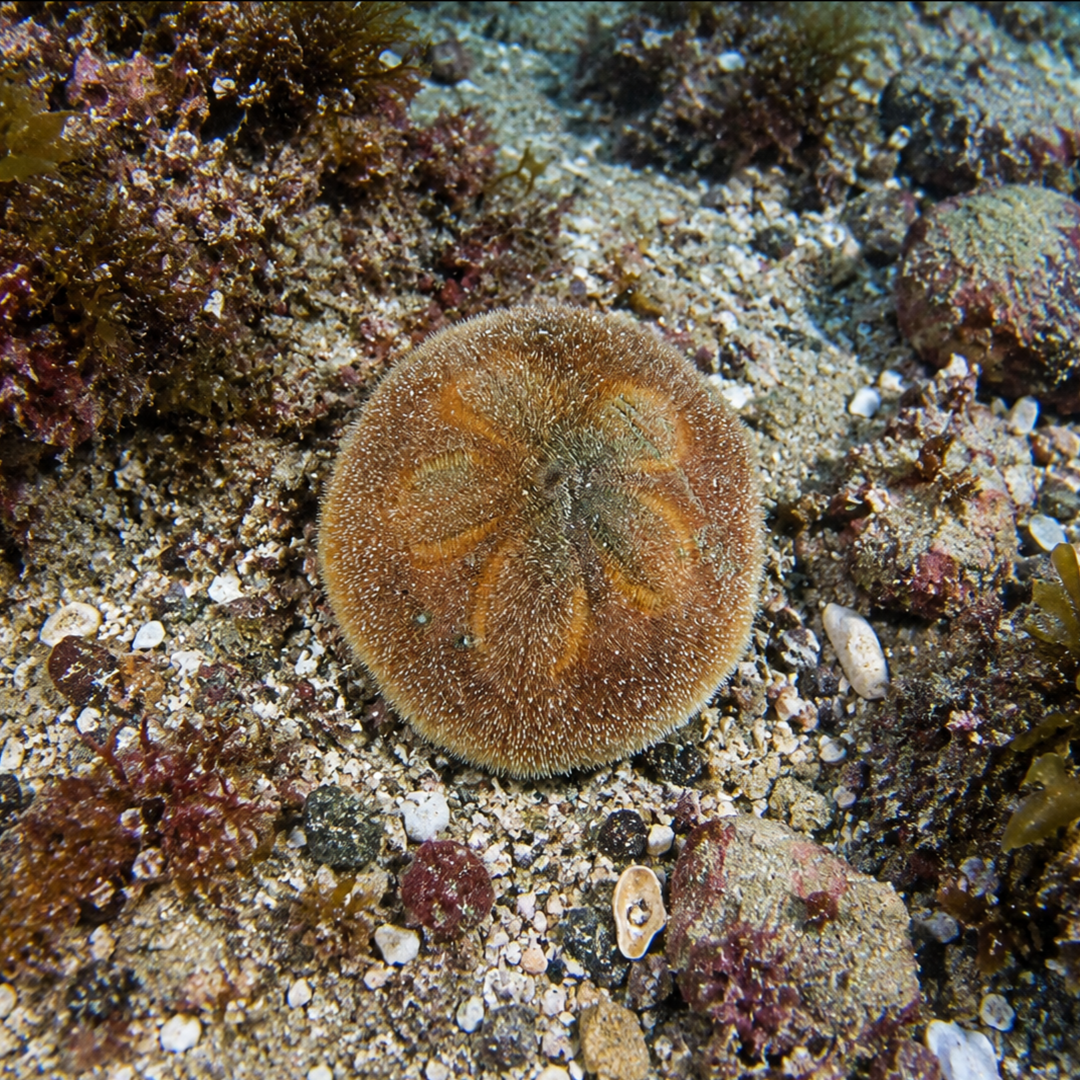
カシパン類は、ウニ綱の中でも「不正形類」と呼ばれる系統に属する、著しく扁平な体を持つ海産無脊椎動物です。ここで扱う個体は Laganum cf. laganum とされ、cf. は「L. laganum に近いとみられるものの、種まで確定していない」ことを示します。背面には花びらのような5つの花紋が並び、細かな棘や管足を使って砂地を移動します。L. laganum は細かな砂に浅く潜って暮らし、堆積物に含まれる有機粒子を利用することが知られており、岩面を主な餌場とする一般的な球形のウニとは異なる生活様式を持ちます。 Sand dollars in the genus Laganum are highly flattened marine invertebrates belonging to the irregular echinoids. The form treated here is identified as Laganum cf. laganum; the qualifier cf. indicates that it resembles L. laganum but has not been confirmed to species level. Five petal-like structures are visible on the upper surface, and the animal moves through sandy substrate using numerous small spines and tube feet. L. laganum is known to live shallowly buried in fine sand and to feed on organic particles in the sediment, giving it a lifestyle distinct from many rounded sea urchins that graze primarily on hard surfaces.
基本情報 / Basic Information
| 学名 / Scientific Name | Laganum cf. laganum |
|---|---|
| 通称 / Common Name | カシパン、カシパン類Sand dollar |
| 分類 / Family | 棘皮動物門・ウニ綱・Echinolampadacea目・カシパン科 Laganidae・カシパン属 LaganumPhylum Echinodermata, Class Echinoidea, Order Echinolampadacea, Family Laganidae, Genus Laganum |
| 英名 / English Name | Sand dollar |
| 分布 / Distribution | L. laganum はインド・西太平洋を中心に分布し、南日本を含む地域からも記録があります。細かな砂底に浅く潜って暮らし、海草藻場を含む砂質の海底で確認されています。なお、Laganum cf. laganum として流通する個体の正確な産地や種同定は、個体ごとに確認が必要です。L. laganum is distributed mainly across the Indo-West Pacific and has also been recorded from southern Japan. It lives shallowly buried in fine sandy substrate and has been recorded from sandy habitats including seagrass areas. For specimens sold as Laganum cf. laganum, exact origin and species identification should be confirmed individually. |
| 最大体長 / Max Size | 種同定が cf. を含むため一律に断定しにくく、確実な最大殻径の情報はありません。流通個体では、購入時の殻径だけでなく成長後に十分な砂地を確保できるかを重視します。A precise maximum test diameter is difficult to state because the identification includes the qualifier cf.. For aquarium care, available sand-bed area after growth is more important than the size of the specimen at purchase. |
| 寿命 / Lifespan | 確立した飼育下寿命の情報はありません。長期飼育では慢性的な餌不足が問題になりやすく、寿命そのものよりも底砂中の餌資源を継続して維持できるかが重要です。No well-established captive lifespan is available. In long-term care, chronic food shortage is a major concern, so maintaining a continuously productive sand bed is more important than focusing on a fixed lifespan figure. |
飼育環境 / Aquarium Environment
| 水槽サイズ / Tank Size | 本種に対する統一された最低水槽サイズは確立されていません。飼育では水量だけでなく、潜行と採餌に使える砂地の広さが重要です。小型個体でも60cm規格水槽では底面積に余裕が出にくいため、可能であれば90cm規格水槽など、広い砂地を確保できる水槽を目安にします。No universally established minimum aquarium size is available for this species. More important than water volume alone is the area of usable sand for burrowing and feeding. Even for a small specimen, a standard 60 cm tank can provide limited sand-bed area, so a standard 90 cm aquarium or another tank with a broad footprint is a more practical target when possible. |
|---|---|
| 水温 / Temperature | 一般的な熱帯性海水水槽の範囲で安定させることを優先します。飼育目安としては24〜27℃程度が扱いやすい範囲ですが、L. laganum について「28℃を超えると急速に衰弱する」と断定できる根拠は確認できません。短時間の数値よりも、急激な温度変化や長期間の過度な高温を避けることが重要です。 Prioritize stability within the normal range used for tropical marine aquaria. Around 24–27°C is a practical husbandry range, but there is not sufficient evidence to state that L. laganum rapidly declines whenever temperature exceeds 28°C. Avoid abrupt temperature changes and prolonged excessive heat rather than treating a single threshold as absolute. |
| 水質 / Water Quality | 自然海水に近い安定した環境を保ち、pH 8.0〜8.4程度、KH 8〜12 dKH程度を一般的な海水水槽の目安とします。比重、pH、水温を急変させず、定期的な換水で安定性を保ちます。底砂を餌場として利用するため、栄養塩を極端に低くすること自体を目的にせず、底床の生物相が維持されているかを観察します。Maintain stable conditions close to normal seawater, using roughly pH 8.0–8.4 and alkalinity around 8–12 dKH as general marine-aquarium targets. Avoid abrupt shifts in salinity, pH and temperature, and use regular water changes to maintain stability. Because the animal feeds within the substrate, do not pursue extremely low nutrients as an end in itself; instead, watch whether the sand bed remains biologically productive. |
| レイアウト / Layout | 最重要なのは、潜りやすい細かな砂を十分な面積と厚さで用意することです。自然下では細砂に浅く潜ることが知られているため、粗く角張った底材よりも、粒の細かな砂質底床が適しています。厚さは個体が潜行できる余裕を持たせ、底床の一部に微生物や有機物が残る成熟した環境を維持します。The most important layout feature is a sufficiently broad and deep bed of fine sand that the animal can burrow into easily. In nature, L. laganum is known to live shallowly buried in fine sand, so a fine sandy substrate is more appropriate than coarse or sharp material. Provide enough depth for normal burrowing and maintain a mature substrate in which some microorganisms and organic matter remain available. |
| 注意点 / Precautions | 底砂のないベアタンクは、本来の潜行行動と採餌を行いにくいため適しません。長期飼育では底砂中の餌資源が不足しないよう、砂を過度に洗浄・吸い出さないことが重要です。底砂掃除を行う場合は一度に全面を処理せず、場所を分けて少しずつ行うと、底床の生物相と有機物を残しやすくなります。Bare-bottom aquariums are unsuitable because they restrict the animal’s normal burrowing and sediment-feeding behavior. In long-term care, avoid excessive cleaning that removes most food resources from the sand. When substrate cleaning is necessary, work in separate sections rather than disturbing the entire sand bed at once so that more of the established biological community and organic material are retained. |
餌と給餌 / Feeding
| 餌の種類 / Diet | L. laganum は砂を取り込みながら、堆積物に含まれる有機粒子を利用する底質食者です。飼育下ではデトリタスや細かな有機物を含む成熟した底砂が重要な餌場になります。微小藻類やバイオフィルムも底床環境の一部として利用される可能性がありますが、それだけを主食と決めつけないほうが適切です。L. laganum is a sediment feeder that ingests sand and utilizes organic particles contained within it. In captivity, a mature sand bed containing detritus and fine organic matter is therefore an important feeding ground. Microalgae and biofilm may form part of this substrate community, but they should not be treated as the animal’s sole or definitively primary food. |
|---|---|
| 給餌のポイント / Feeding Tips | 「強い照明を当てて珪藻を増やすこと」が必須条件だとする十分な根拠は確認できません。重要なのは、底砂を清潔にしすぎて有機粒子や微生物相を失わせないことです。砂面の状態、個体の移動、棘の状態などを継続して観察し、底床が極端に痩せた環境にならないよう管理します。There is not sufficient evidence to treat strong lighting specifically for growing diatoms as an essential requirement. The more important point is to avoid cleaning the substrate so aggressively that organic particles and its established biological community are stripped away. Continue to monitor the sand surface, the animal’s movement and spine condition, and avoid allowing the substrate to become extremely depleted. |
性格と混泳 / Temperament and Tank Mates
| 性格 / Temperament | おとなしい底生生物で、他の生体を積極的に攻撃する性質はありません。砂の中に浅く潜ったり、砂面をゆっくり移動したりしながら生活し、その移動に伴って底砂を少しずつ動かします。This is a peaceful benthic animal that does not actively attack tank mates. It lives partly buried or moves slowly across the sand, gradually disturbing the sediment as it travels and feeds. |
|---|---|
| 混泳の相性 / Compatibility | 温和な海水魚などとは合わせやすい一方、カシパンをつつく魚や捕食性の強い生体との同居は避けます。また、底砂を激しく掘り返す魚や、同じ底床の餌資源を強く利用する生体が多い環境では、落ち着いて採餌できる砂地が減るため注意が必要です。It is generally compatible with peaceful marine fish, but animals that pick at or prey on sand dollars should be avoided. Caution is also needed with fish that heavily excavate the substrate or with numerous animals that strongly compete for the same sand-bed food resources. |
病気と対策 / Diseases and Prevention
| かかりやすい病気 / Common Diseases | カシパン類について、家庭飼育で診断しやすい特定疾病の情報は多くありません。実際には、餌不足、急な水質変化、長期間の過度な高温、不適切な底材による棘や表皮の損傷など、飼育環境に由来する衰弱を先に疑う場面が多くなります。There is limited aquarium-specific information on clearly diagnosable diseases of laganid sand dollars. In practice, decline is often more usefully investigated first in terms of food shortage, abrupt water-quality changes, prolonged excessive heat, or physical damage caused by unsuitable substrate. |
|---|---|
| 対策と予防 / Prevention | 水温、比重、pH、KHを急変させず、導入時は慎重に水合わせを行います。細かな底砂と安定した水質を維持し、底床が過度に清掃されて餌資源を失っていないかも確認します。棘の脱落、動きの著しい低下など普段と異なる変化が見られた場合は、水質、温度、底砂の状態、餌不足の可能性を順に見直します。Avoid sudden changes in temperature, salinity, pH and alkalinity, and acclimate new specimens carefully. Maintain fine substrate and stable seawater, and check that excessive cleaning has not depleted the sand bed. If unusual spine loss or marked inactivity appears, review water quality, temperature, substrate condition and possible food shortage in a systematic way. |
増やし方(繁殖) / Breeding
| 雌雄の判別 / Sexing | 外見から雌雄を確実に判別する一般的な方法は知られていません。生殖腺の状態などを詳しく調べなければ識別が難しく、観賞飼育の範囲では雌雄判定は実用的ではありません。There is no widely practical method for reliably distinguishing males and females by external appearance. Detailed examination of reproductive tissues may be required, so routine sexing is generally impractical in aquarium keeping. |
|---|---|
| 繁殖形態 / Reproduction | ウニ類では雌雄が海中へ卵と精子を放出する放卵放精が一般的で、間接発生を行う種では浮遊性の幼生期を経て底生生活へ移行します。L. laganum について家庭飼育向けに確立された繁殖情報は乏しいため、種固有の条件までは断定できません。Broadcast spawning, in which males and females release gametes into the water, is common among echinoids, and species with indirect development pass through a planktonic larval stage before settling. Aquarium-specific reproductive information for L. laganum is limited, so species-specific breeding conditions cannot be stated with confidence. |
| 繁殖のポイント / Breeding Tips | 家庭用水槽での計画的な繁殖は非常に難しく、安定した繁殖技術は一般化していません。親個体の成熟条件、産卵誘発、浮遊幼生への微細餌料の供給、変態・着底に必要な環境条件を個別に整える必要があり、通常の観賞飼育とは別の専用設備と管理が求められます。Planned breeding in home aquaria is very difficult and no broadly established hobby protocol is available. Successful culture would require control of broodstock maturation, spawning induction, microscopic food for planktonic larvae, and the specific environmental cues needed for metamorphosis and settlement. |
雑学と豆知識 / Trivia and Fun Facts
| 1. 「カシパン」は扁平化したウニの仲間 / 1. A Sand Dollar Is a Flattened Relative of Sea Urchins | カシパンは、丸いウニからは想像しにくいほど薄い円盤状の姿をしていますが、分類上はウニの仲間です。不正形類では、砂泥底での生活に適応する過程で口や肛門の位置関係が変化し、前後方向を持つ左右相称性がはっきりしました。扁平な体と細かな棘による移動は、砂の表面や内部で暮らす生活様式と深く結び付いています。Sand dollars look very different from familiar rounded sea urchins, yet they are true echinoids. During the evolution of irregular echinoids, adaptation to life in soft sediment was accompanied by changes in the positions of structures such as the mouth and anus and by a clearer front-to-back, bilaterally organized body plan. Their flattened form and movement by small spines are closely associated with life on and within sandy substrate. |
|---|---|
| 2. 花びらの模様は呼吸に関わる器官 / 2. The Flower-Like Pattern Is Part of the Respiratory System | 背面に見える5枚の花びらのような模様は、単なる装飾ではありません。この「花紋」には呼吸に関わる管足が並び、砂に潜った状態でも海水とのガス交換を助けます。カシパンの美しい模様は、見た目のために作られたものではなく、砂の中で生きるための機能がそのまま幾何学的な模様として現れたものです。The five petal-like markings on the upper surface are not decorative. These petaloids contain specialized tube feet involved in gas exchange, helping the animal respire even while partly buried. The elegant floral pattern is therefore a visible expression of physiological adaptation to life beneath the sediment. |
| 3. 平たい殻の中には「支柱」がある / 3. The Flat Test Is Reinforced from Within | 薄く見える殻は、単純な中空の器ではありません。内部には石灰質の支柱が発達し、上下の殻板を結び付けています。この構造によって、外からの圧力や砂の重みを分散しやすくなっています。外観は繊細でも、内部では建築物の補強材のような仕組みが働いており、扁平な体形と強度を両立させています。Despite its thin appearance, the test is not a simple hollow shell. Calcified internal pillars and buttresses connect the upper and lower surfaces and help distribute mechanical loads. The result is a structure that combines a flattened outline with surprising rigidity, much like an engineered shell reinforced from within. |
| 4. 「Laganum」は古代の平たいパンを連想させる名前 / 4. The Name “Laganum” Evokes an Ancient Flat Bread | 属名 Laganum は、古代ギリシャ語の laganon やラテン語の laganum と結び付けられ、これらの語は薄く平たいパンや生地を指して使われてきました。扁平なカシパンの姿を思わせる名称ですが、命名者がどこまでその形を意識したのかという細部までは、ここでは断定しません。英語の一般名 sand dollar も、円盤状の姿を硬貨になぞらえた呼び名です。The genus name Laganum is associated with the ancient Greek laganon and Latin laganum, terms used for thin, flat bread or sheets of dough. The name readily evokes the animal’s flattened form, although the precise intention of the original naming should not be overstated without direct historical evidence. The common English name “sand dollar” similarly compares the disc-like shape with a coin. |
| 5. 砂を食べながら海底を耕す「生物攪拌者」 / 5. A Bioturbator That Constantly Reworks the Seafloor | カシパンは砂に潜ったり砂面を移動したりしながら、堆積物を取り込んで採餌します。その結果、海底の砂は少しずつ動かされます。こうした生物による堆積物のかき混ぜは「生物攪拌」と呼ばれ、底質中の物質移動や微小環境に影響を与えます。水槽の砂面に残る移動跡は、自然下でのこうした生活を身近に観察できる痕跡でもあります。As a sand dollar burrows and feeds, it takes in sediment and gradually moves the surrounding sand. This biological reworking of sediment is known as bioturbation and can influence material transport and small-scale conditions within the seabed. Trails left across an aquarium sand bed are therefore visible traces of the same basic behavior seen in nature. |
| 6. よく似た属は生殖孔の数で見分ける / 6. Closely Related Genera Can Be Distinguished by Genital Pores | Laganum 属と近縁の Peronella 属は、外見だけでは非常によく似ています。分類上の重要な識別点の一つが、生殖孔の数です。Laganum では頂上系の周囲に5つ、Peronella では4つとされます。ショップで「カシパン」とだけ呼ばれている個体を正確に同定するには、全体の輪郭だけでなく、こうした小さな形態形質を確認する必要があります。The genera Laganum and Peronella can look extremely similar. One important taxonomic character is the number of genital pores around the apical system: five in Laganum and four in Peronella. Correct identification of a specimen sold simply as a “sand dollar” may therefore require examination of fine anatomical features rather than overall shape alone. |
| 7. 飼育の難しさは「弱さ」よりも餌場の再現にある / 7. The Main Challenge Is Recreating a Living Feeding Ground | カシパンは目に見える餌へ素早く集まる生き物ではないため、十分に採餌できているか判断しにくい生体です。長期飼育では、毎日の給餌量だけを見るのではなく、底砂にデトリタスや細かな有機粒子が適度に残り、採餌できる環境が維持されているかを考える必要があります。カシパンを飼うことは、個体だけでなく、その生活場所である砂底の状態を管理することでもあります。Sand dollars do not rush toward visible food, so it can be difficult to judge whether they are feeding adequately. Long-term care requires attention not only to what is added each day, but also to whether the sand bed continues to contain suitable detritus and fine organic particles. Keeping a sand dollar therefore means managing the condition of its sandy habitat as well as the animal itself. |
まとめ / Conclusion
カシパン類は、薄い円盤状の体に、砂底で暮らすための特徴を備えたウニの仲間です。花びら状に並ぶ呼吸用の管足、内部の支えを持つ扁平な殻、細かな棘や管足を使った移動など、その形と働きは砂質の海底での生活と密接に結び付いています。 Sand dollars are echinoids whose flattened bodies carry a suite of features associated with life on sandy seabeds. Their petal-like respiratory tube feet, internally supported test, and movement by fine spines and tube feet all reflect adaptation to life on and within soft sediment.
飼育では、潜行できる細かな底砂と安定した海水環境を用意し、底床を清掃しすぎて採餌に使う有機物まで失わせないことが重要です。砂の中へ静かに潜り、ゆっくりと底床を動かしながら暮らす姿は、魚とは異なる海底生物ならではの生活を水槽の中で見せてくれます。 Successful care depends on fine sand suitable for burrowing, stable marine water conditions, and avoiding excessive substrate cleaning that removes the organic material used during feeding. Its quiet habit of burying itself and slowly reworking the sand offers a view of benthic life that is very different from the behavior of ordinary aquarium fish.

気になる道具や飼い方を見つけてみませんか?
 アイのアクアグッズ案内海水魚初心者の必需品|水槽・人工海水・比重計・水質検査道具の特徴や使い方、選ぶときのポイントをアイが紹介します。記事はコチラ →
 アイのアクアグッズ案内コリドラスのもふもふ時間を楽しむ|餌・底砂・お掃除用品の選び方コリドラスのもふもふする食事風景を楽しむために。沈む餌2種類の違い、口元に配慮した底砂、食べ残しを回収する道具を、アクアグッズナビゲーターのアイが紹介します。記事はコチラ →
 アイのアクアグッズ案内マジックリーフ物語|一枚の葉がアクアリウム用品になるまで道具の特徴や使い方、選ぶときのポイントをアイが紹介します。記事はコチラ →
 アイのアクアグッズ案内水槽のろ材の選び方|ウール・リング・活性炭の違いとおすすめ商品フィルターの中の綿や石は何をしている? アイとコタロウが、ウール・スポンジ・セラミック・焼結ガラス・活性炭・ゼオライトを比較。機種との相性、入れ方、洗い方と交換まで商品とともに紹介します。記事はコチラ →
さまざまな飼育テーマをご紹介。リンク先の記事には広告・商品紹介が含まれます。
案内・紹介記事一覧へ →分布マップ
Laganum laganum はインド・西太平洋を中心に広く分布し、南日本を含む地域からも記録されています。以下の地図では、その広い分布地域を概略的に表示しています。
この地図はインド・西太平洋を中心とする分布域を把握するための概略表示です。表示されているマーカーは地図上の代表地点として設定したもので、実際の採集地点、標本産地、生息確認地点を示すものではありません。また、Laganum cf. laganum として流通する個体の正確な産地や種同定は個体ごとに異なる場合があります。
参考文献
- Kroh, A. & Mooi, R. (2026). World Echinoidea Database: Laganum laganum (Leske, 1778). World Register of Marine Species (WoRMS). 分類・有効学名・異名の確認。 https://www.marinespecies.org/aphia.php?p=taxdetails&id=513360
- Clark, A. M. & Rowe, F. W. E. (1971). Monograph of Shallow-water Indo-West Pacific Echinoderms. Trustees of the British Museum (Natural History), London. インド・西太平洋産棘皮動物の分類・識別形質・分布を扱う基礎的モノグラフ。 https://www.sealifebase.ca/References/FBRefSummary.php?id=81296
- Lee, T. & Shin, S. (2014). Echinoderm Fauna of Chuuk, The Federated States of Micronesia. Animal Systematics, Evolution and Diversity, 30(2), 108–118. Laganum laganum の分布記録、形態的識別、海草域での採集記録を参照。 https://doi.org/10.5635/ASED.2014.30.2.108
- Dian R, A., Hartati, R. & Ambariyanto, A. (2005). Identifikasi Sand Dollar dan Karakteristik Habitatnya di Pulau Cemara Besar, Kepulauan Karimunjawa Jepara. ILMU KELAUTAN: Indonesian Journal of Marine Sciences, 10(1), 1–10. Laganum laganum が確認された砂質環境と底質中の有機物に関する現地調査。 https://doi.org/10.14710/ik.ijms.10.1.1-10
- Serafy, D. K. & Fell, F. J. (1985). Marine Flora and Fauna of the Northeastern United States: Echinodermata: Echinoidea. NOAA Technical Report NMFS 33. 不正形ウニ類の底質食、放卵放精と浮遊幼生、飼育時に適切な底質を必要とすることなど、ウニ類一般の生物学を参照。 https://spo.nmfs.noaa.gov/Technical%20Report/tr33opt.pdf
- Caskey, P. (2023). 4-H Marine Aquarium Project Book: Youth Project Guide to Starting and Maintaining a Saltwater Aquarium System. University of Florida IFAS Extension. 海水水槽における水温、pH、塩分、炭酸塩硬度などの一般的な水質管理範囲を参照。 https://doi.org/10.32473/edis-4H433-2022
- Tajima, K., Cunha da Silva, J. R. M. & Lawrence, J. M. (2007). Disease in sea urchins. In J. M. Lawrence (Ed.), Edible Sea Urchins: Biology and Ecology, pp. 167–182. Elsevier. ウニ類で報告される疾病、棘の脱落などの症状、温度条件と疾病の関係を扱う総説。Laganum laganum 固有の疾病資料ではないため、病気欄の一般的背景に限定して参照。 https://doi.org/10.1016/S0167-9309(07)80073-1




コメント