

解説 / Description
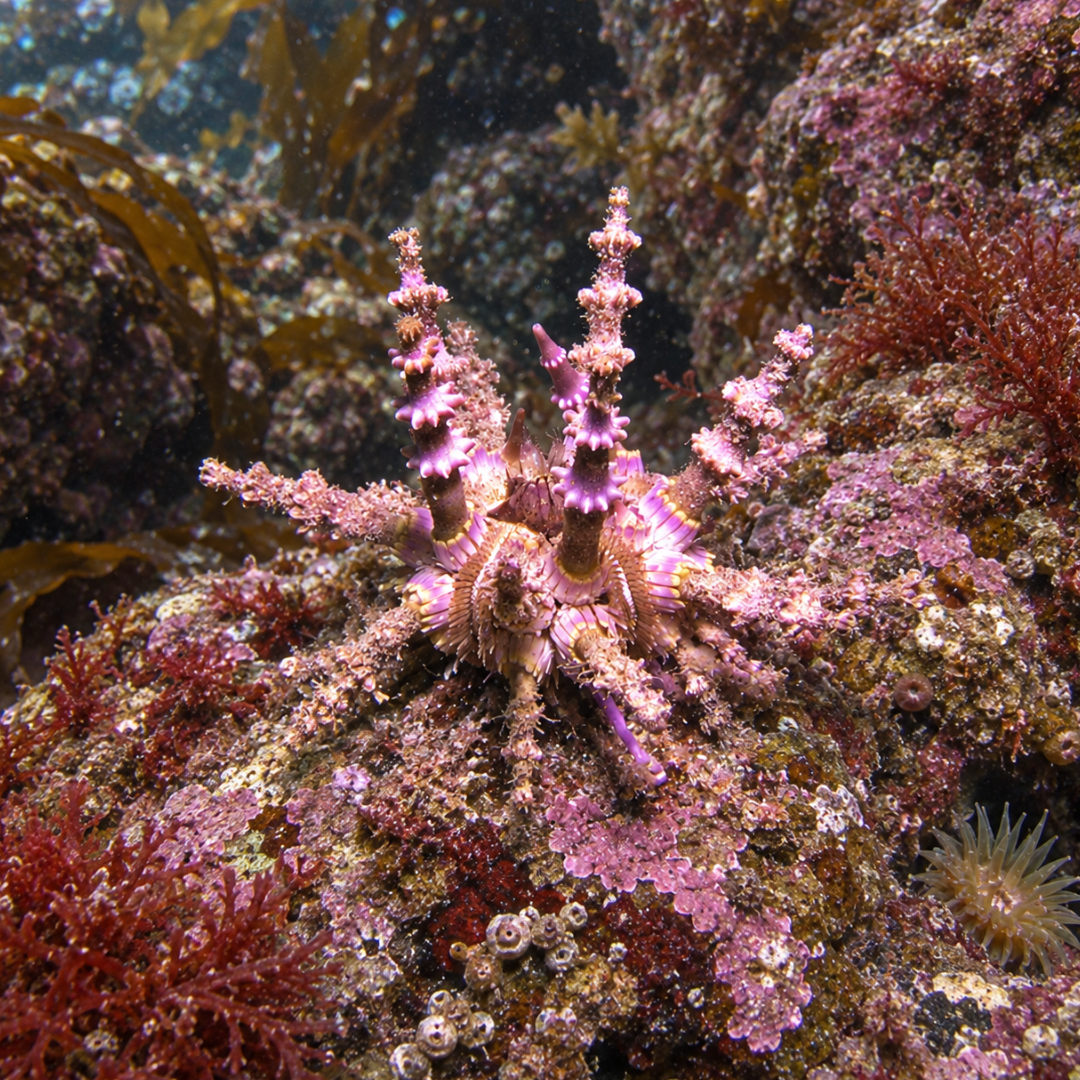
フシザオウニは、太い主棘に歯車や王冠を思わせる輪状の突起が何段も並ぶ、非常に個性的な姿のウニです。殻そのものは比較的小型ですが、節のある主棘が四方へ伸びるため、水槽内では数字以上の存在感があります。インド太平洋に広く分布し、日本でも南日本の暖海域で確認されています。転石の下や岩の隙間に潜み、夜間に姿を見せることがあるため、明るい時間帯には見つけにくい生き物です。成熟したオウサマウニ類の主棘には付着生物が定着しやすく、フシザオウニでも棘の表面にさまざまな生物が付着した個体が観察されます。マリンアクアリウムでは魅力的な無脊椎動物ですが、食性について不明な点が残り、飼育下でサンゴをかじった例も報告されているため、サンゴを主役にしない水槽の方が管理しやすい種類です。 Plococidaris verticillata is a highly distinctive sea urchin whose thick primary spines bear several whorls of gear-like or crown-like projections. The test itself is relatively small, but the projecting spines give the animal a much larger visual presence in an aquarium. It is widely distributed across the Indo-Pacific and occurs in warm waters of southern Japan. It shelters beneath rubble and in rocky crevices and may be seen at night, so it can be difficult to find during bright daytime hours. Mature cidaroid primary spines readily support encrusting organisms, and P. verticillata is often observed with marine life attached to its spines. It can be a fascinating aquarium invertebrate, but aspects of its diet remain poorly documented, and coral grazing has been reported in captivity. A system in which valuable corals are not the main focus is therefore easier to manage.
基本情報 / Basic Information
| 学名 / Scientific Name | Plococidaris verticillata (Lamarck, 1816) |
|---|---|
| 通称 / Common Name | フシザオウニ。文献によっては旧組み合わせのPrionocidaris verticillataが使われていることがあります。Gear-wheel sea urchin. Some literature uses the former combination Prionocidaris verticillata. |
| 分類 / Family | 棘皮動物門・ウニ綱・オウサマウニ目・オウサマウニ科・フシザオウニ属Phylum Echinodermata, Class Echinoidea, Order Cidaroida, Family Cidaridae, Genus Plococidaris |
| 英名 / English Name | Gear-wheel sea urchin |
| 分布 / Distribution | インド太平洋に広く分布し、東アフリカ・マダガスカルからフィジー、ハワイ諸島、南日本、オーストラリア東岸などで記録されています。日本では八丈島や紀伊半島以南、琉球列島などの暖海域で確認されています。サンゴ礁や岩礁の転石下、岩の隙間などに見られ、潮間帯付近から水深50m前後までの記録があります。Widely distributed across the Indo-Pacific, with records from East Africa and Madagascar to Fiji, the Hawaiian Islands, southern Japan, and the east coast of Australia. In Japan it has been recorded around Hachijojima, south of the Kii Peninsula, and in the Ryukyu Islands. It is associated with reefs and rocky habitats, especially beneath rubble and in crevices, with records from the intertidal zone to around 50 m depth. |
| 最大体長 / Max Size | 殻径は2〜3cmほどの個体がよく見られ、文献上は最大約4cmに達します。主棘が大きく張り出すため、棘を含めた見かけの大きさは殻径よりかなり大きくなります。Individuals with a test diameter of about 2–3 cm are commonly documented, and published descriptions give a maximum test diameter of about 4 cm. Because the primary spines project well beyond the test, the animal appears considerably larger overall. |
| 寿命 / Lifespan | 本種に限定した信頼できる寿命データは十分に確認されておらず、具体的な年数は不明です。Reliable species-specific lifespan data are not sufficiently established, so a precise lifespan cannot currently be given. |
飼育環境 / Aquarium Environment
| 水槽サイズ / Tank Size | 本種について学術的に定められた最低水量はありませんが、実用上は100L前後以上を目安にし、水質と水温を安定させやすい環境を用意します。日本の規格水槽では90cm規格水槽(約150L前後)程度の水量があると管理しやすく、張り出した主棘にも余裕を持たせられます。No scientifically established minimum tank volume is available for this species. In practice, around 100 L or more is a reasonable starting point, with larger volumes making temperature and water chemistry easier to stabilize. A standard Japanese 90 cm aquarium of roughly 150 L provides useful extra room for the projecting primary spines. |
|---|---|
| 水温 / Temperature | 飼育情報では24〜28℃を目安とする例がありますが、本種の最適水温が実験的に確立されているわけではありません。流通個体がそれまで管理されていた水温を確認し、急激な変化を避けて安定させます。高水温が続くと溶存酸素も低下しやすいため、日本の夏は水槽用クーラーなどで過度な上昇を防ぐと安心です。 Aquarium references commonly give about 24–28°C, although an experimentally established species-specific optimum is not available. Check the temperature at which the specimen has been maintained and avoid abrupt changes. Prolonged high temperatures also reduce dissolved oxygen, so a chiller can be useful during hot Japanese summers. |
| 水質 / Water Quality | 天然海水に近い安定した水質を保ち、実用的な目安として比重1.023〜1.026、pH8.1〜8.4程度で管理します。アンモニアと亜硝酸は検出されない状態を維持し、硝酸塩の蓄積も抑えます。本種に限らずウニ類は急な塩分変化や水質悪化の影響を受けやすいため、導入時は時間をかけて水合わせを行います。Maintain stable seawater conditions close to natural marine values; a practical aquarium target is a specific gravity of about 1.023–1.026 and pH of about 8.1–8.4. Ammonia and nitrite should remain undetectable and nitrate accumulation should be limited. As with sea urchins generally, sudden salinity changes and deteriorating water quality should be avoided, so gradual acclimation is important. |
| レイアウト / Layout | ライブロックや岩組みで暗い隠れ家を複数作り、日中に落ち着いて潜める場所を確保します。主棘が引っ掛かったり、移動時に岩を押したりすることがあるため、不安定な石組みは避けてください。餌を探して夜間に動き回れる底面スペースも残します。Create several shaded shelters with live rock or stable rockwork so the urchin can retreat during the day. Avoid loose structures, as the large spines may catch on objects or the animal may push against unstable rocks while moving. Leave sufficient open bottom area for nocturnal foraging. |
| 注意点 / Precautions | リーフセーフとは断定できません。飼育下ではソフトコーラルをかじった例が報告されており、飼育情報でも海綿、ホヤ、コケムシ、サンゴポリプなどを口にする可能性が挙げられています。高価なサンゴを維持するリーフタンクより、FOWLRなど食害の影響を管理しやすい構成が無難です。また、ウニ類は銅を含む薬剤の影響を受けるため、魚病薬を使用する場合は無脊椎動物への安全性を確認してください。This species should not be assumed to be reef-safe. Coral grazing has been reported in captivity, including damage to soft corals, and aquarium references also list sponges, tunicates, bryozoans, and coral polyps among possible foods. A FOWLR-style system is therefore safer than a display built around valuable corals. Sea urchins are also sensitive to copper exposure, so check invertebrate safety before using fish medications. |
餌と給餌 / Feeding
| 餌の種類 / Diet | 本種の食性を詳しく定量化した資料は多くありません。飼育情報では藻類のほか、コケムシ、海綿、ホヤ、サンゴポリプなどを口にするとされているため、単純な草食性とは考えない方が安全です。飼育下では海苔や植物質を含む沈下性の海水用飼料を基本にし、必要に応じてアサリやエビなど動物質の餌を少量補助します。Detailed quantitative information on the diet of this species is limited. Aquarium references list algae together with bryozoans, sponges, tunicates, and coral polyps, so it is safer not to regard it as strictly herbivorous. In captivity, dried seaweed and sinking marine foods containing plant material can form the basis of the diet, with small amounts of animal food such as clam or shrimp offered as a supplement when needed. |
|---|---|
| 給餌のポイント / Feeding Tips | 水槽内に自然発生する藻類だけで必要量をまかなえるとは限らないため、消灯後など活動している時間に餌を近くへ置き、管足でつかむ様子を確認します。食べ残しは水質悪化の原因になるため回収してください。活動の低下、岩への付着力の低下、棘の脱落などが見られた場合は、給餌だけでなく水温、塩分、水質もあわせて確認します。Naturally occurring aquarium algae may not provide enough food on their own. Offer food near the animal when it is active, often after lights-out, and confirm that the tube feet can take hold of it. Remove uneaten food before it degrades water quality. If activity decreases, attachment to the substrate weakens, or spines are lost, review temperature, salinity, water quality, and feeding together rather than assuming a single cause. |
性格と混泳 / Temperament and Tank Mates
| 性格 / Temperament | 魚を追い回すような攻撃性はなく、岩陰を利用しながらゆっくり移動します。夜間に姿を見せることがあり、餌を探して岩組みの周囲を動きます。主棘が大きく張り出すため、固定の甘い岩や小さな置物、サンゴ片には接触しないよう配置に余裕を持たせます。It is not aggressive toward fish and moves slowly while using rocky shelters. It may become more visible at night as it forages around the rockwork. Because the primary spines project widely, leave enough clearance around loosely secured rocks, small ornaments, and coral fragments. |
|---|---|
| 混泳の相性 / Compatibility | 本種を捕食しない温和な海水魚との混泳は比較的行いやすいです。一方、フグ類、大型ベラ類、モンガラカワハギ類など、ウニをついばんだり噛み砕いたりする魚とは避けます。サンゴ、海綿、ホヤなどの付着性無脊椎動物とは食害の可能性があるため、組み合わせを慎重に判断してください。Compatibility is generally good with peaceful marine fish that do not prey on echinoderms. Avoid species such as puffers, large wrasses, and triggerfish that may bite or crush sea urchins. Corals, sponges, tunicates, and other sessile invertebrates may be grazed, so these combinations should be considered carefully. |
病気と対策 / Diseases and Prevention
| かかりやすい病気 / Common Diseases | フシザオウニに特有の疾病について、飼育下で整理された情報は多くありません。活動の低下、岩への付着力の低下、棘の脱落などは異常の手がかりになりますが、原因を症状だけで特定することはできません。輸送後のストレスや急な塩分変化、高水温、低酸素、水質悪化、給餌不足などを一つずつ確認します。Well-established aquarium information on diseases specific to P. verticillata is limited. Reduced activity, weaker attachment to the substrate, and spine loss can be warning signs, but they do not identify a cause by themselves. Check transport stress, sudden salinity changes, excessive temperature, low oxygen, deteriorating water quality, and inadequate feeding systematically. |
|---|---|
| 対策と予防 / Prevention | 導入時はゆっくり水合わせを行い、水温と比重を安定させ、十分な溶存酸素を確保します。定期的な換水とろ過設備の維持を行い、急激な環境変化を避けてください。異常時はまず水温、比重、アンモニア、亜硝酸、硝酸塩、pH、酸素供給、給餌状況を確認します。魚病薬を使う必要がある場合は、本種を無脊椎動物用の安全な別水槽へ移し、銅を含む薬剤への曝露を避けます。Use slow acclimation, maintain stable temperature and salinity, and provide good oxygenation. Perform regular water changes and maintain filtration while avoiding abrupt environmental shifts. If abnormal behavior appears, first check temperature, salinity, ammonia, nitrite, nitrate, pH, oxygenation, and feeding. If fish medication is required, move the urchin to a safe invertebrate system and prevent exposure to copper-containing treatments. |
増やし方(繁殖) / Breeding
| 雌雄の判別 / Sexing | 本種について、外見だけで雌雄を確実に見分ける実用的な方法は確立されていません。通常の飼育環境では判別困難と考えてください。No practical, reliable method of determining sex from external appearance is established for this species. In a normal aquarium, sexing should be regarded as difficult. |
|---|---|
| 繁殖形態 / Reproduction | 本種の繁殖生態に関する詳しい資料は限られています。ウニ類では一般に、卵と精子を海中へ放出して体外受精し、エキノプルテウス幼生として浮遊生活を送ったのち、変態して海底生活へ移行します。Detailed reproductive information for this species is limited. Sea urchins generally reproduce by releasing eggs and sperm into the water for external fertilization; the embryos develop into echinopluteus larvae, pass through a planktonic phase, and later metamorphose into benthic juveniles. |
| 繁殖のポイント / Breeding Tips | 本種に特化した安定した家庭繁殖法は確立されていません。仮に水槽内で放卵放精が起きても、浮遊幼生を変態まで育成するには成体とは別の管理系と微細な餌が必要になるため、一般家庭での計画繁殖は難しいと考えられます。A reliable home-breeding protocol specific to this species has not been established. Even if spawning occurs in an aquarium, rearing planktonic larvae through metamorphosis requires a separate culture system and appropriately small foods, making planned breeding difficult in a typical home setup. |
雑学と豆知識 / Trivia and Fun Facts
| 1. 「節竿」という名前を生んだ主棘 / 1. The Whorled Spines Behind the Japanese Name | フシザオウニを初めて見ると、まず主棘の造形に目を引かれます。一本の太い棘に、王冠や歯車のような突起が何段も輪生し、まるで節を刻んだ竿のように見えます。和名の「フシザオウニ」は、この節のある竿を思わせる棘に由来します。輪生する突起は見た目の特徴であるだけでなく、本種を識別するうえでも重要な形質です。The most immediately striking feature of this species is the form of its primary spines. Each thick spine carries several whorls of crown-like or gear-like projections, creating the appearance of a rod divided into repeated segments. The Japanese name “Fushizao-uni” refers to this jointed, rod-like appearance. The whorled projections are not only visually distinctive but also an important character for recognizing the species. |
|---|---|
| 2. 学名は一度では落ち着かなかった / 2. A Scientific Name with a Complicated History | 本種は1816年にラマルクによって記載され、その後の分類研究では別の属に置かれた時期もあり、Prionocidaris verticillataという学名も文献に残っています。1909年、モルテンセンは本種を含むPlococidaris属を設けました。その後も属の扱いには異なる見解がありましたが、現在の主要な分類データベースではPlococidaris verticillataが有効名として採用されています。学名の変遷をたどると、同じ生物でも、どの形態を分類上重視するかによって位置づけが見直されてきたことが分かります。The species was described by Lamarck in 1816 and was placed in different genera during later taxonomic work, leaving combinations such as Prionocidaris verticillata in the literature. Mortensen established the genus Plococidaris in 1909. Its generic placement continued to be treated differently by some authors, but major current taxonomic databases accept Plococidaris verticillata as the valid name. The history illustrates how the classification of the same animal can change as taxonomists reassess which anatomical characters best reflect relationships. |
| 3. 棘の表面が「小さな生息地」になる / 3. A Spine Can Become a Tiny Habitat | オウサマウニ類の太い主棘は、一般的なウニの棘とは少し違った世界を持っています。成体では主棘表面が生きた上皮で完全には覆われず、石灰質の骨格表面が外界にさらされやすいため、海綿、石灰藻、有孔虫などの付着生物が定着することがあります。フシザオウニの節状の棘は凹凸が多く、付着場所としても複雑です。野生個体の棘が「汚れている」ように見えても、それは単なる汚れではなく、小さな生物群集が形成されている場合があります。ウニ一個体の体表が、さらに別の生物の生活空間になるという、サンゴ礁らしい重層的な関係が見えてきます。The massive primary spines of cidaroid sea urchins form a somewhat different world from the spines of many other urchins. In adults, the primary spine surface is not completely covered by living epidermis, leaving the calcitic skeleton exposed and available for colonization by organisms such as sponges, calcareous algae, and foraminiferans. The many ridges and whorls of P. verticillata provide an especially complex surface. A wild specimen that appears to have “dirty” spines may actually be carrying a miniature community, illustrating how one reef animal can become habitat for many others. |
| 4. 軽くて強い棘を作る「ステレオム」 / 4. Stereom: A Lightweight Architecture Inside the Spine | フシザオウニの主棘を内部から見ると、「ステレオム」と呼ばれる棘皮動物特有の三次元網目構造が広がっています。研究では、本種の主棘は中央の髄質とその周囲の放射層に網目状のステレオムをもち、さらに外側を微細な孔のある皮質が包むことが示されています。つまり、外見は一本の硬い石灰質の棘でも、内部まで均一な塊ではありません。このような階層的な構造は、軽量さと力学的な働きを両立させる仕組みを考える材料となるため、ウニの骨格は生物模倣研究の対象にもなっています。Inside the primary spine is a three-dimensional meshwork called stereom, a characteristic skeletal architecture of echinoderms. Studies of this species show a central medulla and surrounding radiating layer made of porous stereom, enclosed by a finely perforated cortex. In other words, a spine that looks like a solid calcitic rod is not uniform throughout its interior. This hierarchical construction is of interest in biomimetic research because it offers a biological example of combining low mass with useful mechanical performance. |
| 5. 現生ウニの中でも古い分岐を残す系統 / 5. An Early-Branching Lineage Among Living Sea Urchins | フシザオウニが属するオウサマウニ目は、現生のほかのウニ類とは早い段階で分かれた系統として位置づけられています。そのため、太い主棘や独特の骨格は、ウニ類の進化を比較するうえで重要な材料になります。ただし、「古い系統」であることは、現在のフシザオウニが太古の姿のまま変化していないことを意味しません。本種も長い時間の中で進化を続けてきた現生生物であり、その姿にウニ類の系統の違いがよく表れている、と理解するのが適切です。The order Cidaroida belongs to an early-diverging lineage relative to the other living sea urchins. Its robust primary spines and distinctive skeletal organization are therefore useful for evolutionary comparisons. However, belonging to an ancient lineage does not mean that modern P. verticillata has remained unchanged since deep time. It is a modern species with its own long evolutionary history; its anatomy simply preserves clear differences between major living echinoid lineages. |
| 6. ウニの棘を支える可変性結合組織 / 6. Mutable Connective Tissue in Sea Urchin Spine Joints | ウニ類の棘と殻の関節には、硬さを可逆的に変えられる結合組織があり、「キャッチ装置」と呼ばれます。研究では、この組織が硬くなると棘の姿勢を保ち、柔らかくなると棘を動かしやすくなることが示されています。こうした仕組みは神経の制御を受け、筋肉だけに頼らず姿勢を維持するのに役立ちます。フシザオウニだけを対象にした実験ではありませんが、太い主棘が単なる硬い棒ではなく、関節と結合組織によって動的に支えられていることを理解する手がかりになります。At the joint between a sea urchin spine and the test is a collagen-rich structure known as the catch apparatus, whose stiffness can change reversibly. Experiments on sea urchins show that stiffening helps hold a spine in position, while softening allows it to move more freely. The process is under nervous control and helps maintain posture without relying on continuous muscular force alone. These experiments were not specific to P. verticillata, but they help explain how its large primary spines are supported as movable jointed structures rather than as rigid rods fixed permanently in place. |
まとめ / Conclusion
フシザオウニは、小さな殻から伸びる節状の主棘によって、ほかのウニとはひと目で違う印象を与える海の無脊椎動物です。岩陰や転石下に身を潜め、夜間に姿を見せることがあるため、水槽でも落ち着ける隠れ場所を用意すると本来の行動を観察しやすくなります。食性には不明な点が残り、飼育下でサンゴをかじった例もあることから、単純な「コケ取り役」としてではなく、一個体の生態を見ながら餌と環境を調整する種類と考えるのが適切です。 Plococidaris verticillata is a marine invertebrate whose small test and strongly whorled primary spines give it an unmistakable appearance. Because it shelters beneath rocks and rubble and may emerge at night, providing secure hiding places makes its natural behavior easier to observe in captivity. Important details of its diet remain poorly documented, and coral grazing has been reported in aquaria, so it is better treated as an animal whose feeding and environment should be monitored individually rather than simply as an algae-control species.
急な水質変化を避け、十分な酸素と落ち着ける岩陰を確保し、実際の摂餌を確認しながら給餌することが長期管理の基本になります。節のある主棘は外見上の魅力であるだけでなく、その表面には付着生物が暮らし、内部には精巧なステレオム構造が広がっています。独特な姿を観察するほど、生態と進化、骨格の仕組みがひとつながりに見えてくる、奥行きのあるウニです。 Long-term care depends on avoiding abrupt changes in water conditions, maintaining good oxygenation, providing secure rocky shelter, and adjusting feeding while confirming that the animal is actually eating. Its whorled primary spines are more than a visual attraction: their surfaces can support encrusting organisms, while their interiors contain an intricate stereom architecture. The closer this urchin is observed, the more clearly its ecology, evolutionary history, and skeletal design connect with one another.
気になる道具や飼い方を見つけてみませんか?
 アイのアクアグッズ案内小型カラシンの群れを楽しむ|餌と水換えから考える飼育用品ガイド小型カラシンの群れを眺める時間を、もっと楽しく。泳ぐ余白、餌の食べ方、続けやすい水換えを軸に、日本で揃えやすい用品の選び方を紹介します。記事はコチラ →
 アイのアクアグッズ案内水槽の流木の選び方|枝・マングローブ・アク抜きとおすすめ商品水槽に小さな森を作る流木。枝流木やマングローブという名前の違いから、魚の隠れ家、水草の取り付け、浮く・水が茶色くなるときの準備まで、アイとコタロウが商品とともに案内します。記事はコチラ →
 アイのアクアグッズ案内水草用ソイルの選び方|土・砂の違いとおすすめ商品道具の特徴や使い方、選ぶときのポイントをアイが紹介します。記事はコチラ →
 アイのアクアグッズ案内カルキ抜き・水質調整剤の選び方|水換えと水槽の種類に合わせて選ぶ道具の特徴や使い方、選ぶときのポイントをアイが紹介します。記事はコチラ →
さまざまな飼育テーマをご紹介。リンク先の記事には広告・商品紹介が含まれます。
案内・紹介記事一覧へ →分布マップ
フシザオウニ(Plococidaris verticillata)はインド太平洋に広く分布し、東アフリカ・マダガスカルからフィジー、ハワイ諸島、南日本、オーストラリア東岸などで記録されています。
この地図は記事内の分布情報をもとに、インド太平洋の分布範囲を大まかに示した概略図です。表示しているマーカーは分布域を把握しやすくするために設定した代表地点であり、実際の採集地点や個体の確認地点を示すものではありません。
参考文献
-
Kroh, A. & Mooi, R. World Echinoidea Database. Plococidaris verticillata (Lamarck, 1816). World Register of Marine Species (WoRMS).
https://www.marinespecies.org/aphia.php?p=taxdetails&id=513478 -
Filander, Z. & Griffiths, C. L. (2014). Additions to and revision of the South African echinoid fauna (Echinodermata: Echinoidea). African Natural History, 10, 47–56.
https://www.scielo.org.za/scielo.php?script=sci_arttext&pid=S2305-79632014000100002 -
公益財団法人東京都公園協会・八丈ビジターセンター「フシザオウニ」。
https://www.tokyo-park.or.jp/park/hachijo/creature/detail/0780.html -
Environment Canada (2014). Reference Method for Measuring the Toxicity of Contaminated Sediment to Embryos and Larvae of Echinoids (Sea Urchins or Sand Dollars). Reference Method EPS 1/RM/58.
https://www.canada.ca/en/environment-climate-change/services/wildlife-research-landscape-science/biological-test-method-publications/measuring-toxicity-contaminated-sediment-embryos-larvae-echinoids.html -
Natural History Museum, London. The Echinoid Directory: Reproduction and life history.
https://www.nhm.ac.uk/our-science/data/echinoid-directory/intro/reproduction.html -
Tajima, K., Cunha da Silva, J. R. M. & Lawrence, J. M. (2007). Disease in sea urchins. In J. M. Lawrence (Ed.), Edible Sea Urchins: Biology and Ecology, 2nd ed., pp. 167–182. Elsevier.
https://doi.org/10.1016/S0167-9309(07)80073-1 -
Wynne, J., LaDouceur, E. E. B. & Ryan, H. (2015). Clinical copper toxicosis in a large mixed group of marine invertebrates. Journal of Zoo and Wildlife Medicine, 46(3), 601–604.
https://doi.org/10.1638/2014-0153.1




コメント