

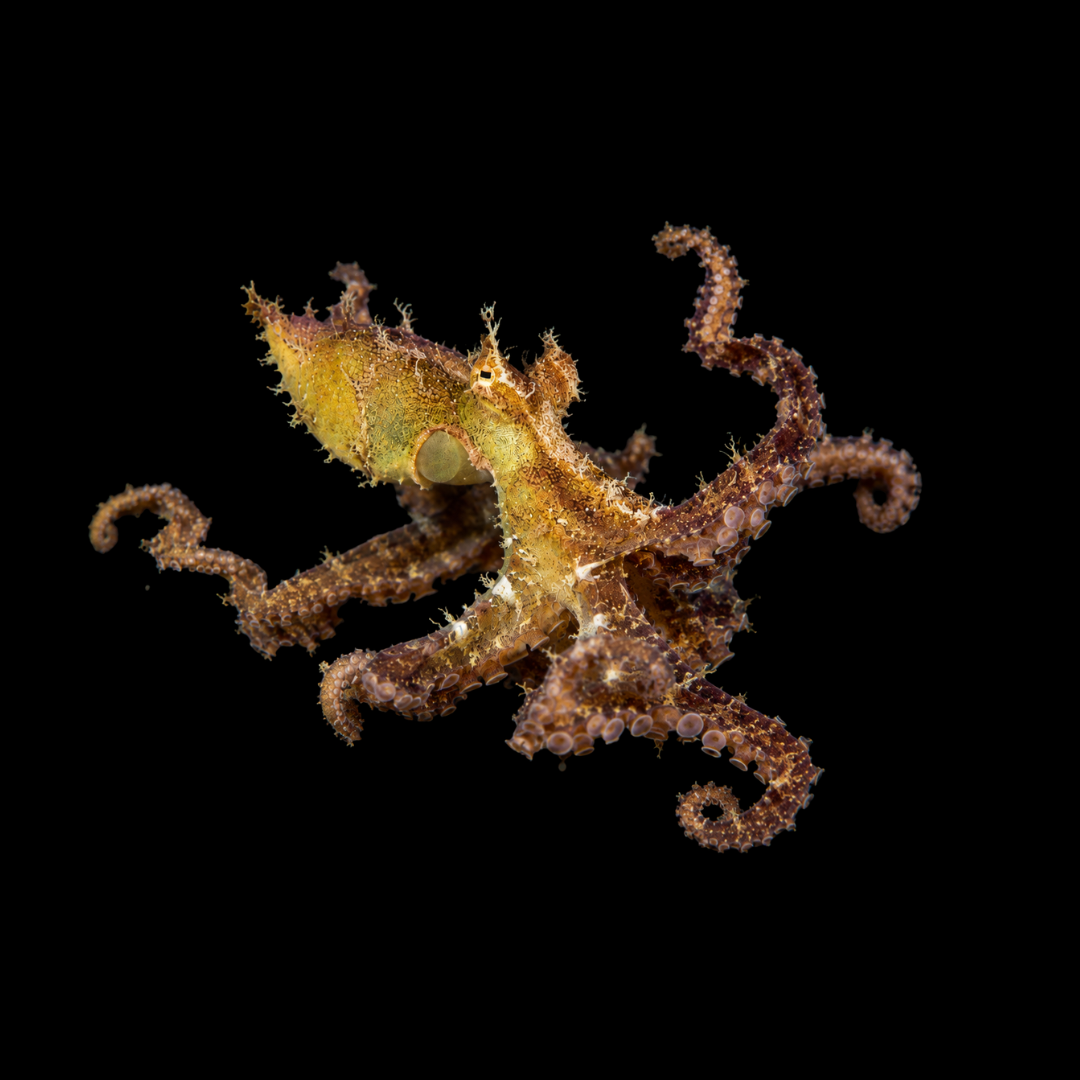
解説 / Description
ウデナガカクレダコは、マダコ科カクレダコ属に属する小型のタコです。外套は小さい一方で腕が非常に細長く、褐色、灰色、黄褐色などを組み合わせた体色と、皮膚表面の突起を瞬時に変化させることで、藻の付いた貝殻やサンゴ礫に驚くほど自然に溶け込みます。主に潮間帯から浅いサンゴ礁、海草藻場、砂礫底で暮らし、日中に巣穴から出てカニやエビなどの小型甲殻類を探します。二本の腕を使った「二足歩行」、腕の自切と再生、複雑な交尾行動など、行動学的にも非常に興味深い種です。飼育下では行動を観察する魅力が大きい一方、甲殻類中心の食性で水を汚しやすく、脱走対策も欠かせません。さらに寿命が短いため、十分に成熟した海水水槽を用意し、日々の状態変化を細かく見られる経験者向けの生体といえます。 The algae octopus is a small octopus in the family Octopodidae and genus Abdopus. Its mantle is relatively small, but its arms are exceptionally long and slender. By rapidly changing combinations of brown, gray and ochre coloration together with the texture of its skin, it can blend convincingly with algae-covered shells, coral rubble and other shallow-water substrates. It inhabits intertidal flats, shallow reefs, seagrass beds and sandy or rubble bottoms, leaving its den mainly during the day to hunt small crustaceans such as crabs and shrimps. Its bipedal walking, voluntary arm loss and regeneration, and complex mating behavior make it especially notable in behavioral biology. In captivity it is fascinating to observe, but its crustacean-based diet can place a heavy load on water quality, and escape prevention is essential. Its naturally short life span also means it is best suited to experienced marine aquarists who can provide a mature, secure system and monitor changes in condition closely.
基本情報 / Basic Information
| 学名 / Scientific Name | Abdopus aculeatus (A. d’Orbigny, 1834) 厳密な種同定に留保がある個体では、分類学上の慣例として Abdopus cf. aculeatus と表記されることがあります。When identification remains provisional, the taxonomic qualifier cf. may be used, giving Abdopus cf. aculeatus. |
|---|---|
| 通称 / Common Name | ウデナガカクレダコ。沖縄では「シガヤー」などの地方名でも知られます。Algae octopus; prickly octopus. In Okinawa it is also known by local names such as “Shigaya.” |
| 分類 / Family | 軟体動物門・頭足綱・タコ目・マダコ科・カクレダコ属Phylum Mollusca, Class Cephalopoda, Order Octopoda, Family Octopodidae, Genus Abdopus |
| 英名 / English Name | Algae octopus / Prickly octopus |
| 分布 / Distribution | インド・西太平洋の熱帯から亜熱帯域に分布します。日本では琉球列島から記録され、フィリピン、インドネシア、オーストラリア北部などでも知られています。主な生息域は潮間帯から浅い亜潮間帯です。Tropical to subtropical Indo-West Pacific. In Japan it has been recorded from the Ryukyu Islands, and it is also known from the Philippines, Indonesia and northern Australia. It is primarily a very shallow-water species of intertidal and shallow-subtidal habitats. |
| 最大体長 / Max Size | 外套長は最大約7cm、全長はおよそ43cmに達するとされます。胴体に対して腕が非常に長く、長い腕そのものが本種の大きな特徴です。Maximum mantle length is about 7 cm, and total length is reported to reach roughly 43 cm. The arms are exceptionally long relative to the mantle. |
| 寿命 / Lifespan | おおむね1年前後と考えられています。熱帯性の小型タコらしく生活史は短く、成熟・繁殖後には急速な老化が進みます。個体差や飼育条件によって前後します。Generally thought to be around one year. Like many small tropical octopuses, it has a short life cycle and undergoes rapid senescence after maturation and reproduction. Exact longevity varies among individuals and conditions. |
飼育環境 / Aquarium Environment
| 水槽サイズ / Tank Size | 小型種ですが、専用水槽としては60cm規格水槽(約60L前後)を下限の目安とし、余裕を持たせるなら90cm規格水槽(約180L前後)が扱いやすくなります。実際の水量は岩組みや底砂で少なくなるため、体長だけで水槽を小さくせず、十分な濾過容量を確保することが重要です。オーバーフロー式など、大きな濾過槽を取れる構成が適しています。Although this is a small species, a standard 60 cm aquarium of roughly 60 L should be treated as a practical lower guideline for a dedicated tank, while a standard 90 cm aquarium of roughly 180 L provides more working volume. Actual water volume will be lower after rockwork and substrate are added, so tank size should not be based on body length alone. A system with generous filtration capacity, such as an overflow aquarium with a sump, is well suited. |
|---|---|
| 水温 / Temperature | 24〜26℃を目安に、急変させず安定させます。日本の夏は水温上昇が大きな負担になるため、水槽用クーラーとヒーターを組み合わせ、年間を通して安定した温度管理を行うのが安全です。 Maintain a stable 24–26°C and avoid rapid fluctuations. In Japan, summer overheating is a major concern, so a reliable aquarium chiller together with a heater is recommended for year-round stability. |
| 水質 / Water Quality | 自然海水に近い塩分を安定して保ち、比重は1.023〜1.025程度を目安にします。アンモニアと亜硝酸塩は検出されない状態を維持し、硝酸塩も低く抑えます。十分な生物濾過、プロテインスキマー、定期換水を組み合わせ、銅を含む魚病薬や銅製の配管・部材は避けます。Maintain stable seawater close to natural marine salinity, using a specific gravity around 1.023–1.025 as a practical guide. Ammonia and nitrite should remain undetectable, while nitrate should be kept low through mature biological filtration, protein skimming and regular water changes. Avoid copper-based fish medications as well as copper plumbing or fittings. |
| レイアウト / Layout | ライブロックや安定した岩組みで複数の巣穴候補をつくり、サンゴ礫や貝殻など、入口を自分で整えられる小物を用意します。底床はサンゴ砂などを薄く敷く程度でも構いません。最優先は脱走防止で、フタ、オーバーフロー部、配管、コード穴まで隙間なく塞ぎます。吸水口やポンプなど、腕を巻き込む可能性のある機器にもガードが必要です。Provide several den options with securely arranged live rock or other stable rockwork, and scatter small pieces of coral rubble or shells that the octopus can move around the den entrance. A shallow layer of aragonite or coral sand is suitable. Escape prevention is the highest priority: seal the lid, overflow, plumbing gaps and cable openings completely. Intakes and pumps should also be guarded so that arms cannot be trapped. |
| 注意点 / Precautions | 最大の注意点は脱走と急激な水質悪化です。タコは硬い骨格を持たず、ごく狭い隙間も通り抜けるため、フタや配管まわりまで確実に塞ぐ必要があります。また、ストレスで大量に墨を吐くと、閉鎖的な水槽では鰓への付着や水質悪化によって危険な状態になることがあります。プロテインスキマーや活性炭を利用し、墨が多量に出た場合は速やかに除去と換水を行います。原則として専用水槽で単独飼育し、銅を含む薬剤は使用しません。The greatest risks are escape and rapid deterioration of water quality. Because an octopus lacks a rigid skeleton, it can pass through very narrow openings, so lids and gaps around plumbing must be secured carefully. Heavy inking under stress can coat the gills and degrade water quality in a closed aquarium. Use protein skimming and activated carbon, and remove ink and perform water changes promptly after a major inking event. A dedicated species tank is strongly recommended, and copper-containing medications should not be used. |
餌と給餌 / Feeding
| 餌の種類 / Diet | 主食は甲殻類です。活きた小型のカニ、エビ、ヤドカリなどは自然な狩猟行動を引き出しやすく、環境エンリッチメントとしても有効です。餌付けば、解凍したエビ、アサリ、ホタテなどの無加熱の海産物も利用できます。淡水産の餌だけに偏らせず、海産由来の多様な餌を組み合わせます。Crustaceans form the core of the diet. Live small crabs, shrimps and hermit crabs readily stimulate natural hunting behavior and also provide enrichment. Once trained to accept non-live foods, thawed raw marine shrimp, clams and scallops can also be offered. Avoid relying solely on freshwater-derived foods and provide a varied marine-based diet. |
|---|---|
| 給餌のポイント / Feeding Tips | 給餌頻度は固定せず、若い個体では毎日、成体では数日に1回を出発点に、体つきや活動量、食べ残しの有無を見ながら調整します。冷凍餌は長いピンセットやフィーディングスティックで目の前に提示すると受け入れやすくなります。カニ類を与える場合は大きなハサミによる負傷に注意し、必要に応じて危険なハサミを除去します。殻や食べ残しは水質悪化を防ぐため、給餌後に回収します。Do not treat feeding frequency as a fixed rule. Daily feeding can be a starting point for growing juveniles, while adults may be offered food every few days, with the schedule adjusted to body condition, activity and uneaten food. Present thawed food with long forceps or a feeding stick. When offering crabs, watch for injury from powerful claws and remove dangerous claws if necessary. Remove shells and leftovers after feeding to prevent rapid water deterioration. |
性格と混泳 / Temperament and Tank Mates
| 性格 / Temperament | 基本的には単独性で、腕や吸盤を使って周囲を確かめながら行動します。野生では昼行性が明瞭で、日中に採餌や繁殖行動を行い、休息時には巣穴を利用します。繁殖場面ではオス同士の競争や威嚇も見られます。飼育下の活動性には個体差があるため、隠れている時間だけで状態を判断せず、食欲や吸着、移動の様子を合わせて観察します。It is primarily solitary and explores its surroundings extensively with its arms and suckers. In the wild it is distinctly diurnal, foraging and mating during the day and using dens for shelter. Males may show strong competition and aggression toward other males during reproductive interactions. Activity levels vary among captive individuals, so time spent hiding should be interpreted together with appetite, sucker attachment and normal movement. |
|---|---|
| 混泳の相性 / Compatibility | 原則として単独飼育が適します。小型魚やエビ、カニ、ヤドカリ、貝類は捕食対象になり得ます。一方で大きな魚や攻撃的な魚はタコの腕や眼を傷つける可能性があります。同種同士も繁殖目的以外では争いや捕食の危険があるため、常設の混泳は勧められません。一般的なサンゴ礁水槽の「お掃除役」との共存も期待しない方が安全です。A solitary species tank is the safest choice. Small fish, shrimps, crabs, hermit crabs and mollusks may become prey, while larger or aggressive fishes may injure the octopus’ arms or eyes. Conspecifics can also fight or prey upon one another outside carefully managed breeding situations. Do not expect normal reef-tank cleanup animals to remain safe with this octopus. |
病気と対策 / Diseases and Prevention
| かかりやすい病気 / Common Diseases | 観賞魚の白点病のように一つの病名を想定するより、擦れや吸盤・腕の損傷、脱走時の乾燥、外傷後の二次感染、水質悪化や低酸素による状態悪化に注意します。食欲の低下、吸盤の吸着力低下、普段と異なる不動状態、外傷の悪化などが見られた場合は、水質と飼育環境を優先して確認します。繁殖後の老化でも活動や摂餌は低下するため、外傷や水質異常と区別して観察することが大切です。Rather than assuming a single named disease as is often done with aquarium fishes, watch for abrasions, sucker and arm injuries, desiccation after escape, secondary infection after trauma, and decline associated with poor water quality or low oxygen. Reduced appetite, weak sucker attachment, abnormal inactivity or worsening wounds should prompt an immediate review of water quality and housing. Because feeding and activity also decline during post-reproductive senescence, natural aging should be considered separately from injury or water-quality problems. |
|---|---|
| 対策と予防 / Prevention | 成熟した濾過槽を用意し、アンモニアと亜硝酸塩を0に保つことが最優先です。脱走やポンプへの巻き込みを防ぎ、鋭い岩や不安定なレイアウトも避けます。食べ残しはすぐに除去し、異常があれば水温、比重、pH、アンモニア、亜硝酸塩、硝酸塩、溶存酸素を確認します。頭足類は薬剤への反応が魚類と大きく異なるため、魚用薬を自己判断で使用せず、とくに銅系薬剤は避けます。Prevention begins with a fully mature filtration system and permanent zero ammonia and nitrite. Prevent escapes and pump injuries, and avoid sharp or unstable rockwork. Remove uneaten food promptly. If behavior changes, check temperature, salinity, pH, ammonia, nitrite, nitrate and oxygenation. Cephalopods respond differently to many medications than fishes do, so fish treatments should not be used casually, and copper-based medications must be avoided. |
増やし方(繁殖) / Breeding
| 雌雄の判別 / Sexing | 成熟したオスでは右第3腕が交接腕(ヘクトコチルス)として特殊化しており、先端部の形態がほかの腕と異なります。メスにはこの特殊化がありません。若い個体では判別が難しく、販売サイズでは確実な雌雄判定ができないこともあります。In mature males, the third right arm is modified into a hectocotylus used during mating, with a specialized distal structure distinct from the other arms. Females lack this modification. Juveniles can be difficult to sex reliably, and young animals in the aquarium trade may not be identifiable with confidence. |
|---|---|
| 繁殖形態 / Reproduction | 雌雄異体の卵生で、オスは交接腕を用いて精莢をメスへ渡します。野生ではメイトガーディング、スニーカー交尾、一時的な交尾など複数の交尾戦略が知られています。メスは多数の小さな卵を巣穴内に産み付け、孵化まで世話を続けます。多くのタコと同様に一回繁殖型の生活史を持ち、繁殖後は老化が進みます。This is a dioecious, egg-laying species. The male transfers spermatophores with the hectocotylus. Wild populations show several mating tactics, including mate guarding, sneaker mating and transient copulation. Females attach many small eggs inside the den and tend them until hatching. Like many octopuses, the species is semelparous, with pronounced senescence following reproduction. |
| 繁殖のポイント / Breeding Tips | 家庭水槽での累代繁殖は難易度が非常に高い部類です。研究例では24〜26℃で産卵から孵化まで約30〜36日とされますが、孵化仔は小さな浮遊幼生として生活するため、微小な生き餌を安定して供給できる専用の育成系が必要になります。また、野生では繁殖をめぐるオス同士の競争が強く、雌雄の接触も慎重な観察が必要です。繁殖を試みる場合は、単に雌雄を常時同居させるのではなく、成熟状態を確認し、十分な退避場所を設けた管理環境で行います。Multi-generation breeding in a home aquarium is extremely difficult. Experimental observations report roughly 30–36 days from spawning to hatching at 24–26°C, but hatchlings begin life as very small planktonic paralarvae and require a specialized rearing system capable of providing a stable supply of appropriately sized live prey. Wild males compete strongly over mating opportunities, and contact between adults requires close observation. Breeding attempts should therefore avoid permanent unsupervised cohabitation and should provide ample retreat space after maturity has been assessed. |
雑学と豆知識 / Trivia and Fun Facts
| 1. 「ウデナガカクレダコ」という名前にたどり着くまで / 1. From Octopus aculeatus to Abdopus aculeatus | このタコは1834年、フランスの博物学者アルシド・ドルビニによって、当初はマダコ属の Octopus aculeatus として記載されました。種小名の aculeatus は「とげのある」「針状の」といった意味を持ち、眼の上や外套に現れる皮膚突起を思わせる名称です。その後、マダコ属に多様な系統が含まれていることが明らかになり、2001年にNormanとFinnがカクレダコ属 Abdopus を設立し、現在の組み合わせになりました。日本では2007年に金子奈都美・窪寺恒己によって日本からの初記録が報告され、「ウデナガカクレダコ」という標準和名が提唱されています。なお、同定に留保がある個体には「Abdopus cf. aculeatus」という表記が使われることがあります。「cf.」は「aculeatus と比較すべき」という分類学上の注記で、その個体を A. aculeatus と断定していないことを示します。The species was originally described in 1834 by the French naturalist Alcide d’Orbigny as Octopus aculeatus. The epithet aculeatus, meaning “spiny” or “prickly,” evokes the papillae that can appear above the eyes and on the mantle. As the traditional genus Octopus was recognized to contain multiple distinct lineages, Norman and Finn established the genus Abdopus in 2001, producing the modern combination Abdopus aculeatus. In Japan, Natsumi Kaneko and Tsunemi Kubodera reported the first Japanese records in 2007 and proposed the Japanese name Udenaga-kakuredako. When identification remains provisional, a specimen may be written as Abdopus cf. aculeatus. The abbreviation “cf.” is a taxonomic qualifier meaning that the specimen should be compared with A. aculeatus and is not being identified as that species with full certainty. |
|---|---|
| 2. 八本腕なのに「二足歩行」するタコ / 2. An eight-armed animal that walks on two | ウデナガカクレダコを行動学的に有名にしたのが、二本の腕を使って海底を進む二足歩行です。後方の腕を支持に使い、残りの腕を持ち上げたり丸めたりしながら移動することで、海藻の切れ端のような輪郭を保ったまま素早く場所を変えられます。2005年のScience誌で水中二足歩行が紹介され、続く2006年の詳細な運動解析では、この歩き方が通常の遊泳に匹敵する速度を持ちながら、擬態を大きく崩しにくい逃走手段であることが示されました。速く逃げたい一方、目立ちたくはない。その二つの要求を同時に満たす、実にタコらしい解決策です。One behavior that made the algae octopus famous is bipedal locomotion: moving across the seabed using only two arms as supports while the remaining arms are raised or curled. This allows the animal to change position quickly while maintaining a silhouette reminiscent of drifting or attached algae. Underwater bipedal locomotion was highlighted in Science in 2005, and a detailed 2006 biomechanical study showed that this mode can approach swimming speed while preserving more of the animal’s camouflage. It is an elegant solution to a difficult problem—escaping quickly without becoming conspicuous. |
| 3. 腕を切り離して逃げ、そして再生する / 3. Voluntary arm loss and regeneration | 外敵に腕をつかまれたとき、ウデナガカクレダコは腕を自ら切り離す自切を行うことがあります。切り離された腕は本体から離れたあともしばらく激しく動き、吸盤で周囲に吸い付くため、捕食者の注意をそらす囮として働くと考えられています。研究では離れた腕の動きが長時間続き、失われた腕には数週間後から再生の兆候が確認されています。柔らかな腕の中には筋肉だけでなく膨大な神経と感覚器が組み込まれているため、再生とは単に「肉が伸びる」現象ではありません。運動、吸着、感覚を備えた精密な構造を作り直す、頭足類の高い再生能力が現れる場面です。When seized by a predator, the algae octopus can voluntarily shed an arm. The detached arm continues vigorous movement and sucker attachment for an extended period, likely drawing attention away from the escaping animal. Experimental work has documented prolonged movement after detachment and visible signs of regeneration within several weeks. An octopus arm is not merely muscle; it contains extensive nerves, suckers and sensory structures. Regrowth therefore means rebuilding a highly integrated organ capable of movement, adhesion and sensation, illustrating the remarkable regenerative capacity of cephalopods. |
| 4. 2026年に明らかになった「触って感じる」交尾の感覚 / 4. The 2026 discovery of touch-based chemical sensing in mating | 2026年にScience誌へ発表された研究では、オスの交接腕が精子を渡すだけの器官ではなく、接触した相手の化学情報を受け取る感覚器官としても働くことが示されました。ウデナガカクレダコでも、切り離した交接腕がプロゲステロンに反応し、さらに視覚情報を遮った条件でも雌雄が交尾できることが確認されています。つまりオスは、交接腕で相手に触れながら化学的な手掛かりを得て、目だけに頼らず交尾相手とその体内の経路を探っていると考えられます。触覚と化学感覚が一体になったタコの吸盤の能力が、繁殖の場面でも重要な役割を担っていることを示す研究です。A 2026 Science study showed that the male hectocotylus is not only a sperm-transfer organ but also a sensory structure for contact-dependent chemical detection. In the algae octopus, severed hectocotyli responded to progesterone, and males and females were also able to mate when visual cues were blocked. In practical terms, the male can use the mating arm to gather chemical information while touching the female, rather than relying on vision alone to locate a mate and navigate the reproductive tract. The study shows that the touch-and-chemistry capabilities of octopus suckers are also central to reproduction. |
| 5. 一種類ではない、オスたちの交尾戦略 / 5. Males use more than one mating tactic | 野生のウデナガカクレダコでは、体の大きなオスがメスの近くに巣穴を構えて他のオスを追い払う「メイトガーディング」だけでなく、小型のオスが目立たない姿勢と体色で防衛オスを避けながら交尾を試みる「スニーカー交尾」、採餌中などに出会ったメスと一時的に交尾する行動も記録されています。つまり、力の強い個体だけが一つの方法で繁殖するのではなく、自分の体格や周囲の状況に応じて異なる行動戦略が使われます。普段は単独性の強いタコですが、繁殖の場面では個体同士の駆け引きが急に複雑になる点が、この種の大きな魅力の一つです。Wild algae octopuses use several distinct mating tactics. Large males may occupy dens near females and drive away rivals in mate-guarding situations. Smaller males can attempt sneaker copulations by remaining inconspicuous and avoiding the guarding male, while transient matings also occur when individuals meet during normal activity such as foraging. Reproduction is therefore not governed by a single tactic available only to the strongest male. Individuals can adopt different behavioral solutions according to body size and social circumstances. For an animal that is otherwise strongly solitary, the sudden complexity of its reproductive interactions is especially striking. |
| 6. 沖縄の海では「シガヤー」として人の暮らしにも近い / 6. In Okinawa, “Shigaya” links the octopus to local coastal culture | 南西諸島の浅瀬に暮らすウデナガカクレダコは、研究者やアクアリストだけの存在ではありません。沖縄では「シガヤー」などの名で呼ばれ、潮の引いた浅瀬で採られたり、タマン(ハマフエフキ)や大型のアジ類を狙う釣り餌として利用されたりしてきました。学術名の歴史をたどるとヨーロッパの分類学へつながり、行動研究を追えばインドネシアやオーストラリアへ広がりますが、日本では同じ生き物が島の海辺の生活文化にも結び付いています。生態学上の研究対象、観賞生物、地域資源という複数の顔を持つことも、ウデナガカクレダコを理解する面白さです。In the southwestern islands of Japan, the algae octopus is not known only to researchers and aquarists. In Okinawa it is called by local names such as “Shigaya,” collected from shallow coastal flats, and traditionally used as bait for powerful reef fishes such as spangled emperor and large jacks. Its scientific history connects it with European taxonomy, while behavioral research leads to Indonesia and Australia, yet in Japan the same animal is also tied to everyday island coastal culture. Its overlapping identities as a research organism, aquarium animal and local marine resource add another layer to its appeal. |
まとめ / Conclusion
ウデナガカクレダコは、小さな外套と細長い腕という独特の姿に、高度な擬態、二足歩行、自切と再生、複雑な繁殖行動まで備えた、観察するほど奥行きのあるタコです。巣穴の入口を自分で整え、腕先で周囲を確かめ、体色と質感を変えながら動く姿には、一般的な魚類とはまったく異なる頭足類ならではの知覚と行動が表れます。 The algae octopus combines a small mantle and unusually long arms with sophisticated camouflage, bipedal locomotion, arm autotomy and regeneration, and complex reproductive behavior. Watching it arrange the entrance to a den, examine objects with the tips of its arms, and alter both color and skin texture reveals a sensory and behavioral world fundamentally different from that of typical aquarium fishes.
飼育には、十分な濾過、安定した海水、甲殻類を中心とした適切な食事、そして徹底した脱走対策が欠かせません。単独飼育を基本に、安心して隠れられる巣穴と探索できる空間を用意すると、腕を使って周囲を確かめ、獲物を探し、環境に応じて姿を変える本来の行動を観察しやすくなります。短い生涯だからこそ、日々の小さな変化を丁寧に見守りたい生き物です。 Captive care requires ample filtration, stable seawater, an appropriate crustacean-based diet and thorough escape prevention. With solitary housing, secure dens and room to explore, the octopus is more likely to show the natural behaviors that make the species so distinctive: probing its surroundings with the arms, searching for prey and changing its appearance with the environment. Its life is short, making careful observation of small day-to-day changes especially important.
気になる道具や飼い方を見つけてみませんか?
 アイのアクアグッズ案内コケを食べるコイの仲間に合わせる飼育用品|フライングフォックス・アルジイーター・ガラ道具の特徴や使い方、選ぶときのポイントをアイが紹介します。記事はコチラ →
 アイのアクアグッズ案内アカヒレの仲間に合わせる飼育用品|無加温・混泳・繁殖の水槽とろ過道具の特徴や使い方、選ぶときのポイントをアイが紹介します。記事はコチラ →
 アイのアクアグッズ案内金魚を長く楽しむ飼育用品|水槽・フィルター・エアレーション・水換え道具の特徴や使い方、選ぶときのポイントをアイが紹介します。記事はコチラ →
 アイのアクアグッズ案内コリドラスのもふもふ時間を楽しむ|餌・底砂・お掃除用品の選び方コリドラスのもふもふする食事風景を楽しむために。沈む餌2種類の違い、口元に配慮した底砂、食べ残しを回収する道具を、アクアグッズナビゲーターのアイが紹介します。記事はコチラ →
さまざまな飼育テーマをご紹介。リンク先の記事には広告・商品紹介が含まれます。
案内・紹介記事一覧へ →分布マップ
ウデナガカクレダコ(Abdopus aculeatus)は、インド・西太平洋の熱帯から亜熱帯域に分布し、日本では琉球列島から記録されています。フィリピン、インドネシア、オーストラリア北部などでも知られ、主に潮間帯から浅い亜潮間帯に生息します。
この地図は分布地域を把握するための概略表示です。表示範囲は既知の分布地域全体を見渡せるよう設定しており、マーカーは地図上の代表地点として配置したもので、実際の採集地点や個体の確認地点を示すものではありません。
参考文献
- MolluscaBase eds. (2026). Abdopus aculeatus (A. d’Orbigny, 1834). World Register of Marine Species (WoRMS). 主な対応:現在の有効学名、分類、原記載名。 World Register of Marine Species
- Kaneko, N. & Kubodera, T. (2007). First Records of Two Abdopus Octopuses, A. abaculus (Norman and Sweeney, 1997) and A. aculeatus (d’Orbigny, 1834) from Japan. Taxa, Proceedings of the Japanese Society of Systematic Zoology, 22, 38–43. 主な対応:日本での初記録、琉球列島での分布、形態的な識別情報、標準和名。 https://doi.org/10.19004/taxa.22.0_38
- Ikeda, Y. (2024). Abdopus aculeatus, the prickly octopus. In R. Rosa, I. G. Gleadall & G. J. Pierce (eds.), Octopus Biology and Ecology, pp. 217–228. Academic Press. 主な対応:インド・西太平洋での分布、生息環境、体サイズ、寿命、成熟、繁殖、24〜26℃での胚発生期間。 https://doi.org/10.1016/B978-0-12-820639-3.00015-7
- Huffard, C. L. (2007). Ethogram of Abdopus aculeatus (d’Orbigny, 1834) (Cephalopoda: Octopodidae): Can behavioural characters inform octopodid taxonomy and systematics? Journal of Molluscan Studies, 73(2), 185–193. 主な対応:潮間帯での生息、昼行性、巣穴利用、体色・皮膚表現、採餌や繁殖を含む行動生態。 https://doi.org/10.1093/mollus/eym015
- Huffard, C. L. (2006). Locomotion by Abdopus aculeatus (Cephalopoda: Octopodidae): walking the line between primary and secondary defenses. Journal of Experimental Biology, 209, 3697–3707. 主な対応:二足歩行、遊泳・ジェット推進との比較、擬態を保ちながら移動する防御行動。 https://doi.org/10.1242/jeb.02435
- Huffard, C. L., Caldwell, R. L. & Boneka, F. (2008). Mating behavior of Abdopus aculeatus (d’Orbigny 1834) (Cephalopoda: Octopodidae) in the wild. Marine Biology, 154, 353–362. 主な対応:メイトガーディング、スニーカー交尾、一時的交尾、オス同士の競争などの繁殖行動。 https://doi.org/10.1007/s00227-008-0930-2
- Villar, P. et al. (2026). A sensory system for mating in octopus. Science, 392(6793), 96–101. 主な対応:交接腕の化学感覚、プロゲステロンへの反応、Abdopus aculeatusで確認された視覚情報に依存しない交尾行動。 https://doi.org/10.1126/science.aec9652
- Fiorito, G. et al. (2015). Guidelines for the Care and Welfare of Cephalopods in Research: A consensus based on an initiative by CephRes, FELASA and the Boyd Group. Laboratory Animals, 49(2 Suppl), 1–90. 主な対応:水質管理、塩分・温度の安定、濾過、残餌除去、単独飼育、外傷防止、重金属・銅を避ける管理上の注意。 https://doi.org/10.1177/0023677215580006
- Sykes, A. V., Perkins, K., Grigoriou, P. & Almansa, E. (2019). Aquarium Maintenance Related Diseases. In C. Gestal, S. Pascual, Á. Guerra, G. Fiorito & J. M. Vieites (eds.), Handbook of Pathogens and Diseases in Cephalopods, pp. 181–191. Springer. 主な対応:飼育下で起こる外傷、水質由来の障害、ストレスと二次感染、pH・微量元素を含む水質管理上の注意。 https://doi.org/10.1007/978-3-030-11330-8_13




コメント