

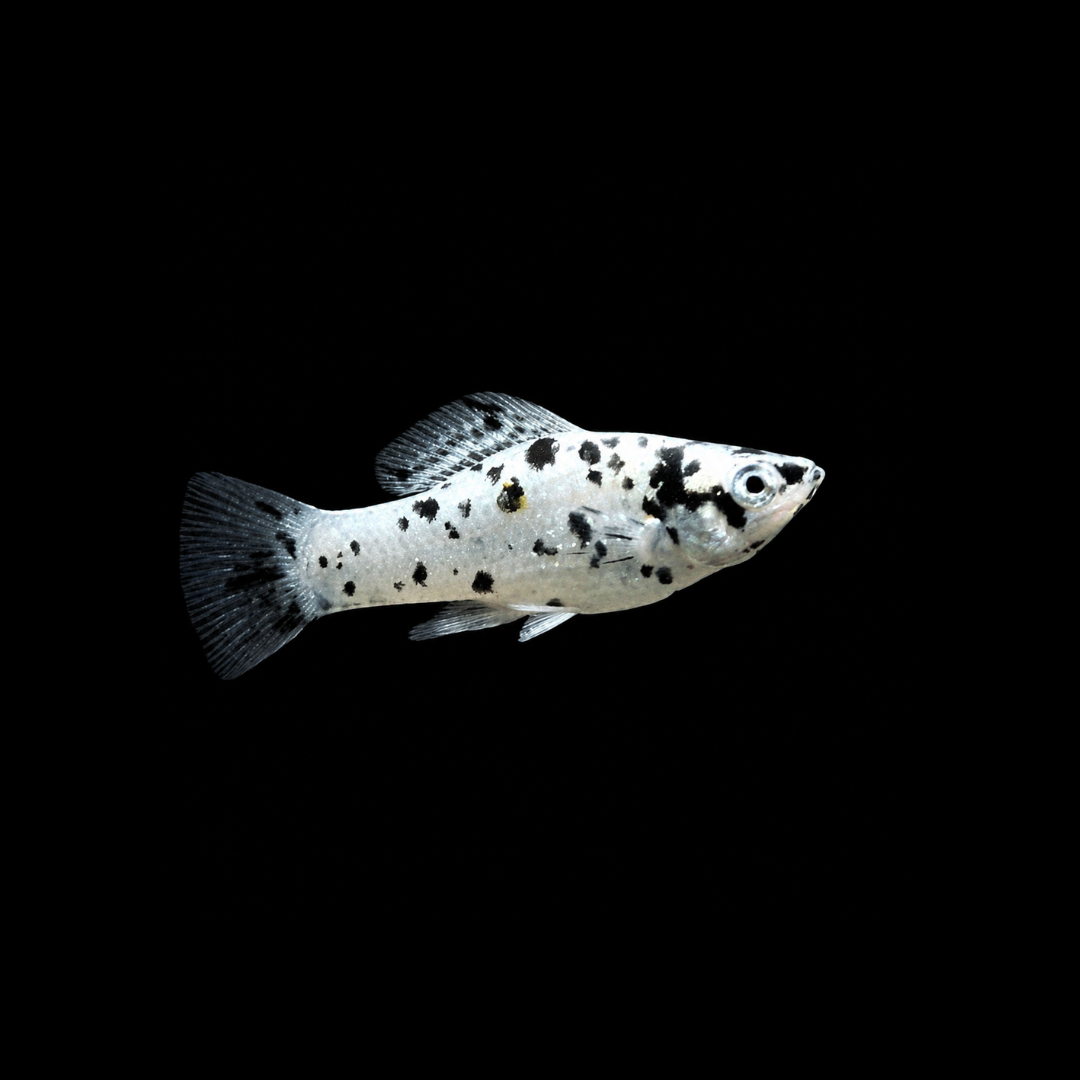
解説 / Description
ダルメシアンモーリーは、銀白色から白色の体に黒い斑点が入るモーリーの観賞用品種です。犬のダルメシアンを思わせる模様には大きな個体差があり、細かな点が散る個体から、黒斑がまとまってマーブル状に見える個体までさまざまです。流通上は Poecilia sphenops var. と記載されることがありますが、観賞用モーリーには交雑由来の系統もあり、流通名だけから野生種を一意に特定することはできません。丈夫で繁殖しやすい一方、長期飼育では水質との相性が重要です。とくに極端な軟水・酸性環境を避け、適度なミネラルを含む中性から弱アルカリ性の水を安定して維持すると調子を保ちやすくなります。日本の水道水やソイル水槽では軟水・弱酸性へ傾くことがあるため、pHだけでなくGHやKHも確認すると管理しやすくなります。 The Dalmatian molly is an ornamental molly strain with black spots on a silvery-white to white body. Its pattern varies widely, from fine scattered speckles to larger patches that create a marbled appearance. In the aquarium trade it may be labeled Poecilia sphenops var., but ornamental mollies include lineages with complex breeding histories, so a trade name alone does not identify a single wild species. Although these fish are generally hardy and breed readily, long-term success depends strongly on suitable water chemistry. They do best when very soft, acidic conditions are avoided and the aquarium provides stable, mineral-rich water from neutral to mildly alkaline. In Japan, soft tap water and active soil substrates can push conditions toward low hardness and acidity, so monitoring GH and KH as well as pH is useful.
基本情報 / Basic Information
| 学名 / Scientific Name | Poecilia sp. (ornamental strain; often traded as Poecilia sphenops var.) |
|---|---|
| 通称 / Common Name | ダルメシアンモーリー、ダルメシアン・モーリーDalmatian molly |
| 分類 / Family | カダヤシ目・カダヤシ科・グッピー属(Poecilia)Order Cyprinodontiformes, family Poeciliidae, genus Poecilia |
| 英名 / English Name | Dalmatian Molly |
| 分布 / Distribution | 観賞用品種のため、ダルメシアンモーリー自体に固有の野生分布はありません。流通モーリーの基盤となる野生種のうち、Poecilia sphenops はメキシコからコロンビアに、Poecilia latipinna は米国南東部からメキシコ湾岸に分布し、淡水から汽水・沿岸域まで利用する系統が知られています。As an ornamental strain, the Dalmatian molly has no natural range of its own. Among wild species that have contributed to the aquarium molly complex, Poecilia sphenops occurs from Mexico to Colombia, while Poecilia latipinna ranges from the southeastern United States to the Gulf coast of Mexico and uses habitats from fresh water to brackish and coastal environments. |
| 最大体長 / Max Size | 一般的なショートフィン系では全長6〜10cm程度が目安です。系統差が大きく、セイルフィン系の特徴を持つ個体ではさらに大型になることがあります。About 6–10 cm is a practical guide for standard short-fin strains. Size varies by lineage, and fish with sailfin ancestry or traits may grow larger. |
| 寿命 / Lifespan | 飼育下では数年程度で、3〜5年ほどがひとつの目安です。水質、系統、繁殖負荷などによって差があります。In captivity, a lifespan of several years is typical, with roughly 3–5 years serving as a practical guide. Longevity varies with water quality, lineage, and reproductive demands. |
飼育環境 / Aquarium Environment
| 水槽サイズ / Tank Size | 標準体型を3〜4匹程度で飼うなら、60cm規格水槽(約60Lクラス)をひとつの目安にすると管理しやすくなります。繁殖を前提とした群れや、大型になる系統を含む場合は、90cm規格水槽以上を選ぶと水質と個体数の管理に余裕が生まれます。モーリーは活発で排泄量も多く、繁殖すると短期間で個体数が増えるため、長期飼育では水量に余裕を持たせることが大切です。For a small group of three to four standard-bodied mollies, a Japanese 60 cm standard aquarium, roughly a 60 L class tank, is a practical starting point. A 90 cm standard aquarium or larger provides more room for breeding groups or larger strains and makes population and water-quality management easier. Mollies are active, produce substantial waste, and can increase in number quickly, so extra water volume is valuable for long-term keeping. |
|---|---|
| 水温 / Temperature | 24〜28℃を中心に管理します。許容範囲の広さよりも、急な温度変化を避けて安定させることを優先してください。 Maintain approximately 24–28°C. Stability is more important than using the full tolerated range, so avoid sudden temperature changes. |
| 水質 / Water Quality | 中性から弱アルカリ性で、適度に硬度のある水を好みます。Poecilia sphenops の飼育・生息情報では pH 7.5〜8.2、硬度11〜30 dHが示されていますが、観賞用品種には系統差があるため、数値を無理に追い込むより、極端な軟水・酸性を避けて安定させることが重要です。アンモニアと亜硝酸は0を維持してください。日本の軟水では、必要に応じてサンゴ砂やカキ殻を濾過槽に少量使う、または観賞魚用のミネラル調整剤を利用し、GH・KHを測りながら調整します。食塩はGHやKHを上げるものではなく、適切な淡水環境が整っていれば常用する必要はありません。They prefer neutral to mildly alkaline water with moderate mineral content. Husbandry and habitat data for Poecilia sphenops list pH 7.5–8.2 and hardness of 11–30 dH, but ornamental strains vary, so the priority is not to force exact numbers but to avoid very soft, acidic water and maintain stable conditions. Keep ammonia and nitrite at zero. In soft Japanese tap water, small amounts of crushed coral or oyster shell in the filter, or a dedicated remineralizing product, can be used while monitoring GH and KH. Sodium chloride does not raise GH or KH and is not required as a permanent additive when suitable freshwater conditions are already maintained. |
| レイアウト / Layout | 中央から上層を泳げる空間を確保しつつ、水草や流木などで休める場所と稚魚の隠れ家を作ります。硬度のある水でも育てやすい水草を選ぶと、水質管理との両立がしやすくなります。水面付近もよく利用するため、飛び出しが心配な環境ではフタを用意します。水面をついばむ姿はよく見られますが、油膜が慢性的に出る場合は、給餌量、濾過、表面水流を見直すことが先です。Leave open swimming room through the middle and upper levels while providing plants or wood for resting areas and fry cover. Choosing plants that tolerate harder water makes it easier to maintain suitable chemistry for both fish and plants. Mollies use the surface frequently, so a lid is helpful where jumping is a concern. They often peck at the water surface, but persistent surface film should be addressed first by reviewing feeding, filtration, and surface movement. |
| 注意点 / Precautions | 飼育で特に避けたいのは、極端な軟水・酸性環境が続くことと、水温や水質が急変することです。活性ソイルを使う水草水槽では、pHだけでなくGH・KHが下がりすぎていないか確認してください。導入時の水合わせは「長時間かけること」自体が目的ではなく、輸送水と水槽水の差を見ながら急変を避けるために行います。塩を治療目的で使う場合は、水草やエビ、貝、同居魚への影響を考え、必要に応じて別容器で行います。The main risks are prolonged exposure to very soft, acidic water and abrupt changes in temperature or water chemistry. In planted aquariums that use active soil, monitor GH and KH as well as pH. Acclimation is not about making the process as long as possible; its purpose is to prevent sudden change while accounting for the difference between transport water and aquarium water. If salt is used therapeutically, consider its effects on plants, shrimp, snails, and tank mates, and use a separate treatment container when appropriate. |
餌と給餌 / Feeding
| 餌の種類 / Diet | 雑食性で、熱帯魚用フレークや小粒ペレットを主食にできます。植物質をよく利用するため、スピルリナなどを含む植物質配合フードや藻類系フードも組み合わせるとよいでしょう。補助的にブラインシュリンプやミジンコなども利用できます。水槽内では柔らかな藻類や付着生物をついばむ姿が見られます。They are omnivorous and readily accept tropical flakes and small pellets as staple foods. Because they make substantial use of plant and algal material, foods containing spirulina or other vegetable ingredients are useful additions. Brine shrimp and daphnia can be offered as supplements. In the aquarium they also graze soft algae and attached microorganisms. |
|---|---|
| 給餌のポイント / Feeding Tips | 1日1〜2回、数分以内に食べ切れる量を基本にします。モーリーは食欲が強い一方、過剰給餌は肥満や水質悪化、油膜の増加につながります。水槽内をついばむ自然な採餌行動もできるよう、食べ残しが出ない量に調整してください。Feed once or twice daily in portions that are consumed within a few minutes. Mollies are enthusiastic feeders, but overfeeding contributes to obesity, declining water quality, and increased surface film. Adjust portions so that no food remains uneaten and the fish still have time for natural grazing behavior. |
性格と混泳 / Temperament and Tank Mates
| 性格 / Temperament | 基本的には温和で活発な魚です。ただし、オスはメスを頻繁に追いかけるため、狭い水槽やオスの多い群れではメスに負担がかかります。複数飼育ではオス1匹に対してメス2〜3匹程度を目安にすると、追尾が一匹に集中しにくくなります。成熟したオス同士では小競り合いが見られることもあります。They are generally peaceful and active, but males frequently court and chase females. In cramped tanks or male-heavy groups, this can place considerable stress on females. A practical guideline is about one male to two or three females so that chasing is not concentrated on a single fish. Mature males may also show minor sparring. |
|---|---|
| 混泳の相性 / Compatibility | 中性から弱アルカリ性で、適度な硬度を好む温和な魚と合わせやすい種類です。プラティやソードテールなどは水質面で合わせやすい代表例です。一方、典型的な軟水性魚とは性格が合っていても、長期的にはどちらかの好適水質を妥協することがあります。ヒレを執拗にかじる魚、大型肉食魚、モーリーを追い回す魚との混泳は避けてください。They are easiest to keep with peaceful species that also prefer neutral to mildly alkaline, moderately hard water. Platies and swordtails are common examples with broadly compatible requirements. Typical soft-water fish may be behaviorally peaceful yet still require a long-term compromise in water chemistry. Avoid persistent fin-nippers, large predators, and fish that repeatedly harass mollies. |
病気と対策 / Diseases and Prevention
| かかりやすい病気 / Common Diseases | 白点病、カラムナリス症を含む細菌性の皮膚・ヒレ・エラの障害、水カビ症などに注意します。また、モーリーでは体をその場で小刻みに揺らす「シミー」と呼ばれる状態が知られています。シミーは特定の病原体による病名ではなく、環境ストレスや体調不良のサインとして現れることがあります。見られた場合は、水温、水質、呼吸状態、体表やヒレの異常などをまとめて確認することが大切です。Watch for ich, bacterial disease affecting the skin, fins, or gills including columnaris, and water mold. Mollies are also known for a condition called the “shimmies,” in which a fish rocks or trembles while staying nearly in place. Shimmies are not the name of a single infectious disease; they can appear as a sign of environmental stress or poor condition. When they occur, check temperature, water quality, breathing, and any visible abnormalities of the skin or fins together rather than assuming one specific cause. |
|---|---|
| 対策と予防 / Prevention | 新しく迎えた個体は、可能であれば本水槽へ入れる前に別容器で一定期間観察します。アンモニア・亜硝酸を0に保ち、水温とGH・KHを安定させ、過密を避けることが基本的な予防策です。シミーが出た場合も、まず水温、pH、GH、KH、アンモニア、亜硝酸などを確認し、環境上の問題があれば修正します。塩水浴は補助的に使われることがありますが、すべての病気に共通する治療ではありません。感染症が疑われる場合は病魚を隔離し、症状と製品表示に合った観賞魚用医薬品を使用します。原因が分からないまま急速に悪化する場合は、魚病に詳しい専門家へ相談してください。When possible, observe newly acquired fish in a separate container for a period before adding them to the main aquarium. Basic prevention consists of keeping ammonia and nitrite at zero, maintaining stable temperature and GH/KH, and avoiding overcrowding. If shimmying occurs, first check temperature, pH, GH, KH, ammonia, and nitrite and correct any environmental problems. Salt baths are sometimes used as supportive care, but they are not a universal treatment for all diseases. If infection is suspected, isolate affected fish and use an aquarium medication that matches the symptoms and product instructions. Seek specialist fish-health advice if the condition worsens rapidly without a clear cause. |
増やし方(繁殖) / Breeding
| 雌雄の判別 / Sexing | 成熟したオスは臀びれが細長い交接器(ゴノポディウム)に変化します。メスの臀びれは扇形のままで、一般にメスの方が体が大きく、腹部もふっくらします。若魚では判別しにくいことがあるため、臀びれの形がはっきりしてから確認すると分かりやすくなります。Mature males have an elongated anal fin modified into a gonopodium. Females retain a fan-shaped anal fin and are generally larger and fuller-bodied. Juveniles can be difficult to sex until the anal-fin shape becomes clear. |
|---|---|
| 繁殖形態 / Reproduction | 体内受精を行い、自由遊泳できる稚魚を直接産むライブベアラーです。日本のアクアリウムでは伝統的に「卵胎生魚」と呼ばれることも多いグループです。Poecilia sphenops では約28日の妊娠期間後に20〜150匹の稚魚を産む記録がありますが、観賞用品種ではメスの大きさ、年齢、系統、栄養状態などによって大きく変わります。メスは精子を体内に保存できるため、オスを分けた後も複数回出産することがあります。Mollies use internal fertilization and give birth directly to free-swimming fry. In Japanese aquarium usage, they have traditionally been grouped among “ovoviviparous” livebearers. Poecilia sphenops has been reported to produce 20–150 young after about 28 days of gestation, but ornamental strains vary greatly with female size, age, lineage, and condition. Females can store sperm, so additional broods may occur after males have been removed. |
| 繁殖のポイント / Breeding Tips | 繁殖そのものは容易ですが、稚魚の生残率を上げるには隠れ家と給餌管理が重要です。細かな水草や産卵箱などを利用して親魚による捕食を減らし、稚魚には細かく砕いた人工飼料、稚魚用フード、ブラインシュリンプ幼生などを少量ずつ与えます。親魚を選ぶ際は模様だけでなく健康状態も重視してください。ダルメシアン柄は個体差が大きく、親と同じ斑点配置がそのまま再現されるとは限らないため、系統をそろえるには複数世代にわたる選別が必要です。Breeding itself is easy, but fry survival depends on cover and feeding management. Fine plants or a breeder box can reduce predation by adults, and fry can be given finely crushed prepared foods, specialized fry food, or newly hatched brine shrimp in small portions. When choosing breeders, consider overall health as well as pattern. Dalmatian markings vary widely, and the exact parental spot arrangement is not reproduced directly, so maintaining a consistent line requires selection over multiple generations. |
雑学と豆知識 / Trivia and Fun Facts
| 1. 「ダルメシアン」は種名ではなく観賞用品種名 / 1. “Dalmatian” is an ornamental strain name, not a species | ダルメシアンモーリーは、自然界に「ダルメシアンモーリー」という一種がいるわけではなく、白地に黒斑が入る観賞用品種名です。流通上は Poecilia sphenops の品種として扱われることがありますが、観賞用モーリーには交雑由来の系統もあります。したがって、販売名と野生種の学名は分けて考える必要があります。見た目が似ていても、背びれの形や体格が異なる系統が流通するのは、この改良の歴史が背景にあります。The Dalmatian molly is not a naturally occurring species named “Dalmatian molly,” but an ornamental strain defined by black markings on a pale body. It is often traded as a variety of Poecilia sphenops, yet ornamental mollies include lineages with hybrid breeding histories. Trade names and wild-species names therefore need to be considered separately. Differences in dorsal-fin shape and body size among similarly patterned fish reflect this complex breeding background. |
|---|---|
| 2. ブラックモーリーの黒色遺伝には古い研究史がある / 2. Black molly pigmentation has a long genetic research history | ブラックモーリーは古くから遺伝学研究に使われ、特定の研究系統では Niger(N)と Melas(M)と呼ばれる優性の色素関連遺伝子座が報告されています。ただし、この知見は特定のブラックモーリー系統についてのもので、現在流通するダルメシアンモーリーの斑点配置を単一の遺伝子で説明するものではありません。つまり、黒色そのものに遺伝的な背景があることと、白黒の模様全体の仕組みが解明されていることは別です。Black mollies have been used in genetic research for decades, and specific laboratory strains have been described as carrying dominant pigmentation loci called Niger (N) and Melas (M). These findings apply to particular black-molly research lines and do not show that the spot arrangement of modern Dalmatian mollies is controlled by one simple gene. In other words, a genetic basis for black pigmentation does not mean that the full black-and-white pattern is completely understood. |
| 3. 近縁のXiphophorusはメラノーマ研究の重要なモデル / 3. Related Xiphophorus fishes are important melanoma models | 1920年代後半、Myron Gordon や Curt Kosswig らは、プラティとソードテールの仲間である Xiphophorus の交雑個体に遺伝的に制御されたメラノーマが生じることを報告しました。その後、この研究系では EGFR に関連するがん遺伝子 xmrk と、腫瘍化を抑える側に関わる R(Diff) 領域などが詳しく研究され、魚類のがん遺伝学を代表するモデルになりました。重要なのは、これは近縁の Xiphophorus で確立した仕組みであり、ダルメシアンモーリーの斑点形成機構として確認されたものではない点です。近い仲間の研究成果は比較材料になりますが、そのまま同じ仕組みだとみなすことはできません。In the late 1920s, Myron Gordon, Curt Kosswig, and others reported genetically controlled melanoma in hybrids of Xiphophorus, the platyfish and swordtail group. Later work identified key components of this model, including the EGFR-related oncogene xmrk and the regulatory R(Diff) region, making Xiphophorus one of the classic fish systems in cancer genetics. The important distinction is that this mechanism is established in Xiphophorus; it has not been demonstrated as the cause of Dalmatian molly spotting. Research on close relatives can provide useful comparisons, but it should not be assumed to describe the same mechanism. |
| 4. アマゾンモーリーは雌性発生を行う / 4. The Amazon molly reproduces by gynogenesis | 同じ Poecilia 属のアマゾンモーリー Poecilia formosa は、メスだけで維持されることで知られる特殊なライブベアラーです。近縁種のオスと交尾し、精子によって胚発生を開始しますが、通常は父由来のDNAを子に取り込まない雌性発生を行います。この系統は Poecilia mexicana のメスと Poecilia latipinna のオスが関わる古い交雑に由来し、少なくとも約10万年前から存続してきたと考えられています。2026年のゲノム研究では、遺伝子変換が有害な変異を減らしたり有利な変化を選択にかけたりする助けになることが示されました。これは、クローンに近い繁殖を続ける脊椎動物が長期間存続できる理由の一端を示す成果です。The Amazon molly, Poecilia formosa, is an unusual livebearer maintained as an all-female lineage. Females mate with males of related species, and sperm triggers embryonic development, but paternal DNA is normally excluded through gynogenesis. The lineage originated from an ancient hybridization involving a female Poecilia mexicana and a male Poecilia latipinna and is thought to have persisted for at least about 100,000 years. A 2026 genomic study showed that gene conversion can help remove harmful mutations and expose beneficial changes to selection, offering part of the explanation for how a nearly clonal vertebrate lineage can persist for such a long time. |
| 5. 極限環境に適応したモーリーの仲間もいる / 5. Some molly relatives are adapted to extreme environments | Poecilia mexicana 種群には、硫化水素を多く含む泉や洞窟など、一般的な魚には厳しい環境へ局所適応した集団が知られています。また、セイルフィンモーリー Poecilia latipinna は淡水だけでなく汽水や沿岸域でも見られます。こうした例は Poecilia 属が幅広い環境へ進化してきたことを示しますが、観賞用ダルメシアンモーリーが急激な水質変化や悪水質に無制限に耐えられるという意味ではありません。家庭では、強さに頼るより適した水質を安定させる方が長期飼育につながります。Populations in the Poecilia mexicana species complex are locally adapted to harsh environments such as hydrogen-sulfide-rich springs and caves. The sailfin molly, Poecilia latipinna, also occurs not only in fresh water but in brackish and coastal habitats. These examples show the broad evolutionary range of Poecilia, but they do not mean that ornamental Dalmatian mollies can tolerate sudden parameter changes or poor water quality without limit. In the aquarium, stable suitable conditions are more important than relying on the fish’s reputation for toughness. |
| 6. 水面をついばむ習性は油膜対策の補助にとどめる / 6. Surface grazing is only a supporting role in film control | モーリーは藻類や植物質を利用し、水面付近をついばむ姿もよく見られます。このため、水面の膜が減ることを期待して飼われる場合があります。ただし、油膜や表面膜が繰り返し発生する原因は、給餌量、溶け込んだ有機物、濾過、表面水流など水槽側にあります。モーリーの採餌行動は補助にはなっても、原因そのものを解決するものではありません。魚に任せきりにせず、水槽管理と組み合わせて考えるのが適切です。Mollies use algae and plant material and are often seen pecking at the water surface. For that reason, they are sometimes kept with the expectation that surface film will decrease. However, recurring film is driven by aquarium conditions such as feeding, dissolved organic material, filtration, and surface movement. Molly grazing can be helpful, but it does not remove the underlying cause. It is best treated as a supporting behavior alongside proper aquarium maintenance. |
まとめ / Conclusion
ダルメシアンモーリーは、個体ごとに異なる白黒模様と、活発に泳ぎ回る姿が魅力のモーリーです。飼育では、十分な遊泳空間と清浄な水に加え、極端な軟水・酸性を避け、適度なミネラルを含む中性から弱アルカリ性の環境を安定して保つことが重要です。日本の軟水では、pHだけでなくGH・KHまで確認すると、水質のずれに気づきやすくなります。 Dalmatian mollies are appealing for their individually varied black-and-white patterns and active swimming behavior. Successful keeping depends on adequate space, clean water, and stable neutral to mildly alkaline conditions with enough mineral content rather than very soft, acidic water. In Japan’s often-soft water, checking GH and KH as well as pH makes it easier to recognize unsuitable chemistry before the fish lose condition.
繁殖しやすく、水槽内の藻類や水面をついばむ様子も楽しめる一方、増えすぎと過剰給餌には注意が必要です。白黒模様の遺伝には未解明の部分が残っていますが、近縁のモーリー類やカダヤシ科魚類は遺伝学・進化学の研究でも重要な存在です。水質を合わせ、無理のない匹数で飼育すれば、ダルメシアンモーリーらしい活発さと一匹ごとの模様の違いを長く楽しめます。 They breed readily and provide the additional interest of grazing algae and pecking at the surface, although population growth and overfeeding need to be controlled. The inheritance of the black-and-white pattern is not fully resolved, while related mollies and other poeciliids remain important subjects in genetics and evolutionary biology. With suitable water chemistry and sensible stocking, the characteristic activity and individual pattern variation of Dalmatian mollies can be enjoyed over the long term.

気になる道具や飼い方を見つけてみませんか?
 アイのアクアグッズ案内小型カラシンの群れを楽しむ|餌と水換えから考える飼育用品ガイド小型カラシンの群れを眺める時間を、もっと楽しく。泳ぐ余白、餌の食べ方、続けやすい水換えを軸に、日本で揃えやすい用品の選び方を紹介します。記事はコチラ →
 アイのアクアグッズ案内そのごはん、泳いでる! 卵から始めるブラインシュリンプの孵化と道具選び道具の特徴や使い方、選ぶときのポイントをアイが紹介します。記事はコチラ →
さまざまな飼育テーマをご紹介。リンク先の記事には広告・商品紹介が含まれます。
案内・紹介記事一覧へ →分布マップ
ダルメシアンモーリー自体は観賞用品種のため固有の野生分布を持ちません。流通モーリーの基盤となる野生種を参考に、Poecilia sphenops のメキシコからコロンビア、および Poecilia latipinna の米国南東部からメキシコ湾岸までを含む範囲を概略表示しています。
※この地図は記事に記載された分布地域をもとにした概略表示であり、分布境界を厳密に示すものではありません。マーカーは地図上の目安として設定した代表地点で、実際の採集地点・観察地点を示すものではありません。
参考文献
- Fricke, R., Eschmeyer, W. N. & Van der Laan, R. (eds.). 2026. Eschmeyer’s Catalog of Fishes: Genera, Species, References. California Academy of Sciences. Poecilia sphenops species record. 2026年8月25日閲覧。
- Froese, R. & Pauly, D. (eds.). 2026. FishBase, version 02/2026. Poecilia sphenops species summary. 2026年8月25日閲覧。
- U.S. Geological Survey. 2026. Poecilia latipinna (Sailfin Molly) — Species Profile. Nonindigenous Aquatic Species Database. USGS NAS Species Profile. 2026年8月25日閲覧。
- Johnson, E. S. 2025. Standardized Approach to Life History Data Collection in Poeciliid Fishes. Ecology and Evolution, 15(2), e70735. https://doi.org/10.1002/ece3.70735.
- Livengood, E. J. & Chapman, F. A. The Ornamental Fish Trade: An Introduction with Perspectives for Responsible Aquarium Fish Ownership. University of Florida IFAS Extension, FA124. UF/IFAS Extension. 2026年8月25日閲覧。
- Francis-Floyd, R., Yanong, R. P. E. & Pouder, D. B. Ichthyophthirius multifiliis (White Spot) Infections in Fish. University of Florida IFAS Extension, CIR920/FA006. UF/IFAS Extension. 2026年8月25日閲覧。
- Francis-Floyd, R., Stilwell, N. K. & Yanong, R. P. E. Introduction to Fish Health Management. University of Florida IFAS Extension, CIR921/FA004. UF/IFAS Extension. 2026年8月25日閲覧。
- Merck Veterinary Manual. Bacterial Diseases of Fish. Merck Veterinary Manual. 2026年8月25日閲覧。




コメント