

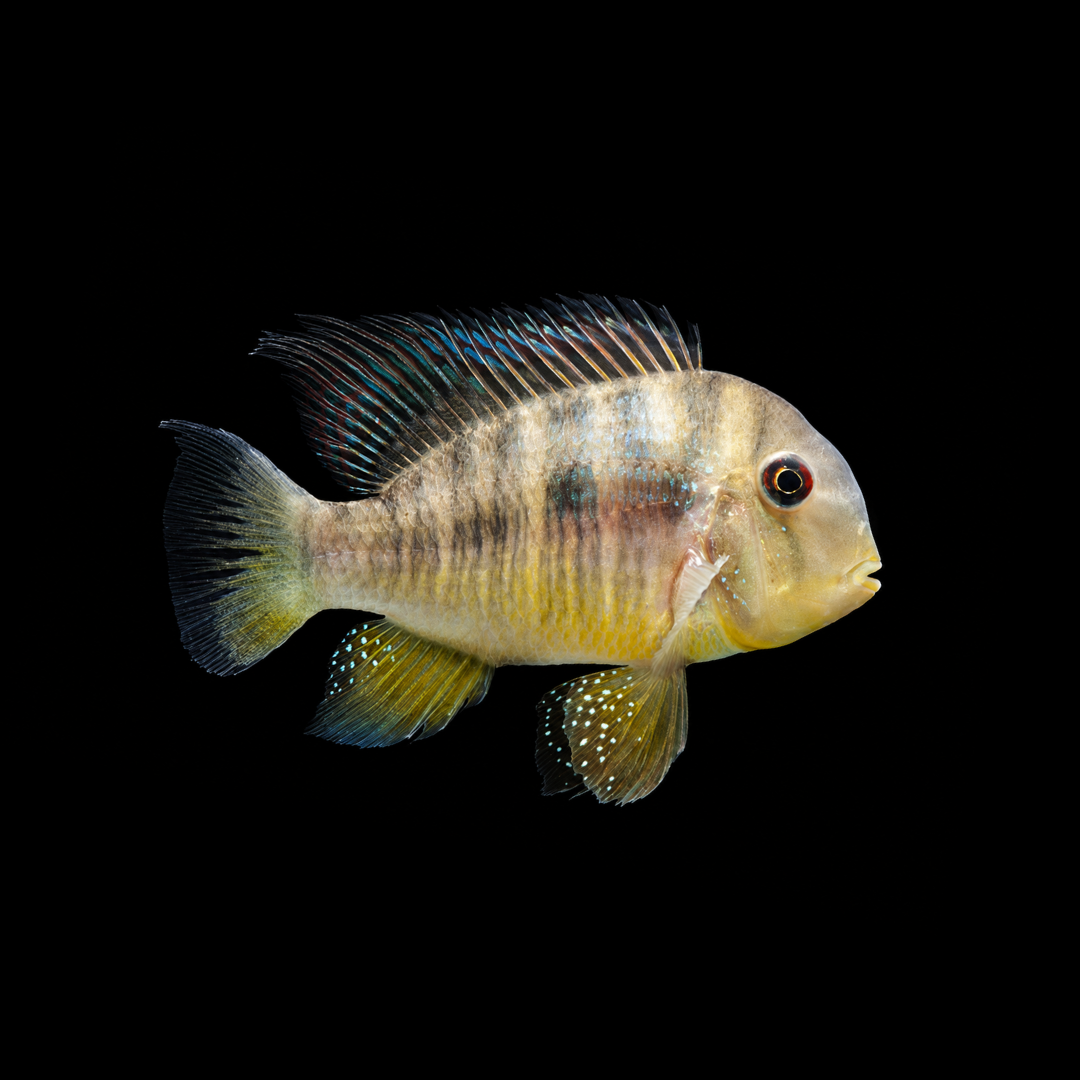
解説 / Description
ギムノゲオファーガス・バルザニィは、ラプラタ水系を中心に南米中南部へ分布し、グアポレ川水系にも記録があるギムノゲオファーガス属のシクリッドです。前後に詰まった高い体型と、成熟したオスの頭部に発達する大きな瘤がひときわ目を引きます。底砂を口に含み、餌になる小動物や有機物を選り分けながら砂を排出する「アースイーター」らしい採餌行動も大きな見どころです。本種は季節による水温変化がある地域に生息するため、飼育でも年間を通じて高水温に固定せず、夏の高温を避けながら季節変化を意識した温度管理が重要です。 Gymnogeophagus balzanii is a South American cichlid distributed mainly in the La Plata drainage, with an additional record from the Guaporé River system. It is immediately recognizable by its short, deep body and the prominent nuchal hump that develops in mature males. It also shows classic “eartheater” behavior, taking substrate into the mouth, separating edible material, and expelling the remaining sand. Because the species occurs in regions with seasonal temperature changes, long-term aquarium care should avoid permanently high temperatures, with particular attention to excessive summer heat and an appropriate seasonal temperature cycle.
基本情報 / Basic Information
| 学名 / Scientific Name | Gymnogeophagus balzanii |
|---|---|
| 通称 / Common Name | バルザニィ、パラグアイ・アースイーター、アルゼンチン・ハンプヘッドParaguay Eartheater, Argentine Humphead |
| 分類 / Family | シクリッド科(Cichlidae)シクリナエ亜科(Cichlinae)ゲオファーガス族(Geophagini)ギムノゲオファーガス属Family Cichlidae, subfamily Cichlinae, tribe Geophagini, genus Gymnogeophagus |
| 英名 / English Name | Paraguay Eartheater / Argentine Humphead |
| 分布 / Distribution | アルゼンチン、ブラジル、ボリビア、パラグアイ、ウルグアイ。パラナ川・パラグアイ川水系と下流ウルグアイ川水系を中心に分布し、アマゾン水系のグアポレ川からも記録があります。Argentina, Brazil, Bolivia, Paraguay, and Uruguay. The species is distributed mainly in the Paraná-Paraguay system and the lower Uruguay drainage, with an additional record from the Guaporé River in the Amazon basin. |
| 最大体長 / Max Size | 全長で最大約20cmに達するとされます。成熟したオスはメスより大型になり、体高も増すため、成魚では数字以上に重厚な印象になります。The species is reported to reach about 20 cm in total length. Mature males become larger and deeper-bodied than females, giving adult males a particularly heavy appearance. |
| 寿命 / Lifespan | 飼育下の平均寿命を一定の年数で示せる信頼性の高い情報は限られます。Reliable information is limited for assigning a single average lifespan in captivity. |
飼育環境 / Aquarium Environment
| 水槽サイズ / Tank Size | 成魚の単独飼育やペア飼育でも、90cm規格水槽(90×45×45cm、総容量約180L)をひとつの最低目安とします。オス1匹と複数のメスを収容する場合は、120cm規格水槽以上(総容量約240L以上)を基準に、個体数や縄張り行動に応じてさらに広い水槽を選びます。幼魚は60cmワイド水槽などで育成できますが、成長に合わせたサイズアップが前提です。For an adult kept alone or as a compatible pair, a standard 90 cm aquarium measuring about 90 × 45 × 45 cm, with a gross volume of roughly 180 L, is a practical minimum reference. For one male with several females, use at least a standard 120 cm aquarium, roughly 240 L or more, and increase the available space according to group size and territorial behavior. Juveniles can be raised temporarily in a 60 cm wide tank, but an upgrade is necessary as they grow. |
|---|---|
| 水温 / Temperature | 通常期は21〜25℃を目安にします。冬季に16〜18℃程度まで水温を下げる季節的な管理は飼育例で広く用いられますが、期間を一律に3〜4か月の必須条件とするよりも、年間を通じた高水温固定を避けることが重要です。30℃前後の高水温が続く環境では負担が大きくなるため、日本の夏は水槽用クーラーや室内空調を利用して過度な水温上昇を防ぎます。 A normal-season range of about 21–25°C is a practical target. Seasonal cooling to around 16–18°C in winter is widely used in aquarium husbandry, but it is better treated as part of an annual temperature cycle rather than as a rigid three- to four-month rule. Avoid keeping the fish at high temperatures throughout the year, and prevent prolonged temperatures around 30°C during hot summers by using an aquarium chiller or room air-conditioning when necessary. |
| 水質 / Water Quality | pH6.0〜8.0が広く飼育目安として示され、硬度は5〜19dH程度が参考範囲です。数値を細かく追うことよりも、水質を急変させず、十分な生物濾過と定期的な換水によって硝酸塩や有機物を蓄積させないことを重視します。水流は強くしすぎず、水槽全体に穏やかに循環させます。A pH of 6.0–8.0 is widely cited as a practical aquarium range, with hardness around 5–19 dH serving as a broad reference. More important than chasing exact values is avoiding sudden changes and preventing the accumulation of nitrate and organic waste through adequate biological filtration and regular water changes. Keep circulation gentle rather than creating a strong current. |
| レイアウト / Layout | 底床には角のない目の細かい砂を十分に敷き、砂を口に含んでふるう本来の採餌行動を妨げないようにします。流木や丸みのある石で視線を切り、メスが退避できる場所を複数作ると安定しやすくなります。水草は掘り返されやすいため、アヌビアス類やミクロソリウムのように流木や石へ活着させる種類、あるいは鉢植えが向いています。Use a generous layer of smooth, fine sand so the fish can sift the substrate naturally without damaging the mouth or gill structures. Driftwood and rounded rocks can be used to break lines of sight and provide several retreats for females. Rooted plants are often uprooted, so epiphytes such as Anubias and Java fern attached to wood or stone, or plants kept in protected pots, are more practical. |
| 注意点 / Precautions | 年間を通じて高水温に固定する飼育は避け、特に夏の過度な水温上昇に注意します。また、粗い砂利や角の鋭い底床は、砂を口に含む際に口周りや鰓を傷つけるおそれがあります。成熟オスは同種オスに対して強い縄張り性を示すため、複数オスを収容する場合は十分な水槽サイズと逃げ場が必要です。Avoid maintaining the species at high temperatures throughout the year, and pay particular attention to excessive summer heat. Coarse gravel or sharp substrate can injure the mouth or gill area during normal sifting behavior. Mature males can be strongly territorial toward other males, so keeping more than one male requires substantial space and multiple retreats. |
餌と給餌 / Feeding
| 餌の種類 / Diet | 雑食性で、動物質を好む傾向があります。主食には良質なシクリッド用沈下性ペレットを用い、冷凍アカムシ、ブラインシュリンプ、ミジンコなどを副食として組み合わせます。植物質を含む人工飼料も適度に取り入れ、特定の餌だけに偏らないようにします。The species is omnivorous and tends to favor animal-based foods. Use a high-quality sinking cichlid pellet as the staple diet and supplement it with foods such as frozen bloodworms, brine shrimp, and daphnia. Prepared foods containing some plant material can also be included so the diet does not become overly narrow. |
|---|---|
| 給餌のポイント / Feeding Tips | 水面よりも底床付近で餌を探す性質が強いため、沈下性の餌を中心にします。細かい砂の上へ広く落とすと、砂を口に含んで選別する自然な採餌行動を観察しやすくなります。食べ残しが底床に埋もれると水質悪化につながるため、少量ずつ与え、残餌が多い場合は給餌量を調整してください。Because the fish strongly prefers to forage near the bottom rather than at the surface, sinking foods should dominate the feeding routine. Dispersing small portions over fine sand encourages natural sifting behavior. Uneaten food can become buried and contribute to deteriorating water quality, so feed modest portions and adjust the amount if leftovers accumulate. |
性格と混泳 / Temperament and Tank Mates
| 性格 / Temperament | 同程度の大きさの他種に対しては比較的落ち着いた面がありますが、繁殖期のオスは縄張り意識が強く、同種オスを激しく追うことがあります。メスも産卵後は卵や仔魚を守るため攻撃性が高まります。普段は底層を中心に行動し、砂をふるいながら探索する時間が長い魚です。It is relatively calm toward similarly sized fish of other species, but breeding males become strongly territorial and may vigorously drive away rival males. Females also become more defensive after spawning while protecting eggs and fry. Much of the fish’s normal activity occurs near the bottom as it searches and sifts through sand. |
|---|---|
| 混泳の相性 / Compatibility | 混泳相手は、本種と同じ季節的な温度管理に対応でき、極端に小さすぎず、主な遊泳層が重なりにくい穏やかな魚が向きます。年間を通じて高水温を必要とする魚、ヒレをつつきやすい魚、極端に攻撃的な大型シクリッドとの組み合わせは避けます。同種では成熟オス同士の争いが起こりやすいため、特に注意が必要です。Suitable tank mates should tolerate the same seasonal temperature regime, be large enough not to be treated as prey, and preferably occupy different swimming levels without being overly aggressive. Avoid species that require consistently high temperatures, persistent fin-nippers, and highly aggressive large cichlids. Extra caution is needed with conspecific males because territorial disputes can become intense. |
病気と対策 / Diseases and Prevention
| かかりやすい病気 / Common Diseases | 本種だけに特有、あるいは特に高頻度と断定できる病気の情報は限られます。シクリッドで見られる頭部穴あき病のような頭部・側線周辺の異常には注意し、水質悪化や底床の汚れ、口周りの外傷を放置しないことが大切です。Reliable information is limited for identifying a disease that is unique to, or clearly more frequent in, this species. As with other cichlids, watch for abnormalities around the head and lateral line, including signs commonly described as hole-in-the-head disease, and do not allow poor water quality, dirty substrate, or mouth injuries to persist. |
|---|---|
| 対策と予防 / Prevention | 十分な濾過能力を確保し、底床に残餌や糞をためないことが基本です。定期的な換水を行い、フィルターの吐出は水槽全体に分散して、強すぎる直線的な水流を避けます。食欲低下、体色の急な変化、頭部や側線の異常が見られた場合は、まず水温と水質、外傷の有無を確認します。Prevention begins with adequate filtration and avoiding the accumulation of uneaten food and waste in the substrate. Perform regular water changes and disperse filter return flow through the aquarium rather than directing a strong jet at the fish. If appetite declines, coloration changes abruptly, or abnormalities appear around the head or lateral line, first check temperature, water quality, and possible injuries. |
増やし方(繁殖) / Breeding
| 雌雄の判別 / Sexing | 成熟オスはメスより大型になり、頭部に目立つ瘤を発達させます。背鰭と尻鰭も後方へ伸び、繁殖期には体色がより鮮やかになります。メスはより小型で、頭部の瘤や鰭の伸長はオスほど顕著ではありません。Mature males become larger than females and develop a conspicuous nuchal hump. The dorsal and anal fins also become more extended, and coloration intensifies in breeding condition. Females remain smaller, with much less development of the hump and fin extensions. |
|---|---|
| 繁殖形態 / Reproduction | 遅延型の母系マウスブルーダーです。メスは平らな石などの基質へ産卵し、しばらく卵を守ったのち、孵化した仔魚を口内へ収容して保護します。産卵直後から卵を口に含むタイプではない点が、本種の繁殖行動の特徴です。This species is a delayed maternal mouthbrooder. The female lays eggs on a cleaned surface such as a flat stone, guards them there for a period, and then takes the hatched larvae into her mouth for protection. Unlike immediate mouthbrooders, she does not begin oral incubation as soon as the eggs are laid. |
| 繁殖のポイント / Breeding Tips | 年間の温度を一定に固定せず季節変化をつけ、平らな産卵基質とメスが退避できる場所を用意します。繁殖期のオスは縄張り意識が強くなるため、オス同士を避け、十分な広さがある場合はオス1匹と複数のメスで管理しやすくなります。産卵後はメスが保育を担うため、驚かせず落ち着いた環境を保ちます。稚魚が自由遊泳を始めたら、ブラインシュリンプ幼生や細かく砕いた人工飼料を与えます。Do not keep the annual temperature completely constant; provide a seasonal cycle, along with a flat spawning surface and retreats for females. Males become strongly territorial during breeding, so rival males are best avoided. Where adequate space is available, one male with several females is often easier to manage. After spawning, the female provides the parental care, so minimize disturbance. Once the fry become free-swimming, offer newly hatched brine shrimp or finely crushed prepared food. |
雑学と豆知識 / Trivia and Fun Facts
| 1. 「バルザニィ」に残された探検家の名前 / 1. The Explorer Remembered in “balzanii” | 種小名の「balzanii」は、19世紀末に南米を探検したイタリアの博物学者ルイジ・バルザンに献名されたものです。バルザンが採集した標本はヨーロッパへ運ばれ、1891年にアルベルト・ペルージャが本種を科学的に記載しました。水槽の中で悠然と砂をふるう一匹の背後には、まだ南米内陸部の生物相が十分に知られていなかった時代の探検史が重なっています。学名を知ると、バルザニィは単に珍しい観賞魚ではなく、19世紀の博物学と標本採集の歴史を今に伝える存在としても見えてきます。The species name “balzanii” honors the Italian naturalist and explorer Luigi Balzan, who collected important biological material in South America near the end of the nineteenth century. Specimens from his journeys reached Europe, and Alberto Perugia formally described the species in 1891. Behind the image of a fish calmly sifting sand in an aquarium lies an era when the inland fauna of southern South America was still poorly known to European science. Knowing the origin of the name gives the species a direct connection to the history of nineteenth-century natural history and exploration. |
|---|---|
| 2. 「裸のゲオファーガス」という属名の意味 / 2. Why the Genus Means “Naked Geophagus” | 属名のGymnogeophagusは、ギリシャ語で「裸」を意味するgymnosと、「土を食む者」を意味するGeophagusを組み合わせた名称です。名前の「裸」は体全体に鱗がないという意味ではなく、頬部や背鰭前方の正中線上に鱗がないという特徴を指しています。砂を口に含む姿だけを見ると典型的なゲオファーガス類に見えますが、解剖学的には独自の特徴を積み重ねてきた系統であることが、属名そのものに刻まれています。The genus name Gymnogeophagus combines the Greek gymnos, meaning “naked,” with Geophagus, literally “earth-eater.” The word “naked” does not mean that the entire body lacks scales. Instead, it refers to characteristic scaleless areas on the cheek and along the midline in front of the dorsal fin. The fish may look like a typical eartheater while sifting sand, yet its anatomy preserves distinctive features that separate this lineage from other geophagine cichlids. |
| 3. 冬の低水温が作る「季節のあるシクリッド」 / 3. A Cichlid Shaped by a Real Winter | バルザニィの主な分布域は、季節による気温や水温の変化がある南米中南部です。飼育でも一年中同じ高水温に固定するのではなく、年間の温度変化を意識することが重要とされています。ただし、本種を単純な「冷水魚」と考えるのも適切ではありません。日本では冬よりも夏の高水温が問題になりやすく、季節に合わせて温度を調整する魚だと捉えると、その性質を理解しやすくなります。Most populations of G. balzanii occur in regions of central and southern South America where air and water temperatures change with the seasons. In captivity, it is therefore better to think in terms of an annual temperature cycle rather than keeping the fish permanently warm. At the same time, this does not make the species a simple “cold-water fish.” In Japan, excessive summer heat can be a greater concern than winter temperatures, so seasonal adjustment is the most useful way to understand its thermal requirements. |
| 4. 砂を食べているように見えて、実は選別している / 4. It Looks Like Sand-Eating, but It Is Sorting | 「アースイーター」という呼び名から、砂そのものを食べているように思われがちですが、実際には底床を口に含み、その中から食べられる小動物や有機物を選り分けています。不要な砂は口や鰓側から排出されます。水槽で細かく角のない砂が向くのは、自然な採餌行動を観察しやすくするだけでなく、口周りを傷つけにくくするためでもあります。The name “eartheater” can make it sound as though the fish literally eats sand. In practice, it takes substrate into the mouth and separates edible small animals and organic material from the mineral particles. Unwanted sand is then expelled through the mouth or gill openings. Fine, smooth sand is therefore useful not only for observing natural foraging behavior but also for reducing the risk of injury around the mouth. |
| 5. 卵をすぐ口に入れない、遅延型マウスブルーディング / 5. Mouthbrooding That Begins Only After Hatching | バルザニィの繁殖で興味深いのは、産卵直後から卵を口に含むのではないことです。メスはいったん平らな基質の上で卵を守り、孵化した仔魚を口内へ移して保護します。基質産卵から口内保育へ段階的に切り替わるため、「遅延型」のマウスブルーディングと呼ばれます。ひとつの繁殖の中で二つの保育方法が連続する点は、本種を観察する大きな魅力です。One of the most interesting features of breeding in G. balzanii is that the female does not take the eggs into her mouth immediately after spawning. She first guards them on a flat surface and then transfers the hatched larvae into her mouth for protection. Because oral care begins after the initial substrate phase, the behavior is described as delayed mouthbrooding. The transition between two forms of parental care makes reproduction especially rewarding to observe. |
まとめ / Conclusion
ギムノゲオファーガス・バルザニィは、大きな頭部の瘤だけでなく、砂を選り分ける採餌行動や季節的な温度変化への適応、基質産卵から口内保育へ移る独特の繁殖行動にも魅力があります。成長した姿だけでなく、日々の行動や繁殖まで観察することで、本種らしさがよりはっきりと見えてきます。 Gymnogeophagus balzanii is notable not only for the male’s large nuchal hump, but also for its sand-sifting feeding behavior, adaptation to seasonal temperature changes, and unusual transition from substrate spawning to mouthbrooding. Its character becomes most apparent when its everyday behavior and breeding are observed as closely as its adult appearance.
十分な広さの水槽、口に優しい細砂、安定した水質、そして夏の高温を避けた季節的な温度管理を整えると、砂をふるいながら探索する本来の行動や、成熟オスの存在感を楽しみやすくなります。成長と季節ごとの変化をゆっくり見守りながら付き合いたい、個性豊かな南米シクリッドです。 With adequate space, mouth-safe fine sand, stable water quality, and a seasonal temperature regime that avoids excessive summer heat, the species can show its characteristic substrate-sifting behavior and the impressive presence of a mature male. It is a distinctive South American cichlid best appreciated by aquarists who enjoy watching gradual changes in growth and seasonal condition.
気になる道具や飼い方を見つけてみませんか?
 アイのアクアグッズ案内水槽のろ材の選び方|ウール・リング・活性炭の違いとおすすめ商品フィルターの中の綿や石は何をしている? アイとコタロウが、ウール・スポンジ・セラミック・焼結ガラス・活性炭・ゼオライトを比較。機種との相性、入れ方、洗い方と交換まで商品とともに紹介します。記事はコチラ →
 アイのアクアグッズ案内グッピー・プラティ・モーリーを親子で楽しむ飼育用品|水槽・稚魚保護・ろ過・餌・水草道具の特徴や使い方、選ぶときのポイントをアイが紹介します。記事はコチラ →
 アイのアクアグッズ案内水槽のエアーポンプの選び方|水深・音・泡で選ぶおすすめ用品道具の特徴や使い方、選ぶときのポイントをアイが紹介します。記事はコチラ →
 アイのアクアグッズ案内水槽用浄水器の選び方|水換えを楽にするタイプとROの違い道具の特徴や使い方、選ぶときのポイントをアイが紹介します。記事はコチラ →
さまざまな飼育テーマをご紹介。リンク先の記事には広告・商品紹介が含まれます。
案内・紹介記事一覧へ →分布マップ
ギムノゲオファーガス・バルザニィ(Gymnogeophagus balzanii)は、アルゼンチン、ブラジル、ボリビア、パラグアイ、ウルグアイに分布し、主にパラナ川・パラグアイ川水系と下流ウルグアイ川水系に生息します。アマゾン水系のグアポレ川からも記録があります。
※この地図は記事の分布情報をもとに、主要な分布地域全体が見えるよう設定した概略表示です。マーカーは分布域を把握しやすくするための代表地点であり、実際の採集地点・標本採集地点を示すものではありません。
参考文献
-
Fricke, R., Eschmeyer, W. N. & Van der Laan, R. (eds.). Eschmeyer’s Catalog of Fishes: Genera, Species, References. California Academy of Sciences.分類 学名・シノニム 分布Eschmeyer’s Catalog of Fishes: Gymnogeophagus balzanii
-
Reis, R. E. & Malabarba, L. R. (1988). Revision of the neotropical cichlid genus Gymnogeophagus Ribeiro, 1918, with descriptions of two new species (Pisces, Perciformes). Revista Brasileira de Zoologia, 4(4), 259–305.分類 形態 分布SciELO
-
Malabarba, L. R., Malabarba, M. C. & Reis, R. E. (2015). Descriptions of five new species of the Neotropical cichlid genus Gymnogeophagus Miranda Ribeiro, 1918 (Teleostei: Cichliformes) from the rio Uruguay drainage. Neotropical Ichthyology, 13(4), 637–662.分類 形態 雌雄差 系統関係https://doi.org/10.1590/1982-0224-20140188
-
Turcati, A., Serra-Alanis, W. S. & Malabarba, L. R. (2018). A new mouth brooder species of Gymnogeophagus with hypertrophied lips (Cichliformes: Cichlidae). Neotropical Ichthyology, 16(4), e180118.繁殖 マウスブルーディング 分布https://doi.org/10.1590/1982-0224-20180118
-
Froese, R. & Pauly, D. (eds.). FishBase: Gymnogeophagus balzanii.分布 生息環境 体長 水温・pH・硬度 繁殖FishBase
-
Amesberger-Freitag, A., Tichy, A., El-Matbouli, M. & Lewisch, E. (2019). Hole-in-the-head disease in discus fish, Symphysodon (Heckel, 1840): Is it a consequence of a dietary Ca/P imbalance? Journal of Fish Diseases, 42(8), 1133–1142.病気 頭部穴あき病 原因評価https://doi.org/10.1111/jfd.13023




コメント