


解説 / Description
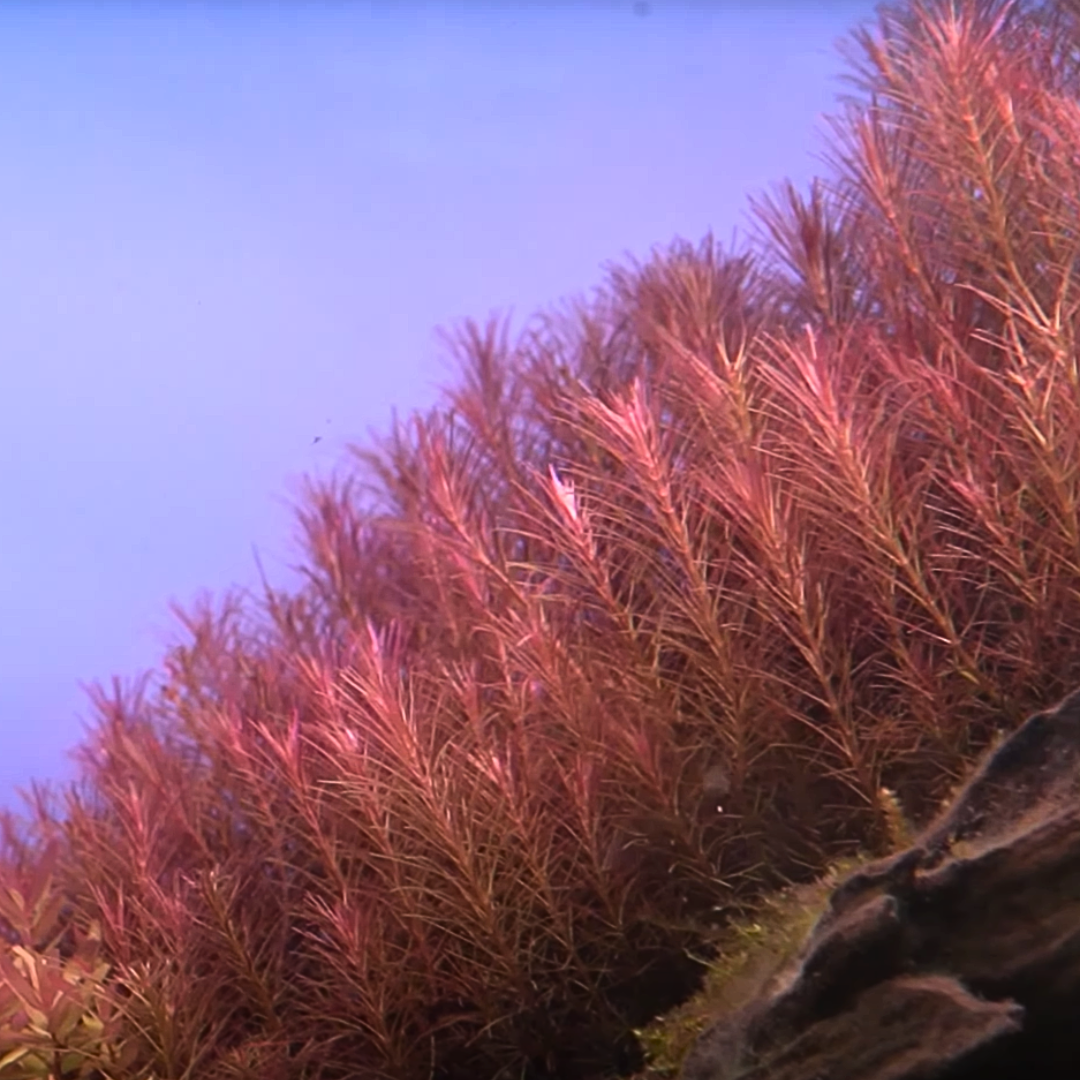
リスノシッポは、ミソハギ科キカシグサ属の有茎草ロタラ・ワリッキーの流通名です。茎の節ごとに糸のように細い葉が何枚も輪になってつき、水中ではふんわりとした房のような姿になります。その様子がリスのしっぽを思わせることから、この愛らしい名前で呼ばれるようになりました。状態よく育った株は、株元のオリーブグリーンから頂部のピンク、赤、オレンジへと色が移ろい、水槽の中にやわらかな炎が灯ったような景色をつくってくれます。 “Risu-no-shippo” (literally “squirrel’s tail”) is the Japanese trade name for Rotala wallichii, a stem plant in the genus Rotala of the loosestrife family, Lythraceae. Each node bears a whorl of thread-fine leaves, so submerged stems form soft, feathery plumes reminiscent of a squirrel’s tail, which is where the charming Japanese name comes from. A well-grown stem shifts from olive green at the base to pink, red and orange at the tip, glowing in the tank like a gentle flame.
一方で、ロタラの仲間の中でもとくに気難しい種類として知られています。軟らかく弱酸性の水、強い光、安定したCO2添加、適度な鉄分のうち、どれかひとつが欠けるだけで成長が止まり、頂芽が白っぽくなったり下葉が落ちたりしがちです。それでも、条件がそろったときに見せる繊細な質感と色合いは格別です。いつか真っ赤に染まった茂みをつくりたいと、多くのアクアリストが挑戦を続ける、上級者の憧れの水草といえるでしょう。 On the other hand, it is known as one of the most demanding members of the genus. If any one of soft, slightly acidic water, strong light, steady CO2 injection or adequate iron is missing, the plant tends to stall, its growing tips turn pale and its lower leaves drop. Yet the delicate texture and color it shows when everything comes together are exceptional. Many aquarists keep taking up the challenge in hopes of one day growing a fully red stand, making it a plant that advanced hobbyists aspire to.
基本情報 / Basic Information
| 学名 / Scientific Name | Rotala wallichii (Hook.f.) Koehne 最初は別属のHydrolythrum wallichiiとして記載され、のちにキカシグサ属(ロタラ属)へ移されました。種小名は植物学者ナサニエル・ウォリッチにちなみます。Originally described as Hydrolythrum wallichii in a separate genus and later transferred to Rotala. The specific epithet honors the botanist Nathaniel Wallich. |
|---|---|
| 通称 / Common Name | リスノシッポ、ロタラ・ワリッキーWhorly Rotala, Rotala wallichii |
| 分類 / Family | ミソハギ科 キカシグサ属(ロタラ属)Lythraceae, genus Rotala |
| 分布 / Distribution | 中国南部や台湾から東南アジア、インドにかけて分布します。湿地や水田、沼、流れのゆるやかな水辺に生え、水位の変化に合わせて水上でも水中でも育つことができる両生植物です。Found from southern China and Taiwan through Southeast Asia to India. It grows in marshes, rice paddies, ponds and slow-moving waters, and as an amphibious plant it can grow both above and below the water as levels change. |
| 育成難易度 / Difficulty | 難しい(上級者向け)。軟水・弱酸性の水、強い光、CO2添加がそろって初めて本来の姿を見せます。CO2無添加の水槽や硬めの水では、長期維持は困難です。Difficult (for advanced growers). It only shows its true form when soft, slightly acidic water, strong light and CO2 injection are all in place. Long-term success is very unlikely without CO2 or in harder water. |
育成環境 / Cultivation Environment
| 光量 / Light | 強い光が必要です。60cm規格水槽(約57L)であれば、水草育成用の高出力LEDを使うのがひとつの目安です。光が強いほど赤く色づきやすく、光が足りないと緑がかった細長い姿になり、下葉も落ちやすくなります。赤い光ばかりを強くすると茎が間延びしやすいため、青や白の光もしっかり含むバランスのよい照明が向いています。点灯時間は1日7〜8時間ほどを基本にしましょう。Strong light is essential. For a standard 60 cm tank (about 57 L), a high-output planted-tank LED is a good benchmark. The stronger the light, the more readily the plant turns red; under insufficient light it becomes greenish and leggy, and its lower leaves drop more easily. Boosting only red light tends to make stems stretch, so a well-balanced fixture that also provides plenty of blue and white light is best. Aim for a photoperiod of around 7–8 hours a day. |
|---|---|
| CO2添加 / CO2 Injection | 必須です。細い葉は水中のCO2不足の影響をすぐに受け、葉が小さくなったり頂芽が白くなったりします。強い照明と組み合わせ、点灯中は途切れないよう安定して添加することが大切です。魚やエビの様子を見ながら、ドロップチェッカーなどで濃度を確認すると安心です。Required. The fine leaves react quickly to a lack of CO2, producing smaller leaves and pale growing tips. Pair it with strong lighting and keep the supply steady and uninterrupted throughout the photoperiod. Checking the level with a drop checker while watching your fish and shrimp is a safe approach. |
| 水質 / Water Quality | 水温21〜28℃、pH5.5〜6.8、総硬度(GH)2〜6程度、炭酸塩硬度(KH)0〜4程度の、軟らかく弱酸性の水を好みます。30℃を超える高水温では調子を崩しやすいため、夏場は冷却ファンなどで対策しましょう。日本の水道水は軟水の地域が多いものの、地域によっては硬度がやや高いこともあるので、一度測っておくと安心です。硬度が高い場合は、RO水(逆浸透膜で浄化した水)を混ぜて調整する方法もあります。Prefers soft, slightly acidic water: 21–28 °C, pH 5.5–6.8, GH around 2–6 and KH around 0–4. Temperatures above 30 °C easily upset it, so use a cooling fan or similar in summer. Tap water in much of Japan is soft, but some areas are somewhat harder, so it is worth testing once. If your water is hard, blending in RO (reverse osmosis) water is one way to adjust it. |
| 底床 / Substrate | pHと硬度を下げる働きのある栄養系ソイルが、ほぼ必須です。大磯砂のような砂利や、硬度を上げやすい石を多く使ったレイアウトとは相性がよくありません。追肥は鉄分を含む液体肥料を中心に、カリウムや微量元素もバランスよく補いましょう。鉄分が不足すると新芽が黄白色になり、赤い色はもちろん、緑色を保つことも難しくなります。上級者の間では、硝酸塩をやや控えめにしつつリン酸塩は切らさないようにして、赤みを強める工夫も知られています。ただし窒素を絞りすぎると成長そのものが止まってしまうため、様子を見ながら少しずつ試すのがおすすめです。A nutrient-rich aqua soil that lowers pH and hardness is practically a must. It does not pair well with inert gravel or with layouts that use many stones that raise hardness. Fertilize mainly with an iron-containing liquid fertilizer, and supply potassium and trace elements in balance. With too little iron, new shoots turn yellowish-white and the plant struggles to stay green, let alone red. Some advanced growers deepen the red by keeping nitrate on the lean side while never letting phosphate run out. However, cutting nitrogen too far stops growth altogether, so adjust gradually while watching the plant. |
レイアウト / Layout
| 配置 / Positioning | 中景から後景に向いています。ダッチアクアリウムでは、細かく赤い葉そのものが強い見どころになるため、丸く大きな緑の葉を持つ水草を隣に置くと、色と葉の形の対比がくっきりと際立ちます。ネイチャーアクアリウム風の水景では、石組や流木の後ろに植えると、硬い素材の印象をやわらかく包み込んでくれます。明るい緑のロタラの茂みに少しだけ混ぜて、差し色として使うのも効果的です。水流にゆらぐ細い葉は、水景に動きを添えてくれます。Best suited to the midground and background. In Dutch-style aquascapes its fine red foliage is itself a strong focal point, so placing a plant with large, rounded green leaves beside it sharply highlights the contrast in color and leaf shape. In nature-style layouts, planting it behind rocks or driftwood softens the impression of the hard materials. Mixing a few stems into a bright green Rotala bush as an accent color also works well. The fine leaves swaying in the current add movement to the scene. |
|---|---|
| 注意点 / Precautions | 自分の葉がつくる影にとても弱く、光が届かなくなった部分の葉をすぐに落としてしまいます。植えるときは数本まとめて挿さず、1本ずつピンセットでつまんで、1〜2cmほどの間隔をあけましょう。また、同じような細葉の赤系水草と隣り合わせると輪郭がぼやけてしまうため、葉の形や色が異なる種類と組み合わせるのがコツです。It is very sensitive to shading by its own leaves and quickly drops leaves on any part that no longer receives light. When planting, do not push in several stems at once; place them one by one with tweezers, about 1–2 cm apart. Also, placing other fine-leaved red plants right next to it blurs the outline, so pair it with species of different leaf shape and color. |
増やし方(トリミング) / Propagation & Trimming
| 増やし方 / Propagation | 一般的な有茎草と同じく、差し戻しで増やせます。水面近くまで伸びた茎の上部を切り取り、下葉を少し取り除いてから底床に植え直しましょう。切ったあとに残った下側の茎からも脇芽が出るため、状態がよければ少しずつ本数が増えていきます。組織培養カップの株は、培地をよく洗い流してから小分けにして植えます。水上葉の株は植えた直後に葉を落とすことがありますが、新しい水中葉が出てくれば、順調に水中の環境に慣れてきたサインです。Like most stem plants, it is propagated by replanting cuttings. Cut the upper part of stems that have grown close to the surface, remove a few of the lower leaves, and plant them back into the substrate. The stems left behind also send out side shoots, so in good conditions the number of stems gradually increases. For tissue-culture cups, rinse off the gel medium thoroughly and plant in small portions. Emersed-grown stems may drop leaves right after planting, but new submerged leaves are a sign that the plant is settling in well. |
|---|---|
| トリミング / Trimming | 茂りすぎると下のほうに光が届かず、茎の下部が裸になりやすくなります。水面に届く前に上部を切って差し戻すか、中ほどで切って脇芽を出させるかを繰り返し、光の通り道を確保しながら少しずつ密度を上げていきましょう。下部が見苦しくなったときは、きれいな上部を植え直して古い茎を抜くと、見た目を一気に整えられます。If the bush grows too dense, light no longer reaches the lower part and the bottoms of the stems tend to go bare. Before stems reach the surface, either cut the tops and replant them or cut midway to encourage side shoots, repeating this to build density gradually while keeping light paths open. When the lower parts become untidy, replanting the healthy tops and pulling out the old stems tidies the look in one go. |
病気と対策(コケなど) / Pests & Algae
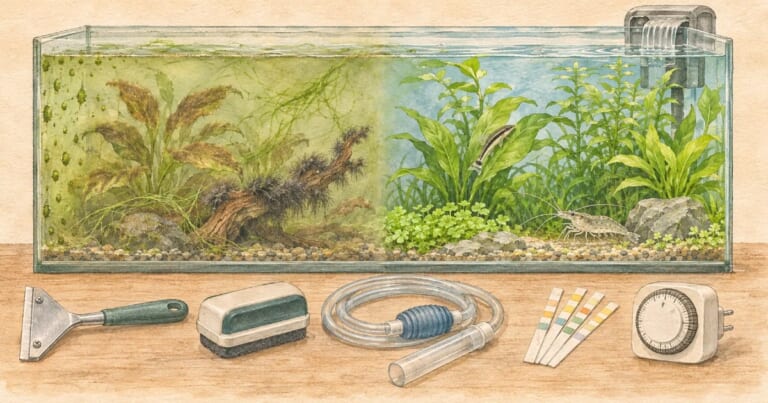
| かかりやすい病気 / Common Issues | よく見られるのは、頂芽が白くなったり縮れたりする症状、成長が止まってしまう「いじけ」、下葉が黒ずんで落ちる症状です。多くの場合、CO2不足、鉄分などの栄養不足、水の硬さ、光不足、密植による影が原因です。また、細かい葉の間には糸状のコケや黒髭状のコケが絡みやすく、一度付くと取り除くのに苦労します。Common problems include pale or crinkled growing tips, stunted growth, and lower leaves that darken and drop. In most cases the causes are insufficient CO2, shortages of nutrients such as iron, hard water, low light, or shading from overcrowding. Hair algae and black beard algae also tend to tangle in the fine foliage and are difficult to remove once established. |
|---|---|
| 対策と予防 / Prevention | まずは水質、CO2、光、肥料のバランスを見直し、状態の悪い茎は早めに取り除きましょう。コケ対策には、ヤマトヌマエビなどのコケを食べる生体と定期的な換水が役立ちます。鉛巻きなどの株には、農薬が残っていたりスネールの卵が付いていたりすることがあるため、エビのいる水槽に入れる前に下処理をしておくと安心です。組織培養カップの株は無菌の状態で育てられているので、こうした心配がほとんどなく、導入しやすいのが魅力です。First review the balance of water chemistry, CO2, light and fertilization, and remove poorly growing stems early. Algae-eating livestock such as Amano shrimp, together with regular water changes, help with algae control. Bunched plants may carry pesticide residue or snail eggs, so pretreat them before adding them to a tank with shrimp. Tissue-culture cups are grown under sterile conditions, so these concerns hardly apply, which makes them easy to introduce. |
雑学と豆知識 / Trivia and Fun Facts
| 1. 名前に刻まれた植物学者ウォリッチ / 1. Wallich, the Botanist Behind the Name | 種小名のwallichiiは、デンマーク出身の外科医で植物学者のナサニエル・ウォリッチ(1786〜1854)に献名されたものです。若くしてインドにあったデンマークの居留地セランポールに赴任したウォリッチは、イギリス東インド会社が居留地を占領した際に一時捕らわれの身となりますが、その後はイギリス東インド会社のもとで働くことになりました。のちにカルカッタ植物園の園長を務め、ネパールやビルマ(現ミャンマー)などから膨大な植物標本を集めています。それらの標本を番号付きで整理した目録は「ウォリッチ・カタログ」と呼ばれ、今もアジアの植物研究に欠かせない資料です。リスノシッポの名前の基準となった標本も、ビルマで採集され、このカタログに記録されたものです。The epithet wallichii honors Nathaniel Wallich (1786–1854), a Danish surgeon and botanist. As a young man he was posted to the Danish settlement of Serampore in India, and when the British East India Company seized it he was briefly held captive, but he went on to work for the Company. He later served as superintendent of the Calcutta Botanic Garden and gathered enormous numbers of plant specimens from Nepal, Burma (now Myanmar) and elsewhere. The numbered list of these specimens, known as the Wallich Catalogue, remains an essential resource for Asian botany. The specimen on which this species’ name is based was also collected in Burma and recorded in that catalogue. |
|---|---|
| 2. 最初は別の属だった / 2. It Started Out in Another Genus | リスノシッポが正式に学名を与えられたのは1867年のことです。イギリスの植物学者J.D.フッカーが、同じミソハギ科の別属Hydrolythrum(ヒドロリスルム)の一種として記載しました。その後1880年、ドイツの植物学者ケーネがミソハギ科を整理し直す中で本種をキカシグサ属に移し、現在のRotala wallichiiという名前が定着しました。日本の田んぼで見られるキカシグサやミズマツバも同じ属の仲間です。リスノシッポは、身近な田んぼの小さな草の、ちょっと華やかな親戚といえます。The species received its formal scientific name in 1867, when the British botanist J.D. Hooker described it as a member of Hydrolythrum, a separate genus in the same family, Lythraceae. In 1880 the German botanist Koehne, while reorganizing the family, moved it into Rotala, and the name Rotala wallichii has been in use ever since. Rotala indica and Rotala mexicana, small plants of Japanese rice paddies, belong to the same genus. In other words, this plant is a rather glamorous relative of familiar little paddy-field plants. |
| 3. 夜になると「眠る」水草 / 3. A Plant That “Sleeps” at Night | 消灯後の水槽をのぞくと、リスノシッポの頂芽が葉を寄せてすぼまっていることがあります。昼と夜で葉の開き方を変えるこうした動きは「就眠運動」と呼ばれ、ダーウィンも晩年に熱心に観察したテーマです。仕組みの研究が進んでいるのはネムノキの仲間などのマメ科植物で、葉の付け根にある「葉枕(ようちん)」という部分の細胞が、体内時計のリズムに合わせて水を出し入れし、膨らんだり縮んだりすることで葉が動くことがわかってきました。つまり植物は、明るさに反応するだけでなく、自分の中の時計で「そろそろ夜だ」と準備をしているのです。ロタラの葉が同じ仕組みで動いているかどうかは詳しくわかっていませんが、毎晩繰り返される姿の変化は、水槽の中で植物の一日のリズムを感じられる楽しい観察ポイントです。If you peek into the tank after lights-out, you may find the growing tips of this plant drawn together and closed up. Such day-night changes in how leaves open are called nyctinasty, a subject Darwin studied intensively late in life. The mechanism is best understood in legumes such as the silk tree and its relatives: cells in a joint at the leaf base called the pulvinus take in and release water in time with the internal clock, swelling and shrinking to move the leaf. In other words, plants do not simply react to light; they use an inner clock to prepare for nightfall. It is not well known whether Rotala leaves move by the same mechanism, but this nightly change is a delightful way to sense a plant’s daily rhythm right in your tank. |
| 4. 赤色の正体はアントシアニン / 4. The Red Comes from Anthocyanins | リスノシッポの赤やピンクは、葉緑素ではなく、ブルーベリーや赤く色づいた紅葉にも含まれるアントシアニンという色素によるものです。アントシアニンには強い光から体を守る「日焼け止め」のような働きがあると考えられており、光が強い環境や、窒素が少なめでストレスがかかった状態で多く作られる傾向があります。同じ株でも、水面に近く強い光を浴びる頂部ほど赤く、下のほうほど緑が濃くなるのは、この性質が大きく関わっています。色の変化を眺めていると、植物が光の強さに応じて自分の体を守っている様子が見えてきます。The red and pink of this plant come not from chlorophyll but from anthocyanins, the same pigments found in blueberries and red autumn leaves. Anthocyanins are thought to work like a sunscreen that protects tissue from intense light, and they tend to be produced in greater amounts under strong light or mild stress such as low nitrogen. This is largely why, even on a single stem, the tips nearest the surface and the brightest light are the reddest while the lower parts stay greener. Watching these color changes lets you see the plant protecting itself according to how strong the light is. |
| 5. よく似たロタラたちとの見分け方 / 5. Telling It Apart from Look-Alike Rotalas | 入門種として知られるロタラ・ロトンディフォリアは、リスノシッポより葉に幅があり、さまざまな水質に適応できる丈夫な種類です。台湾の南仁山にちなむ「ロタラ・ナンセアン」は、細い葉を持ちながらリスノシッポより育てやすく、ロトンディフォリアとの関係がたびたび話題になります。ほかにも、葉が長く優雅に枝垂れる「ロングリーフ」や、頂芽の形や色合いが少し異なる「ベトナム」といった名前で流通する系統があります。葉の細さ、輪になってつく葉の密度、頂芽の色づき方を見比べると、それぞれの個性がよくわかります。Rotala rotundifolia, a well-known beginner species, has broader leaves than R. wallichii and is a hardy plant that adapts to a wide range of water conditions. Rotala sp. ‘Nanjenshan’, named after Nanjenshan in Taiwan, has fine leaves yet is easier to grow than R. wallichii, and its relationship to R. rotundifolia is often discussed. Other strains are traded under names such as ‘Long Leaf’, with longer, gracefully drooping leaves, and ‘Vietnam’, with slightly different tip shape and coloring. Comparing leaf fineness, the density of the leaf whorls and how the tips color up reveals each one’s character. |
まとめ / Conclusion
リスノシッポは、糸のような細い葉が輪になって重なり、頂部に向かってピンクや赤へと色づく、ほかの水草では代わりのきかない質感を持った有茎草です。水流にそよぐやわらかな房は、ダッチアクアリウムでもネイチャーアクアリウムでも、水景に華やかさと動きを添えてくれます。夜には頂芽をすぼめ、眠るような姿を見せてくれるのも、毎日眺める楽しみのひとつです。 With thread-fine leaves stacked in whorls and tips that blush pink and red, this is a stem plant whose texture no other aquatic plant can replace. Its soft plumes swaying in the current bring color and movement to Dutch and nature-style layouts alike. Watching its tips fold up as if asleep at night is one more pleasure of looking at the tank every day.
美しく育てるいちばんのコツは、軟らかい水、強い光、途切れないCO2、鉄分の補給のバランスを整え、1本ずつ間隔をあけて植えて光を株全体に行き渡らせることです。手のかかる水草ではありますが、そのぶん水槽の一角が燃えるような赤に染まったときの喜びはひとしおです。じっくり向き合うほどに応えてくれる、育てがいのある水草です。 The key to growing it beautifully is to balance soft water, strong light, uninterrupted CO2 and regular iron, and to plant stems one by one with space between them so light reaches the whole plant. It certainly takes effort, but that makes the moment a corner of your tank turns a fiery red all the more rewarding. The more patiently you work with it, the more it gives back.

困りごとの解決から、用品えらび、水槽づくり、生き物えらびまで。飼育に役立つ案内です。
分布マップ
Rotala wallichii(リスノシッポ)は、中国南部や台湾から東南アジア、インドにかけて分布します。湿地や水田、沼、流れのゆるやかな水辺に生える両生植物です。
※地図は分布地域全体の位置関係を示す概略表示です。正確な自生範囲を示すものではありません。マーカーは地図表示のための代表地点であり、実際の採集地点や自生地ではありません。
参考文献
分類・学名
- Bentham, G. & Hooker, J.D. (1867). Genera Plantarum 1: 777. London: Reeve & Co.(Hydrolythrum wallichii Hook.f. の原記載)
- Koehne, E. (1880). Lythraceae. Botanische Jahrbücher für Systematik, Pflanzengeschichte und Pflanzengeographie 1: 154.(Rotala wallichii (Hook.f.) Koehne の発表)
- Prasanth, A. & Sardesai, M.M. (2024). Nomenclatural notes on type materials of fourteen names in Lythraceae. Phytotaxa 660(3): 243–258.
- Royal Botanic Gardens, Kew. Rotala wallichii (Hook.f.) Koehne. Plants of the World Online. https://powo.science.kew.org/taxon/554248-1
- World Flora Online. Rotala wallichii (Hook.f.) Koehne. https://list.worldfloraonline.org/wfo-0001215949
分布・生育環境・形態
- Wu, Z., Raven, P.H. & Hong, D. (eds.) (2007). Flora of China Vol. 13. Beijing: Science Press; St. Louis: Missouri Botanical Garden Press.
- Santisuk, T. & Balslev, H. (eds.) (2014). Flora of Thailand 11(4): 499–666. Bangkok: The Forest Herbarium, Royal Forest Department.
- 国立台湾大学. Rotala wallichii(瓦氏水豬母乳). Taiwan Plant Information Integration System(TAI2). https://tai2.ntu.edu.tw/species/455 006 06 0
ウォリッチとウォリッチ・カタログ
- Royal Botanic Garden Edinburgh. The Wallich Catalogue Online. https://wallich.rbge.org.uk/
- Om Prakash, R. (2016). Wallich and his contribution to the Indian natural history. Rheedea 26(1): 13–20. https://doi.org/10.22244/rheedea.2016.26.01.02
就眠運動
- Darwin, C. & Darwin, F. (1880). The Power of Movement in Plants. London: John Murray.
- Oikawa, T., Ishimaru, Y., Munemasa, S., Takeuchi, Y., Washiyama, K., Hamamoto, S., Yoshikawa, N., Murata, Y., Uozumi, N. & Ueda, M. (2018). Ion channels regulate nyctinastic leaf opening in Samanea saman. Current Biology 28(14): 2230–2238. https://doi.org/10.1016/j.cub.2018.05.042
- Suh, S., Moran, N. & Lee, Y. (2000). Blue light activates potassium-efflux channels in flexor cells from Samanea saman motor organs via two mechanisms. Plant Physiology 123(3): 833–844. https://doi.org/10.1104/pp.123.3.833
アントシアニンと赤い発色
- Chalker-Scott, L. (1999). Environmental significance of anthocyanins in plant stress responses. Photochemistry and Photobiology 70(1): 1–9. https://doi.org/10.1111/j.1751-1097.1999.tb01944.x
- Gould, K.S. (2004). Nature’s Swiss army knife: the diverse protective roles of anthocyanins in leaves. Journal of Biomedicine and Biotechnology 2004(5): 314–320. https://doi.org/10.1155/S1110724304406147
水草としての育成
- Kasselmann, C. (2003). Aquarium Plants. Malabar, Florida: Krieger Publishing Company.
コメント