


解説 / Description
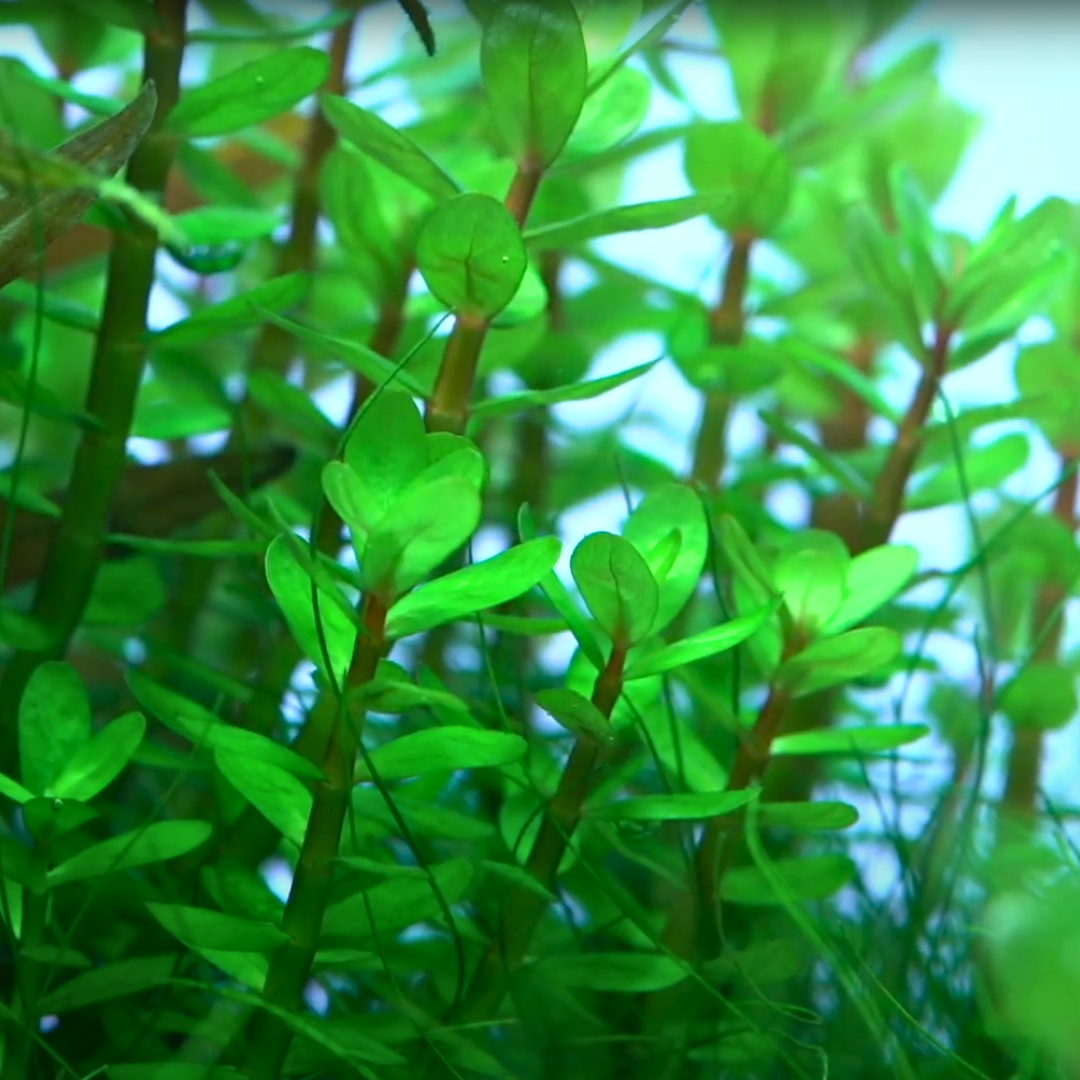
ロタラsp. ボンサイは、太くしっかりした茎に小さな丸い葉を向かい合わせにつけ、まっすぐ上へ伸びていく有茎草です。枝分かれが控えめで姿が乱れにくく、トリミングを重ねると、名前のとおり小さな盆栽のような引き締まった茂みになります。強い光の下では頂芽のあたりが明るい黄緑からオレンジ、淡いピンクへと色づき、そのやわらかなグラデーションが水景に温かみを添えてくれます。 Rotala sp. ‘Bonsai’ is a stem plant that grows straight upward on thick, sturdy stems lined with small, rounded leaves in opposite pairs. It branches sparingly and keeps its shape well, so repeated trimming turns it into a compact, tidy bush that, true to its name, resembles a miniature bonsai. Under strong light, the shoot tips shift from bright yellow-green to orange and soft pink, and this gentle gradient adds warmth to the aquascape.
その正体は、日本の水田や湿地でもよく見られるキカシグサ(Rotala indica)です。はじめは「アマニアsp. ボンサイ」という名前で欧州のファームから広まり、のちに本物のロタラ・インディカだと判明しました。長年「ロタラ・インディカ」の名で売られてきた赤ロタラ(ロタラ・ロトンジフォリア)とは別の植物で、水中でも葉が丸いままで、茎がまっすぐ立つ点で見分けられます。成長がゆっくりで扱いやすい一方、硬度の高い水や極端な肥料切れには弱いので、こうした性質を知っておくことが美しく育てる近道になります。 Its true identity is Rotala indica, known in Japan as Kikashigusa, a plant commonly found in Japanese rice paddies and wetlands. It first spread through the hobby from European farms under the name “Ammannia sp. ‘Bonsai'” and was later identified as the genuine Rotala indica. It is a different plant from the red rotala (Rotala rotundifolia) that was sold for decades as “Rotala indica,” and it can be told apart by its leaves, which stay rounded underwater, and its upright stems. It grows slowly and is easy to manage, but it dislikes hard water and severe nutrient deficiency, so understanding these traits is the shortest path to growing it well.
基本情報 / Basic Information
| 学名 / Scientific Name | Rotala indica (Willd.) Koehne 流通上は「Rotala indica ‘Bonsai’」とも表記されます。旧流通名の「Ammannia sp. ‘Bonsai’」は別の属の名前を当てたもので、現在は使われなくなりつつあります。日本の個体群は、変種 Rotala indica var. uliginosa として扱われることもあります。なお、古くから「ロタラ・インディカ」の名で流通してきた水草の多くは Rotala rotundifolia(ホザキキカシグサ)で、本種とは別種です。It is also traded as “Rotala indica ‘Bonsai’.” The former trade name “Ammannia sp. ‘Bonsai'” assigned it to the wrong genus and is gradually falling out of use. Japanese populations are sometimes treated as the variety Rotala indica var. uliginosa. Note that much of what has long been sold as “Rotala indica” is actually Rotala rotundifolia, a separate species. |
|---|---|
| 通称 / Common Name | ロタラsp. ボンサイ、ロタラ・インディカ(真性)、アマニアsp. ボンサイ(旧流通名)、キカシグサ(和名)Rotala sp. ‘Bonsai’, Rotala indica ‘Bonsai’, true Rotala indica, Ammannia sp. ‘Bonsai’ (former trade name), Indian toothcup, Kikashigusa (Japanese name) |
| 分類 / Family | ミソハギ科 キカシグサ属(ロタラ属)Lythraceae, genus Rotala |
| 分布 / Distribution | 日本を含む東アジアから東南アジア、南アジアにかけて広く分布する一年草で、水田やため池のほとり、湿地などに生えます。稲作とともに各地へ広がったと考えられており、イタリアやポルトガル、アメリカの稲作地帯などでは、帰化した水田雑草として知られています。An annual widely distributed from East Asia, including Japan, through Southeast and South Asia, it grows in rice paddies, along pond edges, and in wetlands. It is thought to have spread alongside rice cultivation and is known as a naturalized paddy weed in rice-growing regions of Italy, Portugal, and the United States. |
| 育成難易度 / Difficulty | やさしい〜普通。光量とCO2がそろっていれば丈夫に育ちますが、硬度の高い水では新芽が縮れやすく、極端な肥料切れでは下葉が落ちて成長が止まります。植え付け直後は葉が溶けることも多いため、立ち上げから時間がたち、水質が安定した水槽に植えると安心です。Easy to moderate. With adequate light and CO2 it grows robustly, but in hard water the new shoots tend to curl, and severe nutrient deficiency causes lower leaves to drop and growth to stall. Leaf melt is also common right after planting, so it is safest to introduce it to a mature tank with stable water conditions. |
育成環境 / Cultivation Environment
| 光量 / Light | 中〜強めの光量が適しています。光が足りないと、持ち味である太い茎が細くなり、節と節の間も間延びしてしまいます。照明が控えめな場合は、コケの様子を見ながら点灯時間を少し長めにすると補いやすくなります。十分な光が当たると、頂芽付近がオレンジからピンクがかった色に染まります。Medium to high light is ideal. Without enough light, the characteristic thick stems become thin and the spaces between leaf pairs stretch out. If your lighting is on the weaker side, extending the photoperiod somewhat, while watching for algae, can help compensate. Under ample light, the shoot tips take on orange to pinkish hues. |
|---|---|
| CO2添加 / CO2 Injection | 添加を強くおすすめします。無添加でも枯れずに残ることはありますが、成長がとても遅くなり、肉厚な葉や密な茂み、きれいな発色はなかなか引き出せません。Strongly recommended. The plant can survive without it, but growth becomes very slow, and its thick leaves, dense growth, and attractive coloration are hard to bring out. |
| 水質 / Water Quality | 水温20〜28℃、pH 5.5〜7.5(弱酸性〜中性)、軟水〜やや軟らかめの中硬水が目安です。とくに硬度には敏感で、硬い水では頂芽が縮れたり、成長が鈍ったりしやすくなります。水中のカルシウムやマグネシウムが多すぎると、鉄などの微量元素を吸収しにくくなるためと考えられています。国内の水道水はおおむね軟水ですが、硬度を上げる石材を使った石組レイアウトでは、硬度の上昇に気をつけてください。水温はやや低めの24℃前後に保つと、節間の詰まったまとまりのよい姿になりやすいといわれます。Aim for 20–28°C (68–82°F), pH 5.5–7.5 (slightly acidic to neutral), and soft to moderately soft water. It is particularly sensitive to hardness; in hard water the shoot tips tend to curl and growth slows, likely because excess calcium and magnesium make it harder for the plant to absorb iron and other trace elements. Tap water in Japan is generally soft, but watch for rising hardness in rock layouts that use stones which raise hardness. Keeping the temperature slightly cool, around 24°C (75°F), is said to help produce a compact form with short spaces between leaf pairs. |
| 底床 / Substrate | 根からよく養分を吸うため、栄養系ソイルがもっとも向いています。砂利や化粧砂で育てる場合は、株元に固形肥料を定期的に埋め込みましょう。液肥は、窒素・リン・カリウムと鉄を含む総合タイプを適量ずつ継続して与えるのが基本です。赤みを引き出す目的で窒素を極端に減らすのは避けたほうが安全です。It takes up plenty of nutrients through its roots, so nutrient-rich aqua soil suits it best. If you use gravel or decorative sand, insert root tabs near the plants regularly. For liquid fertilizer, steady, moderate doses of a comprehensive product containing nitrogen, phosphorus, potassium, and iron work best. It is safer to avoid drastically cutting nitrogen in an effort to bring out red coloration. |
レイアウト / Layout
| 配置 / Positioning | 中景の主役として特に重宝されます。まっすぐ伸びて高さをそろえやすいため、ダッチアクアリウムで手前から奥へ斜めに高くなるよう刈り込む「ストリート」づくりに最適です。成長がゆるやかで草丈も抑えやすく、30cmキューブ水槽(約27L)のような小型水槽なら、中景から後景まで幅広く使えます。60cm規格水槽(約57L)では、石や流木の際にまとめて植えると、景観を引き締めるアクセントになります。It is especially valued as a midground centerpiece. Because it grows straight up and is easy to keep at an even height, it is ideal for forming “streets” in Dutch-style aquascapes, trimmed to rise diagonally from front to back. Its slow growth and manageable height let it serve anywhere from midground to background in small tanks such as a 30 cm cube (about 27 L). In a standard 60 cm tank (about 57 L), planting a group along stones or driftwood creates an accent that tightens the whole layout. |
|---|---|
| 注意点 / Precautions | 小さな丸葉と淡い色合いは、葉の大きな水草や濃い緑、鮮やかな赤の水草と隣り合わせると輪郭が際立ちます。質感の似た細葉の有茎草と並べると境目がぼやけやすいので、対比を意識して組み合わせましょう。また、密植しすぎると下のほうに光が届かず下葉が落ちやすくなるため、植え付けは1〜2本ずつ、少し間隔をあけて行うのがおすすめです。Its small round leaves and pale tones stand out best next to broad-leaved plants, dark green species, or vivid red plants. Placing it beside fine-leaved stem plants of similar texture can blur the boundary, so plan your combinations around contrast. Also, overly dense planting keeps light from reaching the lower stems and leads to leaf drop, so plant one or two stems at a time with a little space between them. |
増やし方(トリミング) / Propagation & Trimming
| 増やし方 / Propagation | 差し戻しで簡単に増やせます。カットした頂芽はもっとも元気で色づきもよい部分です。ピンセットで底床に1〜2cmほど挿しておけば、やがて根を出し、群れを広げてくれます。It propagates easily by replanting cuttings. The trimmed tops are the healthiest and most colorful parts of the plant; push them 1–2 cm into the substrate with tweezers, and they will root and expand the group. |
|---|---|
| トリミング / Trimming | 茎が水面に届く前、あるいは狙った高さで、節のすぐ上をハサミでカットします。切り口の下の節から脇芽が出るので、何度か繰り返すうちに枝数が増え、こんもりとした茂みに仕上がります。成長がゆっくりなぶん、手入れの頻度は少なめで済みます。長く維持して根元が古くなり、下葉が落ちてきたら、古い茎を抜いて元気な頂芽だけを植え直し、株を更新しましょう。Cut just above a node with scissors before the stems reach the surface, or at your target height. New side shoots emerge from the node below the cut, so repeating this a few times increases branching and creates a bushy clump. Because it grows slowly, maintenance is needed only occasionally. When long-kept stems become old at the base and lose their lower leaves, pull them out and replant only the healthy tops to renew the group. |
病気と対策(コケなど) / Pests & Algae
| かかりやすい病気 / Common Issues | 植え付けから数週間は、水上葉や組織培養の葉が半透明になって溶けることがあります。これは水中の環境に合った葉へ作り替えている過程なので、新芽が伸びていれば心配いりません。ほかによく見られるのは、光不足による間延び、窒素不足による下葉の脱落と成長停止、硬度が高すぎることによる頂芽の縮れです。成長が止まると、葉にコケも付きやすくなります。For the first few weeks after planting, emersed or tissue-culture leaves may turn translucent and melt. The plant is replacing them with leaves suited to underwater life, so there is nothing to worry about as long as new shoots are growing. Other common problems include stretched, leggy growth from low light, lower-leaf drop and stalled growth from nitrogen deficiency, and curled shoot tips from overly hard water. Once growth stalls, algae also tends to settle on the leaves. |
|---|---|
| 対策と予防 / Prevention | 溶けた葉はこまめに取り除き、立ち上げ直後の不安定な水槽への導入は避けましょう。組織培養カップは農薬やスネール、コケを持ち込む心配がほとんどなく、本種のように成長がゆっくりな水草には特に安心です。水上葉の鉢植えや鉛巻きは、エビ類に害のある残留農薬に注意し、無農薬の表記を確かめるか、植える前に下処理をしてください。ほかの水槽から分けてもらったカット株は、すでに水中葉になっているので扱いやすい反面、コケや貝の持ち込みに気をつけましょう。症状が出たら、まず光量・肥料・硬度を順に見直します。コケには換水を行い、ヤマトヌマエビやオトシンクルスなどのコケ取り生体の力を借りるのも効果的です。Remove melted leaves promptly and avoid planting into newly set-up, unstable tanks. Tissue-culture cups carry virtually no risk of introducing pesticides, snails, or algae, which is especially reassuring for a slow grower like this. With potted or lead-banded emersed plants, beware of pesticide residues that can harm shrimp; check for pesticide-free labeling or treat the plants before planting. Cuttings shared from other tanks are already in submersed form and quick to settle in, but watch for hitchhiking algae and snails. When symptoms appear, first review light, fertilization, and hardness in turn. For algae, water changes help, as do algae eaters such as Amano shrimp or otocinclus. |
雑学と豆知識 / Trivia and Fun Facts
| 1. 二つの「インディカ」をめぐる取り違え / 1. A Tale of Two “Indicas” | 東南アジアから観賞用水草の輸出が盛んになり始めたころ、「ロタラ・インディカ」の名で出回った水草がありました。ところが、その中身は赤く色づくロタラ・ロトンジフォリアでした。この美しい水草が世界中で人気を集めたことで、誤った名前のほうがすっかり定着してしまいます。その後、欧州のファームから「アマニアsp. ボンサイ」として新しい水草が登場します。2000年代の終わりごろ、アメリカの水草愛好家が水上で咲かせた花を専門家が調べたところ、これこそが本物のロタラ・インディカだと判明しました。長いあいだ自分の名前をほかの植物に使われていた本家が、別の名前をまとって水槽の世界に戻ってきたというわけです。When ornamental aquatic plants first began to be exported in quantity from Southeast Asia, a plant appeared under the name “Rotala indica.” It was in fact the red-tinged Rotala rotundifolia, and as this attractive plant became popular worldwide, the wrong name became firmly established. Later, a new plant was released by European farms as “Ammannia sp. ‘Bonsai’.” Around the end of the 2000s, an American aquatic plant enthusiast flowered it emersed, and when specialists examined the flowers, it proved to be the genuine Rotala indica. The species whose name had long been used for another plant had returned to the aquarium world under a different name. |
|---|---|
| 2. 葉のふちの白い縁取り / 2. The White Edge of the Leaf | ルーペで葉を観察すると、ふちに沿って白っぽい細い縁取りがあるのがわかります。これは軟骨質と呼ばれる硬めの組織で、本種を見分ける手がかりのひとつとされています。花も重要な手がかりです。水上で育てると、本種は葉の付け根にピンクがかったごく小さな花を咲かせます。一方のロトンジフォリアは、茎の先に目立つ花穂をつけるので、花を見比べれば違いはすぐにわかります。Look at a leaf under a loupe and you will see a thin, whitish edging along the margin. This is a firm, cartilage-like tissue and is considered one of the clues for identifying the species. The flowers are another important clue. Grown emersed, this plant bears tiny pinkish flowers in the leaf axils, whereas R. rotundifolia produces conspicuous flower spikes at the stem tips, so comparing the flowers makes the difference clear at a glance. |
| 3. 田んぼの野草から人気の中景草へ / 3. From Paddy Plant to Prized Midground Plant | 和名のキカシグサとして見れば、本種は夏から秋の水田でよく見かける身近な野草です。そんな野草と同じ種が、海外のファームで水中向けに育てられ、洒落た商品名をつけられて、日本のアクアリストのもとへ水草として届けられています。水草の価値は植物そのものだけでなく、水中で美しく育てる技術や、魅力を伝える名前によっても形づくられている。そんなことを感じさせてくれるエピソードです。As Kikashigusa, this is a familiar wild plant often seen in Japanese rice paddies from summer to autumn. Yet the very same species is grown for underwater culture on overseas farms, given a stylish trade name, and delivered to aquarists in Japan as an aquarium plant. It is a story that shows how an aquarium plant’s value is shaped not only by the plant itself, but also by the skill of growing it beautifully underwater and by the name that conveys its appeal. |
| 4. 一年草なのに水槽では長く楽しめる / 4. An Annual You Can Keep for Years | 野外のキカシグサは、秋に種を実らせたあと冬の寒さで枯れ、翌年は種から芽生える一年草です。ところが、水温が一年中安定した水槽には冬がやってきません。そのため、カットした茎を植え直していけば、同じ株から増やしたものを長く維持できます。一年草といっても、その一生は季節の移り変わりに左右されているのだと気づかされます。In the wild, Kikashigusa is an annual: it sets seed in autumn, dies back in the winter cold, and comes up from seed the following year. In an aquarium with stable temperatures all year, however, winter never arrives. By replanting cuttings, you can keep plants propagated from the same stock going for a long time. It is a reminder that even an annual’s life cycle is governed by the changing seasons. |
| 5. 稲とともに世界へ / 5. Traveling the World with Rice | 本種は稲作の広がりとともに分布を広げたと考えられており、イタリア北部やポルトガル、アメリカのカリフォルニアなど、遠く離れた稲作地帯でも帰化した雑草として記録されています。水槽の中では行儀のよい盆栽のような姿を見せる一方で、外の世界ではたくましく生き抜く野草の顔も持っているのです。トリミングした茎や不要になった株は屋外の水辺に捨てず、責任をもって処分しましょう。The species is thought to have spread alongside rice cultivation and has been recorded as a naturalized weed in distant rice-growing regions such as northern Italy, Portugal, and California. Though it behaves like a well-mannered bonsai in the aquarium, outdoors it is a tough, resilient wild plant. Never discard trimmings or unwanted plants into outdoor waters; dispose of them responsibly. |
| 6. 色づきは植物の日焼け止め / 6. Coloration as the Plant’s Sunscreen | 強い光の下で頂芽がオレンジやピンクに染まるのは、アントシアニンなどの色素が、強すぎる光から葉の細胞を守るはたらきをしているためと考えられています。ただし、本種は深紅にまで染まるタイプではありません。赤みを求めて窒素を極端に減らすと、真っ赤になるどころか、下葉を落として弱ってしまいます。淡いグラデーションこそが、この水草本来の色なのです。The orange and pink tones on the shoot tips under strong light are thought to come from pigments such as anthocyanins, which help protect leaf cells from excessive light. This species, however, does not turn deep red. Drastically cutting nitrogen in pursuit of redder color will not make it crimson; instead, it will shed its lower leaves and weaken. The soft gradient is this plant’s natural color. |
まとめ / Conclusion
ロタラsp. ボンサイは、まっすぐ伸びる太い茎と丸い葉、そして淡くにじむオレンジ色で、水景に端正な表情を与えてくれる水草です。日本の田んぼにも生える野草が、名前の取り違えを経て、いまでは中景草の定番として親しまれている。そう思うと、水槽の中の一株にもちょっとした物語が感じられます。 Rotala sp. ‘Bonsai’ gives any aquascape a refined look with its straight, thick stems, rounded leaves, and softly blended orange tones. Knowing that a wild plant of Japanese rice paddies came through a naming mix-up to become a beloved midground staple gives even a single stem in your tank a story of its own.
十分な光とCO2、軟らかめの水、そして途切れない穏やかな施肥。この基本さえ押さえれば、トリミングのたびに枝数が増え、少しずつ盆栽のような茂みへと育っていきます。ゆっくりとした成長に寄り添いながら姿を整えていく時間こそ、この水草を育てるいちばんの楽しみです。 Ample light and CO2, soft water, and steady, moderate fertilization are all it needs. With these basics in place, each trim adds more branches, and the plant gradually grows into a bonsai-like clump. Shaping it patiently in step with its slow growth is the greatest pleasure of keeping this plant.

困りごとの解決から、用品えらび、水槽づくり、生き物えらびまで。飼育に役立つ案内です。
分布マップ
Rotala indica(キカシグサ)は、日本を含む東アジアから東南アジア、南アジアにかけて広く分布し、水田やため池のほとり、湿地などに生える一年草です。稲作とともに各地へ広がったと考えられており、イタリアやポルトガル、アメリカの稲作地帯などでは帰化した水田雑草として知られています。
※ 地図は自生域のおおよその範囲を示す概略表示で、正確な分布境界を示すものではありません。マーカーは分布域の目安として置いた代表地点であり、実際の採集地点ではありません。帰化地域(ヨーロッパ・北アメリカなど)は表示範囲に含めていません。
参考文献 / References
- Cook, C.D.K. (1979). A revision of the genus Rotala (Lythraceae). Boissiera 29: 1–156. Conservatoire et Jardin botaniques de Genève.
- Graham, S.A. (2021). Rotala indica. In: Flora of North America Editorial Committee (eds.), Flora of North America North of Mexico, Vol. 10. Oxford University Press. https://floranorthamerica.org/Rotala_indica
- Iwatsuki, K., Boufford, D.E. & Ohba, H. (eds.) (1999). Flora of Japan, Vol. IIc. Kodansha, Tokyo.
- Wu, Z., Raven, P.H. & Hong, D. (eds.) (2007). Flora of China, Vol. 13. Science Press, Beijing & Missouri Botanical Garden Press, St. Louis.
- Tutin, T.G. et al. (eds.) (1968). Flora Europaea, Vol. 2: Rosaceae to Umbelliferae. Cambridge University Press. https://treatment.plazi.org/id/03B0402C-FE80-E229-FF20-FB39D3CBFCD4
- Valdés, B. (2012+). Rotala. In: Euro+Med Plantbase – the information resource for Euro-Mediterranean plant diversity. https://www.europlusmed.org/cdm_dataportal/taxon/908d6795-c032-4169-82d0-bf4e94d3768d
- Thieret, J.W. (1972). Rotala indica (Lythraceae) in Louisiana. Sida 5: 45.
- POWO (2026). Rotala indica (Willd.) Koehne. Plants of the World Online. Royal Botanic Gardens, Kew. https://powo.science.kew.org/taxon/urn:lsid:ipni.org:names:554186-1
- World Flora Online. Rotala indica (Willd.) Koehne. https://www.worldfloraonline.org/taxon/wfo-0000405905
- U.S. Fish and Wildlife Service (2025). Indian Toothcup (Rotala indica) Ecological Risk Screening Summary. https://www.fws.gov/sites/default/files/documents/2025-01/ecological-risk-screening-summary-indian-toothcup.pdf
コメント