


解説 / Description
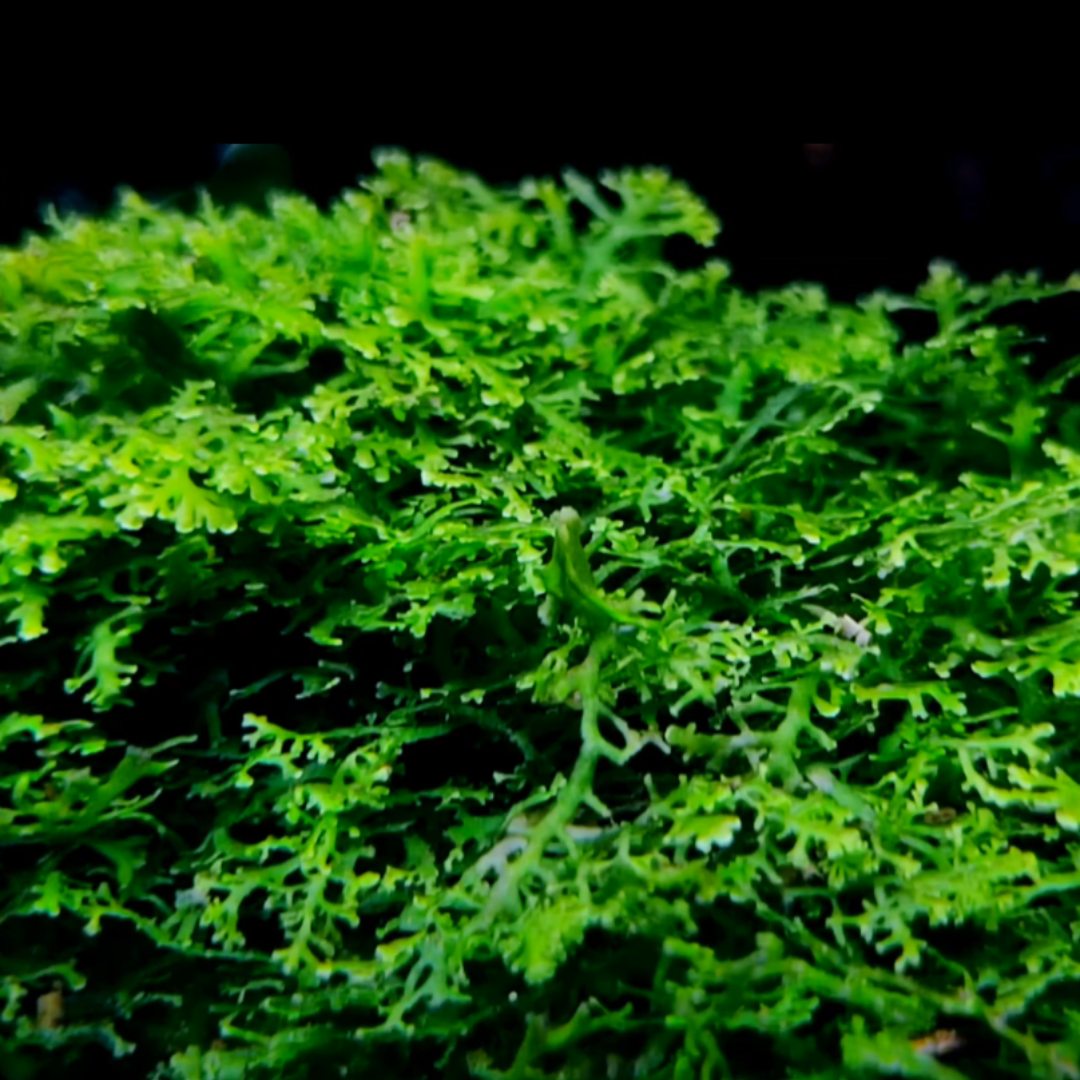
プレミアムモスは「モス」の名で流通していますが、ウィローモスなどの蘚類とは系統の異なる苔類(タイ類)の仲間です。茎と葉の区別がない平たい体(葉状体)が鳥の羽のように細かく枝分かれしながら重なり合い、深い緑色のふっくらとしたクッションをつくります。流木の枝先や石の割れ目に添えるだけで、長い年月を経たような落ち着きを水景に与えてくれるため、レイアウトを楽しむアクアリストから高い人気を集めています。 Although it is sold as a “moss,” Premium Moss is actually a liverwort, from a lineage quite separate from true mosses such as Java moss. Its flat body, called a thallus, has no distinction between stem and leaf; it branches finely like a feather and layers into soft, deep-green cushions. Tucked onto the tip of a driftwood branch or into a crack in a stone, it gives a scape the calm look of something that has aged for years, which makes it a favorite among aquascapers.
成長はとてもゆっくりで、熱帯魚水槽にありがちな高めの水温を苦手とします。そのぶん、手をかけた水槽で少しずつ密度を増していく姿には格別の味わいがあります。国内では組織培養カップでの流通が中心なので、スネールや残留農薬の心配が少なく、エビの水槽にも導入しやすいのはうれしいところです。 It grows very slowly and dislikes the warm water typical of tropical tanks. In return, watching it gradually fill out in a well-tended aquarium is a special pleasure. In Japan it is mostly sold in tissue-culture cups, so there is little worry about snails or pesticide residues, making it easy to add even to shrimp tanks.
基本情報 / Basic Information
| 学名 / Scientific Name | Riccardia sp. 流通上は長く Riccardia chamedryfolia の名で扱われてきました。しかし、この学名の種は本来温帯に分布しており、熱帯魚水槽で育てられている系統とは別の種と考えられています。流通品には見た目での区別が難しい複数の Riccardia が含まれている可能性もあるため、Riccardia sp. や Riccardia sp. “chamedryfolia” と表記するのが無難です。It has long been traded as Riccardia chamedryfolia. However, that species is native to temperate regions and is thought to differ from the strain grown in tropical aquariums. The trade may also include several Riccardia species that are hard to tell apart by eye, so Riccardia sp. or Riccardia sp. “chamedryfolia” is the safer label. |
|---|---|
| 通称 / Common Name | プレミアムモス、リカルディア、リカルディア・カメドリフォリアPremium Moss, Riccardia, Riccardia chamedryfolia, Coral Moss, Mini Pellia |
| 分類 / Family | 苔植物門 ツボミゴケ綱 フタマタゴケ目 スジゴケ科 リカルディア属(スジゴケ属)Marchantiophyta, Jungermanniopsida, Metzgeriales, Aneuraceae, genus Riccardia |
| 分布 / Distribution | リカルディア属は熱帯から温帯まで世界に広く分布し、日本にも複数種が自生しています。アクアリウムで育てられている熱帯性の系統は、タイで採集された株に由来するという記録があります。自然下では、渓流沿いの岩や倒木、滝のしぶきがかかる場所など、常に湿った環境で見られます。The genus Riccardia is widespread from the tropics to temperate zones, and several species occur naturally in Japan. Records suggest that the tropical strain grown in aquariums came from plants collected in Thailand. In the wild, these liverworts grow in constantly damp places such as rocks and fallen logs along streams or spots wetted by waterfall spray. |
| 育成難易度 / Difficulty | やや難しい。光量とCO2がそろえば育ちますが、成長が遅いうえ、高水温や液体カーボン(グルタルアルデヒド系の添加剤)で溶けやすい点に注意が必要です。特に夏場の水温管理が成否を分けます。Moderately difficult. It grows well with adequate light and CO2, but it is slow and melts easily at high temperatures or when exposed to liquid carbon (glutaraldehyde-based additives). Keeping the water cool in summer is especially important. |
育成環境 / Cultivation Environment
| 光量 / Light | 中程度からやや強めの光量がおすすめです。光が足りないと葉状体がひょろひょろと間延びし、持ち味である詰まった姿が崩れてしまいます。モスを置く位置でPPFD 60 μmol/m²/s程度以上をひとつの目安にするとよいでしょう。水草育成用のLEDを使い、他の水草や石組みの影にならないよう配置を工夫してください。Medium to fairly strong light is recommended. Without enough light the thallus stretches and loses its signature compact form. A useful guideline is about 60 μmol/m²/s PPFD or more at the moss’s position. Use an LED designed for planted tanks and avoid placing the moss in the shade of other plants or hardscape. |
|---|---|
| CO2添加 / CO2 Injection | CO2添加なしでも維持できることはありますが、密度のある美しい姿に育てるなら添加をおすすめします。水中濃度15〜25 mg/L程度が目安です。成長が鈍るとコケが付きやすくなるため、CO2で成長を後押しすることはコケ予防にもつながります。It can sometimes be maintained without CO2, but injection is recommended for dense, attractive growth, aiming for roughly 15–25 mg/L. Slow growth invites algae, so supporting growth with CO2 also helps prevent algae. |
| 水質 / Water Quality | 水温:20〜26℃(28℃を超える状態が続くと、下の方から溶けやすくなります。夏は冷却ファンや水槽用クーラーを用意しましょう) pH:6.0〜7.0(弱酸性〜中性) 硬度:GH・KHともに低め(0〜6程度)の軟水が適しています。Temperature: 20–26°C (if it stays above 28°C, the moss tends to melt from the base; use a cooling fan or aquarium chiller in summer) pH: 6.0–7.0 (slightly acidic to neutral) Hardness: soft water with low GH and KH (around 0–6) suits it best. |
| 底床 / Substrate | 流木や石に活着させて育てるため、底床に植え込む必要はありません。底床には、水質を弱酸性の軟水に保ちやすい水草用ソイルが向いています。栄養は体の表面から水中の成分を直接取り込むので、液体肥料はごく控えめにし、与えすぎによるコケの発生に気をつけてください。Because it is grown attached to wood or stone, it does not need to be planted in the substrate. An aquasoil that keeps the water soft and slightly acidic is a good choice for the tank. The moss takes up nutrients directly from the water through its surface, so dose liquid fertilizer sparingly and watch for algae caused by overfeeding. |
レイアウト / Layout
| 配置 / Positioning | 流木の枝先や分かれ目、石の割れ目、岩肌のくぼみなど、細部のアクセントに最適です。細かな枝分かれが、離れて見ると大木の茂みや遠くの山肌のように映り、景色を実際より大きく感じさせてくれます。30cmキューブ水槽(約27L)や45cm規格水槽(約32L)などの小型水槽ではワンポイントでも存在感があり、60cm規格水槽(約65L)以上なら流木全体に散らすことで、苔むした森の雰囲気を演出できます。It is perfect for small accents: the tips and forks of driftwood branches, cracks in stones and hollows in rock surfaces. Seen from a distance, its fine branching looks like the crown of a large tree or a far-off mountainside, making the scene feel larger than it really is. In small tanks such as a 30 cm cube (about 27 L) or a standard 45 cm tank (about 32 L), even a single patch stands out; in a standard 60 cm tank (about 65 L) or larger, scattering it across the driftwood creates the feel of a mossy forest. |
|---|---|
| 注意点 / Precautions | 自力で流木や石に張り付く力が弱いので、小さく分けた株を木綿糸やテグス、水草用接着剤でしっかり固定しましょう。固定が甘いと、水流で外れたり魚につつかれて散らばったりします。また、群生が厚くなりすぎると下の層まで光と水流が届かなくなり、そこから傷んで塊ごと剥がれ落ちることがあります。厚く盛りすぎないことがきれいに保つコツです。It attaches to wood and stone only weakly on its own, so tie or glue small portions firmly in place with cotton thread, fishing line or aquarium plant glue. If loosely fixed, it can be washed away by the current or scattered by fish. When a clump grows too thick, light and water flow no longer reach the lower layers, which can decay and cause the whole mass to peel off. Avoiding thick build-up is the key to keeping it looking good. |
増やし方(トリミング) / Propagation & Trimming
| 増やし方 / Propagation | 株を小さく分けて別の流木や石に固定すれば増やせます。水を張る前に水上で育てて定着させる「ミスト式」もおすすめです。その際は、刻んだモスに少量の水と砕いた水草用ソイルを混ぜて泥状にし、流木や石に塗りつける方法が便利です。ヨーグルトをつなぎに使う方法も知られていますが、密閉した高温多湿の水槽内では腐敗やカビの原因になりやすく、日本の夏場には向きません。ミスト式では定着までに4〜8週間ほどかかります。カビを防ぐため、ラップに通気用の穴を開けるか1日1回は換気をし、底床の表面に水が溜まらないよう水位を低めに保ちましょう。Divide a clump into small portions and attach them to other pieces of wood or stone. The “Dry Start Method,” in which plants are grown above water to establish before the tank is filled, also works well. A convenient technique is to mix chopped moss with a little water and crushed aquasoil into a muddy paste and spread it onto wood or rock. Yogurt is sometimes used as a binder, but in a sealed, warm, humid tank it easily spoils and breeds mold, so it is not suited to Japanese summers. Establishment takes about 4–8 weeks. To prevent mold, poke a few vent holes in the plastic wrap or air the tank once a day, and keep the water level low so no puddles form on the substrate surface. |
|---|---|
| トリミング / Trimming | 成長が遅いので頻繁な手入れは必要ありませんが、厚みが出てきたら先の細いハサミで表面を薄く削ぐように切りそろえます。こうしておくと下の層まで光と水流が届き、塊ごと剥がれ落ちるのを防げます。切った断片は水流に乗って水槽内に散らばりやすいので、すぐにホースなどで吸い出してください。取り出したトリミング片は排水口に流さず、よく乾かしてから可燃ゴミとして処分しましょう。Because it grows slowly, frequent maintenance is unnecessary. Once it thickens, use fine-tipped scissors to shave the surface thinly. This lets light and water flow reach the lower layers and keeps the clump from peeling off. Cut fragments drift around the tank easily, so siphon them out right away. Never flush cuttings down the drain; dry them thoroughly and dispose of them as burnable waste. |
病気と対策(コケなど) / Pests & Algae
| かかりやすい病気 / Common Issues | 最も多いトラブルは、体が白っぽく変色したり崩れたりする「溶け」です。主な原因は、高水温、群生の厚くなりすぎ、そして液体カーボンなどグルタルアルデヒドを含む添加剤です。苔類は体の表面を守る層が薄く、ごく薄い組織で水に直接触れているため、薬剤の影響を受けやすく、規定量でも溶けてしまったという例が多く聞かれます。また、成長が鈍ると黒ヒゲゴケや糸状のコケが絡みやすくなり、ミスト式の立ち上げ中にはカビや藍藻(シアノバクテリア)が出ることもあります。The most common problem is melting, in which the moss turns whitish or falls apart. The main causes are high temperature, overly thick clumps and additives containing glutaraldehyde, such as liquid carbon. Liverworts have only a thin protective surface layer and very thin tissue in direct contact with the water, so they are easily affected by chemicals; many hobbyists report melting even at standard doses. When growth slows, black beard algae and filamentous algae tend to tangle in, and mold or cyanobacteria may appear during a dry start. |
|---|---|
| 対策と予防 / Prevention | プレミアムモスを育てている水槽では、グルタルアルデヒド系の添加剤は使わないのが鉄則です。モスにコケが絡んだときは、その部分をハサミで切り取るのが最も安全です。周囲の流木や石に付いたコケには、ろ過を一時止めて市販のオキシドール(約3%の過酸化水素水)を注射器でごく少量かけ、10〜15分ほど置いてからろ過を再開し、多めに換水する方法もあります。この場合も、モスに直接かからないよう量と範囲は最小限にとどめてください。組織培養カップを導入する際は、ぬるま湯に数分浸して培地をゆるめ、ピンセットで大まかに取り除く程度にします。培地には糖分や栄養分が含まれており、多く持ち込むと水質悪化やカビの原因になりますが、強くもみ洗いすると組織が傷んで溶けにつながります。わずかな培地の残りよりも、傷めてしまうことのほうを避けましょう。The golden rule is never to use glutaraldehyde-based additives in a tank with Premium Moss. If algae become tangled in the moss, cutting out the affected part is the safest remedy. For algae on nearby wood or stone, you can briefly stop the filter, apply a very small amount of drugstore hydrogen peroxide (about 3%) with a syringe, wait 10–15 minutes, then restart the filter and do a generous water change. Even then, keep the amount and area to a minimum so that it does not reach the moss directly. When introducing a tissue-culture cup, soak it in lukewarm water for a few minutes to loosen the gel and remove it roughly with tweezers. The gel contains sugars and nutrients that can foul the water or encourage mold if too much enters the tank, but vigorous rinsing damages the tissue and leads to melting. A little leftover gel is less of a risk than damaging the moss. |
雑学と豆知識 / Trivia and Fun Facts
| 1. 「モス」なのにモスではない?苔類と蘚類のちがい / 1. A “Moss” That Isn’t a Moss: Liverworts vs. Mosses | 日本語ではどちらも「コケ」と呼ばれますが、植物学では蘚類(Moss)と苔類(Liverwort)は別の門に分けられています。ウィローモスやクリスマスモスは茎と葉をもつ蘚類、プレミアムモスはゼニゴケと同じ苔類の仲間です。苔類の多くは細胞の中に「油体」という小さな器官をもっていますが、蘚類にはこれがありません。油体の形や数は種によって異なり、顕微鏡で種類を見分ける大切な手がかりになっています。同じ「モス」の棚に並んでいても、両者は陸上植物の進化の早い段階で分かれた、遠い親戚どうしなのです。In Japanese both are simply called “koke,” but botanists place mosses and liverworts in separate divisions. Java moss and Christmas moss are true mosses with stems and leaves, while Premium Moss is a liverwort, like Marchantia. Many liverworts have small organelles called oil bodies inside their cells, which mosses lack. Their shape and number vary by species, making them an important clue for identification under the microscope. Although they share the same “moss” shelf in shops, the two are distant relatives that went their separate ways early in the evolution of land plants. |
|---|---|
| 2. 名前をめぐるミステリー / 2. The Mystery Behind the Name | プレミアムモスは長く Riccardia chamedryfolia と呼ばれてきましたが、この学名をもつ本来の種は、ヨーロッパなど温帯に暮らす苔類です。水草研究で知られるクリステル・カッセルマン氏の著作によると、アクアリウムに広まった熱帯性の系統は、1990年代に水草ファームTropica社の創業者がタイのプーケット島で採集し、蘚苔類の専門家が Riccardia graeffei と同定した株に由来する可能性があるそうです。流通名と学名が食い違ったまま世界に広まるのは水草では珍しいことではありませんが、ひとつのラベルの裏にこうした採集の物語があると知ると、見慣れたカップにも少し愛着がわいてきます。Premium Moss has long been called Riccardia chamedryfolia, but the species that properly bears this name is a liverwort of temperate regions such as Europe. According to the writings of aquatic plant expert Christel Kasselmann, the tropical strain that spread through the hobby may trace back to plants collected on Phuket, Thailand, in the 1990s by the founder of the Tropica nursery and identified by a bryologist as Riccardia graeffei. Aquarium plants often spread worldwide under names that don’t match their true identity, but knowing there is a collecting story behind the label makes even a familiar cup feel a little more special. |
| 3. 根のようで根ではない「仮根」 / 3. Rhizoids: Roots That Aren’t Roots | プレミアムモスの裏側からは、細い毛のような「仮根」が伸びて、岩や流木にくっつきます。見た目は根に似ていますが、ひとつの細胞だけでできた単純なつくりで、主な役目は体を固定する「錨」です。水や栄養は、根から吸い上げるのではなく、主に体の表面から直接取り込んでいます。つまり水に溶けたものの影響をダイレクトに受けやすく、液体カーボンなどの薬剤に弱い理由のひとつもここにあります。Fine, hair-like rhizoids grow from the underside of Premium Moss and attach it to rocks and wood. They look like roots, but each one is a simple structure made of a single cell, and its main job is to act as an anchor. Rather than drawing water and nutrients up through roots, the moss takes them in mainly through its surface. This means it is directly affected by whatever is dissolved in the water, which is one reason it is so vulnerable to chemicals like liquid carbon. |
| 4. 水景のスケールを操るコケ / 4. A Liverwort That Plays With Scale | ネイチャーアクアリウムの考え方では、コケは時の流れや侘び寂びを表す大切な素材とされています。プレミアムモスが水草レイアウトコンテストの作品でもよく見かけられるのは、細かな枝分かれが遠近感の錯覚を生み、数十センチの水槽を広大な森や山並みのように見せてくれるからです。きれいな群生ができあがるまでには数ヶ月かかるため、作品づくりでは早い段階で定着させ、撮影日に向けて薄いトリミングを重ねながら厚みを整えていくという、長い時間をかけた計画が欠かせません。In the Nature Aquarium philosophy, mosses and liverworts are valued as materials that express the passage of time and the beauty of wabi-sabi. Premium Moss is often seen in layout contest entries because its fine branching creates an illusion of depth, making a tank only tens of centimeters wide look like a vast forest or mountain range. Since a neat colony takes several months to form, contest builders establish it early and shape it with repeated light trims ahead of the photo date, a plan that unfolds over a long stretch of time. |
まとめ / Conclusion
プレミアムモスは、羽のように繊細な枝分かれと深い緑色で、水景に静かな時間の流れを感じさせてくれる苔類です。流木の先にほんのひと塊あるだけで、水槽の中に古い森の気配が漂います。 Premium Moss is a liverwort whose feather-fine branching and deep green color give an aquascape a quiet sense of passing time. Even a single tuft at the tip of a driftwood branch fills the tank with the feeling of an old forest.
夏でも水温を26℃程度までに抑え、光とCO2をしっかり届け、液体カーボンは使わない。この基本を守れば、少しずつ密度を増していく姿をじっくり楽しめます。急がず、薄く整えながら育てていく時間そのものが、このモスと付き合う醍醐味といえるでしょう。 Keep the water at around 26°C or below even in summer, provide plenty of light and CO2, and avoid liquid carbon. With these basics in place, you can enjoy watching it grow denser little by little. Taking your time and shaping it with light trims is perhaps the true pleasure of keeping this moss.

困りごとの解決から、用品えらび、水槽づくり、生き物えらびまで。飼育に役立つ案内です。
分布マップ
リカルディア属(Riccardia)は熱帯から温帯まで世界に広く分布し、日本にも複数種が自生しています。アクアリウムで育てられている熱帯性の系統は、タイで採集された株に由来するという記録があるため、地図ではタイ周辺の東南アジアを表示しています。
※地図は分布のおおよその範囲を示す概略表示です。マーカーは由来とされるタイ南部(プーケット島付近)に置いた代表地点で、実際の採集地点を示すものではありません。リカルディア属全体の分布はこの範囲より広く、世界各地に及びます。
参考文献 / References
- Crandall-Stotler, B., Stotler, R. E. & Long, D. G. (2009). Phylogeny and classification of the Marchantiophyta. Edinburgh Journal of Botany, 66(1), 155–198.
- Söderström, L., Hagborg, A., von Konrat, M. et al. (2016). World checklist of hornworts and liverworts. PhytoKeys, 59, 1–828. https://pmc.ncbi.nlm.nih.gov/articles/PMC4758082/
- Furuki, T. (1991). A taxonomical revision of the Aneuraceae (Hepaticae) of Japan. Journal of the Hattori Botanical Laboratory, 70, 293–397.
- Gradstein, S. R., Dubuisson, J.-Y., Nebel, M., Quandt, D. & Reeb, C. (2017). New insights into the phylogeny and relationships within the worldwide genus Riccardia (Aneuraceae, Marchantiophytina). European Journal of Taxonomy, 273, 1–26.
- He, X., Sun, Y. & Zhu, R.-L. (2013). The oil bodies of liverworts: unique and important organelles in land plants. Critical Reviews in Plant Sciences, 32(5), 293–302.
- Jones, V. A. S. & Dolan, L. (2012). The evolution of root hairs and rhizoids. Annals of Botany, 110(2), 205–212.
- Kasselmann, C. (2010). Aquarienpflanzen (3. Auflage). Stuttgart: Eugen Ulmer.
- Amano, T. (1994). Nature Aquarium World. Neptune City, NJ: T.F.H. Publications.
コメント