

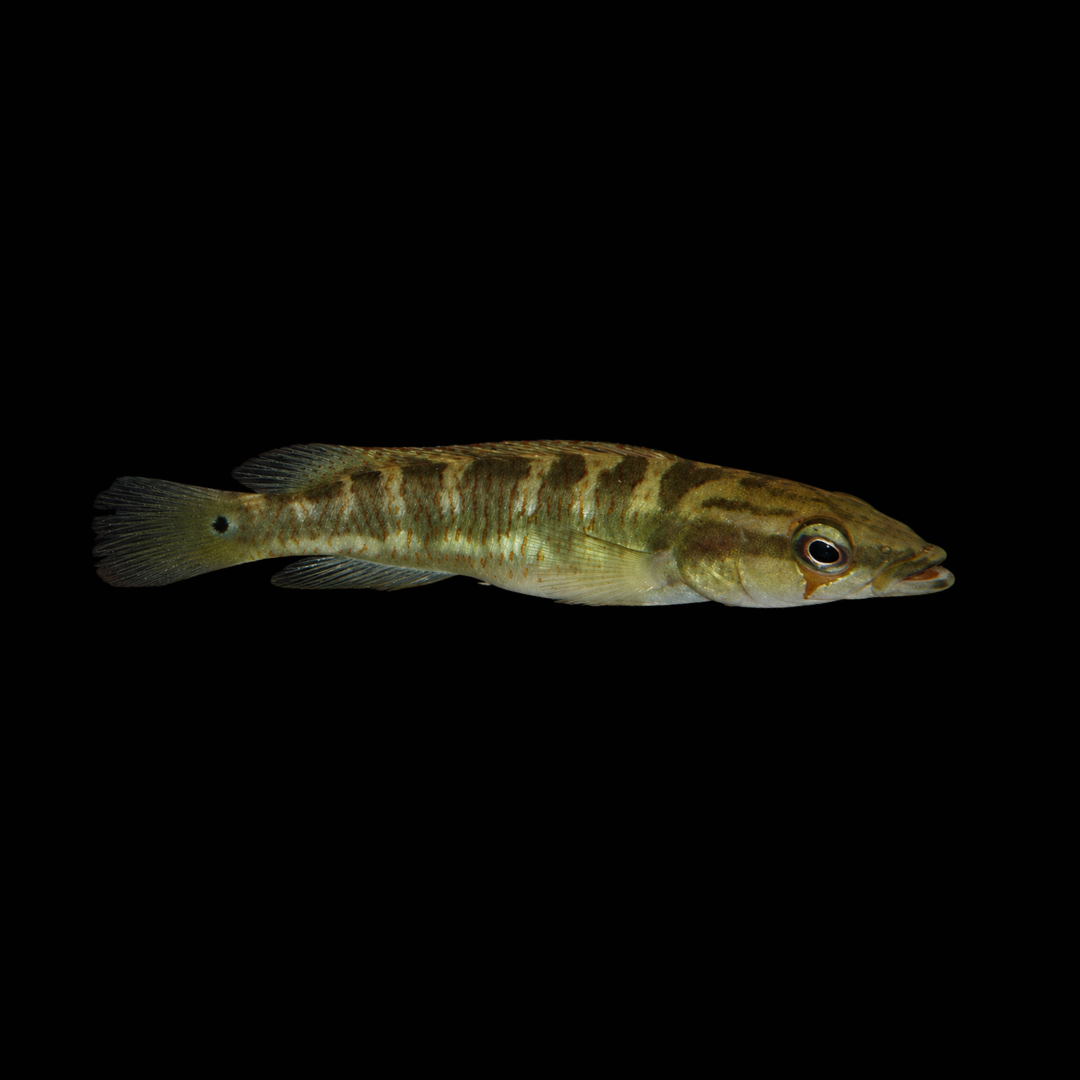
解説 / Description
ヘメライア・チチャは、ブラジル・マットグロッソ州のタパジョス川上流域、ジュルエナ川水系のパパガイオ川とその支流に分布するパイクシクリッドです。細長い体型、目の下から斜め後方へ伸びる明瞭な暗色ライン、成熟雄で伸長する背鰭、青灰色の体側に現れる橙色系の模様が特徴です。2012年にクレニシクラ・チチャとして新種記載され、2023年のパイクシクリッド類の分類再検討で新設されたヘメライア属へ移されました。パパガイオ川は透明で岩の多い流れの速い河川ですが、現地観察では本種は主に淀みや大岩の背後など、流れが比較的緩い場所で確認されています。そのため水槽でも、強い水流を一様に当て続けるより、安定した水質と十分な酸素供給を確保しつつ、岩組みによって流れの緩急と退避場所を作ることが大切です。分類学的な特徴と、急流を含む河川の中で穏やかな場所を選んで暮らす生態の両方に面白さがある南米シクリッドです。 Hemeraia chicha is a pike cichlid distributed in the Rio Papagaio and its tributaries in the Rio Juruena drainage of the upper Rio Tapajós basin, Mato Grosso, Brazil. It is characterized by an elongated body, a conspicuous dark stripe running obliquely behind the eye, elongated dorsal-fin rays in mature males, and orange markings on bluish-grey flanks. The species was described in 2012 as Crenicichla chicha and was transferred to the newly established genus Hemeraia in the 2023 revision of pike-cichlid classification. The Rio Papagaio is a clear, rocky river with swift current, yet field observations found the fish mainly in backwaters and behind large boulders where the current was relatively slack. In the aquarium, this means that uniform, relentless high flow is less appropriate than stable water quality, good oxygenation, and rockwork that creates both moving water and sheltered low-flow refuges. Its appeal lies in both its distinctive taxonomy and the way it uses quieter microhabitats within a fast-flowing river system.
基本情報 / Basic Information
| 学名 / Scientific Name | Hemeraia chicha (Varella, Kullander & Lima, 2012) |
|---|---|
| 通称 / Common Name | クレニシクラ・チチャ、クレニキクラ・チチャ、パイクシクリッド・チチャ。学術上はヘメライア・チチャですが、日本の観賞魚流通では旧属名を用いた呼び方も現在なお見られます。Crenicichla chicha remains in use as a former scientific and aquarium-trade name; the current scientific combination is Hemeraia chicha. |
| 分類 / Family | シクリッド科(Cichlidae)・シクリッド亜科(Cichlinae)・ゲオファーガス族(Geophagini)・クレニシクラ亜族(Crenicichlina)・ヘメライア属(Hemeraia)Family Cichlidae, subfamily Cichlinae, tribe Geophagini, subtribe Crenicichlina, genus Hemeraia. |
| 英名 / English Name | 標準化された英名は確認されていません(説明的に Chicha pike cichlid と表記される場合があります) |
| 分布 / Distribution | 南米ブラジル、マットグロッソ州。タパジョス川上流域のジュルエナ川水系に属するパパガイオ川とその支流。ウチアリティ滝の上流・下流の双方から記録されています。Mato Grosso, Brazil, South America. Known from the Rio Papagaio and tributaries in the Rio Juruena drainage of the upper Rio Tapajós basin, with records from both above and below the Utiariti waterfall. |
| 最大体長 / Max Size | 記載標本で確認された最大標準体長(SL)は雄137.7mm、雌97.2mmです。標準体長は尾鰭を含まない測定値であり、「全長13.8cm」という意味ではありません。水槽サイズはこの数値だけでなく、縄張りと退避スペースを含めて判断します。The largest specimens in the original description measured 137.7 mm standard length (SL) for a male and 97.2 mm SL for a female. Standard length excludes the caudal fin, so 137.7 mm SL should not be read as a total length of 13.8 cm. Aquarium size should therefore be planned with territorial and refuge space in mind rather than from this measurement alone. |
| 寿命 / Lifespan | 本種に限定した信頼できる飼育下寿命の公表データは十分に確認されていません。長期飼育では、急な環境変化や高水温時の酸素不足を避け、安定した水質を維持することが重要です。Reliable species-specific data on lifespan in captivity are not sufficiently documented. For long-term care, avoid abrupt environmental changes and oxygen depletion during hot conditions, and maintain stable water quality. |
飼育環境 / Aquarium Environment
| 水槽サイズ / Tank Size | 単独の成魚では90cm規格水槽(90×45×45cm、約180Lクラス)を実用上の目安とします。ペア飼育や混泳では、120cmワイド水槽など300L以上を確保できる設備の方が、縄張りと退避場所を分けやすくなります。これらは本種について公表された最低水量ではなく、体格とパイクシクリッド類の縄張り行動を考慮した飼育上の目安です。For a single adult, a standard 90 cm aquarium of about 90 × 45 × 45 cm, roughly 180 L, is a practical husbandry guideline. For a pair or community setup, a 120 cm wide aquarium providing 300 L or more makes it easier to separate territories and refuges. These figures are practical recommendations rather than published species-specific minimum volumes. |
|---|---|
| 水温 / Temperature | 本種に限定した原産地の詳細な水温データや、確立された飼育適温は十分に確認されていません。23〜26℃程度は飼育上の保守的な目安として扱い、急変を避けて管理します。夏季は高水温に伴う溶存酸素の低下に注意し、エアレーションを強化し、必要に応じて冷却を行います。 Detailed field-temperature data and a firmly established species-specific captive optimum are not sufficiently documented. Approximately 23–26°C can be treated as a conservative husbandry guideline rather than a measured native range. Avoid abrupt changes, and during hot weather maintain strong aeration and use cooling when necessary to prevent oxygen depletion. |
| 水質 / Water Quality | 本種に限定したpHや硬度の詳細な現地測定値は十分に確認されていないため、pH6.0〜7.0、GH3〜12程度は飼育上の目安として扱います。原産地のパパガイオ川は透明な流水として記載される一方、やや濁った砂泥底の小支流でも確認されており、濃いブラックウォーターの再現を必須条件とする根拠はありません。数値を無理に調整するより、アンモニア・亜硝酸を蓄積させず、定期換水で水質を安定させることを優先します。Detailed species-specific field measurements for pH and hardness are not sufficiently documented, so pH 6.0–7.0 and GH 3–12 are best treated as husbandry guidelines rather than confirmed native-water values. The Rio Papagaio is described as clear flowing water, while the species has also been found in a smaller, slightly turbid tributary with a sandy-muddy bottom; there is no basis for treating strongly stained blackwater as essential. Prioritize stable conditions, undetectable ammonia and nitrite, and regular water changes over forcing exact numbers. |
| レイアウト / Layout | 川砂や細かな砂利を底床にし、表面の滑らかな石や岩を安定して組んで複数の隠れ場所を作ります。原産地は流れの速い河川ですが、本種そのものは大岩の背後や淀みなど流れの緩い場所で多く観察されています。水流ポンプを使う場合も水槽全体を激流にせず、流れがある場所と静かな退避場所を同時に作ります。岩組みは掘り返されても崩れないよう、水槽底面から安定させます。Use river sand or fine gravel and arrange smooth stones and rocks securely to provide several shelters. Although the native river is fast-flowing, the fish itself was observed mainly behind large boulders and in backwaters where current was weaker. If a circulation pump is used, avoid turning the whole aquarium into a torrent; provide both moving water and quiet refuges. Support rockwork securely from the tank base so digging cannot cause a collapse. |
| 注意点 / Precautions | 飼育下では、同種や体型の近いパイクシクリッドとの縄張り争いに備える必要があります。ただし、本種だけを対象にした体系的な社会行動・混泳データは十分ではないため、攻撃性の強さを一律に断定するのは避けます。高水温による酸素不足、狭い水槽での逃げ場不足、導入時の急な水質変化を避け、必要ならすぐ隔離できる仕切りや予備水槽を用意します。In captivity, be prepared for territorial conflict with conspecifics and similarly shaped pike cichlids. However, systematic species-specific data on social behaviour and tank-mate compatibility are limited, so the intensity of aggression should not be treated as uniform. Avoid oxygen depletion at high temperatures, insufficient refuge space, and abrupt water-chemistry changes during introduction, and keep a divider or spare aquarium available if separation becomes necessary. |
餌と給餌 / Feeding
| 餌の種類 / Diet | 本種に限定した自然下の食性を詳しく示すデータは十分に確認されていません。飼育では肉食傾向のあるシクリッドとして、肉食魚・大型シクリッド向けの良質な沈下性ペレットを主食にし、冷凍アカムシ、イサザアミ、オキアミ、適切な大きさのエビ類などを補助的に組み合わせます。特定の餌だけに偏らせず、人工飼料を軸にすると栄養管理がしやすくなります。Detailed species-specific data on the natural diet are not sufficiently documented. In captivity, it can be managed as a carnivorous-leaning cichlid, using a high-quality sinking pellet for predatory fish or large cichlids as the staple and supplementing with foods such as frozen bloodworms, mysid shrimp, krill, and appropriately sized shrimp. Keeping prepared food as the dietary base makes nutritional management easier than relying on a single food type. |
|---|---|
| 給餌のポイント / Feeding Tips | 人工飼料を主軸にし、一度に多量を与えず、食べ切れる量を与えます。生きた小魚だけに偏らせると栄養の偏りや病原体持ち込みのリスクがあるため、常用は避けます。導入直後に人工飼料を食べない個体には、冷凍餌など嗜好性の高い餌をきっかけにし、状態を見ながら徐々に人工飼料へ慣らします。Use prepared foods as the main diet and avoid large meals, offering only what the fish can finish. Routine dependence on live feeder fish can create nutritional imbalance and introduce pathogens. Newly introduced individuals that refuse pellets can be started with palatable frozen foods and gradually conditioned to prepared diets as their condition stabilizes. |
性格と混泳 / Temperament and Tank Mates
| 性格 / Temperament | 現地ではダイバーへ近づく好奇心の強い行動が観察されています。水槽内ではパイクシクリッド類として縄張り争いに備え、岩組みや視線を遮る構造を用意します。本種に限った社会行動の詳細は十分に整理されていないため、「常に非常に攻撃的」などと一律には捉えず、個体ごとの行動を観察することが大切です。In the field, individuals were observed approaching divers, indicating notably inquisitive behaviour. In the aquarium, territorial disputes should be anticipated as with other pike cichlids, and rockwork or other visual barriers should be provided. Because detailed species-specific social data are limited, it is better to judge each individual rather than assume uniformly extreme aggression. |
|---|---|
| 混泳の相性 / Compatibility | 本種に限定した体系的な混泳データは十分ではありません。実際に試す場合は、口に入らない大きさで体型や遊泳層が大きく異なる丈夫な魚を候補とし、中〜大型プレコ類や同程度の体格を持つ中層性魚などが検討対象になります。ただし安全を保証できる組み合わせではありません。小型魚や小型エビは捕食される可能性があり、同種や似た体型のパイクシクリッドでは縄張り争いに特に注意します。Systematic species-specific compatibility data are limited. If tank mates are attempted, robust fishes too large to swallow and differing clearly in body form or swimming zone are more reasonable candidates; medium to large plecos or similarly sized midwater fishes may be considered. No combination can be guaranteed safe. Small fishes and shrimp may be treated as prey, while conspecifics and similarly shaped pike cichlids require particular caution because of territorial conflict. |
病気と対策 / Diseases and Prevention
| かかりやすい病気 / Common Diseases | 本種に特有の病気は確認されていません。一般的な熱帯魚と同様、輸送や水質悪化で状態を崩したときは白点病、細菌性の皮膚・鰭のトラブル、過食や偏食に伴う消化不良などに注意します。高水温時に呼吸が速くなった場合は、病気だけでなく溶存酸素の低下も疑います。No disease is known to be unique to this species. As with other tropical fishes, transport stress or deteriorating water quality can be followed by ich, bacterial skin or fin problems, and digestive trouble associated with overfeeding or an unbalanced diet. Rapid breathing during hot conditions should prompt consideration of low dissolved oxygen as well as disease. |
|---|---|
| 対策と予防 / Prevention | 新規導入魚は可能なら隔離観察し、急な水温・水質変化を避けて導入します。ろ過とエアレーションを十分に確保し、残餌を放置せず、定期換水で有機物の蓄積を抑えます。治療が必要な場合は症状だけで病名を決めつけず、水温、呼吸、排泄、食欲、外傷の有無を確認して原因を絞り込みます。Quarantine new fish when possible and avoid abrupt changes in temperature or water chemistry during introduction. Provide adequate filtration and aeration, remove uneaten food, and limit organic buildup with regular water changes. If treatment becomes necessary, do not diagnose from a single symptom; check temperature, respiration, waste, appetite, and external injuries before narrowing down the cause. |
増やし方(繁殖) / Breeding
| 雌雄の判別 / Sexing | 成熟雄では背鰭の第6〜12軟条が伸長し、とくに第9・第10軟条は尾鰭中央付近まで達するか、個体によっては尾鰭後端を越えることがあります。原記載の標本では最大雄が137.7mm SL、最大雌が97.2mm SLでしたが、この標本差だけから「雌は必ず小型」と断定することはできません。雌雄判別では、成熟雄の背鰭形状を最も確かな手掛かりの一つとして扱います。In mature males, dorsal-fin soft rays 6–12 become elongated, with rays 9 and 10 reaching toward the middle of the caudal fin and in some specimens extending beyond its distal margin. In the original material, the largest male was 137.7 mm SL and the largest female 97.2 mm SL, but those sample maxima alone do not prove that every female remains smaller. The elongated dorsal fin of mature males is therefore one of the more reliable visible clues for sexing. |
|---|---|
| 繁殖形態 / Reproduction | 本種に限定した詳細な繁殖記録は、確認できる資料では十分に整理されていません。パイクシクリッド類には基質産卵と親魚による保護行動を示す種がいますが、その一般的な性質をそのままヘメライア・チチャの確定した繁殖様式として扱うことは避けます。実際の産卵を確認した場合は、産卵場所、卵数、親魚の役割などを個別に観察する必要があります。Detailed breeding records specifically for Hemeraia chicha are not sufficiently documented in the sources that can be verified. Some pike cichlids are substrate spawners with parental care, but those general traits should not be presented as a confirmed reproductive pattern for this species without direct evidence. If spawning occurs in captivity, the spawning site, clutch size, and parental roles should be recorded from the actual pair. |
| 繁殖のポイント / Breeding Tips | 本種で確立された繁殖手順は情報不足です。繁殖を試みる場合は、まず雌雄が互いに距離を取れる広さと複数の退避場所を確保し、強い追尾や攻撃が続いたときに直ちに隔離できるようにします。産卵や仔魚を確認できた場合も、既知のパイクシクリッド類の方法を機械的に当てはめず、親魚の行動と水質の安定を優先して管理します。No established species-specific breeding protocol is sufficiently documented. If breeding is attempted, first provide enough space and multiple refuges for the fish to separate from one another, with a way to isolate either fish immediately if persistent pursuit or attack occurs. If eggs or fry are actually observed, avoid applying a generic pike-cichlid method mechanically; prioritize the behaviour of the pair and stable water quality. |
雑学と豆知識 / Trivia and Fun Facts
| 1. クレニシクラからヘメライアへ / 1. From Crenicichla to Hemeraia | この魚が新種として記載された2012年の学名はクレニシクラ・チチャでした。2023年の再検討では、パイクシクリッド類全体について216の形態形質と既報の分子データを組み合わせて解析し、ヘメライア属が新設され、本種とヘメライア・ヘメラの2種がまとめられました。ただし、この2種自身には分子データがなく、解析には形態データだけが使われています。2種をヘメライア属としてまとめることは各解析で支持された一方、ヘメライア属がパイクシクリッド類の系統樹のどこに位置するかは解析法によって異なりました。つまり、属としてのまとまりには明確な根拠が示されていますが、より大きな系統関係には今後の分子データで検討できる余地が残っています。When this fish was described in 2012, its name was Crenicichla chicha. The 2023 revision analysed pike cichlids using 216 morphological characters together with molecular data compiled from published studies, established the genus Hemeraia, and grouped this species with Hemeraia hemera. Importantly, those two Hemeraia species themselves lacked molecular data and were represented by morphology only. Their grouping as Hemeraia was recovered in all analyses, but the position of the genus within the broader pike-cichlid tree changed among analytical methods. In practical terms, there is clear evidence for treating the two species as a genus, while their deeper phylogenetic placement remains open to further testing when molecular data become available. |
|---|---|
| 2. 眼下骨は文献によって番号表記が異なる / 2. Infraorbital Numbering Differs Between Papers | 2012年の原記載では、本種の特徴である癒合した眼下骨を「第3・第4眼下骨」と記述しています。一方、2023年のヘメライア属の診断では、同じ特徴が「第4・第5眼下骨の癒合」と記されています。両論文で番号表記が異なるため、番号だけを切り取って同じ基準だとみなすと混乱します。重要なのは、ヘメライア属では眼下骨の一部が癒合し、中央に開口部をつくることが診断形質として扱われている点です。古い記載と新しい再検討を読み比べるときには、形態用語の番号が論文間で一致しているかまで確かめる必要があります。The 2012 original description refers to the diagnostic fused infraorbitals as bones 3 and 4, whereas the 2023 diagnosis of Hemeraia describes the same diagnostic condition as fusion of infraorbitals 4 and 5. Because the numbering differs between the papers, the numbers should not be compared in isolation as though the conventions were necessarily identical. The important biological point is that part of the infraorbital series is fused and forms a median opening, a feature used in diagnosing Hemeraia. Comparing older descriptions with later revisions therefore requires attention not only to names, but also to how anatomical structures are numbered in each study. |
| 3. 「チチャ」は色でも地名でもない / 3. “Chicha” Is Neither a Color nor a Place Name | 種小名のchichaは、この魚の体色や採集地を直接示す言葉ではありません。名付けの背景には、マットグロッソ高原に暮らす先住民族パレシ族、またはハリティの文化があります。彼らが集い、歌い、踊り、神話を語り継ぐ「チチャ」の祭りでは、キャッサバ由来のオロニティという飲み物が重要な役割を担います。新種記載者たちは、その土地で長く受け継がれてきた文化への敬意を魚の名前に刻みました。学名を一語たどるだけで、河川の魚類相から人々の暮らしと伝統へ物語が広がっていく、印象的な命名例です。The specific epithet chicha does not directly describe the fish’s color or its collecting locality. Its background lies in the culture of the Paresi, or Halíti, Indigenous people of the Mato Grosso plateau. During their chicha festivities, communities gather to sing, dance and recount traditional narratives, with a cassava-based drink called olóniti playing an important role. The authors who described the species placed this cultural reference into the scientific name as an homage. Following a single word in the binomial therefore opens a story that reaches beyond fish diversity to the people and traditions of the landscape in which the species lives. |
| 4. 90m級の滝をまたいで分布する / 4. Distribution on Both Sides of a 90-Metre Waterfall | パパガイオ川には落差約90mのウチアリティ滝があり、ヘメライア・チチャはその上流と下流の両方から採集されています。原記載では、滝の上流側で確認されたクレニシクラ類は本種だけでしたが、下流側では旧クレニシクラ・サクサティリス種群に属する未記載種と同じ場所で確認されました。巨大な滝があるからといって本種の分布そのものが滝で完全に二分されているわけではなく、上流と下流で一緒に暮らすパイクシクリッドの顔ぶれが異なる、という点が興味深いところです。The Rio Papagaio contains the Utiariti waterfall, roughly 90 metres high, and Hemeraia chicha has been collected both above and below it. In the original description, it was the only Crenicichla-type pike cichlid recorded above the falls, whereas below the falls it occurred together with an undescribed species then assigned to the Crenicichla saxatilis group. The waterfall therefore does not simply divide the distribution of H. chicha itself; rather, the assemblage of pike cichlids living with it differs between the two sides. |
| 5. 流れの速い川でも、魚が選ぶのは穏やかな場所 / 5. A Fast River, but Quieter Microhabitats | パパガイオ川は透明で岩が多く、急流や瀬が連続する河川です。しかし、現地でヘメライア・チチャが多く観察されたのは、淀みや大岩の背後など流れが比較的弱い場所でした。さらに、やや濁った砂泥底の小支流でも確認されています。つまり「流れの速い川に生息すること」と「常に強い流れの中にいること」は同じではありません。水槽でも激流を再現すること自体を目的にせず、岩組みで流れの強弱を作り、魚が居場所を選べるようにする方が、現地観察に沿った考え方です。The Rio Papagaio is clear, rocky, and broken by swift current and numerous rapids. Yet Hemeraia chicha was observed mainly in backwaters and behind large boulders where current was relatively weak, and it was also found in a smaller, slightly turbid tributary with a sandy-muddy bottom. Living in a fast-flowing river is therefore not the same as remaining constantly in the strongest current. In an aquarium, the field observations support creating a range of flow conditions with rockwork rather than treating maximum current as the goal. |
| 6. 近縁種との見分けは「鱗」と「目の下」 / 6. Scales and the Mark Below the Eye Separate Its Closest Relative | 同じヘメライア属のヘメライア・ヘメラは外見がよく似ていますが、分類学者は体側のE1列と呼ばれる鱗列や眼下の模様を重要な手掛かりにします。チチャではE1列の鱗が66〜75枚と多く、目の下から斜め後方へ伸びる細い黒色ラインが明瞭です。ヘメラはE1列が58〜65枚と少なく、眼下の模様も細い線ではなく丸みのあるマークになります。華やかな発色だけでなく、一枚一枚の鱗や小さなラインまで観察すると、パイクシクリッドを見る解像度が一段上がります。Hemeraia hemera, the other species in the genus, can look very similar at first glance, but taxonomists rely on details such as the E1 scale row and the marking below the eye. H. chicha has 66–75 scales in the E1 row and a conspicuous narrow dark stripe running obliquely beneath the eye. H. hemera has fewer E1 scales, 58–65, and its suborbital marking is more rounded rather than a fine stripe. Looking beyond brilliant coloration to individual scales and small facial markings reveals how much diagnostic information is hidden in the details of a pike cichlid. |
| 7. 日本では旧名が今も流通名として残る / 7. The Former Name Remains in the Japanese Aquarium Trade | 学術上はヘメライア・チチャへ移行していますが、日本の観賞魚流通では「クレニシクラ・チチャ」や「クレニキクラ・チチャ」という旧属名由来の呼び方が現在も使われています。分類変更後もしばらく旧名が残るのは観賞魚では珍しくありません。ショップの入荷情報や過去の飼育記録を探すときは新旧両方の名前を知っていると情報へたどり着きやすく、一匹の魚の呼び名から分類学の更新が市場へ浸透していく過程も見えてきます。Although the scientific combination is now Hemeraia chicha, Japanese aquarium listings still use trade names derived from the former genus, including variants of “Crenicichla chicha.” Older names often remain in aquarium commerce for some time after a taxonomic change. Knowing both the current and former names therefore makes it easier to find shop records and older husbandry information, while also illustrating how taxonomic updates gradually filter into the aquarium trade. |
まとめ / Conclusion
ヘメライア・チチャは、目の下の細い暗色ライン、成熟雄の伸長する背鰭、青灰色と橙色が重なる体色を楽しめる一方、原産地での暮らし方を知るほど印象が変わるパイクシクリッドです。流れの速いパパガイオ川に生息しながら、実際には大岩の背後や淀みなど流れの緩い場所をよく利用します。水槽でも一様な激流を作るのではなく、安定した水質と酸素供給を保ち、岩組みによって落ち着ける場所を用意することが飼育の基本になります。 Hemeraia chicha combines a narrow dark stripe below the eye, elongated dorsal-fin rays in mature males, and a striking mixture of bluish-grey and orange coloration. Its ecology adds another layer to that appearance: although it lives in the fast-flowing Rio Papagaio, field observations show that it frequently uses backwaters and sheltered areas behind large rocks. In the aquarium, the same pattern favours stable water quality, good oxygenation, and rockwork that creates calm refuges rather than uniform high current.
分類上は2023年にヘメライア属へ移されましたが、日本の流通では旧名もまだ使われています。成熟雄の鰭や体色だけでなく、岩陰を選びながら流れの中で位置を取る姿を落ち着いて観察できる環境を整えると、この魚ならではの魅力が見えやすくなります。確認されていない繁殖・食性情報を無理に決めつけず、個体の状態と行動を丁寧に見ることが、希少な本種と長く付き合ううえで大切です。 Taxonomically, the species was transferred to Hemeraia in 2023, although its former name remains familiar in the Japanese aquarium trade. A well-planned aquarium allows the keeper to appreciate not only the mature male fin shape and coloration, but also the fish’s characteristic use of sheltered positions within moving water. Because detailed species-specific information on diet and breeding remains limited, careful observation of the individual fish is more valuable than treating unverified claims as fixed rules.

気になる道具や飼い方を見つけてみませんか?
 アイのアクアグッズ案内水槽のコケ掃除|道具の選び方とお掃除生体の得意・不得意道具の特徴や使い方、選ぶときのポイントをアイが紹介します。記事はコチラ →
 アイのアクアグッズ案内水槽の流木の選び方|枝・マングローブ・アク抜きとおすすめ商品水槽に小さな森を作る流木。枝流木やマングローブという名前の違いから、魚の隠れ家、水草の取り付け、浮く・水が茶色くなるときの準備まで、アイとコタロウが商品とともに案内します。記事はコチラ →
 アイのアクアグッズ案内水合わせの道具とやり方|魚を迎える前にそろえたい容器・点滴キット・ネット買ってきた魚はすぐ水槽に入れていい? 水温合わせと水合わせの違いから、透明ケース・点滴キット・ネットの選び方、時間をかけすぎない注意点まで、アイとコタロウが紹介します。記事はコチラ →
 アイのアクアグッズ案内アカヒレの仲間に合わせる飼育用品|無加温・混泳・繁殖の水槽とろ過道具の特徴や使い方、選ぶときのポイントをアイが紹介します。記事はコチラ →
さまざまな飼育テーマをご紹介。リンク先の記事には広告・商品紹介が含まれます。
案内・紹介記事一覧へ →分布マップ
ヘメライア・チチャ(Hemeraia chicha)は、南米ブラジル・マットグロッソ州のタパジョス川上流域に位置するジュルエナ川水系、パパガイオ川とその支流に分布し、ウチアリティ滝の上流・下流の双方から記録されています。
※この地図は、記事に記載されたパパガイオ川とその支流を中心とする分布地域を把握するための概略表示です。マーカーは分布域を示すためにウチアリティ滝付近へ設定した代表地点であり、実際の採集地点や個体の確認地点を示すものではありません。
参考文献
Varella, H. R., Kullander, S. O. & Lima, F. C. T. (2012). Crenicichla chicha, a new species of pike cichlid (Teleostei: Cichlidae) from the rio Papagaio, upper rio Tapajós basin, Mato Grosso, Brazil. Neotropical Ichthyology, 10(2), 233–244.
本種の原記載。パパガイオ川水系での分布、透明で流れが速く岩の多い生息環境、淀みや大岩背後での観察、ウチアリティ滝の上下流からの記録、標準体長、雌雄差、E1列鱗数、眼下の暗色ラインなどの種固有情報を支える主要資料。
DOI: 10.1590/S1679-62252012000200002Varella, H. R., Kullander, S. O., Menezes, N. A., Oliveira, C. & López-Fernández, H. (2023). Revision of the generic classification of pike cichlids using an integrative phylogenetic approach (Cichlidae: tribe Geophagini: subtribe Crenicichlina). Zoological Journal of the Linnean Society, 198(4), 982–1034.
パイクシクリッド類の包括的な分類再検討。Crenicichlinaの位置づけ、Hemeraia属の新設、Hemeraia chichaへの組み替え、属の診断形質、および本種と近縁種を含む系統解析の扱いを支える資料。
DOI: 10.1093/zoolinnean/zlad021Strietman, M., Lopes, D. A., Barboza, T. B. & Carvalho, F. R. de (2021). Life history traits of parental care in Crenicichla lepidota (Cichliformes, Geophagini) in the upper Paraguay River basin, Brazil. Papéis Avulsos de Zoologia, 61, e20216103.
パイクシクリッド近縁種で、雌雄による仔魚の保護と防衛行動を野外観察した査読研究。本種の繁殖様式を直接証明する資料ではなく、記事中の「パイクシクリッド類には基質保護や親魚による保護行動を示す種がいる」という比較上の記述を支える資料。
DOI: 10.11606/1807-0205/2021.61.03Yanong, R. P. E. Fish Health Management Considerations in Recirculating Aquaculture Systems—Part 1: Introduction and General Principles. UF/IFAS Extension, University of Florida.
アンモニア、亜硝酸、硝酸塩、pH、水温、溶存酸素、硬度などの水質管理、魚種ごとの環境要求、栄養、シクリッド類の攻撃行動への配慮、導入魚の隔離と衛生管理を支える大学機関の専門資料。
UF/IFAS ExtensionMSD Veterinary Manual. Routine Health Care of Fish.
魚の一般的な体調変化、呼吸異常、食欲低下、体表や鰭の異常、水質モニタリング、残餌除去、定期換水、ろ過設備の維持など、記事の病気予防と日常管理を支える獣医学資料。
MSD Veterinary ManualUF/IFAS Extension. Submission of Fish for Diagnostic Evaluation. University of Florida.
魚の異常時に水温、pH、アンモニア、亜硝酸、溶存酸素などを確認する必要性と、症状だけで病名を決めつけず、水質・栄養・感染症など複数の原因を切り分けて診断する考え方を支える専門資料。
UF/IFAS Extension



コメント