

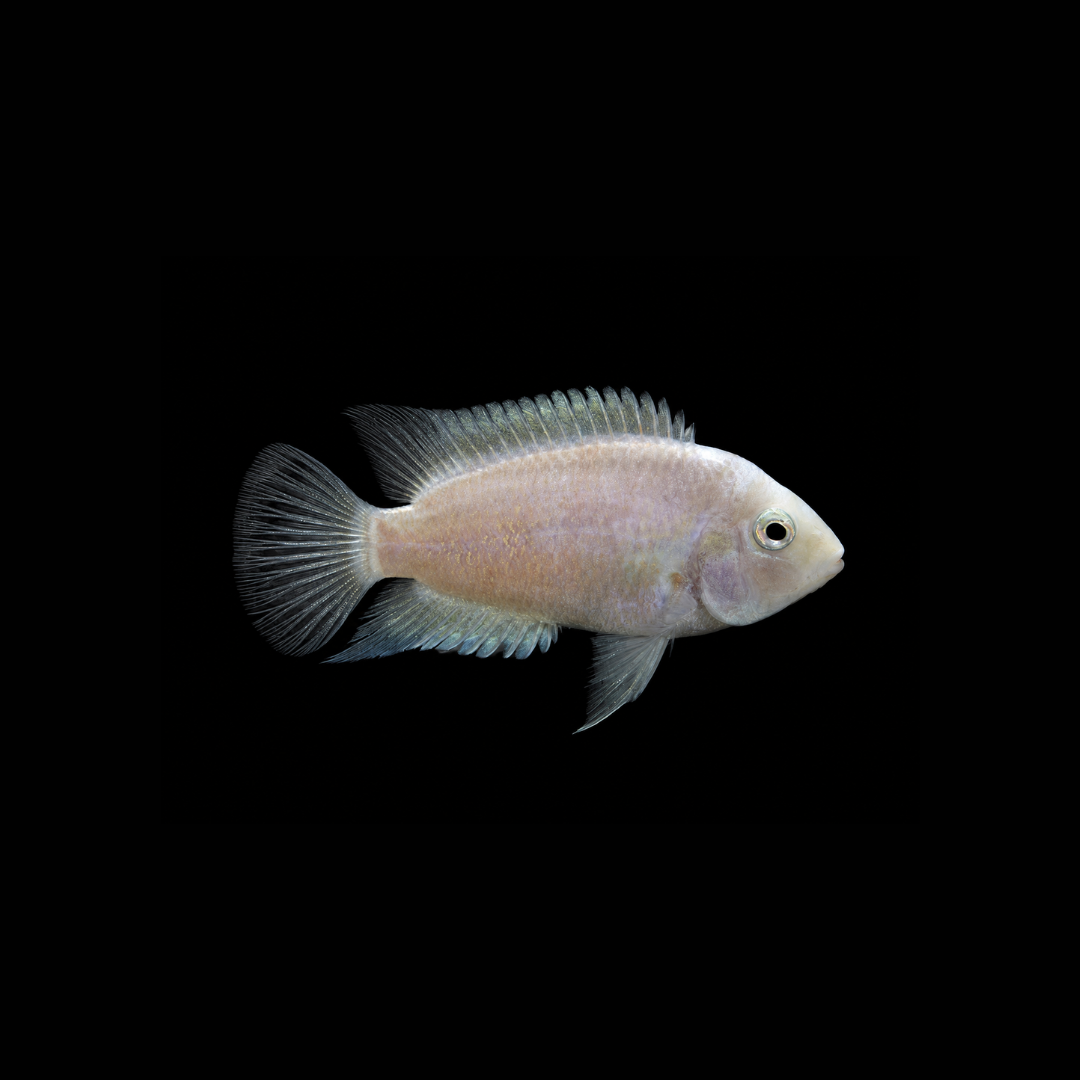
解説 / Description
スノーホワイトパロットは、純白の体色と丸みのある体型で流通するシクリッド系の観賞魚です。ただし、「スノーホワイトパロット」「ホワイトコンビクト」「プラチナパロット」は分類学上の正式名称ではなく、流通上の呼び名として必ずしも同じ系統を指していません。ホワイトコンビクトとしてコンビクトシクリッド Amatitlania nigrofasciata の白色型が扱われる例がある一方、短身体型や交雑由来とされる個体も似た名称で販売されています。そのため、商品名だけから遺伝的背景を断定せず、体型や口の形、販売元が示す系統情報を確認して飼育条件を考えるのが適切です。 The Snow White Parrot is a cichlid-type ornamental fish sold for its white coloration and rounded appearance. However, Snow White Parrot, White Convict, and Platinum Parrot are trade names rather than formal taxonomic names, and they are not used consistently for a single lineage. White Convicts may be white color morphs of the Convict Cichlid, Amatitlania nigrofasciata, while short-bodied or purported hybrid forms may be sold under similar names. The fish’s ancestry therefore should not be inferred from the trade name alone; body shape, mouth structure, and lineage information from the seller are more useful when planning care.
基本情報 / Basic Information
| 学名 / Scientific Name | 流通名だけでは一意に定められません。ホワイトコンビクトとして Amatitlania nigrofasciata の白色型が扱われる例がありますが、スノーホワイトパロット/プラチナパロットには短身体型や交雑由来とされる個体も含まれ、由来が明示されない場合があります。No single scientific name can be assigned from the trade name alone. White Convicts may be white color morphs of Amatitlania nigrofasciata, while fish sold as Snow White Parrot or Platinum Parrot may include short-bodied or purported hybrid forms whose ancestry is not always documented. |
|---|---|
| 通称 / Common Name | スノーホワイトパロット、ホワイトコンビクト、プラチナパロットSnow White Parrot, White Convict, Platinum Parrot |
| 分類 / Family | シクリッド科。流通系統により、Amatitlania nigrofasciata の白色型、または短身体型・交雑由来とされるシクリッドFamily Cichlidae; depending on the line, a white color morph of Amatitlania nigrofasciata or a short-bodied / purported hybrid cichlid form |
| 英名 / English Name | Snow White Parrot / White Convict / Platinum Parrot |
| 分布 / Distribution | 人工交雑系統には自然分布はありません。Amatitlania nigrofasciata は現在、グアテマラ、エルサルバドル、ホンジュラスの一部水系を原産地とする種として整理されています。古い資料ではニカラグアやコスタリカまで含めることがありますが、現在は近縁種として分けられる地域があります。流通個体の養殖地は販売元によって異なるため、一律には扱えません。Artificial hybrid forms have no natural distribution. Amatitlania nigrofasciata is currently treated as native to parts of Guatemala, El Salvador, and Honduras. Older sources often applied the name more broadly into Nicaragua and Costa Rica, where related Amatitlania species are now recognized. The production origin of aquarium-trade fish varies by seller and should not be generalized. |
| 最大体長 / Max Size | 流通名に複数の系統が含まれるため一律ではありません。Amatitlania nigrofasciata では最大約10cmの標準体長(尾びれを除く体長)が示されています。短身体型や交雑系統は成長サイズに幅があるため、販売元が示す成魚サイズも確認してください。There is no single adult size for every fish sold under these trade names. Amatitlania nigrofasciata is listed to about 10 cm standard length, excluding the caudal fin. Short-bodied or hybrid trade forms can vary, so the seller’s expected adult size should also be checked. |
| 寿命 / Lifespan | 流通名全体に共通する、信頼できる統一値は確認できません。系統差と飼育環境の影響が大きいため、特定の年数を断定せず、長期飼育を前提に管理します。A reliable, standardized lifespan figure cannot be applied to every fish sold under these trade names. Longevity is likely to vary with lineage and husbandry, so these fish should be approached as a long-term commitment rather than assigned a precise lifespan without documented lineage data. |
飼育環境 / Aquarium Environment
| 水槽サイズ / Tank Size | 白色コンビクト系統の単独〜ペア飼育では60cm規格水槽を最低限の目安とし、成魚が大きくなる系統、複数飼育、他魚との混泳では90cm以上を検討します。繁殖ペアは縄張りが強くなるため、同じ水槽寸法でも混泳できるとは限りません。For a single fish or pair in a White-Convict-type line, a standard 60 cm aquarium can be treated as a minimum guideline. Larger-growing lines, groups, and mixed-species setups should be considered for aquariums of 90 cm or more. A breeding pair may become highly territorial, so tank length alone does not guarantee compatibility with other fish. |
|---|---|
| 水温 / Temperature | 23〜28℃を実用的な目安とし、急激な変化を避けて安定させます。コンビクトシクリッドの飼育・繁殖研究では26℃前後がよく用いられていますが、水温だけで消化不良や遊泳異常を予防できるわけではありません。 A practical range is about 23–28°C, with stability more important than chasing a single target value. Around 26°C is commonly used in captive studies of Convict Cichlids, but temperature alone should not be presented as a way to prevent digestive or buoyancy problems. |
| 水質 / Water Quality | 流通名に複数系統があるため一律の最適値は設定しにくいものの、Amatitlania nigrofasciata の参考値としてpH7.0〜8.0、硬度9〜20dHが示されています。数値を細かく追い込むより、急変を避けて安定した水質を保つことを優先します。Because several lineages may be sold under these names, there is no single proven optimum for all of them. As a reference, Amatitlania nigrofasciata is listed at pH 7.0–8.0 and hardness 9–20 dH. Stable water conditions and avoidance of abrupt changes are more important than fine-tuning toward a narrow number. |
| レイアウト / Layout | 流木、岩組み、素焼きの土管などを複数配置し、視線を遮れる場所と洞窟状の隠れ家を作ります。底砂を口に含んで掘り返すため、角のない滑らかな底床が適しています。水草を使う場合は、アヌビアス・ナナなど根張りの強い種類を選ぶか、流木へ活着させると管理しやすくなります。Use driftwood, rockwork, and unglazed clay tubes to create caves and break lines of sight. Because these fish may dig and move substrate with their mouths, smooth, rounded substrate is preferable. If plants are used, choose firmly rooted species such as Anubias nana or attach plants to driftwood. |
| 注意点 / Precautions | 縄張り意識が強く、繁殖期には攻撃性が大きく高まります。また、短身体型の個体では体型の個体差が大きいため、摂餌や遊泳に無理がないかを日常的に観察します。浮く、沈む、傾く、転覆するといった遊泳異常は原因が一つとは限らないため、消化不良だけに決めつけず、水質や給餌、外傷、感染症なども含めて状態を確認する必要があります。These fish can be strongly territorial, with aggression increasing during breeding. In strongly short-bodied individuals, body shape varies considerably, so feeding and swimming should be observed closely. Floating, sinking, tilting, or rolling are nonspecific signs rather than proof of a digestive cause; water quality, feeding, injury, and disease may all need to be considered. |
餌と給餌 / Feeding
| 餌の種類 / Diet | 日常の主食は、シクリッド向けの良質な人工飼料を中心にします。個体の口の形と食べ方に合う粒径を選び、必要に応じて植物質を含む餌なども組み合わせて、内容が偏らないようにします。Use a good-quality prepared cichlid diet as the everyday staple. Choose a particle size that suits the fish’s mouth and feeding behavior, and add suitable foods containing plant matter when needed so that the diet does not become unnecessarily one-sided. |
|---|---|
| 給餌のポイント / Feeding Tips | 一度に多く与えず、体型と食欲を見ながら食べ切れる量に調整します。沈下性か浮上性かは、個体の口の形や採餌行動に合わせて選びます。本種では、特定の浮沈性の飼料だけを遊泳異常の予防策として固定する十分な根拠は確認できないため、飼料のタイプよりも過剰給餌を避けることを優先します。Avoid large meals and adjust the amount to the individual’s body form and appetite. Choose floating or sinking foods according to the fish’s mouth shape and feeding behavior. There is not enough species-specific evidence to present one feed buoyancy type as a proven prevention for abnormal swimming, so avoiding overfeeding is the more defensible priority. |
性格と混泳 / Temperament and Tank Mates
| 性格 / Temperament | やや荒い〜攻撃的な性格で、特にペア形成後や産卵・育児中は縄張り防衛が強くなります。コンビクトシクリッド系統では、オスとメスが協力して卵や稚魚を守る両親保護がよく知られており、攻撃性と子育て行動が同時に目立つ時期があります。Temperament ranges from semi-aggressive to aggressive, and territorial defense can intensify after pairing and during spawning or parental care. Convict-Cichlid-type lines are well known for biparental care, in which both parents protect eggs and fry, so breeding periods can combine strong parental behavior with heightened aggression toward other fish. |
|---|---|
| 混泳の相性 / Compatibility | 「同じくらいの大きさなら安全」とは言えません。特に繁殖ペアは他魚を強く排除するため、繁殖を狙う場合はペアを単独で管理するほうが安全です。混泳する場合は十分な遊泳スペースと視線を遮る隠れ家を用意し、口に入る大きさの小型魚や逃げ場を確保しにくい相手は避けます。個体差が大きいため、相性が悪ければ分けられる準備も必要です。Similar size does not guarantee a safe pairing. Breeding pairs may strongly exclude other fish, so a dedicated pair setup is the safer choice when breeding is intended. In a mixed aquarium, provide ample swimming room and visual barriers, avoid fish small enough to be swallowed or unable to escape persistent aggression, and be prepared to separate incompatible individuals. |
病気と対策 / Diseases and Prevention
| かかりやすい病気 / Common Diseases | スノーホワイトパロット/ホワイトコンビクトだけに特有の「かかりやすい病気」を示す十分なデータは確認できません。淡水観賞魚一般と同様に白点病などの感染症には注意が必要です。また、浮く、沈む、傾く、転覆するといった遊泳異常が見られることがありますが、これは病名ではなく症状で、原因を一つに決めることはできません。白い体色では白点を見つけにくいことがあるため、体表だけでなく呼吸や行動の変化も観察します。There is not enough evidence to identify a disease that is uniquely or consistently more common in every Snow White Parrot or White Convict. As with other freshwater aquarium fish, infections such as ich are important to watch for. Floating, sinking, tilting, or rolling are signs of abnormal swimming rather than a diagnosis and can have more than one cause. On a white fish, early white spots may be harder to notice, so breathing and behavior should be observed as well as the skin. |
|---|---|
| 対策と予防 / Prevention | 予防の基本は、安定した水質と水温、適量の給餌、過密や急な環境変化を避けることです。遊泳異常が出た場合は、まず水質・水温、給餌状況、他魚からの攻撃などを確認し、原因を決めつけないことが重要です。白点病は寄生虫の生活環に合わせて複数回の治療が必要になるため、塩分や加温を一律の濃度・温度で行うのではなく、使用する魚病薬の説明や専門家の指示に従って対処します。Prevention centers on stable water quality and temperature, appropriate feeding, and avoiding overcrowding or abrupt environmental change. If abnormal swimming appears, first review water conditions, temperature, feeding, and aggression from tank mates rather than assuming a single cause. Ich treatment must address the parasite’s life cycle and usually requires repeated treatment, so salt, heat, or medication should not be applied at a one-size-fits-all concentration without following the chosen fish medication’s instructions or expert guidance. |
増やし方(繁殖) / Breeding
| 雌雄の判別 / Sexing | 幼魚では外見からの判別が難しいものの、コンビクトシクリッドでは成熟すると性的二形が現れます。メスは腹部にオレンジ色の発色が出ることが代表的な特徴で、オスは一般に大きくなり、背鰭・尻鰭の先端が長く伸びる傾向があります。成熟したオスでは前頭部が盛り上がることもあります。ただし、短身体型や交雑系統では外見が変わるため、同じ特徴が明瞭に出るとは限りません。Juveniles are difficult to sex visually. In Convict Cichlids, mature females characteristically develop orange ventral coloration, while males generally grow larger and tend to have more elongated dorsal and anal fin tips; mature males may also develop a fuller forehead. Short-bodied or hybrid trade forms can obscure these traits, so they may not be equally obvious in every fish sold under these names. |
|---|---|
| 繁殖形態 / Reproduction | 繁殖データは主に Amatitlania nigrofasciata やコンビクトシクリッドに近い系統のものです。基質産卵型で、岩の隙間や土管など洞窟状の場所に粘着卵を産み、両親が卵と稚魚を守ります。産卵数は100〜200個ほどが目安とされます。発生速度は水温に左右され、26〜27℃ではおよそ3日前後で孵化し、産卵から約6日前後で自由遊泳に移るのが一つの目安です。交雑系統では同じ数値がそのまま当てはまるとは限りません。Breeding data are best established for Amatitlania nigrofasciata and closely Convict-like lines. They are substrate spawners, placing adhesive eggs in cave-like sites such as rock crevices or clay tubes, with both parents guarding the eggs and fry. Clutches are commonly on the order of 100–200 eggs. Development is temperature-dependent; around 26–27°C, hatching is roughly a three-day event, with free swimming beginning at about six days after spawning as a practical guideline. Hybrid lines may not follow the same timing or reproductive pattern exactly. |
| 繁殖のポイント / Breeding Tips | 落ち着いて産卵できる洞窟状の隠れ家を用意し、ペアが形成されたら周囲の魚への攻撃に注意します。コンビクトシクリッドでは、親魚が卵へ水を送り、孵化仔魚を口で安全な場所へ移し、自由遊泳後の稚魚を群れとして守る段階的な育児が観察されます。繁殖中は親魚の縄張りを確保できる水槽構成が重要です。流通個体の由来が不明な場合は、繁殖能力や育児行動が同じと決めつけず、実際の行動を見ながら管理します。Provide cave-like spawning sites where the pair can settle without disturbance and watch for aggression toward other fish once a pair forms. Convict Cichlids fan their eggs, move newly hatched larvae to safer pits with their mouths, and later guard free-swimming fry as a group. Adequate territory is important during breeding. When the trade fish’s ancestry is unknown, do not assume that fertility or parental behavior will be identical; manage according to the behavior actually observed. |
雑学と豆知識 / Trivia and Fun Facts
| 1. 名前だけでは正体を決められない魚 / 1. A Trade Name That Can Hide Different Origins | 「スノーホワイトパロット」「ホワイトコンビクト」「プラチナパロット」は、分類学上の名称ではなく流通名です。販売例を見ても、Amatitlania nigrofasciata として扱われる白色個体、短身体型のコンビクトとして扱われる個体、交雑魚として説明される個体が混在しています。したがって、「真のスノーホワイトパロットは特定の2種の交雑」といった固定的な定義は、由来の記録がない個体には当てはめられません。商品名よりも、販売元が示す親魚情報や成魚サイズ、体型を確認するほうが実用的です。Snow White Parrot, White Convict, and Platinum Parrot are trade names, not taxonomic names. Current listings use them for fish identified as white Amatitlania nigrofasciata, short-bodied Convict forms, and fish described as hybrids. Without documented parentage, it is therefore not defensible to define every Snow White Parrot as one specific cross. Seller-provided parentage, adult size, and body form are more useful than the trade name alone. |
|---|---|
| 2. 白い体色は闘争行動にも関係する可能性がある / 2. White Coloration May Be Linked to Fighting Behavior | コンビクトシクリッドでは、黒い縦縞を持つ野生型と、研究上「アメラニスティック」と記載された縞のない白色型を比較した闘争実験があります。その実験では、野生型のオスは体格で不利なときに攻撃頻度を高める傾向がありましたが、白色型では同じ反応が見られず、体格で不利な個体が敗れやすい結果でした。研究者は、攻撃性そのものの遺伝的差異と、縞模様の色変化を威嚇シグナルとして使いにくい可能性の両方を仮説として挙げています。つまり、色彩型と闘争行動の関連は示されていますが、この結果をすべてのスノーホワイトパロットへそのまま当てはめることはできません。A fighting experiment compared normally barred Convict Cichlids with a barless white morph described by the researchers as amelanistic. Wild-type males tended to increase aggression when at a size disadvantage, whereas the white morph did not show the same response and disadvantaged individuals lost more often. The authors proposed both genetic differences in aggression and reduced ability to signal through bar-color changes as possible explanations. The study therefore supports a relationship between color morph and contest behavior, but it should not be generalized automatically to every fish sold as a Snow White Parrot. |
| 3. 魚とは思えないほど丁寧な共同子育て / 3. Remarkably Elaborate Biparental Care | コンビクトシクリッドでは、オスとメスの両方が育児に参加します。卵に水流を送り、孵化した仔魚を口で安全な場所へ移し、自由遊泳後も稚魚の群れを守るという一連の行動が観察されています。研究では、一般にオスが外敵への防御、メスが巣や仔魚に近い直接的な世話へ多くの時間を使う一方、役割は固定ではなく状況に応じて入れ替わることも示されています。つまり、単に「両親が守る」だけでなく、2匹が役割を調整しながら子育てする点がこの系統の特徴です。Convict Cichlids provide biparental care. They fan the eggs, move newly hatched larvae to safer locations with their mouths, and continue to guard the fry after free swimming begins. Studies show a typical division in which males spend more time on defense while females spend more time in direct nest or offspring care, although the roles are flexible and can switch. In other words, the pair coordinates parental work rather than simply performing identical behavior side by side. |
| 4. 求愛から育児へ、ホルモンも切り替わる / 4. Hormones Shift from Courtship to Parenting | コンビクトシクリッドのオスでは、11-ケトテストステロン(11-KT)の血中濃度が求愛期に高く、育児期には低いという変化が研究で確認されています。これは、求愛から育児への行動変化とホルモン動態が対応していることを示しますが、11-KTだけが行動を決めるという意味ではありません。別の繁殖実験では、同じ相手と2回目の繁殖をさせたペアより、新しい相手と組んだ個体のほうが2回目の産卵までの期間が短く、繁殖成功に至る割合も高い傾向が示されました。つまり、コンビクトシクリッドで見られる連続的一夫一婦制には、繁殖間隔を短くする利点がある可能性が示されています。In male Convict Cichlids, circulating 11-ketotestosterone (11-KT) is higher during courtship and lower during parental care. This shows that the behavioral transition from courtship to parenting is associated with a hormonal shift, but it does not mean that 11-KT alone determines the behavior. In a separate breeding experiment, fish given new partners reached a second spawning sooner and were more likely to produce a second brood than pairs kept with the same mate, supporting a possible reproductive benefit of serial monogamy in this species. |
| 5. 観賞魚でありながら研究モデルでもある / 5. An Aquarium Fish and a Scientific Model | コンビクトシクリッドは繁殖しやすく、社会行動を観察しやすいため、行動生態学や内分泌学、環境毒性学などの研究に利用されています。フルオキセチン曝露の研究では繁殖やファニング行動への影響が調べられましたが、著者らは大きな影響が主に自然環境で報告される濃度より高い条件で見られたとしています。また、胚発生の速度は水温で大きく変わり、2018年の研究では孵化まで24℃で94時間、27℃で64時間でした。つまり、「受精から約72時間で孵化する」という数字は固定値ではなく、水温条件を伴って読む必要があります。Convict Cichlids are used in behavioral ecology, endocrinology, and environmental toxicology because they breed readily and show observable social behavior. A fluoxetine-exposure study examined effects on reproduction and fanning, but its authors noted that the stronger effects occurred mainly at concentrations above those reported from natural environments. Embryonic development is also strongly temperature-dependent: a 2018 study reported about 94 hours to hatching at 24°C and 64 hours at 27°C. The familiar “about 72 hours” figure is therefore not a fixed biological constant and needs to be read together with temperature conditions. |
まとめ / Conclusion
スノーホワイトパロット/ホワイトコンビクトは、純白の体色と個性的な体型が魅力のシクリッド系観賞魚です。一方で、その呼び名は単一の分類群を示すものではなく、Amatitlania nigrofasciata の白色型から短身体型・交雑由来とされる個体まで、異なる背景の魚に使われています。迎えるときは商品名だけで性質を決めず、成魚サイズ、体型、販売元が示す系統情報を確認することが大切です。 Snow White Parrot and White Convict are attractive cichlid trade fish known for their white coloration and distinctive body forms. The names do not identify a single taxonomic group, however, and may be applied to white Amatitlania nigrofasciata as well as short-bodied or purported hybrid forms. Care should therefore be planned from the individual fish’s expected adult size, body form, and documented lineage rather than from the trade name alone.
十分な広さと隠れ家を用意し、水温と水質を安定させ、食べ切れる量を適切に給餌することが飼育の基本です。繁殖期の強い縄張り行動にも備え、必要なら他魚と分けられる環境を用意します。コンビクトシクリッドに近い系統では、卵へのファニングや仔魚の移動、稚魚を守る両親保護まで観察でき、白い外見だけでは分からない複雑な社会行動を楽しめます。 Provide adequate space and hiding places, keep temperature and water quality stable, and feed portions that the fish can finish without chronic overfeeding. Be prepared for strong territorial behavior during breeding and separate tank mates if necessary. In Convict-like lines, fanning eggs, moving larvae, and biparental defense of fry can reveal complex social behavior that is not apparent from the fish’s white appearance alone.

気になる道具や飼い方を見つけてみませんか?
 アイのアクアグッズ案内コケを食べるコイの仲間に合わせる飼育用品|フライングフォックス・アルジイーター・ガラ道具の特徴や使い方、選ぶときのポイントをアイが紹介します。記事はコチラ →
 アイのアクアグッズ案内水槽用浄水器の選び方|水換えを楽にするタイプとROの違い道具の特徴や使い方、選ぶときのポイントをアイが紹介します。記事はコチラ →
 アイのアクアグッズ案内水槽のエアーポンプの選び方|水深・音・泡で選ぶおすすめ用品道具の特徴や使い方、選ぶときのポイントをアイが紹介します。記事はコチラ →
 アイのアクアグッズ案内金魚を長く楽しむ飼育用品|水槽・フィルター・エアレーション・水換え道具の特徴や使い方、選ぶときのポイントをアイが紹介します。記事はコチラ →
さまざまな飼育テーマをご紹介。リンク先の記事には広告・商品紹介が含まれます。
案内・紹介記事一覧へ →分布マップ
スノーホワイトパロット/ホワイトコンビクトは流通名で、人工交雑系統には自然分布がありません。以下の地図は、ホワイトコンビクトとして扱われることがある Amatitlania nigrofasciata の原産域として記事中に記載されている、グアテマラ、エルサルバドル、ホンジュラスの一部水系を中心に概略表示しています。
※この地図は記事中の分布情報をもとに地域全体が見えるよう設定した概略表示です。マーカーは分布地域を示すための代表地点であり、実際の採集地点・生息確認地点を示すものではありません。また、流通するスノーホワイトパロット/ホワイトコンビクトには由来の異なる系統が含まれるため、すべての個体にこの自然分布が当てはまるわけではありません。
参考文献
- Schmitter-Soto, J. J. (2007). A systematic revision of the genus Archocentrus (Perciformes: Cichlidae), with the description of two new genera and six new species. Zootaxa, 1603(1), 1–78. https://doi.org/10.11646/zootaxa.1603.1.1
- Bagley, J. C., Matamoros, W. A., McMahan, C. D., Tobler, M., Chakrabarty, P., & Johnson, J. B. (2017). Phylogeography and species delimitation in convict cichlids (Cichlidae: Amatitlania): implications for taxonomy and Plio–Pleistocene evolutionary history in Central America. Biological Journal of the Linnean Society, 120(1), 155–170. https://doi.org/10.1111/bij.12845
- Froese, R., & Pauly, D. (eds.). FishBase. Amatitlania nigrofasciata (Günther, 1867). 分類、分布、生息環境、体長、水質、食性、繁殖情報。2026年8月11日閲覧。 FishBase
- Petty, B. D., Francis-Floyd, R., & Yanong, R. P. E. Management of Aquarium Fish. MSD Veterinary Manual. Updated June 2026. MSD Veterinary Manual
- Petty, B. D., Francis-Floyd, R., & Yanong, R. P. E. Nutritional Diseases of Fish. Merck Veterinary Manual. Updated June 2026. Merck Veterinary Manual
- Beeching, S. C., Gross, S. H., Bretz, H. S., & Hariatis, E. (1998). Sexual dichromatism in convict cichlids: the ethological significance of female ventral coloration. Animal Behaviour, 56(4), 1021–1026. https://doi.org/10.1006/anbe.1998.0868
- Snekser, J. L., & Itzkowitz, M. (2020). Convict cichlid parents that stay with the same mate develop unique and consistent divisions of roles. PeerJ, 8, e10534. https://doi.org/10.7717/peerj.10534
- Jung, H. S., Ko, M. G., Lee, H. B., Noh, J. K., & Kim, D. S. (2018). Embryonic Development of Convict Cichlid Amatitlania nigrofasciata. Korean Journal of Fisheries and Aquatic Sciences, 51(4), 420–425. https://doi.org/10.5657/KFAS.2018.0420
- Petty, B. D., Francis-Floyd, R., & Yanong, R. P. E. Parasitic Diseases of Fish. Merck Veterinary Manual. Updated September 2024. Merck Veterinary Manual




コメント