

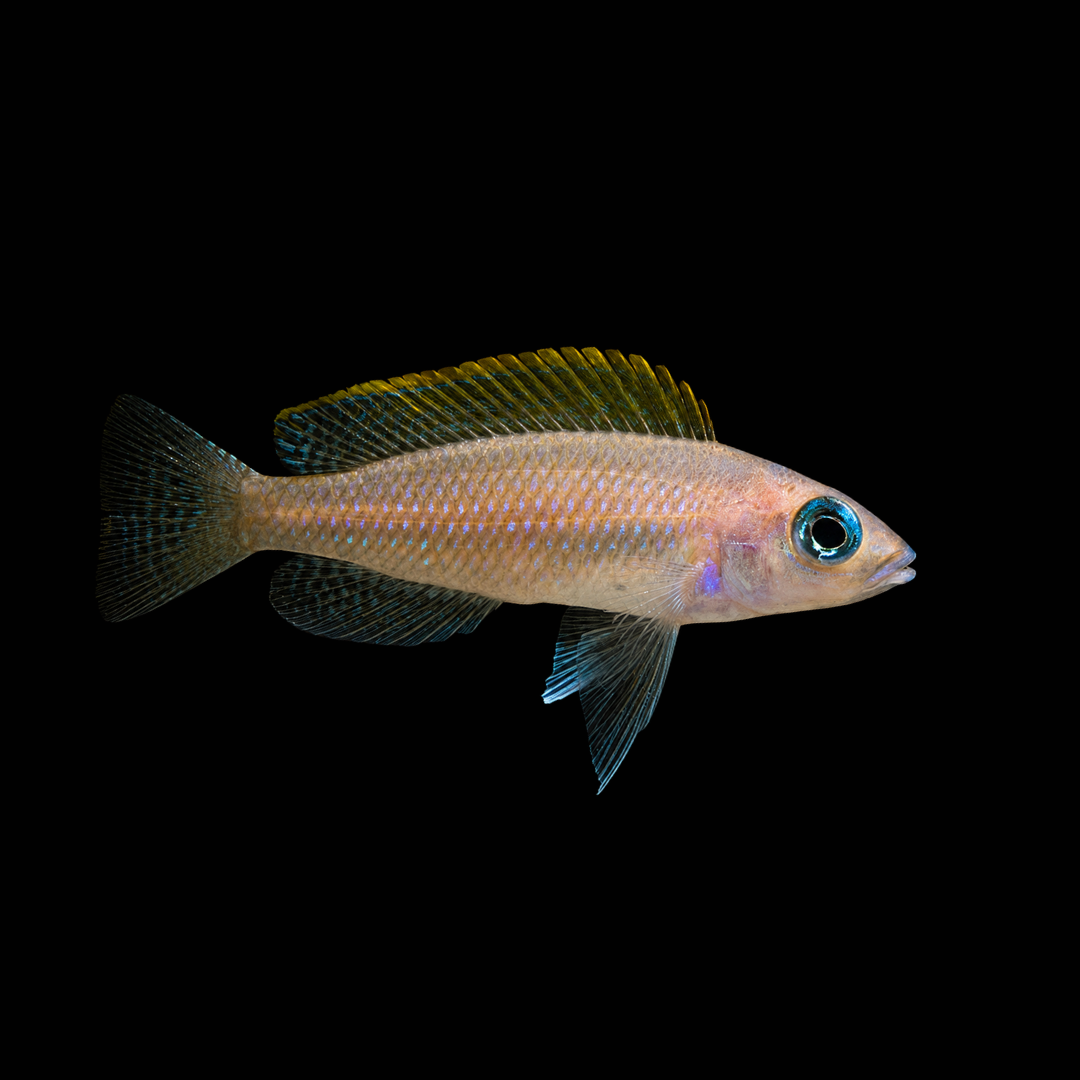
解説 / Description
ネオランプロローグス・カウドプンクタータスは、アフリカのタンガニーカ湖南部に生息する小型のシクリッドです。銀灰色から淡いベージュを基調とする体に、黄橙色に縁取られた背鰭と、尾鰭から体側後半に散る細かな真珠色の斑点が映えます。色彩は派手すぎず、光の角度によって斑点がきらめくため、落ち着いた水景の中で繊細な美しさを楽しめます。野生では砂地と岩場が入り混じる環境を利用し、底床の少し上でホバリングしながら動物プランクトンなどを捕食します。繁殖期には岩の下を掘って巣を作り、飼育下では適切な大きさの巻貝の殻を産卵場所として利用することもあります。硬水・アルカリ性の水質を安定して維持できれば、ペア形成、縄張り防衛、子育てといったタンガニーカ湖産シクリッドらしい行動をじっくり観察できる種類です。 Neolamprologus caudopunctatus is a small cichlid from the southern part of Lake Tanganyika in Africa. Its silvery-gray to pale beige body is accented by a yellow-orange dorsal-fin margin and fine pearly spots on the rear flanks and caudal fin. The coloration is subtle rather than showy, but the spots shimmer at certain angles and give the fish a refined appearance. In nature it uses mixed sand-and-rock habitats and hovers just above the bottom while feeding on zooplankton and small invertebrates. Breeding pairs excavate shelters beneath rocks, and in aquaria they may also use suitably sized snail shells as spawning sites. When maintained in stable hard, alkaline water, the species offers excellent opportunities to observe pair formation, territorial defense, spawning, and parental care.
基本情報 / Basic Information
| 学名 / Scientific Name | Neolamprologus caudopunctatus |
|---|---|
| 通称 / Common Name | カウドプンクタータス、ネオランプロローグス・カウドプンクタータスCaudopunctatus cichlid, Caudopunctatus |
| 分類 / Family | シクリッド科(Cichlidae)/アフリカンシクリッド亜科(Pseudocrenilabrinae)/ランプロローグス族(Lamprologini)/ネオランプロローグス属(Neolamprologus)Family Cichlidae / Subfamily Pseudocrenilabrinae / Tribe Lamprologini / Genus Neolamprologus |
| 英名 / English Name | Caudopunctatus Cichlid |
| 分布 / Distribution | タンガニーカ湖南部。ザンビア沿岸で確実に知られ、タイプ産地はCape Kabeyeyeです。コンゴ民主共和国側のLunangwaからKapampaにかけても分布が報告されています。Southern Lake Tanganyika. The species is well documented from the Zambian shore, with Cape Kabeyeye as the type locality. Specialist field sources also report populations along the Congolese shore between Lunangwa and Kapampa. |
| 最大体長 / Max Size | 野生の成魚は全長4.5〜6cmほどが中心で、最大約6.5cmが一つの目安です。飼育下では、これよりやや大きく見える個体が報告されることもあります。Wild adults are commonly about 4.5–6 cm in total length, with approximately 6.5 cm serving as a well-supported maximum reference. Aquarium individuals may sometimes appear slightly larger. |
| 寿命 / Lifespan | 本種だけを対象にした長期的で信頼性の高い寿命データは限られているため、具体的な年数を一律に示すのは難しいのが現状です。長期飼育では、水質の安定、適切な栄養、慢性的なストレスを避けることが重要です。Reliable long-term lifespan data specific to this species are limited, so a single precise figure is difficult to justify. Stable water chemistry, appropriate nutrition, and avoidance of chronic stress are central to long-term maintenance. |
飼育環境 / Aquarium Environment
| 水槽サイズ / Tank Size | ペア単独飼育では、60cmワイド水槽など、100L前後の水量と十分な底面積を確保できる環境を目安にします。混泳や複数個体からのペア形成を考える場合は、90cm規格水槽以上を用意すると縄張りを分けやすくなります。本種は水槽の高さよりも底面積を有効に使います。For a pair, a tank around 100 L with a broad footprint, such as a 60 cm wide-format aquarium, is a practical target. For community keeping or allowing pairs to form from a group, a standard 90 cm tank or larger provides much more room for territorial separation. Floor area is more important than height. |
|---|---|
| 水温 / Temperature | 23〜25℃を基本的な目安とします。高水温を常用するよりも、急変を避けて安定させることを優先します。 A basic target of 23–25°C is appropriate. Stability is more important than maintaining the fish at the upper end of broad aquarium temperature ranges. |
| 水質 / Water Quality | アルカリ性の硬水を維持します。pH7.5〜8.5、総硬度は15dH前後以上を一つの目安とし、極端な数値を追い込むよりも安定性を優先します。日本の水道水は軟水の地域が多いため、換水用の水をリフトレイク用ミネラルソルトやバッファー剤で調整すると再現性が高くなります。アラゴナイトサンドやサンゴ砂は補助的な緩衝材として利用できます。Maintain hard, alkaline water with a pH of about 7.5–8.5. FishBase lists hardness beginning around 15 dH, while a clear upper limit is not established, so consistency is more important than chasing an extreme number. In areas with soft tap water, Rift Lake mineral salts and buffers can be used to prepare replacement water. Aragonite or coral sand can provide supplementary buffering. |
| レイアウト / Layout | 細かな砂を底床に敷き、大小の岩を組んで岩の下や隙間に巣を作れる場所を用意します。岩は崩れないように安定させ、魚が砂を掘っても倒れない配置にします。適切な大きさの巻貝の空き殻を複数置くと、飼育下では産卵場所として利用することがあります。複数個体を飼う場合は、岩組みで視線を遮り、縄張り同士が直接向き合わないようにすると争いを抑えやすくなります。Use fine sand and stable rockwork that creates sheltered spaces beneath and between rocks. The rocks should remain secure even when the fish excavate the substrate. Several suitably sized empty snail shells may also be provided, as they can be adopted as spawning sites in aquaria. For groups, use rockwork to break lines of sight and separate territories. |
| 注意点 / Precautions | 水質を一度に大きく変えないことが最優先です。換水時は新しい水のpHや硬度を水槽水に近づけ、硝酸塩や有機物をためないように定期的な換水と十分な濾過を行います。本来のホバリングを長時間やめて底床付近で動かなくなった場合は、水質、酸素量、照明、同居魚からの圧力などを確認します。ただし、この姿勢だけで特定の病気やストレス原因を診断することはできません。Avoid sudden changes in water chemistry. Match the pH and hardness of replacement water as closely as practical, and use regular water changes and adequate filtration to prevent nitrate and organic waste from accumulating. If a fish stops its normal hovering behavior and remains close to the substrate for prolonged periods, review water quality, oxygenation, lighting, and social pressure. This posture alone is not diagnostic of any specific disease or stressor. |
餌と給餌 / Feeding
| 餌の種類 / Diet | 小型シクリッド向けの微粒状人工飼料を主食にし、冷凍ブラインシュリンプ、イサザアミ、ミジンコ、ケンミジンコ類などを組み合わせます。野生では水中を漂う動物プランクトンや小型無脊椎動物を捕食するため、動物質を中心にしつつ、単一の餌に偏らない給餌が適しています。Use fine prepared food for small cichlids as the staple diet, supplemented with frozen brine shrimp, mysids, daphnia, and small copepods. In nature the species feeds on zooplankton and small invertebrates, so a varied diet based mainly on animal foods is appropriate. |
|---|---|
| 給餌のポイント / Feeding Tips | 一度に多量を与えるより、食べ切れる量を少量ずつ与えます。繁殖を狙う場合も、餌の量だけを増やすのではなく、冷凍餌などを組み合わせて餌の種類を増やし、栄養バランスを整えます。稚魚は自由遊泳を始めると微細な餌を摂るため、粉末状の稚魚用飼料や孵化直後のブラインシュリンプ幼生を利用できます。Feed small portions that are consumed promptly rather than large meals. For breeding conditioning, increase dietary variety rather than simply increasing quantity. Once fry are free-swimming, finely powdered fry food and newly hatched brine shrimp nauplii are suitable. |
性格と混泳 / Temperament and Tank Mates
| 性格 / Temperament | 非繁殖時は比較的落ち着いていますが、繁殖期には巣の周囲を強く防衛します。ペアは繁殖場所を中心に縄張りを持ち、特に稚魚を守っている時期は近づく魚を追い払います。小型種だからといって狭い水槽に詰め込むと、逃げ場のない個体が継続的に攻撃を受けることがあります。Outside breeding periods the species is relatively calm, but spawning pairs defend the nest area vigorously. Territorial behavior becomes especially pronounced while fry are being guarded. Despite its small size, it should not be crowded into a confined aquarium where subordinate fish cannot escape aggression. |
|---|---|
| 混泳の相性 / Compatibility | 十分な広さがある水槽では、中層から上層を主に泳ぐタンガニーカ湖産種と遊泳空間を分けやすくなります。キプリクロミス属などは候補になりますが、相手側にも広い遊泳空間が必要です。一方、ネオランプロローグス・マルチファスキアータスやネオランプロローグス・シミリスなど、同じ底面と貝殻を縄張りにする種類とは競合しやすいため、混泳させる場合は広い底面積と明確な区画分けが欠かせません。In sufficiently large aquaria, mid- and upper-water Lake Tanganyika species can occupy different spatial zones. Cyprichromis can be considered in appropriately sized tanks, although they also require ample open swimming space. Bottom-dwelling shell breeders such as Neolamprologus multifasciatus and N. similis compete more directly for floor space and shelters, so generous footprint and clear territorial divisions are essential. |
病気と対策 / Diseases and Prevention
| かかりやすい病気 / Common Diseases | 本種に特有の疾病として、十分に確立されたものはありません。ただし、不適切な水質、急激なpHや硬度の変化、過密、餌の与えすぎなどは体調を崩す要因になります。食欲低下、呼吸の乱れ、鰭をたたむ、体色の変化、通常のホバリングをしなくなるといった異常が続く場合は、まず飼育環境を確認します。There is no well-established disease known to be uniquely common in this species. However, unsuitable water chemistry, abrupt changes in pH or hardness, overcrowding, and overfeeding can undermine health. Persistent loss of appetite, abnormal respiration, clamped fins, color changes, or loss of normal hovering behavior should prompt a review of husbandry conditions. |
|---|---|
| 対策と予防 / Prevention | 予防の基本は、硬水・アルカリ性を安定させたうえで、十分な濾過と定期換水を続けることです。新しい魚は可能であれば別水槽で状態を確認してから導入し、餌は食べ切れる量に抑えます。異常が見られた場合は、薬を使う前に水温、pH、硬度、硝酸塩、酸素量、同居魚との関係を確認し、原因を一つずつ切り分けます。Prevention depends on stable hard, alkaline water, adequate filtration, and regular water changes. When possible, observe new fish separately before introduction and avoid overfeeding. If problems appear, first check temperature, pH, hardness, nitrate, oxygenation, and social interactions before resorting to medication. |
増やし方(繁殖) / Breeding
| 雌雄の判別 / Sexing | 雌雄の外見差は小さく、色彩だけで確実に判別するのは困難です。成熟するとオスのほうがやや大きくなる傾向がありますが、個体差もあります。繁殖期のメスは腹部がふくらむため判断材料になりますが、最も確実なのは繁殖行動や産卵を継続して観察することです。The sexes are externally very similar, and coloration alone is not a reliable guide. Mature males tend to be somewhat larger, but individual variation is substantial. A female in breeding condition may develop a fuller abdomen, while repeated observation of spawning behavior provides the most reliable practical confirmation. |
|---|---|
| 繁殖形態 / Reproduction | 基質産卵性で、野生では岩の下の砂を口で運び出し、洞窟状の繁殖場所を作ります。飼育下では巻貝の殻も利用するため、通性的に貝殻を繁殖場所として使う種類とみなせます。ザンビアの野生個体群を対象にした遺伝解析では婚外父性が確認されず、その調査個体群では遺伝的単婚性が支持されました。飼育下では一度に約75〜150個の卵を産む例があり、稚魚は産卵後およそ1週間で自由遊泳を始めるとされています。This is a substrate-spawning species. In the wild, breeding pairs remove sand from beneath rocks to create cave-like shelters. In aquaria they may also use snail shells, making them facultative shell users rather than obligate shell breeders. A genetic study of a wild Zambian population found no extra-pair paternity, supporting genetic monogamy in that study population. Aquarium references report clutches of roughly 75–150 eggs, with fry becoming free-swimming after about one week. |
| 繁殖のポイント / Breeding Tips | 細かな砂、岩下の隠れ場所、巻貝の殻など、複数の繁殖場所を選べるようにします。複数の若魚から自然にペアを作らせる方法は有効ですが、その場合は十分に広い水槽を用意し、ペアから排除された個体を移せる準備も必要です。野生では両親が卵、仔魚、自由遊泳後の稚魚を合わせて約40日間保護すると報告されています。保護期間が終わった稚魚を確実に育てたい場合は、成長に応じて別水槽へ移すと管理しやすくなります。Provide several potential spawning sites, including fine sand, rock shelters, and suitable snail shells. Allowing pairs to form naturally from a group can work well, but it requires a spacious aquarium and a plan for removing fish rejected from established territories. In the wild, both parents have been reported to guard eggs, larvae, and free-swimming fry for about 40 days. Fry intended for continued rearing are often easier to manage if transferred as they grow. |
雑学と豆知識 / Trivia and Fun Facts
| 1. 学名は「斑点のある尾」を表している / 1. The species name refers to its spotted tail | 本種は1978年にマックス・ポールによってLamprologus caudopunctatusとして記載され、現在はNeolamprologus caudopunctatusとして扱われています。タイプ産地はザンビア沿岸のCape Kabeyeyeです。種小名caudopunctatusは、ラテン語で「尾」を意味するcaudaと、「斑点のある」を意味するpunctatusに由来し、尾鰭に散る細かな斑点をよく表しています。The species was described by Max Poll in 1978 as Lamprologus caudopunctatus and is now placed in Neolamprologus. Its type locality is Cape Kabeyeye on the Zambian shore. The epithet caudopunctatus derives from Latin cauda, meaning “tail,” and punctatus, meaning “spotted,” referring to the fine spots on the caudal fin. |
|---|---|
| 2. 「骨化グループ」に含まれる系統 / 2. A member of the lamprologine “ossified group” | ランプロローグス族の系統研究では、本種は「骨化グループ」と呼ばれる系統群に含められてきました。このグループは、口唇靭帯周辺に特徴的な種子骨をもつことで知られています。一方、ランプロローグス族ではミトコンドリアDNAと核DNAから得られる系統関係が完全には一致しない例もあり、過去の交雑や遺伝子浸透を含む複雑な進化史が関与した可能性が議論されています。系統関係は単純な一本の枝分かれだけでは説明しにくく、今後も分類の再検討が続く可能性があります。Phylogenetic studies have placed this species within the lamprologine “ossified group,” a lineage characterized by a distinctive sesamoid ossification associated with the labial ligament. Mitochondrial and nuclear datasets do not always recover identical relationships within Lamprologini, and historical hybridization or introgression has been discussed as part of this complex evolutionary history. The tribe remains taxonomically challenging and may continue to be revised. |
| 3. 近縁種とは水深をずらして共存する / 3. Depth partitioning helps it coexist with a close relative | Neolamprologus leloupiと同所的に見られる地域では、両種の水深利用には明瞭な違いが見られます。N. leloupiは主に2〜10m付近で見られるのに対し、N. caudopunctatusは10mより深い場所で多く観察され、25mを超える水深にも生息します。ただし、本種が浅場にまったく現れないわけではありません。このような水深利用の違いは、近縁種が同じ沿岸域で共存する仕組みを考えるうえで興味深い例です。Where Neolamprologus leloupi and N. caudopunctatus occur together, they show a clear difference in depth use. N. leloupi is most often found around 2–10 m, whereas N. caudopunctatus is more common below 10 m and can occur deeper than 25 m. N. caudopunctatus is not completely absent from shallower water, so this is a strong tendency rather than absolute separation. |
| 4. ホバリングは本種らしい採餌姿勢 / 4. Hovering is a characteristic feeding posture | 本種は底砂のすぐ上に体を保ち、静止しているように見えるホバリングを行います。そこから水中を漂う動物プランクトンなどを捕食するため、常に岩肌をついばむタイプのシクリッドとは水槽内での動き方が大きく異なります。繁殖に参加していない成魚が中層で大きな群れを作ることも報告されており、繁殖ペアが底面を使う時期との行動差も特徴の一つです。The species often holds position just above the substrate in a hovering posture and takes zooplankton from the water column. Its movement therefore differs markedly from cichlids that spend much of their time grazing directly from rock surfaces. Nonbreeding adults have also been reported to form large midwater shoals, contrasting with breeding pairs that occupy the substrate. |
| 5. 遺伝解析で確認された単婚性は「調査個体群」の結果 / 5. Genetic monogamy was demonstrated in a studied population | 2015年の研究では、350個体を超える標本を11のマイクロサテライト遺伝子座で解析した結果、調査した繁殖ペアに婚外父性は確認されませんでした。また、遺伝的類似度に応じて配偶相手を選ぶ傾向は見られず、体サイズが近い個体同士がペアになりやすい同類交配が確認されました。この結果は本種の強いペア形成を裏付けますが、一つの野生個体群で得られた結果であるため、種全体で例外がないと断定するより、調査個体群で遺伝的単婚性が支持されたと捉えるのが正確です。A 2015 study genotyped more than 350 individuals at 11 microsatellite loci and found no extra-pair paternity among the breeding pairs studied. Pairing was not associated with genetic similarity, but pairs were assortatively matched by body size. These findings strongly support genetic monogamy in the sampled population, while avoiding the stronger claim that every population must behave identically. |
| 6. 岩の下と巻貝の殻を使い分ける / 6. It can switch between rock shelters and snail shells | 野生では岩の下の砂を口で運び出し、繁殖用の空間を作ります。生息地では適切な巻貝の殻が少ないため、通常は岩下の空間を利用しますが、飼育下で利用できる殻を用意すると産卵場所として採用することがあります。このため、常に貝殻だけを利用する典型的なシェルブリーダーではなく、状況に応じて貝殻も利用できる柔軟な基質産卵魚と考えるのが実態に即しています。In the wild, pairs excavate sand from beneath rocks to create breeding cavities. Suitable snail shells are scarce in much of their habitat, but in aquaria available shells may be adopted as spawning sites. The species is therefore better viewed as a flexible substrate spawner capable of facultative shell use rather than as an obligate shell breeder. |
| 7. 別の親の稚魚まで一緒に育てることがある / 7. Pairs may raise fry that are not their own | 野生では、1組の親が守っている稚魚の群れに、その親から生まれていない「よその子」が混ざることがあります。これは「ブルード・ミキシング」と呼ばれる現象です。遺伝子を調べた研究では、32の稚魚群のうち19群で、世話をしている両親とは血縁のない稚魚が見つかりました。つまり本種では、親が自分たちの子だけを厳密に選んで育てているわけではないようです。なぜ別の家族の稚魚が同じ群れに加わるのかは、まだ完全には分かっていません。稚魚自身が別の巣へ移動するほか、親が稚魚を運んでいる可能性も研究で示唆されています。小さな魚でありながら、子育てをめぐる社会関係が意外に複雑であることを示す興味深い行動です。In the wild, a pair may guard a group of fry that includes juveniles produced by other parents. This phenomenon is known as brood mixing. Genetic analysis found unrelated fry in 19 of 32 groups examined. In other words, these fish do not appear to raise only their own offspring with perfect discrimination. Why unrelated fry join another family’s brood is still not fully understood. Fry may move between nests on their own, and parental transport has also been suggested as a possibility. The behavior reveals an unexpectedly complex social system in this small Lake Tanganyika cichlid. |
| 8. N. leloupiとの識別では尾鰭後縁が重要 / 8. The caudal-fin margin is important when separating N. leloupi | よく似たNeolamprologus leloupiとの識別では、体側模様だけに頼らないことが大切です。現地資料では、N. leloupiの尾鰭後縁には黒色帯があるのに対し、N. caudopunctatusではその黒色帯を欠く点が、両種を見分ける有力な特徴として挙げられています。体側の淡い模様は個体差や発色状態で見え方が変わるため、尾鰭、背鰭、体型、生息地情報を合わせて判断するほうが安全です。When distinguishing the similar Neolamprologus leloupi, flank pattern alone should not be relied upon. Field-oriented references emphasize the black posterior margin of the caudal fin in N. leloupi, which is absent in N. caudopunctatus. Because subtle body markings can vary with condition and individual appearance, fin coloration, body form, and locality information are best considered together. |
| 9. 現在の保全評価は低危険種 / 9. Current conservation status is Least Concern | IUCNの2025年2月26日付評価では、本種は低危険種(Least Concern)とされています。これは「個体数が減らない」という意味ではなく、現時点で絶滅リスクが高いカテゴリーには入っていないことを示します。観賞魚として入手する場合も、ワイルド個体では採集地情報や輸入経路を確認し、由来が明確な個体を選ぶことが望まれます。The IUCN assessment reflected in FishBase lists the species as Least Concern, with an assessment date of February 26, 2025. This does not mean populations can never decline; it means the species is not currently placed in a higher extinction-risk category. For wild-caught aquarium fish, clear locality and origin information remain valuable. |
まとめ / Conclusion
ネオランプロローグス・カウドプンクタータスは、真珠色の斑点と黄橙色の背鰭を備えた端正な姿に加え、底砂の上を漂うようなホバリング、岩下の巣作り、強いペア形成、両親による子育てなど、多彩な行動を見せる小型シクリッドです。近縁種と水深をずらして共存する生態や、他家の稚魚を含む繁殖群が確認されるブルード・ミキシングなど、野生での暮らしにはタンガニーカ湖の複雑な生態系を映し出す特徴が詰まっています。 Neolamprologus caudopunctatus combines refined coloration with a rich behavioral repertoire: hovering above the sand, excavating shelters beneath rocks, forming strong pair bonds, and providing biparental care. Its depth partitioning with close relatives and the occurrence of brood mixing in wild colonies reveal how much ecological complexity can be contained within such a small cichlid.
飼育の鍵は、タンガニーカ湖産種に適した硬水・アルカリ性の水質を無理なく安定させ、細かな砂と岩場を組み合わせて十分な底面積を確保することです。環境が整うと、控えめな体色の奥にある繊細な輝きと、ペアが巣を選び、守り、稚魚を育てる一連の行動が水槽内で際立ちます。派手な色彩だけではなく、魚の生態や社会行動そのものを観察したい飼育者にとって、長く向き合うほど魅力が深まる種類です。 Successful care depends on maintaining stable hard, alkaline water and providing a broad bottom area with fine sand and secure rock shelters. Under suitable conditions, the fish’s restrained coloration, subtle iridescence, nest selection, territorial defense, and parental behavior become its strongest attractions. For aquarists interested not only in color but also in ecology and social behavior, it is a species whose appeal deepens with long-term observation.

気になる道具や飼い方を見つけてみませんか?
 アイのアクアグッズ案内水槽用浄水器の選び方|水換えを楽にするタイプとROの違い道具の特徴や使い方、選ぶときのポイントをアイが紹介します。記事はコチラ →
 アイのアクアグッズ案内水槽のろ材の選び方|ウール・リング・活性炭の違いとおすすめ商品フィルターの中の綿や石は何をしている? アイとコタロウが、ウール・スポンジ・セラミック・焼結ガラス・活性炭・ゼオライトを比較。機種との相性、入れ方、洗い方と交換まで商品とともに紹介します。記事はコチラ →
 アイのアクアグッズ案内海水魚の底砂の選び方|サンゴ砂・ライブサンドとおすすめ商品道具の特徴や使い方、選ぶときのポイントをアイが紹介します。記事はコチラ →
 アイのアクアグッズ案内水草の肥料の選び方|底床用・液肥・メネデールの使い分け道具の特徴や使い方、選ぶときのポイントをアイが紹介します。記事はコチラ →
さまざまな飼育テーマをご紹介。リンク先の記事には広告・商品紹介が含まれます。
案内・紹介記事一覧へ →分布マップ
Neolamprologus caudopunctatusはタンガニーカ湖南部に分布し、ザンビア沿岸のCape Kabeyeyeをタイプ産地とします。コンゴ民主共和国側ではLunangwaからKapampaにかけても分布が報告されています。
※この地図は記事の分布情報をもとに、タンガニーカ湖南部の分布域を概略的に表示したものです。マーカーは分布域を把握しやすくするために設定した代表地点であり、実際の採集地点を示すものではありません。
参考文献
- Poll, M. (1978). Contribution à la connaissance du genre Lamprologus Schth. Description de quatre espèces nouvelles, réhabilitation de Lamprologus mondabu et synopsis remanié des espèces du lac Tanganika. Bulletin de la Classe des sciences, 64, 725–758. 分類・原記載・学名 https://doi.org/10.3406/barb.1978.58453
- Catalogue of Life (2026). Neolamprologus caudopunctatus (Poll, 1978). Catalogue of Life, 2026-07-17 XR. 現在の有効名・分類学的位置づけ https://www.catalogueoflife.org/data/taxon/46K2J
- Froese, R. & Pauly, D. (eds.). FishBase: Neolamprologus caudopunctatus. 分布・最大体長・底層〜中層性・水温・pH・硬度・ホバリング・動物プランクトン食 https://www.fishbase.se/summary/8654
- Sturmbauer, C., Salzburger, W., Duftner, N., Schelly, R. & Koblmüller, S. (2010). Evolutionary history of the Lake Tanganyika cichlid tribe Lamprologini (Teleostei: Perciformes) derived from mitochondrial and nuclear DNA data. Molecular Phylogenetics and Evolution, 57(1), 266–284. ランプロローグス族の系統関係・骨化グループ・ミトコンドリアDNAと核DNAによる系統解析 https://doi.org/10.1016/j.ympev.2010.06.018
- Ochi, H. & Yanagisawa, Y. (1999). Sand-transfer behavior outside the nest by guarding parents of the Tanganyikan cichlid, Neolamprologus caudopunctatus. Ichthyological Research, 46, 419–422. 砂を運ぶ営巣行動・基質産卵・両親による繁殖場所と稚魚の防衛 https://doi.org/10.1007/BF02673984
- Schaedelin, F. C., van Dongen, W. F. D. & Wagner, R. H. (2015). Mate choice and genetic monogamy in a biparental, colonial fish. Behavioral Ecology, 26(3), 782–788. 生息環境・成魚サイズ・基質産卵・約40日間の両親保護・遺伝的単婚性・体サイズによる同類交配 https://doi.org/10.1093/beheco/arv011
- Schaedelin, F. C., van Dongen, W. F. D. & Wagner, R. H. (2013). Nonrandom brood mixing suggests adoption in a colonial cichlid. Behavioral Ecology, 24(2), 540–546. ブルード・ミキシング・非血縁稚魚の養育・繁殖群間での稚魚移動 https://doi.org/10.1093/beheco/ars195
- Merck Veterinary Manual. Environmental Diseases of Aquatic Animals in Aquatic Systems. 水質悪化による疾病リスク・pH・アルカリ度・硬度・アンモニアなどの水質管理と注意点 https://www.merckvetmanual.com/exotic-and-laboratory-animals/aquatic-systems/environmental-diseases-of-aquatic-animals-in-aquatic-systems




コメント