

解説 / Description
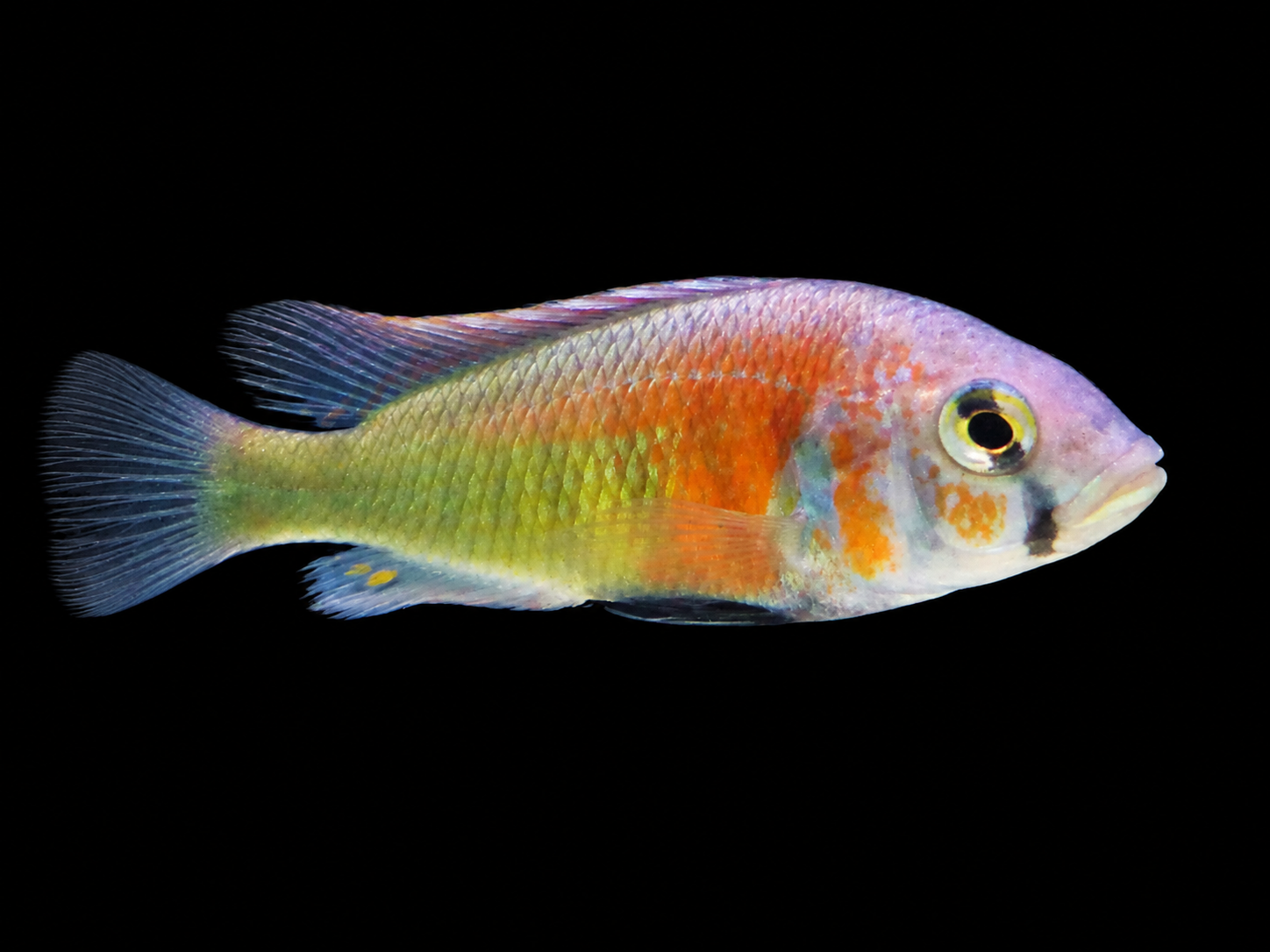
ハプロクロミス・sp.「ヒッポポイント・サーモン」は、ビクトリア湖のケニア側にあるヒッポポイントの名を冠した、未記載のハプロクロミス類です。成熟したオスは頭部から体側にかけてサーモンピンクや橙赤色を帯び、状態によって青緑色の光沢も現れます。一方、メスと若魚は灰褐色からオリーブ色を基調とするため、成熟後は雌雄の色彩差がはっきりします。 Haplochromis sp. “Hippo Point salmon” is an undescribed haplochromine cichlid named after Hippo Point on the Kenyan side of Lake Victoria. Mature males develop salmon-pink to orange-red coloration over the head and flanks, sometimes with blue-green iridescence. Females and juveniles remain grey-brown to olive, so the colour difference between mature males and females is pronounced.
この魚は、巻貝を利用する口腔型の軟体動物食シクリッドとして流通しています。ビクトリア湖の同じ摂食型では、短く頑丈な口と湾曲した歯で巻貝の軟体部をつかみ、殻から引き出す行動が知られています。ただし、「ヒッポポイント・サーモン」そのものは正式な種記載がなく、自然下の食性や生息環境に関する種単位の研究も限られています。飼育では、特徴的な色彩だけでなく、由来を記録しながら系統を混ぜずに維持する姿勢が大切です。 The fish is traded as an oral mollusc-feeding cichlid. In Lake Victoria cichlids of this feeding type, short robust jaws and curved teeth are used to grip snail tissue and pull it from the shell. However, “Hippo Point salmon” has not been formally described as a species, and species-specific studies of its natural diet and habitat remain limited. In captivity, its striking colour should be matched by careful record keeping and the maintenance of clearly separated lineages.
基本情報 / Basic Information
| 学名 / Scientific Name | Haplochromis sp. “Hippo Point salmon” 流通上はAlso traded as Ptyochromis sp. “salmon” / “Hippo Point salmon” |
|---|---|
| 通称 / Common Name | ヒッポポイント・サーモン、プティオクロミス・sp.「サーモン」Hippo Point salmon cichlid |
| 分類 / Family | シクリッド科・ハプロクロミス族。正式な種記載はありません。Ptyochromisはグリーンウッドが1980年に提唱した属名ですが、後の分類ではHaplochromisのシノニムまたは便宜的な亜属的名称として扱われることがあります。観賞魚流通では現在も両方の表記が使われています。Family Cichlidae, tribe Haplochromini. The fish has not been formally described as a species. Ptyochromis was proposed by Greenwood in 1980, but later classifications have treated it as a synonym of Haplochromis or retained it only as a convenient subgeneric-style name. Both usages remain common in the aquarium trade. |
| 英名 / English Name | Hippo Point salmon |
| 分布 / Distribution | アフリカ・ビクトリア湖のケニア側、キスム近郊のヒッポポイントに由来するとされています。採集地点名は広く共有されていますが、野生個体群の分布範囲、個体数、微生息環境について公表された詳細資料は限られています。Reported from Hippo Point near Kisumu on the Kenyan side of Lake Victoria, Africa. The locality name is widely used, but published details on the wild population’s full range, abundance and microhabitat are limited. |
| 最大体長 / Max Size | 全長およそ10〜14cm。一般にオスの方が大きくなりますが、飼育系統や環境によって差があります。Approximately 10–14 cm in total length. Males are generally larger, although size varies among captive lines and husbandry conditions. |
| 寿命 / Lifespan | 本種に限定した信頼できる寿命データは確認されていません。長期飼育では、安定した水質、過密の回避、適切な給餌、繁殖負担の管理が健康維持の中心になります。Reliable species-specific lifespan data have not been established. Long-term health depends chiefly on stable water quality, avoidance of overcrowding, appropriate feeding and careful management of breeding stress. |
飼育環境 / Aquarium Environment
| 水槽サイズ / Tank Size | 成魚の1オス複数メスを維持する場合は、90cm規格水槽相当の底面積を最低限の目安とし、できれば120cm規格水槽、約240L以上を用意します。オスを複数入れる場合や他魚と混泳させる場合は、さらに広い水槽が必要です。水量だけでなく、縄張りを分けられる横幅と奥行きを重視します。For an adult group of one male with several females, a standard 90 cm aquarium should be regarded as a minimum footprint, while a standard 120 cm aquarium of roughly 240 L or more is preferable. Multiple males or mixed-species communities require still more space. Floor area and the ability to separate territories are more important than volume alone. |
|---|---|
| 水温 / Temperature | 24〜27℃を目安に保ちます。高温時は魚の酸素要求量が増えるため、夏季は水温の上がり過ぎと酸欠に注意します。 Maintain approximately 24–27°C. At higher temperatures the fish require more oxygen, so overheating and oxygen shortage need particular attention in summer. |
| 水質 / Water Quality | 中性付近から弱アルカリ性で、急変しない水質が適します。飼育上はpH7.2〜8.2前後、中程度以上の硬度を目安にすると管理しやすいでしょう。ビクトリア湖の沿岸水は場所や季節によって変動し、マラウイ湖やタンガニーカ湖と同じような極端な高硬度水が必須とは限りません。日本の軟水を調整する場合も、測定しながら少しずつ行い、数値を急に引き上げないことが重要です。Stable water from near neutral to mildly alkaline is suitable. In captivity, about pH 7.2–8.2 with moderate or greater hardness is a practical range. Inshore Lake Victoria water varies by locality and season, and the fish does not necessarily require the extremely hard conditions associated with Lakes Malawi or Tanganyika. When adjusting soft tap water, make gradual, measured changes rather than rapidly forcing target values. |
| レイアウト / Layout | 細かな砂または角のない砂利を敷き、岩組みや洞窟状の隠れ家で視線を遮ります。求愛や採餌に使える開けた底面も残してください。底床を掘ることがあるため、重い岩は砂の上に積まず、底面に安定させてから周囲へ底床を入れます。Use fine sand or smooth gravel and create visual barriers with stable rockwork and cave-like refuges. Leave open bottom areas for courtship and foraging. Because the fish may dig, heavy rocks should be secured on the tank base before substrate is added around them. |
| 注意点 / Precautions | 成熟オスは繁殖期を中心に縄張り性が強くなり、メスや劣位個体を追い続けることがあります。複数の逃げ場を設け、追われる個体が餌を食べられているか、ヒレや体表に傷がないかを毎日確認します。また、近縁のビクトリア湖産シクリッドとは交雑する可能性があるため、系統維持を目的とする場合は単種飼育を基本とします。Mature males can become strongly territorial, especially during breeding, and may repeatedly chase females or subordinate fish. Provide several escape routes and check daily that harassed fish are feeding and free of fin or skin damage. Because hybridisation with related Lake Victoria cichlids is possible, species-only maintenance is the safest approach when preserving a lineage. |
餌と給餌 / Feeding
| 餌の種類 / Diet | 良質なシクリッド用の小粒ペレットやフレークを主食にし、冷凍ブラインシュリンプ、イサザアミ、ミジンコ類などを補助的に与えます。小型の巻貝を食べることもありますが、巻貝だけに依存した給餌は必要ありません。自然下での食性を厳密に再現するより、栄養の偏りと過給餌を避けることを優先します。Use a high-quality small cichlid pellet or flake as the staple, supplemented with frozen brine shrimp, mysids and daphnia-type foods. Small snails may also be eaten, but a snail-based diet is unnecessary. Preventing nutritional imbalance and overfeeding is more important than attempting to reproduce the natural diet exactly. |
|---|---|
| 給餌のポイント / Feeding Tips | 1日1〜2回、短時間で食べ切れる量を与えます。高脂肪・高タンパクの餌に偏らせず、粒の大きさと魚の口に合う複数の餌を少量ずつ組み合わせます。残餌は水質を悪化させるため、食べ残しが出る場合は量を減らしてください。巻貝は摂食行動を引き出す補助的な環境刺激として利用できますが、スネール駆除だけを目的に導入する魚ではありません。Feed once or twice daily in portions consumed quickly. Avoid an excessively rich, high-fat or high-protein diet, and rotate several appropriately sized foods in small amounts. Reduce the portion whenever food remains, as leftovers rapidly impair water quality. Snails can provide behavioural enrichment, but the fish should not be purchased solely as a pest-control animal. |
性格と混泳 / Temperament and Tank Mates
| 性格 / Temperament | 活発で縄張り意識があり、成熟オスは同種オスや繁殖可能なメスに対して強く反応します。攻撃性には個体差がありますが、小型でおとなしい魚と組み合わせる種類ではありません。飼育群では、1オスに対して複数のメスを入れ、特定のメスへ追尾が集中しないようにします。Active and territorial, mature males react strongly to rival males and receptive females. Aggression varies among individuals, but this is not a suitable companion for small or timid fish. In a breeding group, keep one male with several females so that courtship pressure is not concentrated on a single fish. |
|---|---|
| 混泳の相性 / Compatibility | 混泳させる場合は、同程度の体格と活動性を持ち、水質条件が合う魚を選びます。ただし、近縁のハプロクロミス類は、外見が異なっていても交雑する可能性があります。保全的な繁殖や純系維持を行う場合は、他のビクトリア湖産ハプロクロミス類と分けて飼育してください。シノドンティス類など生活圏の異なる魚も候補になりますが、実際の相性は個体と水槽構成によって変わります。Choose robust companions of similar size and activity that share the same water requirements. Closely related haplochromines may hybridise even when their appearance differs. For conservation breeding or pure-line maintenance, keep this fish apart from other Lake Victoria haplochromines. Catfish such as Synodontis may be considered because they use a different part of the aquarium, although compatibility still depends on the individuals and tank design. |
病気と対策 / Diseases and Prevention
| かかりやすい病気 / Common Diseases | 本種だけに特有の感染症は確認されていません。水質悪化、過密、急な水温変化、継続的な追尾ストレスが重なると、白点病、体表の細菌感染、食欲不振、腹部の異常など、一般的な淡水魚の不調が起こります。古い飼育者報告には成長後の脊椎湾曲も記載されていますが、発生頻度や原因が科学的に確立された本種固有の疾患ではありません。No infectious disease has been established as unique to this fish. Poor water quality, overcrowding, sudden temperature changes and persistent social stress can contribute to common freshwater problems such as ich, bacterial skin infection, appetite loss and abdominal disorders. Older hobby reports also mention spinal curvature appearing during growth, but its frequency and cause have not been scientifically established as a species-specific condition. |
|---|---|
| 対策と予防 / Prevention | 十分なろ過と酸素供給を行い、アンモニアと亜硝酸を検出させず、硝酸塩の蓄積を定期換水で抑えます。新規個体は隔離して観察し、導入時の温度差と水質差を小さくします。繁殖に用いる個体は、体形、遊泳、摂餌、成長を長期的に確認し、明らかな形態異常や慢性的な虚弱がある個体は親魚に選びません。異常の原因を近親交配だけに決めつけず、水質、栄養、外傷、発育環境も含めて見直します。Provide efficient filtration and aeration, keep ammonia and nitrite undetectable, and control nitrate accumulation with regular water changes. Quarantine new fish and minimise differences in temperature and water chemistry during introduction. Breeding fish should be assessed over time for body shape, swimming, feeding and growth, and individuals with clear deformity or chronic weakness should not be selected as parents. Do not assume that every abnormality is caused by inbreeding; review water quality, nutrition, injury and developmental conditions as well. |
増やし方(繁殖) / Breeding
| 雌雄の判別 / Sexing | 成熟オスはサーモンピンクから橙赤色に発色し、体側に青緑色の光沢が加わることがあります。メスは灰褐色からオリーブ色を基調とし、オスより小型にとどまる傾向があります。若魚や劣位オスは発色が弱いため、体色だけで早期に判別すると誤ることがあります。Mature males become salmon-pink to orange-red and may show blue-green iridescence along the flanks. Females remain grey-brown to olive and tend to be smaller. Juveniles and subordinate males may show little colour, so early sexing by appearance alone can be unreliable. |
|---|---|
| 繁殖形態 / Reproduction | メスが受精卵と仔魚を口内で保護する母系性マウスブルーダーです。オスは底面に産卵場所を確保し、体を震わせる求愛でメスを誘います。メスは産み落とした卵を口に含み、オスの尻ビレにあるエッグスポットへ反応する一連の行動を通じて受精が進みます。飼育報告では、抱卵から仔魚の放出までおよそ3週間が目安とされています。This is a maternal mouthbrooder. The male establishes a spawning site and attracts the female with quivering displays. The female collects each egg in her mouth, and fertilisation proceeds during the sequence in which she responds to egg spots on the male’s anal fin. Aquarium reports generally place the brooding period at about three weeks. |
| 繁殖のポイント / Breeding Tips | 1オスに対して3匹以上のメスを組み合わせ、抱卵メスが追われずに休める隠れ家を設けます。抱卵中のメスは採餌量が大きく減るため、痩せ方と呼吸を観察し、必要に応じて落ち着いた別水槽へ移します。ただし、移動そのものが卵を吐き出す原因になることもあります。仔魚を人為的に口から取り出すストリッピングは、顎や口腔を傷つける危険があるため、通常の飼育では自然放出を基本とします。遊泳を始めた仔魚には、ふ化直後のブラインシュリンプや細かく砕いた人工飼料を少量ずつ与えます。Keep one male with at least three females and provide secluded refuges where brooding females can rest without harassment. Brooding females eat very little, so monitor body condition and breathing and move a female to a quiet separate tank only when necessary; the move itself can cause premature release. Stripping fry from the mouth can injure the jaw and oral tissues, so natural release is preferable in normal aquarium care. Once free-swimming, fry can be offered newly hatched brine shrimp and finely crushed prepared food in small portions. |
雑学と豆知識 / Trivia and Fun Facts
| 1. 二つの属名が並ぶ理由 / 1. Why two genus names appear | ビクトリア湖のハプロクロミス類は、非常に近縁な多数の種が短期間に分化したグループです。グリーンウッドは1980年、顎や歯、頭骨などの形態を手がかりに大きなHaplochromis群を複数の属へ分け、巻貝食の一群にPtyochromisという名称を与えました。その後、この分割は系統関係を十分に示さないという批判を受け、PtyochromisをHaplochromisへ戻す扱いも広まりました。現在の流通名に二つの属名が残るのは、単なる誤記ではなく、ビクトリア湖産シクリッドの分類が歩んできた歴史を映しています。Lake Victoria haplochromines are a large group of closely related fishes that diversified rapidly. In 1980, Greenwood divided the broad genus Haplochromis into several genera using features of the jaws, teeth and skull, and applied the name Ptyochromis to one mollusc-feeding group. Later authors criticised the split for not adequately representing phylogenetic relationships, and many returned Ptyochromis to Haplochromis. The two names seen in the aquarium trade therefore reflect a real history of changing classification rather than a simple spelling error. |
|---|---|
| 2. 殻を砕く魚と、軟体部を引き出す魚 / 2. Shell crushers and oral shellers | ビクトリア湖の巻貝食シクリッドは、同じ餌資源へ一つの方法だけで適応したわけではありません。喉の奥にある咽頭顎で小型の巻貝を殻ごと砕く種類がいる一方、口先の歯で軟体部をつかみ、頭を振って殻から引き出す種類もいます。「ヒッポポイント・サーモン」は後者に近い流通型とされています。ただし、正式な種記載と種単位の行動研究がないため、既知のPtyochromis類で確認された摂食機構を、この魚にも完全に同一と断定することはできません。Lake Victoria’s snail-eating cichlids did not adapt to the same resource in only one way. Some swallow small snails and crush the shells with their pharyngeal jaws, while others grip the soft body with oral teeth and shake it free. “Hippo Point salmon” is traded as a form close to the latter group. Because it lacks a formal species description and species-specific behavioural study, however, the feeding mechanism documented in known Ptyochromis-type shellers should not be assumed to be identical in every detail. |
| 3. 光が支える摂食と配偶者選択 / 3. Light links feeding and mate choice | 研究されたビクトリア湖の口腔型シェラーでは、暗い条件になると巻貝を利用する効率が低下しました。また、湖のハプロクロミス類では、オスの婚姻色とメスの視覚による選択が種の識別に深く関わっています。濁りが強まると色彩信号を見分けにくくなり、近縁種間の生殖隔離が弱まる可能性があります。鮮やかな体色と特殊な採餌行動は別々の特徴に見えますが、どちらも水中で十分に物を見ることができる環境に支えられています。In studied Lake Victoria oral shellers, feeding efficiency on snails declines under very low light. Among lake haplochromines, male breeding colours and visually guided female choice also play important roles in species recognition. Increased turbidity can obscure colour signals and weaken reproductive isolation between related species. Vivid coloration and specialised feeding may appear unrelated, yet both depend on an underwater environment in which visual information remains available. |
| 4. 若い湖で起きた急速な多様化 / 4. Rapid diversification in a young lake | 地質学的研究では、ビクトリア湖が後期更新世に大きく縮小し、完全に干上がった時期を経て、約1万4600年前に再び満たされた可能性が示されています。この解釈が正しければ、現在の湖に見られる多数の固有シクリッドは、進化学的にはきわめて短い時間に多様化したことになります。近年のゲノム研究は、急速な適応放散が突然すべてを生み出したのではなく、祖先集団が以前から持っていた豊富な遺伝的変異を再利用した可能性も示しています。Geological studies suggest that Lake Victoria underwent severe late-Pleistocene contraction, possibly complete desiccation, before refilling about 14,600 years ago. If this interpretation is correct, the lake’s many endemic cichlids diversified within an exceptionally short evolutionary period. Recent genomic research also indicates that this rapid radiation did not arise from nothing; ancestral populations may have repeatedly reused abundant genetic variation that already existed before the radiation. |
| 5. CARESの「脆弱」はIUCN評価とは別 / 5. CARES Vulnerable is not an IUCN assessment | CARESの保全優先リストには、Ptyochromis sp. “salmon”が「CVU(CARES Vulnerable)」として掲載されています。これは、野生下で中期的に絶滅する危険が高いとCARESが判断した保全区分です。ただし、未記載種である本魚に対するIUCNレッドリストの正式評価を意味するものではありません。飼育者に求められるのは、危機を強調するだけではなく、個体の由来を記録し、近縁種との交雑を避け、繁殖個体を責任ある飼育者へ引き継ぐことです。The CARES priority list includes Ptyochromis sp. “salmon” as CVU, or CARES Vulnerable, indicating that CARES considers it at high risk of extinction in the wild in the medium term. This is not the same as a formal IUCN Red List assessment of this undescribed fish. Responsible maintenance involves more than emphasising its threatened status: aquarists should document origin, prevent hybridisation with related fish and transfer offspring to keepers who can continue the lineage. |
| 6. 日本で迎えるときは来歴を優先する / 6. Prioritise provenance when acquiring fish in Japan | 日本では常時大量に流通する種類ではなく、専門店の輸入、通信販売、愛好家やブリーダー間の分譲など、限られた経路で断続的に扱われる魚です。未発色の若魚は種類や雌雄を見分けにくいため、価格や発色だけでなく、販売名、親魚の名称、繁殖元、入手時期が記録されているかを確認します。流通名の異なる系統を安易に交配せず、同じ採集地名を持つ個体でも由来が不明な場合は、保全繁殖用の純系と断定しない慎重さが必要です。In Japan this fish is not generally available in large, continuous numbers. It appears intermittently through specialist imports, mail-order dealers and exchanges among hobbyists or breeders. Juveniles are difficult to identify by colour or sex, so buyers should ask about the trade name, parent stock, breeder and acquisition date rather than judging only by price or display colour. Lines sold under different names should not be crossed casually, and even fish carrying the same locality label should not be presented as a conservation-grade pure line when their provenance is unknown. |
まとめ / Conclusion
ハプロクロミス・sp.「ヒッポポイント・サーモン」は、成熟オスの温かみのある赤色と、巻貝食シクリッドとしての進化的背景が印象に残るビクトリア湖産魚です。十分な底面積、安定した水質、視線を遮る岩組み、複数のメスが休める環境を整えることで、発色、求愛、産卵、マウスブルーディングという一連の行動を落ち着いて観察できます。 Haplochromis sp. “Hippo Point salmon” is a memorable Lake Victoria cichlid, combining the warm red coloration of mature males with the evolutionary background of a mollusc-feeding fish. With sufficient floor space, stable water, sight-breaking rockwork and refuges for several females, aquarists can observe its coloration, courtship, spawning and mouthbrooding under controlled conditions.
その魅力を長く保つためには、鮮やかさだけを追うのではなく、個体の健康と系統の来歴を同じ重さで扱う必要があります。近縁種との交雑を避け、親魚と繁殖履歴を記録し、無理のない範囲で次の飼育者へ健全な子孫をつなぐことが、この魚と向き合ううえで最も確かな保全になります。適切に管理された水槽の中で、本種はビクトリア湖の急速な進化と、失われやすい多様性の両方を静かに伝え続けます。 Preserving its appeal requires treating health and provenance as seriously as colour. Preventing hybridisation, recording parentage and breeding history, and passing healthy offspring to capable keepers are the most practical forms of conservation available to aquarists. In a well-managed aquarium, this fish quietly represents both the extraordinary speed of evolution in Lake Victoria and the fragility of the diversity that evolution produced.

気になる道具や飼い方を見つけてみませんか?
 アイのアクアグッズ案内水草の肥料の選び方|底床用・液肥・メネデールの使い分け道具の特徴や使い方、選ぶときのポイントをアイが紹介します。記事はコチラ →
 アイのアクアグッズ案内水草トリミングの道具とやり方|ハサミ・ピンセットを水草に合わせて選ぼう伸びすぎた水草は切っていい? 有茎草の差し戻し、前景草の絨毯、流木のモスを整える場面から、水草用ハサミ・ピンセット・ゴミ取りネットの選び方と片付けを紹介します。記事はコチラ →
 アイのアクアグッズ案内マジックリーフ物語|一枚の葉がアクアリウム用品になるまで道具の特徴や使い方、選ぶときのポイントをアイが紹介します。記事はコチラ →
 アイのアクアグッズ案内コケを食べるコイの仲間に合わせる飼育用品|フライングフォックス・アルジイーター・ガラ道具の特徴や使い方、選ぶときのポイントをアイが紹介します。記事はコチラ →
さまざまな飼育テーマをご紹介。リンク先の記事には広告・商品紹介が含まれます。
案内・紹介記事一覧へ →分布マップ
本種はアフリカ・ビクトリア湖のケニア側、キスム近郊のヒッポポイントに由来するとされています。野生個体群の正確な分布範囲や詳細な採集地点は十分に公表されていないため、地図ではヒッポポイント周辺を示す概略代表地点のみを表示しています。
※この地図は記事中の分布情報をもとにした概略表示です。マーカーは実際の採集地点、厳密な生息地点、野生個体群の分布境界を示すものではありません。
参考文献
本種を直接扱う査読資料は限られるため、分類、生息水域、摂食型、繁殖様式、飼育管理、魚病予防を支える一次資料および専門機関資料を掲載しています。
-
1
分類属名の成立
Greenwood, P. H. (1980). “Towards a phyletic classification of the ‘genus’ Haplochromis (Pisces, Cichlidae) and related taxa. Part II: The species from Lakes Victoria, Nabugabo, Edward, George and Kivu.” Bulletin of the British Museum (Natural History), Zoology, 39(1), 1–101. DOI・本文
-
2
分類属区分の再検討
van Oijen, M. J. P. (1996). “The generic classification of the haplochromine cichlids of Lake Victoria, East Africa.” Zoologische Verhandelingen, 302(2), 57–110. Naturalis本文
-
3
生態巻貝食
Witte, F., & van Oijen, M. J. P. (1990). “Taxonomy, ecology and fishery of Lake Victoria haplochromine trophic groups.” Zoologische Verhandelingen, 262(1), 1–47. Naturalis本文
-
4
生息環境濁り・光量口腔型シェラー
Witte, F., Seehausen, O., Wanink, J. H., Kishe-Machumu, M. A., Rensing, M., & Goldschmidt, T. (2013). “Cichlid species diversity in naturally and anthropogenically turbid habitats of Lake Victoria, East Africa.” Aquatic Sciences, 75, 169–183. DOI・本文
-
5
分布水域ウィナム湾水質
Marriott, A. L., Osano, O. F., Coffey, T. J., Humphrey, O. S., Ongore, C. O., Watts, M. J., & Aura, C. M. (2023). “Considerations for environmental biogeochemistry and food security for aquaculture around Lake Victoria, Kenya.” Environmental Geochemistry and Health, 45(8), 6137–6162. DOI・本文
-
6
繁殖抱卵メス繁殖季節性
Witte, F. (1980). “Initial results of the ecological survey of the haplochromine cichlid fishes from the Mwanza Gulf of Lake Victoria (Tanzania): Breeding patterns, trophic and species distribution.” Netherlands Journal of Zoology, 31(1), 175–202. DOI
-
7
繁殖母系性マウスブルーディングエッグスポット
Salzburger, W., Mack, T., Verheyen, E., & Meyer, A. (2005). “Out of Tanganyika: Genesis, explosive speciation, key-innovations and phylogeography of the haplochromine cichlid fishes.” BMC Evolutionary Biology, 5, 17. DOI・本文
-
8
繁殖口内受精
Mrowka, W. (1987). “Oral fertilization in a mouthbrooding cichlid fish.” Ethology, 74(4), 293–296. DOI
-
9
飼育条件水質管理隔離・防疫
Petty, B. D., Francis-Floyd, R., & Yanong, R. P. E. “Management of Aquarium Fish.” Merck Veterinary Manual, Professional Version. Full review May 2022; updated June 2026. 専門家向け本文
-
10
病気細菌感染ストレス・過密
Petty, B. D., Francis-Floyd, R., & Yanong, R. P. E. “Bacterial Diseases of Fish.” MSD Veterinary Manual, Professional Version. Full review May 2022; updated September 2024. 専門家向け本文
-
11
保全・注意点系統管理CARES区分
CARES Fish Preservation Program. “Priority list: Cichlidae – Cichlids.” Ptyochromis sp. “salmon”をCVUとして掲載。優先種リスト
CARES Fish Preservation Program. “CARES risk classifications.” 区分の定義




コメント