

解説 / Description
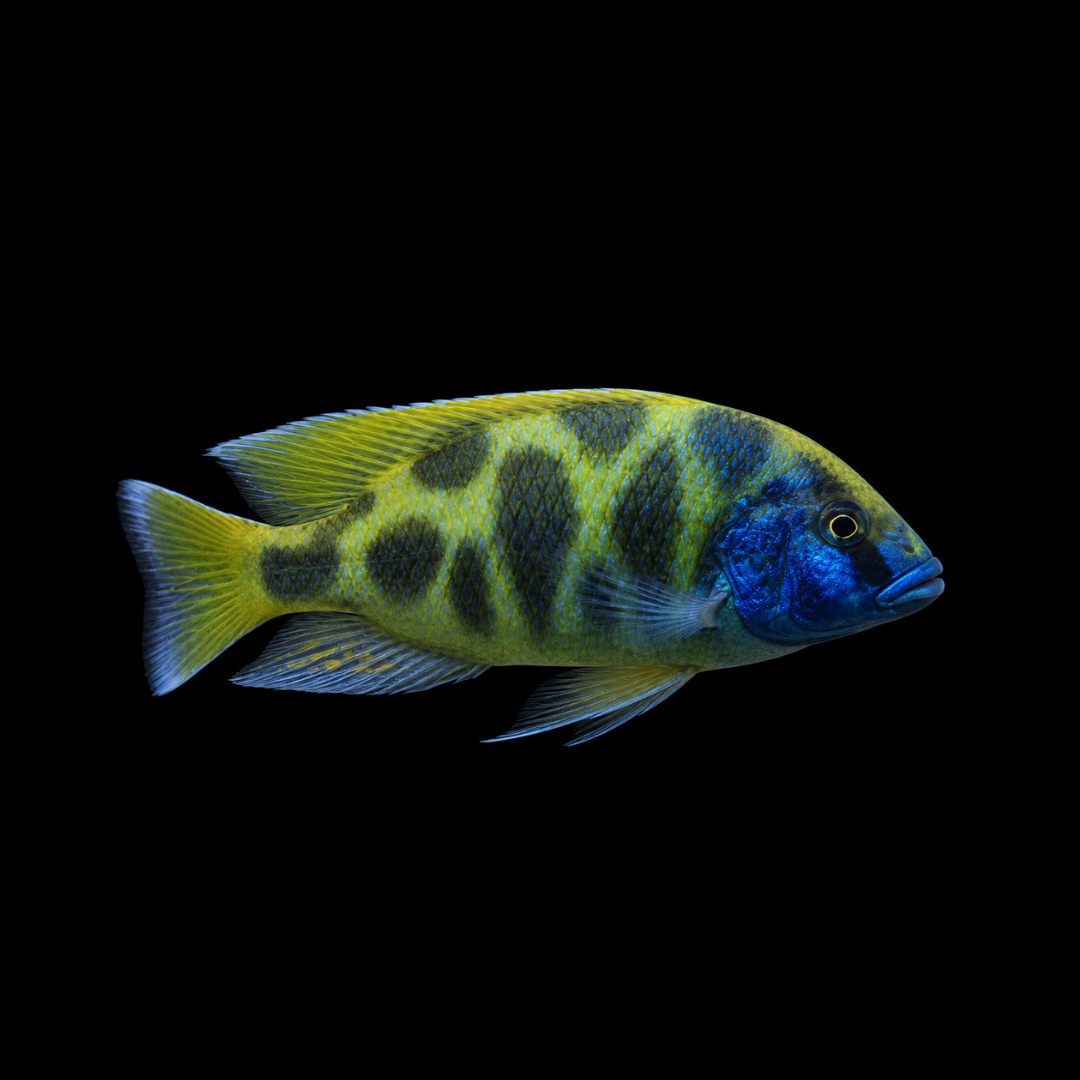
ニンボクロミス・ベネスタス(Nimbochromis venustus)は、アフリカのマラウイ湖とマロンベ湖に分布する大型のアフリカンシクリッドです。幼魚やメスは、黄色から銀色の地に茶褐色の大きな斑紋をまとい、その姿から「ジラフ・シクリッド」とも呼ばれます。成熟したオスは頭部が鮮やかなメタリックブルーに染まり、体側には黄緑色から黄金色の輝きが現れるため、成長に伴う変化を楽しめる魚として高い人気があります。 Nimbochromis venustus is a large African cichlid native to Lake Malawi and Lake Malombe. Juveniles and females have large brown blotches over a yellow to silvery background, giving rise to the common name “Giraffe Cichlid.” Mature males develop a brilliant metallic-blue head and yellow-green to golden coloration along the body, making their dramatic transformation with age one of their greatest attractions.
野生下では砂底に体を半ば潜らせ、ほとんど動かずに小魚を待ち伏せします。水槽内でも力強い遊泳力と明確な縄張り意識を示すため、十分な遊泳空間、安定した弱アルカリ性の水質、強力なろ過、そして同居魚の慎重な選定が欠かせません。美しさと迫力を兼ね備える一方、設備と管理には大型シクリッドにふさわしい準備が求められる魚です。 In the wild, it partially buries itself in sandy bottoms and waits almost motionless to ambush small fish. In aquariums it retains powerful swimming ability and strong territorial behavior, so ample open space, stable alkaline water, robust filtration, and carefully selected tank mates are essential. Its beauty and presence are exceptional, but it requires the preparation and management expected for a large cichlid.
基本情報 / Basic Information
| 学名 / Scientific Name | Nimbochromis venustus |
|---|---|
| 通称 / Common Name | ニンボクロミス・ベネスタス、ベネスタス、HAPL.ベネスタスVenustus, Giraffe Hap |
| 分類 / Family | シクリッド科・Pseudocrenilabrini族・ニンボクロミス属Family Cichlidae, tribe Pseudocrenilabrini, genus Nimbochromis |
| 英名 / English Name | Giraffe Cichlid, Giraffe Hap, Venustus |
| 分布 / Distribution | アフリカ東部のマラウイ湖およびマロンベ湖Lake Malawi and Lake Malombe in eastern Africa |
| 最大体長 / Max Size | 最大約25cm。一般的な成魚は22cm前後に達します。Up to about 25 cm, with many adults reaching around 22 cm. |
| 寿命 / Lifespan | 正確な寿命に関する情報は限られています。大型シクリッドとして長期飼育を前提に設備と管理計画を整えてください。Reliable lifespan data are limited. Plan the aquarium and long-term care as you would for a long-lived large cichlid. |
飼育環境 / Aquarium Environment
| 水槽サイズ / Tank Size | 単独でも最低120cm規格水槽を目安とし、複数飼育や混泳では150cm以上の大型水槽が推奨されます。120cm水槽でも水、底砂、岩、水槽台を含めると総重量が約340〜350kgに達することがあるため、設置前に床の許容荷重を建築士や施工業者へ確認してください。Use at least a standard 120 cm aquarium for a single adult, and preferably a 150 cm or larger tank for groups or mixed communities. A 120 cm setup can weigh roughly 340–350 kg once water, substrate, rocks, and the stand are included, so confirm the floor’s load capacity with a qualified building professional before installation. |
|---|---|
| 水温 / Temperature | 24〜28℃を目安に、急変を避けて安定させます。 Maintain approximately 24–28°C and avoid rapid fluctuations. |
| 水質 / Water Quality | pH7.5〜8.8程度の弱アルカリ性、GH10〜15dGH程度の硬水が目安です。日本の軟水地域では、細目のサンゴ砂やカキガラをろ材として利用し、pHと硬度を緩やかに補います。換水時は新旧の水温と水質を近づけ、急激なpH変化を避けてください。Aim for alkaline water around pH 7.5–8.8 and moderately hard water around GH 10–15 dGH. In soft-water areas of Japan, fine coral sand or oyster shell media can gently support pH and hardness. Match temperature and water chemistry during water changes to avoid sudden pH shifts. |
| レイアウト / Layout | 角の取れた細目のサンゴ砂を敷き、中央から前面には広い遊泳空間を確保します。岩組は隠れ場所と視線の遮断に役立ちますが、魚が掘っても崩れないよう、水槽底面に安定させて設置してください。粗く鋭利な底砂は、潜砂時に眼や体表を傷つけるおそれがあります。Use fine, rounded coral sand and leave a broad open swimming area through the center and front. Rockwork provides shelters and breaks lines of sight, but it must be secured directly and safely so digging cannot cause a collapse. Avoid coarse or sharp substrate that may damage the eyes or skin during burying behavior. |
| 注意点 / Precautions | 大型で排泄量が多いため、強力なろ過と十分な酸素供給、定期的な換水が必要です。縄張り争いが激しくなる場合に備え、隔離用水槽やセパレーターも用意しておきます。水槽を過密気味にして攻撃を分散させる方法は上級者向けで、ろ過能力と水量が不足すると水質悪化を招くため、安易には行わないでください。Because this is a large, heavy-feeding fish, strong filtration, ample oxygenation, and regular water changes are essential. Keep a spare tank or divider available in case territorial fighting escalates. Deliberate crowding to spread aggression is an advanced technique and should not be attempted without sufficient water volume and filtration capacity. |
餌と給餌 / Feeding
| 餌の種類 / Diet | 肉食性のため、魚粉やエビ粉を主原料とした高品質な大型シクリッド用ペレットを中心に与えます。補助的に冷凍ブラインシュリンプなどを組み合わせ、栄養の偏りを抑えます。スピルリナを含むフードを少量取り入れることもできます。As a carnivorous cichlid, it should receive high-quality large-cichlid pellets based primarily on fish meal or shrimp meal. Frozen brine shrimp can be offered as a supplement to improve dietary variety, and a small amount of food containing spirulina may also be included. |
|---|---|
| 給餌のポイント / Feeding Tips | 一度に大量に与えず、短時間で食べ切る量を1日1〜2回に分けます。消化しにくい穀類やでんぷん質の比率が高い餌だけに偏らせず、腹部の膨張、食欲低下、白い粘液状の糞が見られた場合は早めに給餌を止め、隔離して状態を確認してください。Offer only what the fish can finish quickly, divided into one or two small feedings per day. Do not rely exclusively on foods high in poorly digestible grains or starches. If abdominal swelling, loss of appetite, or white stringy feces appear, stop feeding promptly, isolate the fish, and assess its condition. |
性格と混泳 / Temperament and Tank Mates
| 性格 / Temperament | 力が強く、縄張り意識の強い半攻撃的な性格です。特に成熟したオス同士や、体格差の大きい個体間では激しい追い回しが起こることがあります。新しい個体を追加する際は、岩組を組み直して縄張りを一度リセットすると衝突を軽減しやすくなります。It is powerful, territorial, and semi-aggressive. Mature males and fish with large size differences may engage in intense chasing. When adding new individuals, rearranging the rockwork can help reset established territories and reduce immediate conflict. |
|---|---|
| 混泳の相性 / Compatibility | 同程度の大きさと遊泳力を持つ、丈夫なマラウイ湖産の非ムブナ系シクリッドが候補になります。小型魚は捕食される可能性が高く、エンゼルフィッシュ、アピストグラマ、一般的な小型テトラなど、弱酸性を好み攻撃に弱い魚との混泳には向きません。プレコ類を同居させる場合も、口に入らない十分な大きさと水質への適応を確認してください。Suitable companions are robust Lake Malawi non-mbuna cichlids of similar size and swimming ability. Small fish are likely to be eaten, and soft-water species vulnerable to aggression, such as angelfish, Apistogramma, and small tetras, are unsuitable. If keeping a pleco, ensure it is far too large to swallow and fully adapted to the water conditions. |
病気と対策 / Diseases and Prevention
| かかりやすい病気 / Common Diseases | 腹部が膨らみ、食欲低下や白い粘液状の糞を伴う「マラウイ・ブロート」と呼ばれる症状群に注意が必要です。また、粗い底砂や衝突による外傷をきっかけに、眼球白濁、眼球突出、体表の細菌感染が起こることがあります。Watch for the syndrome commonly called Malawi bloat, which may involve abdominal swelling, reduced appetite, and white stringy feces. Injuries from rough substrate or collisions can also lead to cloudy eyes, protruding eyes, or secondary bacterial infections of the skin. |
|---|---|
| 対策と予防 / Prevention | 予防の基本は、水質の安定、過密による慢性的なストレスの回避、角のない細かな底砂、消化に配慮した適量給餌です。異常が見られた個体は早めに隔離し、絶食と水質改善を優先します。魚病薬や抗菌薬、抗原虫薬は適応や国内の法規制を確認し、自己判断での人用医薬品の転用や高濃度の塩類投与は避け、必要に応じて魚類を診療できる獣医師や専門店へ相談してください。Prevention depends on stable water quality, avoiding chronic crowding stress, using smooth fine substrate, and feeding modest amounts of digestible food. Isolate affected fish early and prioritize fasting and water-quality correction. Check the indication and Japanese regulations before using fish medications, avoid repurposing human drugs or applying concentrated salts without guidance, and consult a veterinarian experienced with fish or a knowledgeable specialist when needed. |
増やし方(繁殖) / Breeding
| 雌雄の判別 / Sexing | 幼魚では判別が難しいものの、成熟したオスは頭部が鮮烈なメタリックブルーとなり、体側に黄緑色から黄金色の婚姻色が現れます。メスは黄色から銀色の地色と、茶褐色のジラフ模様を比較的明瞭に保ちます。Juveniles are difficult to sex. Mature males develop a vivid metallic-blue head and yellow-green to golden breeding coloration, while females generally retain a yellow to silvery background with clearly visible brown giraffe-like blotches. |
|---|---|
| 繁殖形態 / Reproduction | 母系口内保育を行います。オスが砂底に浅い産卵床を作ってメスを誘い、受精卵をメスが口に含みます。メスは約2〜3週間、ほとんど餌を取らずに卵と仔魚を守ります。This species is a maternal mouthbrooder. The male prepares a shallow spawning site in the sand and courts the female, which then collects the fertilized eggs in her mouth. She protects the eggs and fry for roughly two to three weeks while eating little or nothing. |
| 繁殖のポイント / Breeding Tips | 口内保育中のメスは体力を消耗し、他魚から攻撃されやすくなります。追い回しが見られる場合は、驚かせないように隔離ネットや別水槽へ移し、静かな環境を用意します。稚魚が自力で泳ぎ始めたら、口に入る大きさの微粒子フードや孵化直後のブラインシュリンプを少量ずつ与え、水質悪化を防ぎます。A mouthbrooding female loses condition and may become a target for other fish. If she is being chased, move her gently to a breeding net or separate aquarium and provide a quiet environment. Once the fry are free-swimming, offer tiny amounts of suitably fine food or newly hatched brine shrimp while carefully preventing water deterioration. |
雑学と豆知識 / Trivia and Fun Facts
| 1. 学名に刻まれた「雨雲」と「美しさ」 / 1. A Name Combining Storm Clouds and Beauty | 属名のNimbochromisは、「雨雲」や「嵐」を意味するnimbusと、魚を表すchromisを組み合わせた名称です。体側に広がる不規則な暗色斑を、空を覆う雲に見立てたものと考えられます。一方、種小名venustusには「美しい」「魅力的な」という意味があり、成熟したオスが見せる青と黄金色の華やかな姿を思わせます。The genus name Nimbochromis combines nimbus, meaning a rain cloud or storm cloud, with chromis, a traditional fish name. It is thought to refer to the irregular dark blotches spread across the body like clouds in the sky. The species name venustus means beautiful or charming, an apt reference to the blue and golden appearance of a mature male. |
|---|---|
| 2. HaplochromisからNimbochromisへ / 2. From Haplochromis to Nimbochromis | 本種は1908年にHaplochromis venustusとして記載され、その後はCyrtocara属に置かれた時期もありました。1989年の分類学的再検討によって、独特の斑紋と魚食性の特徴を共有する仲間とともにNimbochromis属へ移され、現在の学名になりました。古い流通名に「HAPL.」が残っているのは、この分類史の名残です。The species was described in 1908 as Haplochromis venustus and was later placed for a time in the genus Cyrtocara. A major taxonomic revision in 1989 transferred it, together with related predatory species sharing distinctive blotches, to the genus Nimbochromis. The “HAPL.” still seen in the aquarium trade is a reminder of that older classification. |
| 3. 「眠る者」と呼ばれる待ち伏せ名人 / 3. The Ambush Hunter Called “The Sleeper” | マラウイのチェワ語では、ニンボクロミス属の魚が「眠る者」を意味するKaligonoと呼ばれることがあります。本種は砂の中に体を半ば隠し、直立姿勢のまま静止して獲物を待ちます。死魚のように横たわって小魚を誘う近縁のリビングストニーとは少し異なり、周囲の砂や影に溶け込んで射程まで近づかせる、背景同化型の狩りに優れています。In Chichewa, members of Nimbochromis may be called Kaligono, meaning “the sleeper.” This species partially conceals itself in the sand and waits upright and motionless. Unlike its relative N. livingstonii, which may lie on its side like a dead fish to lure prey, it relies more on blending into sand and shadow until a small fish enters striking range. |
| 4. 幼魚のジラフ模様からオスの婚姻色へ / 4. From Juvenile Giraffe Pattern to Male Breeding Color | 幼魚やメスの茶褐色の斑紋は、砂地や岩陰のまだらな光に溶け込む保護色として働きます。オスが成熟すると、頭部のメタリックブルーと体側の黄金色が強まり、元の斑紋は目立ちにくくなります。発色は固定された塗装のようなものではなく、繁殖状態や水槽内の順位、緊張の度合いによって濃淡が変わるため、同じ個体でも日によって印象が異なります。The brown blotches of juveniles and females act as camouflage among mottled light, sand, and rocks. As a male matures, metallic blue intensifies on the head and golden tones spread across the body, making the original pattern less obvious. The coloration is not fixed; its intensity changes with breeding condition, social rank, and stress, so the same fish can look strikingly different from one day to another. |
| 5. 仔魚は生き残るために育つ順番を変える / 5. Fry Change Their Growth Priorities to Survive | 初期発生の研究では、孵化直後の仔魚が体の各部を同じ速さで成長させるのではなく、まず頭部と尾部へ多くのエネルギーを振り向けることが示されています。先に「食べるための頭」と「逃げるための尾」を整え、その後に体幹や眼の発達へ重点を移すという順序です。限られた卵黄の栄養を、生存に直結する器官から優先して配分する仕組みと考えられています。Research on early development shows that newly hatched fry do not grow every body part at the same rate. They first invest heavily in the head and tail, building the structures needed to feed and escape, and later shift emphasis toward the trunk and eyes. This sequence is interpreted as a way of allocating limited yolk energy first to the organs most directly linked to survival. |
| 6. マラウイ湖の適応放散を映す視覚の進化 / 6. Visual Evolution Reflecting Lake Malawi’s Adaptive Radiation | マラウイ湖のシクリッドは、互いに遺伝的に近いにもかかわらず、色彩、食性、生息水深を急速に多様化させたことで知られます。近年は、遺伝子そのものの変化だけでなく、転移因子や調節領域の変化によってオプシン遺伝子の発現が切り替わり、異なる光環境への適応を支えた可能性が研究されています。本種のように中層から底層で小魚を狙う捕食者にとって、光の少ない環境で動く獲物を捉える視覚は、生存と直結する重要な能力です。Lake Malawi cichlids are famous for rapidly diversifying in color, diet, and depth habitat despite being genetically close to one another. Recent research examines how changes in transposable elements and gene-regulatory regions, not only changes in protein-coding genes, may switch opsin expression and support adaptation to different light environments. For a mid- to bottom-water predator such as this species, detecting moving prey under reduced light is a crucial survival ability. |
まとめ / Conclusion
ニンボクロミス・ベネスタスは、幼魚期のジラフ模様と成熟オスの鮮烈な婚姻色、さらに砂底を利用した待ち伏せ行動まで、一匹の成長の中に多くの見どころを備えたアフリカンシクリッドです。広い水槽で悠然と泳ぐ姿には、大型魚ならではの存在感があります。 Nimbochromis venustus combines the giraffe-like pattern of youth, the vivid breeding colors of mature males, and a remarkable sand-based ambush strategy. In a spacious aquarium, its confident swimming and substantial build create the unmistakable presence of a true large cichlid.
その魅力を長く引き出すには、弱アルカリ性の硬水、細かな底砂、強力なろ過、十分な遊泳空間を安定して維持することが大切です。設備と魚同士の力関係を丁寧に整えれば、日々変化する色彩と行動を通して、マラウイ湖の生態の奥深さを身近に感じさせてくれます。 To bring out that appeal over the long term, maintain stable alkaline hard water, fine substrate, powerful filtration, and generous swimming space. With thoughtful equipment and careful management of social relationships, its changing colors and behavior offer a vivid glimpse into the ecological richness of Lake Malawi.

気になる道具や飼い方を見つけてみませんか?
 アイのアクアグッズ案内水槽用浄水器の選び方|水換えを楽にするタイプとROの違い道具の特徴や使い方、選ぶときのポイントをアイが紹介します。記事はコチラ →
 アイのアクアグッズ案内水合わせの道具とやり方|魚を迎える前にそろえたい容器・点滴キット・ネット買ってきた魚はすぐ水槽に入れていい? 水温合わせと水合わせの違いから、透明ケース・点滴キット・ネットの選び方、時間をかけすぎない注意点まで、アイとコタロウが紹介します。記事はコチラ →
 アイのアクアグッズ案内ダニオの仲間に合わせる飼育用品|ゼブラダニオから超小型種まで水槽・ろ過・餌を選ぶ道具の特徴や使い方、選ぶときのポイントをアイが紹介します。記事はコチラ →
 アイのアクアグッズ案内プレコ飼育に必要なもの|餌・流木・ろ過・隠れ家・掃除用品道具の特徴や使い方、選ぶときのポイントをアイが紹介します。記事はコチラ →
さまざまな飼育テーマをご紹介。リンク先の記事には広告・商品紹介が含まれます。
案内・紹介記事一覧へ →分布マップ
ニンボクロミス・ベネスタスは、アフリカ東部のマラウイ湖と、その南側に位置するマロンベ湖に分布します。地図上の範囲とマーカーは分布域を理解するための概略表示であり、実際の採集地点や厳密な生息範囲を示すものではありません。
注記:表示位置と着色範囲は、記事に記載された「マラウイ湖およびマロンベ湖」という分布情報を地理的に把握するための概略です。実際の採集地点、個体群の密度、湖内での厳密な生息範囲を示すものではありません。
参考文献
-
分類・原記載Annals and Magazine of Natural History, Series 8, 2(9), 238–243. DOI: 10.1080/00222930808692478参照項目:原記載名、記載年、タイプ産地、分類史
-
分類・形態Lake Fish Movies, Herten, West Germany, 334 pp.参照項目:Nimbochromis属への分類、識別形質、雌雄差、分類学的背景
-
分類・分布California Academy of Sciences. Online version updated 7 July 2026. Accessed 5 August 2026.参照項目:有効学名、異名、タイプ標本、分類階級、マラウイ湖の分布
-
同定・分布Cichlid Press, El Paso, 360 pp. ISBN: 978-0-9668255-8-9.参照項目:マラウイ湖産シクリッドの同定、分布、分類体系
-
生息環境・繁殖FishBase. Accessed 5 August 2026.参照項目:最大体長、水温、pH、硬度、水深、砂底環境、食性、待ち伏せ行動、母系口内保育
-
自然生態・行動Cichlid Press, 432 pp.参照項目:自然下の生息場所、体色、食性、行動、繁殖生態
-
初期発生・稚魚International Journal of Aquatic Biology, 6(3), 170–178. DOI: 10.22034/ijab.v6i3.525参照項目:口内保育由来の仔魚、卵黄嚢吸収、初期形態発達、相対成長
-
飼育管理・検疫Merck Veterinary Manual. Full review May 2022; updated September 2024. Accessed 5 August 2026.参照項目:水質管理、収容環境、検疫、バイオセキュリティ、診断、薬剤使用上の注意
-
病気・症状Merck Veterinary Manual. Full review February 2020; updated April 2026. Accessed 5 August 2026.参照項目:アンモニアとpHの異常、消化器疾患、寄生虫、白い粘液状の糞、腹部膨満、専門的診断の必要性
-
魚病診断・治療Wiley-Blackwell. Print ISBN: 978-0-8138-0697-6; Online ISBN: 978-1-118-78675-8. DOI: 10.1002/9781118786758参照項目:感染性・非感染性疾患の鑑別、臨床症状、検査、治療判断
-
大型水槽・床荷重e-Gov法令検索. 2026年8月5日閲覧.参照項目:建築物の実況に応じた積載荷重の計算、住宅床に大型水槽を設置する際の構造確認




コメント