

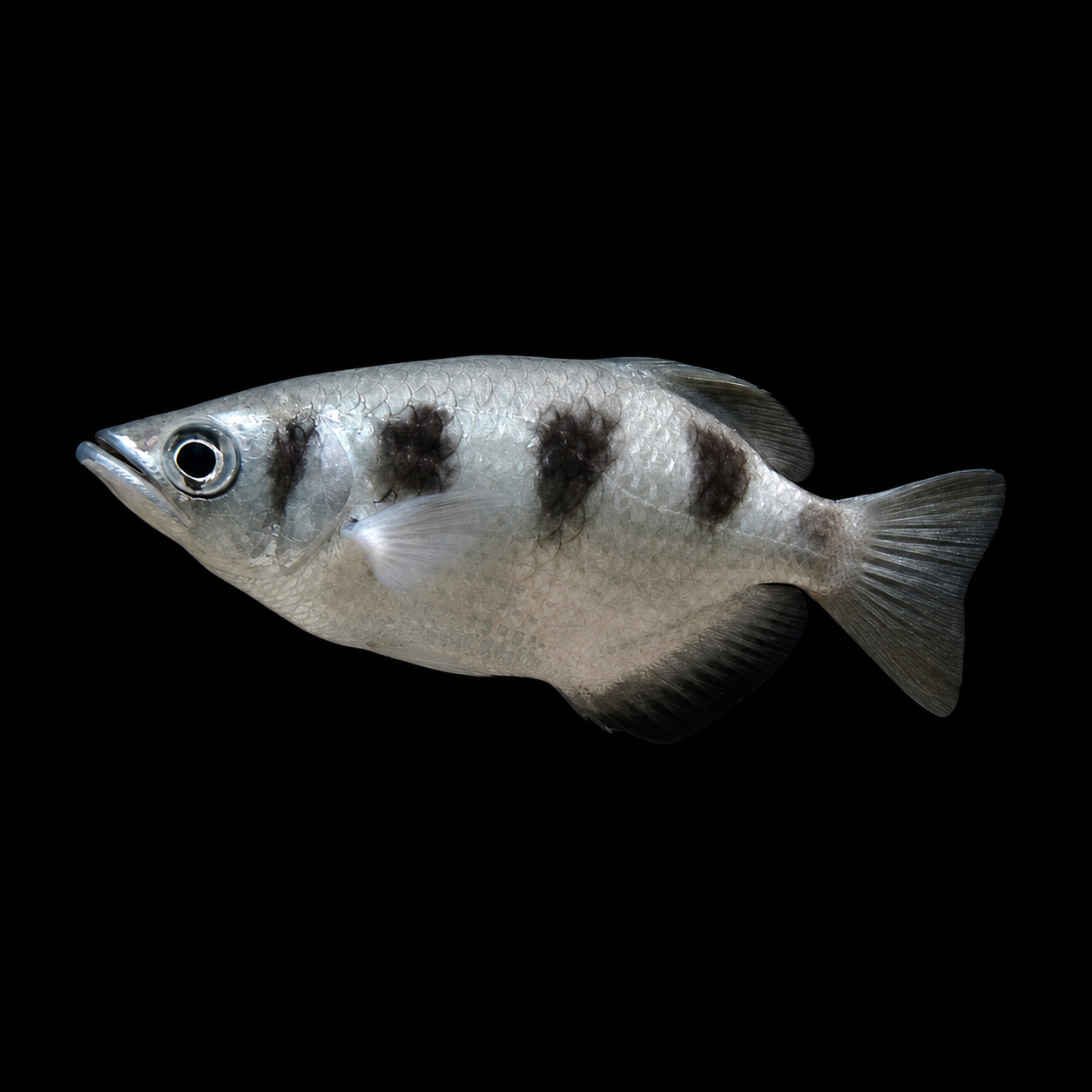
解説 / Description
テッポウウオは、インドから東南アジア、オセアニア北部にかけて分布し、マングローブ林のある河口や汽水域を中心に暮らす広塩性の魚です。水面上の昆虫へ狙いを定め、口から水流を発射して撃ち落とす捕食行動で広く知られています。銀白色の体側に並ぶ黒い帯と、上向きに開く口も特徴です。観賞魚としては、射撃行動を間近で観察できることが大きな魅力ですが、成魚は全長30cmに達することがあり、十分な遊泳空間、安定した汽水環境、飛び出しと水飛沫への対策が欠かせません。なお、「アーチャーフィッシュ」の名で複数種が流通するため、購入時には学名と現在の飼育水の塩分を確認することが大切です。 The banded archerfish occurs from India through Southeast Asia to northern Oceania and is a euryhaline species most often associated with mangrove estuaries and brackish water. It is famous for aiming at insects above the surface and knocking them down with a jet of water. The silvery body marked with dark bands and the upturned mouth are also characteristic. Its shooting behavior is fascinating to observe, but adults may reach 30 cm in total length and require ample swimming space, stable water conditions, and effective protection against jumping and splashing. Because several species are sold under the general name “archerfish,” buyers should confirm both the scientific name and the salinity in which the fish is currently being kept.
基本情報 / Basic Information
| 学名 / Scientific Name | Toxotes jaculatrix (Pallas, 1767) |
|---|---|
| 通称 / Common Name | テッポウウオ、バンデッドアーチャーフィッシュ、アーチャーフィッシュBanded archerfish, archerfish |
| 分類 / Family | アジ目・テッポウウオ科・テッポウウオ属。旧来はスズキ目に含める分類が広く用いられていましたが、近年の分子系統研究ではアジ目に位置づけられています。Order Carangiformes, family Toxotidae, genus Toxotes. Older references often placed the family in Perciformes, whereas recent molecular studies support its placement in Carangiformes. |
| 英名 / English Name | Banded archerfish |
| 分布 / Distribution | インドからフィリピン、インドネシア、パプアニューギニア、ソロモン諸島、バヌアツ、オーストラリア北部にかけて分布します。主な生息環境はマングローブ河口や汽水域ですが、河川や小規模な淡水流にも入ります。日本では西表島に生息し、石垣島でも採集記録があります。ただし、石垣島で定着しているかどうかは確認されていません。Distributed from India eastward through the Philippines and Indonesia to Papua New Guinea, the Solomon Islands, Vanuatu, and northern Australia. It occurs mainly in mangrove estuaries and brackish water but also enters rivers and small freshwater streams. In Japan it is established on Iriomote Island, and specimens have also been recorded from Ishigaki Island, although establishment there has not been confirmed. |
| 最大体長 / Max Size | 全長約30cm。一般的には全長20cm前後の個体が多いとされています。Up to about 30 cm total length, although around 20 cm is more typical. |
| 寿命 / Lifespan | 飼育下では5〜8年ほどを目安とする水族館資料があり、良好な環境で10年近く生きる例も紹介されています。ただし、個体差や飼育条件による幅が大きく、確立した最大寿命は明確ではありません。Public-aquarium references commonly give about 5–8 years in human care, with occasional reports approaching 10 years. Longevity varies considerably with individual condition and husbandry, and a definitive maximum lifespan is not established. |
飼育環境 / Aquarium Environment
| 水槽サイズ / Tank Size | 成魚の長期飼育では、120cm規格水槽(約240L)以上を実用上の目安とします。複数飼育では150cm級、または300L以上の水槽を検討してください。水量だけでなく、水平方向の長さと広い水面を優先します。90cm規格水槽は幼魚の一時的な育成には利用できますが、成魚の終生飼育には余裕が不足しやすくなります。For long-term adult care, a 120 cm aquarium of roughly 240 L should be treated as a practical starting point. Groups are better suited to tanks around 150 cm long or exceeding 300 L. Horizontal swimming length and surface area are more important than depth alone. A 90 cm aquarium may serve temporarily for juveniles but is usually too limited for lifelong adult care. |
|---|---|
| 水温 / Temperature | 25〜28℃を基本に、急変させず安定させます。自然分布に基づく資料では25〜30℃の熱帯域に生息するとされますが、家庭水槽では高温による酸素不足にも注意が必要です。 Maintain a stable 25–28°C. Species references place it in tropical waters of roughly 25–30°C, but in aquariums prolonged high temperatures can reduce dissolved oxygen and should be managed carefully. |
| 水質 / Water Quality | Toxotes jaculatrixは淡水にも入る広塩性魚ですが、流通個体の多くは汽水での長期管理が適しています。比重1.005〜1.010程度を一つの目安とし、中性から弱アルカリ性の水を安定して維持します。ただし、導入時に最も重要なのは販売店の飼育水と急に差をつくらないことです。人工海水と比重計または屈折計を使用し、塩分は時間をかけて調整してください。アンモニアと亜硝酸は常に検出されない状態を保ちます。Toxotes jaculatrix is euryhaline and can enter freshwater, but many aquarium specimens are best maintained long term in brackish water. A specific gravity around 1.005–1.010 is a useful practical guide, with stable neutral to mildly alkaline conditions. The most important consideration at introduction is avoiding a sudden difference from the dealer’s water. Use marine salt and a hydrometer or refractometer, change salinity gradually, and keep ammonia and nitrite undetectable. |
| レイアウト / Layout | 水面付近に十分な遊泳空間を残し、流木や丈夫な植物を水面上へ張り出させると、自然な探索や射撃行動を引き出しやすくなります。強い水流は避け、ろ過器の吐出口は水面を過度に荒らさないよう調整します。水槽上部には、給排水管や配線部分まで覆える丈夫なフタを設けてください。行動展示のために水面上の空間をつくる場合も、魚が外へ飛び出せる隙間は残しません。Leave generous swimming space near the surface. Branches or robust plants extending above the water can encourage natural searching and shooting behavior. Avoid excessive current and position the filter outlet so that the surface is not strongly disturbed. Fit a strong cover that also closes gaps around pipes and cables. Even when providing air space above the water for behavioral enrichment, no opening should allow the fish to jump out. |
| 注意点 / Precautions | 飛び出しと水飛沫への対策が最優先です。電源タップは床へ直置きせず、水槽より高い位置または防滴性のある収納内へ固定し、各ケーブルには水がコンセントへ伝わらないようドリップループを設けます。地震に備えて水槽台を水平で強固な場所へ設置し、耐震マットや転倒・横滑り対策も行ってください。日本の野生個体は絶滅の危機にあり、現地採集を前提にしてはいけません。販売個体は適法な海外由来であることを確認し、飼育個体を自然環境へ放流しないことも重要です。Jump prevention and splash control are essential. Never leave power strips on the floor; mount them above the aquarium or inside a splash-protected cabinet, and form a drip loop in every cable. Place the aquarium and stand on a level, structurally sound surface and use appropriate anti-slip or seismic measures. Wild Japanese populations are highly threatened and must never be treated as a source for aquarium specimens. Confirm legal overseas origin and never release captive fish into the environment. |
餌と給餌 / Feeding
| 餌の種類 / Diet | 自然下では昆虫を中心に、小型の水生動物、甲殻類、小魚、水面に漂う植物質なども利用します。飼育下では、浮上性の肉食魚用ペレットを主食にできる個体が多く、冷凍エビやオキアミ、コオロギ、ハエ類などを組み合わせると食性に幅を持たせられます。ミルワームは脂肪分と外皮が多いため、補助食として少量にとどめます。野外採集した昆虫は農薬や寄生虫の危険があるため使用しません。In nature it feeds mainly on insects but also takes small aquatic animals, crustaceans, small fish, and some floating plant material. Many captive individuals can be conditioned to floating carnivore pellets, supplemented with frozen shrimp or krill and cultured insects such as crickets or flies. Mealworms are fatty and heavily chitinized, so they are best used sparingly. Avoid wild-caught insects because of possible pesticides and parasites. |
|---|---|
| 給餌のポイント / Feeding Tips | 普段は栄養を管理しやすい人工飼料を中心にし、昆虫を水面上へ置く給餌は行動を引き出すための補助として取り入れます。射撃を促すときは、水が照明やコンセントへ届かない位置を選び、餌が水槽外へ落ちないようにしてください。複数飼育では、落下した餌へ素早く集まるため、体格の小さい個体が食べ負けていないかを確認します。食べ残しは早めに回収し、水質悪化を防ぎます。Use nutritionally balanced prepared food for routine feeding and offer insects above the surface mainly as behavioral enrichment. Place shooting targets where water cannot reach lights or electrical outlets and where food cannot fall outside the aquarium. In groups, watch smaller fish carefully because individuals rush quickly toward falling food. Remove leftovers promptly to protect water quality. |
性格と混泳 / Temperament and Tank Mates
| 性格 / Temperament | 水面付近を活発に泳ぎ、視覚刺激への反応が鋭い魚です。自然下では小さな群れをつくることがありますが、給餌時には同種間で競争が起こります。大きさの異なる個体を狭い水槽へまとめると、追い回しや食べ負けが生じやすいため注意してください。This is an active, surface-oriented fish with strong visual responses. Small aggregations occur in nature, but competition among individuals becomes obvious at feeding time. Size differences in a confined aquarium can lead to chasing and unequal access to food. |
|---|---|
| 混泳の相性 / Compatibility | 同じ塩分と水温に適応でき、口に入らない大きさで、極端に攻撃的ではない魚が候補になります。中層から下層を泳ぐ温和な汽水魚は比較的合わせやすい一方、小魚や小型甲殻類は捕食対象になり得ます。ヒレをかじる魚や、水面の餌を激しく奪う魚も避けてください。同種を複数飼育する場合は、十分に大きな水槽を用意し、できるだけ体格をそろえます。Suitable tank mates must tolerate the same salinity and temperature, be too large to swallow, and not be excessively aggressive. Peaceful brackish-water species using the middle or lower levels are generally easier to combine, whereas small fish and crustaceans may be eaten. Avoid fin nippers and highly competitive surface feeders. Conspecific groups require a very large aquarium and individuals of similar size. |
病気と対策 / Diseases and Prevention
| かかりやすい病気 / Common Diseases | テッポウウオだけに特有の代表的な病気は、十分に整理されていません。実際の飼育では、輸送後の衰弱、急な塩分変化による浸透圧ストレス、アンモニア・亜硝酸中毒、白点症状を含む外部寄生虫などに注意します。食欲低下、体色の変化、体を物へこすりつける動き、呼吸の速さは早期発見の手がかりになります。No single disease syndrome is well established as unique to this species. Practical concerns include post-transport weakness, osmotic stress from sudden salinity change, ammonia or nitrite poisoning, and external parasites that may produce white-spot-like symptoms. Reduced appetite, color change, flashing against objects, and rapid breathing are useful early warning signs. |
|---|---|
| 対策と予防 / Prevention | 導入前に販売店の水温と比重を確認し、時間をかけて水合わせを行います。新しい個体は可能であれば隔離水槽で観察し、成熟したろ過設備と定期的な換水によって水質を安定させてください。換水用の水は水温と塩分を本水槽に合わせます。塩分を上げればすべての寄生虫を防げるわけではなく、薬剤によっては汽水環境で作用や安全域が変わるため、症状を確認せずに薬浴や追加の塩分調整を行わないことが重要です。Confirm the dealer’s temperature and specific gravity before introduction and acclimate the fish gradually. Whenever possible, observe new arrivals in quarantine. Use mature filtration and regular water changes, matching replacement water to the aquarium’s temperature and salinity. Brackish water does not prevent every parasite, and medication behavior may differ with salinity, so avoid blind treatment or arbitrary salt increases without identifying the problem. |
増やし方(繁殖) / Breeding
| 雌雄の判別 / Sexing | 外見だけで確実に雌雄を判別する方法は確立していません。繁殖期に成熟した個体では腹部の張りなどに差が現れる可能性がありますが、通常の飼育個体での判断材料としては不十分です。No reliable external method of sexing has been established. Mature females may become fuller in the abdomen during the reproductive period, but this is not a dependable guide for ordinary aquarium specimens. |
|---|---|
| 繁殖形態 / Reproduction | 卵生です。マレーシアの個体群を調べた研究では、成熟した卵を一時期にまとめて放出する一括産卵型とされ、雨季にあたる11〜12月ごろに産卵が集中すると報告されています。ただし、産卵時期は地域や環境条件によって異なる可能性があります。Oviparous. Research on Malaysian populations indicates a total-spawning pattern in which mature eggs are released within a limited period, with spawning concentrated around the monsoon months of November and December. Timing may vary among regions and environmental conditions. |
| 繁殖のポイント / Breeding Tips | 家庭水槽で再現性のある繁殖方法は確立しておらず、難易度は非常に高いと考えられます。成熟した親魚を維持できる大きな水槽に加え、季節変化や塩分、餌、産卵場所など複数の条件を整える必要があります。卵や仔魚が得られた場合も、微小な初期餌料と専用の育成設備が必要になるため、一般的な観賞魚の繁殖より専門性が高い分野です。No repeatable home-aquarium breeding method has been established, and the difficulty is considered very high. Successful work would require a large system for mature broodstock and careful control of seasonal cues, salinity, diet, and spawning conditions. Eggs and larvae would also require specialized rearing space and very small live foods, making this substantially more demanding than the breeding of common ornamental fishes. |
雑学と豆知識 / Trivia and Fun Facts
| 1. 現在のテッポウウオ科は2属9種 / 1. The family currently contains two genera and nine living species | 古い図鑑では、テッポウウオ科をToxotes属だけのグループとして紹介していることがあります。2022年の系統研究では、従来Toxotes lorentziとされていた種がほかの仲間から深く分かれた系統であることが示され、Protoxotes lorentziとして別属へ移されました。現在の主要な魚類目録では、テッポウウオ科はProtoxotes属とToxotes属の2属、現生9種として扱われています。資料によって属数や種数が違うのは、誤りだけでなく、分類体系が更新された時期の違いによる場合があります。Older references may describe Toxotidae as a family containing only the genus Toxotes. A 2022 phylogenetic study showed that the species formerly called Toxotes lorentzi represents a deeply separated lineage and restored it as Protoxotes lorentzi. Major current fish catalogs therefore recognize two genera, Protoxotes and Toxotes, with nine living species. Differences among books may reflect the date of the taxonomic system rather than a simple error. |
|---|---|
| 2. 口の中につくられる「水の発射管」 / 2. A temporary launch channel inside the mouth | テッポウウオの口蓋には縦方向の溝があり、舌に相当する基舌骨を押し当てることで細い水路がつくられます。鰓蓋の動きで口腔内の水を押し出すと、この水路がノズルのように働きます。近年の形態研究は、この「吹き矢」に似た構造が射撃の基本であることを支持しています。特別な器官を一から獲得したのではなく、祖先が持っていた口腔構造を精密な捕食装置へ作り替えた可能性が示されています。A longitudinal groove in the palate meets the basihyal, the tongue-like structure, to form a narrow channel. Movement of the gill covers forces water from the mouth and the channel acts like a nozzle. Recent anatomical work supports this blowpipe-like arrangement as the basic shooting mechanism. The system may have evolved by refining pre-existing oral structures rather than by producing an entirely new organ. |
| 3. 水流は獲物の直前でまとまる / 3. The jet concentrates just before reaching the prey | 発射された水流は、単純な一本の棒のように飛ぶわけではありません。水流が自然にまとまろうとする流体力学的な性質に加え、テッポウウオは後から出る水を速くするよう射出速度を調整します。後続の水が先端へ追いつくことで、獲物の近くに達したときに水が密集し、短時間に大きな力を伝えられます。さらに、魚は獲物までの距離に応じて集束する位置を変えられることが示されています。The emitted jet does not travel as a rigid rod of water. Natural hydrodynamic instability helps the stream gather into masses, while the fish actively adjusts the outflow so that later water moves faster. The trailing portion catches the front, concentrating water near the target and delivering a strong impulse over a short time. Experiments also show that the fish can shift the point of concentration according to target distance. |
| 4. 水面の屈折を補正し、約1.5m先を狙う / 4. It compensates for refraction and can aim about 1.5 m away | 水中から空中を見ると、獲物の見える位置は水面での光の屈折によって実際の位置からずれます。テッポウウオは、水面に対する角度に応じてこのずれを補正し、正確に水を当てます。魚類資料では射程の目安を約150cmとする記録があります。個体の大きさや経験、狙う角度によって成績は変わりますが、水中と空中という二つの環境をまたいで獲物を捉える能力は、テッポウウオを象徴する適応です。An aerial target appears displaced when viewed through the water surface because of refraction. Archerfish adjust their aim according to viewing angle and can hit targets accurately. Species references give a shooting range of roughly 150 cm. Performance varies with body size, experience, and geometry, but the ability to hunt across the water–air boundary is one of the defining adaptations of the group. |
| 5. 落下地点の計算は100ミリ秒未満 / 5. It calculates the landing point in under 100 milliseconds | 昆虫を撃ち落としたあと、テッポウウオは落下を待っているだけではありません。獲物が動き始めてから100ミリ秒に満たない短い時間で、方向、速度、開始位置などの情報を読み取り、将来の落下地点へ向けてCスタート型の急旋回を行います。落下後に追いかけ始めるのではなく、まだ空中にある段階で到達地点を予測するため、ほかの魚との餌の奪い合いで大きな優位を得られます。After knocking an insect down, the fish does not simply wait. In less than 100 milliseconds after the prey begins moving, it samples direction, speed, timing, and starting position, then launches a C-start-type turn toward the future landing point. By predicting the destination while the prey is still airborne, it gains a decisive advantage over competing surface feeders. |
| 6. 実験では人の顔画像も見分けた / 6. Laboratory fish discriminated human face images | モニター上の特定の顔画像へ水を撃つよう訓練した研究では、テッポウウオは最大44枚の未知の顔画像に囲まれても、学習した画像を選び分けました。二つの実験で報告された平均正答率は81%と86%です。これは自然の中で人を個体識別していることを直接示す結果ではありませんが、魚類の脳でも複雑でよく似た視覚パターンを高い精度で区別できることを示した実験として注目されました。In a study that trained archerfish to shoot at a particular human face image on a monitor, the fish selected the learned image even among as many as 44 unfamiliar faces. Mean accuracy was reported as 81% and 86% in two experiments. This does not directly demonstrate natural recognition of individual people, but it shows that a fish brain can discriminate highly similar and complex visual patterns with considerable accuracy. |
| 7. 世界全体では低危険、日本では絶滅危惧IA類 / 7. Globally Least Concern, but Critically Endangered in Japan | Toxotes jaculatrixは広い分布域を持つため、世界全体のIUCN評価では低危険種とされています。一方、日本では生息地が八重山諸島のごく限られた水域に集中し、環境省レッドリスト2020と沖縄県レッドデータブックの双方で絶滅危惧IA類に位置づけられています。世界規模では普通に見られる種でも、分布の端にある地域個体群は深刻な危機に陥ることがあります。観賞魚として迎える際は、適法な海外由来個体を選び、日本の野生個体群を守る姿勢が欠かせません。Toxotes jaculatrix has a broad geographic range and is assessed globally as Least Concern by the IUCN. In Japan, however, its habitat is restricted to a very small part of the Yaeyama Islands, and both the national Red List 2020 and the Okinawa Red Data Book classify it as Critically Endangered. A species can be secure globally while a population at the edge of its range faces severe local risk. Aquarium specimens should therefore be legally sourced from outside Japan, with full respect for the protection of the wild Japanese population. |
まとめ / Conclusion
テッポウウオの射撃は、目立つ曲芸のように見えて、実際には視覚による位置の補正、口腔内の特殊な構造、水流を集束させる制御、落下地点を先読みする判断が連続した捕食戦略です。その一瞬を理解して観察すると、水面上へ向けた視線や口元の動き、撃ち落とした餌へ向かう急旋回まで、日常の行動一つひとつに進化の工夫が見えてきます。 The archerfish’s shot may look like a simple trick, but it is a complete hunting sequence combining visual correction, specialized oral anatomy, controlled jet concentration, and prediction of where falling prey will land. Once this sequence is understood, even its upward gaze, subtle mouth movements, and sudden turn toward a dislodged insect reveal layers of evolutionary refinement.
その能力を健やかな状態で引き出すには、大型水槽と広い水面、安定した汽水、成熟したろ過、飛び出しと水飛沫を防ぐ設備が必要です。適法に流通した個体を選び、体格と行動に見合った環境を整えた水槽でこそ、テッポウウオはマングローブの水辺で磨かれた独自の生き方を、長く静かに伝えてくれます。 To express these abilities in good health, the fish needs a large aquarium with generous surface area, stable brackish conditions, mature filtration, and secure protection against jumping and splashing. When legally sourced specimens are given an environment appropriate to their size and behavior, they offer a lasting view of a remarkable way of life shaped in mangrove waterways.
分布マップ
テッポウウオは、インドからフィリピン、インドネシア、パプアニューギニア、ソロモン諸島、バヌアツ、オーストラリア北部にかけて分布し、主にマングローブ河口や汽水域に生息します。日本では西表島に生息し、石垣島でも採集記録があります。
参考文献・情報源
テッポウウオ(Toxotes jaculatrix)の分類、分布、生息環境、飼育条件、繁殖、病気・管理上の注意点について、査読論文、大学・学術機関のリポジトリ、魚類学データベース、獣医学・水産学の専門資料を中心に選定しています。店舗・通販サイト、個人ブログ、一般的なまとめサイトは参考文献から除外しています。
飼育条件の数値について:本文中の「比重1.005〜1.010程度」や「120cm規格水槽以上」といった数値は、下記の一次研究が単一の標準値として定めたものではありません。広塩性、生息環境、成魚サイズ、実験飼育、水質管理の知見を踏まえた飼育上の実務目安として扱うのが適切です。
-
分類Girard, M. G., Davis, M. P., & Smith, W. L. (2020). The Phylogeny of Carangiform Fishes: Morphological and Genomic Investigations of a New Fish Clade. Copeia, 108(2), 265–298.テッポウウオ科をスイーパー科とともにToxotoideiとしてアジ目(Carangiformes)内へ位置づける高次系統分類の根拠。DOI: 10.1643/CI-19-320
-
分類Girard, M. G., Davis, M. P., Tan, H. H., Wedd, D. J., Chakrabarty, P., Ludt, W. B., Summers, A. P., & Smith, W. L. (2022). Phylogenetics of Archerfishes (Toxotidae) and Evolution of the Toxotid Shooting Apparatus. Integrative Organismal Biology, 4(1), obac013.テッポウウオ科内部の系統関係、Protoxotes属の復活、種のシノニム整理など、現在の分類体系を支える主要論文。DOI: 10.1093/iob/obac013
-
分布・生息環境Froese, R. & Pauly, D. (eds.). FishBase. Toxotes jaculatrix species record.インドから東南アジア、ニューギニア、ソロモン諸島、バヌアツ、オーストラリア北部までの分布、汽水性マングローブ河口を中心とする生息環境、淡水への進入、25〜30℃の生息水温、最大全長約30cmなどの基礎情報。データベース: FishBase, Toxotes jaculatrix species record
-
日本の分布赤池貴大・本村浩之 (2022). 石垣島初記録のテッポウウオ. Ichthy, Natural History of Fishes of Japan, 19, 22–25.それまで国内では西表島のみから知られていたT. jaculatrixについて、石垣島からの標本に基づく初記録を報告した査読論文。DOI: 10.34583/ichthy.19.0_22
-
日本の分布三内悠吾・岸田岳大・浜橋丈 (2023). 石垣島吹通川におけるテッポウウオ Toxotes jaculatrix (Pallas, 1767) の記録. Fauna Ryukyuana, 68, 13–16.石垣島・吹通川からの標本記録と、八重山諸島における既往記録を整理した資料。国内分布の更新確認に有用。DOI: 10.24564/0002020027
-
繁殖Simon, K. D., Bakar, Y., Mazlan, A. G., Zaidi, C. C., Samat, A., Arshad, A., Temple, S. E., & Brown-Peterson, N. J. (2012). Aspects of the Reproductive Biology of Two Archer Fishes Toxotes chatareus and Toxotes jaculatrix. Environmental Biology of Fishes, 93(4), 491–503.生殖腺組織、産卵期、性比、抱卵数を調べた一次研究。マレーシア個体群で11〜12月に産卵が集中すること、一括産卵型の卵巣発達などを報告。DOI: 10.1007/s10641-011-9944-6
-
塩分・繁殖Fahmi, M. R. & Permana, A. (2014). Kematangan gonad ikan sumpit (Toxotes jaculatrix Pallas 1767) pada salinitas berbeda [Gonad maturity of archerfish in different salinity]. Jurnal Iktiologi Indonesia, 14(3), 235–245.0 ppt、12〜15 ppt、30〜35 pptで親魚候補を6か月飼育し、生殖腺の発達を比較した研究。T. jaculatrixの広塩性と、塩分条件と成熟の関係を考える際の直接的な資料。DOI: 10.32491/jii.v14i3.84
-
飼育・水質MSD Veterinary Manual. Management of Aquarium Fish.水槽の生物ろ過、アンモニア・亜硝酸中毒、新規水槽での水質悪化、給餌と水質、環境管理など、観賞魚飼育に共通する獣医学的な管理原則の根拠。資料: MSD Veterinary Manual, Management of Aquarium Fish
-
病気・隔離Francis-Floyd, R., Yanong, R. P. E., & Pouder, D. B. Ichthyophthirius multifiliis (White Spot) Infections in Fish. University of Florida IFAS Extension, CIR920/FA006.白点病の病原体、初期症状、輸送・水温変化・過密との関係、診断、導入魚の隔離などを解説する大学Extension資料。本文ではテッポウウオ固有の病気ではなく、観賞魚一般の外部寄生虫リスクとして参照。資料番号: University of Florida IFAS Extension, CIR920/FA006
-
管理上の注意Livengood, E. J. & Chapman, F. A. The Ornamental Fish Trade: An Introduction with Perspectives for Responsible Aquarium Fish Ownership. University of Florida IFAS Extension, FA124.成熟した生物ろ過、隔離、適切な水温への順応、飛び出し防止のフタ、飼育魚を自然へ放流しないことなど、責任ある観賞魚飼育の基本的な注意事項を支える公的資料。資料番号: University of Florida IFAS Extension, FA124
外部資料の内容・公開状況は2026年7月23日時点で確認。分類や分布は研究の進展によって更新される可能性があるため、学名・分類体系を扱う際は最新版の魚類学資料も併せて確認してください。




コメント