

解説 / Description
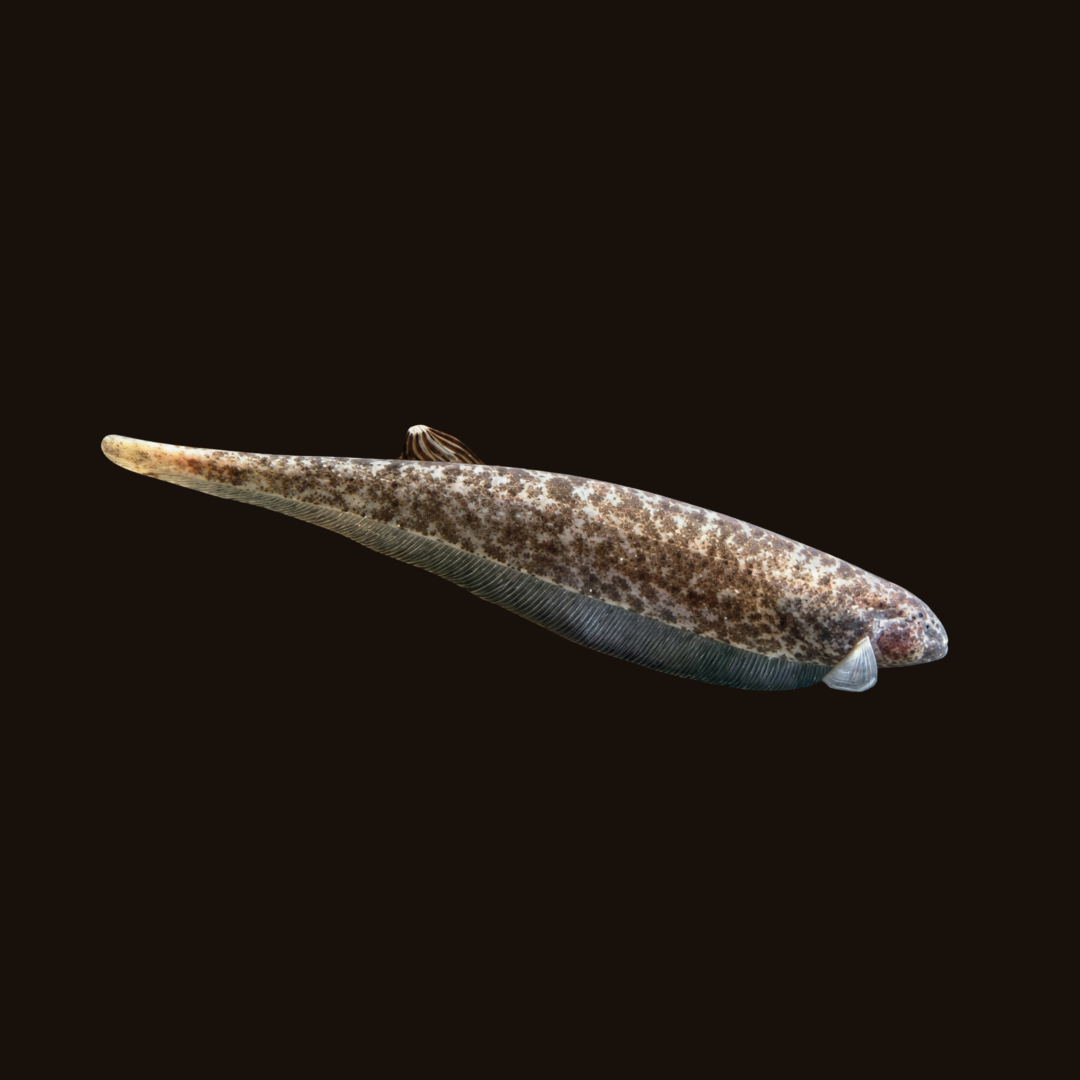
マーブルナイフ、またはバラエノプスの名で流通する Adontosternarchus balaenops は、南米の上部アマゾン川流域に分布する弱電気魚です。淡い地色に褐色から黒色の細かな斑紋が重なり、個体ごとに異なる大理石状の模様を見せます。丸みのある吻と、下顎の深いV字状のくぼみに短い上顎が収まる独特の口も、本種を印象づける特徴です。背鰭と腹鰭を欠き、腹側に長く伸びた尻鰭を波打たせることで、前進、後退、静止に近い微調整を滑らかに行います。 Adontosternarchus balaenops, traded in Japan as the Marble Knife or Balaenops, is a weakly electric fish from the upper Amazon River basin of South America. Its pale body carries fine brown-to-black mottling, producing an individually variable marble-like pattern. A rounded snout and a distinctive mouth, in which the short upper jaw fits into a deep V-shaped notch in the lower jaw, further characterize the species. It lacks dorsal and pelvic fins and moves by undulating its elongated anal fin, allowing smooth forward motion, reverse swimming, and precise station holding.
本種の放電は、デンキウナギが防御や捕食に用いる強い電撃とは性質が異なります。体の周囲に弱い電場を連続的に作り、その乱れを体表の受容器で読み取ることで、暗く濁った水中でも障害物や餌の位置を把握します。放電の一時的な変化は、同種間の信号としても利用されます。一方で、本種そのものを対象とした自然史・飼育研究は多くありません。そのため、確立した種固有情報と、近縁種の知見や飼育実務から導かれた推奨を区別して理解することが、無理のない飼育につながります。 Its discharge differs fundamentally from the powerful shocks used by electric eels for defense or predation. The fish continuously generates a weak electric field and detects distortions through receptors in the skin, enabling it to locate obstacles and food in dark or turbid water. Temporary modulations of the discharge also function as signals between individuals. Species-specific natural-history and husbandry studies remain limited, however. Responsible care therefore requires a clear distinction between established facts about this species and practical recommendations inferred from related fishes and aquarium experience.
基本情報 / Basic Information
| 学名 / Scientific Name | Adontosternarchus balaenops (Cope, 1878) |
|---|---|
| 通称 / Common Name | マーブルナイフ、バラエノプス。マーブルゴーストナイフと呼ばれることもあります。ただし、日本の流通名は同属の近縁種にも使われるため、学名、産地、尾部と各鰭の色彩をあわせて確認する必要があります。Marble Knife and Balaenops; the name Marble Ghost Knifefish is also used. Japanese trade names may be applied to related species in the same genus, so the scientific name, collection locality, and pigmentation of the tail and fins should be checked together. |
| 分類 / Family | 条鰭類、デンキウナギ目、アプテロノトゥス科、アドントステルナルクス属。アジア・アフリカに分布するアロワナ目ナギナタナマズ科のナイフフィッシュとは、外形が似ていても別系統です。Ray-finned fishes, order Gymnotiformes, family Apteronotidae, genus Adontosternarchus. Despite a similar silhouette, it is not closely related to Old World featherbacks of the order Osteoglossiformes and family Notopteridae. |
| 英名 / English Name | Balaenops ghost knifefish / Whale-headed ghost knifefish(いずれも説明的な英名で、統一された標準英名は確認されていません) |
| 分布 / Distribution | 南米の上部アマゾン川流域。最新の魚類分類カタログでは、ブラジル、ペルー、エクアドル、コロンビア、ボリビアから記録されています。原記載地はペルーのペバスです。本種はアマゾン水系に分布し、オリノコ川水系にも分布する同属他種とは区別されます。Upper Amazon River basin in South America, with records in current taxonomic catalogues from Brazil, Peru, Ecuador, Colombia, and Bolivia. The type locality is Pebas, Peru. This species belongs to the Amazon system and should not be confused with congeners that occur in the Orinoco basin. |
| 最大体長 / Max Size | 全長約25cm。20cmを超える標本が知られ、尾部を損傷した野生個体も多いため、成魚の体長だけでなく、長い尻鰭を使って移動できる床面積を確保します。About 25 cm in total length. Specimens exceeding 20 cm are documented, and wild fish frequently show tail damage, so aquarium planning should provide not only sufficient length but also adequate floor area for anal-fin locomotion. |
| 寿命 / Lifespan | 本種固有の信頼できる寿命資料は確認されていません。適切な環境では複数年の飼育が見込まれますが、具体的な年数を確定情報として示すことはできません。No reliable species-specific lifespan estimate has been established. Multi-year maintenance is plausible under suitable conditions, but a precise number of years should not be presented as confirmed fact. |
飼育環境 / Aquarium Environment
| 水槽サイズ / Tank Size | 成魚の単独飼育には、90cm規格水槽、約150〜180L以上を実用上の目安とします。これは種固有の実験で定められた最小値ではなく、最大体長、遊泳方法、水質安定性を考慮した推奨です。60cm規格水槽は、小型個体の一時飼育や検疫用途に限るのが安全です。複数飼育を試みる場合は、120cmワイド水槽、約250L以上を基準に、隠れ場所と給餌場所を個体数より多く設けます。ただし、複数飼育の安全性が確立しているわけではありません。For a single adult, a standard 90 cm aquarium of roughly 150–180 L or more is a practical target. This is not a species-specific experimentally determined minimum; it is a husbandry recommendation based on adult size, locomotion, and water stability. A standard 60 cm tank is best restricted to temporary juvenile care or quarantine. A carefully monitored group should be given a 120 cm wide aquarium of about 250 L or more, with more shelters and feeding stations than fish, although group housing cannot be considered reliably established. |
|---|---|
| 水温 / Temperature | 24〜28℃を実用的な管理範囲とし、通常は25〜27℃で安定させます。本種だけを対象にした最適水温試験は確認されていないため、特定の一点を追うより、日内・換水時の急変を避けることを優先します。 A practical maintenance range is 24–28°C, with 25–27°C suitable for routine care. Because a species-specific optimum has not been experimentally established, avoiding daily and water-change-related fluctuations is more important than pursuing one exact value. |
| 水質 / Water Quality | 弱酸性から中性の軟水〜中程度の硬度を目安とし、pH6.0〜7.2程度で安定させます。この範囲はアマゾン産弱電気魚の飼育実務に基づく目安であり、本種の許容限界を示すものではありません。アンモニアと亜硝酸は検出されない状態を保ち、硝酸塩も定期換水で低く抑えます。導入時は水温だけでなく、pHと導電率の差にも注意して段階的に水合わせを行います。Aim for stable, soft to moderately hard water from mildly acidic to neutral, approximately pH 6.0–7.2. This is a practical range used for Amazonian weakly electric fishes, not a demonstrated tolerance limit for this species. Ammonia and nitrite should remain undetectable, nitrate should be kept low through regular water changes, and acclimation should account for differences in pH and conductivity as well as temperature. |
| レイアウト / Layout | 角のない細かな砂を薄く敷き、流木、土管、太めの塩ビパイプなど、全身を収められる暗い隠れ場所を複数設けます。アヌビアス、ミクロソリウム、浮き草などで照明を和らげると、明るい時間帯の落ち着きにつながります。長い尻鰭、小さな尾鰭、背中のひも状器官を傷つける鋭い石や狭い隙間は避け、緩やかな水流と十分な酸素を確保します。驚いた際の飛び出しに備え、ふたの隙間もふさぎます。Use a thin layer of smooth fine sand and provide several dark shelters large enough to contain the entire fish, such as driftwood caves, ceramic tubes, or wide PVC pipes. Shade from Anubias, Java fern, or floating plants helps the fish settle during bright periods. Avoid sharp rocks and tight gaps that could damage the elongated anal fin, small caudal fin, or dorsal filament organ. Maintain gentle flow, good oxygenation, and a tightly covered lid because a startled fish may jump. |
| 注意点 / Precautions | 立ち上げ直後の水槽には入れず、ろ過が十分に成熟した環境へ導入します。強い照明、繰り返されるレイアウト変更、ガラス面への振動、急激な水質変化は、隠れ続ける、摂餌しないといった不調の原因になります。発する電気は弱く、通常の飼育で人や同居魚へ強い電撃を与える性質はありません。ヒーターにはカバーを付け、吸水口にはスポンジを装着し、体表と尻鰭の事故を防ぎます。Introduce the fish only to a mature, biologically stable aquarium. Intense lighting, repeated rearrangement, vibration against the glass, and rapid water-chemistry changes may lead to persistent hiding or refusal to feed. Its electrical output is weak and is not adapted to deliver a powerful shock to people or tank mates. Fit a heater guard and cover filter intakes with sponge to prevent injuries to the body and anal fin. |
餌と給餌 / Feeding
| 餌の種類 / Diet | 冷凍アカムシ、イトミミズ、イサザアミ、ブラインシュリンプ、小さく刻んだオキアミやエビ類、沈下性の肉食魚用顆粒・タブレットなどが候補です。同属魚や大河川の深水路に暮らす近縁群では、小型の底生無脊椎動物や動物プランクトンの利用が報告されていますが、本種だけの詳細な食性資料は限られます。口に無理なく入る小さな餌を複数組み合わせ、メダカなどの餌用魚は感染症と栄養の偏りを避けるため常用しません。Suitable foods include frozen bloodworms, tubifex, mysid shrimp, brine shrimp, finely chopped krill or shrimp, and sinking carnivore granules or tablets. Related deep-channel fishes and members of the genus are reported to consume small benthic invertebrates and zooplankton, but detailed diet data for this species alone remain limited. Offer a varied selection of small foods that can be swallowed easily, and avoid routine use of feeder fish because of disease and nutritional risks. |
|---|---|
| 給餌のポイント / Feeding Tips | 導入初期は夕方から消灯後に、隠れ家の入口へスポイトや長いピンセットで餌を届けます。まず嗜好性の高い冷凍餌で給餌位置を覚えさせ、同じ場所に沈下性人工飼料を少量ずつ混ぜると移行しやすくなります。1日1〜2回、短時間で食べ切る量を基本とし、腹部のへこみ、体幅の減少、同居魚による食べ負けを確認します。食べたかどうかを推測せず、個体ごとの摂餌を目視することが重要です。During acclimation, deliver food to the shelter entrance with a pipette or long forceps from dusk into the dark period. First establish a feeding location with palatable frozen food, then gradually mix in small amounts of sinking prepared food at the same spot. Feed once or twice daily in portions consumed promptly, and watch for a hollow abdomen, reduced body width, or competition from faster tank mates. Each fish’s actual intake should be observed rather than assumed. |
性格と混泳 / Temperament and Tank Mates
| 性格 / Temperament | 警戒心が強く、明るい時間帯は隠れ場所で過ごす傾向があります。比較行動研究では本種は群居性の種として扱われていますが、その分類は「家庭水槽で多数飼育すれば安定する」という意味ではありません。限られた空間では、隠れ場所の不足、給餌競争、個体差によって弱い個体が痩せる可能性があります。一般家庭では、まず単独飼育で摂餌と体調を安定させる方法が確実です。The species is cautious and tends to remain in shelter during bright periods. Comparative behavioral research treats it as a gregarious species, but that classification does not mean that a group will automatically remain stable in a home aquarium. Limited space, insufficient shelters, feeding competition, and individual variation can cause subordinate fish to lose condition. Establishing one fish successfully is the most dependable starting point for most keepers. |
|---|---|
| 混泳の相性 / Compatibility | 候補となるのは、口に入らない大きさで、攻撃性が低く、中層から上層を主に利用する魚です。ただし、魚種名だけで相性を保証することはできません。素早く餌を独占する魚とは給餌時間と位置を分け、小型魚の稚魚や小さなエビは捕食対象になり得るため避けます。気の強いシクリッド、ひれをかじる魚、大型底生肉食魚との同居は不向きです。他の弱電気魚との混泳は、隠れ家と餌場の競合に加えて電気信号を含む社会的影響を評価しにくいため、十分な広さと観察経験がない限り推奨しません。Potential tank mates are non-aggressive fishes too large to be swallowed and occupying mainly the middle or upper water layers, although compatibility cannot be guaranteed by species name alone. Separate feeding positions and times from fast competitors, and avoid fry and small shrimp that may be eaten. Aggressive cichlids, fin-nipping fishes, and large benthic predators are unsuitable. Housing with other weakly electric fishes is not recommended without substantial space and experience because competition for shelters and food, together with electrical social interactions, is difficult to assess. |
病気と対策 / Diseases and Prevention
| かかりやすい病気 / Common Diseases | 本種に特有の疾病傾向は十分に整理されていません。一般的な輸入熱帯魚と同様に、輸送後の白点病や外部寄生虫、擦り傷に続く細菌感染、尻鰭の損傷、餌付け失敗や食べ負けによる痩せに注意します。体色の急な変化、呼吸の増加、姿勢の乱れ、腹部のへこみ、尻鰭の縁が白く崩れる状態は、早期に水質と外見を確認すべき兆候です。No well-defined disease profile is available for this species. As with other imported tropical fishes, concerns include ich and other external parasites after transport, bacterial infection following abrasions, damage to the anal fin, and emaciation caused by feeding failure or competition. Sudden color change, increased breathing, abnormal posture, a hollow abdomen, or whitening and erosion along the anal-fin margin should prompt immediate inspection of water quality and the fish’s condition. |
|---|---|
| 対策と予防 / Prevention | 新しい個体は別水槽で2〜4週間を目安に観察し、摂餌、呼吸、便、体表の状態を確認してから本水槽へ移します。最優先は、水質悪化と物理的な傷を防ぐことです。予防目的で薬剤や高濃度の塩を常用せず、症状と原因を絞ってから対象魚に使用可能な薬剤を選びます。本種固有の薬剤感受性は確立していないため、製品説明を厳守し、十分な曝気と換水準備を整えたうえで慎重に治療します。Observe new fish in a separate tank for roughly two to four weeks, checking feeding, respiration, feces, and the skin before transfer to the display aquarium. Preventing poor water quality and physical injury is the first priority. Do not use medications or high salt concentrations routinely as prophylaxis; identify the likely problem and choose a product approved for the target condition. Species-specific drug sensitivity has not been established, so follow the manufacturer’s directions strictly, provide strong aeration, and prepare replacement water before treatment. |
増やし方(繁殖) / Breeding
| 雌雄の判別 / Sexing | 外見だけで確実に雌雄を判別する方法は確立していません。アプテロノトゥス科には頭部形状、体高、放電周波数などに性差を示す種がありますが、その特徴を本種へそのまま当てはめることはできません。研究では放電特性も調べられていますが、販売サイズの個体を外観だけで雌雄指定するのは困難です。No reliable external method of sexing has been established. Some apteronotids show sex differences in head shape, body depth, or discharge frequency, but those traits cannot simply be transferred to this species. Electrical traits have been studied experimentally, yet shop-sized individuals cannot be sexed reliably by appearance alone. |
|---|---|
| 繁殖形態 / Reproduction | デンキウナギ目の一般的な繁殖様式から、卵生で体外受精を行うとみられます。ただし、A. balaenops の産卵場所、卵数、求愛、親魚の行動、仔魚育成を体系的に示した公表資料は確認されていません。観賞魚として繁殖方法が確立した種ではありません。By comparison with other Gymnotiformes, the species is expected to be an egg-laying external fertilizer. Published information systematically describing spawning sites, fecundity, courtship, parental behavior, or larval rearing in A. balaenops has not been located. It is not an aquarium fish with an established breeding protocol. |
| 繁殖のポイント / Breeding Tips | 家庭水槽で再現性のある手順は情報なしです。雨季を想定した水位、導電率、水温の緩やかな変化は、他の弱電気魚で繁殖刺激として研究されてきましたが、本種で有効と確認された方法ではありません。試みる場合は、成熟個体を長期に良好な状態で維持し、放電、行動、水質、季節変化を記録する研究的な取り組みになります。卵や仔魚が確認された場合は、吸水口と親魚から保護し、仔魚の口径に合う微小な生き餌を準備します。No repeatable home-aquarium method is available. Gradual seasonal changes in water level, conductivity, and temperature have been investigated as reproductive cues in other weakly electric fishes, but their effectiveness in this species is unconfirmed. Any attempt should be treated as a research-oriented project involving long-term maintenance of mature fish and careful records of electrical behavior, water conditions, and seasonal changes. Eggs or larvae, if discovered, would need protection from adults and filter intakes, together with suitably minute live foods. |
雑学と豆知識 / Trivia and Fun Facts
| 1. 「ナイフ」という名が示すのは体型であり、系統ではない / 1. “Knife” describes shape, not ancestry | 水槽内で細長い尻鰭を波打たせる姿から、系統の異なる複数の魚がナイフフィッシュと呼ばれています。アジアやアフリカのスポッテッドナイフなどはアロワナ目ナギナタナマズ科、本種は南米固有のデンキウナギ目アプテロノトゥス科です。似た輪郭は近縁性を示すものではなく、細長い体で前後へ精密に移動するという課題に、別々の系統が似た形で適応した結果です。アプテロノトゥス科が小さな尾鰭と背中のひも状器官を持つことも、旧大陸のナイフフィッシュと見分ける手掛かりになります。Several unrelated fishes are called knifefishes because they move by undulating a long anal fin. Asian and African featherbacks belong to Osteoglossiformes and Notopteridae, whereas this species is a South American gymnotiform in Apteronotidae. Their similar outlines do not indicate close relationship; they represent independent solutions to precise forward and reverse movement with an elongated body. The small caudal fin and dorsal filament organ of apteronotids also help distinguish them from Old World featherbacks. |
|---|---|
| 2. 1878年の原記載と、現在の属名に至るまで / 2. From the 1878 description to the present genus | エドワード・ドリンカー・コープは1878年、ペルーのペバスで得られた標本を Sternarchus balaenops として記載しました。1912年にエリスが Adontosternarchus 属を設けた際、その対象は別種の A. sachsi でした。バラエノプスが現在の属へ移されたのは、EigenmannとAllenによる1942年の扱いです。属名は成魚が顎の歯を失う特徴を反映し、種小名 balaenops は「鯨」と「顔・外観」に由来します。下顎が上顎より前へ出て包み込む形を、コープがヒゲクジラの口元になぞらえたことに由来する名前です。Edward Drinker Cope described a specimen from Pebas, Peru, in 1878 as Sternarchus balaenops. When Ellis established the genus Adontosternarchus in 1912, it was based on another species, A. sachsi. Balaenops was transferred to its present genus by Eigenmann and Allen in 1942. The generic name reflects the loss of jaw teeth in adults, while balaenops combines roots meaning “whale” and “face or appearance.” Cope compared the projecting lower jaw enclosing the upper jaw to the mouth of a baleen whale. |
| 3. 成魚の電気器官は神経組織に由来する / 3. The adult electric organ is neurogenic | 多くの電気魚では、筋肉から変化した細胞が発電を担います。アプテロノトゥス科は例外的で、幼魚期には筋肉由来の電気器官を持つものの、成長に伴って成魚の神経由来電気器官へ置き換わります。この仕組みによって高周波の波状放電を連続して生み出し、体表の電気受容器で周囲の電場変化を読み取ります。暗い大河川の水路で暮らす本種にとって、電場は単なる「暗視装置」ではなく、探索と通信を支える常時稼働の感覚媒体です。In most electric fishes, electricity is generated by cells derived from muscle. Apteronotids are exceptional: a larval myogenic organ is replaced during development by an adult electric organ derived from nervous tissue. This system supports continuous high-frequency wave-type discharges, while electroreceptors in the skin detect changes in the surrounding field. For a fish living in dark river channels, the electric field is not merely a substitute for vision but a continuously active medium for exploration and communication. |
| 4. 「群居性」と電気信号の複雑さは同じ意味ではない / 4. Gregariousness does not equal signal complexity | 2025年に公表された比較研究では、A. balaenops は群居性の種として、縄張り性の強い種や半社会性の種と比較されました。本種が複数型のチャープを作ることは確認されていますが、社会性が高い種ほど信号構造が必ず複雑になる、という単純な関係は支持されませんでした。電気信号の形は、社会構造だけでなく、放電波形、生息環境、雌雄、攻撃や求愛の場面など、複数の制約のもとで進化したと考えられます。A comparative study published in 2025 treated A. balaenops as a gregarious species and compared it with territorial and semi-social species. The fish produces multiple chirp forms, but the study did not support a simple rule that more social species necessarily have more complex signal structure. Electric signals appear to evolve under interacting constraints that include discharge waveform, habitat, sex, aggression, and courtship context. |
| 5. JARと社会的エンベロープは分けて考える / 5. JAR and social envelopes are distinct concepts | 放電周波数が近い2個体が接近すると「うなり」が生じ、感覚入力を乱すことがあります。周波数を調整して妨害を減らす混信回避応答、JARは弱電気魚研究を代表する現象です。一方、3個体以上の信号が重なって生じる低周波の包絡へ反応する社会的エンベロープ応答、SERは、主に Eigenmannia virescens を用いた実験で示されてきました。SERをバラエノプスで確立済みの能力とみなしたり、水槽ガラスによる電場反射を闘争の直接原因と断定したりする根拠は不足しています。混泳上の問題は、空間、隠れ場所、餌、体格差、水質、個体差を含めて判断します。When two fishes with similar discharge frequencies approach one another, they create beats that can interfere with electrosensory input. The jamming avoidance response, or JAR, reduces this interference through frequency adjustment and is a classic phenomenon in electric-fish research. The social envelope response, or SER, concerns low-frequency envelopes produced by three or more overlapping signals and has been demonstrated mainly in experiments with Eigenmannia virescens. Evidence is insufficient to treat SER as an established ability of Balaenops or to claim that electric-field reflection from aquarium glass directly causes fighting. Compatibility problems must be assessed through space, shelter, food, size differences, water quality, and individual behavior. |
| 6. ネブロススとの識別には尾部と鰭の色彩が役立つ / 6. Tail and fin pigmentation help separate A. nebulosus | 同属の Adontosternarchus nebulosus は、日本の流通で同じ「マーブルナイフ」の名が使われる可能性があります。ネブロススは、暗色斑の後方に長い淡色域が続き、尾柄部まで白く抜けること、胸鰭と尻鰭が透明であること、尻鰭軟条数が112〜154本と比較的少ないことが記載上の特徴です。バラエノプスでは体側後方と各鰭にも色素が入り、尻鰭軟条数は152〜204本と報告されています。ただし、生体の細い鰭条を店頭で正確に数えることは難しいため、尾部と鰭の色彩、体型、産地情報を組み合わせ、確証がなければ Adontosternarchus 属の一種として扱うのが適切です。Adontosternarchus nebulosus may enter the aquarium trade under the same marble-knife name. Its diagnosis includes a long pale region following the dark blotches and extending onto the caudal peduncle, transparent pectoral and anal fins, and a relatively low count of 112–154 anal-fin rays. In A. balaenops, pigment continues over the posterior body and fins, and 152–204 anal-fin rays have been reported. Because fine rays are difficult to count accurately on a live shop specimen, tail and fin pigmentation, body form, and locality data should be assessed together; uncertain fish are best identified conservatively as Adontosternarchus sp. |
| 7. 日本への輸入では「すべての観賞魚が同じ水産防疫対象」ではない / 7. Not all ornamental fishes follow the same Japanese aquatic-quarantine rules | 日本の水産輸入防疫制度は、対象となる魚類・甲殻類・貝類などを列挙しています。2026年7月の動物検疫所案内で対象魚類として示されるのは、サケ科、コイ、フナ属、ハクレン類、ティラピア、マダイなどで、A. balaenops はその魚類一覧に含まれていません。したがって、「生きた観賞魚はすべて、到着5日前までの水産防疫申請が必要」と一律に説明するのは誤りです。ただし、実際の輸入では税関、輸出国側の衛生条件、外来生物法、CITES、航空輸送条件などを貨物ごとに確認する必要があり、制度は更新され得ます。Japan’s aquatic-animal import quarantine system lists the fish, crustacean, molluscan, and other groups to which it applies. In the Animal Quarantine Service guidance checked in July 2026, listed finfish include salmonids, common carp, Carassius, several Asian carps, Nile tilapia, and red seabream; A. balaenops is not included in that finfish list. It is therefore incorrect to claim that every live ornamental fish requires the same aquatic-quarantine application five days before arrival. Actual shipments still require case-by-case checks of customs, exporting-country health requirements, invasive-species legislation, CITES, and air-transport rules, all of which may change. |
| 8. 保全状況と国際取引の扱い / 8. Conservation and international-trade status | 最新のEschmeyer’s Catalog of Fishesでは、本種は有効種として扱われ、IUCN評価は低危険種(Least Concern)と記録されています。CITESについては、公式チェックリストで学名を検索し、附属書掲載の有無を輸入時点で確認するのが安全です。保全評価が低危険種であることは、採集圧や輸送中の死亡を軽視してよいという意味ではありません。入荷個体の正確な同定、状態の良い個体の選択、衝動的な購入を避けることが、希少な野生採集魚を扱ううえで重要です。The current Eschmeyer’s Catalog of Fishes recognizes this as a valid species and records an IUCN assessment of Least Concern. For CITES, the official checklist should be searched under the scientific name at the time of import to confirm whether any listing applies. A Least Concern assessment does not justify ignoring collecting pressure or mortality during transport. Accurate identification, selection of healthy specimens, and avoidance of impulsive purchases remain important when dealing with an uncommon wild-caught fish. |
| 9. 飼育情報は根拠の強さを分けて読む / 9. Husbandry guidance has different levels of evidence | 学名、原記載地、分布、最大体長、形態差、神経由来の電気器官、チャープ研究などは、分類資料や査読論文で直接確認できます。一方、水槽サイズ、pH、給餌方法、検疫期間、混泳の可否は、本種だけを対象に比較実験された数値ではなく、近縁種の生態、流通現場の知見、一般的な熱帯魚飼育の安全側の判断を組み合わせた実務上の推奨です。数値を絶対条件として扱うのではなく、個体の摂餌、体型、呼吸、行動、水質の推移を観察しながら調整する必要があります。The accepted name, type locality, distribution, maximum size, diagnostic morphology, neurogenic electric organ, and chirp research can be checked directly in taxonomic sources and peer-reviewed studies. Tank size, pH targets, feeding methods, quarantine duration, and compatibility advice have not been established through controlled experiments on this species alone; they are practical recommendations combining related-species biology, trade experience, and precautionary aquarium practice. These figures should not be treated as absolute thresholds and must be adjusted through observation of feeding, body condition, respiration, behavior, and water quality. |
| 10. 主な確認資料 / 10. Key references consulted | 分類、原記載地、分布、保全状況は、2026年7月7日更新の California Academy of Sciences「Eschmeyer’s Catalog of Fishes」とFishBaseを確認しました。属の形態と分類史はMago-Leccia、Lundberg、Baskinによる1985年の属改訂、およびLundbergとCox Fernandesによる2007年のネブロスス記載論文、電気器官はBrayほかによる2022年の総説、チャープと社会性はPetzoldほかの比較研究とFreilerほかによる2025年の研究、日本の輸入防疫対象は農林水産省動物検疫所の現行案内に基づき再点検しました。確認日は2026年7月17日です。 主要リンク:Eschmeyer’s Catalog of Fishes、FishBase、Lundberg & Cox Fernandes (2007)、Bray et al. (2022)、Freiler et al. (2025)、農林水産省動物検疫所。Taxonomy, type locality, distribution, and conservation status were checked against the California Academy of Sciences’ Eschmeyer’s Catalog of Fishes, updated 7 July 2026, and FishBase. Morphology and taxonomic history follow the 1985 generic revision by Mago-Leccia, Lundberg, and Baskin and the 2007 description of A. nebulosus by Lundberg and Cox Fernandes. Electric-organ biology follows the 2022 review by Bray and colleagues; chirps and sociality were checked against comparative work by Petzold and colleagues and the 2025 study by Freiler and colleagues. Japanese import-quarantine targets follow current Ministry of Agriculture, Forestry and Fisheries guidance. Sources were rechecked on 17 July 2026. Key links: Eschmeyer’s Catalog of Fishes, FishBase, Lundberg & Cox Fernandes (2007), Bray et al. (2022), Freiler et al. (2025), and the Japanese Animal Quarantine Service. |
まとめ / Conclusion
マーブルナイフは、淡い体に広がる複雑な斑紋、鯨を思わせる口元、長い尻鰭による静かな遊泳を備えた、アマゾン水系ならではの弱電気魚です。視界の利きにくい水中を電場で読み取り、放電の変化を信号として使う姿は、魚類の感覚世界が人の想像以上に多様であることを伝えてくれます。外見の珍しさだけでなく、分類、形態、神経生理、行動が結び付いた生物として観察するほど、その魅力は深まります。 The Marble Knife is a distinctive Amazonian weakly electric fish, combining intricate mottling on a pale body, a whale-like mouth, and quiet locomotion powered by its elongated anal fin. Its ability to interpret poorly visible surroundings through an electric field and to use discharge modulations as signals demonstrates how diverse the sensory worlds of fishes can be. Its interest grows beyond unusual appearance when taxonomy, morphology, neurophysiology, and behavior are considered together.
安定した長期飼育には、余裕のある水槽、暗く安全な隠れ場所、成熟したろ過、急変のない水質、そして一匹ずつ摂餌を確認する丁寧な管理が欠かせません。野生での群居性や電気通信に関する知見は重要ですが、限られた水槽へ単純に置き換えず、個体の反応を優先して判断する必要があります。確かな同定と慎重な導入を経て静かな環境を整えたとき、バラエノプスは目立つ動きに頼らず、暗水域へ適応した独自の存在感を水槽内に示します。 Successful long-term care depends on a spacious aquarium, dark and secure shelter, mature filtration, stable water, and careful confirmation that each fish is feeding. Knowledge of wild gregariousness and electrical communication is valuable, but it should not be transferred uncritically to a confined aquarium; the condition and responses of the individual fish must take priority. With accurate identification, cautious introduction, and a quiet environment, Balaenops reveals a distinctive presence shaped by adaptation to the dark channels of the Amazon.

気になる道具や飼い方を見つけてみませんか?
 アイのアクアグッズ案内ローチの仲間に合わせる飼育用品|クーリー・流水性・ボーシャの水槽と底砂道具の特徴や使い方、選ぶときのポイントをアイが紹介します。記事はコチラ →
 アイのアクアグッズ案内コードもホースもないのに酸素が出る? アイとコタロウのオキシデーター探訪道具の特徴や使い方、選ぶときのポイントをアイが紹介します。記事はコチラ →
さまざまな飼育テーマをご紹介。リンク先の記事には広告・商品紹介が含まれます。
案内・紹介記事一覧へ →分布マップ
本種は南米の上部アマゾン川流域に分布し、ブラジル、ペルー、エクアドル、コロンビア、ボリビアから記録されています。地図では、原記載地であるペルーのペバス周辺を分布イメージ用の概略代表地点として示しています。
このプロットは分布イメージを示すための概略表示です。実際の採集地点や、厳密な生息範囲を示すものではありません。
マーブルナイフ(バラエノプス)の参考文献
分類、分布、生息環境は種または属を直接扱った分類学資料と専門データベースを中心に選定し、飼育管理、繁殖、病気については査読論文および獣医学資料に限定しています。店舗、通信販売、個人ブログ、まとめサイトは含めていません。
資料を読む際の重要な注意
Adontosternarchus balaenopsに固有の、水槽の最小寸法、水温、pH、混泳条件、薬剤耐性、繁殖手順の比較試験データは限られています。そのため、記事中の90cm規格水槽、24〜28℃、pH6.0〜7.2などは、最大体長、生息域、近縁魚の生物学、一般的な魚類飼育管理を組み合わせた実務上の推奨値として扱う必要があります。なお、MSD Veterinary Manualでは、新しく迎えた魚の隔離期間として最低30日を推奨しています。
分類・分布・形態
-
Fricke, R., Eschmeyer, W. N. & Van der Laan, R.(編)Eschmeyer’s Catalog of Fishes: Adontosternarchus balaenops
California Academy of Sciences(参照日:2026年7月17日)
専門分類データベース種固有
資料を確認する
有効学名、原記載名、記載者と年、科・亜科、タイプ産地、上部アマゾン流域における国別記録を確認する基礎資料です。 -
Mago-Leccia, F., Lundberg, J. G. & Baskin, J. N.(1985)Systematics of the South American freshwater fish genus Adontosternarchus(Gymnotiformes, Apteronotidae)
Contributions in Science, 358: 1–19. DOI: 10.5962/p.208178
査読済み分類論文属・種を直接検討
論文を確認する
アドントステルナルクス属の改訂資料で、属の診断形質、バラエノプスの形態、計数形質、分布、近縁種との識別を支えます。 -
Lundberg, J. G. & Cox Fernandes, C.(2007)A new species of South American ghost knifefish(Apteronotidae: Adontosternarchus)from the Amazon Basin
Proceedings of the Academy of Natural Sciences of Philadelphia, 156: 27–37. DOI: 10.1635/0097-3157(2007)156[27:ANSOSA]2.0.CO;2
査読済み原著論文近縁種比較
論文を確認する
A. nebulosusの記載論文ですが、A. balaenopsを含む同属各種を標本に基づいて比較しており、口の構造、色彩、尻鰭軟条数、尾部損傷、アマゾン本流・支流の水路環境に関する記述を裏づけます。
生息環境・体長・食性の補助資料
-
Albert, J. S.(2003)Apteronotidae
Reis, R. E., Kullander, S. O. & Ferraris, C. J. Jr.(編)Checklist of the Freshwater Fishes of South and Central America, pp. 503–508. EDIPUCRS.
専門書の科解説科・属レベル
著者公開PDFを確認する
アプテロノトゥス科の形態、南米での分布、アマゾン大河川の深い水路への適応、Adontosternarchus属の動物プランクトン食という生態的背景を確認できます。 -
Froese, R. & Pauly, D.(編)FishBase: Adontosternarchus balaenops
FishBase species summary(参照日:2026年7月17日)
専門生物データベース種固有
種ページを確認する
淡水・底中層性・熱帯性、上部アマゾン川流域、最大全長25cmという記事の基礎情報を補助的に確認できます。成熟、産卵、卵、仔魚について具体的な種固有データが掲載されていないことも、繁殖情報を断定しない判断材料になります。
繁殖に関する比較資料
-
Cuddy, M., Aubin-Horth, N. & Krahe, R.(2012)Electrocommunication behaviour and non invasively-measured androgen changes following induced seasonal breeding in the weakly electric fish, Apteronotus leptorhynchus
Hormones and Behavior, 61(1): 4–11. DOI: 10.1016/j.yhbeh.2011.09.003
査読済み原著論文近縁科内比較
論文を確認する
同じアプテロノトゥス科の別種で、繁殖期を模した環境変化と生殖内分泌・電気コミュニケーションの変化を調べた研究です。季節変化が繁殖に関わり得るという比較材料にはなりますが、バラエノプスの繁殖条件や家庭水槽での再現手順を直接示す資料ではありません。
飼育管理・病気・注意点
-
MSD Veterinary Manual: Management of Aquarium Fish
Merck & Co., Inc.(参照日:2026年7月17日)
獣医学専門資料魚類一般
資料を確認する
新規導入魚の隔離、専用器具、予防的な薬剤使用の注意、薬剤が生物ろ過へ与える影響など、導入時の安全管理を支える資料です。検疫期間は最低30日とされています。 -
MSD Veterinary Manual: Environmental Diseases of Aquatic Animals in Aquatic Systems
Merck & Co., Inc.(参照日:2026年7月17日)
獣医学専門資料水質管理
資料を確認する
魚の不調ではまず環境と水質を評価すること、非解離アンモニアと亜硝酸を検出されない状態に保つこと、酸素、pH、温度を継続的に確認することを支えます。 -
MSD Veterinary Manual: Parasitic Diseases of Fish
Merck & Co., Inc.(参照日:2026年7月17日)
獣医学専門資料寄生虫症
資料を確認する
淡水魚の白点病を含む主要な寄生虫症について、感染経路、症状、診断、治療時の基本原則を確認できます。本種に特有の罹患率を示す資料ではなく、輸入淡水魚全般のリスク説明を支えるものです。 -
MSD Veterinary Manual: Disorders and Diseases of Fish
Merck & Co., Inc.(参照日:2026年7月17日)
獣医学専門資料外傷・細菌感染
資料を確認する
皮膚と粘液が感染防御の重要な障壁であること、外傷や不良な水質が二次的な細菌感染につながり得ることを支えます。鋭い装飾物、吸水口、ヒーターによる損傷を予防する説明の一般的根拠になります。
引用範囲の整理
分類、分布、最大体長、形態、生息環境は上記1〜5を中心に引用できます。繁殖については、バラエノプスで確立した方法がないことを明記したうえで、6を「近縁種で得られた比較知見」として引用します。水槽寸法、水温、pH、給餌、混泳は種固有の確定値として引用せず、7〜10が示す一般的な安全管理と、個体の状態を優先する実務的提案として記述するのが適切です。




コメント