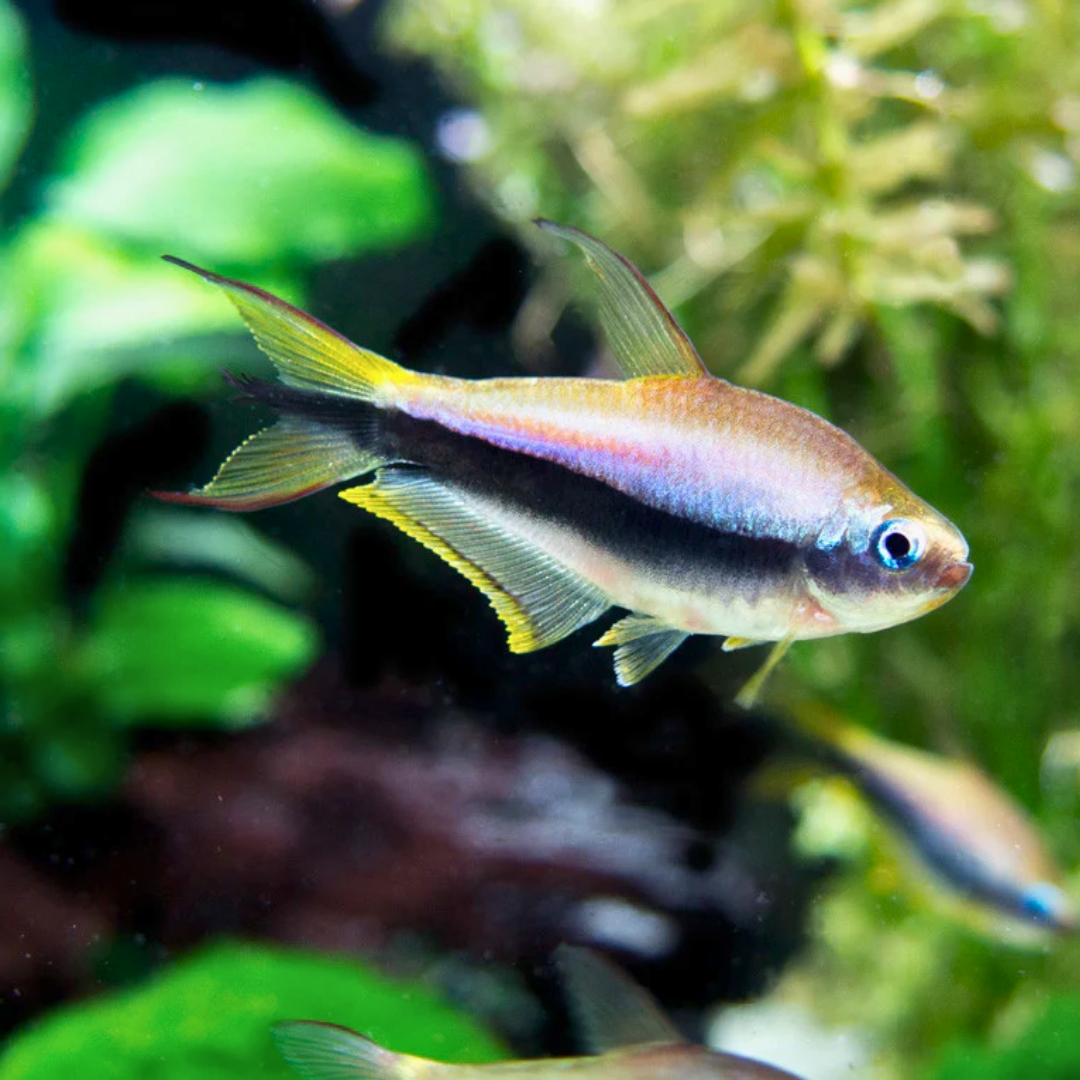
エンペラーテトラは、南米コロンビア西部のアトラト川水系とサン・フアン川水系に分布する、上品な姿の小型テトラです。成熟したオスでは尾びれ中央の軟条が伸び、上下の葉と合わせて三叉のように見える独特のシルエットをつくります。体側には黒いラインが走り、暗めの底床や浮き草で光をやわらげた水槽では、青紫色の金属光沢が静かに浮かび上がります。丈夫で人工飼料にも慣れやすい一方、オス同士の美しいディスプレイや、雌雄で異なる虹彩の色など、じっくり観察するほど味わいが増す魚です。The Emperor Tetra is an elegant small tetra from the Atrato and San Juan river basins of western Colombia, South America. Mature males develop an elongated central caudal-fin ray, creating a distinctive three-pronged tail together with the upper and lower lobes. A dark stripe runs along the body, and in an aquarium with a dark substrate and softened light from floating plants, a blue-violet metallic sheen appears beautifully. It is hardy and readily accepts prepared foods, yet it also rewards careful observation with male display behavior and different iris colors between the sexes.
基本情報 / Basic Information
学名 / Scientific Name
Nematobrycon palmeri Eigenmann, 1911
通称 / Common Name
エンペラーテトラ、パルメリテトラEmperor Tetra, Palmer’s Tetra
分類 / Family
カラシン目アセストロラムフス科ロアドシア亜科ネマトブリコン属。従来はカラシン科として扱われることが多かった魚で、国内の流通名や一部の飼育資料では今も旧来のカラシン科表記が残る場合があります。Order Characiformes, family Acestrorhamphidae, subfamily Rhoadsiinae, genus Nematobrycon. It was traditionally treated within Characidae, and that older family name may still appear in aquarium-trade labels and some hobby literature.
英名 / English Name
Emperor Tetra
分布 / Distribution
南米コロンビア西部のアトラト川水系およびサン・フアン川水系。流れの強い本流よりも、支流や緩やかな小川、岸辺のカバーが多い場所に関連して語られることが多い魚です。Atrato and San Juan river basins in western Colombia, South America. It is most often associated with tributaries, slower streams, and areas with cover rather than fast-flowing main channels.
最大体長 / Max Size
全長約5cm。標準体長ではおおむね4.2cm前後までとされ、オスの方が大きく見えやすい傾向があります。About 5 cm in total length. Standard length is generally reported at around 4.2 cm, with males often appearing larger.
寿命 / Lifespan
一般的には3〜5年ほどが目安です。安定した水質、過密を避けた飼育、偏りのない餌を維持できれば、より長く楽しめる個体もいます。A general expectation is about 3–5 years. With stable water quality, moderate stocking, and a varied diet, some individuals may live longer.
飼育環境 / Aquarium Environment
水槽サイズ / Tank Size
5〜6匹程度の小さな群れなら60cm規格水槽(約57L)を実用的な下限と考えます。オス同士のディスプレイ、遊泳スペース、メスへの追尾の分散まで考えるなら、80cm前後の水槽、または90cm規格水槽(約160L前後)がより安心です。8〜10匹以上で飼うと、自然な群れの動きや雌雄の行動差を観察しやすくなります。For a small group of about 5–6 fish, a standard 60 cm aquarium of around 57 L can be considered a practical lower limit. For male displays, swimming space, and reduced pressure on females, a tank around 80 cm long or a standard 90 cm aquarium of around 160 L is safer. Groups of 8–10 or more make it easier to observe natural shoaling and differences between male and female behavior.
水温 / Temperature
通常飼育では23〜27℃が目安です。繁殖を狙う場合は、状態を見ながら26〜28℃程度にやや高めて管理すると産卵行動を促しやすくなります。A general maintenance range of 23–27°C is suitable. For breeding, slightly warmer water around 26–28°C can help encourage spawning behavior when the fish are in good condition.
水質 / Water Quality
弱酸性から中性付近を中心に、pH5.0〜7.8程度、硬度5〜19dH程度の範囲で飼育例があります。色や落ち着きを引き出すなら、急変のない弱酸性から中性、低めから中程度の硬度を目標にすると扱いやすいです。自然環境を再現する場合も、濃いブラックウォーターに限定せず、流木や落ち葉でタンニンを少し含む澄んだ褐色水から、清澄な緩流環境まで幅を持たせて考えるとよいでしょう。It is kept successfully across a range centered on slightly acidic to near-neutral water, roughly pH 5.0–7.8 and 5–19 dH. To bring out color and calm behavior, aim for stable slightly acidic to neutral water with low to moderate hardness. When recreating its habitat, it is better not to assume only dark blackwater; clear, slow water with some tannins from driftwood and leaves is also a useful model.
レイアウト / Layout
暗めの底床、流木、落ち葉、細葉の水草を組み合わせると、本種の青紫の反射光が引き立ちます。アマゾンフロッグビット、ピスティア、サルビニア、ウォータースプライトなどの浮き草で光を少し遮ると、強い照明で体色が浅く見えるのを抑えやすくなります。水流は強くしすぎず、穏やかに泳げる開けた空間と、弱い個体が逃げ込める陰を両方用意します。A dark substrate, driftwood, leaf litter, and fine-leaved aquatic plants help show the species’ blue-violet reflective sheen. Floating plants such as Amazon frogbit, water lettuce, Salvinia, or water sprite soften the light and help prevent the fish from looking washed out under bright lighting. Water movement should not be excessive; provide both open swimming space and shaded retreats for subordinate fish.
注意点 / Precautions
丈夫な魚ですが、オスは同種間で縄張りを主張し、鰭を広げて競い合います。多くはディスプレイで済みますが、過密や隠れ家不足では弱い個体が追われやすくなります。ワイルド個体は導入初期に輸送疲れや水質差の影響を受けることがあるため、急な水合わせを避け、消灯気味の落ち着いた環境で慎重に立ち上げてください。Although hardy, males can be territorial toward one another and may spar with fins fully spread. Most conflicts remain displays, but overcrowding or a lack of cover can leave weaker fish under stress. Wild-caught individuals may be affected by transport stress and water differences during acclimation, so slow acclimation and a subdued environment are recommended.
餌と給餌 / Feeding
餌の種類 / Diet
肉食傾向のある雑食性で、自然下では小型の水生無脊椎動物、ミミズ状の小動物、甲殻類などを食べるとされます。水槽内では小粒の顆粒飼料やフレークフードを主食にでき、冷凍ブラインシュリンプ、ミジンコ、アカムシ、イトメなどを副食として与えると体つきと発色が整いやすくなります。It is an omnivore with a carnivorous tendency and is reported to feed on small aquatic invertebrates, worm-like animals, and crustaceans in nature. In aquaria, fine granules or flakes can be used as staple foods, supplemented with frozen brine shrimp, daphnia, bloodworms, or tubifex to support condition and coloration.
給餌のポイント / Feeding Tips
1日1〜2回、数分で食べ切れる量を与えます。口は大きくないため、粒が大きい餌は砕いてから与えると食べ残しを減らせます。繁殖を狙う場合は、2週間ほど冷凍餌や活餌を組み合わせてコンディションを上げますが、脂肪のつきすぎや水質悪化を避けるため、餌の量と換水のバランスを意識してください。Feed once or twice daily, offering only what the fish can finish within a few minutes. Because the mouth is small, crush larger foods to reduce leftovers. For breeding preparation, condition the fish for about two weeks with a mixture of frozen and live foods, while balancing richer feeding with water changes to avoid excess waste.
性格と混泳 / Temperament and Tank Mates
性格 / Temperament
他種に対してはおおむね温和で、落ち着いたコミュニティ水槽に向いています。同種間ではオスが互いに張り合い、頭を下げ気味にして鰭を広げるような見応えのあるディスプレイを行います。群れで泳ぐ魚ではありますが、常に密集して泳ぐタイプではなく、安心していると水槽内にゆるく散らばって過ごすこともあります。It is generally peaceful toward other species and suits a calm community aquarium. Among its own kind, males compete and display by spreading their fins, sometimes with the head angled slightly downward. It is a social fish, but it does not always form a tight school; when settled, individuals may spread loosely through the aquarium.
混泳の相性 / Compatibility
同じくらいの大きさで温和なテトラ類、ラスボラ類、ペンシルフィッシュ、小型コリドラス、オトシンクルス、アピストグラマなどの小型ドワーフシクリッドと相性がよいです。大きな魚食性魚、荒い気性の魚、鰭をかじる魚との混泳は避けます。オス1匹に対してメスを多めに入れると、追尾の負担が分散されやすくなります。Good tank mates include similarly sized peaceful tetras, rasboras, pencilfish, small Corydoras, Otocinclus, and small dwarf cichlids such as Apistogramma. Avoid large predatory fish, aggressive species, and fin nippers. Keeping more females than males helps spread out breeding-related chasing.
病気と対策 / Diseases and Prevention
かかりやすい病気 / Common Diseases
本種だけに特有の病気は知られていませんが、導入直後や水温変化が大きい時期には白点病、尾ぐされ、口ぐされ、細菌性の皮膚炎が起こることがあります。痩せ、体色のくすみ、ヒレの閉じ、群れから離れる行動が見られたら、水質悪化や混泳ストレスも疑います。No disease is uniquely associated with this species, but white spot disease, fin rot, mouth rot, and bacterial skin problems may occur after introduction or during large temperature swings. If fish become thin, dull in color, clamp their fins, or isolate themselves from the group, check both water quality and social stress.
対策と予防 / Prevention
急な水質変化を避け、週1回から2週に1回を目安に20〜30%程度の換水を行います。新しく迎えた個体は可能であれば検疫し、導入直後は強い照明や激しい混泳を避けます。病気が出た場合は隔離して観察し、症状に合った市販薬を用いますが、薬浴中は酸欠や水質悪化が起きやすいため、エアレーションと餌の量に注意してください。Avoid sudden changes in water conditions and perform 20–30% water changes weekly or every two weeks as a practical routine. Quarantine new fish when possible, and avoid strong lighting or stressful tank mates immediately after introduction. If disease appears, isolate affected fish and use an appropriate aquarium medication, while paying close attention to aeration and reduced feeding during treatment.
増やし方(繁殖) / Breeding
雌雄の判別 / Sexing
オスはメスより大きくなりやすく、尾びれ中央の軟条が伸びて三叉状に見え、背びれや尻びれも伸長します。虹彩は鮮やかな青みを帯びることが多く、体側の青紫の光沢も強く出ます。メスはやや小型で腹部が丸みを帯び、虹彩は緑色から黄色味を帯びることが多いです。Males tend to grow larger than females, with an elongated central caudal-fin ray that gives the tail a three-pronged look, as well as longer dorsal and anal fins. The iris is often vivid blue, and the blue-violet body sheen is stronger. Females are usually smaller with a rounder belly, and the iris is often greenish to yellowish.
繁殖形態 / Reproduction
ばらまき型の産卵を行う卵生魚で、親は卵や稚魚を保護しません。むしろ食卵することがあるため、まとまった数を育てたい場合は産卵用水槽を用意し、産卵後に親魚を速やかに戻す必要があります。It is an egg-scattering species and provides no parental care. Adults may eat the eggs, so planned breeding requires a separate spawning tank and prompt removal of the parents after spawning.
繁殖のポイント / Breeding Tips
10〜20L前後の小型水槽にスポンジフィルターを入れ、pH6.0前後の軟水、26〜28℃を目安にします。底にはウィローモス、産卵モップ、ビー玉、鉢底ネットなどを使い、落ちた卵に親の口が届きにくい構造をつくります。栄養価の高い餌で2週間ほど仕上げたペアまたは小グループを消灯前に入れると、翌朝から午前中に産卵することがあります。卵は水温にもよりますが24〜36時間ほどで孵化し、さらに4〜5日ほどで泳ぎ始めます。初期飼料はインフゾリアや極小パウダーを使い、成長に合わせて孵化したてのブラインシュリンプやマイクロワームへ移行します。Use a small 10–20 L breeding tank with a sponge filter, aiming for soft water around pH 6.0 and 26–28°C. Java moss, spawning mops, marbles, or mesh can be placed on the bottom so eggs fall out of reach of the adults. After conditioning a pair or small group for about two weeks with rich foods, introduce them shortly before lights out; spawning may occur the following morning. Depending on temperature, eggs hatch in about 24–36 hours, and the fry become free-swimming about 4–5 days later. Start with infusoria or extremely fine powdered fry food, then move to newly hatched brine shrimp or microworms as the fry grow.
雑学と豆知識 / Trivia and Fun Facts
1. 学名に残る採集者の名前 / 1. The collector remembered in the scientific name
種小名の palmeri は、コロンビアで標本を採集した博物学者マーヴィン・ジョージ・パーマーに由来します。1911年、魚類学者カール・H・アイゲンマンは、コンドト川やタマナ川周辺で得られた標本をもとに本種を記載しました。小さなテトラの名前には、熱帯雨林の川を歩いた採集者と、標本の細かな形を読み解いた研究者の仕事が静かに残されています。The species name palmeri honors the naturalist Mervyn George Palmer, who collected specimens in Colombia. In 1911, ichthyologist Carl H. Eigenmann described the species from material collected around the Río Condoto and Río Tamana region. The name of this small tetra quietly preserves the work of both a field collector in tropical rivers and a scientist who interpreted the specimens’ details.
2. 2024年以降に見直された分類上の位置づけ / 2. A taxonomic placement revised after 2024
エンペラーテトラは、長いあいだ「カラシン科のテトラ」として親しまれてきました。しかし近年の分子系統解析では、旧来のカラシン科に含まれていた多くの魚が複数の科へ整理され、本種はアセストロラムフス科ロアドシア亜科に置かれる体系が採用されています。水槽の中では昔と変わらず優雅に泳いでいますが、名前の背後では、南米小型魚の進化史を読み直す大きな流れが進んでいるのです。The Emperor Tetra was long familiar to aquarists simply as a characid tetra. Recent molecular phylogenetic work, however, has reorganized many fishes formerly placed in Characidae into several families, and this species is now placed in Acestrorhamphidae, subfamily Rhoadsiinae, in current classifications. It still swims with the same elegance in the aquarium, but behind its name lies a broader reassessment of South American tetra evolution.
3. 脂びれを持たない、見分けやすいテトラ / 3. An easy-to-recognize tetra without an adipose fin
多くのテトラ類には、背びれと尾びれの間に小さな脂びれがあります。しかしエンペラーテトラでは、この脂びれが見られません。これは同じような名前で流通するブルーエンペラーテトラ、すなわち Inpaichthys kerri と見分ける際にも大切なポイントです。さらに成熟したオスでは尾びれ中央が伸びるため、横から見ると名前にふさわしい堂々とした輪郭が際立ちます。Many tetras have a small adipose fin between the dorsal and caudal fins, but the Emperor Tetra lacks it. This is an important feature when distinguishing it from the similarly named Blue Emperor Tetra, Inpaichthys kerri. Mature males also develop an extended central caudal-fin ray, giving the fish a dignified outline that suits its common name.
4. 「光を強くする」より「影をつくる」魚 / 4. A fish that benefits from shade as much as light
美しい魚をより明るく見せようとして、つい照明を強くしたくなります。しかしエンペラーテトラの場合、強すぎる光では体色が浅く見え、黄色味が前に出ることがあります。浮き草や流木でやわらかな影をつくると、体側の反射光が角度によって青や紫に変化し、森の小川で木漏れ日を拾うような雰囲気になります。水草水槽で本種が長く愛される理由は、この控えめで奥行きのある美しさにもあります。It is tempting to use strong lighting to make a beautiful fish look brighter, but the Emperor Tetra often looks better under softer conditions. Under overly bright light, the body can appear pale and more yellowish. When floating plants and driftwood create gentle shade, the reflective scales shift between blue and violet depending on the angle, evoking light filtering through a forest stream. This subtle, layered beauty is one reason the species remains popular in planted aquariums.
5. ワイルド個体とブリード個体、それぞれの楽しみ / 5. Wild-caught and captive-bred fish each have their appeal
日本で見かけるエンペラーテトラの多くは養殖されたブリード個体で、人工飼料に慣れやすく、導入しやすい点が魅力です。一方、コロンビア産のワイルド個体は入荷が不定期で、導入時の水合わせにも少し気を使いますが、引き締まった体型や落ち着いた発色に惹かれる愛好家も少なくありません。どちらが上というより、ブリード個体は安定して迎えやすい優等生、ワイルド個体は生息地の空気を少し運んでくるような存在として、それぞれ異なる楽しみがあります。Many Emperor Tetras seen in Japan are captive-bred fish, valued for their easy adaptation to prepared foods and straightforward introduction. Wild-caught Colombian fish are less regularly available and require more care during acclimation, but many enthusiasts appreciate their tighter body shape and subdued depth of color. Rather than one being simply better than the other, captive-bred fish are accessible and dependable, while wild fish can feel as though they bring a trace of their native habitat into the aquarium.
6. ブラックフォームと近縁種の物語 / 6. The story of the black form and related species
黒みの強いエンペラーテトラは、かつて別種 Nematobrycon amphiloxus として扱われた歴史がありますが、現在は Nematobrycon palmeri のシノニム、または黒色の強いフォームとして扱われます。また、同属には赤い虹彩で知られるレインボーテトラ Nematobrycon lacortei もいます。似た仲間を比べてみると、体色だけでなく、眼の色、尾びれの伸び方、脂びれの有無といった細部が、魚を見分ける大切な手がかりになることが分かります。The darker Emperor Tetra was once treated as a separate species, Nematobrycon amphiloxus, but it is now regarded as a synonym of Nematobrycon palmeri or as a dark form. The genus also includes the Rainbow Tetra, Nematobrycon lacortei, known for its red iris. Comparing these relatives shows that not only body color but also eye color, caudal-fin extension, and the presence or absence of an adipose fin can be important clues for identification.
まとめ / Conclusion
エンペラーテトラは、丈夫さ、混泳のしやすさ、成熟したオスの見事な鰭、そして青紫に揺らぐ反射光を兼ね備えた、小型テトラの名品です。5匹以上、できれば雌を多めにした群れで飼い、暗めの底床、流木、浮き草、穏やかな水流を組み合わせることで、本来の落ち着いた美しさが引き出されます。The Emperor Tetra is a classic small tetra that combines hardiness, community-tank suitability, striking mature male fins, and a shifting blue-violet sheen. Keeping five or more individuals, preferably with more females than males, and providing a dark substrate, driftwood, floating plants, and gentle water flow will bring out its natural elegance.
初心者にはブリード個体が扱いやすく、より自然味や深い発色を求める愛好家にはワイルド個体も魅力的です。現在の分類ではアセストロラムフス科に置かれるなど、学術的な見方も更新され続けています。小さな体の中に、南米の河川環境、観賞魚史、分類学の変遷が詰まった、長く付き合うほど面白さが増す魚といえるでしょう。Captive-bred fish are especially approachable for beginners, while wild-caught individuals appeal to hobbyists seeking a stronger sense of natural origin and deeper coloration. Its scientific placement has also been updated, with current classifications placing it in Acestrorhamphidae. Within its small body, the species carries stories of South American rivers, aquarium history, and changing taxonomy, making it more rewarding the longer one keeps it.
1. Eigenmann, C. H. 1911. Description of two new Tetragonopterid fishes in the British Museum. Annals and Magazine of Natural History, Series 8, 7: 215–216. 原記載、学名、属の成立を確認。 https://www.biodiversitylibrary.org/page/22098176
4. DoNascimiento, C., Herrera-Collazos, E. E., Herrera-R., G. A., Ortega-Lara, A., Villa-Navarro, F. A., Usma-Oviedo, J. S. and Maldonado-Ocampo, J. A. 2017. Checklist of the freshwater fishes of Colombia: a Darwin Core alternative to the updating problem. ZooKeys, 708: 25–138. コロンビア淡水魚相と分布情報の補強。 https://doi.org/10.3897/zookeys.708.13897
2024年の分類再編・近縁種との識別
5. Melo, B. F., Ota, R. P., Benine, R. C., Carvalho, F. R., Lima, F. C. T., Mattox, G. M. T., Souza, C. S., Faria, T. C., Reia, L., Roxo, F. F., Valdez-Moreno, M., Near, T. J. and Oliveira, C. 2024. Phylogenomics of Characidae, a hyper-diverse Neotropical freshwater fish lineage, with a phylogenetic classification including four families. Zoological Journal of the Linnean Society, 202(1): zlae101. 旧Characidaeの再編、Acestrorhamphidaeを含む新分類体系の根拠。 https://doi.org/10.1093/zoolinnean/zlae101
6. Weitzman, S. H. and Fink, W. L. 1971. A new species of characid fish of the genus Nematobrycon from the Rio Calima of Colombia. Beaufortia, 19(248): 57–77. レインボーテトラ Nematobrycon lacortei の記載、近縁種との比較、属内識別の確認。 https://repository.naturalis.nl/pub/505176
7. García, L. N., Rodrigues de Lara, G. and Merino, G. E. 2025. Practical differentiation between species and sexes of juvenile tropical ornamental fish in the genus Nematobrycon and new localities for the species. AACL Bioflux, 18(6): 2532–2537. ネマトブリコン属の種・雌雄識別、分布記録の補強。 https://bioflux.com.ro/docs/2025.2532-2537.pdf
学名の由来・飼育・繁殖・観賞魚史の補助資料
8. Scharpf, C. 2025. Family Acestrorhamphidae Eigenmann 1907. The ETYFish Project: Fish Name Etymology Database. 属名・種小名の由来、献名情報の確認。 https://etyfish.org/acestrorhamphidae/



 アイのアクアグッズ案内バルブの仲間に合わせる飼育用品|チェリーバルブ・スマトラ・中型種の水槽とろ過道具の特徴や使い方、選ぶときのポイントをアイが紹介します。記事はコチラ →
 アイのアクアグッズ案内水槽用浄水器の選び方|水換えを楽にするタイプとROの違い道具の特徴や使い方、選ぶときのポイントをアイが紹介します。記事はコチラ →



コメント