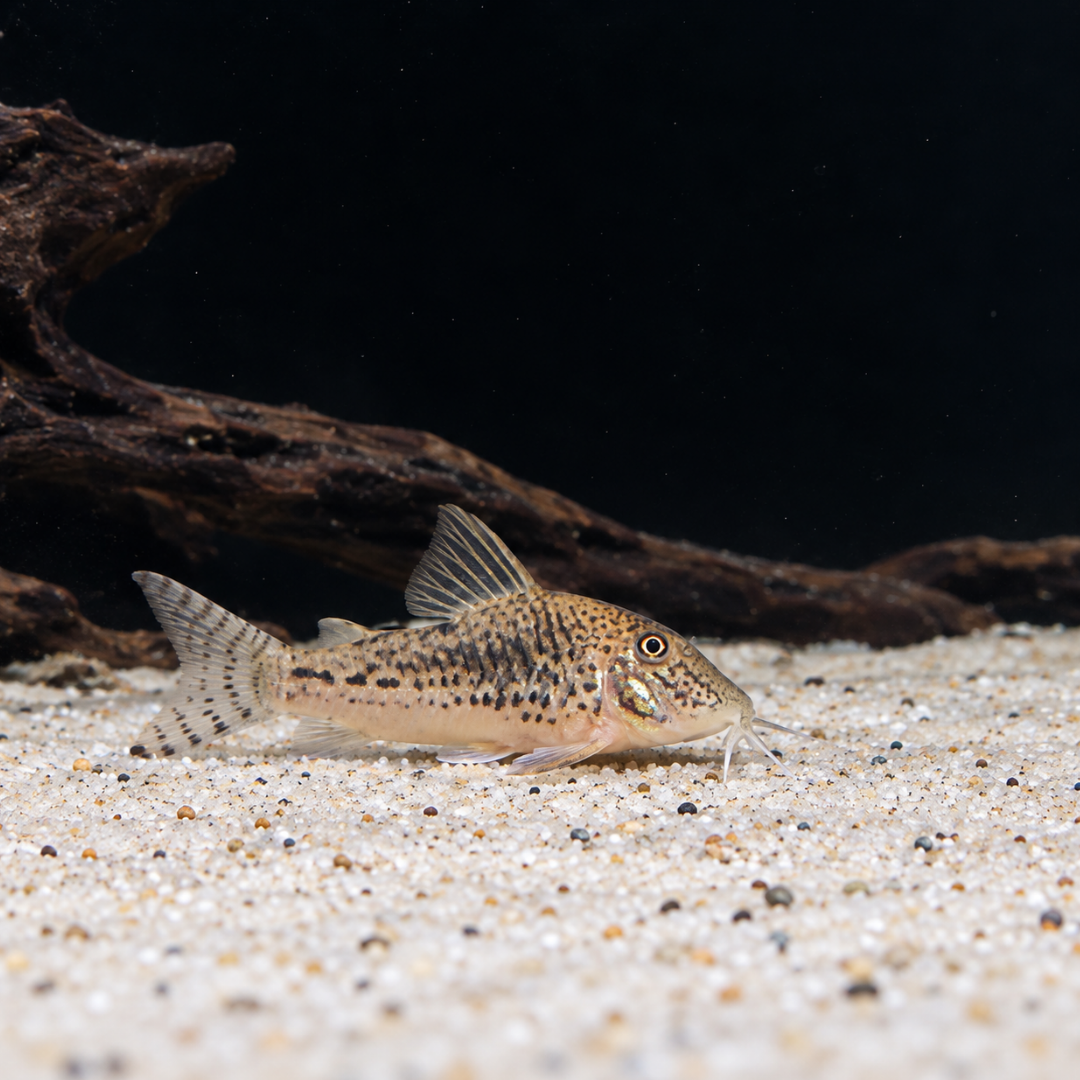
コリドラス・サラレエンシスは、南米ブラジルのグァポレ川上流に注ぐサラレ川から見つかった、ロングノーズタイプのコリドラスです。学名が付く前はCナンバー「C023(C23)」の名で知られており、日本では「グァポレミスト」という流通名で呼ばれることもあります。眼の前から吻端へすらりと伸びた鼻先と、霧を吹きかけたような細かな黒い斑点が大きな魅力です。斑点は細かく散らばるものから、いくつかが融合して大きな斑紋になるものまで個体差が大きく、一匹ごとに異なる表情を楽しめます。細かい砂に鼻先を深く差し込んで餌を探す姿はロングノーズ種ならではのものです。低めの水温、豊富な酸素、角のない細かな砂という条件を整えれば、長く付き合える丈夫な底棲魚として水槽の主役を務めてくれます。Corydoras sarareensis is a long-snouted corydoras discovered in the Rio Sararé, a tributary of the upper Rio Guaporé in Brazil. Before receiving its scientific name it was known by the C-number C023 (C23), and in Japan it is sometimes sold under the trade name “Guaporé Mist.” Its chief attractions are the long snout that extends straight forward from the eyes and a body dusted with fine black spots, as if sprayed with mist. The spotting varies widely, from fine scattered dots to spots merged into larger blotches, so each fish has its own look. Watching it push its snout deep into fine sand in search of food is a pleasure unique to long-nosed species. Given cool water, plenty of oxygen and fine, rounded sand, it becomes a hardy, long-lived bottom dweller that can take center stage in the aquarium.
ナマズ目 カリクティス科 コリドラス亜科 コリドラス属(2024年の再分類後もコリドラス属に残る種)Siluriformes, Callichthyidae, Corydoradinae, genus Corydoras (remains in Corydoras after the 2024 reclassification)
英名 / English Name
Sararé Cory, Guaporé Mist Cory
分布 / Distribution
南米 グァポレ川流域(ブラジルとボリビアの国境地帯)。最初に採集された場所は、ブラジル・マトグロッソ州を流れるグァポレ川上流の右岸支流、サラレ川です。South America: the Rio Guaporé basin along the Brazil–Bolivia border. The type locality is the Rio Sararé, a right-bank tributary of the upper Rio Guaporé in Mato Grosso, Brazil.
最大体長 / Max Size
約6〜7cm。メスのほうがやや大きく、オスは6cm前後、メスは6.5cm前後が目安です。About 6–7 cm. Females are slightly larger, roughly 6 cm for males and 6.5 cm for females.
寿命 / Lifespan
5年以上。環境が整えば、10年近く生きることもあるとされています。Five years or more; in well-kept aquariums some are said to live close to ten years.
飼育環境 / Aquarium Environment
水槽サイズ / Tank Size
5〜6匹の群れで飼うなら、60cm規格水槽(約57L)以上が目安です。底で暮らす魚なので、水槽の高さより底面積の広さが重要になります。90cm規格水槽や60cmワイド水槽を用意できれば、より落ち着いた姿を見せてくれるでしょう。For a group of five or six, a 60 cm standard tank (about 57 L) or larger is a good guide. As a bottom dweller, floor area matters more than tank height. A 90 cm standard tank or a wide 60 cm tank will let the fish behave more calmly.
水温 / Temperature
22〜26℃(許容範囲はおおむね20〜27℃)。熱帯魚としては低めの水温を好み、高水温に弱い魚です。日本の夏は室温とともに水温も上がりやすいため、水槽用クーラーや冷却ファンでの温度管理がほぼ必須となります。22–26°C (tolerable range roughly 20–27°C). It prefers cooler water than many tropical fish and is sensitive to heat. Because water temperatures rise easily during Japanese summers, an aquarium chiller or cooling fan is practically essential.
水質 / Water Quality
弱酸性〜中性(pH6.0〜7.5程度)。数値を細かく合わせることよりも、汚れが少なく酸素を豊富に含んだ水を安定して保つことが大切です。Slightly acidic to neutral (around pH 6.0–7.5). Keeping the water consistently clean and well oxygenated matters more than matching exact figures.
レイアウト / Layout
底床には、田砂やボトムサンドなど角のない非常に細かい砂(粒径0.1〜1mm程度)を2〜3cmほどの厚さで敷きます。厚く敷きすぎると、砂の奥に酸素の届かない層ができやすくなるため注意しましょう。流木や水草で隠れ家を作りつつ、鼻先を砂に差し込んで餌を探せるよう、開けた砂地を広く残すのがポイントです。強めのエアレーションとフィルターの水流で、水がよどむ場所を作らないようにします。Use very fine, rounded sand such as river sand or fine bottom sand (about 0.1–1 mm) in a layer 2–3 cm deep. A thicker bed tends to develop oxygen-poor zones deep inside, so avoid overdoing it. Provide cover with driftwood and plants, but leave a wide open sandy area where the fish can probe for food. Use strong aeration and filter flow so that no stagnant areas form.
注意点 / Precautions
大磯砂のように角のある粗い底砂は、鼻先やヒゲを傷つける原因になるため避けてください。酸素不足と高水温にとても弱く、水面へ頻繁に空気を吸いに上がるようなら、酸欠や水質悪化のサインと考えて早めに換水しましょう。砂の中に食べ残しやフンが溜まらないよう、週1回程度、プロホースなどで底床の表面を掃除しながら3割前後の水を換えるのが基本です。Avoid coarse, sharp-edged gravel, which can damage the snout and barbels. The species is very sensitive to low oxygen and high temperatures; if the fish frequently dash to the surface to gulp air, treat it as a sign of oxygen shortage or deteriorating water and change water promptly. As a routine, siphon the sand surface about once a week while replacing roughly 30% of the water, so that leftover food and waste do not build up in the substrate.
餌と給餌 / Feeding
餌の種類 / Diet
雑食性の底棲魚で、野生では砂の中にいる小さな甲殻類や昆虫の幼虫、有機物などを食べていると考えられています。飼育下では、底までしっかり沈むコリドラス用のタブレットやペレットを主食にしましょう。そこへ冷凍アカムシ、イトメ、冷凍ブラインシュリンプなどの動物性の餌を定期的に加えると、体力の維持や色つやの良さにつながります。An omnivorous bottom dweller thought to feed on small crustaceans, insect larvae and organic matter in the sand in the wild. In aquariums, use sinking corydoras tablets or pellets as the staple, and regularly add animal foods such as frozen bloodworms, live tubifex worms and frozen brine shrimp to help maintain condition and good coloration.
給餌のポイント / Feeding Tips
成長した個体はよく食べますが、中層を泳ぐ魚に先に食べられてしまうと、餌が底まで届きません。混泳魚が多い場合は、消灯前後に沈下性の餌を与えるなど、確実に口に入るよう工夫しましょう。食べ残しは砂の中で傷みやすいため、量は数分で食べきれる程度に抑えます。Grown fish have healthy appetites, but food may never reach the bottom if midwater fish eat it first. With many tank mates, try giving sinking food around lights-out so the corydoras get their share. Leftovers spoil quickly in sand, so give only what can be eaten within a few minutes.
性格と混泳 / Temperament and Tank Mates
性格 / Temperament
基本的には温和で、ほかの魚を襲うことはありません。ただしロングノーズのコリドラスは、底の餌場をめぐって同種やほかの底棲魚を追い払うなど、やや気の強い一面を見せることがあります。群れで暮らす魚なので、5〜6匹以上での飼育がおすすめです。Generally peaceful and does not attack other fish. Long-nosed corydoras can, however, show a somewhat assertive side, chasing conspecifics or other bottom dwellers away from feeding spots. As a social species, it is best kept in groups of five or six or more.
混泳の相性 / Compatibility
上層から中層を泳ぐ温和な小型カラシン(テトラ類)やラスボラ類とは相性が良好です。プレコやローチ、ほかのコリドラスなどの底棲魚を多く入れると餌場の取り合いになりやすいため、水槽の底が過密にならないようにしましょう。高水温を好む魚や、底にいる魚をつつく魚との混泳には向きません。It does well with peaceful small characins (tetras) and rasboras that occupy the upper and middle water layers. Adding many bottom dwellers such as plecos, loaches or other corydoras can lead to competition for feeding spots, so avoid overcrowding the tank floor. It is not suited to fish that need high temperatures or that nip at bottom dwellers.
病気と対策 / Diseases and Prevention
かかりやすい病気 / Common Diseases
代表的なのは、底砂による擦り傷から始まるヒゲの溶けや欠損です。傷口からエロモナス菌などの細菌が入り込むと、腹部などが赤く充血する赤斑病に進むことがあり、重症化すると命に関わります。また、高水温や酸欠によるストレスから体調を崩しやすい傾向があります。The most typical problem is barbel erosion, which starts from abrasions caused by the substrate. If bacteria such as Aeromonas enter the wounds, it can progress to red blotch disease, with reddened, inflamed patches on the belly and elsewhere, which can be fatal in severe cases. The fish also tends to fall ill from stress caused by high temperatures or low oxygen.
対策と予防 / Prevention
予防の要は、角のない細かな砂、低めで安定した水温、十分な酸素の3点です。底床表面の定期的な掃除と換水で砂の中に汚れを溜めないことが、細菌による病気を防ぐ近道になります。ヒゲが短くなり始めたら、すぐに底床と水質を見直しましょう。体に充血が見られる場合は、別の水槽に隔離して早めに治療を始めます。Prevention rests on three essentials: fine, rounded sand; cool, stable temperatures; and ample oxygen. Regular siphoning of the sand surface and water changes keep waste from accumulating, which is the surest way to prevent bacterial disease. If the barbels begin to shorten, review the substrate and water quality immediately. If reddening appears, move the fish to a separate tank and begin treatment early.
増やし方(繁殖) / Breeding
雌雄の判別 / Sexing
成熟すると比較的見分けやすくなります。メスはオスより一回り大きく、上から見ると体の幅が広く、腹ビレも丸みを帯びています。オスは胸ビレの第1条(いちばん前の硬い棘)が太くなり、その表面に細かいトゲ状の突起が密生するのが大きな特徴です。Mature fish are relatively easy to sex. Females are noticeably larger, broader when viewed from above, and have more rounded pelvic fins. Males are characterized by a thickened first pectoral fin ray (the hard leading spine) covered with dense, fine bristle-like projections.
繁殖形態 / Reproduction
卵生です。コリドラス特有の「Tポジション」と呼ばれる姿勢で受精が行われます。メスは腹ビレで作ったくぼみに卵を抱え、ガラス面や流木、幅広の水草の葉などに数個ずつ産み付けます。産卵は一度にまとめて行うのではなく、何回かに分けて行われます。親が卵を守る習性はありません。Egg-layer. Fertilization takes place in a posture called the “T-position,” typical of corydoras. The female carries eggs in a pouch formed by her pelvic fins and attaches them a few at a time to glass, driftwood or broad plant leaves. Spawning occurs in several batches rather than all at once, and the parents do not guard the eggs.
繁殖のポイント / Breeding Tips
オスをメスよりやや多めにした成熟したグループを用意し、動物性の餌を中心にしっかり栄養をつけさせます。メスのお腹が十分にふくらんだら、普段より2〜3℃ほど低い水で換水し、雨季の訪れを再現するのが産卵のきっかけとして知られています。卵は親に食べられやすいため、指先やカードでそっと剥がし、エアレーションをした別容器に移しましょう。稚魚は卵黄の栄養を吸収し終えて泳ぎ始めたら、インフゾリアやブラインシュリンプの幼生を与えます。稚魚は水質の悪化にとても弱いため、食べ残しをこまめに取り除くことが成功の鍵です。なお、ワイルド個体は飼育環境に慣れて産卵するまでに、長い時間がかかる場合があります。Prepare a mature group with slightly more males than females and condition them well, mainly on animal foods. Once the females are visibly full of eggs, a water change with water 2–3°C cooler than usual, simulating the arrival of the rainy season, is a known spawning trigger. Eggs are easily eaten by the parents, so gently remove them with a fingertip or a plastic card and move them to a separate, aerated container. When the fry have used up their yolk and begin swimming, feed infusoria or newly hatched brine shrimp. The fry are very sensitive to poor water quality, so diligently removing leftover food is the key to success. Wild-caught fish may take a long time to settle in before they spawn.
雑学と豆知識 / Trivia and Fun Facts
1. 「C023」から正式な学名へ / 1. From “C023” to a Scientific Name
南米から次々と輸入される名前のないコリドラスを整理するため、ドイツの観賞魚雑誌『DATZ』は「Cナンバー」という番号制度を考案しました。本種はその初期の番号のひとつ「C023」として愛好家の注目を集め、1995年にDinkelmeyerによってドイツの専門誌『Aquaristik aktuell』で正式に新種として記載されました。種小名の「sarareensis」は、模式標本(新種の基準となる標本)が採集されたサラレ川の名に、「〜産の」を意味するラテン語の接尾辞「-ensis」を付けたものです。この模式標本はブラジルのサンパウロ大学動物学博物館に保管されています。番号でしか呼ばれていなかった魚が、名前とともに学術的な基準を得た瞬間でもありました。To keep track of the many unnamed corydoras being imported from South America, the German aquarium magazine DATZ devised the “C-number” system. This species drew attention among hobbyists as one of the early numbers, C023, and was formally described as a new species by Dinkelmeyer in 1995 in the German journal Aquaristik aktuell. The specific name sarareensis combines the name of the Rio Sararé, where the holotype (the specimen that defines the species) was collected, with the Latin suffix -ensis, meaning “from.” The holotype is housed in the Museum of Zoology of the University of São Paulo. It marked the moment when a fish known only by a number gained both a name and a scientific reference point.
2. 2024年の再分類と「本来のコリドラス」 / 2. The 2024 Reclassification and the “Original” Corydoras
かつてのコリドラス属には非常に多くの種がまとめられていましたが、DNA解析が進むにつれて、実はいくつもの異なる系統の寄せ集めであることがわかってきました。そこで2024年、Diasらの研究によって分類が大きく見直され、多くの種がガストロデルムス属やホプリソーマ属など、過去に提唱されていた別の属へ移されました。一方サラレエンシスは、コリドラス属の基準となる種と同じグループ(リネージ1)に属するため、引き続きコリドラス属に残っています。このグループは長い吻を持つロングノーズ型の種が中心です。つまり、同じ「コリドラス」として売られている魚でも、属のレベルで別のグループに分かれている場合があり、体型や暮らし方にも違いが見られるということです。この違いを知っておくと、飼育環境を考えるうえでのヒントにもなります。The genus Corydoras once included a very large number of species, but as DNA studies advanced it became clear that it was actually a mix of several distinct lineages. In 2024, a study by Dias and colleagues substantially revised the classification, moving many species into other previously proposed genera such as Gastrodermus and Hoplisoma. C. sarareensis, however, belongs to the same group as the genus’s type species (lineage 1), so it remains in Corydoras. This group consists mainly of long-snouted species. In other words, fish sold under the same name “corydoras” may belong to different groups at the genus level, and their body shapes and lifestyles can differ accordingly. Knowing this difference is a useful hint when planning their aquarium.
3. 同じ川に暮らすコリドラスたち / 3. Corydoras Sharing the Same River
グァポレ川流域には多くのコリドラスが暮らしており、小型のコリドラス・グァポレ(現在はガストロデルムス属)や、オレンジ色の胸ビレが美しいコリドラス・ステルバイ(現在はホプリソーマ属)もこの流域の出身です。丸い鼻先の種が砂の表面や中層で餌を探すのに対し、サラレエンシスは長い吻を眼のあたりまで砂に差し込み、より深いところにある餌を探します。このように餌を探す場所が少しずつ異なることが、同じ流域で複数の種が共存できる理由のひとつではないかと考えられています。Many corydoras live in the Guaporé basin, including the small C. guapore (now Gastrodermus) and C. sterbai (now Hoplisoma), known for its orange pectoral fins. While round-snouted species search for food on the sand surface or in midwater, C. sarareensis pushes its long snout into the sand up to its eyes to search for food deeper down. Such slight differences in feeding zones are thought to be one reason several species can coexist in the same basin.
4. 「グァポレミスト」という名前 / 4. The Name “Guaporé Mist”
日本で使われる「グァポレミスト」という呼び名は、グァポレ川水系からやってきた、霧のような細かい斑点を持つコリドラスという意味合いで付けられたと考えられています。ただし同じ水系には「コリドラス・グァポレ」という別種も暮らしているため、名前だけでは混同しやすいのが難点です。そのため販売時には、種を見分ける手がかりとして「C023」や「C23」が併記されることがよくあります。購入の際は、ロングノーズの体型と細かな斑点模様も確認しておくと安心です。The Japanese trade name “Guaporé Mist” is thought to describe a corydoras from the Guaporé system that bears fine, mist-like spots. However, a different species called C. guapore lives in the same river system, so the names are easily confused. For this reason, the codes C023 or C23 are often listed alongside the name when it is sold. When buying, it is reassuring to also check for the long-snouted body shape and fine spotting.
5. めったに出会えない理由 / 5. Why It Is Rarely Seen
ドイツの観賞魚卸業者は2023年12月、本種をおよそ20年ぶりに取り扱えるようになったと伝えています。同社によれば、原産地のサラレ川は観賞魚の採集者がめったに足を運ばない川だといいます。また、水槽での繁殖例はあるものの、殖やされた個体が市場に出回ることも少ないとされています。採集の機会も繁殖個体の流通も限られていることが、本種がなかなか手に入らない理由といえるでしょう。In December 2023, a German ornamental fish wholesaler reported that it was able to offer this species for the first time in about twenty years. According to the company, the Rio Sararé is a river that fish collectors seldom visit. Although the species has been bred in aquariums, captive-bred fish are said to be rarely sold. Limited collecting opportunities and few captive-bred fish on the market together explain why it is so hard to obtain.
6. 空気を飲む腸呼吸と胸ビレの秘密 / 6. Gut Breathing and the Secret of the Pectoral Spine
コリドラスの仲間は、水面へすばやく泳ぎ上がって空気を飲み込み、血管の発達した腸で酸素を取り込む「腸呼吸」ができます。季節によって水位や環境が大きく変わる南米の川で、酸素が少なくなる時期を乗り切るための仕組みと考えられています。ただし水槽内でこれを頻繁に行う場合は、酸欠の合図でもあります。また、オスの胸ビレの棘に生える細かなトゲは、繁殖時のTポジションでメスのヒゲを挟み、体勢を保つのに役立っていると考えられています。このときメスはオスの精子を口から取り込み、腹ビレのくぼみの中で卵と受精させるという説もあり、コリドラスの繁殖の仕組みには今も研究者の関心が寄せられています。Corydoras can dart to the surface, gulp air and absorb oxygen through a gut rich in blood vessels. This is thought to help them survive oxygen-poor periods in South American rivers, where water levels and conditions change greatly with the seasons. In an aquarium, however, frequent gulping is a warning sign of low oxygen. The fine bristles on the male’s pectoral spine are thought to help him clamp the female’s barbels and hold position during the T-position. There is also a hypothesis that the female takes in the male’s sperm through her mouth and fertilizes the eggs inside the pouch formed by her pelvic fins, and the details of corydoras reproduction continue to interest researchers.
まとめ / Conclusion
コリドラス・サラレエンシスは、霧を散らしたような細かな斑点模様と、すらりと伸びた鼻先が魅力のロングノーズコリドラスです。2024年の再分類でもコリドラス属に残り、砂の奥を探る独特の暮らしぶりで、ほかのコリドラスとは違った存在感を放っています。Corydoras sarareensis is a long-snouted corydoras prized for its fine, mist-like spotting and elegant, extended snout. It remained in the genus Corydoras after the 2024 reclassification, and its distinctive habit of probing deep into the sand gives it a presence quite different from other corydoras.
角のない細かな砂、低めで安定した水温、たっぷりの酸素という条件を整えれば、何年にもわたって元気な姿を見せてくれる丈夫な魚です。群れが鼻先を砂に埋めながらゆっくりと進む姿は、見ているだけで飽きることのない、穏やかな時間をもたらしてくれるでしょう。Provide fine, rounded sand, cool and stable water and plenty of oxygen, and it will remain a hardy companion for many years. Watching a small group move slowly across the sand with their snouts buried offers calm moments you will never tire of.
Dinkelmeyer, J. (1995). Corydoras sarareensis sp. n. Aquaristik aktuell, 3/1995: 61.
Dias, A. C., Tencatt, L. F. C., Roxo, F. F., Silva, G. S. C., Santos, S. A., Britto, M. R., Taylor, M. I. & Oliveira, C. (2024). Phylogenomic analyses in the complex Neotropical subfamily Corydoradinae (Siluriformes: Callichthyidae) with a new classification based on morphological and molecular data. Zoological Journal of the Linnean Society, zlae053. https://doi.org/10.1093/zoolinnean/zlae053
Alexandrou, M. A., Oliveira, C., Maillard, M., McGill, R. A. R., Newton, J., Creer, S. & Taylor, M. I. (2011). Competition and phylogeny determine community structure in Müllerian co-mimics. Nature, 469: 84–88. https://doi.org/10.1038/nature09660
Fuller, I. A. M. & Evers, H.-G. (2005). Identifying Corydoradinae Catfish: Aspidoras, Brochis, Corydoras, Scleromystax & C-numbers. Ian Fuller Enterprises / A.C.S. GmbH (Aqualog).
Kohda, M., Tanimura, M., Kikue-Nakamura, M. & Yamagishi, S. (1995). Sperm drinking by female catfishes: a novel mode of insemination. Environmental Biology of Fishes, 42: 1–6.
Kramer, D. L. & McClure, M. (1980). Aerial respiration in the catfish, Corydoras aeneus (Callichthyidae). Canadian Journal of Zoology, 58: 1984–1991.








コメント