

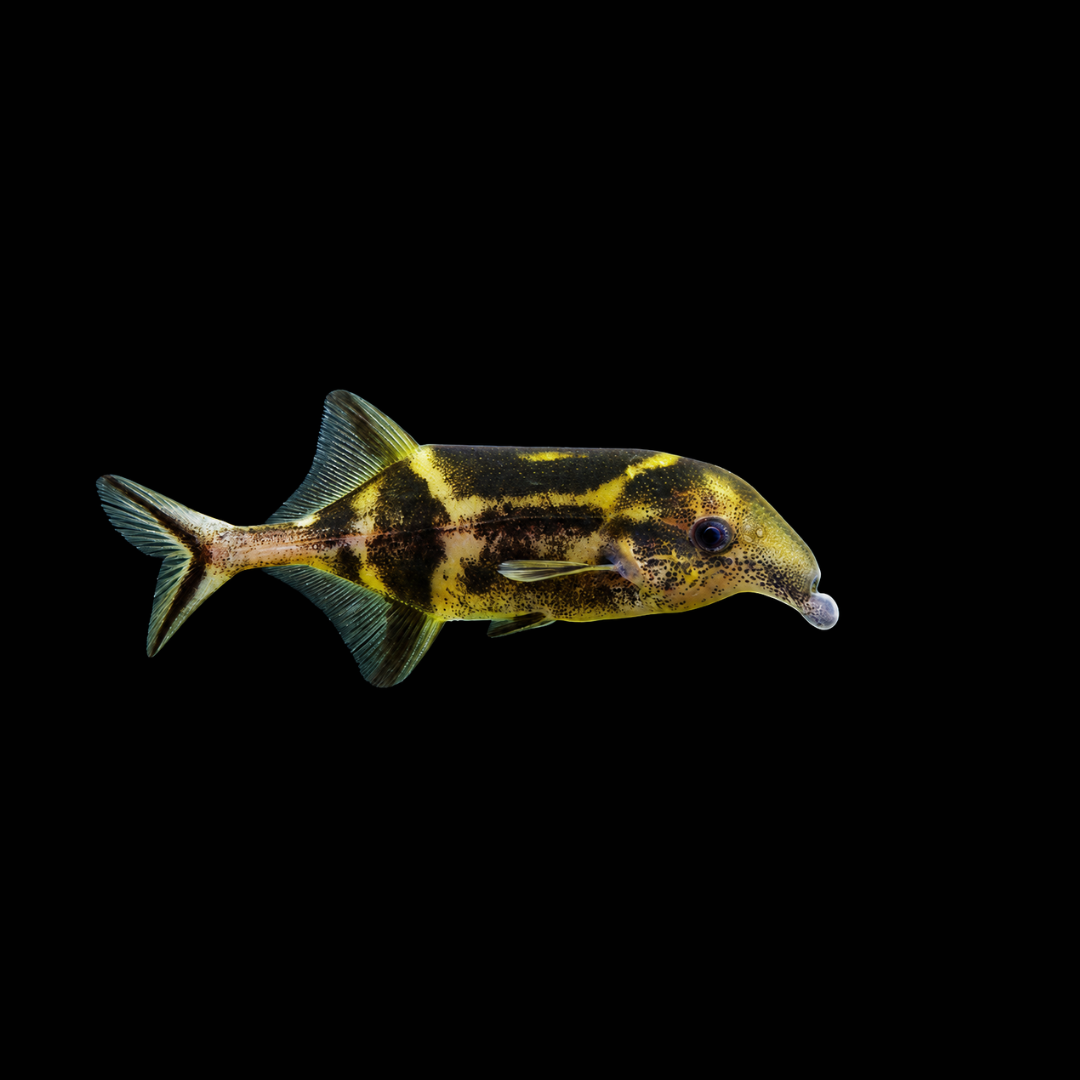
解説 / Description
ダブルトランクエレファントは、日本の観賞魚流通でCampylomormyrus tamanduaに用いられる通称です。西アフリカから中央アフリカの淡水域に分布するモルミルス科の弱電気魚で、下向きに湾曲した細長い吻と、幼魚期に目立つ淡色の帯模様を備えています。尾柄部の発電器官から弱い電気パルスを放ち、体表の電気受容器で周囲の電場の変化を読み取るため、濁りや暗さで視界が限られる環境でも、障害物や餌の位置を探ることができます。砂底を丹念に調べる行動と、静かな水槽内で見せる独特の存在感が大きな魅力です。 Double Trunk Elephantnose is a Japanese aquarium-trade name used for Campylomormyrus tamandua. This weakly electric mormyrid occurs in fresh waters of West and Central Africa and is distinguished by a slender, downward-curving snout and pale banded markings that are most conspicuous in juveniles. A specialized electric organ in the caudal peduncle emits weak pulses, while electroreceptors in the skin detect distortions in the surrounding field. This enables the fish to locate objects and food where turbidity or darkness limits vision. Its deliberate exploration of sandy substrate gives it a distinctive and quietly compelling presence in the aquarium.
基本情報 / Basic Information
| 学名 / Scientific Name | Campylomormyrus tamandua (Günther, 1864) |
|---|---|
| 通称 / Common Name | ダブルトランクエレファント、ダブルトランクエレファントノーズ、カンピロモルミルス・タマンドゥアDouble Trunk Elephantnose, Tamandua elephantnose |
| 分類 / Family | 条鰭綱・アロワナ目・モルミルス科・カムピロモルミルス属Class Actinopterygii, Order Osteoglossiformes, Family Mormyridae, Genus Campylomormyrus |
| 英名 / English Name | Wormjawed mormyrid |
| 分布 / Distribution | 西アフリカから中央アフリカ。ヴォルタ川、ニジェール川、チャド湖・シャリ川水系、コンゴ川水系など。West and Central Africa, including the Volta, Niger, Lake Chad–Chari, and Congo drainage systems. |
| 最大体長 / Max Size | 公表されている最大値は標準体長約43cmです。小型個体で流通することが多くても、飼育設備は最大サイズを見込んで準備します。The published maximum is approximately 43 cm standard length. Even when purchased as a small juvenile, the aquarium should be planned around its potential adult size. |
| 寿命 / Lifespan | 本種に限定した信頼できる寿命資料は確認されていません。特定の年数を断定せず、成魚サイズに対応する設備と長期管理を前提に迎える魚です。No reliable species-specific lifespan has been established. Rather than assuming a fixed number of years, keepers should plan for long-term care in an adult-sized aquarium. |
飼育環境 / Aquarium Environment
| 水槽サイズ / Tank Size | 幼魚期は90cm規格水槽で管理できますが、長期飼育では120cm規格水槽(幅120×奥行45cm程度)以上を推奨します。可能であれば奥行き60cmの120cmワイド水槽を用意し、底面積と旋回スペースに余裕を持たせます。ペアや少数群での飼育には向きません。Juveniles can be managed temporarily in a standard 90 cm aquarium, but a standard 120 cm tank with a footprint of about 120 × 45 cm or larger is recommended for long-term care. A 120 cm wide-format tank with a 60 cm depth is preferable when possible. Pairs and small groups are not recommended. |
|---|---|
| 水温 / Temperature | 23〜26℃を中心に安定させます。生息環境の資料では22〜24℃が示されており、28℃前後の高温を長期間続けると溶存酸素が低下しやすいため避けます。急変を防ぎ、ヒーターにはカバーを装着します。Maintain a stable temperature mainly between 23 and 26°C. Habitat summaries list approximately 22–24°C, and prolonged temperatures around 28°C should be avoided because dissolved oxygen declines as water warms. Prevent rapid changes and fit the heater with a guard. |
| 水質 / Water Quality | 弱酸性から中性の軟水が適し、目安はpH5.5〜7.0、総硬度5dH以下です。アンモニアと亜硝酸を検出させず、硝酸塩の蓄積も定期換水で抑えます。モルミルス類では大きな脳と酸素需要の関係が比較研究で示されているため、本種の種固有の限界値は不明でも、十分なエアレーションと水面の撹拌を維持するのが安全です。Soft, slightly acidic to neutral water is appropriate, with a practical target of pH 5.5–7.0 and total hardness below 5 dH. Keep ammonia and nitrite undetectable and control nitrate through regular water changes. Comparative studies of mormyrids link relative brain size with oxygen demand; although a species-specific threshold is not known for this fish, strong aeration and surface movement are prudent. |
| レイアウト / Layout | 底床には角のない細かな砂を用います。砂と石を比較した行動実験では本種が砂を選好したため、吻を差し込んで探索できる砂地を広く残すことが、行動面でも重要です。流木や滑らかな筒状シェルターで複数の暗がりを作り、照明は控えめにします。吻や体側が挟まる狭い隙間、鋭い石、粗い砂利は避けます。Use fine, rounded sand. In a controlled choice experiment, this species preferred sand to stones, so leaving broad sandy areas where the snout can probe the substrate is important for natural behavior. Provide several dim shelters using driftwood or smooth tubes, and keep lighting subdued. Avoid sharp rocks, coarse gravel, and narrow gaps that could trap or abrade the snout and body. |
| 注意点 / Precautions | 導入直後は、呼吸、吻の傷、腹部の痩せ、摂餌の有無を毎日確認します。高温、酸欠、急な水質変化、餌競争が重なると状態を崩しやすいため、停電時のエアレーションも準備しておくと安心です。薬剤耐性に関する種固有の定量データは乏しく、「常に半量」といった一律の方法には根拠がありません。治療時は隔離水槽を用い、製品表示と専門家の助言に従います。After introduction, check breathing, the condition of the snout, abdominal fullness, and feeding every day. Heat, oxygen shortage, abrupt water changes, and food competition can combine to cause rapid decline, so emergency aeration for power failures is advisable. Quantitative species-specific medication tolerance data are scarce, and there is no sound basis for a universal “half-dose” rule. Use a hospital tank and follow product guidance and specialist advice. |
餌と給餌 / Feeding
| 餌の種類 / Diet | 野生下では水生昆虫の幼虫を中心とする底生無脊椎動物を利用し、胃内容物から有機物や砂泥も確認されています。飼育下では冷凍赤虫、衛生的に管理されたイトミミズ、小型の甲殻類、刻んだミミズなどを組み合わせます。沈下性の人工飼料を食べる個体もいるため、栄養の偏りを避ける目的で少しずつ慣らします。In nature it feeds mainly on benthic invertebrates such as aquatic insect larvae, while organic matter and sand or mud have also been recorded in stomach contents. In captivity, combine frozen bloodworms, hygienically cultured tubifex, small crustaceans, and chopped earthworms. Some individuals accept sinking prepared diets, which can be introduced gradually to broaden nutrition. |
|---|---|
| 給餌のポイント / Feeding Tips | 薄暮から消灯後に、底へ沈む餌を個体の近くへ届けます。スポイトや給餌管を使うと、臆病な個体にも確実に与えやすくなります。量よりも実際に飲み込んだかを確認し、残餌は早めに回収します。腹部が落ちる、隠れたまま出てこない、餌を追わないといった変化があれば、餌の種類だけでなく、水質、酸素、混泳相手からの圧力も見直します。Offer sinking food near the fish from dusk to after lights-out. A pipette or feeding tube helps timid individuals receive food reliably. Confirm that the fish actually swallows the food rather than judging only by the amount offered, and remove leftovers promptly. A sunken abdomen, persistent hiding, or failure to pursue food should prompt checks of water quality, oxygenation, and pressure from tank mates as well as diet. |
性格と混泳 / Temperament and Tank Mates
| 性格 / Temperament | 他科の魚に対しては比較的穏やかですが、同種や近縁のモルミルス類には追尾や小競り合いが起こりやすく、特にペアや少数群では一方が継続的に追われる危険があります。基本は単独飼育が扱いやすく、活発になるのは主に薄暮から夜間です。It is generally peaceful toward unrelated fishes, but chasing and repeated disputes are common among conspecifics and closely related mormyrids. In pairs or small groups, one individual may be persistently targeted. Solitary housing is therefore the most manageable approach, and activity is greatest from dusk through the night. |
|---|---|
| 混泳の相性 / Compatibility | 混泳させる場合は、同程度の水質を好み、攻撃性が低く、餌を独占しない中上層魚を選びます。動きの速い大食漢、ヒレや吻をつつく魚、夜間に同じ底層を強く占有する魚、大きな口で本種を飲み込める魚は避けます。大型水槽で多数を飼う方法が紹介されることもありますが、10尾以上を収容できる非常に大きな設備と多くの隠れ家が必要な上級者向けの管理です。Choose calm mid- or upper-water fishes that share similar water requirements and do not monopolize food. Avoid fast, voracious feeders, fin- or snout-nippers, strongly territorial nocturnal bottom dwellers, and predators capable of swallowing this fish. Very large groups are sometimes maintained, but this requires a genuinely large system, numerous shelters, and enough space for at least ten individuals, making it an advanced option rather than a routine recommendation. |
病気と対策 / Diseases and Prevention
| かかりやすい病気 / Common Diseases | 本種だけに特有の主要疾病は確立されていません。飼育下では、粗い底床や輸送による吻・体表の擦過傷、その傷に続く細菌・真菌の二次感染、野生採集個体が持ち込む外部寄生虫、餌不足による痩せ、酸素不足による呼吸促迫に注意します。白点病など一般的な淡水魚の疾病にも罹患します。No major disease unique to this species has been established. Captive risks include abrasions of the snout or skin from transport or rough substrate, secondary bacterial or fungal infection, external parasites introduced with wild-caught fish, emaciation from inadequate feeding, and rapid breathing associated with low oxygen. It can also contract common freshwater fish diseases such as ich. |
|---|---|
| 対策と予防 / Prevention | 新規個体は隔離して、摂餌と排泄、呼吸、吻の先端、体表を観察します。細かな砂、滑らかな隠れ家、十分な酸素、急変のない軟水を維持し、食べ残しを残さないことが予防の中心です。治療が必要な場合は原因を推測だけで決めず、可能なら顕微鏡検査や魚類診療に対応する獣医師の判断を受けます。薬浴中も酸素供給を強め、魚の反応を継続して確認します。Quarantine new fish and monitor feeding, waste production, breathing, the snout tip, and the skin. Fine sand, smooth shelters, ample oxygen, stable soft water, and prompt removal of uneaten food form the core of prevention. When treatment is needed, avoid diagnosing by appearance alone; microscopic examination or advice from a veterinarian experienced with fish is preferable. Increase aeration during medication and observe the fish continuously. |
増やし方(繁殖) / Breeding
| 雌雄の判別 / Sexing | 幼魚の外見から確実に判別するのは困難です。成熟個体ではメスの腹部が丸みを帯びることや、雌雄で尻鰭の輪郭が異なることが飼育・繁殖施設から報告されていますが、個体差があり、一般の販売サイズでは決め手になりません。Reliable visual sexing of juveniles is difficult. Breeding facilities report that mature females may become fuller-bodied and that the outline of the anal fin can differ between sexes, but individual variation is considerable and these traits are not dependable in typical sale-sized fish. |
|---|---|
| 繁殖形態 / Reproduction | 卵生です。研究施設では採卵、人工受精、仔魚育成が行われ、C. tamanduaのオスとC. compressirostrisのメスから得たF1雑種が成熟後に自然産卵し、繁殖能力を持つことも確認されています。観賞魚流通ではインドネシア繁殖由来とされる個体が扱われていますが、家庭水槽で再現できる標準的な繁殖手順は確立されていません。It is egg-laying. Research facilities have carried out egg collection, artificial fertilization, and larval rearing. F1 hybrids produced from a male C. tamandua and a female C. compressirostris later spawned naturally and were shown to be fertile. Fish sold as Indonesian captive-bred are present in the ornamental trade, but there is no standardized breeding protocol readily reproducible in a home aquarium. |
| 繁殖のポイント / Breeding Tips | 繁殖を試みるには、確実に雌雄をそろえた成熟魚、少数飼育による攻撃を避けられる大規模な設備、水質と給餌を精密に管理できる環境、採卵・人工受精および卵と仔魚を分離して育成する設備が必要です。研究例は高度に管理された条件での成果であり、単に水温を変えたり複数個体を同居させたりするだけでは再現できません。Breeding attempts require reliably sexed adults, a large system that avoids the aggression typical of small groups, precise control of water quality and feeding, and facilities for egg collection, artificial fertilization, and separate rearing of eggs and larvae. Published success comes from highly managed research conditions and cannot be reproduced simply by changing temperature or placing several adults together. |
雑学と豆知識 / Trivia and Fun Facts
| 1. 1864年に記載されたタマンドゥア / 1. The “Tamandua” Described in 1864 | 本種は1864年にアルベルト・ギュンターによってMormyrus tamanduaとして記載されました。タイプ産地は西アフリカのニジェール川で、ホロタイプはロンドン自然史博物館に収蔵されています。種小名のtamanduaはアリクイ類を連想させる名で、下向きに伸びた吻の姿が学名にも刻まれています。その後、分類上の位置づけが見直され、現在はCampylomormyrus属の有効種として扱われています。Albert Günther described the species in 1864 as Mormyrus tamandua. The type locality is the Niger River in West Africa, and the holotype is held by the Natural History Museum in London. The name tamandua evokes anteaters and reflects the fish’s downward-projecting snout. Later taxonomic revisions placed it in the valid genus Campylomormyrus. |
|---|---|
| 2. 学術英名と日本の流通名 / 2. Scientific and Trade Names | 日本では「ダブルトランクエレファント」の名が定着していますが、国際的な魚類データベースではWormjawed mormyridという英名が用いられています。観賞魚名は地域や業者によって別種にも似た呼び名が使われることがあるため、購入時はCampylomormyrus tamanduaという学名まで確認すると取り違えを防ぎやすくなります。In Japan, “Double Trunk Elephantnose” is a well-established trade name, whereas international fish databases use the English name Wormjawed mormyrid. Aquarium names can vary between regions and may be applied inconsistently to similar species, so confirming the scientific name Campylomormyrus tamandua helps prevent misidentification. |
| 3. 約0.32ミリ秒の電気的な「声」 / 3. An Electrical “Voice” of About 0.32 Milliseconds | 本種の電気器官放電は、平均約0.32ミリ秒の短い三相性パルスとして報告されています。最初に小さな頭部負極性の成分が現れ、その後に主要な正極性・負極性成分が続きます。同属には数十ミリ秒に達する放電を持つ種もいるため、人の目には似た姿でも、電気信号の時間構造は大きく異なります。放電は探索だけでなく、個体間の通信にも使われます。The electric organ discharge has been reported as a brief, mainly triphasic pulse averaging about 0.32 milliseconds. A small head-negative component precedes the main positive and negative phases. Other species in the genus produce signals lasting tens of milliseconds, so visually similar fishes can have very different temporal signal structures. These discharges serve both electrolocation and communication. |
| 4. 三つの受容器系が情報を分担する / 4. Three Electroreceptor Systems Share the Work | モルミルス類の体表には、能動的な電気定位に関わるモルミロマスト、他個体の放電を受け取るクノレンオルガン、低周波の外来電場を感知するアンプラ型受容器という主要な受容器系があります。周囲の物体を調べる働きと、仲間の信号を受け取る働きが別々の経路で処理されることで、視界の乏しい環境でも複雑な行動が可能になります。Mormyrids possess major receptor systems including mormyromasts for active electrolocation, Knollenorgans for receiving the discharges of other fish, and ampullary receptors for low-frequency external fields. Separating object analysis from social signal reception allows complex behavior even where visual information is limited. |
| 5. 砂底への好みは実験で確かめられた / 5. Sand Preference Has Been Tested Experimentally | 砂と石を選べる実験水槽では、比較的短い吻を持つC. tamanduaが砂側で有意に長く過ごし、砂を探る行動も多く示しました。対照的に、吻の長いC. rhynchophorusは石側を選びました。この結果は、吻の形が異なる底質での採餌に関係している可能性を支持します。ただし、自然界での餌種や放電波形との機能的な結びつきには、なお検証すべき点が残されています。In a choice experiment between sand and stones, the relatively short-snouted C. tamandua spent significantly more time over sand and probed it more often. The long-snouted C. rhynchophorus, by contrast, preferred stones. The result supports a relationship between snout form and foraging substrate, although links with natural prey and discharge waveform remain incompletely resolved. |
| 6. 「水を噴射する」より正確な表現 / 6. A More Accurate Description Than “Jetting Water” | 細長い吻で底質から餌を取り出す方法は、研究ではgrasp-suction feeding、つまり吻で対象に近づき吸引して取り込む特殊な採餌様式として説明されています。吻先からジェット水流を噴射して砂を吹き飛ばすという種固有の行動は、今回確認した文献では裏付けられませんでした。水槽では細かな砂を用意し、吻を差し込んで探る本来の動きを妨げないことが大切です。Its specialized method of removing prey from the substrate is described in research as grasp-suction feeding: the tubular snout approaches and captures prey using suction. The species-specific claim that it shoots a jet of water from the snout to blast away sand was not supported by the sources checked. Fine sand allows the fish to perform its natural probing behavior without obstruction. |
| 7. 大きな脳には代謝上の費用がある / 7. A Large Brain Carries an Energetic Cost | モルミルス科は、電気感覚情報を処理する小脳系が著しく発達した魚として知られています。複数種を比較した研究では、相対的に大きな脳を持つ種ほど酸素消費が高く、低酸素への耐性が低い傾向が示されました。これは本種だけを測定して導いた単純な飼育基準ではありませんが、十分な酸素供給を重視し、高温と水質悪化を重ねないという管理方針を支える知見です。Mormyrids are known for extensive development of cerebellar regions involved in electrosensory processing. A comparative study across several species found that greater relative brain size was associated with higher oxygen demand and lower hypoxia tolerance. This does not provide a simple species-specific threshold for C. tamandua, but it supports husbandry that prioritizes oxygenation and avoids the combination of heat and deteriorating water quality. |
| 8. 交雑実験が示す進化の余地 / 8. Hybrid Experiments Reveal Evolutionary Potential | C. tamanduaのオスとC. compressirostrisのメスから作られたF1雑種は、成熟後に自然産卵を行い、F2世代を残せる繁殖能力を示しました。近縁種間の生殖障壁が実験条件では完全ではないことを示す興味深い結果です。ただし、この成果だけで自然界における古代の交雑や遺伝子浸透が証明されたわけではなく、野生集団での検証は別に必要です。F1 hybrids produced from a male C. tamandua and a female C. compressirostris later spawned naturally and produced an F2 generation, showing that reproductive barriers between these relatives are incomplete under experimental conditions. This result is highly informative, but it does not by itself prove ancient hybridization or introgression in wild populations; those questions require separate population-level evidence. |
| 9. 幼魚の模様は成長とともに薄れる / 9. Juvenile Markings Fade with Growth | 幼魚では背鰭と尻鰭の前方を結ぶような暗色帯と、その両側の淡色域が目立ちます。魚類資料では、この模様は体長20cmを超える個体で消失すると記載されています。成長した個体ほど全身が暗色にまとまりやすいため、幼魚時の鮮やかな模様が薄くなることは、直ちに体調不良を意味するものではありません。Juveniles display a dark band between the front of the dorsal and anal fins, bordered by paler areas. Fish references report that this pattern disappears in individuals over about 20 cm. Older fish therefore tend to become more uniformly dark, and loss of the juvenile pattern does not necessarily indicate poor health. |
まとめ / Conclusion
ダブルトランクエレファントの魅力は、長く湾曲した吻の奇抜さだけではありません。砂底へ静かに吻を差し込み、自ら発した微弱な電気を手掛かりに周囲を読み取る姿には、濁ったアフリカの河川で生き抜いてきた感覚と形態の進化が表れています。幼魚の帯模様が成長とともに落ち着いた暗色へ変わる過程も、長く付き合うほど味わいが増す本種ならではの変化です。 The appeal of the Double Trunk Elephantnose extends far beyond its unusual curved snout. Its quiet probing of sand and its use of self-generated electrical pulses reveal an evolutionary history shaped by life in turbid African rivers. The gradual change from a patterned juvenile to a darker, more uniform adult also gives the fish a character that becomes more rewarding over years of careful observation.
健やかに維持するには、成魚を収容できる広い水槽、吻を傷つけない細かな砂、薄暗い隠れ場所、清浄な軟水、そして十分な酸素が欠かせません。消灯後の摂餌を一尾ずつ確認し、同種間の争いと他魚による餌の横取りを避けることで、本来の落ち着いた探索行動が現れやすくなります。目立つ派手さよりも、環境を読みながら慎重に動く姿を楽しむ魚であり、飼育者の丁寧な観察に静かに応えてくれる存在です。 Successful long-term care depends on an adult-sized aquarium, fine sand that protects the snout, dim shelters, clean soft water, and dependable oxygenation. Confirming each feeding after lights-out and preventing both conspecific conflict and food theft by tank mates allow its natural exploratory behavior to emerge. This is not a fish defined by constant spectacle, but by subtle movement and sensory precision—a species that rewards attentive, patient husbandry.
分布マップ
西アフリカから中央アフリカに広く分布し、ヴォルタ川、ニジェール川、チャド湖・シャリ川水系、コンゴ川水系などで知られます。地図は掲載された水系をまとめた概略表示で、マーカーは実際の採集地点ではありません。
この地図の範囲とマーカーは、記事に記載された広域分布を把握するための概略表示です。実際の採集地点、個体群の位置、厳密な生息範囲、河川内の連続分布を示すものではありません。
参考文献・根拠資料
ダブルトランクエレファント(Campylomormyrus tamandua)の分類、分布、生息環境、食性、底質選好、酸素管理、繁殖研究、病気の予防と治療上の注意を確認するために使用した資料です。観賞魚店、通信販売サイト、個人ブログ、一般的なまとめサイトは含めず、原記載、学術データベース、査読論文、大学および獣医学機関の資料に限定しています。
資料の読み方:本種の学名、分布、最大体長、水温・pHの掲載範囲、砂底への選好、野生下の食性、繁殖実験には種固有の根拠があります。一方、120cm水槽という推奨寸法、具体的な給餌回数、混泳構成、薬剤の安全濃度について、本種だけを対象とした比較試験は確認されていません。これらは最大体長や行動特性、モルミルス科の酸素生理、一般的な魚類医療の原則を組み合わせた飼育上の判断です。
-
原記載・分類史
1. Günther, A. (1864). Description of a new species of Mormyrus. Proceedings of the Zoological Society of London, 1864, p.22, Pl.2.
原記載名Mormyrus tamandua、形態記載、種小名の由来を確認する一次資料。
Biodiversity Heritage Libraryで閲覧 -
分類・タイプ標本
2. Fricke, R., Eschmeyer, W. N. & Van der Laan, R. (eds.). Eschmeyer’s Catalog of Fishes: Campylomormyrus tamandua.
現在の有効学名、モルミルス科への所属、原記載、タイプ産地、ホロタイプ番号を確認する分類学データベース。
California Academy of Sciencesで閲覧 -
分布・生息環境・最大体長
3. Froese, R. & Pauly, D. (eds.). FishBase: Campylomormyrus tamandua(Wormjawed mormyrid).
ヴォルタ川、ニジェール川、チャド湖・シャリ川、コンゴ川水系への分布、淡水底生性、最大標準体長43cm、掲載水温22〜24℃、pH5.0〜7.0、硬度5dH以下、幼魚斑紋などの基礎情報。
FishBaseで閲覧 -
野生下の食性
4. Nwani, C. D., Eyo, J. E. & Udeh, E. F. (2006). Food and feeding habits of Campylomormyrus tamandua in Anambra River, Nigeria. Animal Research International, 3(1), 410–414.
ナイジェリアのアナンブラ川で採集した個体の胃内容物を調べ、底生・陸生由来の無脊椎動物を中心とする食性を検討した種固有の研究。
DOI: 10.4314/ari.v3i1.40760 -
底質選好・吻形態
5. Amen, R., Nagel, R., Hedt, M. et al. (2020). Morphological differentiation in African weakly electric fish (genus Campylomormyrus) relates to substrate preferences. Evolutionary Ecology, 34, 427–437.
砂と石を用いた選択実験で、C. tamanduaが砂底を有意に選び、砂上で探索行動を多く示したことを報告。細かな砂を広く確保する飼育提案の主要根拠。
DOI: 10.1007/s10682-020-10043-3 -
酸素需要・低酸素への注意
6. Sukhum, K. V., Freiler, M. K., Wang, R. & Carlson, B. A. (2016). The costs of a big brain: extreme encephalization results in higher energetic demand and reduced hypoxia tolerance in weakly electric African fishes. Proceedings of the Royal Society B, 283, 20162157.
複数のモルミルス科魚類を比較し、相対的な脳サイズ、酸素消費量、低酸素耐性の関係を検討した研究。本種単独の限界値ではないため、十分な通気を重視する補助根拠として使用。
DOI: 10.1098/rspb.2016.2157 -
繁殖誘導・発生
7. Nguyen, M. D. L., Paul, C., Mamonekene, V., Bartsch, P., Tiedemann, R. & Kirschbaum, F. (2017). Reproduction and development in some species of the weakly electric genus Campylomormyrus (Mormyridae, Teleostei). Environmental Biology of Fishes, 100, 49–68.
飼育下のCampylomormyrus属で、導電率の変化による生殖周期の誘導、ホルモン処理、人工授精、卵・仔魚の発生を検討した研究。家庭水槽での再現が容易でないことを示す根拠。
DOI: 10.1007/s10641-016-0554-1 -
交雑・F1の稔性
8. Korniienko, Y., Nguyen, L., Baumgartner, S. et al. (2020). Intragenus F1-hybrids of African weakly electric fish (Mormyridae: Campylomormyrus tamandua ♂ × C. compressirostris ♀) are fertile. Journal of Comparative Physiology A, 206, 571–585.
交雑F1が成熟し、自然産卵を行ってF2世代を生じたことを報告した種固有の繁殖研究。野生下での交雑を直接証明する資料ではない点に注意。
DOI: 10.1007/s00359-020-01425-7 -
水質悪化・酸欠・窒素化合物
9. Francis-Floyd, R., Yanong, R. P. E. & Petty, B. D. (2023; updated 2024). Environmental Diseases of Aquatic Animals in Aquatic Systems. Merck Veterinary Manual.
低溶存酸素、アンモニア、亜硝酸、塩素、温度変動など、飼育環境に由来する疾病と水質管理を扱う査読済み獣医学資料。アンモニアと亜硝酸を検出させず、通気と生物ろ過を維持する一般原則の根拠。
Merck Veterinary Manualで閲覧 -
外傷・細菌・水生菌・診断
10. Francis-Floyd, R., Stilwell, N. K. & Yanong, R. P. E. Introduction to Fish Health Management. UF/IFAS Extension, University of Florida.
粗い取り扱いや外傷を入口とする日和見細菌感染、損傷組織への水生菌の二次感染、病気発生時に最初に水質を確認する原則を解説。吻や体表の擦過傷を防ぐ注意点の根拠。
UF/IFAS Extensionで閲覧 -
白点病・隔離・薬剤使用
11. Francis-Floyd, R., Yanong, R. P. E. & Pouder, D. B. Ichthyophthirius multifiliis (White Spot) Infections in Fish. UF/IFAS Extension, University of Florida.
白点病の生活環、導入魚の隔離、治療を複数回行う必要性、魚種・水質・飼育設備に応じて薬剤を選ぶ原則を解説。低アルカリ度では銅が強い毒性を示し得るため、一律の薬量変更を避ける注意点にも対応。
UF/IFAS Extensionで閲覧
最終確認日:2026年7月29日。オンラインデータベースは更新されるため、分類や保全状況を引用する際はリンク先の更新日も確認してください。




コメント