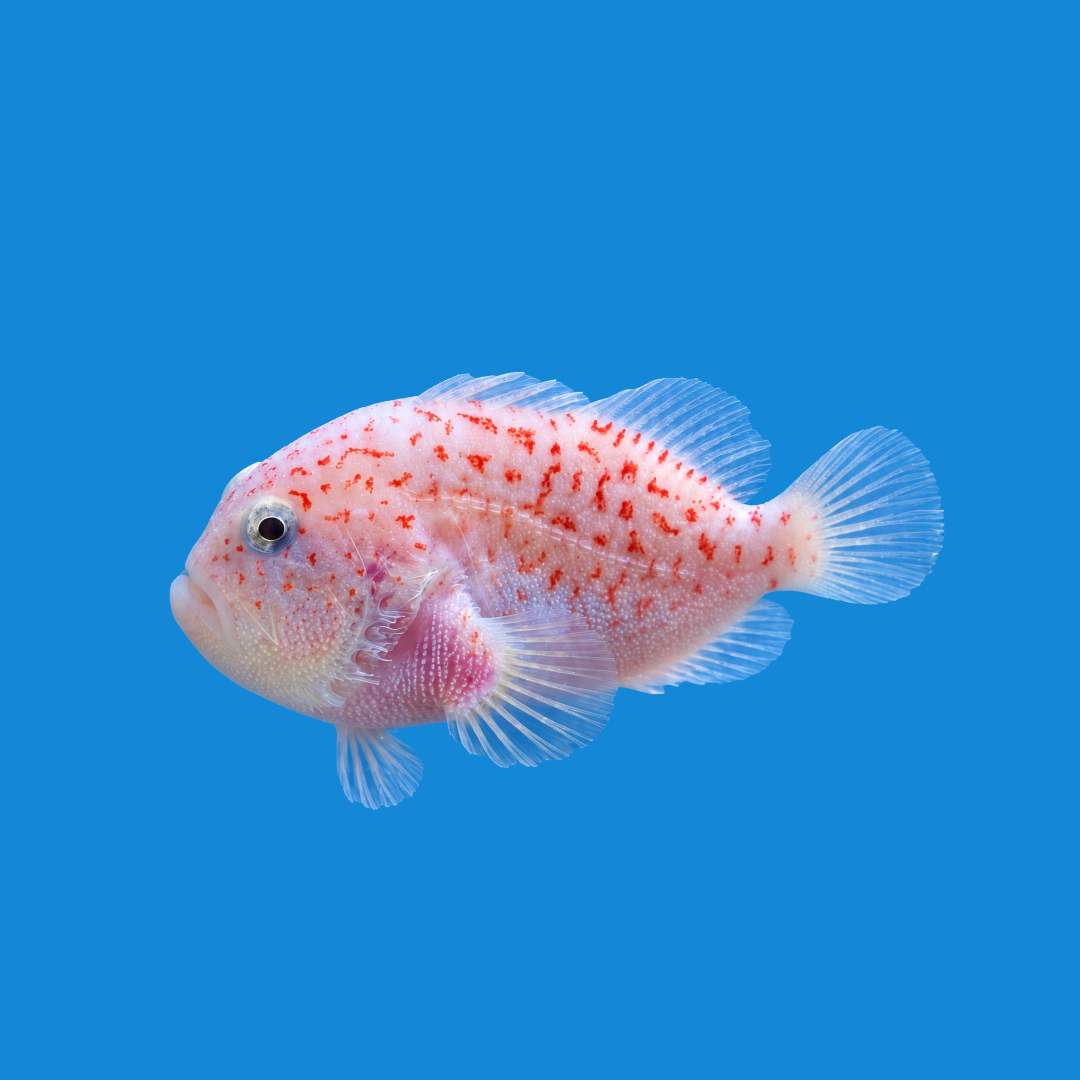
ダンゴオコゼは、サンゴの枝と枝の間に身を寄せて暮らす、小型の海水魚です。丸みのある体は左右に薄く、淡い灰色から褐色の体に赤褐色の細かな斑点が散らばります。体表には微小な突起が密生しており、近くで見るとビロードを思わせる質感があります。水槽を活発に泳ぎ回る魚ではなく、隠れ家から顔をのぞかせたり、胸びれを使って枝間を移動したりする姿が魅力です。飼育では、落ち着ける隠れ家と、一匹ずつ確実に餌を食べられる環境が大切になります。背びれに毒棘があるため、日常の作業でも直接触れないように注意してください。The spotted coral croucher is a small marine fish that lives among coral branches. Its rounded body is compressed from side to side, with fine reddish-brown spots over a pale gray to brown background. Tiny projections densely cover the skin, giving it a velvety appearance. Rather than swimming constantly through open water, it peeks out of shelter and moves between branches using its pectoral fins. Successful care depends on secure shelter and ensuring that each fish receives enough food. Its dorsal fin has venomous spines, so avoid direct contact during routine maintenance.
東インド洋から西部・中部太平洋の熱帯・亜熱帯域。日本では琉球列島などで見られ、浅いサンゴ礁の枝状サンゴに生息します。Tropical and subtropical waters from the eastern Indian Ocean through the western and central Pacific. In Japan, it occurs in the Ryukyu Islands and other southern localities, inhabiting branching corals on shallow reefs.
最大体長 / Max Size
全長約5cm。Approximately 5 cm in total length.
寿命 / Lifespan
野外・飼育下ともに、寿命の目安を示せる十分な情報はありません。There is insufficient reliable information to provide a typical lifespan in the wild or in captivity.
飼育環境 / Aquarium Environment
水槽サイズ / Tank Size
単独飼育でも、水温や塩分の安定を重視し、60cm規格水槽(約60L、幅60×奥行30×高さ36cm)を目安にすると管理しやすくなります。45cm規格水槽(約35L、幅45×奥行30×高さ30cm)では、蒸発や給餌に伴う水質変化への、より細かな対応が必要です。水量は満水時の概算で、底砂や岩を入れた実際の水量は少なくなります。Even for a single fish, a standard Japanese 60 cm aquarium, approximately 60 L at 60 × 30 × 36 cm, is a practical choice for maintaining stable temperature and salinity. A standard 45 cm aquarium, approximately 35 L at 45 × 30 × 30 cm, requires closer attention to evaporation and feeding-related water quality changes. These are approximate full capacities; substrate and rock reduce the actual water volume.
水温 / Temperature
飼育管理の目安は24~26℃です。同居するサンゴの適温にも合わせ、急な温度変化や夏場の高水温を避けます。この範囲は飼育上の目安であり、本種が耐えられる水温の上限・下限を示すものではありません。A practical husbandry target is 24–26°C. Also consider the requirements of any corals, and avoid abrupt temperature changes or summer overheating. This range is a management guideline, not an established upper or lower tolerance limit for the species.
水質 / Water Quality
清浄で酸素が十分に行き渡る海水を保ちます。サンゴとの飼育を想定した管理の目安は、塩分33~35‰、比重約1.025~1.026(25℃付近)、pH8.1~8.4です。アンモニアと亜硝酸が検出されない、ろ過の安定した水槽に導入してください。蒸発した分は真水で補い、換水には水槽と水温・塩分を合わせた人工海水を使用します。サンゴを飼育する場合は、炭酸塩硬度やカルシウムなどの管理も必要です。Maintain clean, well-oxygenated seawater. Practical targets for a coral aquarium are salinity 33–35 ppt, specific gravity approximately 1.025–1.026 near 25°C, and pH 8.1–8.4. Introduce the fish into an established aquarium with undetectable ammonia and nitrite. Replace evaporated water with freshwater, and match the aquarium’s temperature and salinity when changing seawater. Corals also require appropriate alkalinity and calcium management.
レイアウト / Layout
体を隠せる枝間や狭い隙間を用意します。自然下ではハナヤサイサンゴ類などの枝状サンゴに暮らすため、こうした隠れ場所を中心に環境を整えましょう。生きたサンゴを導入する場合は、そのサンゴに適した照明・水流・水質を維持できることが前提です。岩組みは崩れないように固定し、魚が落ち着ける場所と、スポイトで餌を届けられる経路を確保します。水槽全体に水を循環させつつ、隠れ家にポンプの強い水流が直接当たり続けないようにしてください。Provide branching shelter and narrow crevices. In nature, this fish lives within branching corals such as Pocillopora, so suitable refuges should be central to the layout. Live corals require appropriate lighting, flow, and water chemistry. Secure rockwork against collapse and arrange shelter so that the fish can settle while remaining accessible for pipette feeding. Maintain circulation throughout the aquarium without directing a continuous powerful jet into its refuge.
注意点 / Precautions
背びれの毒棘に注意し、素手でつかまないでください。サンゴや岩を動かす前に居場所を確認し、移動には硬い容器を使います。隠れ家から無理に引き出すことは避けましょう。網には棘が絡むことがあります。刺された場合は作業を中止し、医療機関に相談してください。また、姿が見えにくい魚なので、毎日の給餌時に所在、呼吸の様子、腹部が痩せていないかを確認します。Avoid the venomous dorsal spines and never grasp the fish with bare hands. Locate it before moving coral or rock, and use a rigid container for transfers. Do not forcibly pull it from shelter. Its spines may become caught in a net. If stung, stop work and seek medical advice. Because this fish is easily overlooked, check its location, breathing, and abdominal condition during daily feeding.
餌と給餌 / Feeding
餌の種類 / Diet
小型甲殻類などを食べる肉食性です。飼育下では、口に入る大きさの冷凍アミ類、栄養強化したブラインシュリンプ、細かく刻んだエビやアサリなどを組み合わせます。冷凍餌を食べない個体には、イサザアミなどの小型の生きた甲殻類を試し、まず摂餌を確認します。人工飼料への餌付きには個体差があるため、人工飼料だけで飼育できることを前提に迎えないようにしてください。A carnivore feeding on small crustaceans and other small prey. Offer suitably sized frozen mysids, enriched brine shrimp, and finely chopped shrimp or clam in rotation. Small live crustaceans, such as live mysids, may help establish feeding in fish that refuse frozen food. Acceptance of prepared diets varies, so do not acquire this fish on the assumption that dry food alone will be sufficient.
給餌のポイント / Feeding Tips
1日1~2回を目安に、少量ずつ口元の近くへ届け、食べた量や体つきに応じて調整します。スポイトの先で追い回したり、餌を顔へ強く吹き付けたりせず、隠れ家の入口にゆっくり流してください。餌が流される場合は一時的に水流を弱め、給餌後に必ず戻します。餌を入れるだけで済ませず、飲み込むところまで確認しましょう。他魚に奪われる場合は給餌場所を分け、残餌は取り除きます。Start with small portions once or twice daily, adjusting to actual intake and body condition. Gently release food close to the mouth near the shelter entrance, rather than chasing the fish with a pipette or blasting food at its face. Briefly reduce flow if necessary and restore it afterward. Confirm that the food is swallowed. Feed competing fish elsewhere and remove leftovers.
性格と混泳 / Temperament and Tank Mates
性格 / Temperament
隠れ家への依存が強く、開けた場所にはあまり出てきません。他魚を活発に追い回すタイプではありませんが、口に入る小さな生き物は捕食対象になります。同種同士では隠れ場所をめぐって争うことがあるため、複数飼育には相性の確認が必要です。A secretive, shelter-dependent fish that rarely ventures into open water. It does not usually chase other fish, but small animals that fit into its mouth may become prey. Individuals can compete for shelter, so compatibility must be monitored when keeping more than one.
混泳の相性 / Compatibility
単独飼育、または餌を奪い合いにくい穏やかな小型魚との組み合わせが管理しやすいでしょう。小型ハゼ類でも、同じ隙間を占有する種類や、口に入るほど小さな個体は避けます。気の強いスズメダイ類、餌取りの速い魚、本種を捕食できる大型魚との同居には向きません。小型エビや稚エビにも捕食の危険があります。サンゴとの同居では、魚が触れる場所でポリプが開かなくなったり、組織が傷んだりしていないかも観察してください。Keeping it alone or with peaceful small fish that do not compete strongly for food is easiest to manage. Even small gobies may be unsuitable if they occupy the same crevices or are small enough to swallow. Avoid aggressive damselfishes, rapid feeders, and fish large enough to eat it. Small shrimp and juvenile shrimp may also be preyed upon. When keeping it with corals, monitor contact areas for persistent polyp retraction or tissue damage.
病気と対策 / Diseases and Prevention
かかりやすい病気 / Common Diseases
海水魚の白点病やウーディニウム病などに注意が必要です。ただし、本種がほかの海水魚より特にかかりやすいと判断できる情報は十分ではありません。給餌不足による痩せ、輸送中や作業中にできた傷、その傷に伴う感染も健康を損なう原因になります。体表の変化だけでなく、呼吸が速くなっていないか、食欲が落ちていないかも確認してください。Watch for marine white spot disease and marine velvet, although there is insufficient evidence that this species is unusually susceptible compared with other marine fish. Inadequate feeding, injuries during transport or maintenance, and secondary infections can also compromise health. Monitor rapid breathing and appetite loss as well as visible skin changes.
対策と予防 / Prevention
導入前には、ろ過が安定し、洗浄できる隠れ家を備えた隔離水槽で、体調と餌付きを確認します。水温・塩分の急変を避け、器具の共用による病原体の持ち込みにも注意してください。異常があれば原因を確認し、必要に応じて魚の診療に対応する獣医師などへ相談します。サンゴやエビがいる水槽へ安易に薬剤を入れず、薬剤を使う場合は対象魚への適否と用法を確認し、別水槽で治療してください。Before introduction, assess health and feeding in an established quarantine tank with cleanable shelter. Avoid abrupt temperature or salinity changes and prevent pathogen transfer through shared equipment. Investigate abnormalities and consult a veterinarian experienced with fish when needed. Do not medicate a coral or invertebrate aquarium indiscriminately. Check whether the treatment is suitable for the fish, follow its instructions, and use a separate treatment tank.
増やし方(繁殖) / Breeding
雌雄の判別 / Sexing
外見だけで雌雄を確実に見分ける実用的な方法は、十分に確立されていません。体の大小だけで判断せず、複数飼育では相性や行動を慎重に観察します。同属の近縁種では、メスからオスへ性転換する「雌性先熟」を支持する生殖腺の特徴が報告されています。ただし、その知見だけで本種の性転換の有無や条件を断定することはできません。A reliable practical method for external sexing is not well established. Size alone is insufficient, and compatibility and behavior require careful observation when keeping multiple fish. Gonadal features supporting protogyny, a change from female to male, have been reported in closely related species of the same genus. Those findings alone do not establish whether, or under what conditions, sex change occurs in C. maculatus.
繁殖形態 / Reproduction
卵生です。近縁種の卵巣構造からは、ゼラチン状の物質に包まれた卵を放出する繁殖様式が示唆されています。一方、本種の自然下での産卵行動や卵の性質には不明な点が残っています。サンゴの枝に卵を産み付けるという説明もありますが、本種の確立した繁殖様式として扱えるだけの情報は十分ではありません。Oviparous. Ovarian structure in related species suggests the release of eggs within a gelatinous matrix. However, natural spawning behavior and egg characteristics in C. maculatus remain incompletely known. Accounts of eggs being laid on coral branches also exist, but the available evidence is insufficient to treat this as an established reproductive pattern for the species.
繁殖のポイント / Breeding Tips
家庭水槽で安定して繁殖させ、仔魚を育てる方法は、十分に確立されていません。まずは親魚が確実に餌を食べ、良好な体調を保てる環境を優先します。複数を飼う場合は離れた隠れ家と退避場所を用意し、相性の悪い個体を無理に同居させないでください。産卵しても育成できるとは限らず、仔魚の回収方法、最初に与える餌の種類や大きさ、水流などには個別の検討が必要です。A reliable home-aquarium method for breeding and larval rearing is not well established. Prioritize consistent feeding and good parental condition. Provide separated shelters and escape routes when keeping multiple fish, and do not force incompatible individuals to coexist. Spawning does not guarantee successful rearing; larval collection, suitable first foods, and water flow all require separate consideration.
雑学と豆知識 / Trivia and Fun Facts
1. 小さな体に残る、分類の歴史 / 1. A Small Fish with a Taxonomic History
ダンゴオコゼは1831年に記載され、当初は現在とは異なる属名を使った Micropus maculatus という学名で呼ばれていました。その後、ダンゴオコゼ属に移され、独立したダンゴオコゼ科にまとめる分類が広く使われてきました。一方、骨格などを詳しく比較した研究では、ダンゴオコゼ属をカサゴ科に含めることが支持されています。丸い体と独特の皮膚からは分かりにくくても、体の内部にはほかのカサゴ類との類縁関係をたどる手掛かりがあるのです。資料によって科名が異なる背景には、こうした分類の変遷や、採用する分類体系の違いがあります。Described in 1831, this fish originally bore the name Micropus maculatus. It was later placed in Caracanthus, a genus long treated within the separate family Caracanthidae. Detailed anatomical comparisons have supported including the genus in Scorpaenidae. Although its rounded body and unusual skin may obscure the resemblance, its internal anatomy provides clues to its relationship with other scorpionfishes. Differences in family names reflect this taxonomic history and the classification system being used.
2. 斑点と背びれに注目すると / 2. Spots and a Notched Dorsal Fin
種小名の maculatus は、ラテン語で「斑点のある」という意味です。体に散らばる赤褐色の点は、学名にも表れた特徴です。よく似たワタゲダンゴオコゼと見比べる際には、この斑点と、背びれの前方の棘がある部分と後方の柔らかな部分の間にある、深い切れ込みが手掛かりになります。ワタゲダンゴオコゼの体色は褐色から灰褐色で比較的均一であり、背びれに同じような深い切れ込みはありません。隠れていると特徴が見えにくいため、無理に引き出さず、姿を見せたときに観察しましょう。The Latin species name maculatus means “spotted,” referring to the reddish-brown dots on the body. When comparing it with the similar C. unipinna, look for these spots and the deep notch between the front, spiny portion and the rear, soft-rayed portion of the dorsal fin. C. unipinna is more uniformly brown to grayish-brown and lacks a similarly deep notch. Observe these features when the fish becomes visible rather than pulling it from shelter.
3. 毛皮のように見える、枝間暮らしの体 / 3. A Velvety Body among Coral Branches
毛皮のように見える体表は、毛ではなく、皮膚に密生した微小な突起によるものです。横から見ると丸く、正面から見ると薄い体は、サンゴの狭い枝間に収まります。胸びれを使って少しずつ位置を変え、隙間に落ち着く姿には、開けた場所を泳ぎ回る魚とは違う暮らしぶりが表れています。丸い輪郭だけに注目していると見落としがちですが、見る角度を変えると、枝間で暮らす魚らしい体つきがよく分かります。Its furry appearance comes from tiny skin projections rather than hair. Rounded from the side but narrow from the front, its body fits into tight spaces between coral branches. The way it shifts position with its pectoral fins and settles into a crevice reveals a lifestyle unlike that of open-water swimmers. Looking from different angles makes this distinctive body shape easier to appreciate.
4. 同じサンゴに暮らしても、食卓は少しずつ違う / 4. Shared Shelter, Different Meals
サンゴの枝間には、魚だけでなく、小さなカニやエビ、貝なども暮らしています。消化管に残った餌のDNAを調べた研究では、ダンゴオコゼ、ベニゴンベ、メガネゴンベの間で、検出される餌生物の組み合わせが大きく異なっていました。つまり、同じような場所に暮らす捕食魚でも、食べているものが同じとは限らないのです。また、サンゴを守る働きを持つ甲殻類が餌に占める割合は小さいと示されましたが、まったく食べられていないわけではありません。なお、検出されたDNAの割合は、食べた餌の重さや得られた栄養の割合と同じではありません。この研究は、サンゴの枝間に、見た目だけでは分からない複雑な食べる・食べられる関係があることを示しています。Coral branches shelter small crabs, shrimp, mollusks, and fish. A study of prey DNA remaining in digestive tracts found substantial differences among the prey assemblages of coral crouchers, flame hawkfish, and arc-eye hawkfish. In other words, predators living in similar places do not necessarily eat the same things. Crustaceans that help protect corals made a relatively small contribution to the detected diets, but they were not entirely spared. The proportion of detected DNA is also not equivalent to prey weight or nutritional contribution. These findings reveal feeding relationships within coral branches that cannot be understood from appearance alone.
5. 団子にも、お菓子にも見える魚 / 5. A Fish That Resembles a Sweet
「ダンゴオコゼ」という和名は、その丸い姿から団子を連想させます。英語圏の流通名にも、砂糖をまぶした小さなゼリー菓子を意味する「ガムドロップ」が使われています。丸い輪郭と細かな凹凸のある体表を眺めると、お菓子に見立てたくなるのもうなずけます。一方、英名の「クラウチャー」には、うずくまるものという意味があります。こちらは形よりも暮らし方を思わせる呼び名で、サンゴの奥にじっと収まる姿によく似合います。The Japanese name Dango-okoze evokes a rounded rice dumpling. An English trade name uses “gumdrop,” a small sugar-coated jelly sweet. Its rounded outline and textured skin make the comparison easy to understand. “Croucher,” meanwhile, describes something that crouches. Rather than its shape, this name evokes its way of life, tucked quietly into coral shelter.
6. サンゴの枝間を守るということ / 6. Protecting a Home among Coral Branches
ダンゴオコゼにとって枝状サンゴは、単なる背景ではなく、外敵を避けながら暮らすための住まいです。サンゴが死に、その後に骨格が崩れると、身を隠せる枝間も失われていきます。白化はサンゴの死そのものではありませんが、環境の悪化が長引けば、サンゴだけでなく、そこに依存する魚の暮らしにも影響します。水槽で向き合う際にも、無理なく世話ができる数を迎え、十分な餌と安定した環境を用意して長く育てることが大切です。Branching coral is more than scenery for this fish: it is a home that provides protection. When coral dies and its skeleton subsequently breaks down, the spaces used for shelter are lost. Bleaching is not the same as coral death, but prolonged environmental deterioration can affect both the coral and the fish that depend on it. In an aquarium, responsible care begins with keeping only as many fish as can be properly supported and providing sufficient food and stable conditions throughout their lives.
まとめ / Conclusion
ダンゴオコゼは、サンゴの枝間からのぞく表情や、胸びれを使って位置を変える仕草が魅力の魚です。落ち着ける隠れ家を整え、餌を確実に食べていることを日々確認することが、健やかな飼育につながります。The spotted coral croucher is captivating for the face it reveals between branches and the way it shifts position with its pectoral fins. Secure shelter and daily confirmation that it is eating are central to keeping it in good condition.
丸い姿を楽しみながらも毒棘には触れず、静かに見守りたい一匹です。枝間に身を寄せて暮らす姿は、活発に泳ぐ魚とは異なる、穏やかな存在感を水槽に添えてくれます。Its rounded appearance is best enjoyed through quiet observation, without touching its venomous spines. Nestled among branches, it brings a calm and distinctive presence to the aquarium.
Petty, B. D., Francis-Floyd, R. & Yanong, R. P. E.
Management of Aquarium Fish.
Merck Veterinary Manual. 飼育管理・予防の一般原則:導入時の隔離、器具を介した病原体の持ち込み防止、水質管理、薬剤使用時の留意点。

コメント