

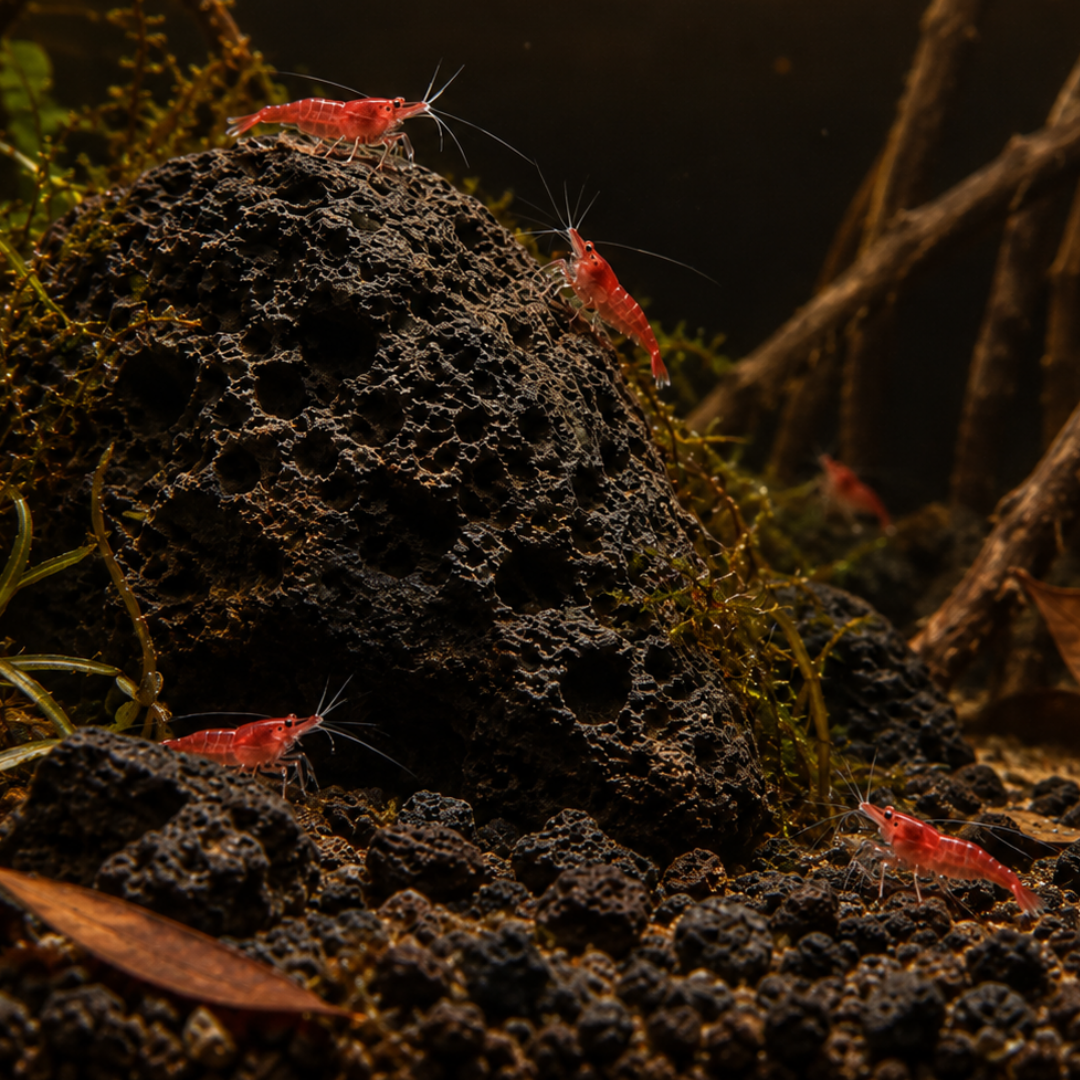
解説 / Description
スカーレットシュリンプは、ハワイ諸島に固有の非常に小さなヌマエビの仲間です。現地ではオパエウラ(ʻōpae ʻula)と呼ばれ、日本ではスカーレットシュリンプやホロホロシュリンプなどの名称で流通しています。体長は1cm前後で、赤色を基調とした体色と、幅広い塩分環境に対応できる生理能力が大きな特徴です。自然界では、海岸近くの地下で淡水と海水が混ざり合う「アンキアライン池」と、それにつながる地下水系に生息しています。丈夫なエビとして知られていますが、その強さは「どのような環境でも放置できる」という意味ではありません。長く健康に飼育するには、安定した汽水環境を用意し、岩や底床に育つバイオフィルムを活用しながら、急激な水質変化と過剰給餌を避けることが大切です。 The scarlet shrimp is a tiny atyid shrimp endemic to the Hawaiian Islands. In Hawaiʻi it is known as ʻōpae ʻula, while in Japan it is commonly sold as the Scarlet Shrimp or Holoholo Shrimp. Adults are only around a centimeter long and are notable for their reddish coloration and exceptional physiological ability to cope with a broad range of salinities. In nature they inhabit anchialine pools and connected subterranean waters where fresh groundwater and seawater mix beneath coastal areas. Although the species is remarkably hardy, this does not mean that it thrives under any conditions without care. Long-term maintenance is best achieved with stable brackish water, well-developed biofilm and avoidance of abrupt environmental changes and excessive feeding.
基本情報 / Basic Information
| 学名 / Scientific Name | Halocaridina rubra Holthuis, 1963 |
|---|---|
| 通称 / Common Name | スカーレットシュリンプ、ホロホロシュリンプ、オパエウラʻŌpae ʻula, Scarlet Shrimp, Hawaiian Red Shrimp |
| 分類 / Family | 十脚目 ヌマエビ科 Halocaridina属Order Decapoda, Family Atyidae, Genus Halocaridina |
| 英名 / English Name | Hawaiian Red Shrimp / Red Pond Shrimp / ʻŌpae ʻula |
| 分布 / Distribution | ハワイ諸島固有。ハワイ島、マウイ島、モロカイ島、オアフ島、カホオラウェ島などの沿岸部にあるアンキアライン池と、それにつながる地下水系に分布します。Endemic to the Hawaiian Islands, where it occurs in anchialine pools and associated subterranean waters on islands including Hawaiʻi, Maui, Molokaʻi, Oʻahu and Kahoʻolawe. |
| 最大体長 / Max Size | およそ1.0〜1.5cm。多くの成体は1cm前後で、雌は雄よりやや大きく、腹部に丸みが出る傾向があります。Approximately 1.0–1.5 cm, with many adults around 1 cm in length. Females tend to be somewhat larger and more robust through the abdomen than males. |
| 寿命 / Lifespan | 小型のエビとしては非常に長寿で、適した環境では10〜15年ほど生きるとされています。実際の寿命は飼育環境や栄養状態などによって左右されます。Exceptionally long-lived for such a small shrimp, with a lifespan of about 10–15 years reported under suitable conditions. Actual longevity varies with husbandry and nutritional conditions. |
飼育環境 / Aquarium Environment
| 水槽サイズ / Tank Size | 長期飼育では5〜10L以上を一つの目安とし、20cmキューブ水槽程度から扱いやすくなります。ごく少数であればさらに小さな容器でも飼育できますが、水量が少ないほど水温や塩分、水質が変動しやすくなります。長期維持や繁殖を考える場合は、生体の小ささだけで容器を決めず、水質の安定性を優先してください。For long-term maintenance, a volume of roughly 5–10 L or more is a practical guideline, with an aquarium around the size of a 20 cm cube providing useful stability. Very small groups can be kept in smaller containers, but lower water volume allows temperature, salinity and water quality to change more rapidly. For long-term colonies and breeding, environmental stability is more important than matching tank size to the shrimp’s tiny body size. |
|---|---|
| 水温 / Temperature | 飼育上は20〜28℃程度の安定した範囲を目安にします。本種は環境変化への耐性が高いことで知られますが、飼育下では極端な高温や低温、短時間での大きな温度変化を避けるほうが安全です。日本の夏は小型水槽ほど水温が上がりやすいため、設置場所にも注意してください。 For aquarium care, a stable range of roughly 20–28°C is a practical guideline. Although the species is known for considerable environmental tolerance, captive shrimp are better protected from extreme temperatures and rapid temperature shifts. Small aquaria can warm quickly during Japanese summers, so placement of the tank should be considered carefully. |
| 水質 / Water Quality | 汽水での飼育が基本です。家庭での管理では比重1.010〜1.015前後を一つの実用的な目安とし、市販の人工海水の素を使って汽水を作ります。pHは中性〜弱アルカリ性を目安とし、数値そのものより急激に変化させないことが重要です。蒸発すると水だけが失われて塩分は残るため、蒸発分の補充には塩水ではなくカルキを抜いた真水を使用します。水換えを行う場合は、交換水の温度と塩分を水槽に近づけ、一度に大きく変化させないようにします。Brackish water is the standard choice for captivity. A specific gravity around 1.010–1.015 is a practical aquarium guideline and can be prepared with a commercial marine salt mix. Roughly neutral to mildly alkaline water is suitable, but avoiding sudden changes is more important than pursuing an exact pH value. Because evaporation removes water while leaving salts behind, evaporated water should be replaced with dechlorinated fresh water rather than additional saltwater. Replacement water used for water changes should be matched as closely as practical for temperature and salinity. |
| レイアウト / Layout | 溶岩石など表面に凹凸の多い素材は、微細藻類やバクテリアを含むバイオフィルムの付着面を増やせるため、本種と相性があります。底床にはサンゴ砂やアラゴナイト系の素材も利用できます。重要なのは装飾そのものより、エビが継続的についばめる成熟した表面を確保することです。ろ過を使う場合は強い水流を避け、スポンジフィルターなど吸い込みの穏やかな方式が扱いやすいでしょう。Textured materials such as porous lava rock provide extensive surfaces on which microalgae and bacteria-rich biofilm can develop. Coral sand or aragonite-based substrates can also be used. More important than the decorative material itself is the presence of mature surfaces that the shrimp can graze continuously. If filtration is used, strong current is unnecessary and a gentle sponge filter is a practical option. |
| 注意点 / Precautions | 強健な種類ではありますが、アンモニアや亜硝酸の蓄積、急激な塩分・温度変化、長時間の高温などは避けます。新しい水槽では、エビをすぐに入れるのではなく、水質が安定し、岩や底床にバイオフィルムが形成されてから導入すると管理しやすくなります。また、完全密閉容器では給餌や水質調整による修正ができないため、長期飼育を目的とする場合は、内部を観察し必要に応じて手入れできる環境のほうが適しています。Although exceptionally hardy, the shrimp should still be protected from accumulated ammonia or nitrite, abrupt salinity and temperature changes, and prolonged excessive heat. A new aquarium is easier to manage if it is allowed to stabilize and develop biofilm before the shrimp are introduced. Completely sealed containers provide little opportunity to correct nutrition or water-quality problems, so an accessible system that can be observed and maintained is better suited to deliberate long-term husbandry. |
餌と給餌 / Feeding
| 餌の種類 / Diet | 自然界では、岩や底質に形成された藻類・シアノバクテリアを含む微生物膜や細かな有機物を主についばむ、微小食性のグレイザーです。飼育下でも成熟した水槽内のバイオフィルムを重要な餌資源として利用します。必要に応じて、エビ用の微粒子フードや藻類を主体とした餌をごく少量補助的に与えます。In nature, the species is primarily a microphagous grazer, scraping and collecting fine food material from microbial films that include algae and cyanobacteria on rock and substrate surfaces. Mature aquarium biofilm likewise provides an important food source in captivity. Very small amounts of fine shrimp food or algae-based food can be offered as a supplement when needed. |
|---|---|
| 給餌のポイント / Feeding Tips | 小型水槽では、餌不足より過剰給餌による水質悪化が問題になりやすいため、少量から始めます。十分に成熟した水槽であれば、補助給餌は週1回程度を目安にし、短時間で食べ切れる量に抑えます。残餌が残る場合は量や回数を減らしてください。一方で、「絶対に餌を与えないこと」を飼育目標にする必要もありません。エビの数、バイオフィルムや藻類の量、繁殖状況を観察しながら調整します。In a small aquarium, deterioration of water quality from overfeeding is often a greater concern than a lack of supplemental food, so begin conservatively. In a mature system, supplemental feeding around once a week can serve as a starting point, using only an amount that disappears quickly. Reduce the quantity or frequency if food remains uneaten. At the same time, complete absence of supplemental food does not need to be a husbandry goal. Adjust feeding according to colony size, available biofilm and algae, and reproductive activity. |
性格と混泳 / Temperament and Tank Mates
| 性格 / Temperament | 非常に温和で、同種同士で目立った争いをすることはほとんどありません。岩や底床、ガラス面などを歩きながら細かな餌をついばみ、環境に落ち着くと水中を泳ぐ姿も見られます。物陰や岩の隙間もよく利用するため、見えなくなったからといってすぐに異常とは限りません。The species is very peaceful, with little conspicuous aggression among members of the same colony. Individuals spend much of their time walking over rock, substrate and glass while grazing, and may also swim actively when settled. They readily use crevices and sheltered spaces, so an individual temporarily disappearing from view is not necessarily a sign of trouble. |
|---|---|
| 混泳の相性 / Compatibility | 基本的にはスカーレットシュリンプだけの単独種水槽が最も管理しやすいでしょう。体が非常に小さいため、多くの魚に捕食される可能性があり、汽水という水質条件も一般的な淡水魚との混泳を難しくします。繁殖を目的とする場合も単独種水槽が適しています。また、由来が明確な地域系統を維持する場合は、その系統情報を失わないよう、別産地の個体を不用意に混ぜないことが重要です。A species-only aquarium is generally the simplest and safest arrangement. Because the shrimp are extremely small, many fish are potential predators, while the brackish-water requirements also limit compatibility with ordinary freshwater species. A dedicated aquarium is particularly useful for breeding. When maintaining stocks with documented geographic provenance, separate management is also important if the goal is to preserve that lineage information. |
病気と対策 / Diseases and Prevention
| かかりやすい病気 / Common Diseases | 観賞用として飼育されるスカーレットシュリンプについて、特定の病気が特に多いとする情報は十分に確立されていません。飼育下で調子を崩した場合は、病名を推測する前に、水質悪化、急激な塩分や温度の変化、過剰給餌などの環境要因を確認することが重要です。No particular disease is well established as being especially common in captive scarlet shrimp. When a colony begins to decline, environmental factors such as deteriorating water quality, sudden salinity or temperature changes, and excessive feeding should be examined before attempting to assign a specific disease diagnosis. |
|---|---|
| 対策と予防 / Prevention | 予防の基本は、十分に安定した水槽を使用し、汽水の塩分と水温を急変させず、餌を与えすぎないことです。新しい個体を導入する際は、輸送水と飼育水の温度や塩分に大きな差がないか確認し、差がある場合は急に移さず徐々に慣らします。死骸や明らかな残餌を見つけた場合は取り除き、水質悪化を防ぎます。Prevention centers on a stable, mature aquarium, gradual rather than abrupt changes in salinity and temperature, and conservative feeding. When new shrimp are introduced, check for substantial differences between transport water and aquarium water and acclimate gradually when necessary. Remove dead animals or obvious uneaten food to reduce the risk of water-quality deterioration. |
増やし方(繁殖) / Breeding
| 雌雄の判別 / Sexing | 成熟した雌は雄より大きくなる傾向があり、卵を抱える腹部にも丸みがあります。雄は比較的小型で細身です。ただし本種は非常に小さいため、若い個体では外見だけから確実に雌雄を判別するのは難しく、抱卵した個体であれば雌と確実に判断できます。Mature females tend to be larger and have a broader, more rounded abdomen used for carrying eggs, while males are generally smaller and more slender. Because the species is so small, juveniles can be difficult to sex reliably by appearance alone. An egg-carrying individual can of course be identified confidently as female. |
|---|---|
| 繁殖形態 / Reproduction | 雌は卵を腹肢に抱えて保護し、孵化すると遊泳性の幼生が水中へ放たれます。幼生は初期には卵黄由来の栄養への依存が強く、成体とは塩分への対応能力も異なります。実験では、淡水に近い低塩分条件で幼生の生存率が大きく低下し、汽水や海水条件ではより高い生存率が確認されています。Females carry eggs beneath the abdomen until hatching, after which free-swimming larvae are released. Early larvae rely strongly on maternally supplied yolk and differ from adults in their ability to cope with salinity. Laboratory experiments have shown markedly poorer larval survival in conditions approaching fresh water and substantially better survival in brackish and seawater conditions. |
| 繁殖のポイント / Breeding Tips | 繁殖では、特定の比重へ頻繁に調整することより、成熟した汽水環境を長期間安定させることが重要です。特に孵化後の幼生は成体ほど低塩分に強くないため、急激な淡水化は避けてください。ろ過を使う場合は、幼生が吸い込まれにくいスポンジフィルターなどが適しています。抱卵個体を何度も移動させるより、親が落ち着いている成熟した水槽内で孵化させ、水温や塩分を大きく変えずに見守るほうが環境を安定させやすくなります。For breeding, long-term stability of a mature brackish aquarium is more important than repeatedly adjusting the system to a particular specific gravity. Newly hatched larvae are less tolerant of very low salinity than adults, so sudden freshening should be avoided. If filtration is used, a sponge filter or another system with gentle intake is appropriate for larvae. Rather than repeatedly transferring berried females, allowing hatching to occur in a mature aquarium where the adults are already settled generally minimizes environmental disturbance. |
雑学と豆知識 / Trivia and Fun Facts
| 1. 海とつながっていないように見える「アンキアライン池」 / 1. Anchialine Pools: Inland Water Connected to the Sea Underground | スカーレットシュリンプの代表的な生息地であるアンキアライン池は、地表だけを見ると海から切り離された池のように見えます。しかしハワイの多孔質な火山岩の地下には亀裂や空隙が広がり、そこを通して海水と地下の淡水が行き来しています。そのため、海と直接つながる水路が見えなくても水位が潮汐に反応し、場所や深さによって塩分も変わります。スカーレットシュリンプの優れた広塩性は、こうした変化の多い環境で進化してきたことと深く結び付いています。Anchialine pools, one of the characteristic habitats of this shrimp, can appear to be completely isolated from the sea when viewed from the surface. Beneath Hawaiʻi’s porous volcanic rock, however, cracks and cavities allow seawater and fresh groundwater to move through the landscape. Pool levels can therefore respond to ocean tides even without a visible surface channel, while salinity varies with location and depth. The extraordinary euryhalinity of the scarlet shrimp is closely associated with life in this variable environment. |
|---|---|
| 2. 塩分が変わっても、すぐに対応できる生理機構 / 2. Physiology Prepared for Changing Salinity | スカーレットシュリンプの生理学で特に注目されるのが、浸透圧調節能力です。実験では、成体がほぼ淡水に近い条件から高塩分環境まで生存できることが確認されています。さらに、他の甲殻類では塩分変化に応じて発現量が変わることの多いイオン輸送関連遺伝子について、本種では塩分を移した後も多くが大きく変化しませんでした。研究者は、エラのイオン輸送能力を恒常的に維持することが、頻繁な塩分変化へ素早く対応する仕組みの一つではないかと考えています。つまり、環境が変わるたびに一から準備するのではなく、変化の多い場所で暮らすための体制を普段から維持していると考えると分かりやすいでしょう。One of the most remarkable aspects of the species’ biology is its osmoregulatory ability. Laboratory experiments have shown that adults can survive conditions ranging from nearly fresh water to highly saline water. In addition, many ion-transport genes that commonly change expression after salinity shifts in other crustaceans showed relatively little change in H. rubra. Researchers have therefore suggested that maintaining constitutive ion-transport capacity in the gills may help the shrimp respond rapidly to frequent salinity fluctuations. In simple terms, the animal appears to remain physiologically prepared for change rather than building its entire response only after conditions shift. |
| 3. 赤色を決めるのは、餌の色素量だけではない / 3. Red Coloration Is Not Determined by Diet Alone | 特徴的な赤色には、甲殻類でよく知られるカロテノイド色素のアスタキサンチンが関わっています。研究では、遺伝的に異なる飼育系統ごとにアスタキサンチン量の違いが見られ、餌のカロテノイドを増やしたり制限したりしても、それぞれの系統が持つ基準的な量は大きく変わりませんでした。この結果から、少なくとも調べられた系統間の色素量の違いは、単純な餌不足だけでは説明できず、遺伝的背景が関与している可能性が高いと考えられています。したがって、赤色を濃くしたいからと色揚げ餌を大量に与えるという考え方は、本種では必ずしも科学的根拠に沿ったものではありません。The characteristic red coloration is associated with astaxanthin, a carotenoid pigment common in crustaceans. Research on genetically distinct captive lineages found lineage-specific differences in astaxanthin content, while dietary carotenoid supplementation or restriction did not substantially shift each colony away from its characteristic baseline. These results suggest that differences among the tested lineages cannot be explained simply by the amount of carotenoid in the diet and are likely influenced by genetic background. Heavy use of color-enhancing food therefore should not be assumed to be an effective way to intensify coloration in this species. |
| 4. 同じ姿の中に隠れた大きな遺伝的違い / 4. Deep Genetic Differences Hidden Behind a Similar Appearance | ハワイ各地のスカーレットシュリンプは外見だけでは非常によく似ていますが、遺伝子解析では島や地域ごとに深く分化した複数の系統が確認されています。ハワイ島だけを調べた研究でも、海岸地域の異なる集団間に大きな遺伝的分化があり、離れた個体群の間では遺伝子流動が少ないことが示されました。つまり、見た目が同じだからといって、自然界ですべてが一つの均一な集団として自由に行き来しているわけではありません。由来の明確な飼育系統を維持したい場合には、別系統を不用意に混ぜないことに意味があります。一方で、産地名を付けて販売する場合は、外見では判定できないため、繁殖履歴など確かな由来情報が必要です。Scarlet shrimp from different parts of Hawaiʻi can look extremely similar, yet genetic studies have identified multiple deeply differentiated lineages associated with different islands and regions. Even within the island of Hawaiʻi, research has revealed substantial genetic separation among populations and limited gene flow over larger distances. In other words, similar appearance does not mean that all wild populations form a single freely mixing group. Keeping documented captive lineages separate can therefore be meaningful when preservation of provenance is a goal. Geographic labels used in trade, however, require reliable breeding records because these lineages cannot be identified confidently from appearance alone. |
| 5. 幼生と成体では、塩分への強さが違う / 5. Larvae and Adults Differ in Salinity Tolerance | 成体のスカーレットシュリンプは非常に幅広い塩分に対応できますが、孵化直後の幼生は同じではありません。飼育実験では、淡水に近い条件で幼生の着底までの生存率が低く、汽水や海水条件では大幅に高くなりました。また、イオン輸送に利用できる明瞭なエラは、幼生が変態して稚エビになるまで発達しません。野外では幼生そのものが直接確認されていないため、その生活場所は実験結果などから推定されていますが、研究者は、低塩分で変動の大きい表層よりも、塩分が高く安定した地下水域が幼生の発育場所になると考えています。成体が元気に暮らせる水であっても、幼生にとって同じ条件が最適とは限らないという点は、繁殖を考えるうえで重要です。Adult scarlet shrimp can cope with an exceptionally broad range of salinities, but newly hatched larvae cannot. In laboratory experiments, survival to settlement was poor under conditions approaching fresh water and much higher in brackish and seawater treatments. Clearly developed gills capable of ion transport also do not appear until metamorphosis into the juvenile stage. Because larvae have not been directly observed in the wild, their natural location is inferred from experimental and ecological evidence. Researchers propose that they develop mainly in the more saline and stable subterranean portion of anchialine systems rather than in the lower-salinity, fluctuating surface pools. Conditions tolerated easily by adults are therefore not automatically ideal for their larvae. |
| 6. ハワイの暮らしと結び付いてきたオパエウラ / 6. ʻŌpae ʻUla in Hawaiian Life and Fishing | オパエウラとアンキアライン池は、ハワイの人々にとって自然史上の存在だけではありません。アンキアライン池でエビを採り、池そのものを利用・管理してきたことを示す記録が残されています。20世紀末にまとめられた先住ハワイアンの慣習的利用に関する証言には、オパエウラを採集してオペル漁の餌に利用し、そのオペルをさらに大型魚の漁に使ったという具体的な内容もあります。小さなエビが、沿岸の池から沖合の漁までをつなぐ資源の一つだったことが分かります。こうした背景を知ると、オパエウラは単なる観賞用の小型エビではなく、ハワイの土地と水、漁労文化に関わってきた生き物として見えてきます。ʻŌpae ʻula and anchialine pools are significant not only in natural history but also in Hawaiian cultural practice. Historical records document the gathering of shrimp and the use and maintenance of anchialine ponds. Testimony concerning customary Native Hawaiian use recorded that ʻōpae ʻula were collected as bait for ʻōpelu fishing, with ʻōpelu then used in turn for larger fish. This provides a concrete example of how a tiny anchialine shrimp could connect coastal ponds with offshore fisheries. Seen in this context, ʻōpae ʻula is more than an ornamental animal; it is part of a longer relationship among Hawaiian people, land, water and fishing. |
| 7. ワイアナパナパに伝わる赤い水の物語 / 7. The Story of the Red Waters of Waiʻānapanapa | マウイ島のワイアナパナパには、王女ポポアラエアにまつわる伝承があります。王女は残酷な夫である酋長カカエから逃れて洞窟に身を隠しましたが、侍女が持つ王族の象徴である羽根飾りのカヒリが水面に映ったことで隠れ場所を知られ、命を落としたと伝えられています。特定の時期になると洞窟の汽水域に多数の赤いエビが現れ、水が赤く見えることがあり、その光景は王女の血を思い起こさせるものとして語られてきました。生物学的な現象と伝承は別のものですが、一つの小さな生き物が地域の景観と人々の記憶の双方に結び付いていることを示す印象的な物語です。Waiʻānapanapa on Maui is associated with the traditional story of the princess Popoalaea. She is said to have hidden in a cave while fleeing her cruel husband, Chief Kakae, but the reflection of a feathered kahili associated with royalty revealed her hiding place and she was killed. At certain times, large numbers of tiny red shrimp appear in the cave’s brackish water and can make the water look red, a sight traditionally associated with the blood of the slain princess. The biological phenomenon and the cultural tradition are distinct, but together they illustrate how closely a small animal can become connected with both landscape and human memory. |
| 8. 閉鎖型生態系で世界に知られるようになったエビ / 8. The Shrimp That Became Famous Through Closed Ecosystems | スカーレットシュリンプが広く知られるきっかけの一つが、光、藻類、微生物、小型動物による物質循環をガラス容器内で見せる閉鎖型生態系でした。NASAとジェット推進研究所の閉鎖生態系研究から派生した技術は、1980年代に観賞・教育用の製品へ展開され、外部から給餌しなくても長期間維持できる小さな生態系として注目されました。この仕組みは物質循環を目で理解する教材として興味深いものですが、長期間生存できることと、飼育者が生体の状態に応じて環境を改善できることは別の問題です。完全密閉型では餌や水質を調整できないため、長期的に状態を観察しながら飼育するのであれば、必要に応じて手を加えられる環境のほうが管理しやすいでしょう。One reason the scarlet shrimp became widely familiar was its use in sealed ecological displays that demonstrate the cycling of matter among light, algae, microorganisms and small animals. Technology derived from closed-ecosystem research associated with NASA and the Jet Propulsion Laboratory was developed into educational and ornamental products during the 1980s, attracting attention because the systems could persist for long periods without external feeding. Such displays are interesting demonstrations of ecological cycling, but long survival is not the same as allowing a keeper to respond to changing nutritional or water-quality needs. For deliberate long-term husbandry, an accessible system that can be monitored and adjusted offers greater control than a permanently sealed vessel. |
| 9. 小さなエビが池の状態を大きく変える / 9. A Tiny Grazer with a Major Influence on Its Habitat | スカーレットシュリンプは、アンキアライン池の岩や底質に形成される藻類・シアノバクテリアを含む微生物膜を継続的についばみます。この摂食活動は、池の表面を覆う生物群集の状態や栄養循環に影響します。実際、外来魚が侵入してスカーレットシュリンプの活動や個体数が低下した池では、藻類量や堆積物の増加と結び付く変化が報告されています。水槽内で一日中岩やガラスをついばむ姿は、単なるかわいらしい仕草ではなく、自然界でこのエビが果たしている摂食者としての役割そのものでもあります。Scarlet shrimp continually graze microbial films containing algae and cyanobacteria from rocks and other surfaces in anchialine pools. This feeding activity can influence the structure of surface communities and nutrient cycling within the habitat. Studies of pools invaded by introduced fish have associated reduced activity or abundance of H. rubra with increases in algal production and accumulated sediment. The seemingly simple behavior of constantly picking at rock and glass in an aquarium is therefore an expression of the same grazing role that the shrimp performs in its natural ecosystem. |
| 10. 持続可能な流通では由来の記録が大切 / 10. Traceable Origins Matter in Sustainable Trade | ハワイのアンキアライン池は、外来魚、沿岸開発、地下水環境の変化、汚染など複数の影響を受けています。観賞用として長く楽しむためにも、野生個体の採集へ過度に依存するのではなく、継代繁殖された個体を中心に流通させる考え方が適しています。国内ブリード個体であれば、長距離輸送を減らし、繁殖履歴を管理しやすいという利点もあります。さらに特定の地域系統として扱うのであれば、親個体や仕入れ元、繁殖世代を記録しておくことで、産地名を単なる商品名ではなく追跡可能な情報として残せます。小さなエビを次の世代まで維持していくこと自体が、持続可能な楽しみ方につながります。Hawaiian anchialine pools face multiple pressures, including introduced fishes, coastal development, changes in groundwater conditions and pollution. For a sustainable aquarium trade, it is therefore preferable to build supply around established captive-bred stocks rather than excessive dependence on wild collection. Domestically bred shrimp can also reduce long-distance transport and make breeding history easier to document. When animals are sold as a particular geographic lineage, recording parental stock, source and breeding generations allows that locality information to remain traceable rather than functioning merely as a commercial label. Maintaining healthy captive generations is itself an important part of a sustainable approach to enjoying this species. |
まとめ / Conclusion
スカーレットシュリンプは、ハワイのアンキアライン池という特殊な環境に適応し、幅広い塩分変化に対応する生理能力を身につけた小型のエビです。体はわずか1cm前後ですが、岩の表面をついばむ日々の行動から、成体と幼生で異なる塩分への適応、地域ごとに分化した遺伝的背景まで、その小さな姿からは想像しにくいほど多彩な特徴を持っています。 The scarlet shrimp is a tiny Hawaiian endemic shaped by life in the unusual environment of anchialine pools and equipped with remarkable physiological tolerance of changing salinity. Although only around a centimeter long, it combines a distinctive grazing lifestyle with different salinity requirements between adults and larvae and substantial genetic differentiation among regional populations.
飼育では、その丈夫さを「何もしなくてもよい」という意味に置き換えず、安定した汽水と成熟したバイオフィルムを用意することが大切です。過剰に手を加える必要はありませんが、水温や塩分を大きく変えず、餌も必要な分だけ補うことで、落ち着いた群れの行動や繁殖を長い時間をかけて楽しめます。由来の明確な繁殖個体を選び、小さな水槽の中でも安定した環境を維持することが、スカーレットシュリンプと長く付き合うための基本となります。 Successful husbandry depends on recognizing that hardiness does not mean an absence of basic needs. Stable brackish water, mature biofilm, restrained supplemental feeding and avoidance of abrupt environmental changes provide a sound foundation for long-term care. With traceable captive-bred stock and a stable aquarium, a colony can offer years of quiet grazing behavior and, under suitable conditions, the opportunity to observe reproduction across generations.

気になる道具や飼い方を見つけてみませんか?
 アイのアクアグッズ案内バルブの仲間に合わせる飼育用品|チェリーバルブ・スマトラ・中型種の水槽とろ過道具の特徴や使い方、選ぶときのポイントをアイが紹介します。記事はコチラ →
 アイのアクアグッズ案内海水魚初心者の必需品|水槽・人工海水・比重計・水質検査道具の特徴や使い方、選ぶときのポイントをアイが紹介します。記事はコチラ →
 アイのアクアグッズ案内グッピー・プラティ・モーリーを親子で楽しむ飼育用品|水槽・稚魚保護・ろ過・餌・水草道具の特徴や使い方、選ぶときのポイントをアイが紹介します。記事はコチラ →
 アイのアクアグッズ案内金魚を長く楽しむ飼育用品|水槽・フィルター・エアレーション・水換え道具の特徴や使い方、選ぶときのポイントをアイが紹介します。記事はコチラ →
さまざまな飼育テーマをご紹介。リンク先の記事には広告・商品紹介が含まれます。
案内・紹介記事一覧へ →分布マップ
スカーレットシュリンプ(Halocaridina rubra)はハワイ諸島の固有種で、ハワイ島、マウイ島、モロカイ島、オアフ島、カホオラウェ島などの沿岸部にあるアンキアライン池と、それにつながる地下水系に分布します。
※この地図は記事中の分布情報をもとに、主な分布地域が見渡せる範囲を概略表示したものです。マーカーは地図上の目安として設定した代表地点であり、実際の採集地点や特定個体群の所在地を示すものではありません。
参考文献
- DecaNet eds. (2026). Halocaridina rubra Holthuis, 1963. World Register of Marine Species. 分類・学名 https://www.marinespecies.org/aphia.php?p=taxdetails&id=586540
- Bailey-Brock, J. H. & Brock, R. E. (1993). Feeding, Reproduction, and Sense Organs of the Hawaiian Anchialine Shrimp Halocaridina rubra (Atyidae). Pacific Science, 47(4), 338–355. 分布・生息環境・食性・繁殖 https://manoa.hawaii.edu/lifesciences/wormlab/index.php/publications/
- Santos, S. R. (2006). Patterns of genetic connectivity among anchialine habitats: a case study of the endemic Hawaiian shrimp Halocaridina rubra on the island of Hawaii. Molecular Ecology, 15(10), 2699–2718. 分布・地域個体群・アンキアライン環境 https://doi.org/10.1111/j.1365-294X.2006.02965.x
- Havird, J. C., Santos, S. R. & Henry, R. P. (2014). Osmoregulation in the Hawaiian anchialine shrimp Halocaridina rubra (Crustacea: Atyidae): expression of ion transporters, mitochondria-rich cell proliferation and hemolymph osmolality during salinity transfers. Journal of Experimental Biology, 217, 2309–2320. 塩分耐性・浸透圧調節・飼育時の水質理解 https://doi.org/10.1242/jeb.103051
- Havird, J. C., Vaught, R. C., Weese, D. A. & Santos, S. R. (2015). Reproduction and Development in Halocaridina rubra Holthuis, 1963 (Crustacea: Atyidae) Clarifies Larval Ecology in the Hawaiian Anchialine Ecosystem. The Biological Bulletin, 229(2), 134–142. 繁殖・幼生発育・幼生期の塩分条件 https://doi.org/10.1086/BBLv229n2p134
- Marrack, L. & Beavers, S. C. (2023). Anchialine pool shrimp (Halocaridina rubra) as an indicator of sewage in coastal groundwater ecosystems on the island of Hawaiʻi. PLoS ONE, 18(8), e0290658. 生息環境・食性・水質汚染・生息地保全上の注意点 https://doi.org/10.1371/journal.pone.0290658




コメント