

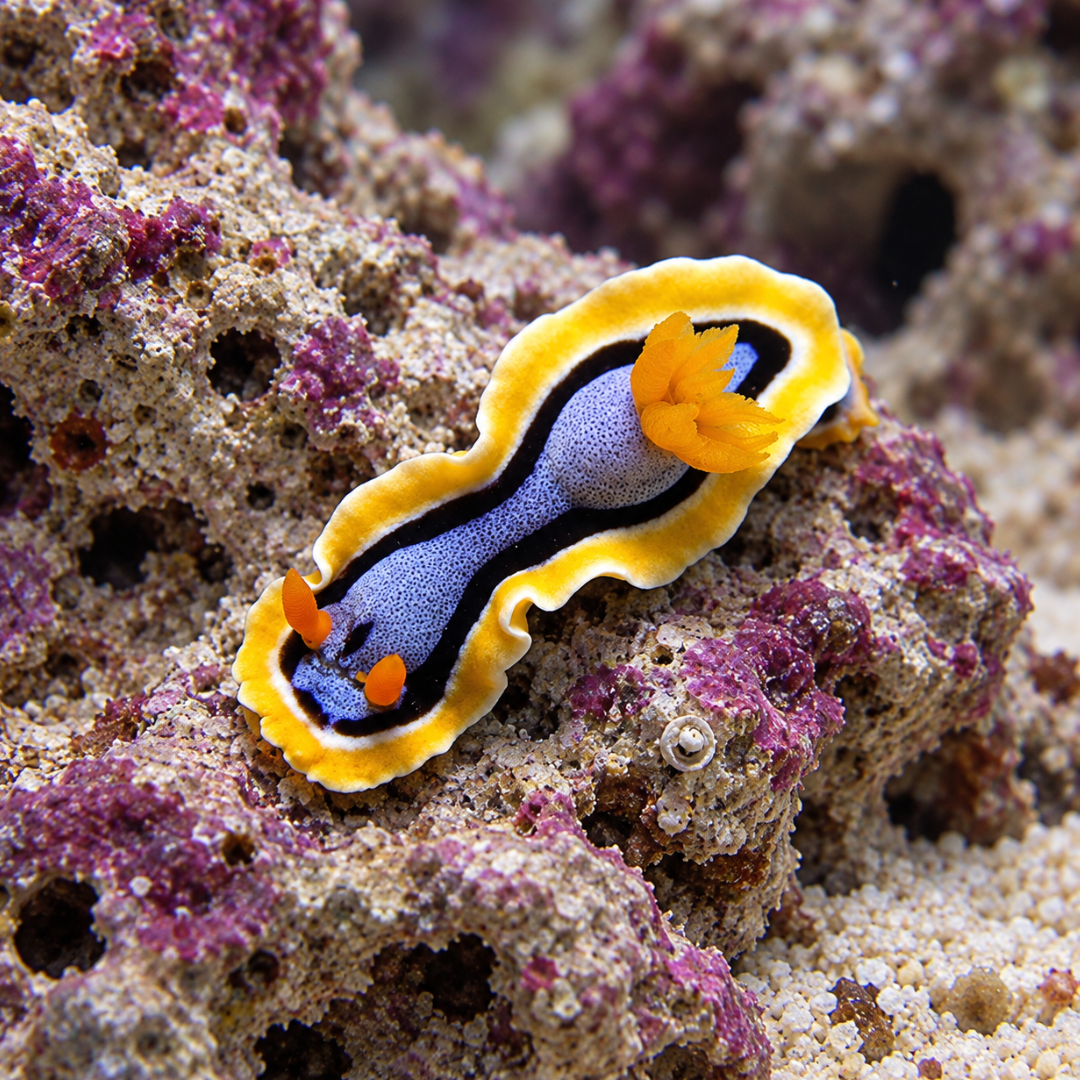
解説 / Description
アンナウミウシは、青い体に黒い線、白色帯と黄橙色の縁取りをまとった、インド・西太平洋の暖海に生息するイロウミウシ科の裸鰓類です。とりわけ青色部に散る暗色の細点と、触角の間に見られる短い黒色線は、よく似た近縁種との識別に役立ちます。鮮やかな色彩は単なる装飾ではなく、餌となる海綿から取り込んだ防御物質を利用する化学生態と結びついた警告色と考えられています。外見は華やかですが、飼育では適切な餌海綿を継続して確保することが難しく、一般的な海水水槽での長期維持は非常に困難です。 Chromodoris annae is a chromodorid nudibranch from warm Indo-West Pacific waters, distinguished by a blue body crossed with black markings and edged in white and yellow to orange. Fine dark speckling within the blue areas and a short black mark between the rhinophores are especially useful for separating it from similar congeners. Its brilliant coloration is thought to function as warning coloration associated with defensive compounds obtained from sponge prey. Despite its beauty, long-term aquarium maintenance is exceptionally difficult because an appropriate sponge food source is hard to provide continuously in a typical marine system.
基本情報 / Basic Information
| 学名 / Scientific Name | Chromodoris annae Bergh, 1877 |
|---|---|
| 通称 / Common Name | アンナウミウシAnna’s chromodoris |
| 分類 / Family | 軟体動物門・腹足綱・裸鰓目・イロウミウシ科・イロウミウシ属Phylum Mollusca, Class Gastropoda, Order Nudibranchia, Family Chromodorididae, Genus Chromodoris |
| 英名 / English Name | Anna’s Chromodoris |
| 分布 / Distribution | インド・西太平洋の熱帯域に分布し、インドネシア、フィリピン、マレーシア周辺から西太平洋の島嶼域などで記録されています。日本の暖海域にも観察記録があります。主にサンゴ礁や岩礁、その周辺の礫地などで見られます。Tropical Indo-West Pacific waters, with records from areas around Indonesia, the Philippines, Malaysia, and western Pacific islands. It has also been recorded from warm waters of Japan. It is found on coral and rocky reef habitats and nearby rubble areas. |
| 最大体長 / Max Size | 最大約50mmとされる中型のウミウシです。野外では数cm程度の個体が多く記録されています。A medium-sized nudibranch reported to reach about 50 mm in length. Many field records involve individuals measuring only a few centimeters. |
| 寿命 / Lifespan | 本種に限定した信頼性の高い寿命データはほとんどありません。飼育下では餌となる適切な海綿を継続して確保できないことが多く、寿命を全うする前に餓死する例が問題になります。Reliable species-specific lifespan data are scarce. In captivity, suitable sponge prey is rarely available on a continuous basis, so starvation often becomes the limiting factor long before a natural lifespan can be reached. |
飼育環境 / Aquarium Environment
| 水槽サイズ / Tank Size | 本種固有の推奨水槽サイズは確立されていません。小型の生体ですが、長期維持では水槽容積そのものより、餌となる海綿を維持できる成熟した環境と水質の安定性が重要です。実用上は60cm規格水槽(約57L)以上をひとつの目安とし、餌海綿の維持や別槽の併設まで考える場合は、より大きな総水量のほうが管理しやすくなります。No species-specific minimum tank size has been established. Although the animal itself is small, long-term maintenance depends more on a mature, stable system capable of supporting suitable sponge prey than on tank volume alone. A standard 60 cm aquarium of roughly 57 L or larger can be treated as a practical reference rather than a proven biological requirement, and a larger total water volume is easier to manage if a separate sponge-support system is used. |
|---|---|
| 水温 / Temperature | 本種固有の最適水温は確立されていません。熱帯性の海水環境として24〜27℃前後をひとつの目安とし、入手元の管理水温から急変させず安定させます。 A species-specific optimum has not been established. As a practical tropical-marine reference, maintain roughly 24–27°C and avoid abrupt changes from the conditions in which the animal was previously held. |
| 水質 / Water Quality | 自然海水に近い安定した塩分を保ち、比重は1.023〜1.026程度を管理上の目安とします。本種固有の最適値として確立された範囲ではないため、導入時は急変を避けることが重要です。硝酸塩やリン酸塩の過剰蓄積は避けつつ、餌となる海綿の維持も考え、極端に無栄養な環境へ偏らせないようにします。Maintain stable salinity close to normal seawater, using a specific gravity of about 1.023–1.026 as a practical aquarium reference rather than a species-specific optimum. Avoid abrupt changes during acclimation. Excessive nitrate and phosphate should be avoided, while an extremely nutrient-stripped system may also be unsuitable for maintaining sponge prey. |
| レイアウト / Layout | 成熟したライブロックを中心に、餌となり得る海綿が維持できる陰影部や穏やかな水流域を用意します。水槽全体には十分な循環を確保しつつ、ウミウシが直接強い水流を受け続けないようにします。オーバーフローや水流ポンプの吸入口にはスポンジカバーなどを装着し、巻き込みを防止します。Use mature live rock and provide shaded, moderately flowing areas where potential sponge prey can persist. Ensure adequate overall circulation while avoiding continuous direct blast on the nudibranch. Cover overflows and pump intakes with sponge guards or similar protection to prevent the animal from being drawn in. |
| 注意点 / Precautions | 最大の難関は餌で、一般的な人工飼料で代替できるとは考えにくい生体です。また、外套膜などにラトランクリンAを蓄積することが確認されています。家庭水槽で死亡・損傷時にどの程度の量が水中へ移行し、同居生体へどの程度影響するかは十分に定量化されていませんが、衰弱個体や死亡個体は速やかに隔離・除去し、必要に応じて活性炭や換水を行う慎重な管理が適切です。導入時は水温と比重を丁寧に合わせ、強い物理刺激を避けます。The greatest challenge is food, as ordinary prepared diets are not considered a realistic substitute. Latrunculin A has been confirmed in the mantle and other tissues. The amount that may enter aquarium water after injury or death, and the resulting effect on tank mates, have not been quantified well enough for precise predictions. Weak or dead individuals should therefore be isolated or removed promptly, with activated carbon and water changes used as prudent risk management. Acclimate carefully to temperature and salinity and avoid rough handling. |
餌と給餌 / Feeding
| 餌の種類 / Diet | 海綿を食べる専門性の高い捕食者で、利用できる餌は限られると考えられています。Petrosaspongia属とみられる海綿への摂食記録があるほか、近年の研究ではCacospongia mycofijiensisを含む複数の海綿をChromodoris属の個体が利用することが確認され、従来考えられていたほど単一の餌に厳密ではない可能性も示されています。本種が利用できる餌海綿の全範囲は確定しておらず、一般的な人工飼料、乾燥飼料、アサリなどでの代替は期待できません。This is a highly specialized sponge feeder whose usable prey appears limited. Feeding has been recorded on a sponge identified as probably Petrosaspongia, while more recent work on Chromodoris species documented feeding on several sponge groups, including Cacospongia mycofijiensis, suggesting that the genus may be less restricted than once assumed. The full prey range of C. annae remains unresolved, and ordinary pellets, dried foods, or chopped shellfish are not realistic substitutes. |
|---|---|
| 給餌のポイント / Feeding Tips | 長期飼育を試みる場合は、購入時に実際に摂食していた海綿を確認し、その餌を継続して維持できることが理想です。ライブロックに海綿が付着していても、本種が利用できる種類とは限りません。海綿そのものも水槽内で長期維持するのが難しいため、適切な餌を継続供給できない環境では、外見上すぐに異常がなくても徐々に消耗する可能性があります。摂食の有無と体つきの変化を継続して確認します。For long-term maintenance, the ideal approach is to confirm the sponge on which the animal was actually feeding and to keep that food source alive continuously. The presence of unidentified sponges on live rock does not mean they are usable prey, and sponges themselves can be difficult to maintain in aquaria. Without a reliable food source, the nudibranch may gradually lose condition even if it initially appears normal. Continue checking for feeding and changes in body condition. |
性格と混泳 / Temperament and Tank Mates
| 性格 / Temperament | 通常は海綿を探して基質上を移動する底生性のウミウシです。2010年には東ティモールで、同種2個体が歯舌を使って互いを攻撃する非常に珍しい闘争行動が報告されました。ただし、これは限られた観察記録であり、本種を日常的に攻撃性の高い生物とみなす根拠にはなりません。It normally moves across the substrate in search of sponge prey. A notable 2010 field report from Timor-Leste documented two individuals using their radulae in a prolonged aggressive encounter. This is a limited observation and does not justify describing the species as routinely aggressive. |
|---|---|
| 混泳の相性 / Compatibility | 長期維持を目指すなら、専用または準専用水槽が扱いやすいでしょう。ウミウシをつついたり傷つけたりする可能性のある魚類や大型のカニ類などとの混泳は避けます。死亡・損傷時の防御物質による影響は家庭水槽では十分に定量化されていないため、混泳では異変時にすぐ隔離できる管理が望まれます。同種間では稀な闘争記録があるため、複数飼育時も長時間の接触や損傷がないか観察します。A dedicated or near-dedicated aquarium is easier to manage when long-term maintenance is the goal. Avoid fishes and large crabs likely to nip or injure the nudibranch. The effect of defensive metabolites released after severe injury or death has not been quantified well in home aquaria, so mixed-species systems should allow rapid isolation if problems occur. Rare intraspecific fighting has been documented, so multiple individuals should also be watched for prolonged contact or injury. |
病気と対策 / Diseases and Prevention
| かかりやすい病気 / Common Diseases | アンナウミウシ固有の病気について、観賞飼育で確立された診断体系はほとんどありません。実際の飼育では、病原体だけでなく、餌不足による慢性的な消耗、急な比重・水温変化、水流ポンプへの巻き込みや同居生体による外傷、衰弱後の組織崩壊が大きな問題になります。体が明らかに細くなる、移動が極端に減る、触角や鰓を長時間収納したままにするなどの変化は、病名を特定する所見ではありませんが、状態悪化を疑う目安になります。There is little established aquarium diagnostic information for diseases specific to Chromodoris annae. In practice, major problems include chronic starvation, abrupt salinity or temperature changes, mechanical injury from pumps or tank mates, and tissue deterioration after severe weakening. A thinner body, marked reduction in movement, or prolonged retraction of the rhinophores and gills does not identify a specific disease, but it can indicate declining condition. |
|---|---|
| 対策と予防 / Prevention | 餌海綿を確保したうえで、比重と水温を安定させ、吸水口を保護し、攻撃性のある生体から隔離することが基本です。無脊椎動物なので銅を含む魚病薬は使用しません。衰弱や組織崩壊が見られた個体は隔離し、死亡時は速やかに取り出します。防御物質の流出が疑われる状況では、活性炭の交換と十分な換水を行うとリスク低減に役立ちます。Prevention centers on securing appropriate sponge prey, maintaining stable salinity and temperature, guarding pump intakes, and protecting the animal from aggressive tank mates. Because it is an invertebrate, copper-based fish medications should not be used. Isolate animals showing tissue breakdown and remove dead individuals promptly. If release of defensive metabolites is suspected, fresh activated carbon and substantial water changes can help reduce risk. |
増やし方(繁殖) / Breeding
| 雌雄の判別 / Sexing | 同時的雌雄同体で、1個体がオスとメス双方の生殖機能を持つため、外見から雌雄を分けて判別することはできません。繁殖には成熟した2個体が必要です。The species is a simultaneous hermaphrodite, with each individual possessing both male and female reproductive functions. There is therefore no practical external male-female distinction, and two mature individuals are required for mating. |
|---|---|
| 繁殖形態 / Reproduction | 交尾後、基質上に平らな二次元状の卵塊を中心から外側へ渦巻き状に産み付けます。アンナウミウシでは淡いクリーム色の卵塊が3〜4巻き程度になることが多いと報告されています。発生後はベリジャー幼生として孵化し、一定期間の浮遊生活を経て、適切な着底条件が整うと変態します。After mating, the animal lays a flat, two-dimensional spiral egg mass from the center outward. In Chromodoris annae, the egg mass is commonly described as pale cream and averaging about three to four whorls. Development proceeds to a veliger larval stage, followed by a planktonic period before settlement and metamorphosis under suitable conditions. |
| 繁殖のポイント / Breeding Tips | 産卵そのものが起きても、家庭水槽で累代繁殖まで進めるのは非常に困難です。本種の幼生はプランクトン栄養型のベリジャーとして孵化するため、浮遊幼生を維持する餌と水流管理が必要になります。さらに、着底後の稚ウミウシには利用できる海綿を用意しなければなりません。まず親個体を健康に維持できる餌環境を確立することが先決です。Spawning may occur in captivity, but completing the full life cycle is extremely difficult. The larvae hatch as planktotrophic veligers, so maintaining the planktonic stage requires suitable food and careful flow management. After settlement, juveniles must also have access to an acceptable sponge. Establishing reliable nutrition for the adults is therefore the first priority before attempting breeding. |
雑学と豆知識 / Trivia and Fun Facts
| 1. 青い体に隠された「見分けるための点描」 / 1. A dotted signature hidden in the blue | アンナウミウシはエリザベスウミウシやミゾレウミウシなど、同じ青・黒・黄橙色系の配色を持つ仲間と驚くほどよく似ています。ところが近くで観察すると、青色部には暗い細点が細かく散り、触角の間には短い黒色線が現れます。この「青の中の点描」は日本の水族館でも識別点として紹介されており、華やかな色彩の奥に、分類学者が読み解く微細なサインが隠れていることを教えてくれます。Chromodoris annae can look remarkably similar to blue, black, and yellow-orange relatives such as C. elisabethina and C. lochi. Seen more closely, however, the blue areas are peppered with fine dark dots, and a short black mark often appears between the rhinophores. This dotted texture is also emphasized by Japanese aquarium references as a useful identification feature, showing how subtle taxonomic clues can hide inside an otherwise spectacular color pattern. |
|---|---|
| 2. 1877年から続いた分類の迷路 / 2. A taxonomic maze beginning in 1877 | 本種は1877年にRudolph Berghによって記載されましたが、当時は生時の色彩が失われた保存標本を頼りに種を見分ける必要があり、近縁種との区別は長く混乱しました。20世紀には別種の同物異名として扱われた時期もありましたが、1982年のRudmanによる再検討で独立種として整理されました。その後は分子系統解析によってイロウミウシ科全体の属分類が大きく組み替えられましたが、アンナウミウシは現在もChromodoris annaeという有効な学名で受け入れられています。The species was described by Rudolph Bergh in 1877, at a time when taxonomists often had to distinguish species from preserved specimens that had lost their living colors. Confusion with similar chromodorids persisted for decades, and the species was at times treated as a synonym of other forms. Rudman’s 1982 revision restored a clearer species concept, and later molecular phylogenetics reshaped chromodorid classification more broadly. Despite those changes, Chromodoris annae remains an accepted species name today. |
| 3. 餌から選び取る化学兵器、ラトランクリンA / 3. Latrunculin A: a chemical weapon selected from food | イロウミウシ科の仲間には、食べた海綿が作る化学物質を自分の防御に転用するものがいます。アンナウミウシを含む複数のChromodorisでは、強い細胞毒性を持つラトランクリンAが外套膜の防御組織に選択的に蓄積されることが示されています。この物質はアクチンの重合を妨げるため、多くの真核細胞にとって厄介な化合物です。つまり鮮やかな体色の裏側では、「食べた毒を捨てずに、使える形で保管する」という高度な化学生態が働いています。Some chromodorid nudibranchs repurpose defensive chemistry produced by the sponges they eat. In several Chromodoris species including C. annae, the potent cytotoxin latrunculin A is selectively accumulated in defensive mantle tissues. Latrunculin A interferes with actin polymerization, making it a powerful biological compound for many eukaryotic cells. Behind the brilliant warning colors, the animal is therefore practicing an elegant form of chemical recycling: retaining a dietary toxin and redeploying it for defense. |
| 4. 自分の毒に耐える鍵は、少し違うアクチンかもしれない / 4. A slightly different actin may be the key to toxin resistance | ラトランクリンAがアクチンを標的にするなら、それを大量に蓄えるウミウシ自身はなぜ平気なのでしょうか。2023年の研究では、調べられたChromodoris各種に通常とは異なるアクチンの型が見つかり、ラトランクリンAが結合する領域の近くに2か所のアミノ酸置換が確認されました。実験ではChromodorisがラトランクリンAに耐性を示し、この変異型アクチンが耐性に関与する可能性が示されています。ただし、研究者自身も因果関係を「示唆」として扱っており、すべての分子機構が完全に解明されたわけではありません。If latrunculin A attacks actin, why can a nudibranch store so much of it without poisoning itself? A 2023 study found a novel actin isoform in the Chromodoris species examined, including two amino-acid substitutions near the region where latrunculin A binds. The animals also showed resistance to the compound, suggesting that this modified actin may contribute to toxin insensitivity. Importantly, the study frames this as a proposed mechanism rather than a fully closed case, so the molecular story remains open to further testing. |
| 5. 温和なウミウシが見せた12分間の「決闘」 / 5. A rare duel between normally placid nudibranchs | 2010年、東ティモールで体長約30mmのアンナウミウシ2個体が、歯舌を露出して互いの頭部や外套膜、鰓などを繰り返し攻撃する行動が記録されました。争いは十数分に及び、両個体には外套膜の損傷が残りました。報告者は共食いではないと判断した一方、交尾や摂食と関係する行動なのか、それ以外の目的なのかは特定できないとしています。イロウミウシ科で報告された非常に珍しい同種間攻撃として、行動学的に興味深い記録です。In 2010, two roughly 30 mm Chromodoris annae in Timor-Leste were observed repeatedly exposing their buccal mass and attacking one another with their radulae, targeting the head, mantle margin, and gills. The encounter continued for more than ten minutes and left visible mantle damage on both animals. The original report regarded the behavior as non-cannibalistic but could not determine whether it was related to mating, feeding, or some other cause. It remains a particularly unusual record of conspecific aggression within the Chromodorididae. |
| 6. 平らな卵塊が語る進化の系統 / 6. Flat egg masses reveal evolutionary relationships | 多くのウミウシは、ひらひらと立ち上がったリボン状の卵塊を作ります。ところがアンナウミウシを含む一群のChromodorisは、基質に沿うような平らな渦巻き状の卵塊を産みます。この「平面状産卵」は単なる産み方の違いではなく、分子系統研究と結び付けてChromodorisの一群を理解する重要な特徴として扱われてきました。卵の置き方ひとつが、外見だけでは分からない進化のつながりを教えてくれるのです。Many nudibranchs produce upright, frilly ribbon-like egg masses. A group of Chromodoris that includes C. annae instead lays a flat spiral egg mass pressed against the substrate. This planar spawning pattern is more than a reproductive curiosity: it has been used together with molecular phylogenetic evidence to understand evolutionary relationships within Chromodoris. Even the geometry of an egg ribbon can therefore preserve clues to ancestry that body color alone does not reveal. |
| 7. 14,260塩基対のミトコンドリアゲノム / 7. A 14,260-base-pair mitochondrial genome | 2017年にはアンナウミウシの完全なミトコンドリアゲノムが解読されました。全長は14,260塩基対で、13個のタンパク質コード遺伝子、22個のtRNA遺伝子、2個のrRNA遺伝子を含みます。水槽の中では数cmしかない小さな生き物ですが、そのDNA情報はイロウミウシ科の系統関係や進化を読み解く材料になっています。鮮やかな色彩で知られるウミウシが、分子系統学の世界では塩基配列という別の「模様」を提供しているのは興味深いところです。In 2017 the complete mitochondrial genome of Chromodoris annae was decoded. It is 14,260 base pairs long and contains 13 protein-coding genes, 22 tRNA genes, and two rRNA genes. Although the animal itself is only a few centimeters long, its DNA sequence provides valuable information for studying chromodorid relationships and evolution. A nudibranch famous for visible color patterns thus offers molecular biologists another kind of pattern entirely: the arrangement of its genetic sequence. |
まとめ / Conclusion
アンナウミウシは、青・黒・白・黄橙色が織りなす鮮烈な姿だけでなく、海綿との食物関係、餌由来のラトランクリンAを体内に蓄えて防御へ利用する化学生態、近縁種と見分けるための繊細な模様まで、小さな体に多くの特徴を備えています。研究が進むにつれ、その鮮やかな色彩と化学防衛が、生息環境や食性と密接に結びついていることが少しずつ明らかになっています。 Chromodoris annae is remarkable not only for its vivid combination of blue, black, white, and yellow-orange, but also for its ecological relationship with sponge prey, its sequestration of dietary latrunculin A for chemical defense, and the subtle markings that separate it from close relatives. Ongoing research is gradually clarifying how closely its coloration and chemical defenses are tied to its feeding ecology and habitat.
その一方で、餌海綿への強い依存は飼育上の大きな壁になります。美しい外見だけを理由に一般的な海水水槽へ導入するのではなく、実際に利用できる海綿を継続して確保できるかを最初に考える必要があります。長期維持が難しいことまで含めて生態を理解すると、アンナウミウシの色彩や行動は、サンゴ礁で築かれてきた食う・守るという関係を映し出すものとして、より深く見えてきます。 At the same time, its dependence on suitable sponge prey is the main obstacle to aquarium care. Before adding the animal for its appearance alone, a keeper must first consider whether an actually usable sponge food source can be supplied continuously. Understanding the difficulty of long-term maintenance also makes its coloration and behavior more meaningful, revealing how feeding and defense are linked in the reef environment.

気になる道具や飼い方を見つけてみませんか?
 アイのアクアグッズ案内海水魚初心者の必需品|水槽・人工海水・比重計・水質検査道具の特徴や使い方、選ぶときのポイントをアイが紹介します。記事はコチラ →
 アイのアクアグッズ案内プレコ飼育に必要なもの|餌・流木・ろ過・隠れ家・掃除用品道具の特徴や使い方、選ぶときのポイントをアイが紹介します。記事はコチラ →
 アイのアクアグッズ案内マジックリーフ物語|一枚の葉がアクアリウム用品になるまで道具の特徴や使い方、選ぶときのポイントをアイが紹介します。記事はコチラ →
 アイのアクアグッズ案内水草用ソイルの選び方|土・砂の違いとおすすめ商品道具の特徴や使い方、選ぶときのポイントをアイが紹介します。記事はコチラ →
さまざまな飼育テーマをご紹介。リンク先の記事には広告・商品紹介が含まれます。
案内・紹介記事一覧へ →分布マップ
アンナウミウシ(Chromodoris annae)は、インド・西太平洋の熱帯域に分布し、インドネシア、フィリピン、マレーシア周辺から西太平洋の島嶼域、日本の暖海域まで記録されています。主にサンゴ礁や岩礁、その周辺の礫地などで見られます。
※この地図は記事内の分布情報をもとに、生息域のおおよその広がりを示した概略表示です。マーカーは分布域を把握しやすくするために設定した代表地点であり、実際の採集地点や個体の確認地点を示すものではありません。
参考文献
- MolluscaBase eds. (2026). Chromodoris annae Bergh, 1877. World Register of Marine Species. WoRMS 分類・有効学名
- Rudman, W. B. (1982). The Chromodorididae (Opisthobranchia: Mollusca) of the Indo-West Pacific: Chromodoris quadricolor, C. lineolata and Hypselodoris nigrolineata colour groups. Zoological Journal of the Linnean Society, 76(3), 183–241. DOI 分類・形態・近縁種との識別・分布
- Johnson, R. F. & Gosliner, T. M. (2012). Traditional Taxonomic Groupings Mask Evolutionary History: A Molecular Phylogeny and New Classification of the Chromodorid Nudibranchs. PLoS ONE, 7(4), e33479. DOI 分子系統・属分類・インド太平洋の生態的背景
- Biological Information System for Marine Life (BiSMAL), JAMSTEC. Chromodoris annae Bergh, 1877. BiSMAL 日本を含む出現記録・分布・水深記録
- Rudman, W. B. & Bergquist, P. R. (2007). A review of feeding specificity in the sponge-feeding Chromodorididae (Nudibranchia: Mollusca). Molluscan Research, 27(2), 60–88. DOI 海綿食・食性の専門性・飼育上の餌確保
- Trickey, J. S., Vanner, J. & Wilson, N. G. (2013). Reproductive variance in planar spawning Chromodoris species (Mollusca: Nudibranchia). Molluscan Research, 33(4), 265–271. DOI 平面状の卵塊・卵塊の巻数・プランクトン栄養型ベリジャー幼生
- Cheney, K. L., White, A., Mudianta, I. W., Winters, A. E., Quezada, M., Capon, R. J., Mollo, E. & Garson, M. J. (2016). Choose Your Weaponry: Selective Storage of a Single Toxic Compound, Latrunculin A, by Closely Related Nudibranch Molluscs. PLoS ONE, 11(1), e0145134. DOI ラトランクリンA・外套膜への選択的蓄積・化学防衛・毒性
- Hertzer, C., Undap, N. I. J., Papu, A., Bhandari, D. R., Aatz, S., Kehraus, S., Kaligis, F., Bara, R., Schäberle, T. F., Wägele, H. & König, G. M. (2023). Is a Modified Actin the Key to Toxin Resistance in the Nudibranch Chromodoris? A Biochemical and Molecular Approach. Diversity, 15(2), 304. DOI ラトランクリンA耐性・変異型アクチン・餌由来化合物の蓄積
- Willan, R. C. (2010). Intraspecific aggression in the nudibranch Chromodoris annae Bergh, 1877: novel ‘fighting’ behaviour for the Chromodorididae (Gastropoda, Opisthobranchia). Basteria, 74(4–6), 89–94. 掲載ページ 同種間闘争・行動上の注意点
- Lin, G.-M., Xiang, P., Sampurna, B. P. & Hsiao, C.-D. (2017). Genome skimming yields the complete mitogenome of Chromodoris annae (Mollusca: Chromodorididae). Mitochondrial DNA Part B, 2(2), 609–610. DOI ミトコンドリアゲノム・分布・生息水深
- Rudman, W. B. (2008). Chromodoris annae. Sea Slug Forum, Australian Museum. Australian Museum 飼育下での餌海綿確保の難しさ・長期飼育上の制約
- Yanong, R. P. E. Use of Copper in Marine Aquaculture and Aquarium Systems. University of Florida IFAS Extension, FA165. University of Florida IFAS 海産無脊椎動物に対する銅剤の毒性・治療時の注意




コメント