

解説 / Description
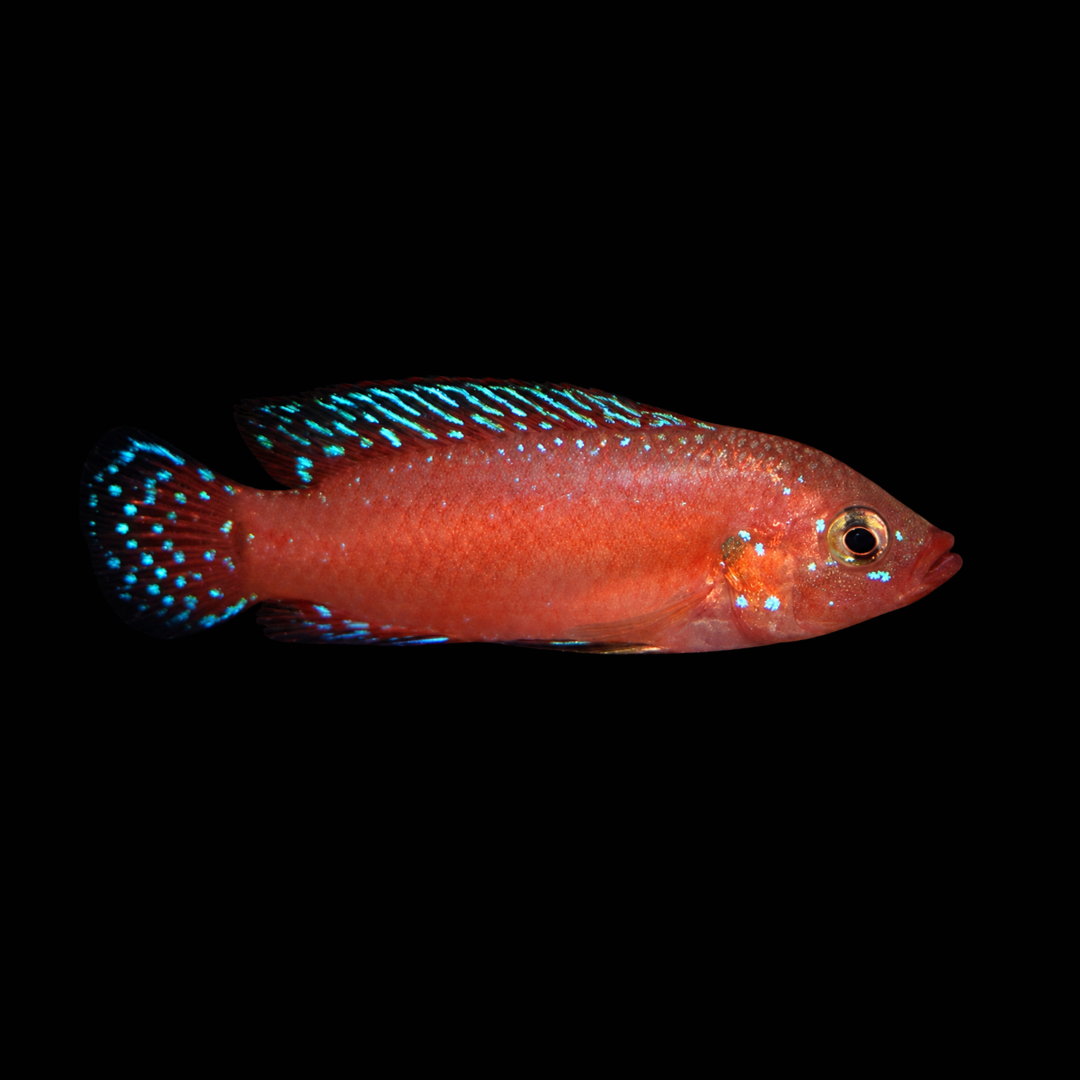
ルブリカトクロミス・エクスルは、ケニアのトゥルカナ湖に固有の小型アフリカンシクリッドです。鮮やかなオレンジレッドから赤色の体に青緑色の光沢斑が散り、背びれ・尾びれ・尻びれの暗い縁取りが印象的です。長くヘミクロミス属に置かれていましたが、2022年に公表された系統分類学的な見直しによって赤いジュエルシクリッド群が新属ルブリカトクロミスへ分けられ、現在は Rubricatochromis exsul が用いられています。飼育下では幅広い水質に適応する一方、同種間の争いや繁殖期の縄張り行動は軽視できません。十分な底面積と、互いの視線を遮れるレイアウトを用意することが安定飼育の基本です。 Rubricatochromis exsul is a small African cichlid endemic to Lake Turkana in Kenya. Its orange-red to red body is scattered with blue-green iridescent flecks, while dark margins on the dorsal, caudal, and anal fins give it a distinctive appearance. The species was long placed in Hemichromis, but a phylogenetic and taxonomic revision published in 2022 separated the red jewel cichlid lineage into the new genus Rubricatochromis, and the name Rubricatochromis exsul is now used. Captive fish can adapt to a range of water conditions, but aggression between conspecifics and strong breeding territoriality should not be underestimated. Ample floor space and a layout that breaks lines of sight are basic requirements for stable long-term care.
基本情報 / Basic Information
| 学名 / Scientific Name | Rubricatochromis exsul (Trewavas, 1933) |
|---|---|
| 通称 / Common Name | トゥルカナレッドシクリッド、トゥルカナレッドジュエルシクリッド、ヘミクロミス・エクスル(旧属名による流通名)Turkana Jewel Cichlid, Turkana Red Jewel Cichlid; Hemichromis exsul is still encountered as an older trade name. |
| 分類 / Family | シクリッド目 Cichliformes・シクリッド科 Cichlidae・Pseudocrenilabrinae亜科・ルブリカトクロミス属 RubricatochromisOrder Cichliformes, family Cichlidae, subfamily Pseudocrenilabrinae, genus Rubricatochromis |
| 英名 / English Name | Turkana Jewel Cichlid |
| 分布 / Distribution | アフリカ東部・トゥルカナ湖(ケニア)。同湖の固有種として扱われています。Lake Turkana in East Africa, Kenya. The species is regarded as endemic to the lake. |
| 最大体長 / Max Size | 最大約10cm(標準体長)。Up to about 10 cm standard length. |
| 寿命 / Lifespan | 本種単独の信頼できる寿命データは十分に確立されていません。適切な水質管理と栄養管理のもとでは、数年単位での長期飼育を前提に管理します。Reliable species-specific lifespan data are not well established. Under stable water conditions and good nutrition, husbandry should be planned for a multi-year commitment. |
飼育環境 / Aquarium Environment
| 水槽サイズ / Tank Size | ペア単独でも90cmクラスを目安とし、長期飼育では90cm規格水槽(約180L)程度の余裕があると管理しやすいでしょう。繁殖時には縄張りが広がるため、混泳ではさらに余裕のある水槽が必要です。水量だけでなく、底面積と退避場所の確保を重視します。Plan around a 90 cm-class aquarium even for a compatible pair. For long-term care, a Japanese 90 cm standard tank of about 180 L provides useful extra room, while community keeping requires still more space. Floor area and access to retreat sites matter as much as total water volume because a breeding pair can expand its territory. |
|---|---|
| 水温 / Temperature | 23〜28℃を目安とし、通常は25℃前後で安定させると管理しやすいでしょう。繁殖を狙う場合も急な昇温は避け、適温範囲の中で安定した状態を維持します。 Aim for 23–28°C, with a stable temperature around 25°C being practical for routine care. When encouraging spawning, avoid abrupt temperature increases and maintain stable conditions within the normal range. |
| 水質 / Water Quality | 中性〜弱アルカリ性を中心に、pH 7.0〜8.0程度を目安とします。トゥルカナ湖の湖水は強いアルカリ性で、やや塩分を含みますが、飼育下でpH 9以上の湖水条件を厳密に再現する必要はありません。急激なpH変動を避け、十分な緩衝力を保って水質を安定させることを優先します。サンゴ砂や石灰質素材は、必要に応じて緩衝力を補う目的で利用できます。Aim for neutral to mildly alkaline water, around pH 7.0–8.0. Lake Turkana itself is strongly alkaline and slightly saline, but reproducing lake water above pH 9 is not necessary in captivity. Avoid abrupt pH shifts and prioritise stable buffering. Coral sand or calcareous media can be used where additional buffering is needed. |
| レイアウト / Layout | 砂または細かな砂利を敷き、溶岩石、丸石、スレート、流木などで複数の隠れ家と視線の遮断帯を作ります。産卵床として平らな石を用意すると繁殖行動を観察しやすくなります。底床を掘るため、植物はアヌビアス類やミクロソリウム類など、石や流木に活着させられる丈夫な種類が向いています。Use sand or fine gravel and build several refuges and visual barriers with lava rock, rounded stones, slate, and driftwood. Flat stones are useful spawning surfaces. Because the fish may dig, hardy epiphytes such as Anubias and Java fern are better choices than delicate rooted plants. |
| 注意点 / Precautions | 通常時の攻撃性には個体差がありますが、同種間では順位争いが起こり、繁殖期には縄張り性がさらに強くなります。ペアの相性も重要で、単に雌雄を1匹ずつ入れただけでは弱い個体が追い詰められることがあります。若魚を複数飼育し、自然に相性のよいペアが形成されるのを待つ方法が安全です。ろ過を十分に確保し、定期換水で水質を安定させます。Aggression varies between individuals, but dominance disputes can occur between conspecifics and territoriality becomes stronger during breeding. Pair compatibility matters, and simply placing one male with one female can result in the weaker fish being harassed. Raising a small group of juveniles and allowing a compatible pair to form naturally is safer. Provide efficient filtration and regular partial water changes to keep conditions stable. |
餌と給餌 / Feeding
| 餌の種類 / Diet | 良質なシクリッド用ペレットやフレークを主食に、冷凍アカムシ、ブラインシュリンプ、イサザアミなどを組み合わせます。特定の餌だけに偏らせず、人工飼料と冷凍餌を使い分けて栄養の偏りを避けます。Use high-quality cichlid pellets or flakes as the staple, supplemented with frozen foods such as bloodworm, brine shrimp, and mysis. Avoid relying on a single food and alternate prepared and frozen foods to provide a varied diet. |
|---|---|
| 給餌のポイント / Feeding Tips | 1日1〜2回、短時間で食べ切れる量を与えます。発色は健康状態、水質、個体の順位、繁殖状態などでも変化します。餌の量だけで発色を調整しようとせず、過給餌による水質悪化を避けながら体型を見て給餌量を調整します。Feed once or twice daily in portions that are consumed quickly. Colour also varies with health, water quality, social status, and breeding condition, so do not try to improve colour simply by increasing food. Adjust portions to body condition and avoid overfeeding, which can quickly degrade water quality. |
性格と混泳 / Temperament and Tank Mates
| 性格 / Temperament | 縄張り意識があり、個体差も大きいシクリッドです。成熟してペアが形成されると、産卵・子育て中は水槽内の広い範囲を占有し、侵入する魚を強く追い払います。通常時に落ち着いて見える個体でも繁殖期には行動が変わるため、必要に応じて隔離できる準備が必要です。This is a territorial cichlid with considerable individual variation. Once a mature pair forms, it may claim a large part of the aquarium while spawning and raising fry, driving away intruders. Even fish that appear settled during routine maintenance can change behaviour during breeding, so be prepared to separate individuals if aggression escalates. |
|---|---|
| 混泳の相性 / Compatibility | 混泳する場合は十分に広い水槽を用意し、同程度以上の大きさで丈夫かつ素早く泳げる魚を選びます。それでも相性を保証することはできず、繁殖期には相手を問わず追撃することがあります。確実性を求めるならペア単独飼育が最も安全です。小型魚、動きの遅い魚、長いひれを持つ魚との混泳は避けます。If tank mates are attempted, use a sufficiently large aquarium and choose robust, fast-swimming fish of similar or greater size. Compatibility can never be guaranteed, and a breeding pair may attack almost any intruder. A species-only pair is therefore the safest option. Avoid small fish, slow-moving species, and long-finned tank mates. |
病気と対策 / Diseases and Prevention
| かかりやすい病気 / Common Diseases | 本種に特有の疾病傾向を示す信頼できる情報は限られており、特定の病気に特に弱いとは言い切れません。一般的な熱帯魚と同様に白点病などに注意するほか、輸送や同種間の争いで生じたひれ裂けや鱗の損傷は、二次感染につながることがあります。Reliable information on species-specific disease susceptibility is limited, so it is not appropriate to claim that this fish is especially prone to a particular disease. As with other tropical freshwater fish, watch for ich and for secondary infection following torn fins or scale damage caused by transport or fighting. |
|---|---|
| 対策と予防 / Prevention | 新規導入魚は可能なら隔離観察し、急激な水温・pH変化を避けて導入します。定期換水、十分なろ過、過密回避、隠れ家の確保が基本です。外傷を見つけた場合は攻撃個体との隔離を優先し、水質を清浄に保ちます。薬剤を使う際は症状を見極め、対象魚種と水槽環境に適した用法・用量を守ります。Quarantine new fish when possible and avoid abrupt changes in temperature or pH during introduction. Regular water changes, efficient filtration, appropriate stocking density, and adequate cover are the main preventive measures. If injuries occur, separate the aggressor or injured fish first and maintain excellent water quality. When medication is necessary, identify the condition carefully and follow a product appropriate for the species and aquarium system. |
増やし方(繁殖) / Breeding
| 雌雄の判別 / Sexing | 外見だけでの確実な雌雄判別は難しい種類です。成熟したオスはメスより大きくなる傾向があり、メスは産卵前に腹部が丸みを帯びることがあります。色彩や頭部の形だけでは個体差の影響を受けやすいため、繁殖期の産卵管や実際の生殖行動を合わせて判断します。Reliable sexing from external appearance alone is difficult. Mature males tend to grow larger, while females may become noticeably rounder before spawning. Colour and head shape are affected by individual variation, so the breeding tube and actual reproductive behaviour provide more dependable confirmation. |
|---|---|
| 繁殖形態 / Reproduction | ペアを形成する基質産卵型のオープンスポウナーです。平らな石などを清掃して卵を列状に産み付け、オスが追って受精します。産卵後は雌雄が役割分担しながら卵と稚魚を守る両親保護を行います。孵化した仔魚をあらかじめ掘ったくぼみへ移す行動も見られます。This is a pair-forming, substrate-spawning open breeder. The pair cleans a flat surface, the female lays rows of eggs, and the male follows to fertilise them. Both parents participate in brood care, often dividing duties between tending the brood and guarding the territory. Hatched larvae may be moved into pre-dug pits. |
| 繁殖のポイント / Breeding Tips | 若魚を5〜6匹ほど育て、自然に相性のよいペアが形成されるのを待つ方法が安全です。平らな石を複数用意し、安定した水質と十分な栄養状態を保ちます。産卵数は親魚の大きさや状態によって変わりますが、数百卵に達する飼育例があります。孵化や自由遊泳までの日数は水温などの条件で変わるため、固定的な日数で判断せず、卵の発生と親魚の行動を観察します。自由遊泳を始めた稚魚には、孵化させたブラインシュリンプの幼生を与えます。親魚が次の繁殖に入る前に、十分に成長した稚魚を別水槽へ移すと管理しやすくなります。Raising five or six juveniles and allowing a compatible pair to form naturally is the safer approach. Provide several flat stones and maintain stable water quality and good nutrition. Clutch size varies with the condition and size of the parents, but aquarium reports describe broods of several hundred eggs. Hatching and free-swimming times vary with conditions such as temperature, so observe egg development and parental behaviour rather than relying on a fixed number of days. Once the fry are free-swimming, newly hatched brine shrimp are a suitable first food. Moving well-grown juveniles to a separate aquarium before the parents begin another spawning cycle makes management easier. |
雑学と豆知識 / Trivia and Fun Facts
| 1. 1933年に始まった学名の旅 / 1. A Taxonomic Journey Beginning in 1933 | 本種はEthelwynn Trewavasによって1933年に Pelmatochromis exsul として記載されました。その後は Hemichromis に移され、さらに広域分布する近縁種の変異と考えられてシノニム扱いされた時期もあります。種小名 exsul はラテン語で「追放された者」「放浪者」といった意味を持ちますが、この語を選んだTrewavasの具体的な意図までを断定できる資料は限られています。それでも、西・中央アフリカに多い赤いジュエルシクリッド群から遠く離れたトゥルカナ湖に孤立して暮らす姿を思うと、どこか印象的な響きを持つ名前です。Ethelwynn Trewavas described the species in 1933 as Pelmatochromis exsul. It was later transferred to Hemichromis and, for a period, treated as a synonym of more widely distributed jewel cichlids. The Latin word exsul means an exile, banished person, or wanderer, although the exact intention behind Trewavas’s choice of the name should not be assumed without direct documentation. Even so, the name feels striking for a red jewel cichlid isolated far to the east of the group’s main West and Central African distribution. |
|---|---|
| 2. 1998年のカラー写真が再検討のきっかけに / 2. A 1998 Colour Photograph Prompted Reconsideration | 長く近縁種のシノニムとみなされていた本種を再検討するきっかけの一つが、Lothar Seegersがトゥルカナ湖で採集した個体を生きたまま観察し、1998年にカラー写真とともに紹介したことでした。暗いひれの縁取りと、体側中央の黒斑がほとんど見えない姿は、当時まとめられていた近縁種とは色彩上の違いが明瞭でした。この記録は、それまでの同定を見直す重要な手がかりとなりました。One important prompt for reconsidering the species came when Lothar Seegers collected a specimen in Lake Turkana, observed it alive, and published a colour photograph in 1998. Its dark fin margins and the near absence of the mid-lateral black blotch showed a clear colour-pattern difference from the jewel cichlids with which it had been synonymised. The record provided an important reason to re-examine the earlier identification. |
| 3. 2022年、赤いジュエルシクリッドは新属 Rubricatochromis へ / 3. In 2022 the Red Jewel Cichlids Moved to Rubricatochromis | Anton LambojとStephan Koblmüllerによる2022年の分類学的研究では、DNA配列の比較に加えて形態や計数形質、体色も検討され、従来 Hemichromis とされてきた魚が大きく二つの進化系統に分かれることが示されました。その結果、赤いジュエルシクリッド群を収容する新属 Rubricatochromis が設立され、本種も Rubricatochromis exsul となりました。つまり、単なる呼び名の変更ではなく、従来一つの属にまとめられていた魚たちの進化的なまとまりを整理し直した変更です。属名は、赤い体色を表すラテン語 rubricatus と、アフリカ産シクリッドの属名でよく使われる chromis を組み合わせたものです。In their 2022 taxonomic study, Anton Lamboj and Stephan Koblmüller combined DNA sequence data with morphology, meristic characters, and body colour to show that fishes traditionally grouped under Hemichromis fall into two major evolutionary lineages. The red jewel cichlid lineage was therefore placed in the newly established genus Rubricatochromis, making this species Rubricatochromis exsul. In other words, the change was not simply a new label; it reorganised the old genus to better reflect evolutionary relationships. The genus name combines the Latin rubricatus, referring to red coloration, with chromis, a common ending in African cichlid genus names. |
| 4. 暗いひれの縁取りは、種を見分ける強い手がかり / 4. Dark Fin Margins Are a Powerful Identification Clue | 赤いジュエルシクリッド類は色彩変異が大きく、流通名だけでの同定が難しいグループです。その中でエクスルは例外的に見分けやすく、背びれ・尾びれ・尻びれの黒みを帯びた縁取りと、体側中央の典型的な黒斑が多くの個体で欠けることが重要な特徴です。青い光沢斑は成熟や気分によって強弱が変わるため、赤色の濃さだけではなく、ひれの輪郭や黒斑の配置を見ることがポイントになります。Red jewel cichlids are notoriously variable, making identification from trade names alone difficult. R. exsul is an unusually recognisable exception: the dark margins of the dorsal, caudal, and anal fins, together with the frequent absence of the typical mid-lateral black blotch, are important clues. Blue iridescent flecks and red intensity change with maturity and mood, so fin edging and blotch placement are more useful than body redness alone. |
| 5. トゥルカナ湖の極端な水を、そのまま水槽へ持ち込む必要はない / 5. Lake Turkana’s Extreme Water Need Not Be Copied Exactly | トゥルカナ湖は流出口を持たない乾燥地のアルカリ湖で、蒸発によって溶存成分が濃縮されます。本種がそのような環境に由来することから、飼育でも強いアルカリ性が必須と思われがちですが、飼育下では中性〜弱アルカリ性の安定した水で維持されています。水槽では自然の数値をそのまま再現することよりも、急変を避け、緩衝力を保ち、清浄な水質を安定して維持することが実用上重要です。Lake Turkana is an endorheic alkaline lake in an arid region, where evaporation concentrates dissolved substances. That origin can give the impression that extreme alkalinity is mandatory in captivity, yet aquarium populations are maintained in stable neutral to mildly alkaline water. In practice, avoiding sudden changes, maintaining buffering capacity, and keeping the water clean are more important than copying every wild water value exactly. |
| 6. 2018年、ドイツ繁殖個体の供給が始まった / 6. German-bred Fish Became Available in 2018 | ケニアから淡水観賞魚が商業的に輸出される機会は限られており、本種は長く入手困難な魚でした。Aquarium Glaserは2018年、確保した個体から得られたドイツ繁殖個体の供給を開始したと記録しています。同社は2024年、現在の飼育系統が2018年にケニアから到着した祖先より穏やかに見えるとも報告しています。ただし、これは同社の飼育系統についての観察であり、本種全体で性格が変化したことを示す科学的な実証とは区別して受け取る必要があります。Commercial export opportunities for freshwater ornamental fishes from Kenya are limited, and the species remained difficult to obtain for many years. Aquarium Glaser recorded that it began offering German-bred fish produced from stock secured in 2018. In a 2024 account, the company also reported that its current captive line appeared less aggressive than the ancestors that arrived from Kenya in 2018. This should be treated as an observation from that captive line, not as scientific evidence that the temperament of the species as a whole has changed. |
| 7. 日本でも2026年に流通例が確認される / 7. The Species Continues to Appear in the Japanese Trade | 日本では旧学名 Hemichromis exsul や「レッドジュエルシクリッド・トゥルカナ」「トゥルカナレッドジュエルシクリッド」といった名前で流通することがあります。常時在庫される一般種ではなく、入荷状況は時期や店舗によって異なります。現在の学名だけでなく旧属名でも販売されるため、探す際は両方の名前を確認すると見つけやすいでしょう。In Japan, the fish is still sold under the older name Hemichromis exsul as well as trade names such as “Red Jewel Cichlid Turkana” and “Turkana Red Jewel Cichlid.” It is not a permanently stocked mass-market fish, and availability varies by shop and season. Because the old genus name is still used in trade, checking both Hemichromis exsul and Rubricatochromis exsul is useful when searching for the species. |
| 8. 保全状況は「LC」のまま。ただし評価年の古さに注意 / 8. The Official Status Remains LC, but the Assessment Is Old | 本種のIUCNレッドリスト上の扱いは、現在参照できる情報では2006年評価の「低懸念(LC)」です。「危急種(VU)へ正式に変更された」という事実は確認できません。ただし評価年が古いため、このLC評価だけを根拠に現在の野生個体群の状況を細かく断定することもできません。観賞魚として扱う際は、正式な保全評価とは分けて考えつつ、種名と由来を明確にし、他種との安易な交雑を避けて系統を管理することが大切です。Available IUCN-linked information lists the species as Least Concern, based on a 2006 assessment. A formal change to Vulnerable could not be confirmed. Because the assessment is old, however, the LC category alone should not be used to make detailed claims about the present condition of wild populations. In the aquarium trade, this formal conservation status should be kept separate from good lineage management: keep the species identity and origin clear and avoid casual hybridisation with other jewel cichlids. |
まとめ / Conclusion
ルブリカトクロミス・エクスルは、鮮やかな赤色と青緑色の光沢斑、暗く縁取られたひれが印象的な、トゥルカナ湖固有のシクリッドです。長く近縁種のシノニムとみなされた時期を経て、現在は Rubricatochromis 属の独立種として扱われています。外見の美しさに加え、分類学の見直しによって位置づけが整理されてきた歴史も、本種を理解するうえで興味深い特徴です。 Rubricatochromis exsul is a Lake Turkana endemic distinguished by vivid red colour, blue-green iridescent flecks, and dark-edged fins. After a period in which it was treated as a synonym of related jewel cichlids, it is now recognised as a distinct species in the genus Rubricatochromis. Its appearance is striking, but the history of how its taxonomic position was clarified is equally useful for understanding the species.
飼育では湖水の極端なアルカリ性をそのまま再現することより、安定した中性〜弱アルカリ性の水、十分な底面積、複数の退避場所を確保することが重要です。相性のよいペアが成立すると、産卵床を整え、卵と稚魚を雌雄で守るシクリッドらしい繁殖行動を観察できます。鮮やかな色彩だけでなく、縄張り形成や子育てまで含めた行動をじっくり観察できることが、本種を飼い込む大きな魅力です。 Successful care depends less on copying Lake Turkana’s extreme alkalinity than on maintaining stable neutral-to-mildly alkaline water, ample floor space, and several retreat sites. Once a compatible pair forms, both parents may prepare a spawning surface and defend the eggs and fry, revealing the strongly developed parental behaviour typical of these cichlids. The combination of vivid colour, territorial behaviour, and attentive brood care gives the species lasting interest in a well-planned aquarium.

気になる道具や飼い方を見つけてみませんか?
 アイのアクアグッズ案内水槽ライトの選び方|魚の見え方・水草・海水で選ぶおすすめ照明道具の特徴や使い方、選ぶときのポイントをアイが紹介します。記事はコチラ →
 アイのアクアグッズ案内ローチの仲間に合わせる飼育用品|クーリー・流水性・ボーシャの水槽と底砂道具の特徴や使い方、選ぶときのポイントをアイが紹介します。記事はコチラ →
 アイのアクアグッズ案内水槽のろ材の選び方|ウール・リング・活性炭の違いとおすすめ商品フィルターの中の綿や石は何をしている? アイとコタロウが、ウール・スポンジ・セラミック・焼結ガラス・活性炭・ゼオライトを比較。機種との相性、入れ方、洗い方と交換まで商品とともに紹介します。記事はコチラ →
 アイのアクアグッズ案内水草用ソイルの選び方|土・砂の違いとおすすめ商品道具の特徴や使い方、選ぶときのポイントをアイが紹介します。記事はコチラ →
さまざまな飼育テーマをご紹介。リンク先の記事には広告・商品紹介が含まれます。
案内・紹介記事一覧へ →分布マップ
ルブリカトクロミス・エクスル(Rubricatochromis exsul)は、アフリカ東部のケニアにあるトゥルカナ湖に分布し、同湖の固有種として扱われています。
※この地図は、記事の分布情報をもとにトゥルカナ湖全体が見えるよう設定した概略表示です。マーカーは分布域を把握しやすくするための代表地点であり、本種の実際の採集地点や観察地点を示すものではありません。
参考文献
- Trewavas, E. (1933). Scientific Results of the Cambridge Expedition to the East African Lakes, 1930–1.—11. The Cichlid Fishes. Zoological Journal of the Linnean Society, 38(259), 309–341. 対応:原記載、形態、分布、分類史 https://doi.org/10.1111/j.1096-3642.1933.tb00062.x
- Lamboj, A., & Koblmüller, S. (2023). Molecular phylogeny and taxonomic revision of the cichlid genus Hemichromis (Teleostei, Cichliformes, Cichlidae), with description of a new genus and revalidation of H. angolensis. Hydrobiologia, 850, 2177–2198. 対応:Rubricatochromis属の設立、系統関係、分類、形態・色彩による識別 https://doi.org/10.1007/s10750-022-05060-y
- Fricke, R., Eschmeyer, W. N., & Van der Laan, R. (eds.). Eschmeyer’s Catalog of Fishes: Rubricatochromis exsul. California Academy of Sciences. 対応:現在の有効学名、分類上の位置、トゥルカナ湖での分布 https://researcharchive.calacademy.org/research/ichthyology/catalog/fishcatget.asp?spid=53552
- Yuretich, R. F., & Cerling, T. E. (1983). Hydrogeochemistry of Lake Turkana, Kenya: Mass balance and mineral reactions in an alkaline lake. Geochimica et Cosmochimica Acta, 47(6), 1099–1109. 対応:トゥルカナ湖の閉鎖湖としての性質、アルカリ性、溶存塩類、水質環境 https://doi.org/10.1016/0016-7037(83)90240-5
- Kolding, J. (1992). A summary of Lake Turkana: An ever-changing mixed environment. SIL Communications, 1953–1996, 23(1), 25–35. 対応:湖の水文・季節変動、湖水環境、魚類を取り巻く自然条件 https://doi.org/10.1080/05384680.1992.11904005
- Horvath, G. (2025). The stunning cichlid of Lake Turkana. Practical Fishkeeping, April 2025. 対応:本種の飼育水質、水温、水槽サイズ、レイアウト、給餌、縄張り性、繁殖時の管理 https://www.practicalfishkeeping.co.uk/features/the-stunning-cichlid-of-lake-turkana/
- Noble, G. K., Kumpf, K. F., & Billings, V. N. (1938). The induction of brooding behavior in the jewel fish. Endocrinology, 23(3), 353–359. 対応:ジュエルシクリッド類の両親保護、卵・仔魚の防衛、仔魚を口で回収する行動 https://doi.org/10.1210/endo-23-3-353
- Harper, C., & Wolf, J. C. (2009). Morphologic Effects of the Stress Response in Fish. ILAR Journal, 50(4), 387–396. 対応:輸送・取り扱い・過密・水質変動・外傷によるストレスと二次感染リスク、飼育上の注意点 https://doi.org/10.1093/ilar.50.4.387
- Merck Veterinary Manual. Disorders and Diseases of Fish. 対応:白点病を含む一般的な魚病、隔離、過密回避、水質管理、感染症予防 https://www.merckvetmanual.com/all-other-pets/fish/disorders-and-diseases-of-fish




コメント