

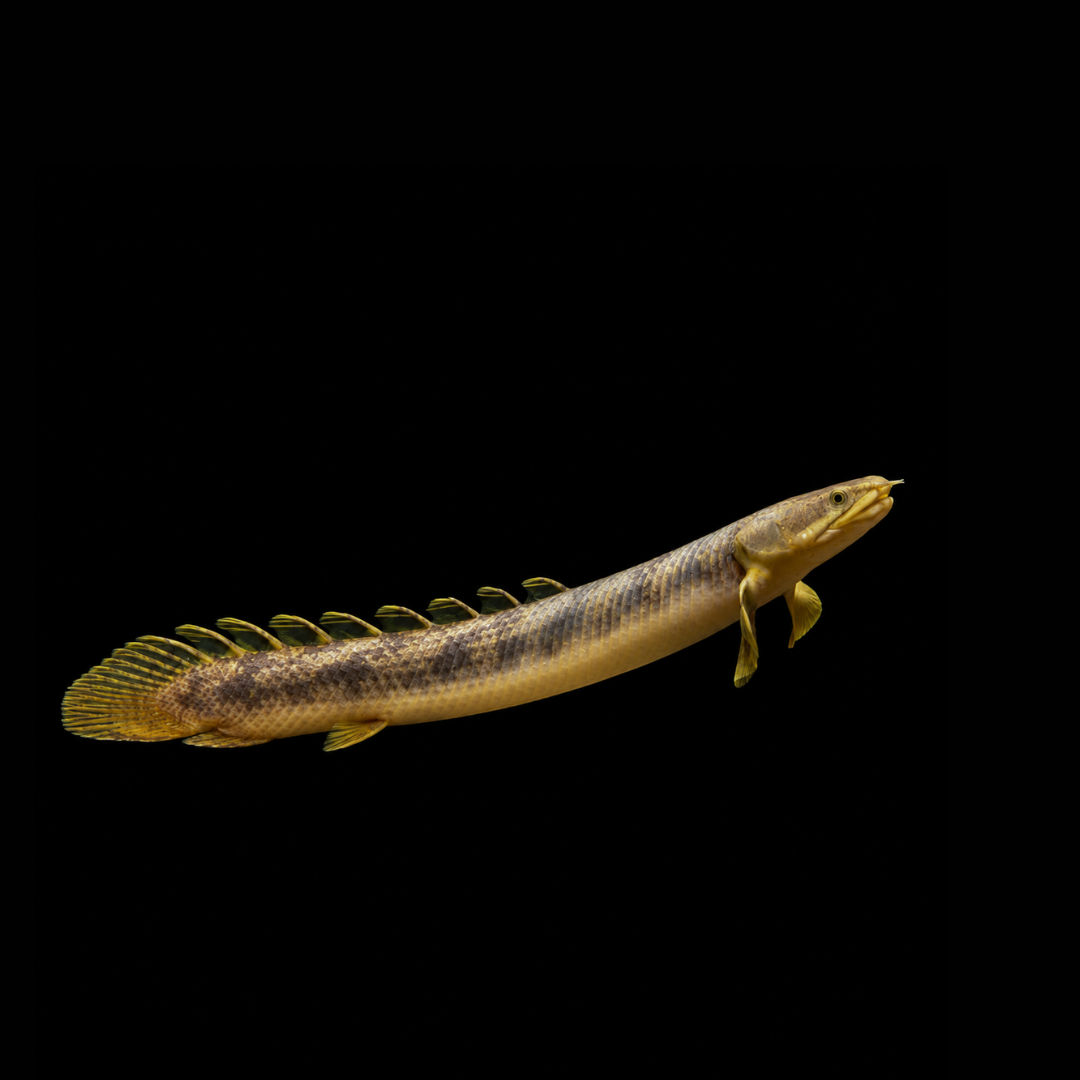
解説 / Description
ポリプテルス・パルマスは、西アフリカの上部ギニア地域に分布するポリプテルス科の淡水魚です。細長く円筒形に近い体を持ち、背中には7〜10本の小離鰭が並びます。上顎が下顎よりわずかに長い上顎突出型で、記録上の最大標準体長は35.3cmです。体色や斑紋には個体差・地域差があり、黄褐色からオリーブ色の地色に暗色の網目状や帯状の模様が現れます。ポリプテルス類に特徴的な空気呼吸能力を備え、水面へ上がって肺に空気を取り込むため、水槽では確実な飛び出し対策と呼吸用の空気層が欠かせません。比較的丈夫で人工飼料にも慣れやすい一方、野生由来個体を導入する際は外部寄生虫や輸送時の傷を想定し、十分に観察してから本水槽へ移すことが大切です。 Polypterus palmas is a freshwater bichir from the Upper Guinea region of West Africa. It has an elongated, nearly cylindrical body with 7–10 separate dorsal finlets. The upper jaw extends slightly beyond the lower jaw, and the recorded maximum standard length is 35.3 cm. Color and pattern vary among individuals and localities, commonly showing dark reticulated or banded markings over yellow-brown to olive tones. Like other bichirs, it breathes atmospheric air using lungs, so a securely covered aquarium must still provide an air space above the water. The species is generally hardy and often adapts to prepared foods, but wild-origin specimens should be carefully quarantined and observed for external parasites and transport injuries before entering the main aquarium.
基本情報 / Basic Information
| 学名 / Scientific Name | Polypterus palmas |
|---|---|
| 通称 / Common Name | ポリプテルス・パルマス、パルマスPalmas bichir, Marbled bichir |
| 分類 / Family | 条鰭綱・ポリプテルス目・ポリプテルス科・ポリプテルス属Actinopterygii, Polypteriformes, Polypteridae, Polypterus |
| 英名 / English Name | Marbled bichir |
| 分布 / Distribution | 西アフリカの上部ギニア地域。ギニアビサウからリベリアにかけての沿岸河川、コートジボワールのカヴァリ川上流域、セネガルのカザマンス川上流域などに分布します。コンゴ川流域からの古い記録には、現在は別種とされるポリプテルス・ポーリーが含まれていた可能性があります。The Upper Guinea region of West Africa, including coastal rivers from Guinea-Bissau to Liberia, the upper Cavally River in Côte d’Ivoire, and the upper Casamance River in Senegal. Older Congo Basin records may include Polypterus polli, which is now recognized as a separate species. |
| 最大体長 / Max Size | 記録上の最大標準体長は35.3cmです。標準体長は尾鰭を含まないため、飼育設備は30cmを超える成魚を想定して余裕を持たせます。The recorded maximum standard length is 35.3 cm. Because standard length excludes the caudal fin, aquarium planning should allow generous space for an adult exceeding 30 cm. |
| 寿命 / Lifespan | 本種だけを対象にした信頼性の高い寿命データは乏しく、明確な年数は定まっていません。長期飼育を前提に設備と管理計画を整えるのが適切です。Reliable species-specific lifespan data are limited, and no well-established figure is available. It is best regarded as a long-term aquarium commitment. |
飼育環境 / Aquarium Environment
| 水槽サイズ / Tank Size | 幼魚は60cm規格水槽でも管理できますが、終生飼育では単独でも90cm規格水槽(90×45×45cm、約180L)以上を目安にすると安心です。底層を広く使うため、水量だけでなく奥行きと底面積を重視します。複数飼育や大型魚との混泳では、さらに広い水槽が適します。Juveniles can be managed temporarily in a 60 cm standard aquarium, but a 90 cm standard tank (about 90 × 45 × 45 cm, roughly 180 L) or larger is a sensible long-term target for a single adult. Floor area and depth are especially important for this bottom-oriented fish. Larger quarters are preferable for groups or communities with large tank mates. |
|---|---|
| 水温 / Temperature | 26〜28℃を基本の目安とし、急激な変化を避けて安定させます。A stable 26–28°C is a suitable target. Avoid rapid temperature changes. |
| 水質 / Water Quality | 弱酸性〜中性の軟水寄りを目安とします。ポリプテルス類は比較的適応力がありますが、排泄量が多いため、十分な生物ろ過と定期的な換水でアンモニアや亜硝酸を蓄積させないことが重要です。Slightly acidic to neutral, relatively soft water is appropriate. Bichirs are adaptable, but their substantial waste production makes strong biological filtration and regular water changes important to prevent ammonia and nitrite accumulation. |
| レイアウト / Layout | 底床は細かな砂や角の少ない砂利、または掃除を優先したベアタンクでも管理できます。流木や土管などで落ち着ける陰を作り、体を傷つけやすい鋭い装飾は避けます。レイアウト用品は魚が押しても倒れないよう安定させてください。Fine sand, smooth gravel, or a bare-bottom setup can all be used depending on maintenance priorities. Provide shaded retreats with driftwood or pipes, avoid sharp décor, and secure furnishings so they cannot shift when the fish pushes against them. |
| 注意点 / Precautions | 飛び出し対策は最重要です。水面へ空気を吸いに上がる習性があり、わずかな隙間から脱出することがあります。フタは十分な強度を持つものを確実に固定し、配線や配管まわりの隙間も小さくします。同時に、水面とフタの間には空気呼吸のための空間を残してください。Escape prevention is essential. Bichirs regularly rise to the surface to breathe air and can escape through surprisingly small gaps. Use a strong, securely fixed lid and minimize openings around cables and plumbing, while maintaining an air space between the water surface and the cover. |
餌と給餌 / Feeding
| 餌の種類 / Diet | 肉食魚用の沈下性人工飼料を主食にし、ミミズ、エビや魚の切り身、冷凍餌などを補助的に組み合わせます。自然下では魚類や水生無脊椎動物などを利用する捕食性の魚です。生き餌は必須ではなく、病原体を持ち込む可能性があるため、入手経路が不明な小魚を常用する必要はありません。Use sinking pellets formulated for carnivorous fish as the staple diet, supplemented with foods such as earthworms, pieces of shrimp or fish, and suitable frozen foods. In nature it is a predator that consumes fish and aquatic invertebrates. Live feeder fish are not necessary and may introduce pathogens when their origin is uncertain. |
|---|---|
| 給餌のポイント / Feeding Tips | 底層で餌を探すため、沈下する餌を確実に届かせます。薄暗い時間帯に活動しやすいので、消灯前後は給餌しやすいタイミングです。混泳水槽では泳ぎの速い魚に餌を取られやすいため、パルマスが実際に食べているか確認します。食べ残しは早めに回収し、水質悪化を防ぎます。Make sure food reaches the bottom where the fish can find it. Feeding around lights-out often suits its activity pattern. In community tanks, faster fish may take most of the food, so confirm that the bichir is actually eating. Remove leftovers promptly to protect water quality. |
性格と混泳 / Temperament and Tank Mates
| 性格 / Temperament | 同程度の大きさの魚に対しては比較的落ち着いていますが、肉食魚であることに変わりはありません。口に入る大きさの魚やエビは捕食される可能性があります。日中は物陰で休み、照明が落ち着くと底層をゆっくり探索する姿がよく見られます。It is generally calm toward similarly sized fish, but it remains a predator. Fish or shrimp small enough to be swallowed may be eaten. It often rests under cover during the day and explores the bottom more actively under dimmer lighting. |
|---|---|
| 混泳の相性 / Compatibility | 口に入らず、極端に攻撃的でない中〜大型魚が候補になります。体格の近いポリプテルス類との混泳も可能ですが、底面積と隠れ場所を十分に確保します。小型魚や小型甲殻類は捕食対象になりやすく、反対に大型シクリッドなど気性の強い魚はパルマスを傷つけることがあります。混泳相手の種類だけでなく、個体ごとの性格と給餌競争も観察してください。Suitable tank mates are medium to large fish that cannot be swallowed and are not excessively aggressive. Similarly sized bichirs can also be kept together when floor space and hiding places are sufficient. Small fish and crustaceans are likely prey, while highly aggressive large cichlids may injure the bichir. Individual behavior and feeding competition should always be monitored. |
病気と対策 / Diseases and Prevention
| かかりやすい病気 / Common Diseases | 野生由来のポリプテルス類では、導入時に単生類などの外部寄生虫が問題になることがあります。ポリプテルス属ではマクロギロダクティルス類の寄生が知られていますが、パルマスの野生個体に一定の高率で寄生すると断定できる十分なデータはありません。体表の異物、過剰な粘液、ヒレの傷み、体を物に擦りつける行動、呼吸の変化などを総合して状態を判断します。輸送傷から細菌性の二次感染が起こる可能性にも注意します。Wild-origin bichirs may arrive with external parasites, including monogeneans. Macrogyrodactylus species are documented from Polypterus, but there is not sufficient evidence to claim a consistently high infection rate specifically in wild P. palmas. Watch for visible organisms, excess mucus, damaged fins, repeated rubbing, and changes in breathing. Transport injuries can also provide entry points for secondary bacterial infections. |
|---|---|
| 対策と予防 / Prevention | 新規導入魚はすぐに本水槽へ入れず、隔離水槽で食欲、呼吸、体表、排泄、擦りつけ行動などを観察します。寄生虫が疑われる場合は、症状や寄生虫の種類を確認したうえで、対象魚に使用できる薬剤を選びます。単生類にはプラジカンテルなどが用いられる例がありますが、薬剤の安全域や濃度は魚種・製品・水質条件で異なるため、自己判断で濃度を上げたり、高水温や塩水浴を一律に併用したりせず、製品の用法または魚類診療に詳しい専門家の指示に従うのが安全です。Quarantine new fish before introducing them to the main aquarium and monitor appetite, respiration, skin condition, feces, and rubbing behavior. If parasites are suspected, identify the likely problem before selecting a medication that is appropriate for the fish. Praziquantel is used against some monogeneans, but safe doses vary with the species, product, and water conditions. Avoid increasing concentrations or automatically combining medication with high temperatures or salt; follow product directions or advice from a veterinarian experienced with fish. |
増やし方(繁殖) / Breeding
| 雌雄の判別 / Sexing | 成熟したオスは臀鰭が幅広く肉厚に発達し、メスは相対的に細い臀鰭を持ちます。幼魚では差が分かりにくいため、ある程度成長してから判別します。Mature males develop a broad, thick anal fin, whereas females have a relatively narrower anal fin. Sexing juveniles is difficult, so the distinction becomes clearer as the fish matures. |
|---|---|
| 繁殖形態 / Reproduction | 卵生で、親が卵を保護しない散卵型です。繁殖時にはオスが発達した臀鰭をカップ状に使ってメスが放出した卵を受け、受精後に水草などへ散らす行動がポリプテルス類で知られています。パルマスでも飼育下の繁殖例があり、二次資料では26〜28℃前後で卵が数日で孵化する例が紹介されていますが、産卵数などの細かな数値は資料間の差が大きいため、一定値として扱わない方が安全です。This is an egg-laying, non-guarding scatter spawner. In bichirs, the male uses his enlarged anal fin like a cup to receive eggs released by the female and scatters them onto vegetation after fertilization. Captive breeding of P. palmas has been reported, and secondary sources describe hatching within several days around 26–28°C, but detailed fecundity figures vary and should not be treated as a fixed species value. |
| 繁殖のポイント / Breeding Tips | 状態のよい成熟個体を用意し、細葉の水草や産卵用モップなど、卵が付着できる場所を多く設けます。軟水寄りの清浄な水を維持し、急激な刺激ではなく安定した環境の中で季節的な変化を緩やかに与える方法が考えられます。親魚が卵を食べる可能性があるため、産卵後は卵を保護できる管理が必要です。セネガルスほど繁殖情報が豊富ではありませんが、パルマスは「飼育下繁殖が不可能な種」ではありません。Use healthy mature fish and provide abundant fine-leaved plants or spawning mops for egg attachment. Maintain clean, relatively soft water and introduce seasonal cues gradually rather than through abrupt changes. Adults may consume eggs, so the spawn should be protected after breeding. Captive-breeding information is less extensive than for P. senegalus, but P. palmas is not an impossible species to reproduce in aquaria. |
雑学と豆知識 / Trivia and Fun Facts
| 1. 1850年に記載されたパルマス / 1. A species described in 1850 | ポリプテルス・パルマスは1850年、W. O. Ayresによって新種として記載されました。タイプ産地はリベリアのCape Palmasで、種小名palmasもこの地名に由来します。属名Polypterusは「多く」を表す語と「翼・ヒレ」を表す語に由来し、背中に並ぶ多数の小離鰭をよく表しています。学名を知ってから魚を見ると、背中の輪郭そのものが名前の由来として読み取れる魚です。Polypterus palmas was described by W. O. Ayres in 1850. Its type locality is Cape Palmas in Liberia, which is also the source of the specific name palmas. The genus name Polypterus refers to the many separate finlets along the back, making the scientific name unusually easy to connect with the fish’s visible anatomy. |
|---|---|
| 2. 「ブティコフェリー」と「ポーリー」をめぐる分類の整理 / 2. Clarifying “buettikoferi” and “polli” | パルマスの仲間は、かつて複数の亜種として扱われた時期があり、その名称が現在の流通名にも残っています。2019年のポリプテルス科の分類学的再検討では、P. buettikoferiとP. retropinnis loweiはP. palmasの新参異名とされ、P. polliは独立した有効種として扱われています。そのため、「パルマス・ポーリー」という販売名を見かけても、現在の分類ではP. palmasとP. polliは別種です。流通名だけで判断せず、産地や形態を合わせて確認することが重要です。Members of the palmas complex were historically treated as several subspecies, and those names still survive in the aquarium trade. A 2019 revision of Polypteridae treated P. buettikoferi and P. retropinnis lowei as junior synonyms of P. palmas, while P. polli is recognized as a separate valid species. Thus, a trade label such as “palmas polli” does not reflect the current species-level classification. |
| 3. 小離鰭はポリプテルスを象徴する形態 / 3. Dorsal finlets define the bichir silhouette | 一般的な魚の背鰭が一枚の連続した形を取るのに対し、ポリプテルスの背中には独立した小離鰭が一列に並びます。パルマスでは7〜10本が数えられ、種を見分けるための形態形質の一つにもなっています。休んでいるときには寝かせ、動き出すと一枚ずつ立てる様子があり、古代魚らしい輪郭を形づくるだけでなく、観察する楽しさの大きな部分を占めています。Unlike the single continuous dorsal fin seen in many fishes, bichirs carry a row of separate finlets. P. palmas has 7–10, and the count is one of the morphological characters used in identification. The finlets can be folded down at rest and raised as the fish moves, giving bichirs their unmistakable silhouette. |
| 4. 非対称な二葉性の肺を持つ / 4. An asymmetric, bilobed lung | ポリプテルス類の空気呼吸器官は、一般的な硬骨魚の浮き袋とは異なり、咽頭の腹側に由来する肺です。成魚では左右が非対称な二葉性の構造を示し、水面で取り込んだ空気を利用してガス交換を行います。このため、水面へのアクセスは飼育上の必須条件です。外へ逃がさないためのフタと、空気を吸える水面上の空間という、一見反対に見える二つの条件を同時に満たす必要があります。The air-breathing organ of bichirs is a lung arising from the ventral side of the pharyngeal region rather than a typical dorsal swim bladder. In adults it forms an asymmetric, bilobed structure used for aerial gas exchange. Surface access is therefore essential, and aquarium design must provide both a secure lid and an accessible air space. |
| 5. 逃避時には筋肉内圧が約90kPaに達する / 5. Intramuscular pressure can approach 90 kPa during escape | パルマスを使った1998年の運動生理学研究では、驚いた魚がC字状に体を曲げて急加速する「ファストスタート」の際、筋肉内圧が最大約90kPaまで上昇することが測定されました。高まった圧力は体を硬く保ち、筋力を推進力へ伝える仕組みの一部として働くと考えられています。普段のゆったりした泳ぎからは想像しにくい瞬発力ですが、水槽のフタを強く固定すべき理由を生体力学の面からも説明してくれます。A 1998 biomechanics study using P. palmas measured intramuscular pressures of up to about 90 kPa during the rapid C-shaped fast-start escape response. Elevated pressure appears to help stiffen the body and transmit muscular force. The finding helps explain why a fish that normally moves slowly can still generate enough sudden force to challenge a poorly secured lid. |
| 6. 稚魚の外鰓は発生学でも注目される / 6. Juvenile external gills are important to developmental biology | ポリプテルス類の仔稚魚には、頭部の後方から羽毛状の外鰓が伸びます。近年、セネガルスを用いた発生学研究では、この外鰓が舌弓領域の発生時期が前倒しされる「ヘテロクロニー」と関係して形成されることが示されました。外鰓は成長とともに縮小しますが、幼魚の一時期だけ見られる姿は、ポリプテルスが進化発生学の研究対象として重視される理由の一つです。Bichir larvae and young juveniles carry feathery external gills behind the head. Developmental studies in P. senegalus have shown that these structures are associated with a heterochronic acceleration of the hyoid arch region. The gills shrink as the fish grows, but their brief appearance is one reason bichirs remain important models in evolutionary developmental biology. |
| 7. 国内では野生個体とブリード個体の両方が見られる / 7. Both wild and captive-bred fish appear in the Japanese trade | 日本の市場では、西アフリカ由来のワイルド個体が流通する一方、近年は「パルマス」「ブティコフェリー」などの名称でブリード個体が販売される例も確認できます。旧分類名が販売名として残っているうえ、ポーリーなど近縁種との名称混同も起こりやすいため、購入時には学名表記、産地、ワイルドかブリードかという情報を分けて確認するのが確実です。流通名の歴史まで含めて見ると、パルマスは分類学とアクアリウム文化の距離がとても近い魚だと分かります。Wild-imported P. palmas remain available in Japan, while captive-bred fish are also sold under names such as “palmas” and “buettikoferi.” Because older taxonomic names persist as trade labels and confusion with related species such as P. polli still occurs, buyers should separately confirm the scientific name, locality, and whether a specimen is wild or captive bred. |
まとめ / Conclusion
ポリプテルス・パルマスは、黄褐色からオリーブ色の体に浮かぶ複雑な斑紋と、背中に並ぶ小離鰭が印象的な中型のポリプテルスです。上顎突出型の頭部、空気呼吸を支える肺、幼魚期の外鰓など、現生の条鰭類の中でも特異な形態と発生を備えています。分類の変遷が流通名に残っている点も含め、外見だけでなく魚類学的な背景まで掘り下げるほど魅力が増していく種類です。 Polypterus palmas is a medium-sized bichir distinguished by complex dark markings over yellow-brown to olive coloration and a row of separate dorsal finlets. Its upper-jaw morphology, air-breathing lung, and juvenile external gills reflect an unusual combination of anatomical and developmental traits among living ray-finned fishes. Even the persistence of historical taxonomic names in the aquarium trade adds another layer to its biological and cultural interest.
飼育では、成魚が無理なく旋回できる底面積、安定したろ過、適切な給餌に加え、確実な飛び出し防止と水面上の空気層を両立させることが基本になります。野生由来個体では導入時の検疫も丁寧に行うことで、長期飼育の安全性を高められます。環境が落ち着けば、日中は静かに身を潜め、薄暗い時間になると底層を巡る独特の行動を見せ、時間をかけて観察するほど存在感の深まる魚です。 Successful long-term care depends on adequate floor space for adult turning, stable filtration, appropriate feeding, and the combination of a secure lid with an air space above the water. Careful quarantine is especially valuable for wild-origin specimens. Once settled, the fish often rests quietly by day and begins deliberate bottom-level exploration under dimmer light, becoming an increasingly rewarding presence with sustained observation.
分布マップ
ポリプテルス・パルマスは、西アフリカの上部ギニア地域に分布し、ギニアビサウからリベリアにかけての沿岸河川、コートジボワールのカヴァリ川上流域、セネガルのカザマンス川上流域などで知られます。下の地図は記事に記載された広い分布地域を概略的に示したもので、実際の採集地点や厳密な生息範囲を示すものではありません。
※表示しているマーカーと範囲は、記事の分布記述をもとにした概略的な代表表示です。実際の採集地点、個体の確認地点、厳密な生息範囲ではありません。また、コンゴ川流域からの古い記録は別種が含まれていた可能性があるため、確実な分布地点として地図には表示していません。
参考文献・出典
ポリプテルス・パルマスの分類、分布、生息環境、形態、空気呼吸、繁殖、外部寄生虫に関する記述を確認するため、査読論文、魚類学の専門データベース、公的な保全評価、獣医学資料を中心に選定しています。店舗・通販サイト、個人ブログ、一般的なまとめサイトは参考文献から除外しています。
文献適用上の注意: 「90cm規格水槽以上」といった具体的な水槽寸法は、学術論文が本種の必要水槽サイズとして実験的に定めた数値ではありません。記事中の水槽サイズは、最大体長、底層性、空気呼吸、水面へのアクセスといった生物学的情報から導く飼育上の実務的な目安です。また、ポリプテルス科の繁殖行動については研究がありますが、P. palmasだけを対象に産卵条件や孵化日数を詳細に検証した一次資料は限られるため、種特異的な数値は固定値として扱わないのが適切です。
-
Moritz, T. & Britz, R. (2019). Revision of the extant Polypteridae (Actinopterygii: Cladistia). Ichthyological Exploration of Freshwaters, 29, 97–192.対応項目:分類、近縁種との識別、旧亜種名の整理。P. buettikoferiおよびP. retropinnis loweiをP. palmasの新参異名として扱い、P. polliを独立した有効種として整理した、現生ポリプテルス科の包括的な分類学的再検討です。
-
Hanssens, M. M., Teugels, G. G. & Thys van den Audenaerde, D. F. E. (1995). Subspecies in the Polypterus palmas complex (Brachiopterygii; Polypteridae) from West and Central Africa. Copeia, 1995(3), 694–705.対応項目:分布、最大体長、形態的識別、P. palmas群の分類史。現在の分類体系以前の研究ですが、P. palmas群の標本比較と地理的分布を検討した重要な基礎資料で、FishBaseの本種ページでも主要文献として採用されています。
-
Fricke, R., Eschmeyer, W. N. & Van der Laan, R. (eds.). Eschmeyer’s Catalog of Fishes: Polypterus palmas Ayres, 1850. California Academy of Sciences.対応項目:有効学名、記載者・記載年、タイプ産地、現在の分類上の位置づけ。魚類の学名と原記載を確認する際の国際的な標準資料の一つです。
-
Froese, R. & Pauly, D. (eds.). FishBase: Polypterus palmas Ayres, 1850.対応項目:最大標準体長35.3cm、小離鰭7〜10本、上顎が下顎より長いという診断形質、底生性、淡水性、西アフリカでの分布、26〜28℃の環境情報、空気呼吸性。複数の一次文献を統合した魚類学データベースです。水温・pH・硬度は実験的な「許容限界」ではなく、データベース上の生息・飼育情報として扱うのが適切です。
-
Lalèyè, P. & Olaosebikan, B. D. (2020). Polypterus palmas. The IUCN Red List of Threatened Species 2020: e.T182701A135027184.対応項目:自然分布、生息域、野生個体群に関する保全上の基礎情報。西アフリカにおける本種の自然分布を確認する公的資料として利用できます。
-
Graham, J. B., Wegner, N. C., Miller, L. A., Jew, C. J., Lai, N. C., Berquist, R. M., Frank, L. R. & Long, J. A. (2014). Spiracular air breathing in polypterid fishes and its implications for aerial respiration in stem tetrapods. Nature Communications, 5, 3022.対応項目:空気呼吸、肺、噴水孔、水面へのアクセス、生息環境。複数種のPolypterusで空気呼吸を実測し、P. palmasの画像資料も用いて噴水孔から肺へ至る経路を示しています。水槽内でも水面から空気を取り込める環境が必要であるという生理学的根拠になります。
-
Holden, M. J. (1971). Significance of Sexual Dimorphism of the Anal Fin of Polypteridae. Nature, 232, 135–136.対応項目:雌雄判別、繁殖行動。ポリプテルス科ではメスの臀鰭が細く、オスでは幅広く丸みを帯び、繁殖時にカップ状に使われることを論じた資料です。
-
Britz, R. & Bartsch, P. (1998). On the reproduction and early development of Erpetoichthys calabaricus, Polypterus senegalus, and Polypterus ornatipinnis (Actinopterygii: Polypteridae). Ichthyological Exploration of Freshwaters, 9(4), 325–334.対応項目:ポリプテルス科の繁殖、卵、初期発生、外鰓。P. palmasそのものを対象とした論文ではありませんが、同科で共通して観察される繁殖・初期発生の基礎資料として有用です。P. palmas固有の産卵数や孵化日数をこの論文から直接断定することはできません。
-
Khalil, L. F. (1964). On the Biology of Macrogyrodactylus polypteri Malmberg, 1956, a Monogenetic Trematode on Polypterus senegalus in the Sudan. Journal of Helminthology, 38(3–4), 219–222.対応項目:外部寄生虫への注意。Macrogyrodactylus polypteriがPolypterusの皮膚に寄生し、水槽内で重度の寄生が成立し得ることを示す一次資料です。宿主はP. senegalusであり、P. palmas野生個体の寄生率を示した研究ではないため、「パルマスには高確率で寄生する」といった表現の根拠にはできません。
-
Merck Veterinary Manual. Parasitic Diseases of Fish: Monogenean Parasites of Aquarium Fish.対応項目:検疫、単生類感染時の擦りつけ、呼吸異常、皮膚・鰓病変、治療上の注意。観賞魚の単生類に対するプラジカンテルの利用を含む獣医学的な総説資料です。薬剤濃度は魚種、製品、水質、診断によって適否が変わるため、記事では特定の濃度をP. palmasへ一律に適用する根拠としてではなく、診断と適切な薬剤選択の重要性を支える資料として扱います。
参考文献は、P. palmasを直接対象とした資料と、ポリプテルス科・観賞魚医療に共通する知見を区別して採用しています。種をまたいだ研究結果については、P. palmas固有の性質として過度に一般化しないことが重要です。




コメント