

解説 / Description
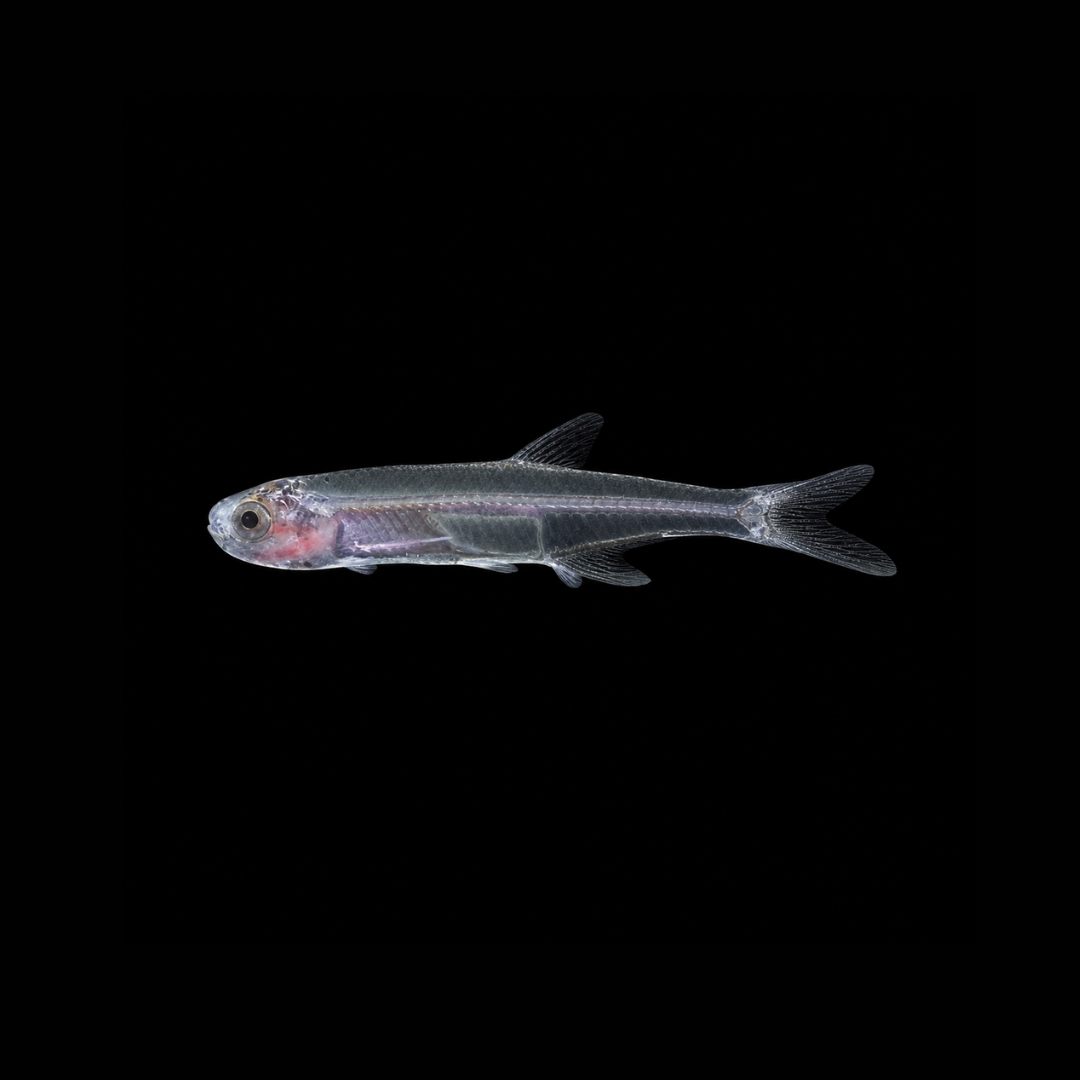
ホエールグラスフィッシュは、南アメリカの大河川水系に暮らす小型の純淡水性カタクチイワシです。細長く透き通った体の中央を銀色の帯が走り、丸みのある吻が愛嬌のある横顔をつくります。日本ではかつて「ホエールグラステトラ」と呼ばれたこともありますが、テトラ類ではなくニシン目カタクチイワシ科に属します。中層から上層を群れで泳ぐ姿は軽快で、照明の角度によって透明感と銀色の反射が繊細に変化します。 The whale glassfish is a small, fully freshwater anchovy from the great river systems of South America. Its slender translucent body carries a bright silver stripe, while its rounded, projecting snout gives it a charming profile. It was once sold in Japan as the “whale glass tetra,” but it is not a tetra; it belongs to the anchovy family Engraulidae in the order Clupeiformes. A school moving through the middle and upper levels of an aquarium creates a light, flowing display, with the body transparency and silver reflection changing subtly with the viewing angle.
基本情報 / Basic Information
| 学名 / Scientific Name | Anchoviella jamesi (Jordan & Seale, 1926) |
|---|---|
| 通称 / Common Name | ホエールグラスフィッシュ、ホエールヘッドグラスフィッシュ、旧流通名:ホエールグラステトラWhale glassfish, whale-head glassfish; formerly traded in Japan as whale glass tetra |
| 分類 / Family | ニシン目・カタクチイワシ科・カタクチイワシ亜科・アンコヴィエーラ属Order Clupeiformes, family Engraulidae, subfamily Engraulinae, genus Anchoviella |
| 英名 / English Name | James’s anchovy |
| 分布 / Distribution | 南アメリカのアマゾン川およびオリノコ川水系。ペルー、ブラジル、ボリビア、コロンビア、ベネズエラ、ギアナ地方などの純淡水域から記録されています。The Amazon and Orinoco river basins of South America, with freshwater records from Peru, Brazil, Bolivia, Colombia, Venezuela, and the Guianas. |
| 最大体長 / Max Size | 標準体長約5cm。流通個体では全長4〜6cmほどが目安です。About 5 cm standard length; aquarium specimens are commonly around 4–6 cm in total length. |
| 寿命 / Lifespan | 信頼できる長期飼育記録が少なく、明確な寿命は不明です。導入後の安定した維持を最優先に考える魚種です。A reliable captive lifespan has not been established because long-term husbandry records are scarce. Successful acclimation and stable maintenance should be treated as the first priorities. |
飼育環境 / Aquarium Environment
| 水槽サイズ / Tank Size | 少なくとも6匹前後の群れに60cm規格水槽(約60L)以上を用意し、10匹以上をゆったり泳がせるなら90cm規格水槽(約180L)以上が理想的です。体は小さくても遊泳性が高いため、水量だけでなく横方向の長さを重視します。Provide at least a standard 60 cm aquarium of roughly 60 L for a group of about six. A standard 90 cm aquarium of roughly 180 L or larger is preferable for a school of ten or more. Although the fish is small, it is highly active, so horizontal swimming length matters as much as water volume. |
|---|---|
| 水温 / Temperature | 飼育目安は22〜26℃です。20〜27℃程度の範囲でも急変を避け、夏場は高水温による溶存酸素の低下に注意します。 A practical target is 22–26°C. Temperatures around 20–27°C may be workable when changes are gradual, but warm summer water can reduce dissolved oxygen and requires particular care. |
| 水質 / Water Quality | 弱酸性から中性の軟水を基本とし、目安はpH6.2〜7.2、4〜10dGH程度です。アンモニアと亜硝酸は常に検出されない状態を保ち、硝酸塩も低く維持します。数値を追うだけでなく、急変のない成熟した水を用意することが重要です。Use soft, slightly acidic to neutral water, with a practical target of pH 6.2–7.2 and about 4–10 dGH. Ammonia and nitrite should remain undetectable, and nitrate should be kept low. A mature aquarium with stable conditions is more important than chasing exact numbers. |
| レイアウト / Layout | 中層から上層に広い遊泳空間を残し、流木や水草は側面や後景にまとめます。穏やかな一方向の水流と、水面を軽く波立たせる十分な酸素供給が適しています。強すぎる照明は避け、浮草や陰になる場所を少量設けると落ち着きやすくなります。Leave a broad open area through the middle and upper water, arranging wood and plants along the sides or rear. A gentle directional current and good surface agitation for oxygenation are suitable. Avoid excessively bright lighting, and provide a small amount of floating cover or shaded space. |
| 注意点 / Precautions | 導入直後は水質差と輸送による擦れの影響を受けやすいため、照明を落としてゆっくり水合わせを行います。袋の水質が悪化している場合は長時間の点滴法がかえって負担になることもあるため、水温、pH、アンモニアの状態を見て方法を調整してください。飛び出し防止のフタを必ず設置し、目の粗いネットで追い回すことも避けます。New arrivals can be vulnerable to differences in water chemistry and abrasion from transport, so dim the lights and acclimate carefully. If shipping water has deteriorated, prolonged drip acclimation can sometimes increase exposure to toxic ammonia; adjust the method according to temperature, pH, and shipping-water condition. Use a tight-fitting lid, and avoid chasing the fish with coarse nets. |
餌と給餌 / Feeding
| 餌の種類 / Diet | 孵化したブラインシュリンプ、冷凍アカムシ、ミジンコ類などの小さな動物質の餌が導入時に有効です。状態が整えば、細かなフレークや小粒の浮上性・緩沈下性人工飼料にも慣らせます。自然下の詳しい食性資料は限られるため、口に入る大きさの多様な動物性飼料を中心に組み立てます。Newly hatched brine shrimp, frozen bloodworms, daphnia, and other small animal-based foods are useful during acclimation. Once settled, the fish can often be trained onto finely crushed flakes or tiny floating and slowly sinking prepared foods. Because detailed species-specific diet data are limited, use a varied menu of appropriately sized animal-based foods. |
|---|---|
| 給餌のポイント / Feeding Tips | 中層を漂う小さな餌に反応しやすいため、一度に多量を落とさず、1日2〜3回に分けて少量ずつ与えます。最初は動く餌で摂餌反応を引き出し、冷凍餌、人工飼料へ段階的に移行します。腹部がくぼむ個体がいないか毎日確認し、混泳魚に食べ負ける場合は給餌場所を分けます。The fish responds best to small particles moving through midwater. Offer modest portions two or three times daily rather than one heavy feeding. Begin with moving live foods to trigger a feeding response, then gradually mix in frozen and prepared diets. Check each fish for a pinched abdomen and separate feeding zones when faster tank mates dominate the food. |
性格と混泳 / Temperament and Tank Mates
| 性格 / Temperament | 温和で、群れをつくって中上層を泳ぐタイプです。単独や少数では警戒が強まりやすいため、最低でも5〜6匹、できれば10匹以上での飼育が向きます。群れが落ち着くと摂餌反応も安定し、透明な体と銀色の帯が連なって見える本来の魅力が現れます。Peaceful and schooling, it spends most of its time in the middle and upper water. Individuals kept alone or in very small numbers may remain nervous, so keep at least five or six, and preferably ten or more. A settled school usually feeds more confidently and displays the characteristic chain of translucent bodies and silver stripes. |
|---|---|
| 混泳の相性 / Compatibility | 同程度の水質を好む温和な小型魚や、小型コリドラス、オトシンクルスなどの底層魚と合わせやすい魚です。大型魚、口に入る魚を捕食する魚、強い縄張りを持つ魚、ひれをかじる魚は避けます。ゼブラダニオや活発なバルブ類など、餌を素早く独占する魚との混泳では痩せに注意が必要です。It can be combined with peaceful small fishes that share similar water requirements, as well as small Corydoras and Otocinclus occupying the lower levels. Avoid large predators, strongly territorial species, and fin nippers. With very fast feeders such as zebra danios or active barbs, monitor body condition carefully because the anchovies may be outcompeted. |
病気と対策 / Diseases and Prevention
| かかりやすい病気 / Common Diseases | 本種だけに特有の病気は知られていませんが、輸送ストレスや急な水質変化の後には白点病、細菌性の皮膚炎、鰭の傷みなど一般的な淡水魚のトラブルが起こり得ます。鱗や体表を傷めた個体では、二次感染に注意します。No disease is known to be unique to this species, but common freshwater problems such as ich, bacterial skin infection, and fin damage may appear after shipping stress or rapid changes in water conditions. Fish with damaged scales or skin require close observation for secondary infection. |
|---|---|
| 対策と予防 / Prevention | 成熟した隔離水槽で2〜4週間ほど状態を観察し、十分な酸素、安定した水温、少量頻回の給餌を優先します。毎週の部分換水を基本とし、ろ材や底床を一度に大きく洗い過ぎないようにします。薬剤や塩分への種固有の耐性資料は乏しいため、予防目的の常用は避け、症状を確認してから適切な濃度で治療します。Observe new fish in a mature quarantine aquarium for roughly two to four weeks, prioritizing strong oxygenation, stable temperature, and frequent small feedings. Perform regular partial water changes without over-cleaning all filter media or substrate at once. Species-specific tolerance data for medications and salt are limited, so avoid routine preventive dosing and treat only after identifying a clear problem. |
増やし方(繁殖) / Breeding
| 雌雄の判別 / Sexing | 外見による確実な判別方法は確立されていません。成熟した雌は産卵期に腹部がやや丸く見える可能性がありますが、通常時の判別材料としては不確実です。No reliable external method of sexing has been established. Mature females may appear slightly fuller when carrying eggs, but this is not a dependable method under ordinary conditions. |
|---|---|
| 繁殖形態 / Reproduction | 群れで産卵することが記録されています。カタクチイワシ類では水中に卵を放つ集団産卵が一般的ですが、本種の卵の性質、産卵時刻、仔魚の初期餌料については種固有の資料が不足しています。School spawning has been reported. Group release of eggs into open water is common among anchovies, but species-specific information on egg characteristics, spawning time, and first foods for the larvae remains insufficient. |
| 繁殖のポイント / Breeding Tips | 水槽内繁殖の標準手法は確立されていません。試みる場合は、よく太った成魚群を別水槽に移し、清浄で酸素量の多い軟水と穏やかな水流を用意します。産卵が確認できたら親魚と卵を分け、孵化仔魚にはワムシやインフゾリアなど極小の生き餌を準備する必要があると考えられます。いずれも近縁群の知見を基にした実験的な目安です。A standard aquarium breeding method has not been established. An experimental attempt would use a well-conditioned adult school in a separate aquarium with clean, oxygen-rich soft water and gentle flow. If spawning occurs, separate the adults from the eggs and prepare extremely small live foods such as rotifers or infusoria for the larvae. These suggestions are provisional and based on knowledge of related clupeiform fishes. |
雑学と豆知識 / Trivia and Fun Facts
| 1. テトラではなく、川に定着したカタクチイワシ / 1. An Anchovy of the Rivers, Not a Tetra | 透明な小型魚が群れで泳ぐ姿から、日本への導入初期には「ホエールグラステトラ」という名で扱われました。しかし本種はカラシン目ではなくニシン目の魚で、前方へ張り出す丸い吻、短い上顎、鰭の配置、脂鰭を持たない体つきなどにカタクチイワシ科らしさが表れます。海や河口に暮らす仲間が多い科の中で、中上流の純淡水域に生活史を築いたことこそ、本種の最大の個性です。Because a school of small translucent fish resembles many aquarium characins, the species was initially sold in Japan as the “whale glass tetra.” It is actually a clupeiform anchovy. Its rounded overhanging snout, short upper jaw, fin arrangement, and absence of an adipose fin all contribute to its anchovy-like form. In a family dominated by marine and estuarine fishes, its life in the middle and upper reaches of freshwater rivers is its most remarkable feature. |
|---|---|
| 2. ウィリアム・ジェームズの名を受け継ぐ魚 / 2. A Fish Bearing William James’s Name | 種小名jamesiは、哲学者・心理学者として知られるウィリアム・ジェームズに献名されたものです。若きジェームズは1865年、医学修業の途中でルイ・アガシが率いるブラジル探検に加わり、アマゾンの標本採集に携わりました。本種は1926年にAmplova jamesiとして記載され、そのタイプ産地はブラジルのジュタイ川、ホロタイプはハーバード大学比較動物学博物館のMCZ 18014です。小さな透明魚の学名には、19世紀の探検史と思想史が静かに重なっています。The species name jamesi honors William James, the influential philosopher and psychologist. As a young medical student, James joined Louis Agassiz’s Brazilian expedition in 1865 and took part in collecting Amazonian specimens. The fish was described in 1926 as Amplova jamesi; its type locality is the Rio Jutahy in Brazil, and the holotype is MCZ 18014 at Harvard’s Museum of Comparative Zoology. The name of this tiny translucent fish therefore carries an unexpected link between exploration, natural history, psychology, and philosophy. |
| 3. 透明な体と銀色の帯は別々の光学戦略 / 3. Transparency and Silvering as Two Optical Strategies | 体の透明感は輪郭を弱め、銀色の側帯は周囲の光を反射して体のコントラストを下げる方向に働くと考えられます。魚類の銀色は一般に、光を強く反射するグアニン結晶を含む反射細胞と関係しています。透明魚の筋肉が虹色に見える仕組みについては、ゴーストキャットフィッシュで筋節による回折が実証されていますが、同じ機構がホエールグラスフィッシュで直接確認されたわけではありません。本種を観察するときは、確立した一般原理と、まだ検証されていない種固有の仮説を分けて楽しむことが大切です。Body transparency can weaken the outline, while the silver stripe likely lowers contrast by reflecting surrounding light. In fishes, silver coloration is generally associated with reflective cells containing guanine crystals. Sarcomere diffraction has been demonstrated as the source of transmitted iridescence in the transparent ghost catfish, but the same mechanism has not been directly demonstrated in the whale glassfish. Observing this species is therefore especially rewarding when established optical principles are kept separate from attractive but untested species-specific hypotheses. |
| 4. 属名は「小さなアンチョビ」を意味する / 4. The Genus Name Means a Small Anchovy | Anchoviellaという属名はAnchoviaの縮小形で、多くの種が小型であることを表した名と解釈されています。日本の流通名は丸い頭をクジラになぞらえた愛称ですが、学名の側には「小さなアンチョビ」という分類学者らしい素直な見立てが残されています。可愛らしい商品名と、魚類学的な属名の双方が、この魚の輪郭を別々の角度から言い当てています。Anchoviella is a diminutive form of Anchovia and is generally interpreted as referring to the small size of many species in the genus. The Japanese trade name compares the rounded head to a whale, while the scientific genus name simply presents it as a little anchovy. The affectionate aquarium name and the taxonomic name describe the same fish from two very different viewpoints. |
| 5. 日本の観賞魚流通が研究にもつながった / 5. The Japanese Aquarium Trade Reached Scientific Research | 2017年に発表されたカタクチイワシ類の分子系統研究では、比較材料となったAnchoviella jamesiが日本の観賞魚業者から入手されたと記録されています。珍魚として輸入された一個体が、属を越えた系統関係を調べる研究材料になった事例です。飼育者が目にする流通個体と、博物館や研究室で扱われる標本は、決して完全に別の世界ではありません。A molecular study of anchovy relationships published in 2017 recorded that its Anchoviella jamesi specimen was obtained from a Japanese ornamental-fish supplier. A fish imported as an aquarium rarity thus became comparative material for research into broader evolutionary relationships. Aquarium specimens and scientific collections are not always separate worlds; occasionally, one becomes part of the other. |
まとめ / Conclusion
ホエールグラスフィッシュは、海のイワシを思わせる姿を持ちながら、南米の純淡水域で暮らすという意外性に満ちた魚です。透明な体と細い銀色の帯が群れになって水中を進む様子は、派手な色彩とは異なる、光そのものを味わうような美しさを見せてくれます。 The whale glassfish combines the familiar silhouette of a marine anchovy with the surprise of a fully freshwater life in South America. A school of translucent bodies crossed by fine silver stripes offers a beauty based not on bold pigment, but on movement, reflection, and light itself.
長く付き合うためには、珍しさだけで選ばず、成熟した広い水槽、豊富な酸素、慎重な導入、食べ負けを防ぐ給餌を整えることが欠かせません。落ち着いた群れが水槽の中層を滑るように泳ぎ始めたとき、この小さな淡水イワシは、静かな存在感と奥深い物語を毎日の観察に添えてくれます。 Long-term care depends on more than rarity: provide a mature and spacious aquarium, abundant oxygen, careful acclimation, and feeding that prevents weaker individuals from being outcompeted. Once the school settles and begins gliding through midwater, this little freshwater anchovy brings a quiet presence and a remarkably deep story to everyday observation.
分布マップ
ホエールグラスフィッシュは、南アメリカのアマゾン川およびオリノコ川水系を中心とする純淡水域から記録されています。
この地図のマーカーは、記事に記載されたアマゾン川・オリノコ川水系という広域分布をイメージするための概略代表地点です。実際の採集地点、個体の確認地点、厳密な生息範囲を示すものではありません。
記事関連のおススメアイテム
参考文献と資料の適用範囲
ホエールグラスフィッシュ(Anchoviella jamesi)について、店舗・通販サイト・個人ブログ・一般的なまとめサイトを除外し、分類、分布、生息環境、繁殖、および魚類の飼育・防疫を支える学術資料と公的資料を選定しています。本種を直接調査した資料と、近縁種または観賞魚一般の知見を用いる資料は、適用範囲が混同されないように分けて示しています。
記事を読む際の重要な注意
本種を対象に、水温、pH、硬度、水槽寸法、収容数、給餌回数、薬剤・塩分耐性を実験的に検証した資料は確認できませんでした。そのため、20〜27℃、弱酸性〜中性、60cmまたは90cm水槽、5〜10匹程度といった数値は、科学的な安全限界ではなく飼育上の目安です。また、水槽内繁殖の確立手法は報告されていません。病気と予防に関する記述は、本種特有の疾病情報ではなく、観賞魚全般に適用される魚病学・防疫上の原則に基づきます。なお、隔離期間についてMSD Veterinary Manualは最低30日を推奨しており、記事中の「2〜4週間」は厳密な防疫基準としては短い可能性があります。
1. 本種の分類・分布・生息環境を直接支える資料
-
Eschmeyer’s Catalog of Fishes: Anchoviella jamesi
Fricke, R., Eschmeyer, W. N. & Van der Laan, R. eds. California Academy of Sciences. Online database.
対応項目:有効学名、原記載名、著者・年、タイプ産地、ホロタイプ、科・亜科、アマゾン川・オリノコ川水系への分布、純淡水性。分類学上の基準資料として最優先します。
-
Bulletin of the Museum of Comparative Zoology, 67(11), 355–418. 本種の原記載は410頁。
対応項目:Amplova jamesiとしての原記載、タイプ標本とタイプ産地、初期の形態記載。後年の分類改訂を確認する際の出発点となる一次資料です。
-
FAO Fisheries Synopsis No. 125, Vol. 7, Part 2. Anchoviella jamesiの項は334頁。
対応項目:形態的特徴、銀色の体側帯、アマゾン水系の支流とオリノコ川中流域への分布、河川中・上流の純淡水環境。生息環境を直接記載する主要資料です。
-
Neotropical Ichthyology, 10(1), 13–18. DOI: 10.1590/S1679-62252012000100002
対応項目:アマゾン産の淡水性Anchoviella各種の比較、検索表、鰓耙数・上顎・臀鰭位置などによるA. jamesiの識別。本種の形態同定を補強する査読論文です。
-
Journal of Fish Biology, 92(6), 1720–1730. DOI: 10.1111/jfb.13601
対応項目:ペルー・西部アマゾンにおける同属魚の分布と形態比較、A. jamesiと近縁淡水種の識別。輸入個体の産地情報を検討する際にも有用です。
-
FishBase: Anchoviella jamesi, James’s anchovy
Froese, R. & Pauly, D. eds. World Wide Web electronic publication.
対応項目:分類、分布、淡水・遊泳性、最大標準体長5.0cm、形態の要約。信頼性の高い魚類データベースですが、原著論文をまとめた二次資料であるため、分類や分布は上記の一次資料と併用します。
2. 繁殖・初期発生を比較検討する資料
-
Neotropical Ichthyology, 8(4), 805–812. DOI: 10.1590/S1679-62252010000400009
対応項目:同属の純淡水種A. vaillantiにおける仔魚・稚魚の形態発達。本種の繁殖記録ではないため、仔魚の発達や初期餌料を考える際の比較資料に限定して用います。
-
Breder, C. M. & Rosen, D. E. (1966). Modes of Reproduction in Fishes.
T.F.H. Publications, Neptune City, New Jersey, 941 pp.
対応項目:FishBaseの「群れで産卵する」という項目に紐づく一般的な繁殖様式の資料です。A. jamesiを直接観察した繁殖報告とは確認できないため、浮遊卵、産卵時刻、雌雄判別、水槽内繁殖法の根拠には使用できません。
3. 飼育環境・病気・導入時の注意を支える一般資料
-
Petty, B. D., Francis-Floyd, R. & Yanong, R. P. E. Management of Aquarium Fish.
MSD Veterinary Manual, professional version. Full review May 2022; updated September 2024.
対応項目:成熟した生物ろ過、アンモニア・亜硝酸の監視、輸送・取り扱いによる体表損傷、隔離と器具の分離、診断なしの予防投薬を避ける考え方。最低30日の隔離を推奨しています。これらは本種固有ではなく、観賞魚全般の管理原則です。
-
Francis-Floyd, R. & Petty, B. D. Disorders and Diseases of Fish.
MSD Veterinary Manual, pet owner version. Full review February 2020; updated April 2026.
対応項目:ストレス、水質不良、過密、未隔離個体の導入と疾病発生の関係、アンモニア障害、皮膚・粘液層の重要性、細菌性鰓疾患などの一般的な魚病管理。本種に特有の好発疾病を示す資料ではありません。
-
FAO Fisheries Technical Paper No. 502. Rome, FAO. 74 pp. ISBN 978-92-5-105977-7.
対応項目:生体移動に伴う病原体リスク、観賞用水生動物を含む隔離施設、衛生管理、器具・排水の分離と消毒。個別の病名や治療濃度ではなく、導入時の防疫体系を支える国際機関の実務資料です。
資料から直接は確定できない記事内情報
寿命、自然下の詳しい食性、人工飼料への移行方法、1日2〜3回という給餌回数、適切な混泳相手、飛び出しやすさ、照明の強さ、正確な温度・pH・硬度、最低水槽サイズ、最低群数、薬剤・塩分耐性、水槽内繁殖手順については、本種を対象とした査読研究による裏付けを確認できません。これらを掲載する場合は、「国内での飼育例」「一般的な小型群泳魚の管理原則」「近縁種からの推定」など、情報の性格が分かる表現を維持する必要があります。
文献情報・オンラインデータベース確認日:2026年7月21日




コメント