

解説 / Description
フィランサス・フルイタンスは、南米アマゾン川流域を中心に、湖沼や湿地の静かな水面で暮らす浮き草です。直径1〜2cmほどの丸い葉が細い茎に沿って交互に並び、まるで小さなハートを水面に散りばめたような姿を見せてくれます。葉の裏側にはふくらんだくぼみがあり、そこに空気をため込むことで安定して浮かんでいます。何よりの魅力は、環境によって変わる色合いでしょう。光が十分に当たり、水中の栄養が控えめになると、緑色だった葉はワインレッドに、水中に垂れる短い根は鮮やかな赤色に染まります。英語圏で「レッドルートフローター(赤い根の浮き草)」と呼ばれるのは、この根の色に由来しています。 Phyllanthus fluitans is a floating plant that lives on the still surfaces of lakes and wetlands, mainly in the Amazon basin of South America. Round leaves about 1–2 cm across are arranged alternately along a slender stem, looking as if tiny hearts had been scattered across the water. Each leaf has a swollen hollow on its underside that holds air, allowing the plant to float stably. Its greatest charm is a color that changes with its surroundings. When it receives plenty of light and nutrients in the water are modest, the green leaves turn wine red and the short roots hanging below turn a vivid red. That root color is the origin of its English name, the “Red Root Floater.”
本種が属するコミカンソウ科は、樹木や陸上の草が大半を占めるグループです。そのなかで、根を土に下ろさずに水面を自由に漂って暮らすのは、フィランサス・フルイタンスただ一種とされています。根が長く伸びないため、小型水槽やメダカの睡蓮鉢でも景観を邪魔せず、水面に赤いアクセントを添えられるのも嬉しいところです。ただし、葉の表側が水に濡れることと寒さには弱いため、長く楽しむには穏やかな水面と冬場の保温が欠かせません。 The family it belongs to, Phyllanthaceae, consists mostly of trees and terrestrial herbs. Within it, Phyllanthus fluitans is considered the only species that lives drifting freely on the water without rooting in soil. Because its roots do not grow long, it does not clutter small aquariums or medaka bowls, and it adds a welcome red accent to the water surface. However, it is vulnerable to having the upper side of its leaves wetted and to cold, so a calm surface and warmth in winter are essential for enjoying it over the long term.
基本情報 / Basic Information
| 学名 / Scientific Name | Phyllanthus fluitans Benth. ex Müll.Arg. 1863年に新種として記載されました。種小名の「fluitans」はラテン語で「浮かんでいる」という意味です。かつてはトウダイグサ科に含められていましたが、DNAを用いた系統解析によって植物どうしの類縁関係が見直された結果、現在はコミカンソウ科に分類されています。水面での暮らしに特化した独特の性質から、属のなかでも本種だけでサルヴィニオプシス節(Salviniopsis)という独立したグループにまとめられています。It was described as a new species in 1863. The specific epithet “fluitans” is Latin for “floating.” It was formerly included in the spurge family, Euphorbiaceae, but after DNA-based phylogenetic studies revised our understanding of plant relationships, it is now classified in Phyllanthaceae. Because of its distinctive specialization for life on the water surface, it is placed alone within the genus in its own section, Salviniopsis. |
|---|---|
| 通称 / Common Name | フィランサス・フルイタンス、レッドルートフローターRed Root Floater, Floating Spurge |
| 分類 / Family | コミカンソウ科 コミカンソウ属(フィランサス属)Phyllanthaceae, genus Phyllanthus |
| 分布 / Distribution | 南米の熱帯〜亜熱帯域。アマゾン川流域を中心に、ブラジル、ペルー、コロンビア、エクアドル、パラグアイ、アルゼンチン北部などの湖沼や湿地、流れの緩やかな水域に自生しています。原産地以外では、アメリカ合衆国フロリダ州などで、人の手で持ち込まれた株が野生化しています。Tropical to subtropical South America. Centered on the Amazon basin, it grows wild in lakes, wetlands, and slow-moving waters in Brazil, Peru, Colombia, Ecuador, Paraguay, northern Argentina, and elsewhere. Outside its native range, plants brought in by people have become naturalized in places such as Florida in the United States. |
| 育成難易度 / Difficulty | 易しい〜普通。穏やかな水面と十分な光があれば、緑色の状態で育てるのは難しくありません。きれいな赤色を引き出すには光と栄養のバランスに少し工夫が必要です。また、熱帯性の植物なので冬は保温が欠かせません。Easy to moderate. With a calm surface and sufficient light, keeping it growing in its green form is not difficult. Bringing out a beautiful red takes a little fine-tuning of the balance between light and nutrients. As a tropical plant, it also needs to be kept warm in winter. |
育成環境 / Cultivation Environment
| 光量 / Light | 明るい環境を好みます。照明に近い水面で育つため、一般的な水槽用LEDでも成長しますが、赤く色づけたい場合は水草育成向けの明るいLEDを選ぶと発色が良くなります。屋外のビオトープでは、日当たりの良い場所に置くと特に鮮やかに染まります。照明を水面に近づけすぎると熱で葉が傷むことがあるため、適度な距離を保ちましょう。It prefers bright conditions. Because it grows at the surface close to the light, it will grow under ordinary aquarium LEDs, but choosing a bright LED designed for planted tanks improves the red coloration. In outdoor ponds and containers, it colors up especially vividly in a sunny spot. Placing the light too close to the water can damage the leaves with heat, so keep a suitable distance. |
|---|---|
| CO2添加 / CO2 Injection | 不要です。葉の表側が空気に触れているため、光合成に必要な二酸化炭素を大気中から直接取り込めます。Not required. Because the upper side of the leaves is exposed to air, the plant can take the carbon dioxide it needs for photosynthesis directly from the atmosphere. |
| 水質 / Water Quality | 水温20〜28℃、pH6.0〜7.5程度の弱酸性〜中性、軟水〜中硬水が適しています。日本の水道水であれば、多くの場合カルキを抜くだけで問題なく育てられます。目安として、水温が15℃を下回ると成長がほぼ止まり、10℃を下回ると葉が傷み始めます。霜が降りるような環境では冬を越せないため、屋外で育てている場合は、最低気温が一桁になる前に室内の加温した水槽へ移しましょう。Suitable conditions are a temperature of 20–28°C, a slightly acidic to neutral pH of about 6.0–7.5, and soft to moderately hard water. Japanese tap water usually works well once dechlorinated. As a rough guide, growth nearly stops below 15°C and the leaves begin to deteriorate below 10°C. It cannot survive winter where frost occurs, so if you grow it outdoors, move it to a heated indoor tank before nighttime lows fall into single digits. |
| 底床 / Substrate | 浮き草なので底床は必要ありません。栄養は水中から吸収します。魚やエビがいる水槽では、生体の排せつ物に由来する栄養で十分に育つことが多く、基本的に追肥は不要です。葉が小さくなったり、色が抜けて黄ばんだりする場合は、カリウムや鉄分を含む液体肥料を少量加えてみてください。赤い発色を狙うなら、窒素分の多い肥料を控えめにするのがコツです。As a floating plant, it needs no substrate and absorbs its nutrients from the water. In tanks with fish or shrimp, nutrients derived from their waste are often enough, so additional fertilizer is generally unnecessary. If the leaves become small or turn pale and yellowish, try adding a small amount of liquid fertilizer containing potassium and iron. If you are aiming for red coloration, the trick is to go easy on nitrogen-rich fertilizers. |
レイアウト / Layout
| 配置 / Positioning | 水面に浮かべて楽しみます。根が短いため、30cm規格水槽(約12リットル)程度の小型水槽でも魚の泳ぐスペースを圧迫しません。緑の水草が中心の水景に赤い彩りを加えたり、上から眺めるメダカの睡蓮鉢やビオトープで水面のアクセントにしたりと、幅広く使えます。浮き草用のリングで囲めば、浮かべる範囲を区切って整った見た目を保てます。Enjoy it floating on the surface. Its short roots mean it does not crowd the fish’s swimming space even in a small aquarium of about 12 liters, such as a standard 30 cm tank. It is versatile: use it to add red to a layout dominated by green plants, or as a surface accent in a medaka bowl or outdoor container viewed from above. Enclosing it in a floating-plant ring keeps it within a set area and maintains a tidy look. |
|---|---|
| 注意点 / Precautions | 水面の揺れや水しぶきを特に嫌います。フィルターの排水口付近は避け、排水パイプの向きを変えるなどして、浮かべる場所の水面を穏やかに保ちましょう。水槽のフタに付いた結露が葉に落ち続けるのも、傷む原因になります。また、増えて水面を覆い尽くすと下の水草に光が届きにくくなるため、ほかの水草とのバランスを見ながら量を調整してください。It particularly dislikes surface movement and splashing. Avoid the area near the filter outlet and redirect the outflow pipe as needed to keep the water calm where it floats. Condensation from the tank lid that keeps dripping onto the leaves can also damage them. Once it multiplies and covers the surface, it becomes harder for light to reach the plants below, so adjust the amount while keeping a balance with your other plants. |
増やし方(トリミング) / Propagation & Trimming
| 増やし方 / Propagation | 茎が伸びながら枝分かれし、やがてちぎれて別の株になることで自然に増えていきます。特別な作業は必要なく、環境が合えば次々に株数が増えていきます。条件が良いと、葉の付け根に直径数mmほどの小さな白い花が咲くこともあります。It multiplies naturally as the stem grows and branches, eventually breaking apart into separate plants. No special effort is needed; if conditions suit it, the number of plants increases steadily. Under good conditions, tiny white flowers only a few millimeters across may appear at the bases of the leaves. |
|---|---|
| トリミング / Trimming | 増えすぎたら株ごと取り出して間引きます。色の悪い株や古くなった株から優先して取り除くと、残した株がきれいに見えます。覆う範囲を水面の半分程度までにとどめると、下の水草にも光が届きやすくなります。取り出した株は、乾燥させてから可燃ごみとして処分してください。When it becomes too dense, thin it out by removing whole plants. Taking out discolored or older plants first keeps the remaining ones looking their best. Limiting coverage to about half the surface makes it easier for light to reach the plants below. Dry out removed plants before disposing of them with burnable waste. |
病気と対策(コケなど) / Pests & Algae
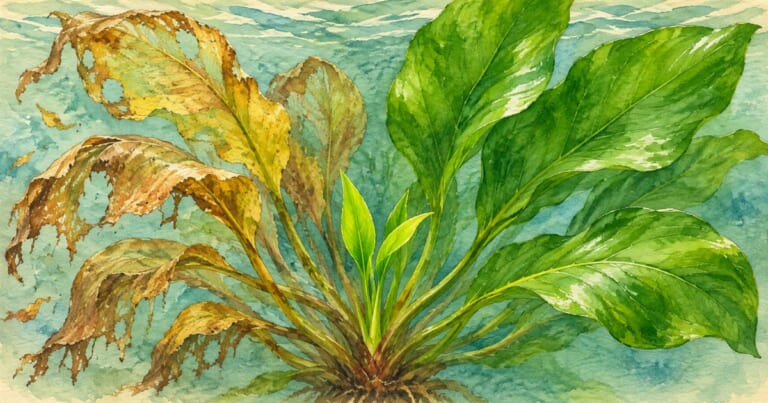
| かかりやすい病気 / Common Issues | 最も多いトラブルは葉の溶けです。水しぶきや結露で葉の表側が濡れた状態が続くと、葉が空気とうまく呼吸できなくなって傷み、やがて溶けてしまいます。低温や急な環境の変化も溶けの原因になります。光や栄養が足りないと、葉が小さく黄色っぽくなり、株も弱りがちです。また、購入した株に小さな巻き貝やウキクサが紛れ込んでいることがあり、屋外ではアブラムシが付くこともあります。The most common problem is melting leaves. When the upper side of the leaves stays wet from splashing or condensation, the leaves can no longer exchange gases with the air properly, and they deteriorate and eventually melt. Low temperatures and sudden environmental changes can also cause melting. A lack of light or nutrients makes the leaves small and yellowish and tends to weaken the plant. Purchased plants may also carry small snails or duckweed, and outdoors aphids sometimes appear. |
|---|---|
| 対策と予防 / Prevention | 穏やかな水面を確保することが、何よりの予防策です。溶けた葉や傷んだ株は、水を汚す前に早めに取り除きましょう。購入した株はしばらく別の容器で様子を見て、巻き貝やウキクサが混じっていないことを確かめてから本水槽に移すと安心です。組織培養のカップ入り商品であれば混入の心配はほとんどありませんが、根に付いた培地は水道水でしっかり洗い流してから使ってください。培地が残っていると、水質の悪化や水カビの原因になります。屋外でアブラムシが付いた場合は、水をかけて洗い落とすか、株ごと取り除いて対処します。Keeping the surface calm is the best prevention of all. Remove melted leaves and damaged plants promptly, before they foul the water. It is reassuring to keep newly purchased plants in a separate container for a while and confirm they are free of snails and duckweed before moving them into the main tank. Tissue-culture cups carry almost no risk of such hitchhikers, but rinse the growth medium off the roots thoroughly with tap water before use, since leftover medium can degrade water quality and encourage water mold. If aphids appear outdoors, wash them off with water or remove the affected plants. |
雑学と豆知識 / Trivia and Fun Facts
| 1. 探検家が目を疑った「花の咲くサンショウモ」 / 1. The “Flowering Salvinia” That Surprised an Explorer | 本種を最初に採集したのは、19世紀半ばにアマゾンを長く探検したイギリスの植物学者リチャード・スプルースです。水面に浮かぶ本種を見つけたスプルースは、その姿が水生シダのサンショウモにあまりにもよく似ていることに驚き、花を咲かせる植物の仲間だとはにわかに信じられなかったと記しています。シダ植物と花を咲かせる植物は、系統的にはまったく別のグループです。それでも、水面に浮かんで暮らすという同じ生き方をするうちに、よく似た姿にたどり着きました。つまり、似ているのは近い親戚だからではなく、同じ環境に適応した結果なのです。このような現象は「収れん進化」と呼ばれ、本種とサンショウモはそのわかりやすい例として今も紹介されています。The first person to collect this species was Richard Spruce, the British botanist who explored the Amazon for many years in the mid-19th century. On finding it floating on the water, Spruce was struck by how closely it resembled the aquatic fern Salvinia, and he wrote that he could scarcely believe it belonged among the flowering plants. Ferns and flowering plants are entirely separate lineages, yet by adopting the same way of life, floating on the water surface, they arrived at strikingly similar forms. In other words, the resemblance comes not from close kinship but from adapting to the same environment. This phenomenon is called convergent evolution, and this species and Salvinia are still presented as a clear example of it. |
|---|---|
| 2. 木の仲間のなかで、ただ一人の浮き草 / 2. The Lone Floater in a Family of Trees | コミカンソウ属は、世界の熱帯〜亜熱帯に数百種以上が知られる大きなグループで、その多くは樹木や低木、陸上の草です。インドで果実が利用されるアンマロク(アムラ)もこの仲間ですし、日本の畑や道端で見かける雑草のコミカンソウも同じ属に含まれます。コミカンソウという和名は、枝の下に並ぶ小さな丸い実をミカンに見立てたものです。この大家族のなかで、水面を自由に漂う暮らしを選んだのはフィランサス・フルイタンスだけです。英名の「フローティング・スパージ(浮かぶトウダイグサ)」は、トウダイグサ科に分類されていた時代の名残です。The genus Phyllanthus is a large group with many hundreds of species known from the tropics and subtropics worldwide, most of them trees, shrubs, or terrestrial herbs. The Indian gooseberry (amla), whose fruit is used in India, belongs to this group, and so does komikansō, a weed seen in Japanese fields and along roadsides. Its Japanese name, meaning “little mandarin plant,” likens the small round fruits lined up beneath its branches to mandarins. Within this large family, Phyllanthus fluitans alone took up a life drifting freely on the water. Its English name “Floating Spurge” is a holdover from the days when it was classified in the spurge family, Euphorbiaceae. |
| 3. 赤い色は植物の「日焼け止め」 / 3. Red as the Plant’s Sunscreen | 葉や根を赤く染めているのは、アントシアニンという色素です。植物は強すぎる光を浴びると、光合成で使い切れないエネルギーから、細胞を傷つける活性酸素が生じてしまいます。アントシアニンは余分な光を吸収するフィルターとして働くうえ、生じた活性酸素を消す抗酸化物質としての役割も担っています。つまり、植物が自分で作り出す日焼け止めのような存在です。また、植物は窒素が不足すると、光合成で得た炭素をアントシアニン作りに回しやすくなることが知られています。そのため本種は、強い光の下で窒素が控えめな環境では赤く色づき、反対に栄養が豊富な環境では緑色のまま勢いよく育つ傾向があります。水草愛好家のなかには、この色の変化を、水中の硝酸塩(窒素分)の多さを推し量る目安として活用する人もいます。The pigment that colors the leaves and roots red is anthocyanin. When a plant is exposed to excessive light, the energy it cannot use for photosynthesis generates reactive oxygen species that damage its cells. Anthocyanin works as a filter that absorbs excess light and also acts as an antioxidant that neutralizes these harmful molecules. In other words, it is something like a sunscreen the plant produces for itself. Plants are also known to channel more of the carbon gained through photosynthesis into making anthocyanin when nitrogen is in short supply. As a result, this species tends to turn red under strong light when nitrogen is limited, while in nutrient-rich water it tends to stay green and grow vigorously. Some planted-tank enthusiasts use this color change as a rough indicator of how much nitrate, a form of nitrogen, is in the water. |
| 4. 美しさの裏にある、野外に出さないという約束 / 4. Behind the Beauty: A Promise to Keep It Out of the Wild | 茎のかけらからでも増えるほどの旺盛な繁殖力は、自然界では大きな問題になることがあります。アメリカのフロリダ州では、人の手で持ち込まれた本種が川で野生化しており、水面を厚く覆って水中への光を遮ることで、在来の水草や水中の酸素環境に悪影響を及ぼすことが心配されています。日本では現在のところ外来生物法による規制の対象ではなく、自由に育てたり販売したりできます。しかし、近年の夏の暑さを考えると、温暖な地域で野生化する可能性がないとは言い切れません。増えすぎた株やトリミングで出た葉は、川や水路、排水口に流さず、乾燥させてから可燃ごみとして処分しましょう。こうした小さな心がけが、この美しい浮き草をこれからも楽しみ続けるための大切な約束です。Its vigorous ability to regrow even from stem fragments can become a serious problem in nature. In Florida in the United States, plants brought in by people have become naturalized in rivers, and there is concern that their thick mats block light from reaching the water below, harming native aquatic plants and oxygen conditions in the water. In Japan it is not currently regulated under the Invasive Alien Species Act and may be freely grown and sold. Given the heat of recent summers, however, the possibility of naturalization in warmer regions cannot be ruled out. Never release surplus plants or trimmings into rivers, ditches, or drains; dry them out and dispose of them with burnable waste. Small habits like this are an important promise that lets us keep enjoying this beautiful floating plant. |
まとめ / Conclusion
フィランサス・フルイタンスは、空気をため込む丸い葉と、赤く色づく短い根を持つ浮き草で、コミカンソウ科で唯一、水面を漂って暮らす種類です。光と栄養のバランスによって緑から深い赤へと表情を変え、育て手の工夫がそのまま葉色に表れるところに、この浮き草ならではの奥深さがあります。小型水槽から屋外のメダカ鉢まで、水面に浮かべるだけで景色を引き締めてくれる存在感も見逃せません。 Phyllanthus fluitans is a floating plant with round, air-holding leaves and short roots that turn red, and it is the only member of Phyllanthaceae that lives drifting on the water surface. Its look shifts from green to deep red depending on the balance of light and nutrients, and the way a keeper’s care shows directly in its leaf color gives it a depth all its own. Its presence is not to be overlooked either: simply floating it on the surface brings the scene together, whether in a small aquarium or an outdoor medaka bowl.
育成の要は、穏やかな水面と十分な光、そして冬の保温です。条件が整えば、水面に広がる赤い葉が、毎日の水槽観察をいっそう楽しいものにしてくれるでしょう。間引いた株を正しく処分する心配りとともに、水面に浮かぶ小さな宝石との暮らしを楽しんでください。 The essentials of growing it are a calm surface, ample light, and warmth in winter. Once those conditions are in place, red leaves spreading across the water will make watching your tank each day all the more enjoyable. Together with the care of disposing of thinned plants properly, enjoy life alongside this little jewel floating on the water.

困りごとの解決から、用品えらび、水槽づくり、生き物えらびまで。飼育に役立つ案内です。
分布マップ / Distribution Map
Phyllanthus fluitans(フィランサス・フルイタンス)は南米の熱帯〜亜熱帯域に分布し、アマゾン川流域を中心に、ブラジル、ペルー、コロンビア、エクアドル、パラグアイ、アルゼンチン北部などの湖沼や湿地、流れの緩やかな水域に自生しています。 Phyllanthus fluitans is distributed across tropical to subtropical South America. Centered on the Amazon basin, it grows wild in lakes, wetlands, and slow-moving waters in Brazil, Peru, Colombia, Ecuador, Paraguay, northern Argentina, and elsewhere.
OpenStreetMapで大きな地図を見るView larger map on OpenStreetMap Google Earthで開くOpen in Google Earth
※この地図は自然分布域のおおよその範囲を示す概略表示です。マーカーはアマゾン川流域中央部に置いた代表地点で、実際の採集地点や生息確認地点ではありません。アメリカ合衆国フロリダ州などの野生化地域は表示範囲に含まれていません。 Note: This map is a rough overview showing the approximate extent of the native range. The marker is a representative point placed in the central Amazon basin and is not an actual collection or confirmed occurrence site. Naturalized areas such as Florida in the United States are outside the displayed area.
参考文献 / References
分類・学名 / Taxonomy and Nomenclature
- Müller Argoviensis, J. (1863). Euphorbiaceae. Vorläufige Mittheilungen aus dem für De Candolle’s Prodromus bestimmten Manuscript über diese Familie. Linnaea, 32.
- Kathriarachchi, H., Samuel, R., Hoffmann, P., Mlinarec, J., Wurdack, K. J., Ralimanana, H., Stuessy, T. F., & Chase, M. W. (2006). Phylogenetics of tribe Phyllantheae (Phyllanthaceae; Euphorbiaceae sensu lato) based on nrITS and plastid matK DNA sequence data. American Journal of Botany, 93(4), 637–655. https://doi.org/10.3732/ajb.93.4.637
- Royal Botanic Gardens, Kew. Phyllanthus fluitans Benth. ex Müll.Arg. Plants of the World Online. https://powo.science.kew.org/taxon/urn:lsid:ipni.org:names:353898-1
分布・生息環境 / Distribution and Habitat
- GBIF Secretariat. Phyllanthus fluitans Benth. ex Müll.Arg. GBIF Backbone Taxonomy. https://www.gbif.org/species/5381811
- Ibáñez, A., & Flores, R. (2021). Phyllanthus fluitans (Phyllanthaceae): a new record of an aquatic plant for the flora of Panama. Acta Botanica Mexicana, 128, e1767. https://doi.org/10.21829/abm128.2021.1767
- Spruce, R. (1908). Notes of a Botanist on the Amazon & Andes (A. R. Wallace, Ed.). London: Macmillan and Co.
生理・発色 / Physiology and Coloration
- Chalker-Scott, L. (1999). Environmental significance of anthocyanins in plant stress responses. Photochemistry and Photobiology, 70(1), 1–9. https://doi.org/10.1111/j.1751-1097.1999.tb01944.x
外来種としてのリスク・法規制 / Invasive Risk and Regulation
- Wilder, G. J., & Sowinski, M. P. (2010). Phyllanthus fluitans Benth. (Euphorbiaceae) a newly reported invasive species in Florida. Wildland Weeds, 13(4), 14–15.
- USDA APHIS PPQ. (2017). Weed Risk Assessment for Phyllanthus fluitans Benth. ex Müll. Arg. (Phyllanthaceae) – Red root floater (Version 2). United States Department of Agriculture. https://www.aphis.usda.gov/media/document/59931/file
- University of Florida IFAS. Phyllanthus fluitans – Red root floater. UF/IFAS Plant Directory. https://plant-directory.ifas.ufl.edu/plant-directory/phyllanthus-fluitans
- 環境省. 特定外来生物等一覧. https://www.env.go.jp/nature/intro/2outline/list.html



コメント