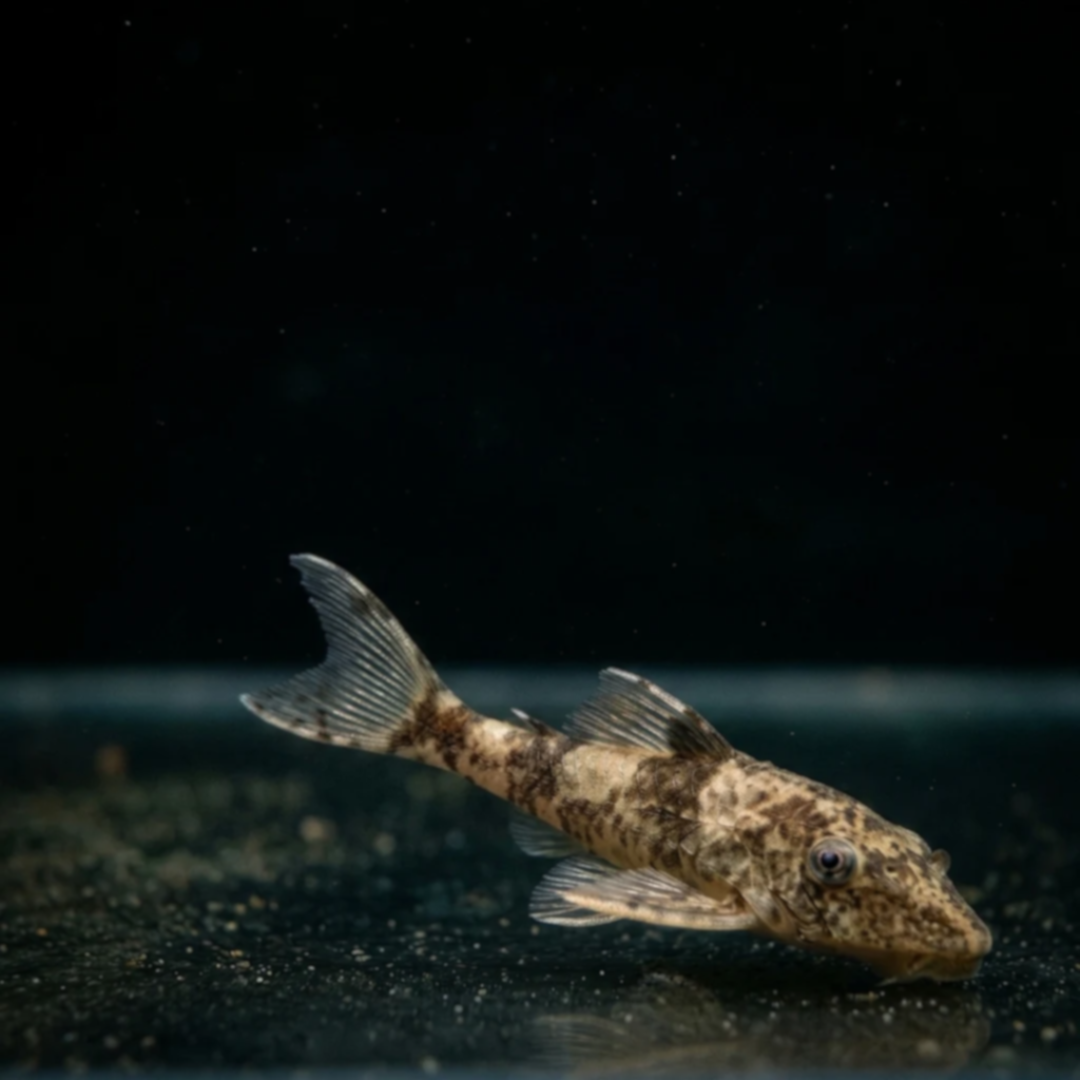
ピグミータイガーオトシンクルスは、南米ペルーのアマゾン川上流域から輸入される、全長2〜3cm前後(入荷時は1〜2cm程度)の極小ロリカリア科魚類です。日本国内では「ピグミータイガーオトシン」の略称で親しまれています。かつては近縁のバンブルビーオトシンとともに Parotocinclus sp. “Peru” という仮の名前でひとまとめに扱われ、両者が同じ魚として売られることも少なくありませんでした。2022年に新しくリノトキンクルス属(Rhinotocinclus)が設けられ、バンブルビーオトシンは Rhinotocinclus isabelae として正式に名前が付けられましたが、ピグミータイガーとして流通する魚には今も確定した学名がなく、Rhinotocinclus sp. として扱われています。バンブルビーオトシンと比べると、体に赤茶色のバンドが入り、体高がやや低くスレンダーな印象を受けるのが特徴で、顔つきもはっきり異なります。また、灰色から淡い緑色を帯びた体に細かな斑点が散るドット型もこの名で流通しており、複数の近縁種や地域変異が含まれていると考えられています。流通する個体はほぼすべてが野生採集で、輸入直後の餓死や水質悪化による死亡が多いことから、長く「超難種」と呼ばれてきました。現在では、熟成させた枯れ葉やバイオフィルム(微生物の膜)を絶やさず供給する飼育法が広まり、専用の環境を整えれば長期飼育を目指せる魚として、中・上級者を中心に根強い人気を集めています。The Pygmy Tiger Otocinclus is a tiny loricariid catfish about 2 to 3 cm in total length (typically 1 to 2 cm when imported), shipped from the upper Amazon basin in Peru. In Japan it is affectionately known by the shortened name “Pygmy Tiger Oto.” It was once lumped together with the related Bumblebee Otocinclus under the provisional name Parotocinclus sp. “Peru,” and the two were often sold as the same fish. In 2022 the new genus Rhinotocinclus was established and the Bumblebee Oto was formally named Rhinotocinclus isabelae, but the fish sold as the Pygmy Tiger still has no confirmed scientific name and is treated as Rhinotocinclus sp. Compared with the Bumblebee Oto, it has reddish-brown bands on the body and a slightly lower, more slender build, and its face is clearly different. A dotted form with fine spots on a grey to faintly greenish body is also sold under this name, and several related species or regional variants are thought to be included. Nearly all specimens in the trade are wild-caught, and because so many died from starvation or poor water quality soon after import, it was long regarded as an extremely difficult species. Today, care methods that keep a steady supply of aged leaf litter and biofilm (microbial films) have spread, and it has become a fish that can be kept long term in a dedicated setup, remaining popular among intermediate and advanced aquarists.
基本情報 / Basic Information
学名 / Scientific Name
Rhinotocinclus sp.
通称 / Common Name
ピグミータイガーオトシン、タイガーオトシンPygmy Tiger Oto, Tiger Oto
分類 / Family
ナマズ目 ロリカリア科 ヒポプトポマ亜科 リノトキンクルス属Siluriformes, Loricariidae, Hypoptopomatinae, genus Rhinotocinclus
英名 / English Name
Pygmy Tiger Otocinclus, Tiger Otocinclus
分布 / Distribution
南米ペルー北東部のアマゾン川上流域。主にロレート県のイキトスから輸出され、ナポ川などの支流域で採集されたとされる個体も流通している。学名が確定しておらず、正確な分布域は明らかになっていない。タンニンで紅茶色に染まったブラックウォーター河川に生息すると考えられている。The upper Amazon basin in northeastern Peru. It is mainly exported from Iquitos in the Loreto Department, and fish said to have been collected from tributaries such as the Río Napo are also traded. Because its scientific name has not been determined, its exact range is unknown. It is thought to inhabit blackwater rivers stained tea-brown by tannins.
最大体長 / Max Size
全長約2〜3cm(入荷時は1〜2cm程度)About 2 to 3 cm in total length (typically 1 to 2 cm when imported)
寿命 / Lifespan
2〜4年程度(飼育下では最大5年ほどが目安とされるが、科学的な実測データはない)About 2 to 4 years (up to around 5 years in captivity is given as a rough guideline, but there are no scientifically measured data)
飼育環境 / Aquarium Environment
水槽サイズ / Tank Size
45cm規格水槽〜60cm規格水槽(水量40L以上)を推奨。体は小さくても水質の急変に非常に弱いため、水量に余裕があるほど管理が安定する。熟練者が専用に管理する場合は25〜40cmクラスで飼育する例もある。輸入直後の個体は、他の活発な魚がいない立ち上げ済みの別水槽で餌付けと体力回復を済ませてから本水槽へ移すのが理想的。A 45 cm to 60 cm standard tank (40 L or more) is recommended. Although the fish is tiny, it is extremely vulnerable to sudden changes in water quality, so the more water volume, the more stable the conditions. Experienced keepers sometimes use 25 to 40 cm tanks in dedicated setups. Newly imported fish are ideally settled in a separate, already-cycled tank without other active fish until they are feeding and have regained condition, then moved to the main tank.
水温 / Temperature
22〜26℃。生息地とされるペルー・アマゾンの河川の水温は26〜28℃前後だが、水温が高いほど水に溶け込める酸素の量は減るため、水量の限られた家庭水槽では低めに保つほうが安全とされる。高水温に非常に弱く、日本の夏は水槽用クーラーの設置か、エアコンによる24時間の室温管理が欠かせない。冬はサーモスタット付きヒーターで水温を安定させる。22 to 26°C. Rivers in the Peruvian Amazon where it is thought to live are around 26 to 28°C, but warmer water holds less dissolved oxygen, so keeping the temperature a little lower is considered safer in the limited volume of a home aquarium. It is very weak against high temperatures, and in the Japanese summer an aquarium chiller or round-the-clock air conditioning is essential. In winter, keep the temperature stable with a thermostat-controlled heater.
水質 / Water Quality
pH 6.0〜7.5(理想は6.0〜7.0)の弱酸性〜中性の軟水。同属のバンブルビーオトシンが暮らすナナイ川などのブラックウォーター河川は、pH 5.0〜6.0前後、電気伝導率15〜50 µS/cm という、溶けているミネラルが極めて少ない超軟水だが、飼育下で同じ数値を無理に再現する必要はなく、水質が安定していることが何より重要。日本の水道水はおおむね軟水で扱いやすいものの、関東地方など硬度が高めの地域では、ソイル、流木、アク抜き済みの枯れ葉、RO水の混合などで緩やかに調整する。アンモニアと亜硝酸は常にゼロ、硝酸塩は20ppm未満を目安とし、十分なエアレーションで溶存酸素を高く保つ。Soft, slightly acidic to neutral water with a pH of 6.0 to 7.5 (ideally 6.0 to 7.0). Blackwater rivers such as the Río Nanay, home of its congener the Bumblebee Oto, are ultra-soft with very few dissolved minerals, with a pH around 5.0 to 6.0 and conductivity of 15 to 50 µS/cm, but there is no need to force the same values in captivity; stability matters most. Japanese tap water is generally soft and easy to work with, but in regions with harder water, such as the Kanto area, adjust gently with soil substrate, driftwood, pre-soaked leaf litter, or a blend with RO water. Ammonia and nitrite must always be zero, nitrate should stay below about 20 ppm, and strong aeration should keep dissolved oxygen high.
レイアウト / Layout
ペルー・アマゾンのブラックウォーター河川をイメージし、砂やソイルの底床に流木と枯れ葉(マジックリーフなど)を配したレイアウトが適している。流木や枯れ葉の表面に育つバイオフィルムは、本種にとって大切な餌にもなる。水草を入れる場合は、葉の表面に柔らかい茶ゴケや微生物の膜が付きやすい陰性水草などが向いている。ろ過バクテリアが十分に定着した熟成水槽を用意し、適度な水流と十分な酸素供給を確保する。止水や無ろ過の水槽は向かない。A layout inspired by the blackwater rivers of the Peruvian Amazon suits it well, with a sand or soil substrate, driftwood, and leaf litter such as catappa leaves. The biofilm that grows on driftwood and leaves is also an important food for this fish. If adding plants, shade-tolerant species whose leaves readily develop soft diatoms and microbial films are a good choice. Use a mature tank with well-established filter bacteria, moderate flow, and ample oxygen. Still-water or unfiltered tanks are not suitable.
注意点 / Precautions
最も多い失敗は餓死(痩せ衰え)であり、コケ取り役として導入するのは避けたい。採集後の蓄養、輸出前の絶食、長距離の空輸を経るため、入荷直後は痩せている個体が多い。購入時は、腹部がふっくらしていて、ガラス面や流木を活発に舐めている個体を選ぶ。導入時は温度合わせの後、点滴法で時間をかけて水合わせを行う。緩衝能(pHを一定に保つ力)が低い軟水では、pH降下剤などの薬品を使うとpHが急変しやすいため、薬品で急に水質を変えるのは厳禁。なお、店頭ではバンブルビーオトシンと混同されて販売されることもあるため、購入時は模様や体型をよく確かめたい。The most common failure is starvation, so this fish should not be introduced as an algae cleaner. Because it goes through holding after collection, fasting before export, and long-haul air transport, many fish arrive thin. When buying, choose fish with rounded bellies that are actively grazing on glass and driftwood. After temperature acclimation, acclimate slowly with the drip method. Soft water has little buffering capacity (the ability to keep pH steady), so pH-lowering chemicals can cause sudden swings; never change water chemistry abruptly with chemicals. It is also sometimes confused with the Bumblebee Oto in shops, so check the pattern and body shape carefully when buying.
餌と給餌 / Feeding
餌の種類 / Diet
主食は、流木や枯れ葉、ガラス面にできる柔らかい茶ゴケ(珪藻)と微細なバイオフィルム。飼育下では、十分に熟成させたマジックリーフ、藻類を主体としたジェル状人工飼料、良質な植物性タブレットを組み合わせる。輸入直後で植物性の餌に反応しない個体には、孵化したての活ブラインシュリンプが命をつなぐ一時的な手段として有効とされる。硬い斑点状のコケや糸状のコケはほとんど食べない。Its staple foods are soft diatoms and fine biofilm on driftwood, leaves, and glass. In captivity, combine well-aged catappa leaves, algae-based gel foods, and high-quality plant-based tablets. For newly imported fish that ignore plant foods, freshly hatched live brine shrimp are considered effective as a temporary lifeline. It hardly eats hard spot algae or filamentous algae.
給餌のポイント / Feeding Tips
餓死を防ぐ鍵は、複数の方法を組み合わせて餌を切らさないこと。マジックリーフは別のバケツで1〜2週間水に浸け、アクと色を出し切り、葉が柔らかく崩れるほどに熟成させてから、少しずつちぎって沈める。ジェル状人工飼料は流木や平らな石の表面に薄く塗って沈めると、吸い付いて削り取る本来の食べ方を引き出しやすい。日の当たる場所に置いたバケツで石や素焼きプレートに柔らかい藻類を育て、本水槽のものと交互に入れ替える「苔石」のローテーションも効果的。水草が密に茂り、栄養塩が低く保たれた美しい水草水槽ほど、本種の餌は不足しやすい点にも注意したい。毎日、ガラス面に張り付いた個体のお腹の膨らみを確かめる習慣が、衰弱を早く見つけるいちばん確かな方法になる。The key to preventing starvation is combining several methods so that food never runs out. Soak catappa leaves in a separate bucket for one to two weeks until the tannins and color are released and the leaves become soft and crumbly, then tear off small pieces and sink them. Gel foods spread thinly on driftwood or flat stones encourage the fish’s natural habit of latching on and scraping. Another effective method is to grow soft algae on stones or unglazed tiles in a sunlit bucket and rotate them with those in the main tank. Note that beautiful, densely planted tanks kept low in nutrients are often the ones where food for this fish runs short. Checking the bellies of fish clinging to the glass every day is the most reliable way to spot decline early.
性格と混泳 / Temperament and Tank Mates
性格 / Temperament
極めて温和で臆病。他の生き物に危害を加えることはなく、流木や葉の上でじっと休みながら、ときおりゆっくりと表面を舐めて回る穏やかな姿を見せる。単独よりも3〜6匹ほどの小群で飼育したほうが落ち着きやすいとされる。Extremely peaceful and shy. It never harms other animals and is often seen resting quietly on driftwood or leaves, occasionally grazing slowly over surfaces. It is said to settle better in a small group of about three to six than when kept alone.
混泳の相性 / Compatibility
ミナミヌマエビ、チェリーシュリンプ、レッドビーシュリンプなどの小型シュリンプ類とは、稚エビも含めて平和に共存でき、脱皮殻をつつく様子も見られる。魚では、穏やかな超小型カラシンや、コリドラス・ピグミーなどのミニコリ類が好相性。一方、活発で食欲旺盛な中型以上のコリドラス、大型プレコ、バルブ類、大型テトラなど、餌の取り合いで本種を圧倒してしまう相手との混泳は避ける。また、数を増やしすぎると水槽内のコケやバイオフィルムが足りなくなるため、用意できる餌の量に見合った匹数に留めることが大切。It coexists peacefully with small shrimp such as Japanese swamp shrimp, cherry shrimp, and crystal red shrimp, including their young, and may be seen nibbling on molted shells. Among fish, peaceful nano characins and dwarf Corydoras such as Corydoras pygmaeus are good companions. Avoid active, voracious tank mates that would outcompete it for food, such as medium or larger Corydoras, large plecos, barbs, and large tetras. Keeping too many also depletes the algae and biofilm in the tank, so match the number of fish to the amount of food you can provide.
病気と対策 / Diseases and Prevention
かかりやすい病気 / Common Diseases
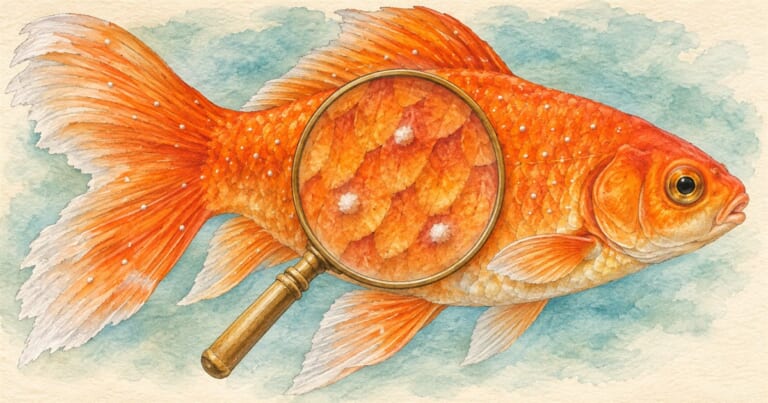
最も多いトラブルは栄養不足による痩せ衰え。ほかに、導入初期に発症しやすい白点病、傷や水質悪化に伴う水カビ病、野生採集個体ならではの寄生虫にも注意が必要。水カビのように見える症状の背景に、カラムナリス症が隠れている場合もある。The most common problem is wasting from malnutrition. White spot disease, which often appears soon after introduction, fungal infections linked to injuries or poor water quality, and parasites typical of wild-caught fish also require attention. Symptoms that look like fungus are sometimes actually caused by columnaris.
対策と予防 / Prevention
予防の基本は、熟成水槽で清潔な水質を保ち、十分な給餌で体力を維持すること。オトシンクルス類などのナマズの仲間は魚病薬や濃い塩分への耐性が低く、本種は高水温にも弱いため、一般的な熱帯魚向けの白点病対策(28〜30℃への昇温、規定量の薬浴、0.5%の塩浴)をそのまま当てはめるのは危険。治療は活性炭などを取り除いた別容器で行い、3匹までなら最低でも5〜6Lの水量を確保し、強めのエアレーションと2日に1回程度の換水を続ける。メチレンブルーなどの薬は規定量より少なめから始め、調子を崩したらすぐに換水して薬を抜く。昇温する場合は1日1℃ずつ緩やかに上げ、呼吸の様子をよく観察する。白点が見えなくなってからも数日〜1週間は管理を続けて再発を防ぐ。カラムナリス症が疑われる場合は塩浴が逆効果になるため、安易に塩を使わない。Prevention starts with keeping clean water in a mature tank and maintaining body condition through ample feeding. Catfish such as otocinclus have low tolerance for medications and strong salt, and this species is also weak against high temperatures, so applying the standard tropical fish treatment for white spot (raising the temperature to 28 to 30°C, a full-dose medication bath, and a 0.5% salt bath) as-is is dangerous. Treat in a separate container with activated carbon removed, providing at least 5 to 6 L of water for up to three fish, with strong aeration and water changes about every two days. Start medications such as methylene blue below the standard dose, and if the fish worsen, change the water immediately to remove the drug. If raising the temperature, do so gradually at 1°C per day while watching their breathing closely. Continue care for several days to a week after the spots disappear to prevent a relapse. If columnaris is suspected, avoid casual use of salt, as it can make things worse.
増やし方(繁殖) / Breeding
雌雄の判別 / Sexing
リノトキンクルス属は、小型ナマズとしてははっきりした雌雄差を示すことが分かっている。成熟した雌は雄よりやや大きく育ち、卵を持つと腹部が丸く膨らむ。頭部を上から見ると、雌は鼻孔のあたりの幅がやや狭く、鼻孔が小さく、左右の鼻孔の間は広く平らになっている。雄は肛門のすぐ後ろに生殖突起があり、腹鰭の最初の鰭条の縁に沿って肉質のひだが発達する。頭部を上から見ると、雄は鼻孔のあたりの幅が広く、大きく開いた鼻孔の間が狭く、盛り上がっている。体が非常に小さいため、ルーペやマクロ撮影での観察が役立つ。The genus Rhinotocinclus is known to show clear differences between the sexes for such small catfish. Mature females grow slightly larger than males, and their bellies become rounded when carrying eggs. Viewed from above, females have a slightly narrower head at the nostrils, smaller nostrils, and a broad, flat area between them. Males have a urogenital papilla just behind the vent and a fleshy fold along the first pelvic fin ray. Viewed from above, the male’s head is wider at the nostrils, and the large, open nostrils are separated by a narrow, raised area. Because the fish are so small, a magnifying glass or macro photography is helpful.
繁殖形態 / Reproduction
本種の産卵や飼育下での繁殖について、科学的に確かめられた記録は現時点でなく、日本国内でも安定した繁殖方法は確立されていない。近縁のオトシンクルス類から推測すると、水草の葉やガラス面、流木に粘着性の卵を産み付け、親は卵を守らないタイプと考えられており、卵は数日で孵化すると推測されている。At present there are no scientifically confirmed records of spawning or captive breeding for this species, and no reliable breeding method has been established in Japan. Judging from related otocinclus, it is thought to attach adhesive eggs to plant leaves, glass, or driftwood without guarding them, and the eggs are estimated to hatch within a few days.
繁殖のポイント / Breeding Tips
挑戦する場合は、繊細な卵を傷めないよう、スポンジフィルターなど穏やかなろ過を備えた専用水槽を用意する。十分に栄養を蓄えた複数の個体(雄1匹に対して雌2匹の割合、または小群)に、アマゾンのスコールを模して、普段より少し低い水温の新しい水で多めに換水すると、産卵のきっかけになるとされる。最大の壁は、針の先ほどの大きさしかない孵化直後の稚魚を育てることで、インフゾリア(微小な原生生物)や熟成水槽の豊富なバイオフィルムを切らさず与えられるかが成否を分けると考えられる。また、この名で流通する魚には複数のタイプが含まれ、バンブルビーオトシンとの混同も起こりやすいため、交雑を避けるためにも、同じ輸入ロットで同じ形態の個体どうしを組み合わせることが望ましい。If you try to breed it, prepare a dedicated tank with gentle filtration, such as a sponge filter, so the delicate eggs are not damaged. For a group of well-conditioned fish (one male to two females, or a small group), a large water change with fresh water slightly cooler than usual, imitating an Amazonian rainstorm, is said to trigger spawning. The greatest hurdle is raising newly hatched fry no bigger than the tip of a needle, and success likely depends on a constant supply of infusoria (tiny protozoa) and abundant biofilm in a mature tank. Because fish sold under this name include several types and are easily confused with the Bumblebee Oto, it is best to pair only fish from the same shipment with the same appearance to avoid hybridization.
雑学と豆知識 / Trivia and Fun Facts
1. バンブルビーと分かれた道、まだ名前のない小さなタイガー / 1. Parting Ways with the Bumblebee: A Little Tiger Still Without a Name
欧米でも日本でも、ペルー産の極小オトシンは長い間、正式な学名を持たない Parotocinclus sp. “Peru” としてひとまとめに扱われ、「タイガーオトシン」「バンブルビーオトシン」「ピグミータイガーオトシン」といった名前が入り混じって使われてきました。この状況を大きく前に進めたのが、2022年に南米の魚類学の学術誌で発表された、ロベルト・E・リース博士とパブロ・レーマン博士による研究です。両博士は、パロトシンクルス属、ヒソノートゥス属、クルクリオニクティス属の3つに分かれて置かれていた18種をひとまとめにし、さらに5つの新種を加えて、23種からなるリノトキンクルス属を新たに設けました。このとき、観賞魚として親しまれてきたバンブルビーオトシンが新種 R. isabelae として正式に名前を得ています。一方で、ピグミータイガーとして流通する魚は、バンブルビーより体高が低くスレンダーで、赤茶色のバンドを持つなど、顔つきも体型も異なる点が国内でも指摘されてきました。斑点のあるドット型については、背中から腹まで瞳より小さな暗色の斑点が散らばる近縁種 R. variola などが候補として考えられていますが、確定には至っていません。つまり、バンブルビーが一足先に名前を得た今も、この小さなタイガーの正体は解き明かされる途中にあるのです。In both the West and Japan, tiny Peruvian otos were long lumped together as Parotocinclus sp. “Peru,” with no formal scientific name, and names such as “Tiger Oto,” “Bumblebee Oto,” and “Pygmy Tiger Oto” were used interchangeably. A major step forward came in 2022 with research by Dr. Roberto E. Reis and Dr. Pablo Lehmann, published in a South American ichthyology journal. They brought together 18 species that had been placed in three separate genera, Parotocinclus, Hisonotus, and Curculionichthys, added five new species, and established the new genus Rhinotocinclus with 23 species. At that time, the Bumblebee Oto, long loved in the hobby, was formally named as the new species R. isabelae. Meanwhile, Japanese keepers had long pointed out that fish sold as the Pygmy Tiger differ in face and body shape, being lower-bodied and more slender than the Bumblebee and bearing reddish-brown bands. For the spotted dotted form, the related species R. variola, which has dark spots smaller than the pupil scattered from back to belly, is considered a candidate, but nothing has been confirmed. In other words, even now that the Bumblebee has received its name, the identity of this little tiger is still being worked out.
2. 属名が語る「長い鼻先」 / 2. A Genus Name That Speaks of a Long Snout
属名 Rhinotocinclus は、ギリシャ語で「鼻・鼻先」を意味する rhinos と、近縁の属名 Otocinclus を組み合わせたものです。Otocinclus はギリシャ語の oto(耳)とラテン語の cinclus(格子細工)に由来し、頭部の耳のあたりにある格子状の小さな穴を表しています。つまり新しい属名は、「長い鼻先を持つオトシンクルスの仲間」といった意味合いで、この属に共通する突き出した鼻先の形を言い表しているのです。ピグミータイガーの横顔をよく見ると、その名にふさわしい尖った鼻先を確かめることができます。The genus name Rhinotocinclus combines the Greek rhinos, meaning “nose” or “snout,” with the name of the related genus Otocinclus. Otocinclus comes from the Greek oto (ear) and the Latin cinclus (latticework), referring to the lattice-like small openings near the ear region of the head. The new genus name thus means something like “an otocinclus relative with a long snout,” describing the projecting snout shared by this genus. Looking closely at a Pygmy Tiger in profile, you can see the pointed snout that suits the name.
3. 雄の鼻先が盛り上がる理由 / 3. Why the Male’s Snout Is Raised
リノトキンクルス属の雄は、左右の鼻孔の間が盛り上がり、鼻孔そのものも大きく開いています。これは、雄が雌よりも大きな嗅覚器官を持っており、その大きさのために目のすぐ前の鼻先が盛り上がって見えるためです。タンニンで紅茶色に染まり、落ち葉や倒木が幾重にも重なる薄暗いブラックウォーター河川の底では、目だけで繁殖相手を探すのは簡単ではありません。雄はこの発達した嗅覚を使い、見通しの悪い水中でにおいを手がかりに相手を探しているのではないかと考えられています。小さな顔に見られる違いは、暗い森の川で暮らすための工夫の表れなのかもしれません。In Rhinotocinclus, males have a raised area between the nostrils and large, open nostrils. This is because males have larger olfactory organs than females, and their size makes the snout just in front of the eyes look raised. At the bottom of dim blackwater rivers, stained tea-brown by tannins and layered with fallen leaves and logs, finding a mate by sight alone is not easy. It is thought that males may use this well-developed sense of smell to find partners by scent in murky water. The small difference in their faces may be a sign of adaptation to life in dark forest rivers.
4. 脂鰭をめぐる小さな謎 / 4. A Small Mystery of the Adipose Fin
ナマズの仲間の分類では、背鰭と尾鰭の間にある小さな肉質の鰭「脂鰭(あぶらびれ)」があるかないかが、昔から重要な目印とされてきました。一般的なオトシンクルス属は脂鰭を持たず、パロトシンクルス属は脂鰭を持つことで区別されてきたのです。ところが新しく設けられたリノトキンクルス属では、バンブルビーオトシン(R. isabelae)や R. variola のように脂鰭を持つ種と、R. loxochelis のように脂鰭を持たない種が、同じ属の中に共存しています。つまり、脂鰭の有無だけではこの仲間を見分けられないということです。さらに、日本で「バンブルビー」や「ピグミータイガー」として流通する個体の中にも、脂鰭のあるものとないものが混じっていると報告されています。それが同じ種の中の個体差なのか、まだ名前のない別種が輸入の際に紛れ込んでいるのかは分かっておらず、ルーペを片手に観察する楽しみの一つになっています。In catfish classification, whether a fish has an adipose fin, a small fleshy fin between the dorsal and tail fins, has long been an important clue. The common genus Otocinclus lacks it, while Parotocinclus was distinguished by having one. In the newly established genus Rhinotocinclus, however, species with an adipose fin, such as the Bumblebee Oto (R. isabelae) and R. variola, coexist with species without one, such as R. loxochelis. In other words, the adipose fin alone cannot be used to tell these fish apart. It has also been reported that fish sold in Japan as “Bumblebee” or “Pygmy Tiger” include individuals with and without an adipose fin. Whether this reflects variation within one species or undescribed species mixed into shipments remains unknown, and it has become one of the pleasures of observing these fish with a magnifying glass in hand.
5. 「小さな鎧の者たち」と並オトシンとの違い / 5. “Little Armored Ones” and How They Differ from Common Otos
ブラジルでは、リノトキンクルス属のような小型の鎧ナマズたちが「カスクジーニョス(小さな鎧を着た者たち)」という親しみを込めた呼び名で呼ばれています。同じヒポプトポマ亜科に属する身近なオトシンクルス属と比べてみると、その生き方の違いも見えてきます。オトシンクルス属の仲間は、食道の一部が袋状にふくらんだ「食道憩室」を補助的な呼吸器官として持ち、水中の酸素が少なくなると水面へ上がって空気を飲み込むことができます。さらに一部の種は、鋭い棘と頑丈な鎧を持つコリドラスに体の模様を似せることで、捕食者に「食べにくい相手」と思わせる「ベーツ型擬態」まで身につけていると考えられています。一方、リノトキンクルス属の極小種たちは、とても小さな体と、枯れ葉や流木に溶け込むタイガー模様や斑点模様を武器に、アマゾンの川で生き抜いてきたと考えられています。同じ小さな鎧ナマズでも、身を守る工夫はそれぞれに異なっているのです。In Brazil, small armored catfish like those of Rhinotocinclus are affectionately called “cascudinhos,” meaning “little armored ones.” Comparing them with the familiar genus Otocinclus, which belongs to the same subfamily Hypoptopomatinae, reveals differences in their ways of life. Otocinclus species have an esophageal diverticulum, a pouch-like swelling of the esophagus that serves as an accessory breathing organ, allowing them to rise to the surface and gulp air when oxygen in the water runs low. Some species are also thought to have developed Batesian mimicry, resembling the patterns of sharply spined, heavily armored Corydoras so that predators see them as hard to eat. The tiny Rhinotocinclus species, on the other hand, are thought to have survived in Amazonian rivers using their very small bodies and tiger stripes or spots that blend into leaf litter and driftwood. Even among little armored catfish, the ways of staying safe differ from one group to another.
6. 川の水位が運んでくる魚 / 6. A Fish Delivered by the Rise and Fall of Rivers
ピグミータイガーオトシンが日本に届くまでの道のりは、アマゾンの季節と深く結びついています。主な集積地となるペルーのイキトスは、道路では外部とつながっておらず、飛行機や船でしか行き来できないペルー・アマゾン最大の都市です。この地域には日本のような四季はなく、川の水位の上がり下がりが季節そのものです。おおむね11月から4月頃の雨季には川があふれて周囲の森が水に沈み、広大な浸水林が生まれます。反対に、おおむね5月から10月頃の乾季には水位が下がって砂浜が現れ、熱帯魚の採集が盛んになります。また、ブラジルが自然保護の規制を強めたことで、南米の熱帯魚の輸出はペルーとコロンビアに集まる傾向が強まったとされ、ペルー産の個性的な小型オトシン類が次々と日本へ紹介されるようになりました。日本の店頭で「久しぶりの入荷」に出会えるかどうかは、遠く離れたアマゾンの川の水位に左右されているのです。The journey of the Pygmy Tiger Oto to Japan is closely tied to the seasons of the Amazon. Iquitos in Peru, the main collection hub, is the largest city in the Peruvian Amazon and has no road connection to the outside world, reachable only by air or river. The region has no four seasons like Japan; the rise and fall of the rivers are the seasons themselves. In the rainy season, roughly from November to April, the rivers overflow and submerge the surrounding forest, creating vast flooded forests. In the dry season, roughly from May to October, the water drops, sandbanks appear, and collection of tropical fish becomes active. In addition, as Brazil tightened its conservation rules, exports of South American aquarium fish are said to have increasingly concentrated in Peru and Colombia, and many distinctive small Peruvian otos came to be introduced to Japan. Whether you come across a “long-awaited arrival” at a Japanese shop depends on the water level of rivers in the faraway Amazon.
7. 「混じり」から始まった歩みと、「超難種」からの転換 / 7. A Story That Began as “Mixed In,” and the Turn from “Extremely Difficult”
日本では、遅くとも2008年頃には「ピグミータイガーオトシン」の名前での入荷が確認されています。流通の初期には、単独でまとまって輸入されるよりも、バンブルビーオトシンの輸入ロットに混じって届くことが多かったといわれています。その後、バンブルビーの入荷が安定するにつれて両者が選り分けられ、ピグミータイガーとして独立して販売されるようになりました。しかし2000年代後半から2010年代前半にかけては、茶ゴケは食べるものの代わりになる餌が見つからず、コケを食べ尽くすと痩せて死んでしまうという失敗が相次ぎ、ベテランでも苦戦する「超難種」と呼ばれました。流れが変わったのは2010年代の中頃です。熟成させた枯れ葉を与える方法やジェル状の人工飼料、バイオフィルムを育てる管理といった考え方が広まりました。水草水槽のコケ取り役として放すのではなく、枯れ葉が分解されてできる有機物や微生物の膜を絶やさず与えながら、その姿を楽しむための専用の管理へと発想が変わったことで、長期飼育への道が開けたのです。近年は入荷が不定期なことや管理に手間がかかることも反映して価格が上がる傾向にありますが、それだけ大切に迎え入れたい魚として見られるようになったともいえるでしょう。In Japan, imports under the name “Pygmy Tiger Oto” have been confirmed since around 2008 at the latest. In the early days, rather than being imported on its own, it is said to have often arrived mixed into shipments of Bumblebee Otos. As Bumblebee imports stabilized, the two were sorted apart, and the Pygmy Tiger came to be sold under its own name. From the late 2000s to the early 2010s, however, keepers repeatedly found that although it ate diatoms, no substitute food could be found, and once the algae was gone it grew thin and died. It became known as an extremely difficult species that challenged even veterans. The turning point came in the mid-2010s, as ideas such as feeding aged leaf litter, using gel foods, and cultivating biofilm spread. The approach shifted from releasing it into planted tanks as an algae cleaner to dedicated care that continuously supplies the organic matter from decomposing leaves and microbial films while enjoying the fish itself, and this opened the way to long-term keeping. Prices have tended to rise in recent years, reflecting irregular imports and the effort its care requires, but this may also show that it has come to be seen as a fish worth welcoming with special care.
まとめ / Conclusion
ピグミータイガーオトシンクルスは、全長2〜3cmほどの小さな体に、赤茶色の縞や細かな斑点をまとった魚です。よく似たバンブルビーオトシンとは顔つきも体つきも異なり、今も学名が定まらない謎を抱えています。手軽な水槽の掃除役ではなく、高水温や水質の変化、そして何より餌不足に弱い繊細な生き物です。それでも、熟成させた枯れ葉や流木に育つバイオフィルムを絶やさず、涼しく清らかな水を保てば、その愛らしい姿を長く見守ることができます。The Pygmy Tiger Otocinclus carries reddish-brown stripes or fine spots on a small body only about 2 to 3 cm long. It differs in face and build from the similar Bumblebee Oto and still holds the mystery of an unsettled scientific name. It is no easy-going tank cleaner but a sensitive creature, vulnerable to high temperatures, changes in water quality, and above all a lack of food. Yet with a steady supply of aged leaf litter and the biofilm that grows on driftwood, and with cool, clean water, you can watch over its endearing presence for a long time.
流木の上でじっと休み、ときおりゆっくりと葉の表面を舐めて回る小さな姿には、アマゾンの薄暗い森の川を思わせる穏やかな時間が流れています。毎日ガラス越しにふっくらとしたお腹を確かめるささやかな習慣が、この小さな魚との長い付き合いを支えてくれるはずです。手をかけるほどに奥深さを見せてくれる、小型ナマズ飼育の醍醐味が詰まった存在です。In its small figure resting quietly on driftwood and occasionally grazing slowly over a leaf, there flows a calm time that recalls the dim forest rivers of the Amazon. The simple daily habit of checking its rounded belly through the glass will support a long companionship with this little fish. It is a presence filled with the joys of keeping small catfish, revealing more of its depth the more care it receives.
Reis, R. E. & Lehmann A., P. (2022). A new genus of armored catfish (Siluriformes: Loricariidae) from the Greater Amazon, with a review of the species and description of five new species. Neotropical Ichthyology, 20(2): e220002. DOI: 10.1590/1982-0224-2022-0002
Lehmann A., P., Schvambach, L. J. & Reis, R. E. (2015). A new species of the armored catfish Parotocinclus (Loricariidae: Hypoptopomatinae), from the Amazon basin in Colombia. Neotropical Ichthyology, 13(1): 47–52. DOI: 10.1590/1982-0224-20140113
Schaefer, S. A. (1997). The Neotropical cascudinhos: systematics and biogeography of the Otocinclus catfishes (Siluriformes: Loricariidae). Proceedings of the Academy of Natural Sciences of Philadelphia, 148: 1–120.
Armbruster, J. W. (1998). Modifications of the digestive tract for holding air in loricariid and scoloplacid catfishes. Copeia, 1998(3): 663–675. DOI: 10.2307/1447796
Axenrot, T. E. & Kullander, S. O. (2003). Corydoras diphyes (Siluriformes: Callichthyidae) and Otocinclus mimulus (Siluriformes: Loricariidae), two new species of catfishes from Paraguay, a case of mimetic association. Ichthyological Exploration of Freshwaters, 14(3): 249–272.
Noga, E. J. (2010). Fish Disease: Diagnosis and Treatment, 2nd ed. Wiley-Blackwell.




コメント