

解説 / Description
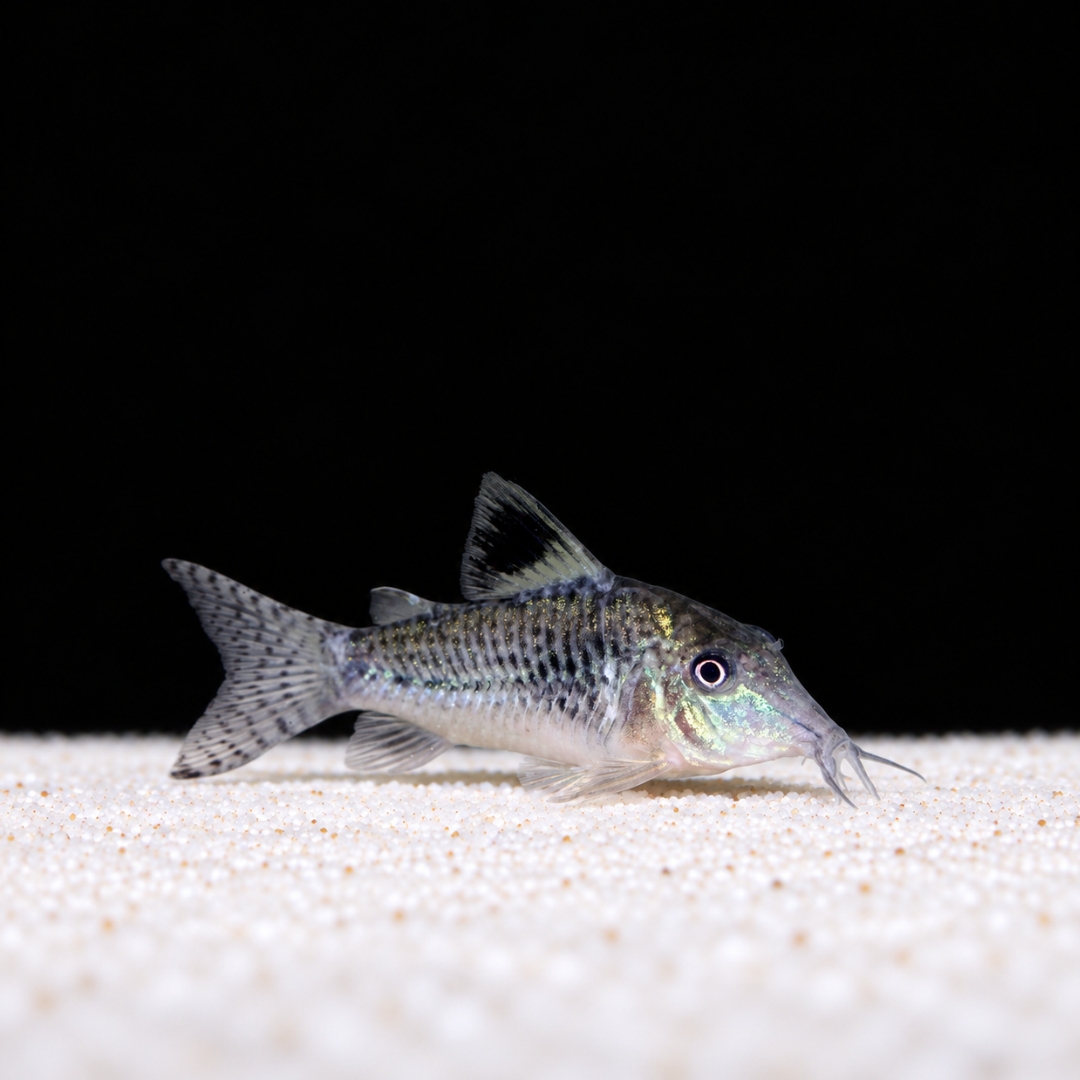
コリドラス・アクトゥスは、南米アマゾン川上流域に暮らすロングノーズタイプのコリドラスです。前方へ鋭く突き出した吻と、背鰭の上部にある黒い斑紋が最大の特徴で、英語圏ではこの斑紋にちなんで「ブラックトップ・コリドラス」と呼ばれています。明るいオリーブ色から淡褐色の体には暗色の小斑が散り、状態の良い個体では鰓蓋のまわりを中心に青や緑のメタリックな光沢が現れます。派手さはないものの、光の加減で浮かび上がるこの輝きが、本種ならではの上品な美しさです。もともとは流れの速い森の小川で、砂や落ち葉の奥に潜む小さな生き物を探して暮らしてきた魚で、細かい砂に長い吻を差し込んで餌を探す姿は、ロングノーズ種ならではの見どころといえます。国内に入荷する個体は主にペルーのイキトスから輸出される野生採集個体で、入荷の機会が比較的少ないことから、コリドラス愛好家の間ではコレクション性の高い種として知られています。 Corydoras acutus is a long-snouted Corydoras from the upper Amazon basin in South America. Its defining features are a sharply projecting snout and a black blotch on the upper part of the dorsal fin, which gives it the English name “Blacktop Corydoras”. The light olive to pale brown body is scattered with small dark spots, and fish in good condition develop a metallic blue-green sheen, especially around the gill covers. Though not flashy, this gleam that emerges with the light gives the species an understated elegance. In the wild it lives in fast-flowing forest streams, searching sand and leaf litter for small creatures, and watching it push its long snout into fine sand in search of food is one of the highlights of keeping long-nosed species. Specimens reaching Japan are mainly wild-caught fish exported from Iquitos, Peru, and because shipments are relatively infrequent, it is regarded among Corydoras enthusiasts as a highly collectible species.
基本情報 / Basic Information
| 学名 / Scientific Name | Corydoras acutus Cope, 1872 |
|---|---|
| 通称 / Common Name | コリドラス・アクトゥス、アクトゥスBlacktop Corydoras, Acutus Cory |
| 分類 / Family | ナマズ目 カリクティス科 コリドラス亜科 コリドラス属Siluriformes, Callichthyidae, Corydoradinae, Corydoras |
| 英名 / English Name | Blacktop Corydoras |
| 分布 / Distribution | アマゾン川上流域(ペルー、エクアドル、ブラジル西部)。ナポ川水系、マラニョン川水系、ヤバリ川、マデイラ川水系のアブナン川などから知られており、ボリビアにも分布する可能性があるとされています。Upper Amazon basin (Peru, Ecuador, and western Brazil). Known from the Napo and Marañón river systems, the Yavarí River, and the Abunã River in the Madeira system, and possibly also occurring in Bolivia. |
| 最大体長 / Max Size | 標準体長(尾鰭を除いた長さ)で最大7cm前後とされます。流通する個体は5cm前後が中心です。Up to around 7 cm in standard length (excluding the tail fin). Fish in the trade are mostly around 5 cm. |
| 寿命 / Lifespan | 本種に限った詳しい記録は多くありませんが、ほかのコリドラス類と同様、安定した環境であれば飼育下で5年以上生きることも珍しくないと考えられています。Detailed records specific to this species are scarce, but as with other Corydoras, it is thought that living more than 5 years in a stable aquarium is not unusual. |
飼育環境 / Aquarium Environment
| 水槽サイズ / Tank Size | 60cm規格水槽(約57L)以上を推奨します。群れで飼うのが望ましい魚なので、底面積を広く取れる60cmワイド水槽や90cm規格水槽なら、より落ち着いた姿を楽しめます。A 60 cm standard tank (approx. 57 L) or larger is recommended. Since this fish is best kept in a group, a tank with a larger footprint, such as a 60 cm wide tank or a 90 cm standard tank, lets you enjoy calmer, more natural behavior. |
|---|---|
| 水温 / Temperature | 22〜28℃(24〜26℃前後が目安)。水温が高いほど水中の酸素が少なくなるため、夏場は特に注意してください。 22–28°C (around 24–26°C is ideal). The higher the temperature, the less oxygen the water holds, so take particular care in summer. |
| 水質 / Water Quality | 弱酸性〜中性(pH6.0〜7.5程度)、軟水〜中硬水。適応できる範囲は比較的広く、日本の水道水はミネラル分が少なくpHも中性付近で安定しているため、カルキ抜きをするだけで十分飼育できます。石灰質の石を多く使うと硬度やpHが上がりやすいので、気になる場合はソイルや流木、マジックリーフなどを使って弱酸性寄りに整えるとよいでしょう。Slightly acidic to neutral (around pH 6.0–7.5), soft to moderately hard water. Its tolerance range is fairly wide, and Japanese tap water, which is low in minerals and stable near neutral pH, is perfectly suitable once dechlorinated. Using a lot of limestone-type rock tends to raise hardness and pH, so if this is a concern, soil substrate, driftwood, or dried Indian almond leaves can be used to shift conditions toward slightly acidic. |
| レイアウト / Layout | 底床には、角のないパウダー状の細かい砂(田砂やボトムサンドなど)を薄めに敷くのが理想です。こうすることで、吻を砂に差し込んで餌を探す本来の習性を存分に発揮できます。流木や落ち葉を配置して原産地の森の小川を思わせるレイアウトにすれば、隠れ家と休息場所を兼ねられます。適度な水流と十分なエアレーションを確保しつつ、流木や石の陰に流れの穏やかな場所を作っておくと、魚が安心して休めます。The ideal substrate is a thin layer of fine, rounded, powder-like sand. This lets the fish fully express its natural habit of pushing its snout into the sand to search for food. Adding driftwood and leaf litter to evoke the forest streams of its native range provides both shelter and resting spots. Ensure moderate water flow and plenty of aeration, while creating calmer areas behind driftwood or rocks where the fish can rest. |
| 注意点 / Precautions | 流れのある環境で暮らす種のため、酸素不足に弱い傾向があります。底でじっと動かなくなる様子が見られたら、水温や酸素量を見直してください。角の立った砂利や汚れのたまった底床は口ひげを傷める原因になるため、底床を清潔に保つことも大切です。また、本種は空気を吸いに水面まで泳ぎ上がるので、水面までの通り道をふさがないようにしましょう。塩水浴や一部の魚病薬に敏感とされるため、薬浴の際は規定量より少なめから始めるなど慎重に扱ってください。胸鰭や背鰭の棘は鋭く網に絡まりやすいので、移動させるときはプラケースなどで水ごとすくうと安全です。As a species from flowing water, it tends to be vulnerable to low oxygen. If fish start lying motionless on the bottom, review the water temperature and oxygen levels. Sharp gravel or a dirty substrate can damage the barbels, so keeping the substrate clean is also important. Because this species swims up to the surface to gulp air, make sure its path to the surface is not blocked. It is considered sensitive to salt baths and some fish medications, so treat carefully, for example by starting below the standard dose. The pectoral and dorsal spines are sharp and easily tangle in nets, so it is safer to scoop fish up together with water in a plastic container when moving them. |
餌と給餌 / Feeding
| 餌の種類 / Diet | 雑食性です。コリドラス用の沈下性タブレットやペレットを主食に、冷凍アカムシ、イトメ、ブラインシュリンプなどの動物性の餌を組み合わせると、良いコンディションを保てます。野生下では植物質も口にしているとされるため、茹でたホウレンソウなどを時折与えるのもよいでしょう。Omnivorous. Use sinking tablets or pellets made for Corydoras as the staple, combined with animal-based foods such as frozen bloodworms, tubifex worms, and brine shrimp, to keep the fish in good condition. Since wild fish are said to also eat plant matter, occasionally offering blanched spinach can be beneficial. |
|---|---|
| 給餌のポイント / Feeding Tips | 他の魚の食べ残しで足りると考えるのは誤りで、本種のための餌を確実に底まで届けることが大切です。夜行性の傾向があるため、導入直後で警戒心が強いうちは、消灯後に餌を入れると食べやすくなります。上層を泳ぐ魚と一緒に飼う場合は、餌を横取りされていないか確認しましょう。It is a mistake to assume that leftovers from other fish are enough; make sure food intended for this species actually reaches the bottom. Because it tends to be nocturnal, feeding after the lights go out helps newly introduced, cautious fish to eat. When kept with fish that swim in the upper layers, check that its food is not being stolen. |
性格と混泳 / Temperament and Tank Mates
| 性格 / Temperament | 基本的には温和で、仲間と群れて過ごす社会性の高い魚です。ただし、ロングノーズ系のコリドラスは同種や他の底棲魚に対してやや気の強さを見せることがあるとされるため、過密にならないよう注意が必要です。6匹以上の群れで飼うと、落ち着いた行動を見せやすくなります。Generally peaceful and highly social, spending its time in groups. However, long-nosed Corydoras are said to sometimes be somewhat assertive toward their own kind and other bottom dwellers, so avoid overcrowding. Keeping a group of six or more tends to encourage calm behavior. |
|---|---|
| 混泳の相性 / Compatibility | 小型カラシン、ペンシルフィッシュ、ハチェットフィッシュ、ドワーフシクリッドなど、温和な小型〜中型魚とは問題なく混泳できます。一方、本種を口に入れられる大型肉食魚との混泳は避けてください。飲み込まれた際に硬い棘が喉に刺さり、双方が命を落とすおそれがあります。底棲魚同士で混泳させる場合は、隠れ家を多めに設けて縄張りが重ならないよう配慮しましょう。It mixes well with peaceful small to medium-sized fish such as small characins, pencilfish, hatchetfish, and dwarf cichlids. Avoid large predatory fish capable of swallowing it; if swallowed, its hard spines can lodge in the predator’s throat, potentially killing both. When keeping it with other bottom dwellers, provide plenty of hiding places so territories do not overlap. |
病気と対策 / Diseases and Prevention
| かかりやすい病気 / Common Diseases | 底床の汚れや角のある砂利で口ひげが擦り減り、そこから細菌に感染して短くなってしまう「ヒゲの溶け」がよく見られます。野生採集個体の場合は、腸に寄生する線虫(カマラヌス類)を持ち込むことがあり、イキトス周辺で採集・出荷されるコリドラス類からも寄生の報告があります。寄生が重いと腸の組織が傷つき、痩せや衰弱につながると考えられています。また、捕獲や輸送で強いストレスを受けると体から毒性のある物質を出し、閉じた容器の中で自分自身や同居魚を弱らせてしまう「自家中毒」も、本種を扱う上で知っておきたい現象です。Barbel erosion is common: barbels worn down by a dirty substrate or sharp gravel become infected with bacteria and shorten. Wild-caught fish may carry intestinal parasitic nematodes (camallanid worms), and infections have been reported in Corydoras collected and shipped around Iquitos. Heavy infections are thought to damage intestinal tissue, leading to weight loss and weakness. Another phenomenon worth knowing is “self-poisoning”: when severely stressed by capture or transport, the fish releases toxic substances that, in a closed container, can weaken both itself and its tankmates. |
|---|---|
| 対策と予防 / Prevention | 細かい砂を使い、こまめな底床掃除と水換えで清潔な環境を保つことが基本です。新しく迎えた個体はトリートメント水槽でしばらく様子を見て、必要に応じて線虫に効く駆虫薬の使用を専門店などに相談するとよいでしょう。導入時は輸送袋の水を水槽に入れず、魚だけを移してください。自家中毒を防ぐには、捕獲や移動の際に魚を追い回さないこと、輸送する場合は水を多めにして1袋に入れる数を減らすことが大切です。The basics are using fine sand and keeping the environment clean through regular substrate cleaning and water changes. Observe newly acquired fish in a quarantine tank for a while, and if needed, consult a specialist shop about using a dewormer effective against nematodes. When introducing fish, do not pour the shipping water into the tank; transfer only the fish. To prevent self-poisoning, avoid chasing fish during capture or moving, and when shipping them, use plenty of water and put fewer fish in each bag. |
増やし方(繁殖) / Breeding
| 雌雄の判別 / Sexing | 成熟した個体であれば比較的見分けやすく、上から見るとメスは腹部が幅広く丸みを帯び、オスは細身でやや小さめです。腹鰭の形にも違いがあり、オスは細長く尖り、メスは丸みを帯びています。Mature fish are relatively easy to sex. Viewed from above, females have a broader, rounder belly, while males are slimmer and slightly smaller. The pelvic fins also differ: males have elongated, pointed pelvic fins, while those of females are rounded. |
|---|---|
| 繁殖形態 / Reproduction | 卵生で、卵は物に貼り付く付着卵です。オスとメスはコリドラス特有の「Tポジション」と呼ばれる姿勢で交尾し、メスは腹鰭を袋状に合わせた中に数個ずつ卵を抱えて受精させ、ガラス面や幅の広い水草の葉に産み付けます。これを繰り返し、1回の産卵で数十〜100個前後の卵を産むことがあります。親魚が卵や稚魚を守ることはありません。An egg-layer with adhesive eggs that stick to surfaces. The pair mates in the “T-position” characteristic of Corydoras; the female holds a few eggs at a time in a pouch formed by her clasped pelvic fins, fertilizes them, and attaches them to the glass or broad plant leaves. Repeating this, she may lay several dozen to around 100 eggs in one spawning. The parents do not guard the eggs or fry. |
| 繁殖のポイント / Breeding Tips | 野生採集個体は水槽環境に慣れるまで時間がかかり、ショートノーズ系に比べて繁殖の難易度は高めです。オス2匹にメス3匹程度を目安にグループを組み、冷凍アカムシなど栄養価の高い餌を十分に与えます。そのうえで、普段より2〜3℃低い新しい水で多めの水換えを行うと、原産地の雨季の始まりに近い変化となり、産卵が誘発されやすいといわれています。卵は親に食べられやすいので、見つけたら丁寧に剥がして別の容器に移し、エアレーションで水を動かしてカビを防ぎます。孵化までは3〜4日ほどで、稚魚がお腹の栄養(ヨークサック)を吸収し終えたら、マイクロワームや孵化直後のブラインシュリンプを少量ずつ与えます。ロングノーズ系の稚魚は水質の悪化に敏感なため、ごく薄く細かい砂を敷いた水槽で育てると生存率が上がりやすいとされています。Wild-caught fish take time to adjust to aquarium life, and breeding is more challenging than with short-nosed species. Form a group of roughly two males to three females and feed them generously with nutritious foods such as frozen bloodworms. Then, a large water change with fresh water 2–3°C cooler than usual, which mimics the start of the rainy season in their native range, is said to help trigger spawning. Eggs are easily eaten by the parents, so carefully detach them, move them to a separate container, and keep the water moving with an air stone to prevent fungus. Hatching takes about 3–4 days; once the fry have absorbed their yolk sacs, offer small amounts of microworms or newly hatched brine shrimp. Long-nosed fry are sensitive to declining water quality, and raising them over a very thin layer of fine sand is said to improve survival. |
雑学と豆知識 / Trivia and Fun Facts
| 1. 「鋭い」という名を持つ魚 / 1. A Fish Named “Sharp” | 本種が学術的に記載されたのは1872年のことです。恐竜化石の研究でも名高いアメリカの古生物学者エドワード・ドリンカー・コープが、ペルーのアマゾン支流アンピヤク川の魚類をまとめた報告の中で、新種として発表しました。種小名の「acutus」はラテン語で「鋭い」「尖った」を意味し、その名のとおり前方へ突き出した吻の形を表しています。150年以上前に名前の由来となった特徴が、今もなお本種を見分ける大きな手がかりになっているのは、なかなか味わい深いことです。This species was formally described in 1872. Edward Drinker Cope, the American paleontologist also famous for his dinosaur fossil research, published it as a new species in a report on the fishes of the Ampiyacu River, an Amazon tributary in Peru. The species name “acutus” is Latin for “sharp” or “pointed”, describing its forward-projecting snout. It is rather charming that the feature that inspired its name more than 150 years ago is still a key clue for identifying the species today. |
|---|---|
| 2. 大再編を経ても「本家コリドラス」 / 2. Still a “True” Corydoras After the Great Reshuffle | 長年、コリドラスは150種以上を含む巨大な一つの属として扱われてきました。しかし2024年、Diasらが遺伝子の解析と体のつくりの比較を組み合わせた研究を発表し、コリドラスの仲間は進化の道筋(系統)ごとに複数の属へ分けられました。多くの人気種がホプリソマ属やガストロデルムス属、オステオガステル属といった別の属へ移る中、アクトゥスはコリドラス属にそのまま残っています。これは、コリドラス属の基準となる種と同じ「Lineage 1(系統1)」に含まれるためで、この系統には吻の長いロングノーズの種が多くまとまっています。つまり本種は、再編後もコリドラスという名前を正統に受け継ぐグループの一員なのです。For many years, Corydoras was treated as a single huge genus containing more than 150 species. In 2024, however, Dias and colleagues published a study combining genetic analysis with comparisons of body structure, and the group was split into multiple genera according to evolutionary lineage. While many popular species moved to other genera such as Hoplisoma, Gastrodermus, and Osteogaster, C. acutus remained in Corydoras. This is because it belongs to “Lineage 1”, the same lineage as the genus’s type species, a lineage that contains many long-snouted species. In other words, even after the reorganization, this species belongs to the group that rightfully carries on the name Corydoras. |
| 3. 腸で息をする魚 / 3. A Fish That Breathes Through Its Gut | 水槽のコリドラスが時折すばやく水面へ泳ぎ上がり、また底へ戻っていく姿を見たことがあるかもしれません。これは空気を飲み込み、血管の発達した腸から酸素を取り込むための行動です。アマゾンでは乾季に水位が下がり、水温の上昇とともに水中の酸素が極端に少なくなることがあります。この能力は、そうした厳しい季節を乗り切るために備わったものだと考えられています。水槽で水面までの通り道を確保しておく必要があるのは、この呼吸のためです。You may have seen aquarium Corydoras occasionally dart up to the surface and back down again. This lets them swallow air and absorb oxygen through their blood-vessel-rich intestine. In the Amazon, water levels drop during the dry season, and as temperatures rise, oxygen in the water can become extremely scarce. This ability is thought to have developed to help them survive such harsh seasons, and it is the reason the route to the surface must be kept open in the aquarium. |
| 4. 身を守るための「毒」と輸送の難しさ / 4. A Defensive “Toxin” and the Difficulty of Shipping | コリドラスの仲間は、強いストレスを受けると、胸鰭の付け根付近にある腺から毒性のある物質を出すことが知られています。自然界では、捕食者に飲み込まれそうになったときにこれを放出し、吐き出させるための防御手段として働くと考えられています。広い川であればすぐに薄まるため問題になりませんが、輸送袋のような狭い空間では濃度が一気に高まり、本人や同じ袋の魚まで弱らせてしまうことがあります。野生採集個体が長い旅を経て届くまでに、この性質への配慮が欠かせないのはそのためです。Members of the Corydoras group are known to release a toxic substance from glands near the base of the pectoral fins when severely stressed. In nature, this is thought to work as a defense: released when a predator tries to swallow the fish, it makes the predator spit it out. In a wide river the substance is quickly diluted and causes no harm, but in a confined space such as a shipping bag its concentration rises rapidly and can weaken the fish itself and others in the same bag. That is why careful handling is essential for wild-caught fish on their long journey. |
| 5. よく似た仲間たち / 5. Look-Alike Relatives | 吻が長く背鰭に黒斑を持つコリドラスは本種だけではなく、未記載種につけられる管理番号(Cナンバー)で呼ばれる、よく似た魚がいくつか知られています。ブラジルのアブナン川で本種と同じ場所に暮らすC077は、本種よりやや小さいとされる以外にはっきりした違いが見つかっておらず、同種とみる意見もあります。一方、C024やC109は姿こそ似ていますが、本種の分布域から数千kmも東に離れたブラジル・パラ州に生息しているため、別種ではないかとする見方があります。また、2021年に新種として記載されたコリドラス・フッレリは、尾鰭の付け根に2つの暗色斑を持つ点で本種と見分けられます。広い分布域の中で、体の模様や背鰭の黒斑の有無に地域差があることも、同定を難しくしている理由の一つです。C. acutus is not the only long-snouted Corydoras with a black dorsal blotch; several similar fish are known by the C-numbers assigned to undescribed species. C077, which lives alongside C. acutus in the Abunã River in Brazil, shows no clear difference apart from reportedly being slightly smaller, and some regard it as the same species. C024 and C109, on the other hand, look similar but live in Pará State, Brazil, thousands of kilometers east of C. acutus’s range, and some consider them likely to be distinct species. Corydoras fulleri, described as a new species in 2021, can be distinguished by the two dark blotches at the base of its tail fin. Regional variation across the wide range, in body pattern and in whether the dorsal blotch is present, is another reason identification can be tricky. |
| 6. ウインクと「カチカチ」の防御 / 6. The “Wink” and the Locked-Spine Defense | コリドラスを眺めていると、目をくるりと下へ動かす仕草に出会うことがあります。まるでウインクをしているように見えることから、飼育者の間では愛らしい行動として親しまれています。その一方で、危険を感じると胸鰭と背鰭の硬い棘をぴんと広げて固定し、体を硬直させて身を守ります。この棘は簡単には戻らないため、網に絡まったり人の指を傷つけたりすることもあります。愛嬌のある顔つきの裏で、厳しい自然を生き抜くための頑丈な守りも備えているのです。Watching Corydoras, you may notice them roll their eyes downward. Because it looks like a wink, keepers cherish it as an endearing behavior. On the other hand, when the fish senses danger, it spreads and locks the stiff spines of its pectoral and dorsal fins and holds its body rigid. Since these spines do not release easily, they can tangle in nets or injure fingers. Behind its charming face, the fish also carries sturdy armor for surviving a harsh natural world. |
まとめ / Conclusion
鋭く伸びた吻、背鰭に映える黒い斑紋、そして光の加減で浮かび上がる青緑の輝き。コリドラス・アクトゥスは、派手さとは異なる落ち着いた美しさで水槽の底を彩ってくれる魚です。仲間とともに細かな砂へ吻を差し入れて餌を探す姿には、アマゾンの森の小川での暮らしぶりがそのまま表れています。 A sharply extended snout, a black blotch on the dorsal fin, and a blue-green sheen that emerges with the light: Corydoras acutus brings a calm, understated beauty to the bottom of the aquarium. As it searches for food alongside its companions, pushing its snout into fine sand, it shows the very way of life it leads in the forest streams of the Amazon.
清潔な細かい砂、十分な酸素、適度な流れ、そして群れで過ごせる広さ。こうした環境を一つずつ整えていくほど、本種はのびのびとした動きと輝きで応えてくれます。出会える機会が限られる魚だからこそ、迎えた群れとじっくり向き合い、長く付き合っていきたい存在です。 Clean fine sand, ample oxygen, moderate flow, and enough room to live as a group: the more carefully each of these is provided, the more this species responds with relaxed movement and radiant color. Precisely because chances to acquire it are limited, it is a fish worth getting to know closely and keeping for many years.

困りごとの解決から、用品えらび、水槽づくり、生き物えらびまで。飼育に役立つ案内です。
分布マップ
コリドラス・アクトゥスは、南米アマゾン川上流域のペルー、エクアドル、ブラジル西部に分布します。ナポ川水系、マラニョン川水系、ヤバリ川、マデイラ川水系のアブナン川などから知られており、ボリビアにも分布する可能性があるとされています。
※地図は分布域全体の位置関係を示す概略表示です。正確な生息範囲を示すものではありません。マーカーは原記載地とされるペルーのアンピヤク川周辺に置いた代表地点であり、実際の採集地点を示すものではありません。
参考文献
分類・原記載・近縁種
- Cope, E. D. (1872). On the fishes of the Ambyiacu River. Proceedings of the Academy of Natural Sciences of Philadelphia, 23: 250–294.
- Dias, A. C., Tencatt, L. F. C., Roxo, F. F., da Costa Silva, G. S., Santos, S. A., Britto, M. R., Taylor, M. I. & Oliveira, C. (2024). Phylogenomic analyses in the complex Neotropical subfamily Corydoradinae (Siluriformes: Callichthyidae) with a new classification based on morphological and molecular data. Zoological Journal of the Linnean Society, 203(3): zlae053. https://doi.org/10.1093/zoolinnean/zlae053
- Alexandrou, M. A., Oliveira, C., Maillard, M., McGill, R. A. R., Newton, J., Creer, S. & Taylor, M. I. (2011). Competition and phylogeny determine community structure in Müllerian co-mimics. Nature, 469: 84–88. https://doi.org/10.1038/nature09660
- Tencatt, L. F. C., dos Santos, S. A., Evers, H.-G. & Britto, M. R. (2021). Corydoras fulleri (Siluriformes: Callichthyidae), a new catfish species from the rio Madeira basin, Peru. Journal of Fish Biology.
分布・生息状況・種の概要
- Chuctaya, J., Sarmiento, J. & Correa, E. (2016). Corydoras acutus. The IUCN Red List of Threatened Species. https://www.iucnredlist.org/species/49830468/53818413
- Froese, R. & Pauly, D. (Eds.). FishBase: Corydoras acutus Cope, 1872. https://www.fishbase.se/summary/Corydoras-acutus.html
- Seriously Fish. Corydoras acutus – Blacktop Cory. https://www.seriouslyfish.com/species/corydoras-acutus
生理・繁殖
- Kramer, D. L. & McClure, M. (1980). Aerial respiration in the catfish, Corydoras aeneus (Callichthyidae). Canadian Journal of Zoology, 58: 1984–1991.
- Kohda, M., Tanimura, M., Kikue-Nakamura, M. & Yamagishi, S. (1995). Sperm drinking by female catfishes: a novel mode of insemination. Environmental Biology of Fishes, 42: 1–6.
病気・取り扱い上の注意
- Kiehl, E., Rieger, C. & Greven, H. (2006). Axillary gland secretions contribute to the stress-induced discharge of a bactericidal substance in Corydoras sterbai (Callichthyidae, Siluriformes). Verhandlungen der Gesellschaft für Ichthyologie, 5: 111–115.
- Morey, G. & Florindez, F. (2018). Procamallanus (Spirocamallanus) pintoi (Kohn and Fernandes, 1988) (Nematoda: Camallanidae) infecting species of Callichthyidae from the Peruvian Amazon. Bulletin of the European Association of Fish Pathologists, 38(6).
- Ailán-Choke, L. G., Sánchez, R., Cremonte, F., Ramallo, G. & Davies, D. (2019). Histopathological study of Corydoras micracanthus (Siluriformes: Callichthyidae) parasitized by the nematode Procamallanus (Spirocamallanus) pintoi (Camallanidae) from Lesser River, northwestern Argentina, South America. Annals of Parasitology, 65(3): 287–291. https://doi.org/10.17420/ap6503.212





コメント