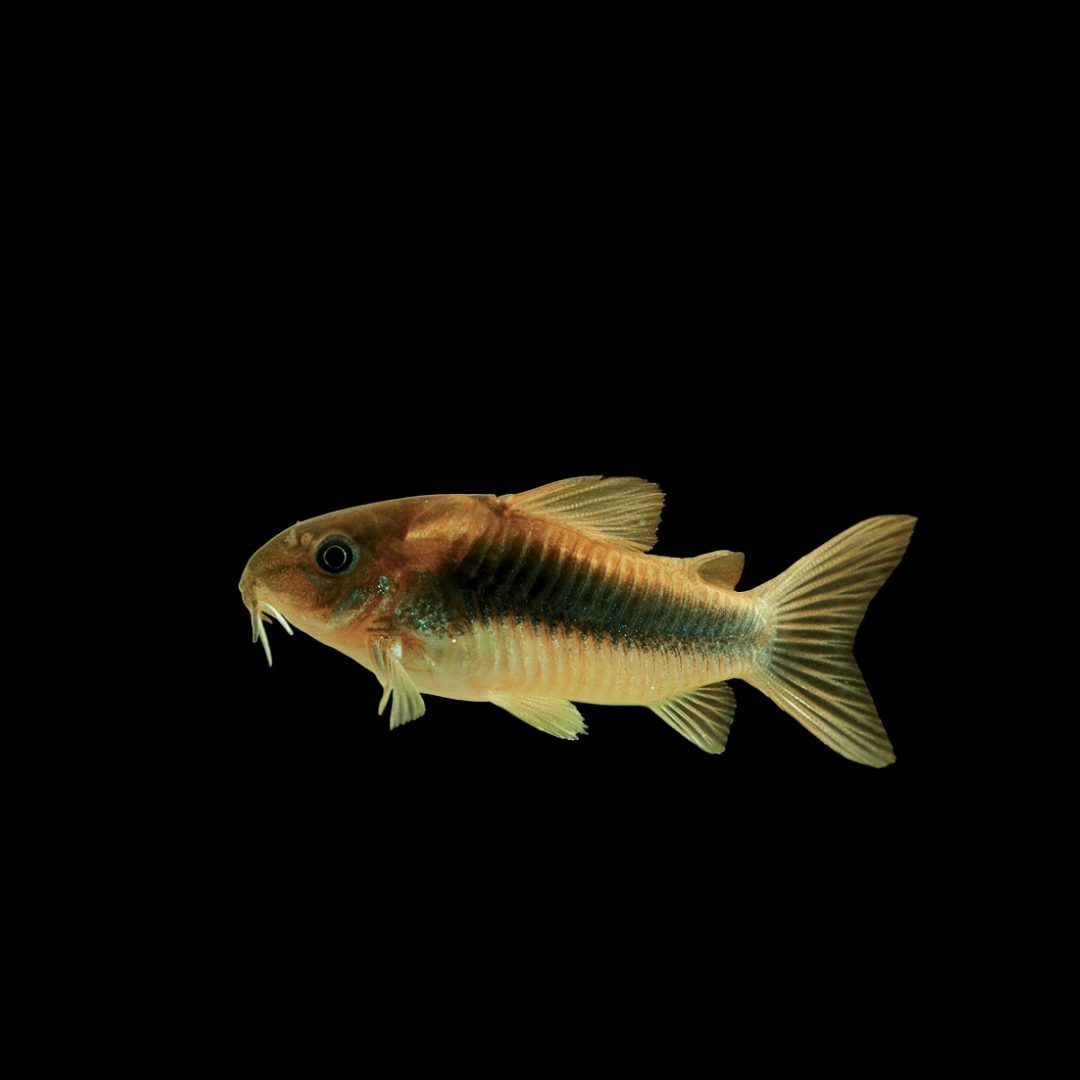
オステオガステル・アエネアは、旧学名コリドラス・アエネウスとして長く親しまれてきた南米産の小型ナマズです。日本では原種に近いブロンズ色の個体が「赤コリ」、アルビノ品種が「白コリ」と呼ばれ、丈夫で温和な性格から熱帯魚飼育の入門種として高い人気を保っています。底砂に口先を差し込みながら餌を探す姿が大きな魅力ですが、単なる「水槽の掃除屋」ではありません。専用の沈下性フード、清潔で角の丸い細砂、そして仲間と落ち着いて過ごせる群れの環境を整えることで、本来の愛らしい行動と長期飼育の楽しさを味わえる魚です。Osteogaster aenea, long known under the former name Corydoras aeneus, is a small South American armored catfish. In Japan, the bronze-colored form is widely called “Aka-cory,” while the albino strain is known as “Shiro-cory.” It remains one of the most popular beginner-friendly tropical fish because it is hardy, peaceful, and full of character. Its sand-sifting foraging behavior is charming, but it should not be treated merely as a tank cleaner. With dedicated sinking foods, clean rounded fine sand, and a settled group environment, this species shows its natural behavior and becomes a rewarding long-term aquarium fish.
赤コリ、ブロンズ・コリドラス、コリドラス・アエネウス、白コリ(アルビノ品種)Bronze corydoras, bronze cory, albino bronze corydoras for the albino strain
分類 / Family
ナマズ目 カリクティス科 コリドラス亜科 オステオガステル属Order Siluriformes, family Callichthyidae, subfamily Corydoradinae, genus Osteogaster
英名 / English Name
Bronze Corydoras, Bronze Cory
分布 / Distribution
南米のアンデス山脈東側に広く分布するとされ、コロンビア、トリニダード周辺からラプラタ川流域まで報告があります。ただし、現在「アエネウス」と呼ばれてきた魚には複数の地域個体群や近縁の未整理群が含まれる可能性が高く、流通名と学術的な種の範囲が完全に一致しない場合があります。Reported broadly from the eastern side of the Andes in South America, from Colombia and Trinidad toward the La Plata basin. However, fish historically called “aeneus” probably include multiple regional populations and closely related unresolved forms, so trade names and strict scientific species boundaries may not always match.
最大体長 / Max Size
標準体長で最大約7.5cm。水槽内では約6〜7cmで、一般にメスのほうがやや大きく、体高と腹幅が出やすい傾向があります。Up to about 7.5 cm standard length. In aquariums, it is usually around 6–7 cm; females are generally slightly larger, deeper-bodied, and broader around the belly.
寿命 / Lifespan
目安は5〜10年程度です。水質が安定し、底砂が清潔で、無理な混泳や慢性的な餌不足がなければ、長く付き合える種類です。A typical guideline is about 5–10 years. With stable water quality, clean substrate, suitable tank mates, and proper feeding, it can be a long-lived aquarium fish.
飼育環境 / Aquarium Environment
水槽サイズ / Tank Size
最低でも60cm規格水槽(約57〜60L)を目安に、5〜6匹以上のグループで飼育するのがおすすめです。小型水槽でも一時飼育は可能ですが、底床の汚れが溜まりやすく水質も揺れやすいため、長期飼育では余裕のある水量が安全です。A standard 60 cm aquarium of about 57–60 L is a good minimum guideline, ideally for a group of five to six or more. Smaller tanks can work temporarily, but they are less stable and bottom debris accumulates more easily, so extra water volume is safer for long-term care.
水温 / Temperature
25〜28℃が目安です。日本の冬はヒーターで保温し、急激な低温や大きな水温変化を避けてください。繁殖誘発のためにやや涼しい新水を使うことはありますが、通常管理では安定を優先します。A guideline of 25–28°C is suitable. In Japan, a heater is needed in winter, and sudden chilling or large temperature swings should be avoided. Slightly cooler fresh water may be used to encourage spawning, but stability is the priority for normal care.
水質 / Water Quality
pH6.0〜8.0、硬度5〜19dH程度まで幅広く適応します。重要なのは極端な数値を狙うことではなく、アンモニアと亜硝酸を出さず、硝酸塩と底床の汚れを溜め込まないことです。コリドラス類への常用の塩分添加は避けるのが無難です。It adapts to a broad range around pH 6.0–8.0 and 5–19 dH. The key is not chasing extreme values but keeping ammonia and nitrite at zero and preventing nitrate and bottom waste buildup. Routine salt addition is best avoided for corydoradine catfish.
レイアウト / Layout
田砂、ボトムサンド、角の取れた細目の砂など、口ヒゲを傷つけにくい底床が向いています。流木、石、水草で隠れ場所を作りつつ、前景には広めの採餌スペースを残すと観察しやすくなります。底砂を掘る魚なので、崩れやすいソイル単独の厚敷きや尖った粗い砂利は避けたほうが安全です。Fine, rounded substrates such as Japanese “Tasa” sand, bottom sand, or smooth fine gravel are suitable because they are less likely to damage the barbels. Provide cover with driftwood, stones, and plants while leaving open foraging space at the front. Because this fish digs into the substrate, thick layers of easily crumbling soil or sharp coarse gravel are not ideal.
注意点 / Precautions
水面に上がって空気を飲み込む行動は腸呼吸に関わる自然な行動ですが、急に回数が増えた場合は酸欠、底床の汚れ、水質悪化を点検してください。また、胸鰭の棘と腋窩腺の分泌物により、輸送や網での扱いではストレスを受けやすいことがあります。導入時は袋の水をむやみに水槽へ入れず、落ち着いた水合わせを行います。Darting to the surface to gulp air is part of its natural intestinal air-breathing behavior, but a sudden increase can indicate low oxygen, dirty substrate, or declining water quality. Its pectoral spines and axillary gland secretions can also make handling and transport stressful. During acclimation, avoid pouring transport water into the aquarium and proceed calmly.
餌と給餌 / Feeding
餌の種類 / Diet
沈下性のコリドラス用タブレットや小粒ペレットを主食にします。コンディションを上げたい時は、冷凍赤虫、イトメ、ブラインシュリンプ、細かい冷凍餌などを組み合わせるとよいでしょう。自然下では小型の底生無脊椎動物、甲殻類、昆虫の幼生などを食べるため、植物質だけに偏らせないことが大切です。Use sinking corydoras tablets or small sinking pellets as the staple diet. For conditioning, supplement with frozen bloodworms, tubifex-type foods, brine shrimp, and other fine frozen foods. In nature it feeds on small benthic invertebrates, crustaceans, and insect larvae, so the diet should not be purely plant-based.
給餌のポイント / Feeding Tips
「他の魚の食べ残しで足りる」と考えず、底まで確実に届く餌を本種の分として与えます。混泳水槽では、ライト消灯前後や他魚の満腹後に沈下餌を入れると行き渡りやすくなります。食べ残しは底床トラブルの原因になるため、数時間残る量は避け、給餌量を水換え時の汚れ方と体つきで調整します。Do not assume that leftovers from other fish are enough; provide food that reliably reaches the bottom. In community tanks, feeding near lights-out or after midwater fish have eaten helps ensure the corys get their share. Leftover food can foul the substrate, so avoid portions that remain for hours and adjust feeding by body condition and substrate cleanliness.
性格と混泳 / Temperament and Tank Mates
性格 / Temperament
非常に温和で、仲間同士でまとまって行動する社会性の高い魚です。単独でも生存はできますが、警戒心が強くなりやすく、複数匹で飼うほうが採餌、休息、短い遊泳などの自然な行動を観察しやすくなります。It is very peaceful and highly social, often moving and resting with its own kind. A single fish can survive, but it may become shy; keeping a group makes natural foraging, resting, and short bursts of swimming much easier to observe.
混泳の相性 / Compatibility
小型テトラ、ラスボラ、グッピー、プラティ、温和な小型ドジョウ類や同程度の底ものと相性がよいです。大型魚、気性の荒いシクリッド、底床を激しく占有する魚、口に入るサイズの稚エビや稚魚との組み合わせには注意が必要です。混泳時は、底層の餌が不足しないかを必ず確認します。Good companions include small tetras, rasboras, guppies, platies, peaceful small loaches, and similarly calm bottom dwellers. Avoid large predators, aggressive cichlids, territorial bottom fish, and very small shrimp or fry that may be eaten opportunistically. In community setups, always check that enough food reaches the bottom.
病気と対策 / Diseases and Prevention
かかりやすい病気 / Common Diseases
底床の汚れや尖った砂利が原因となる口ヒゲの摩耗、口周りの細菌感染、尾ぐされ、肌荒れ、白点病、導入直後の輸送ストレスによる不調に注意します。特に口ヒゲが短くなる、底でじっとする、呼吸が荒い、痩せていくなどの変化は早めに確認したいサインです。Watch for barbel erosion from dirty or sharp substrate, bacterial infections around the mouth, fin rot, skin irritation, ich, and post-transport stress. Shortening barbels, lethargy on the bottom, heavy breathing, and gradual weight loss are important warning signs.
対策と予防 / Prevention
予防の基本は、角の丸い底砂、定期的な底床掃除、安定した濾過、導入前の観察とトリートメントです。薬浴が必要な場合は、ナマズ類に強すぎる薬剤や塩分濃度にならないよう、製品表示を確認しながら慎重に行います。状態悪化時は、まず水質、底砂の汚れ、餌が届いているかを点検してください。Prevention starts with rounded substrate, regular substrate cleaning, stable filtration, and careful observation or quarantine before introduction. If medication is needed, use products cautiously because catfish can be sensitive to some medicines and salt levels. When problems appear, first check water quality, substrate cleanliness, and whether the fish are actually getting food.
増やし方(繁殖) / Breeding
雌雄の判別 / Sexing
成熟するとメスはオスより大きく、上から見ると腹部がふっくら広がります。オスはやや細身で、繁殖期にはメスを追尾する行動が目立ちます。若魚では判別が難しいため、複数匹を育てて自然にペアや繁殖群ができるのを待つのが確実です。Mature females are usually larger and broader through the belly when viewed from above. Males are slimmer and often chase females during breeding activity. Juveniles are difficult to sex, so raising a group and letting natural breeding groups form is the most reliable approach.
繁殖形態 / Reproduction
卵生で、水草、ガラス面、石、フィルター周辺などに粘着卵を産み付けます。コリドラス類特有のTポジションを取り、メスがオスの精子を口から取り込んだ後、腹鰭で作ったポケット状の場所に卵を抱え、そこで受精が進むと考えられています。この「精子飲用」は本種を語るうえで非常に興味深い繁殖行動です。It is an egg-layer that attaches adhesive eggs to plants, glass, stones, filter parts, and other surfaces. During the characteristic corydoradine T-position, the female takes sperm into her mouth, holds eggs in a pocket formed by the pelvic fins, and fertilization is thought to occur there. This “sperm drinking” behavior is one of the most fascinating aspects of the species.
繁殖のポイント / Breeding Tips
よく太らせた成魚を群れで管理し、冷凍赤虫などでコンディションを上げてから、やや低めの新水を使った水換えで雨季の刺激を再現します。産卵後の卵は親に食べられることがあるため、卵だけを隔離するか、産卵用水槽を用意します。水カビを防ぐために弱い水流と清潔な水を保ち、ふ化後はヨークサック吸収を待ってからブラインシュリンプ幼生や微細な稚魚用フードへ移行します。Condition mature adults in a group with nutritious foods such as frozen bloodworms, then simulate rainy-season changes with a water change using slightly cooler fresh water. Adults may eat eggs, so either move the eggs or use a dedicated breeding tank. Keep clean, gently moving water to reduce fungus; after the yolk sac is absorbed, start fry on newly hatched brine shrimp and fine fry foods.
雑学と豆知識 / Trivia and Fun Facts
1. 学名が変わった定番魚 / 1. A familiar fish with a new scientific name
本種は長年Corydoras aeneusとして知られていましたが、コリドラス亜科の大規模な系統研究により、現在はOsteogaster aeneaとして扱われます。研究は2024年に先行公開され、巻号上は2025年に収載されたため、文献によって年の表記が分かれることがあります。なお、Osteogaster属のタイプ種はアエネアではなくOsteogaster equesです。種小名も、属名に合わせてaeneusからaeneaへ語尾が整えられています。This species was known for many years as Corydoras aeneus, but a major phylogenetic revision of Corydoradinae now places it in Osteogaster aenea. The study appeared online in 2024 and was later assigned to a 2025 journal issue, so the year can differ among references. Importantly, the type species of Osteogaster is not O. aenea but Osteogaster eques. The specific epithet was also adjusted from aeneus to aenea to match the genus.
2. 「赤コリ」はひとつの顔だけではない / 2. “Bronze cory” is not a single simple face
アクアリウムで赤コリと呼ばれる魚は身近ですが、学術的には広い分布域を持つ複雑なグループとして扱われます。古い核型研究では、見た目では区別しにくい集団の中に、染色体数が大きく異なる二倍体型と四倍体型が報告されています。このため、店頭名としての「アエネウス」と、厳密な分類学上のOsteogaster aeneaが常に完全一致するとは限らない点を意識しておくと、レーザー系や地域変異の理解もしやすくなります。The aquarium fish called the bronze cory is familiar, but scientifically it belongs to a complex group with a broad distribution. Older karyotype work reported diploid and tetraploid forms with very different chromosome counts among populations that look very similar externally. For this reason, the trade name “aeneus” and the strict taxonomic concept of Osteogaster aenea may not always match perfectly, which helps explain the complexity of laser forms and regional variants.
3. 腸呼吸は「丈夫さ」の裏側にある適応 / 3. Intestinal air-breathing behind its hardiness
本種が水面へ素早く上がって空気を飲み込む行動は、低酸素になりやすい浅い水域や柔らかい底質の環境で役立つ腸呼吸に関係します。正常な行動として時々見られるぶんには問題ありませんが、急に頻度が増える時は水槽の酸素量や底床の汚れを見直す合図になります。つまり、赤コリの「丈夫さ」は放置に耐えるという意味ではなく、変化に気づく観察対象として優れているという意味でもあります。Its quick trips to the surface to gulp air are linked to intestinal air-breathing, an adaptation useful in shallow, soft-bottomed waters where oxygen can be low. Occasional air-gulping is normal, but a sudden increase can be a signal to check oxygen levels and substrate cleanliness. In other words, the bronze cory’s hardiness does not mean it should be neglected; it is also a fish that tells attentive keepers when conditions are changing.
4. 底砂を動かす小さな生態系エンジニア / 4. A small ecosystem engineer of the substrate
実験研究では、Corydoras aeneusとして扱われた本種が、線虫などの微小な底生動物を大量に捕食し、同時に底砂をかき回すことで小さな生物を水中へ押し出すことが示されています。確認できる実験値では、1個体が24時間で数万匹規模の線虫を食べる能力が示されており、単なる残飯処理役ではなく、底床の生物群集に強い影響を与える存在であることが分かります。水槽内でも、彼らが安心して砂を探れる環境を用意することは、行動の豊かさを引き出す大切なポイントです。Experimental studies using fish identified as Corydoras aeneus show that they can consume large numbers of microscopic benthic animals such as nematodes while also disturbing the sediment and pushing small organisms into the water column. Confirmed experimental values show that a single fish can eat tens of thousands of nematodes in 24 hours. This makes it far more than a leftover cleaner; it is a strong influence on bottom-dwelling communities. In aquariums, providing safe sand lets this natural behavior appear in a healthy way.
5. 精子飲用という特異な繁殖 / 5. The unusual reproductive behavior called sperm drinking
本種の繁殖で有名なのが、メスがオスの精子を口から取り込む「精子飲用」です。近年の研究では、オスの貯精嚢液に含まれるcaCA12というタンパク質が精子の運動を抑え、卵の近くに到達するまで余計なエネルギー消費を抑える役割を持つ可能性が示されました。水槽の片隅で起こるTポジションは、見た目には短い繁殖行動でも、その内側では非常に精巧な生理メカニズムが働いているのです。One of the most famous aspects of this species is sperm drinking, in which the female takes sperm into her mouth. Recent research suggests that caCA12, a protein in the male seminal vesicle fluid, suppresses sperm motility and may help prevent unnecessary energy use until the sperm are close to the eggs. The brief T-position seen in the aquarium therefore hides a remarkably refined physiological mechanism.
6. 腋窩腺と輸送時の注意 / 6. Axillary glands and transport caution
カリクティス科のナマズには、胸鰭の棘や体表の装甲だけでなく、分泌物による防御も関わると考えられています。本種では胸鰭付近の腋窩腺が組織学的に報告されており、輸送中のストレスで白色または無色の分泌物が出て死亡につながる例が、アクアリストや輸入関係者から報告されています。ただし、分泌物の毒性成分や作用の全体像は未解明な部分もあるため、記事では「強い毒が確定している」と断定するより、輸送水を持ち込まない、過密輸送を避ける、導入時に状態を観察するという実用面を重視して扱うのが安全です。In callichthyid catfish, defense is thought to involve not only pectoral spines and armor but also secretions. In this species, axillary glands near the pectoral fins have been described histologically, and aquarists and importers have reported white or colorless secretions during stressful transport, sometimes with deaths. However, the full chemistry and action of these secretions remain incompletely resolved, so it is safer to treat the topic practically: avoid adding transport water to the aquarium, prevent overcrowded transport, and observe new arrivals carefully.
7. 品種と流通名の読み解き方 / 7. Reading strains and trade names
赤コリと白コリは大量に養殖される定番品種ですが、ブラック系統やレーザー系統は名前の使われ方に注意が必要です。ブラック系は野生のベネズエラ産個体そのものとして扱われることがありますが、実際にはドイツ由来の飼育下選抜系統として説明されることが多い品種です。また、グリーンレーザーやオレンジレーザーなどはアエネウス近縁のOsteogaster系統として流通しますが、厳密にはO. aeneaそのものではなく未整理の近縁群として扱うほうが慎重です。流通名は飼育の入口として便利ですが、図鑑では学名と由来を分けて見る姿勢が大切です。Normal bronze and albino forms are mass-produced staples, but black and laser forms require caution with trade names. Black forms are sometimes treated as wild Venezuelan fish, yet they are more often explained as captive-selected strains of German origin. Green and orange laser forms are traded within the Osteogaster aeneus-type group, but it is more cautious to treat them as closely related unresolved forms rather than strict O. aenea. Trade names are useful starting points, but an aquarium encyclopedia should separate the market name from the scientific identity.
まとめ / Conclusion
オステオガステル・アエネアは、赤コリや白コリとして長く親しまれてきた、もっとも身近なコリドラス類のひとつです。丈夫で温和な魚ですが、健康に長く育てるためには、細かく角の丸い底砂、安定した濾過、底層まで届く専用フード、そして仲間と過ごせる数をそろえることが欠かせません。水槽の底で砂をふるう姿は、飼育環境が合っていることを教えてくれる、何よりの見どころです。Osteogaster aenea, long loved as the bronze or albino cory, is one of the most familiar corydoradine catfish in the aquarium hobby. It is hardy and peaceful, but long-term health depends on fine rounded substrate, stable filtration, dedicated bottom foods, and a proper group of its own kind. Its sand-sifting behavior at the bottom of the aquarium is one of the best signs that the environment is right.
一方で本種は、分類改定、種複合体、腸呼吸、腋窩腺、精子飲用といった、研究対象としても非常に奥深い魚です。入門魚として迎えやすく、知れば知るほど見方が変わることこそ、赤コリの大きな魅力だといえます。「掃除屋」としてではなく、小さな生態と進化の物語を持つ一匹として向き合うことで、この定番種は水槽の底で、静かで力強い存在感を放ってくれるでしょう。At the same time, this species is scientifically rich, touching on taxonomic revision, species complexes, intestinal air-breathing, axillary glands, and sperm drinking. It is easy to welcome as a beginner fish, yet the more we learn, the more interesting it becomes. When seen not as a cleaner but as a small fish with its own ecological and evolutionary story, this classic species brings a quiet but powerful presence to the bottom of the aquarium.
Dias, A. C., Tencatt, L. F. C., Roxo, F. F., Silva, G. S. C., Santos, S. A., Britto, M. R., Taylor, M. I. & Oliveira, C. (2025). Phylogenomic analyses in the complex Neotropical subfamily Corydoradinae (Siluriformes: Callichthyidae) with a new classification based on morphological and molecular data. Zoological Journal of the Linnean Society, 203(3), zlae053.
根拠範囲:コリドラス亜科の再編、Osteogaster属の復活、旧Corydoras aeneusからOsteogaster aeneaへの分類上の位置づけ。 https://doi.org/10.1093/zoolinnean/zlae053
Tencatt, L. F. C., Gomes, V. C. & Evers, H.-G. (2023). A new species of Corydoras (Siluriformes: Callichthyidae) from the rio Madre de Dios basin, Peruvian Amazon, with comments on Corydoras aeneus identity. Neotropical Ichthyology, 21(2), e230023.
根拠範囲:「アエネウス」と呼ばれる魚群の分類学的整理、近縁群・地域個体群を慎重に扱う必要性。 https://doi.org/10.1590/1982-0224-2023-0023
Kramer, D. L. & McClure, M. (1980). Aerial respiration in the catfish, Corydoras aeneus (Callichthyidae). Canadian Journal of Zoology, 58(11), 1984–1991.
根拠範囲:後腸を用いた空気呼吸、水面への急浮上、空気呼吸頻度と溶存酸素の関係。 https://doi.org/10.1139/z80-273
Pineda, M., Aragao, I., McKenzie, D. J. & Killen, S. S. (2020). Social dynamics obscure the effect of temperature on air breathing in Corydoras catfish. Journal of Experimental Biology, 223(21), jeb222133.
根拠範囲:低酸素・水温・群れ行動が空気呼吸頻度に与える影響。飼育時に水面呼吸の増加を環境確認のサインとして扱う根拠。 https://doi.org/10.1242/jeb.222133
Kohda, M., Tanimura, M., Kikue-Nakamura, M. & Yamagishi, S. (1995). Sperm drinking by female catfishes: a novel mode of insemination. Environmental Biology of Fishes, 42, 1–6.
根拠範囲:Tポジション、メスによる精子の取り込み、腹鰭ポーチ内での受精という繁殖行動。 https://doi.org/10.1007/BF00002344
Yoshida, J., Yamamoto, M., Kamiya, J., Kondo, A., Sakaguchi, Y., Morino, N., Saito, T., Kohda, M., Awata, S., Sato, B., Miyado, K. & Kawano, N. (2025). Seminal vesicle protein ca CA12 in Corydoras aeneus inhibits sperm motility for sperm drinking. Journal of Experimental Biology, 228(9), jeb250293.
根拠範囲:貯精嚢液、caCA12、精子運動抑制と精子飲用を支える生理機構。 https://doi.org/10.1242/jeb.250293
Majdi, N., Weber, S. & Traunspurger, W. (2018). The early catfish catches the worm: predation of Corydoras aeneus (Siluriformes, Callichthyidae) on freshwater nematodes. Annales de Limnologie – International Journal of Limnology, 54, 29.
根拠範囲:線虫を中心とした微小底生動物への捕食圧、底生魚としての能動的な摂食生態。 https://doi.org/10.1051/limn/2018019
Wulfes, R., Traunspurger, W. & Ptatscheck, C. (2024). The armored catfish Corydoras aeneus shapes the meiofaunal community due to predation and disturbance-induced water column dispersal. Hydrobiologia, 851, 1565–1576.
根拠範囲:底砂攪拌、微小底生動物群集へのトップダウン効果、水柱への分散促進。 https://doi.org/10.1007/s10750-023-05408-y
Greven, H., Flasbeck, T. & Passia, D. (2006). Axillary glands in the armoured catfish Corydoras aeneus (Callichthyidae, Siluriformes). Verhandlungen der Gesellschaft für Ichthyologie, 5, 65–69.
根拠範囲:胸鰭付近の腋窩腺の存在、輸送・ハンドリング時の注意点を説明する形態学的背景。 PDF: Heinrich-Heine-Universität Düsseldorf
Wright, J. J. (2009). Diversity, phylogenetic distribution, and origins of venomous catfishes. BMC Evolutionary Biology, 9, 282.
根拠範囲:ナマズ類における棘・毒腺・防御機構の広い進化的背景。腋窩腺分泌物の扱いを断定しすぎないための補助資料。 https://doi.org/10.1186/1471-2148-9-282


 ポチップ
ポチップ



コメント