

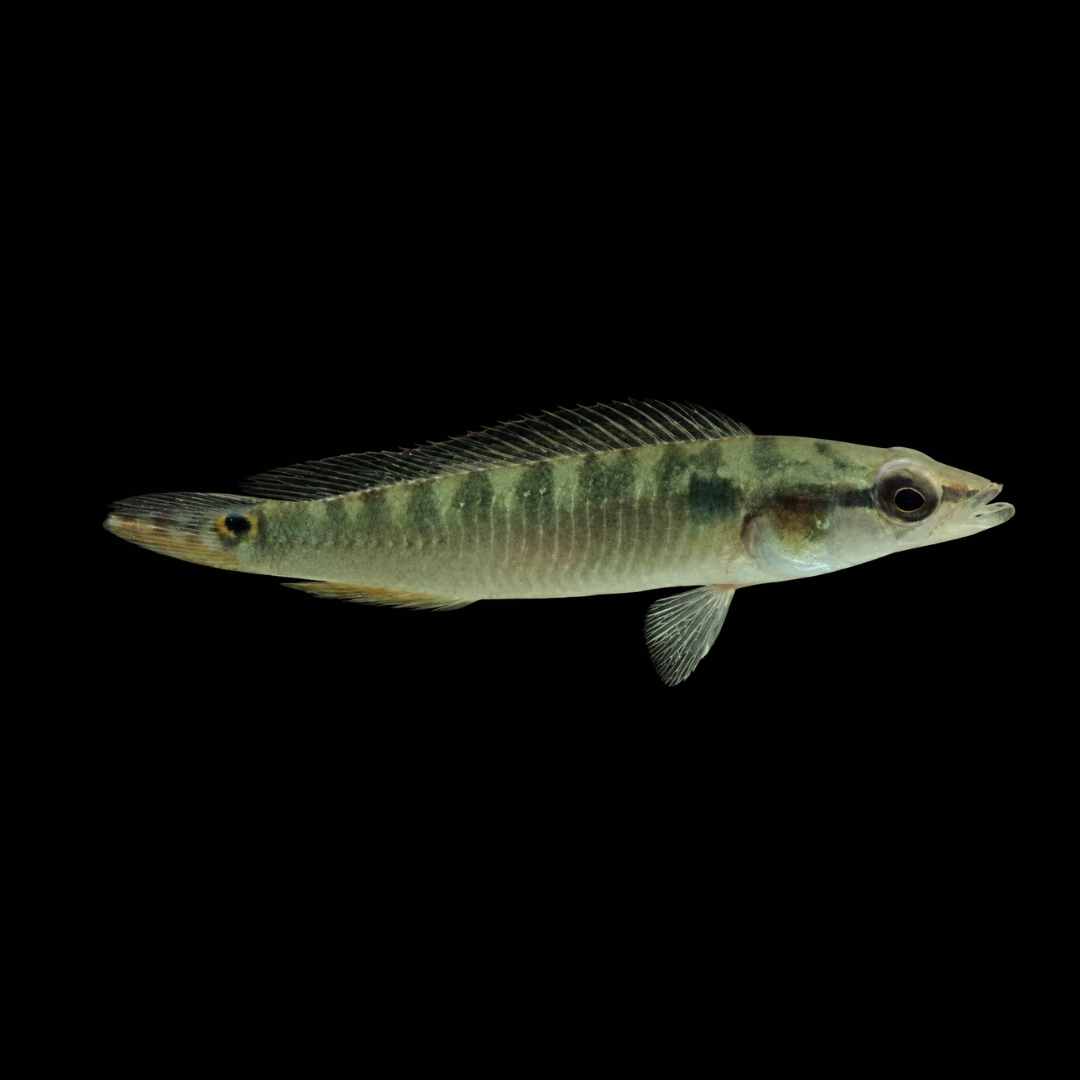
解説 / Description
サクサティリア・ルシウスは、エクアドル、ペルー、ブラジル西部の上流アマゾン水系から記録されている中型のパイクシクリッドです。細長い体型と突出した下顎を持ち、幼魚期から見られる肩斑はSaxatilia属を特徴づける形質のひとつです。成魚では雌雄の色彩差が現れ、オスは不対鰭に赤みが見られることがあり、メスは成熟すると腹部が丸みを帯びて赤紫色を呈します。長くCrenicichla luciusの名で知られてきましたが、2023年の分類学的再編でSaxatilia属へ移されました。 Saxatilia lucius is a medium-sized pike cichlid recorded from the upper Amazon basin in Ecuador, Peru, and western Brazil. It has an elongated body and projecting lower jaw, and the humeral blotch visible from juvenile stages is one of the characters associated with the genus Saxatilia. Adult coloration differs between the sexes: males may show red tones in the unpaired fins, while mature females develop a fuller abdomen with reddish to purplish coloration. Long known as Crenicichla lucius, the species was transferred to Saxatilia in a major taxonomic revision published in 2023.
基本情報 / Basic Information
| 学名 / Scientific Name | Saxatilia lucius (Cope, 1870) |
|---|---|
| 通称 / Common Name | クレニキクラ・ルシウス(旧属名に基づく流通名)、パイクシクリッドPike cichlid; formerly traded under the name Crenicichla lucius |
| 分類 / Family | シクリッド科(Cichlidae)・ゲオファーグス族(Geophagini)・クレニキクラ亜族(Crenicichlina)・Saxatilia属Family Cichlidae; tribe Geophagini; subtribe Crenicichlina; genus Saxatilia |
| 英名 / English Name | Pike Cichlid |
| 分布 / Distribution | 南米の上流アマゾン水系。エクアドル、ペルー、ブラジル西部から記録されています。Upper Amazon basin in South America, with records from Ecuador, Peru, and western Brazil. |
| 最大体長 / Max Size | 標準体長(SL)で最大約16.8cm。標準体長は尾鰭を含まない測定値です。Up to about 16.8 cm standard length (SL). Standard length does not include the caudal fin. |
| 寿命 / Lifespan | 本種に限定した信頼できる具体的な寿命年数は確認できていません。A reliable species-specific lifespan in years has not been established. |
飼育環境 / Aquarium Environment
| 水槽サイズ / Tank Size | 単独飼育や限定的な混泳では90cm規格水槽(90×45×45cm、約180Lクラス)を目安にします。突発的な遊泳や縄張り行動まで考えると、120cm水槽(120×45×45cm、約240Lクラス)のほうが余裕があり理想的です。A standard 90 cm aquarium (90 × 45 × 45 cm, roughly the 180 L class) is a practical baseline for a single specimen or very limited community setup. A 120 cm aquarium (120 × 45 × 45 cm, roughly the 240 L class) provides more room for sudden bursts of swimming and territorial behavior and is preferable when space allows. |
|---|---|
| 水温 / Temperature | 本種に限定した信頼できる推奨水温の数値は確認できていません。導入時や換水時は急変を避け、水温を安定させます。 A reliable species-specific temperature range has not been established. Avoid abrupt temperature changes during acclimation and water changes. |
| 水質 / Water Quality | 本種は小河川やブラックウォーター環境から知られています。飼育では特定のpH値を追うよりも、急激な水質変化を避けて安定させることを優先します。本種固有の必須条件として断定できるpH範囲は明らかではありません。The species is known from streams and blackwater habitats. In captivity, stable conditions and avoidance of abrupt changes are more important than chasing a particular pH value. A species-specific mandatory pH range has not been established. |
| レイアウト / Layout | 流木、太い枝、石、丈夫なシェルターなどを組み合わせ、体を完全に隠せる場所と視線を遮る死角を複数つくります。待ち伏せ型の生態を再現するうえでも隠れ家は重要です。驚いた際に直線的に突進することがあるため、狭い通路や鋭利な飾りを避け、吻端をぶつけにくい空間を確保します。Combine driftwood, heavy branches, rocks, and secure shelters to create several places where the fish can hide completely and where lines of sight are broken. Such cover also reflects its ambush-predatory ecology. Because startled fish may make sudden straight-line dashes, avoid tight passages and sharp decorations and leave open areas that reduce the risk of injury to the snout. |
| 注意点 / Precautions | 小型魚は捕食されるおそれがあり、同種や近縁のパイクシクリッド、ほかのシクリッドとは縄張り争いが起こる可能性があります。繁殖期は攻撃性が高まることを想定し、逃げ場や隔離手段を確保します。輸入直後は急な水質変化を避け、慎重に水合わせを行ってください。Small fishes may be preyed upon, and territorial conflict can occur with conspecifics, related pike cichlids, and other cichlids. Aggression may increase during breeding, so provide refuges and a way to separate fishes if necessary. Newly imported fish should be acclimated carefully to avoid abrupt changes in water conditions. |
餌と給餌 / Feeding
| 餌の種類 / Diet | 野生下の詳細な食性は、本種に限定して十分には明らかになっていません。飼育下では肉食魚用の人工飼料を中心にし、導入直後に食べない場合は冷凍アカムシや冷凍エビなどを補助的に使いながら、状態を見て人工飼料へ慣らします。The detailed wild diet has not been established specifically for this species. In captivity, formulated foods for carnivorous fishes can be used as the dietary base; if a newly imported fish refuses them, frozen bloodworms or frozen shrimp can be used temporarily while it is gradually accustomed to prepared foods. |
|---|---|
| 給餌のポイント / Feeding Tips | ワイルド個体が人工飼料を警戒する場合は、食べる餌で体力を維持しながら少量ずつ人工飼料を併用し、段階的に慣らします。活餌だけに依存せず人工飼料を主軸にできれば栄養管理がしやすくなり、餌生物とともに病原体や寄生虫を持ち込む機会も減らせます。If a wild-caught specimen is reluctant to accept prepared food, maintain its condition with foods it will take while introducing small amounts of formulated food gradually. Making prepared food the dietary base rather than relying entirely on live prey simplifies nutritional management and can reduce opportunities for introducing pathogens or parasites with feeder organisms. |
性格と混泳 / Temperament and Tank Mates
| 性格 / Temperament | 警戒心と瞬発力があり、隠れ家を利用しながら行動するパイクシクリッドです。飼育下では、給餌時に飼育者の接近へ反応して隠れ家から出てくる個体もいます。繁殖時は縄張り性が強まる可能性があるため、同居魚との距離を確保できる環境が必要です。This pike cichlid is alert, capable of sudden bursts of movement, and makes regular use of cover. In captivity, some individuals respond to the keeper’s approach at feeding time and emerge from shelter. Territorial behavior may intensify during breeding, so adequate space between fishes is important. |
|---|---|
| 混泳の相性 / Compatibility | 安全性を重視するなら単独飼育が基本です。混泳させる場合は、口に入らない体格があり、生活場所が強く競合しにくい魚を慎重に選びます。ただし個体差や水槽サイズによって結果は変わるため、相性は保証できません。小型魚や、同種・近縁のパイクシクリッドとの混泳は避けるのが無難です。Keeping the species alone is the safest approach. If tank mates are attempted, choose fishes too large to swallow and whose preferred spaces do not strongly overlap, and introduce them cautiously. Individual temperament and aquarium size can change the outcome, so compatibility cannot be guaranteed. Small fishes and other Saxatilia or closely related pike cichlids are best avoided. |
病気と対策 / Diseases and Prevention
| かかりやすい病気 / Common Diseases | 本種だけに特有の好発病は確認されていません。飼育上は、輸送時のスレ傷や急な水質変化による体調悪化、餌生物とともに病原体や寄生虫を持ち込むことに注意します。No disease has been established as uniquely common in this species. Practical risks include deterioration after shipping abrasions or abrupt water changes, and the introduction of pathogens or parasites with feeder organisms. |
|---|---|
| 対策と予防 / Prevention | 輸入直後は急激な水質変化を避け、落ち着ける隠れ家を用意して体表の損傷やストレスを増やさないことが重要です。日常の給餌では人工飼料を中心にし、活餌へ過度に依存しないことで、外部から病原体や寄生虫を持ち込む機会を減らします。After import, avoid abrupt changes in water chemistry and provide secure cover so that stress and physical injury are not compounded. In routine feeding, using formulated foods as the main diet and avoiding excessive dependence on live feeders can reduce opportunities for introducing pathogens and parasites. |
増やし方(繁殖) / Breeding
| 雌雄の判別 / Sexing | 成熟したオスでは背鰭・臀鰭・尾鰭に赤みが目立つことがあります。メスは成熟すると腹部が丸みを帯び、赤色から紫色を呈するのが大きな手掛かりです。Mature males may show stronger red coloration in the dorsal, anal, and caudal fins. Mature females develop a fuller abdomen with reddish to purplish coloration, which is one of the more useful sex-related color differences. |
|---|---|
| 繁殖形態 / Reproduction | 洞窟状の隠れ家や平らな岩面などを利用する基質産卵型とされ、親魚が卵や稚魚を保護します。本種に限定した具体的な産卵数は明らかではありません。It is regarded as a substrate spawner that uses cave-like shelters or flat rock surfaces, with parental care of eggs and young. A reliable species-specific clutch size has not been established. |
| 繁殖のポイント / Breeding Tips | 成熟した雌雄を相性を見ながら繁殖用水槽へ導入し、流木の陰や平らな石など産卵場所になり得る基質を用意します。繁殖時は親魚の攻撃性が高まる可能性があるため、混泳魚を隔離できるようにします。稚魚が自由遊泳を始めた後は、ふ化直後のブラインシュリンプ幼生など、口に入る大きさの餌を与え、水流は稚魚が流され続けない程度に抑えます。Introduce mature fish to a breeding aquarium while carefully monitoring pair compatibility, and provide potential spawning substrates such as flat stones or sheltered areas beneath driftwood. Territorial behavior may intensify during breeding, so other fishes should be separable. Once the fry are free-swimming, offer suitably small foods such as newly hatched brine shrimp and keep the current gentle enough that the fry are not continuously swept away. |
雑学と豆知識 / Trivia and Fun Facts
| 1. 150年以上使われた名前から、新しい属へ / 1. From a 150-Year-Old Name to a New Genus | この魚が最初に学名を与えられたのは1870年で、エドワード・ドリンカー・コープによってCrenicichla luciusと記載されました。種小名のluciusはカワカマスを指すラテン語に由来し、細長い体と捕食者らしい姿をそのまま名前に写したような響きを持っています。それから約150年、本種はクレニキクラの一員として扱われてきましたが、2023年に形態形質と分子系統データを組み合わせた大規模な再検討が行われ、旧saxatilis種群はSaxatilia属として独立しました。つまり、店頭で「クレニキクラ・ルシウス」と呼ばれる個体を見かけても、それは間違いというより、長いアクアリウム史の中で定着した旧名が今も残っている姿だと理解できます。The species was described in 1870 by Edward Drinker Cope as Crenicichla lucius. The specific name lucius derives from a Latin word for pike, neatly echoing the fish’s elongated body and predatory appearance. For roughly a century and a half it remained within Crenicichla, but a major 2023 reassessment combining morphological characters with molecular phylogenetic data recognized the former saxatilis group as the genus Saxatilia. Thus, when aquarium trade labels still use “Crenicichla lucius,” they preserve a historically entrenched name rather than simply reflecting random inconsistency. |
|---|---|
| 2. 肩の黒斑が教えてくれる近縁種との違い / 2. A Shoulder Spot That Helps Tell Relatives Apart | パイクシクリッドの仲間は一見するとよく似ていますが、Saxatilia luciusでは胸鰭基部の上方に暗い肩斑が見られます。西アマゾンで同所的に見られるS. anthurusでは、この斑紋に白い縁取りが生じるのに対し、ルシウスの肩斑にはその明瞭な白枠がありません。またS. proteusより体が細長いことも識別の手掛かりになります。派手な色だけではなく、斑紋の位置や縁取り、体の比率といった小さな差を追うと、分類学者が魚を見る視点に少し近づくことができます。Many pike cichlids look deceptively similar at first glance, but Saxatilia lucius carries a dark humeral spot above the base of the pectoral fin. In the sympatric western Amazon relative S. anthurus, the corresponding spot is distinctly ocellated with a pale border, whereas the spot in S. lucius lacks that clear white edging. Its more elongated body also helps separate it from S. proteus. Looking beyond bright colors to the position and border of a spot, or to subtle body proportions, offers a glimpse of how taxonomists distinguish closely related fishes. |
| 3. 成魚に残る「幼魚らしさ」と進化の仮説 / 3. Juvenile-Like Patterns and an Evolutionary Hypothesis | 旧saxatilis種群では、幼魚に目立つ体側の帯や頭部の暗色模様が成魚にも残る例があり、近縁種Crenicichla ploegi(現在のSaxatilia ploegi)では、こうした特徴を幼形成熟、すなわちペドモルフォシスとして解釈する仮説が提案されました。これはSaxatilia luciusそのものに同じ進化機構が実証されたという意味ではありません。それでも、同じSaxatilia属の色彩を考えるうえで、成長に伴う模様の変化そのものが進化研究の手掛かりになることを示す興味深い例です。Within the former saxatilis group, some species retain juvenile-like bands and dark head markings into adulthood. In the close relative Crenicichla ploegi, now Saxatilia ploegi, researchers proposed that such retained markings may represent paedomorphosis—the persistence of juvenile traits into later life stages. This does not mean that the same evolutionary mechanism has been demonstrated specifically in Saxatilia lucius. It does, however, show how changes in coloration through growth can become useful evidence when studying the evolution of the group. |
| 4. 「クレニキクラ」が分けられた理由 / 4. Why the Former Crenicichla Was Split | 2023年の分類学的再編は、見た目の違いだけを理由に属名を分けたものではありません。研究では216の形態形質と既報の分子データを組み合わせ、従来のCrenicichlaをそのまま一つの属として扱うより、複数のまとまりを独立した属として認めるほうが系統関係を分類に反映しやすいと判断されました。旧saxatilis種群がSaxatilia属となり、S. luciusの属名が変わったのもその一環です。つまり、この変更は単なる呼び名の更新ではなく、パイクシクリッドの進化関係を分類へ反映し直した結果です。The 2023 taxonomic revision did not split the former Crenicichla simply because the fishes looked different. The study combined 216 morphological characters with previously published molecular data and concluded that recognizing several distinct genera better reflected the evolutionary relationships within pike cichlids than retaining the traditional broad genus unchanged. The former saxatilis group became Saxatilia, and the transfer of S. lucius was part of that larger revision. In other words, the name change reflects a revised view of evolutionary relationships rather than a cosmetic relabeling. |
| 5. 2n=48という染色体数の中にある多様化の痕跡 / 5. Diversification Hidden Within a 2n=48 Karyotype | Saxatilia luciusでは、二倍体染色体数が2n=48と報告されています。シクリッド類では48本という染色体数自体は珍しくなく、同じ数を持つからといって染色体の構成や進化の経路まで同じとは限りません。目に見える斑紋や体型だけでなく、染色体の比較もパイクシクリッドの多様化を考える手掛かりのひとつになります。Saxatilia lucius has been reported with a diploid chromosome number of 2n=48. A count of 48 chromosomes is not unusual among cichlids, and sharing the same number does not mean that chromosome structure or evolutionary history is identical. Chromosome comparisons therefore provide another line of evidence, alongside visible patterns and body shape, for studying diversification in pike cichlids. |
まとめ / Conclusion
サクサティリア・ルシウスは、標準体長で最大約16.8cmの細長い体に、パイクシクリッドらしい力強さと雌雄で異なる色彩を備えた魚です。流木や石で落ち着ける隠れ家をつくり、急激な水質変化を避け、人工飼料を軸に安定して育てることで、その姿や行動をじっくり観察しやすくなります。 Saxatilia lucius combines the elongated form and powerful presence of a pike cichlid with distinct male and female coloration, reaching about 16.8 cm in standard length. Providing secure cover with wood and rock, avoiding abrupt changes in water conditions, and establishing a stable diet based on formulated foods make it easier to observe the species over the long term.
一方で、混泳では小型魚への捕食や同種・近縁種との縄張り争いに注意が必要です。無理な組み合わせを避け、十分な空間と視線を遮る場所を用意すると、細長い体型と落ち着いた構えが生み出す、南米のパイクシクリッドらしい存在感を楽しめます。 In a community aquarium, however, attention must be paid to the risk of predation on small fishes and territorial conflict with conspecifics or close relatives. Avoiding unsuitable combinations and providing enough space and visual barriers allows the elongated form and composed presence of this South American pike cichlid to stand out.

気になる道具や飼い方を見つけてみませんか?
 アイのアクアグッズ案内コリドラスのもふもふ時間を楽しむ|餌・底砂・お掃除用品の選び方コリドラスのもふもふする食事風景を楽しむために。沈む餌2種類の違い、口元に配慮した底砂、食べ残しを回収する道具を、アクアグッズナビゲーターのアイが紹介します。記事はコチラ →
 アイのアクアグッズ案内水草トリミングの道具とやり方|ハサミ・ピンセットを水草に合わせて選ぼう伸びすぎた水草は切っていい? 有茎草の差し戻し、前景草の絨毯、流木のモスを整える場面から、水草用ハサミ・ピンセット・ゴミ取りネットの選び方と片付けを紹介します。記事はコチラ →
 アイのアクアグッズ案内水槽用浄水器の選び方|水換えを楽にするタイプとROの違い道具の特徴や使い方、選ぶときのポイントをアイが紹介します。記事はコチラ →
 アイのアクアグッズ案内エンゼルフィッシュの飼育用品|高さのある水槽・ろ過・水草・餌の選び方道具の特徴や使い方、選ぶときのポイントをアイが紹介します。記事はコチラ →
さまざまな飼育テーマをご紹介。リンク先の記事には広告・商品紹介が含まれます。
案内・紹介記事一覧へ →分布マップ
サクサティリア・ルシウス(Saxatilia lucius)は、南米の上流アマゾン水系に分布し、エクアドル、ペルー、ブラジル西部から記録されています。
※ この地図は記事に記載された分布地域をもとにした概略表示です。マーカーは分布域を把握しやすくするために設定した代表地点であり、実際の採集地点や個体の確認地点を示すものではありません。
参考文献
-
分類・系統・形態Varella, H. R., Kullander, S. O., Menezes, N. A., Oliveira, C. & López-Fernández, H. (2023)Revision of the generic classification of pike cichlids using an integrative phylogenetic approach (Cichlidae: tribe Geophagini: subtribe Crenicichlina). Zoological Journal of the Linnean Society, 198(4), 982–1034.Saxatilia属の設立、Crenicichla luciusからSaxatilia luciusへの組み替え、クレニキクラ亜族の分類、属を識別する形態形質の根拠。
-
分類・分布・生息環境・体長Kullander, S. O. (1986)Cichlid Fishes of the Amazon River Drainage of Peru. Department of Vertebrate Zoology, Swedish Museum of Natural History, Stockholm.Crenicichla luciusとしての再記載、形態、ペルー・アマゾンでの分布、生息環境、標準体長など、本種の基礎情報を支える主要モノグラフ。
-
分布Escobar-Camacho, D., Valdiviezo-Rivera, J., Carrillo-Moreno, C., Argüello, P. & Swing, K. (2025)Exceptional concentration of fish diversity in Yasuní National Park, Ecuador (Napo River Basin). Biodiversity Data Journal, 13, e136476.エクアドルの上流アマゾン、ナポ川流域におけるSaxatilia luciusの記録を支える魚類相チェックリスト。
-
近縁群の形態・色彩Varella, H. R., Loeb, M. V., Lima, F. C. T. & Kullander, S. O. (2018)Crenicichla ploegi, a new species of pike-cichlid of the C. saxatilis group from the Rio Juruena and upper Rio Paraguai basins in Brazil, with an updated diagnosis and biogeographical comments on the group (Teleostei: Cichlidae). Zootaxa, 4377(3), 361–386.現在のSaxatilia属につながる旧C. saxatilis種群の診断、種間比較、成長に伴う色彩変化と幼形成熟仮説を確認するための資料。
-
繁殖・親魚保護の比較資料Strietman, M., Lopes, D. A., Barboza, T. B. & Carvalho, F. R. de (2021)Life history traits of parental care in Crenicichla lepidota (Cichliformes, Geophagini) in the upper Paraguay River basin, Brazil. Papéis Avulsos de Zoologia, 61, e20216103.近縁のパイクシクリッドで野外確認された基質保護と親魚による子の防衛行動を示す比較資料。繁殖時の縄張り性や親魚保護に関する記述の背景資料として参照。
-
飼育環境・水質・レイアウト・給餌Francis-Floyd, R. & Petty, B. D. (Merck Veterinary Manual, updated 2026)Providing a Home for Fish.観賞魚の水質安定、温度管理、ろ過、シクリッドの縄張りを分けるレイアウト、新魚導入時のストレス軽減、人工飼料を含む栄養管理の一般原則を支える獣医学資料。
-
病気・予防・導入時の注意Francis-Floyd, R. & Petty, B. D. (Merck Veterinary Manual, updated 2026)Disorders and Diseases of Fish.輸送・取り扱い・水質悪化などのストレスと疾病の関係、シクリッドを含む観賞魚の寄生虫・感染症、餌生物を介した病原体持ち込みなど、病気と予防上の注意点を支える獣医学資料。




コメント