

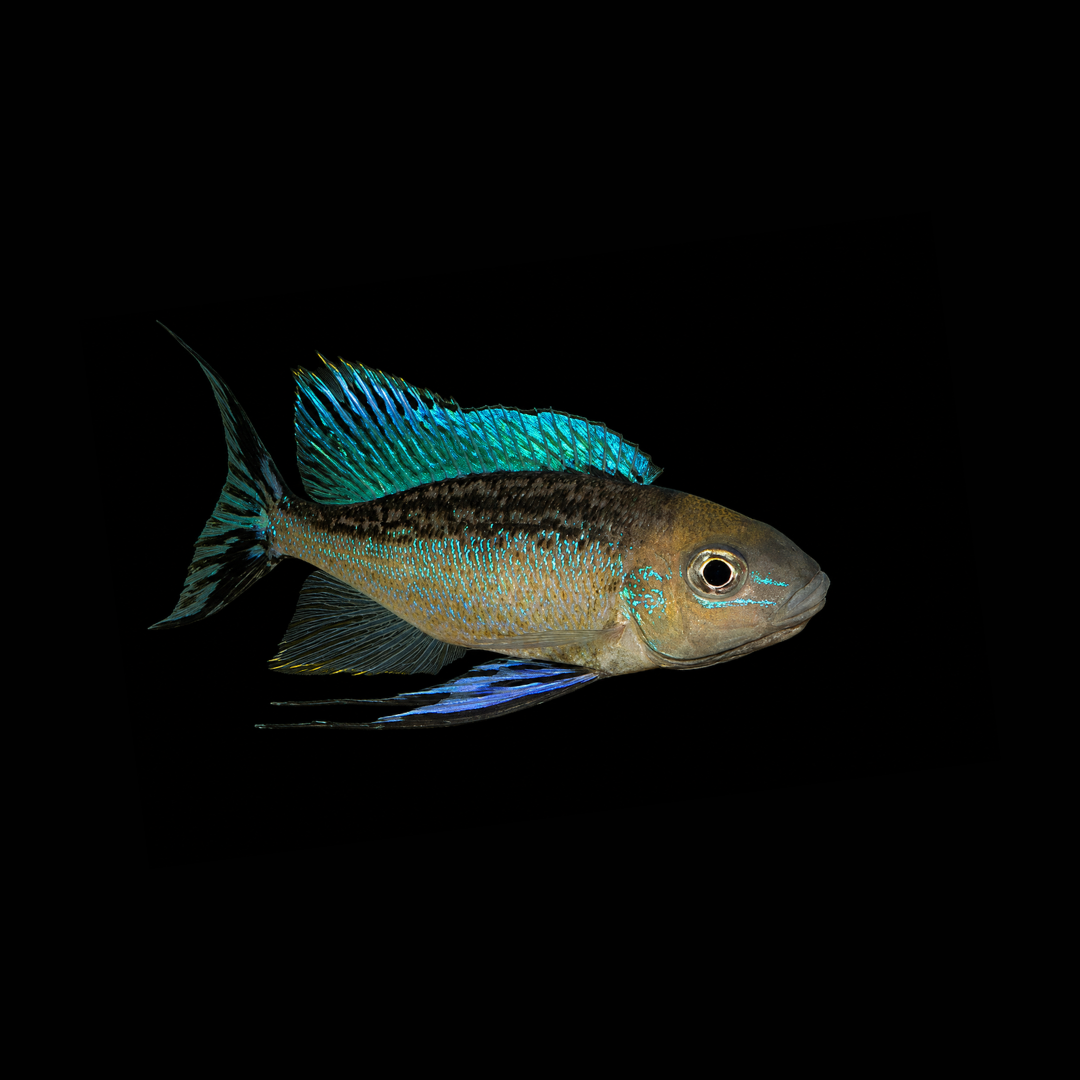
解説 / Description
キアソファリンクス・フルシファーは、東アフリカのタンガニイカ湖に固有のシクリッドです。成熟したオスは青や緑を基調とする強い金属光沢を帯び、腹鰭が糸状に長く伸びます。一方、メスや未成熟個体は銀色から灰褐色を基調とした控えめな体色を示します。大きな特徴は、成熟したオスが砂を運び、すり鉢状のクレーターを繁殖の場として築くことです。鮮やかな婚姻色と、周囲の環境そのものを作り替える行動の両方を観察できる点に、本種ならではの魅力があります。 Cyathopharynx furcifer is a cichlid endemic to Lake Tanganyika in East Africa. Mature males develop strong metallic blue and green tones and greatly elongated pelvic fins, whereas females and immature fish remain comparatively plain silver to gray-brown. A defining trait is the mature male’s construction of a crater-shaped spawning site by moving sand. The species is therefore notable for both its vivid breeding coloration and its conspicuous habitat-modifying behavior.
基本情報 / Basic Information
| 学名 / Scientific Name | Cyathopharynx furcifer |
|---|---|
| 通称 / Common Name | キアソファリンクス、フルシファー。流通上は採集地名を添えて「ハレンベ」「マガラ」「ムビタ」などと呼ばれるほか、個体群によっては「フォアエ」の名が使われることがあります。Cyathopharynx, Furcifer. In the aquarium trade, locality names such as Halembe, Magara, and Mbita are commonly added, and some populations may also be sold under the name “foae.” |
| 分類 / Family | シクリッド科、プセウドクレニラブルス亜科、エクトディーニ族、キアソファリンクス属Family Cichlidae, subfamily Pseudocrenilabrinae, tribe Ectodini, genus Cyathopharynx |
| 英名 / English Name | Featherfin cichlid |
| 分布 / Distribution | アフリカ東部のタンガニイカ湖固有。湖岸各地に地域個体群があり、色彩や一部形態に変異が見られます。Endemic to Lake Tanganyika in East Africa. Numerous locality populations occur around the lake, showing variation in coloration and some morphological traits. |
| 最大体長 / Max Size | 最大で全長約21cmUp to approximately 21 cm total length |
| 寿命 / Lifespan | 飼育下での標準的な寿命は、信頼できる資料では明確に示されていません。A standard captive lifespan is not clearly established in reliable references. |
飼育環境 / Aquarium Environment
| 水槽サイズ / Tank Size | 150cm級の大型水槽を目安とし、とくに底面積を広く確保します。成魚の体格に加えて、オスがクレーターを築き、同種間で縄張りを持つため、水量だけでなく砂地を十分に取れる横幅と奥行きが重要です。A large aquarium in the 150 cm class or larger is a practical target, with generous floor space being especially important. Adult size, male territoriality, and crater construction all require substantial width and depth in addition to overall water volume. |
|---|---|
| 水温 / Temperature | 24〜26℃24–26°C |
| 水質 / Water Quality | pH 8.0〜9.0、硬度9〜19 dH程度を目安とする、アルカリ性でミネラル分の多い水質が適します。日本の軟水地域では、サンゴ砂や石灰質の素材、タンガニイカ湖向けの調整剤などを利用し、急激な水質変化を避けながら硬度と緩衝力を確保します。Alkaline, mineral-rich water is appropriate, with pH 8.0–9.0 and hardness around 9–19 dH as useful reference values. In naturally soft tap water, coral sand, calcareous materials, or dedicated Tanganyika water conditioners can be used while avoiding abrupt changes in water chemistry. |
| レイアウト / Layout | オスが砂を運んでクレーターを作れるよう、角のない細かな砂を十分な厚さで敷きます。岩組みは縄張りの境界になるだけでなく、メスや劣位個体の退避場所としても役立ちます。底床を頻繁に動かすため、根を張る水草は維持しにくく、水草を取り入れる場合は岩などに活着させる種類が扱いやすいでしょう。Provide a generous layer of smooth, fine sand so males can move substrate and construct craters. Rockwork can define territorial boundaries and provide refuges for females or subordinate fish. Because the substrate is frequently rearranged, rooted plants are difficult to maintain; attached plants are generally more practical if vegetation is desired. |
| 注意点 / Precautions | 狭い水槽ではオスの縄張り行動が集中し、メスや劣位個体が逃げ場を失いやすくなります。また、タンガニイカ湖産種に適したアルカリ性の水質を安定して維持し、pHや硬度を急変させないことが重要です。十分な生物ろ過と定期的な換水を行い、窒素化合物の蓄積を抑えます。In cramped aquariums, male territorial behavior can become concentrated and subordinate fish may have little room to escape. Maintain stable alkaline water appropriate for Lake Tanganyika cichlids and avoid sudden changes in pH or hardness. Strong biological filtration and regular water changes help limit the accumulation of nitrogenous waste. |
餌と給餌 / Feeding
| 餌の種類 / Diet | 自然下では、水中を漂うプランクトンをついばむように採食します。飼育下では、口に合うサイズの良質な人工飼料を主食とし、ブラインシュリンプやミジンコなどを補助的に組み合わせると、偏りの少ない給餌を組み立てやすくなります。In the wild, the species picks drifting plankton from the water column. In captivity, use appropriately sized, high-quality prepared foods as the staple diet, with items such as brine shrimp or daphnia offered as supplements for variety. |
|---|---|
| 給餌のポイント / Feeding Tips | 自然下では水中を漂う餌をついばむため、人工飼料も水面から中層で食べやすいよう、少量ずつ分けて与えると自然な摂食行動を引き出しやすくなります。食べ残しを出さない量を基本とし、主食と補助食を組み合わせて栄養の偏りを避けます。Because the species naturally picks drifting plankton from the water column, feeding foods that remain suspended from the surface to midwater suits its natural behavior. A varied diet is preferable to a single food type for maintaining condition and male coloration. |
性格と混泳 / Temperament and Tank Mates
| 性格 / Temperament | 他種に対しては比較的温和ですが、同種間では強い順位関係と縄張り争いが見られ、特に成熟したオス同士は激しく争うことがあります。繁殖時には一夫多妻型の関係を示すため、十分な空間を確保したうえで、1匹のオスに複数のメスを組み合わせる飼育が基本になります。It is relatively peaceful toward many other species, but strong dominance hierarchies and territorial disputes occur within the species, especially between mature males. Because it is polygynous, a spacious setup with one male and several females is generally the most stable arrangement. |
|---|---|
| 混泳の相性 / Compatibility | 混泳相手には、体格が近く、生活圏や縄張りの重なりが少ないタンガニイカ湖産種が向きます。岩場を中心に生活するアルトランプロローグス・カルバスなどは候補になりますが、個体差や水槽サイズによって相性は変わります。大型で攻撃性の強い魚や、絶えず追い回す傾向のある魚との混泳は避けた方が安全です。また、地域個体群ごとの特徴を維持したい場合は、異なるロケーションの個体を同じ繁殖環境に入れないようにします。Tank mates are best chosen from similarly sized Tanganyikan species that occupy different niches and defend different territories. Rock-dwelling species such as Altolamprologus calvus can be comparatively compatible. Very large or highly aggressive fish, including overly forceful Tropheus, may intimidate this species and suppress its coloration. Different locality forms should also be kept separate when preserving lineage purity. |
病気と対策 / Diseases and Prevention
| かかりやすい病気 / Common Diseases | 野生採集個体では、外部寄生虫や鰓に寄生する生物を持ち込む可能性があります。導入後に呼吸が速くなる、体を岩や砂へ繰り返し擦り付ける、食欲が落ちるといった異常が見られる場合は、水質悪化と寄生虫の双方を疑い、隔離して状態を確認します。Wild-caught specimens may introduce external or gill-associated parasites. Rapid breathing, repeated rubbing against rocks or sand, or loss of appetite after introduction can indicate a problem; both water quality and parasites should be considered, and affected fish should be isolated for assessment. |
|---|---|
| 対策と予防 / Prevention | ワイルド個体を導入する場合は、メイン水槽へ入れる前に隔離して健康状態を観察します。治療が必要な場合は症状と原因を確認し、対象となる寄生虫や病原体に合った方法を選びます。日常管理では、急激なpH変化やアンモニア・亜硝酸の発生を避け、安定した水質を保つことが予防の基本です。Wild-caught specimens should be quarantined and observed before being introduced to the main aquarium. If treatment is required, it should be chosen according to the suspected cause rather than applied routinely. Preventive care centers on avoiding abrupt pH changes and preventing ammonia or nitrite from appearing through stable filtration and maintenance. |
増やし方(繁殖) / Breeding
| 雌雄の判別 / Sexing | 成熟オスは全身に強い金属光沢が現れ、腹鰭の先端が糸状に長く伸びます。メスと未成熟オスは銀色から灰褐色で、ヒレの顕著な伸長も見られません。幼魚では性別判定が難しく、発色が始まる成長段階で差が明確になります。Mature males develop intense metallic coloration and greatly elongated, filament-like pelvic fins. Females and immature males are silver to gray-brown and lack pronounced fin extension. Sexing juveniles is difficult, becoming much clearer as males begin to color up. |
|---|---|
| 繁殖形態 / Reproduction | 母親型のマウスブルーダーで、繁殖期のオスは砂底や平らな岩の上にクレーター状の産卵場を築き、メスを誘います。メスは産卵した卵を口に取り込み、その後は口内で卵から稚魚まで保護します。口内保育はおよそ3週間に及ぶとされ、その間のメスは摂食を大きく控えます。This species is a maternal mouthbrooder. During breeding, the male constructs a crater-shaped spawning site on sand or a flat rock surface and attracts females. The female takes the eggs into her mouth and protects the developing eggs and fry there; mouthbrooding is reported to last about three weeks. |
| 繁殖のポイント / Breeding Tips | 繁殖を狙う場合は、オスがクレーターを十分に作れる広い砂地を確保し、1匹のオスに対して複数のメスを組み合わせます。口内保育中のメスは摂食量が大きく減るため、オスや他個体からの追撃を避けられる退避場所を用意し、消耗を抑えることが大切です。For breeding, provide a broad sandy area where the male can build a full-sized crater, with roughly three to four females per male as a practical guideline. Mouthbrooding females greatly reduce feeding, so refuges and low stress are important to protect them from persistent chasing. |
雑学と豆知識 / Trivia and Fun Facts
| 1. 砂で作る「体の外の装飾」 / 1. An Ornament Built Outside the Body | キアソファリンクス・フルシファーのオスが作るクレーターは、単なる産卵場所ではなく、繁殖時のシグナルとして機能する可能性が研究されています。クレーターの大きさはオスの体サイズや構築行動などと関連し、研究では「拡張された表現型」の一例として扱われています。水槽内でも、砂地の形が日々変わり、魚自身が繁殖のための環境を作り上げていく過程は、本種の行動を理解するうえで大きな見どころになります。The crater built by a male Cyathopharynx furcifer is more than a simple spawning site; research has examined it as a potential reproductive signal. Crater size is associated with male body size and building behavior, and the structure has been discussed as an example of an extended phenotype. In the aquarium, watching the fish repeatedly reshape the sand provides valuable insight into this characteristic behavior. |
|---|---|
| 2. 大きければ大きいほど良いわけではないクレーター / 2. A Crater Is Not Better Simply Because It Is Bigger | 野外・飼育下での操作実験では、クレーターを人為的に大きくした場合も小さくした場合も、オスが短期間で元の大きさに近づけるよう作り直すことが確認されています。こうした結果から、クレーターの大きさは個体ごとに比較的安定した特徴であり、オスの体サイズや構築能力、状態などの情報を他個体に伝える可能性が示されています。砂を運ぶという行動の積み重ねが、繁殖に関わる情報の一部になっている点は、本種の行動生態を理解するうえで興味深いポイントです。Manipulation experiments found that both enlarged and reduced craters were rebuilt toward their previous sizes within a short period. These results indicate that crater size is a repeatable individual characteristic and may convey information about the male’s body size, building ability, and condition. Repeated sand-moving behavior therefore appears closely connected with reproductive signaling. |
| 3. ロケーション名が魚の個性を語る / 3. Locality Names Tell the Story of Each Population | 本種はタンガニイカ湖の各地で色彩変異が知られ、観賞魚の流通では「ハレンベ」「マガラ」「レシャ」「ムビタ」「ンドレ」「シブウェサ」など、採集地に由来する名称を添えて扱われることがあります。成熟オスの青み、頭部の光沢、臀鰭の色などに違いが見られ、同じ学名でも産地によって印象が大きく変わります。そのため愛好家にとってロケーション情報は単なる産地表示ではなく、血統や表現型を理解する重要な手掛かりになっています。The species shows pronounced geographic color variation around Lake Tanganyika and is commonly traded under locality names such as Halembe, Magara, Resha, Mbita, Ndole, and Sibwesa. Differences can appear in the degree of blue coloration, head sheen, and anal-fin color. For enthusiasts, locality information is therefore more than a place label—it is an important clue to lineage and phenotype. |
| 4. 「フォアエ」という名前が残る理由 / 4. Why the Name “Foae” Still Appears | 分類学上、かつて別種として記載されたEctodus foaeなどは現在キアソファリンクス・フルシファーのシノニムとして扱われています。しかし観賞魚の流通では、特徴的な表現型や地域個体群を区別するために「フォアエ」という名称が慣習的に残ることがあります。学術分類とアクアリウム流通名が必ずしも同じ歩調で変化しないことを示す好例です。Taxonomically, names such as Ectodus foae, once described as separate species, are now treated as synonyms of Cyathopharynx furcifer. In the aquarium trade, however, the name “foae” may persist as a conventional label for certain phenotypes or locality populations. It is a useful example of how scientific taxonomy and aquarium trade names do not always change at the same pace. |
| 5. 1898年から続く分類学の歴史 / 5. A Taxonomic History Dating to 1898 | 本種はジョルジュ・アルベール・ブーランジェによって1898年にParatilapia furciferとして記載され、現在はCyathopharynx furciferが有効名として扱われています。Cyathopharynxという属名は、ギリシャ語で「杯」を意味するkyathosと「咽頭」を意味するpharynxに由来します。現在のCyathopharynx属は本種のみを含む単型属として扱われていますが、タンガニイカ湖南部の色彩型については、遺伝的・形態的な差が報告されており、分類学的な検討が続く余地があります。George Albert Boulenger originally described the species in 1898 as Paratilapia furcifer, and Cyathopharynx furcifer is the currently accepted name. The genus name Cyathopharynx derives from the Greek kyathos, meaning “cup,” and pharynx, meaning “pharynx.” The genus is currently treated as monotypic, although genetic and morphological differences reported among southern Lake Tanganyika color morphs leave room for further taxonomic study. |
まとめ / Conclusion
キアソファリンクス・フルシファーは、成熟したオスが見せる鮮やかな金属光沢と、砂を運んでクレーターを築く独特の繁殖行動をあわせ持つ、タンガニイカ湖を代表する個性的なシクリッドです。その魅力を十分に引き出すには、広い砂地を確保できる大型水槽と、アルカリ性で硬度のある水質を安定して維持する管理が欠かせません。さらに、同種間の順位関係や縄張り行動を考え、個体が逃げ込める空間を用意することも重要です。 Cyathopharynx furcifer combines the metallic brilliance of mature males with the distinctive reproductive behavior of constructing sand craters, making it one of Lake Tanganyika’s most characteristic cichlids. Bringing out these traits requires a large aquarium with broad sandy areas, stable alkaline and hard water, and enough structure and space to manage social hierarchy and territorial behavior.
適した環境では、オスは体色を深めるだけでなく、砂を運び、クレーターを整え、繁殖に向けた行動を繰り返します。こうした一連の姿は、本種が単に色彩を楽しむ魚ではなく、タンガニイカ湖で育まれた行動そのものを観察する魚であることを実感させてくれます。十分な空間と安定した水質を長期的に維持できれば、キアソファリンクス・フルシファーは、水槽の景観を自ら変化させながら、色彩だけでは語りきれない豊かな観察の楽しみをもたらしてくれる魚です。 In a suitable environment, males do more than intensify their coloration: they move sand, maintain their craters, and repeatedly perform behaviors associated with reproduction. This makes the species more than a display fish; it offers an opportunity to observe a distinctive behavioral system shaped in Lake Tanganyika. For aquarists able to maintain sufficient space and stable water conditions over the long term, Cyathopharynx furcifer brings both a changing underwater landscape and exceptional observational interest to the aquarium.
気になる道具や飼い方を見つけてみませんか?
 アイのアクアグッズ案内水換え・底砂掃除の道具の選び方|砂利・砂・ソイルに合うクリーナーとポンプ道具の特徴や使い方、選ぶときのポイントをアイが紹介します。記事はコチラ →
 アイのアクアグッズ案内金魚を長く楽しむ飼育用品|水槽・フィルター・エアレーション・水換え道具の特徴や使い方、選ぶときのポイントをアイが紹介します。記事はコチラ →
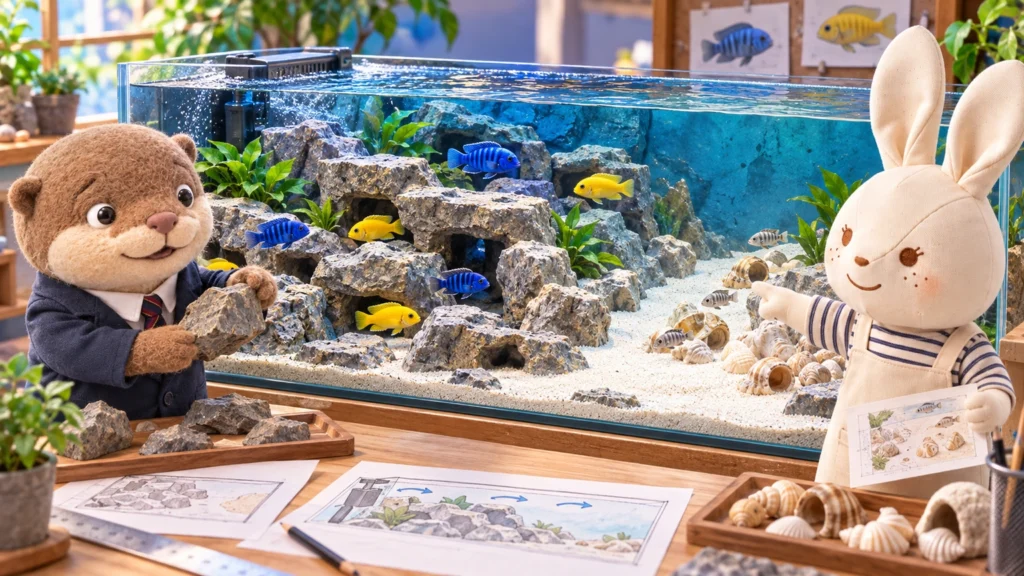 アイのアクアグッズ案内アフリカンシクリッドの飼育用品|水槽・ろ過・底砂・岩組み・餌の選び方道具の特徴や使い方、選ぶときのポイントをアイが紹介します。記事はコチラ →
 アイのアクアグッズ案内バルブの仲間に合わせる飼育用品|チェリーバルブ・スマトラ・中型種の水槽とろ過道具の特徴や使い方、選ぶときのポイントをアイが紹介します。記事はコチラ →
さまざまな飼育テーマをご紹介。リンク先の記事には広告・商品紹介が含まれます。
案内・紹介記事一覧へ →分布マップ
キアソファリンクス・フルシファー(Cyathopharynx furcifer)は、アフリカ東部のタンガニイカ湖に固有で、湖岸各地に地域個体群が分布しています。
※この地図は、記事に記載された「タンガニイカ湖固有」という分布情報をもとに、湖全体が確認できるよう概略範囲を表示したものです。マーカーは分布域を把握するための代表地点であり、実際の採集地点や個体の確認地点を示すものではありません。
参考文献
- Fricke, R., Eschmeyer, W. N. & Van der Laan, R. (eds.). Eschmeyer’s Catalog of Fishes: Genera, Species, References. California Academy of Sciences. Cyathopharynx furcifer taxon record
- Froese, R. & Pauly, D. (eds.). FishBase. Cyathopharynx furcifer (Boulenger, 1898). Species summary
- Schaedelin, F. C. & Taborsky, M. (2006). Mating craters of Cyathopharynx furcifer (Cichlidae) are individually specific, extended phenotypes. Animal Behaviour, 72(4), 753–761. https://doi.org/10.1016/j.anbehav.2005.11.028
- Takahashi, T. & Hori, M. (2012). Genetic and Morphological Evidence Implies Existence of Two Sympatric Species in Cyathopharynx furcifer (Teleostei: Cichlidae) from Lake Tanganyika. International Journal of Evolutionary Biology, 2012, 980879. https://doi.org/10.1155/2012/980879
- Vanhove, M. P. M., Snoeks, J., Volckaert, F. A. M. & Huyse, T. (2011). First description of monogenean parasites in Lake Tanganyika: the cichlid Simochromis diagramma (Teleostei, Cichlidae) harbours a high diversity of Gyrodactylus species (Platyhelminthes, Monogenea). Parasitology, 138(3), 364–380. https://doi.org/10.1017/S0031182010001356
- MSD Veterinary Manual. Disorders and Diseases of Fish. Fish disease and quarantine reference




コメント