

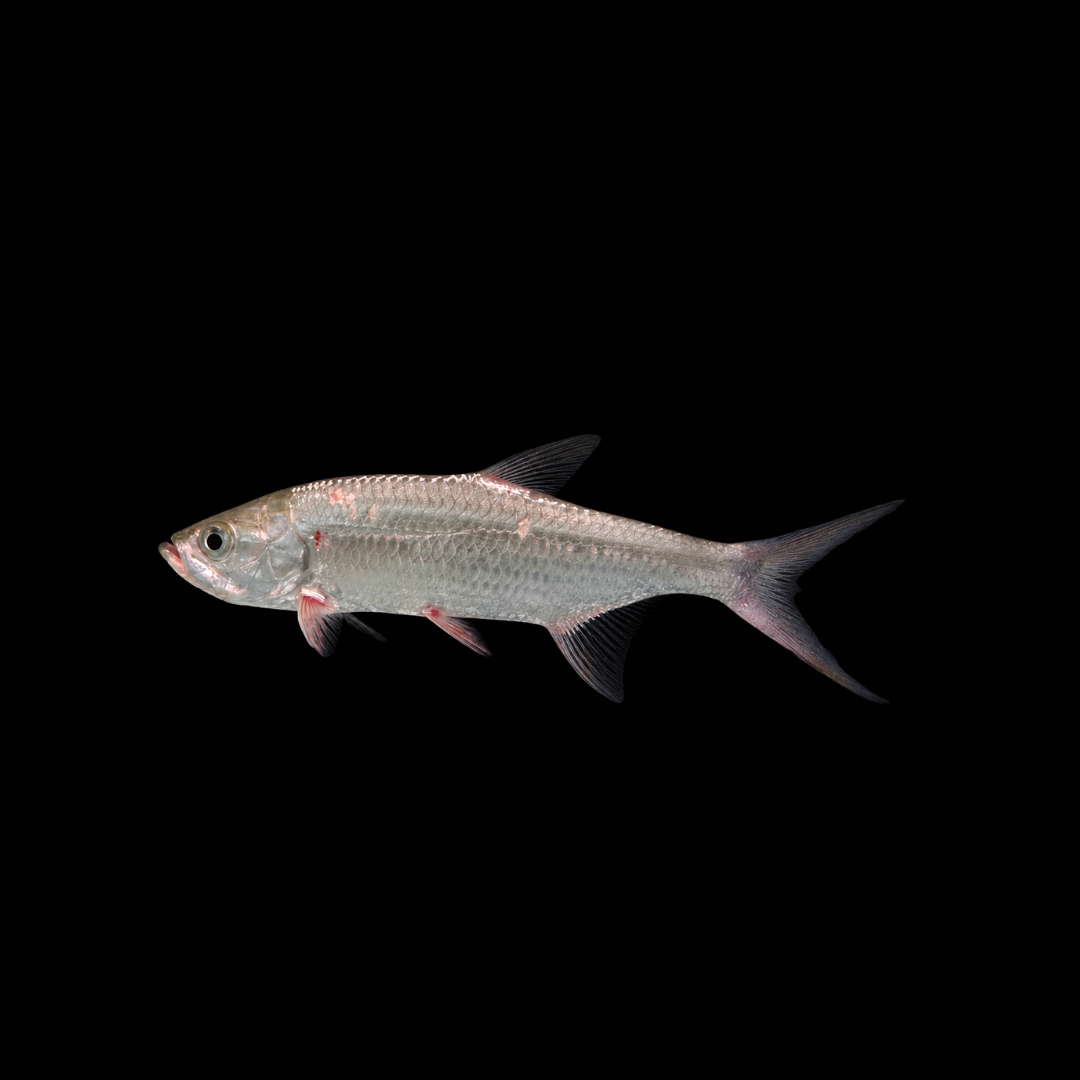
解説 / Description
アトランティックターポンは、大西洋の熱帯・亜熱帯域に広く分布するイセゴイ科の大型魚です。側面を覆う大きな銀色の鱗、上向きの大きな口、深く二叉した尾鰭、そして背鰭の最後の軟条が糸状に伸びる姿は非常に印象的で、英語圏では「シルバーキング」の名でも親しまれています。鰾を利用して空気中の酸素を取り込める特殊な呼吸能力を持ち、幼魚はマングローブや河口の低酸素になりやすい水域を成育場として利用します。観賞魚として流通するのは主に幼魚ですが、成長すると2mを超える可能性があるため、一般的な大型魚よりもはるかに大きな設備と長期的な飼育計画が必要です。 Atlantic tarpon are large members of the family Megalopidae distributed through tropical and subtropical Atlantic waters. Their huge silver scales, upturned mouth, deeply forked tail, and elongated final dorsal-fin ray give them a striking appearance and have earned them the popular name “Silver King.” A specialized swim bladder allows them to gulp atmospheric air, and juveniles often use mangrove creeks and other low-oxygen nursery habitats. Aquarium specimens are usually sold as juveniles, but because adults can exceed 2 m in length, long-term care requires facilities far beyond those used for ordinary large aquarium fish.
基本情報 / Basic Information
| 学名 / Scientific Name | Megalops atlanticus |
|---|---|
| 通称 / Common Name | アトランティックターポン、ターポン、シルバーキングAtlantic tarpon, tarpon, Silver King |
| 分類 / Family | カライワシ目・イセゴイ科・イセゴイ属Order Elopiformes, Family Megalopidae, Genus Megalops |
| 英名 / English Name | Atlantic Tarpon |
| 分布 / Distribution | 西大西洋では米国東岸からメキシコ湾、カリブ海、ブラジル中部にかけて、東大西洋では西アフリカ沿岸に分布します。河口、沿岸、汽水域を利用し、幼魚は淡水域へ入り込むこともあります。Found in the western Atlantic from the eastern United States through the Gulf of Mexico and Caribbean to central Brazil, and along the Atlantic coast of West Africa. They use coastal and estuarine habitats, and juveniles may also enter fresh water. |
| 最大体長 / Max Size | 最大で約2.5m、体重160kg級に達する記録があります。雌は雄より大型化する傾向があります。Recorded to about 2.5 m in length and around 160 kg in weight. Females generally grow larger than males. |
| 寿命 / Lifespan | 長寿で、野生では雌が55年以上生きた例が知られ、飼育下では60年以上の記録もあります。A long-lived species. Wild females have been aged at more than 55 years, and captive individuals have reportedly lived for over 60 years. |
飼育環境 / Aquarium Environment
| 水槽サイズ / Tank Size | 10〜30cmほどの幼魚でも、旋回スペースを確保できる90cmワイド水槽(奥行60cm級)〜120cmワイド水槽を目安にします。成長は速く、50cmを超える頃から家庭用規格水槽では維持が難しくなります。長期飼育では奥行150〜200cm以上、水量数千L級の大型FRP水槽や室内池など、公共施設に近い規模の設備を前提に考える必要があります。Even juveniles of about 10–30 cm should be given a 90 cm wide tank with roughly 60 cm of depth, or preferably a 120 cm wide tank, so they can turn safely. Growth is rapid, and ordinary household aquariums soon become inadequate once the fish exceeds roughly 50 cm. Long-term care should be planned around a custom tank or indoor pool holding several thousand liters with a footprint deep enough for a very large fish to turn comfortably. |
|---|---|
| 水温 / Temperature | 22〜28℃を目安に安定させます。低温には弱いため、日本の冬季はヒーターの故障や急低下に備えた二重化が安心です。 Maintain a stable 22–28°C. Because this tropical species is sensitive to chilling, redundant heating and temperature monitoring are strongly recommended during winter. |
| 水質 / Water Quality | 淡水・汽水・海水を利用できる広塩性の魚ですが、体長だけを基準に一定の塩分へ移行させる必要があるとはいえません。導入時に管理されていた塩分を確認し、水温・pH・硬度・塩分を急変させず、安定した環境を維持します。大型化すると排泄量も増えるため、十分な生物ろ過と定期的な換水を行い、アンモニアや亜硝酸を蓄積させないことが重要です。Atlantic tarpon are euryhaline and can use fresh, brackish, and marine waters, but there is no established rule that they must be moved to a particular salinity at a specific body length. Match the salinity in which the fish was being maintained when acquired, avoid abrupt changes in temperature, pH, hardness, or salinity, and prioritize stability. As the fish grows and waste production increases, strong biological filtration and regular water changes are essential to prevent ammonia and nitrite accumulation. |
| レイアウト / Layout | 広い遊泳空間を最優先し、岩や流木など衝突の原因になる障害物は必要最小限にします。適度な水流を設けると運動量を確保しやすくなります。驚いたときの突進と跳躍が非常に強いため、上部は丈夫なフタで確実に閉じ、角や硬い突起を避けた安全な構成にします。Prioritize open swimming room and keep hard décor such as rocks and driftwood to a minimum. Moderate current can help provide regular exercise. Because startled tarpon can surge and jump with great force, the aquarium must have a secure, heavy-duty cover and should avoid sharp corners or hard projections that could cause injury. |
| 注意点 / Precautions | 最大の注意点は巨大化と衝突事故です。吻端を水槽壁に打ちつけたり、飛び出したりする危険があるため、成長を見越した水槽更新計画が欠かせません。また、鰾で空気呼吸を行うため、水面へ自由にアクセスできる空間を確保します。大量に食べて水を汚すので、アンモニアや亜硝酸の発生を避けるろ過能力と換水量も重要です。自然水域への放流は絶対に行わないでください。The main concerns are extreme adult size and collision injuries. Tarpon may damage the snout by striking the tank or may jump out, so future tank upgrades must be planned before the fish outgrows its current enclosure. Because they gulp air at the surface using a specialized swim bladder, unobstructed surface access is essential. Heavy feeding also creates a high waste load, making strong filtration and regular water changes critical. Never release aquarium fish into natural waters. |
餌と給餌 / Feeding
| 餌の種類 / Diet | 肉食性で、小魚、エビ類などの動物質をよく食べます。幼魚では冷凍アカムシや小型のエビ類から始め、成長に応じて魚肉、エビ、クリル、大型肉食魚用ペレットなどへ広げます。生餌だけに偏らせず、状態を見ながら人工飼料へ慣らすと管理しやすくなります。Carnivorous, feeding readily on small fish and crustaceans. Juveniles can start on foods such as frozen bloodworms and small shrimp, then progress to pieces of fish, shrimp, krill, and pellets formulated for large predatory fish. Moving away from an exclusively live-food diet makes long-term nutrition and husbandry easier to manage. |
|---|---|
| 給餌のポイント / Feeding Tips | 動く餌への反応が強いので、人工飼料への切り替えは生餌や魚肉と一緒に与え、においや動きに慣らしながら段階的に進めます。非常に素早く餌を取るため、混泳時は他魚へ餌が行き渡っているかを必ず確認します。大型化すると排泄量も急増するため、過剰給餌を避け、水質の変化を見ながら給餌量を調整してください。Their strong response to moving prey can be used when training them onto prepared foods: offer pellets together with familiar meaty items and transition gradually. Tarpon feed very quickly, so in mixed-species systems make sure slower tank mates receive food as well. Waste production rises sharply with body size, so avoid overfeeding and adjust portions according to water quality and body condition. |
性格と混泳 / Temperament and Tank Mates
| 性格 / Temperament | 活発で遊泳力が高く、餌への反応も非常に素早い魚です。大型魚らしい迫力がある一方、物音や環境変化に驚くと急激に突進することがあり、狭い水槽では事故につながります。同種間の関係は個体差がありますが、成長とともに争いが深刻になる可能性を考え、基本は余裕のある単独飼育が安全です。An active, powerful swimmer with a very fast feeding response. Despite its imposing size, it may bolt suddenly when startled by noise or environmental change, making cramped enclosures dangerous. Intraspecific tolerance can vary, but serious conflict may develop as fish grow, so spacious solitary housing is the safer default. |
|---|---|
| 混泳の相性 / Compatibility | 口に入らない大型魚で、遊泳層や行動パターンが大きく競合しない相手であれば成立する場合があります。ただし、ターポンは摂食が非常に速く、同居魚の餌を奪いやすい点に注意が必要です。また、成長に伴って汽水〜海水寄りの管理へ移行する場合、タンクメイトにも同程度の塩分耐性が求められます。最終的なサイズを考えると、混泳は超大型設備を用意できる場合に限定して考えるのが現実的です。Compatibility may be possible with other very large fish that cannot be swallowed and that do not compete heavily for the same swimming space. Tarpon feed extremely fast and can easily monopolize food. If the system is shifted toward brackish or marine salinity as the tarpon grows, tank mates must tolerate the same conditions. Given the eventual size of the fish, community keeping is realistic only in extremely large installations. |
病気と対策 / Diseases and Prevention
| かかりやすい病気 / Common Diseases | 観賞飼育下で本種だけに特有とされる代表的な疾病は十分に整理されていません。実際の飼育では、水質悪化や急激な環境変化に伴う体調不良、壁面への衝突や飛び出しによる吻端・体表の外傷、そこから生じる二次感染に注意します。食欲低下、呼吸の変化、体表の異常が見られた場合は、病名を決めつける前に水温、水質、塩分、外傷の有無を確認します。There is no well-established list of aquarium diseases unique to Atlantic tarpon. In captivity, particular attention should be paid to health problems associated with deteriorating water quality or abrupt environmental change, as well as snout and skin injuries caused by collisions or jumping, which can be followed by secondary infection. If appetite, breathing, or skin condition changes, check temperature, water quality, salinity, and physical injury before assuming a specific diagnosis. |
|---|---|
| 対策と予防 / Prevention | 安定した水温とpH、十分なろ過、定期的な換水を維持することが基本です。新規導入魚は落ち着いた環境で立ち上げ、急な塩分変更や大量換水による水質変化を避けます。外傷予防のため水槽内の硬い障害物を減らし、フタを確実に固定します。異常時はまず水質を測定し、症状が続く場合は魚類を診療できる獣医師や専門家へ相談してください。Prevention starts with stable temperature and pH, strong filtration, and regular water changes. Newly acquired fish should be settled in calmly, avoiding abrupt changes in salinity or chemistry. Reduce hard obstacles and secure the lid to prevent trauma. At the first sign of illness, test water quality; persistent or severe problems should be assessed by a veterinarian or professional experienced with fish. |
増やし方(繁殖) / Breeding
| 雌雄の判別 / Sexing | 幼魚の外見からの確実な判別は困難です。成熟すると雌のほうが大型化する傾向がありますが、観賞魚サイズで実用的に雌雄を見分ける方法は確立していません。Reliable visual sexing of juveniles is difficult. Mature females tend to grow larger than males, but there is no practical external method for confidently sexing the aquarium-sized juveniles typically encountered in the trade. |
|---|---|
| 繁殖形態 / Reproduction | 雌雄異体の卵生で、外洋へ回遊して多数の浮遊卵を放つ体外受精型です。孵化後は透明で葉のように薄いレプトケファルス幼生期を経て、沿岸へ運ばれながら変態し、成魚を小型化したような稚魚へ変化します。親魚による保護はありません。A separate-sex, egg-laying species that spawns offshore by external fertilization, releasing very large numbers of pelagic eggs. The larvae pass through a transparent, leaf-like leptocephalus stage before metamorphosing near the coast into juveniles resembling miniature adults. There is no parental care. |
| 繁殖のポイント / Breeding Tips | 家庭の水槽で繁殖させることは現実的ではありません。成熟まで長い年月を要し、成魚は非常に大型になり、自然下では沿岸から外洋へ移動して産卵します。さらに、孵化後のレプトケファルス幼生は成魚とは大きく異なる生活史を持つため、一般的な観賞魚の繁殖設備で再現するのは困難です。飼育では繁殖を前提にするよりも、成長に合わせた安全な設備と健康状態を長期的に維持することを優先します。Breeding in a home aquarium is not realistic. The species takes many years to mature, adults become extremely large, and wild fish move from coastal habitats toward offshore spawning areas. The leptocephalus larvae that follow have a life history very different from that of adults, making reproduction difficult to reproduce with ordinary aquarium breeding systems. In captivity, the priority should therefore be safe long-term housing and health management rather than attempting to breed the fish. |
雑学と豆知識 / Trivia and Fun Facts
| 1. 古い系統を受け継ぐ「シルバーキング」 / 1. An Ancient Lineage Known as the “Silver King” | アトランティックターポンが属するカライワシ上目は、ウナギやソトイワシなどとともに、レプトケファルス幼生を持つ古い硬骨魚類の系統として知られています。イセゴイ科の化石記録も古く、現生のイセゴイ属につながる系統が長い地質時代を生き延びてきたことから、ターポンはしばしば「生きた化石」のような存在として語られます。ただし、これは進化が完全に止まったという意味ではなく、現在の姿に至る基本設計が非常に長く保たれてきた魚として捉えると分かりやすいでしょう。巨大な銀鱗と原始的な印象の体型が、単なる大型魚とは違う独特の存在感を生み出しています。Atlantic tarpon belong to Elopomorpha, an old lineage of bony fishes that also includes eels and bonefishes and is characterized by a leptocephalus larval stage. Fossils assigned to the tarpon family extend far back in geological time, which is why tarpon are sometimes described informally as “living fossils.” That phrase should not be taken to mean that evolution stopped; rather, the basic body plan has remained remarkably recognizable across a very long history. Their huge reflective scales and ancient-looking form give them a presence unlike that of most large aquarium fishes. |
|---|---|
| 2. 鰾を使って空気を吸う魚 / 2. A Fish That Breathes Air with Its Swim Bladder | 水面で体をひねるように浮上し、空気を飲み込む「ローリング」はターポンを象徴する行動です。鰾の内側には血管が発達した組織があり、飲み込んだ空気から酸素を取り込めます。この能力は、特に幼魚期に大きな意味を持ちます。マングローブの奥や停滞した水路は溶存酸素が不足しやすい一方、多くの大型捕食魚にとっては入りにくい環境です。ターポンの幼魚はそこで空気呼吸を利用し、捕食圧の低い成育場を活用します。水槽でも水面へ上がる行動は自然な生理の一部なので、フタをしていても水面そのものを塞がないことが重要です。The rolling rise to the surface to gulp air is one of the most recognizable tarpon behaviors. The swim bladder contains highly vascularized tissue that allows oxygen to be absorbed from swallowed air. This ability is especially important during the juvenile stage. Mangrove backwaters and stagnant creeks can become severely oxygen-poor, yet they may exclude many large predatory fishes. Juvenile tarpon can exploit these nurseries by breathing air at the surface. In captivity, surfacing is therefore a normal physiological behavior, and the water surface must remain accessible even when the tank is securely covered. |
| 3. 葉のような幼生から銀色の稚魚へ / 3. From Leaf-like Larva to Silver Juvenile | ターポンの一生で特に不思議なのがレプトケファルス期です。孵化した幼生は透明で、柳の葉や細いリボンのように平たい姿をしています。外洋を漂った幼生は沿岸へ近づくと大きな変態を始め、一時的に体長を縮めながら筋肉や消化器官、鰾などを発達させていきます。やがて透明な体には銀色の輝きが加わり、私たちが見慣れたターポンの小型版へ変わります。大型の成魚からは想像しにくいほど繊細な幼生期を経ることが、カライワシ上目ならではの魅力です。One of the most unusual parts of the tarpon life cycle is the leptocephalus stage. Newly hatched larvae are transparent and laterally flattened, resembling willow leaves or narrow ribbons. As oceanic larvae approach coastal habitats, they undergo a dramatic metamorphosis, temporarily shrinking in length while developing muscles, digestive organs, the swim bladder, and other adult structures. Their transparent bodies gradually become silver, producing a juvenile that looks like a miniature tarpon. It is a remarkably delicate beginning for a fish that can eventually become a giant. |
| 4. 大西洋の魚が太平洋側へ渡った例 / 4. An Atlantic Fish That Reached the Pacific Side | アトランティックターポンは本来大西洋に分布する魚ですが、パナマ運河を通じて太平洋側へ進出した記録があります。運河水系には淡水のガトゥン湖が含まれており、淡水・汽水・海水を行き来できる本種の広塩性をよく示す事例です。こうした生活史からも、ターポンを単純な「海水魚」として扱うのではなく、塩分変化に適応できる一方で、飼育下では急変を避けるべき魚として理解することが大切です。Atlantic tarpon are native to the Atlantic, but records show that they have reached the Pacific side through the Panama Canal. The canal system includes freshwater Gatun Lake, making this a striking example of the species’ ability to move among fresh, brackish, and marine environments. This life history is a reminder that tarpon are not simply conventional marine fish: they can tolerate a broad salinity range, but abrupt changes should still be avoided in captivity. |
| 5. 巨大な鱗がつくる独特の輝き / 5. Giant Scales Behind the Silver Shine | アトランティックターポンを特徴づける大きな円鱗は、光を強く反射して全身に金属的な銀色の輝きを与えます。鱗は見た目の美しさだけでなく、柔軟な体表を保ちながら外力から身を守る構造の一部でもあります。成魚では一枚一枚の鱗そのものが非常に大きくなり、光の角度によって体側の印象が大きく変わります。「シルバーキング」という呼び名は、巨大魚としての迫力だけでなく、この独特の反射光をよく表しています。The large cycloid scales of Atlantic tarpon strongly reflect light, giving the entire body its characteristic metallic silver appearance. Beyond their visual impact, the scales also form part of a flexible protective covering that helps shield the body from external forces. On large adults, individual scales become strikingly large, and the appearance of the flanks changes dramatically with the angle of the light. The name “Silver King” captures not only the fish’s size and power but also this distinctive reflective surface. |
| 6. スポーツフィッシングを象徴する巨大魚 / 6. An Icon of Big-game Sport Fishing | アトランティックターポンは、掛かった後に水面から何度も跳ね上がる強烈なファイトで知られ、世界的なゲームフィッシュとして特別な地位を持っています。長寿で成熟まで時間がかかるため、個体群の維持には成育場となるマングローブや河口環境の保全が重要です。観賞魚として向き合う場合も、その巨大化と長寿は同じ意味を持ちます。短期間だけ楽しむ魚ではなく、設備、維持費、引き取り先まで含めて将来を考えてから迎えるべき生体です。Atlantic tarpon have an exceptional reputation among sport anglers because hooked fish often make repeated spectacular jumps. Their long lifespan and slow path to maturity also mean that healthy populations depend heavily on the protection of nursery habitats such as mangroves and estuaries. The same biology matters in aquariums: this is not a fish for short-term keeping. Adult size, equipment costs, and a realistic lifelong housing plan should all be considered before purchase. |
まとめ / Conclusion
アトランティックターポンは、巨大な銀鱗、力強い遊泳、空気呼吸、レプトケファルス幼生という特徴をあわせ持つ、非常に個性的な大型魚です。幼魚のうちは水槽で管理できても、その成長速度と最終サイズは一般的な大型熱帯魚の感覚を大きく超えます。広い遊泳空間、衝突を防ぐ安全設計、強力なろ過、安定した水温と水質、そして成長に応じた塩分管理までを長期的に計画することが大切です。 Atlantic tarpon combine enormous silver scales, powerful swimming, aerial respiration, and a remarkable leptocephalus larval stage. Juveniles may initially be manageable in a large aquarium, but their growth rate and eventual adult size far exceed the scale of ordinary large tropical fish. Successful long-term care depends on expansive swimming room, a collision-safe enclosure, powerful filtration, stable temperature and water chemistry, and a carefully planned approach to salinity as the fish grows.
十分な設備と終生飼育の見通しを用意できた環境では、ターポンは水面へ静かに空気を吸いに上がり、光を受けるたびに大きな鱗を銀色に反射させながら泳ぎます。その姿は、古い系統を受け継ぐ魚の生物学と、現代の大型魚飼育の難しさの両方を身近に感じさせてくれます。迫力だけで選ぶのではなく、この魚の長い寿命と巨大な将来まで受け止められる飼育者にこそふさわしい一種です。 In a facility capable of supporting it for life, a tarpon can be seen rising calmly to breathe at the surface and flashing its immense scales silver whenever they catch the light. Its presence brings both the biology of an ancient fish lineage and the realities of modern giant-fish husbandry into the same space. It should be chosen not simply for spectacle, but by a keeper prepared to accommodate its long lifespan and extraordinary future size.
分布マップ
アトランティックターポンは、西大西洋では米国東岸からメキシコ湾、カリブ海を経てブラジル中部付近まで、東大西洋では西アフリカ沿岸に分布します。河口や沿岸、汽水域を利用し、幼魚が淡水域へ入ることもあります。
※ 地図上の着色範囲は、記事の「分布」欄をもとに分布イメージを示した概略範囲です。実際の採集地点や個体ごとの確認地点、厳密な生息範囲を示すものではありません。
参考文献
以下は、アトランティックターポン(Megalops atlanticus)の分類、分布、生息環境、成長・寿命、空気呼吸、温度・塩分への生理的応答、繁殖、飼育時の健康管理を支える資料として選定したものです。店舗・通販サイト、個人ブログ、まとめサイトは含めていません。
資料の読み方:本文中の水槽寸法やレイアウトなどの具体的な飼育設計は、成魚の最大サイズ、遊泳性、空気呼吸、生理的な温度・塩分耐性、一般的な魚類の水質管理原則をもとにした実務上の目安です。アトランティックターポン専用の家庭水槽飼育試験によって「90cm水槽」「120cm水槽」などの規格寸法が科学的に定められているわけではありません。
-
Integrated Taxonomic Information System (ITIS). Megalops atlanticus Valenciennes in Cuvier and Valenciennes, 1847. Taxonomic Serial No. 161116.
主に支える内容:学名の有効性、イセゴイ属・イセゴイ科・カライワシ目という分類体系。 -
Froese, R. & Pauly, D. (eds.). FishBase: Megalops atlanticus Valenciennes, 1847. World Wide Web electronic publication. 参照日:2026年7月24日。
主に支える内容:大西洋域の分布、淡水・汽水・海水の利用、最大体長約250cm、最大公表体重161kg、最大報告年齢55年、形態的特徴。 -
Florida Museum of Natural History. “Tarpon – Megalops atlanticus.” Discover Fishes. 参照日:2026年7月24日。
主に支える内容:沿岸・湾・河口・マングローブ域の利用、淡水進入、広い塩分耐性、鰾による空気呼吸、外部形態、繁殖とレプトケファルス幼生、既知の寄生生物。 -
Wilson, J. K., Adams, A. J. & Ahrens, R. N. M. (2019). Atlantic tarpon (Megalops atlanticus) nursery habitats: evaluation of habitat quality and broad-scale habitat identification. Environmental Biology of Fishes, 102, 383–402. DOI: 10.1007/s10641-018-0835-y.
主に支える内容:幼魚が利用する成育場、沿岸湿地・マングローブ・閉鎖性水域の重要性、生息環境の評価。 -
Seymour, R. S., Wegner, N. C. & Graham, J. B. (2008). Body size and the air-breathing organ of the Atlantic tarpon Megalops atlanticus. Comparative Biochemistry and Physiology Part A: Molecular & Integrative Physiology, 150(3), 282–287. DOI: 10.1016/j.cbpa.2008.03.018.
主に支える内容:鰾内の呼吸組織、空気呼吸器官の構造、低酸素の幼魚成育場で空気呼吸が果たす生理的役割。 -
Geiger, S. P., Torres, J. J. & Crabtree, R. E. (2000). Air breathing and gill ventilation frequencies in juvenile tarpon, Megalops atlanticus: responses to changes in dissolved oxygen, temperature, hydrogen sulfide, and pH. Environmental Biology of Fishes, 59, 181–190. DOI: 10.1023/A:1007640132059.
主に支える内容:溶存酸素、温度、pH、硫化水素に対する幼魚の呼吸応答。低酸素環境と空気呼吸の関係、水質急変を避ける必要性を考える基礎資料。 -
Coffill-Rivera, M. E., Paez Mendez, Y. D., Little, L., Graham, P. M., Franks, J. S., Correa, S. B., Neal, J. W. & Allen, P. J. (2023). The effects of temperature and salinity on the blood chemistry and survival of juvenile Atlantic tarpon Megalops atlanticus. Journal of Fish Biology, 103(2), 272–279. DOI: 10.1111/jfb.15451.
主に支える内容:幼魚の温度・塩分条件に対する血液生理と低温耐性。低温が重要な制限要因であり、塩分条件によって低温耐性が変化すること。 -
Crabtree, R. E., Cyr, E. C., Chacón Chaverri, D., McLarney, W. O. & Dean, J. M. (1997). Reproduction of tarpon, Megalops atlanticus, from Florida and Costa Rican waters and notes on their age and growth. Bulletin of Marine Science, 61(2), 271–285.
主に支える内容:雌雄差、成熟サイズ、繁殖期、卵巣・精巣の成熟、繁殖生態、雌が大型化する傾向。 -
Crabtree, R. E., Cyr, E. C. & Dean, J. M. (1995). Age and growth of tarpon, Megalops atlanticus, from South Florida waters. Fishery Bulletin, 93(4), 619–628. National Marine Fisheries Service, NOAA.
主に支える内容:耳石を用いた年齢査定、成長、長寿性。最大年齢や大型化を扱う本文の基礎資料。 -
Petty, B. D., Francis-Floyd, R. & Yanong, R. P. E. “Management of Aquarium Fish.” Merck Veterinary Manual. Full review: May 2022; updated September 2024.
主に支える内容:水質検査、アンモニア・亜硝酸、pH低下、ろ過、換水、隔離、外傷、二次感染を含む観賞魚の一般的な健康管理。アトランティックターポン固有の病名を示す資料ではなく、本文の「病気と対策」における飼育管理原則を補強する獣医学資料。




コメント