
解説 / Description
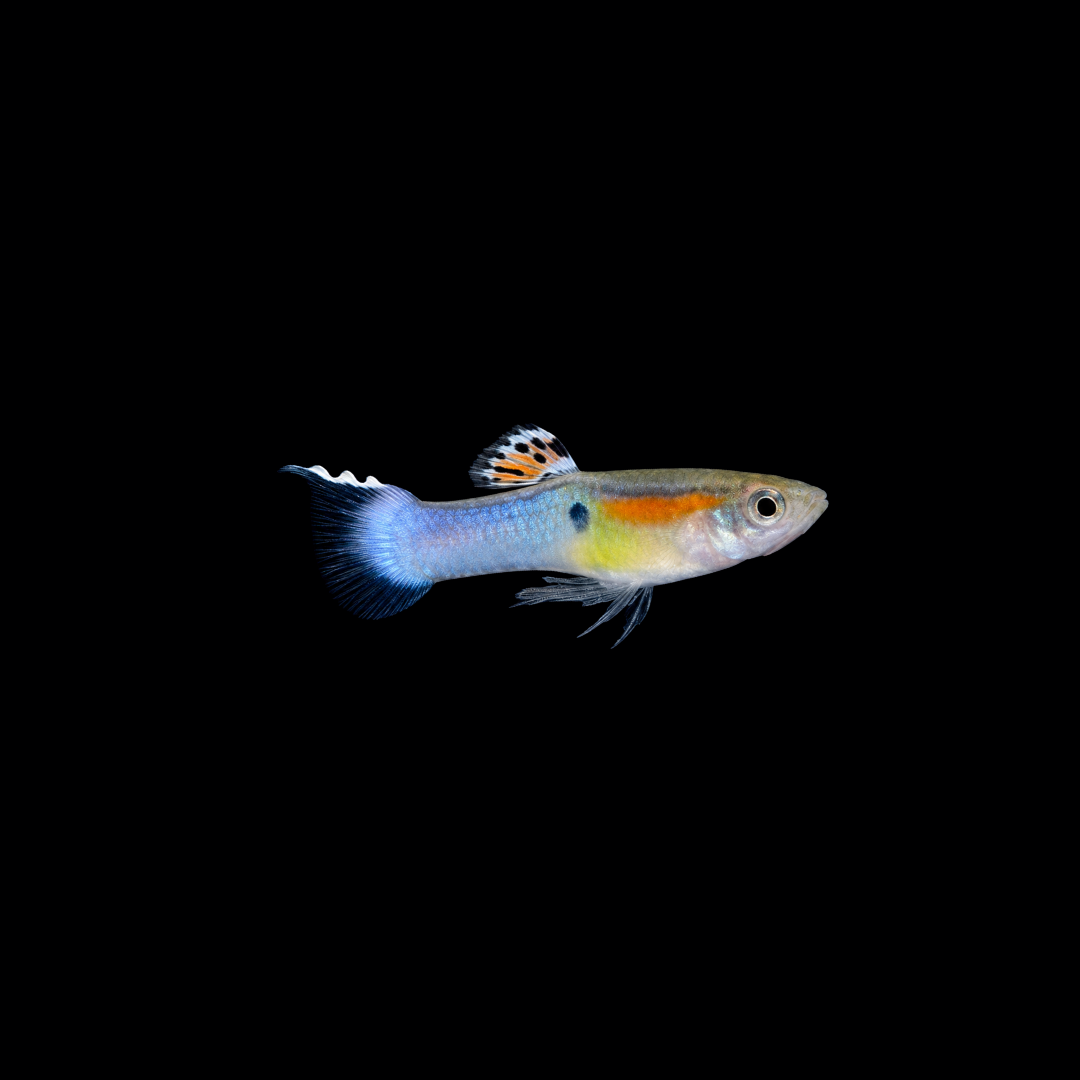
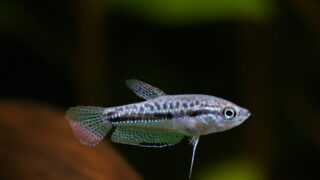
エンドラーズ・ジャパンブルーは、ベネズエラ原産の小型卵胎生メダカであるエンドラーズ・ライブベアラー(Poecilia wingei)に、グッピー(Poecilia reticulata)由来の「ジャパンブルー」形質を組み込んだ交雑改良品種です。最大の魅力は、オスの腰から尾筒にかけての体の後半部が、まるでズボンを履いたように金属光沢のスカイブルーからメタリックブルーに染まる独特の色彩です。この青は色素によるものではなく、皮膚の細胞が光を反射して生まれる構造色のため、照明や見る角度によって輝きが刻々と変わります。胸部の側面にはエンドラーズ由来の黒点や短い黒帯が残る個体が多く、小柄でコンパクトな体型も相まって、緑の水草が茂る水槽で群泳させるとよく映えます。丈夫で繁殖も容易なことから入門魚として親しまれていますが、分類上は原種のエンドラーズとははっきり区別されるハイブリッドであり、その起源についても複数の説が伝わる奥行きのある品種です。 The Endler’s Japan Blue is a hybrid ornamental strain created by introducing the “Japan Blue” trait of the guppy (Poecilia reticulata) into Endler’s livebearer (Poecilia wingei), a small livebearer native to Venezuela. Its greatest charm is the unique coloration of the male, whose rear body, from the hips to the caudal peduncle, is covered in a metallic sky blue to steel blue, almost as if he were wearing a pair of trousers. This blue does not come from pigment; it is a structural color produced by skin cells reflecting light, so its sheen changes constantly with the lighting and viewing angle. Many individuals retain black spots or short black bars on the flanks inherited from Endler’s, and together with their small, compact build, they look striking when kept as a group in a lush planted tank. Although popular as a hardy, easy-to-breed fish for beginners, it is a hybrid clearly distinguished from pure Endler’s in classification, and more than one story is told about its origins, giving the strain surprising depth.
基本情報 / Basic Information
| 学名 / Scientific Name | Poecilia wingei × Poecilia reticulata |
|---|---|
| 通称 / Common Name | エンドラーズ・ジャパンブルー、ジャパンブルー・エンドラーズ、エンドラーズ・ハイブリッド(ジャパンブルー)Endler’s Japan Blue, Japan Blue Endler’s, Endler’s hybrid (Japan Blue) |
| 分類 / Family | カダヤシ目カダヤシ科ポエキリア属(種間交雑による改良品種。エンドラーズの純血度区分ではクラスKに該当)Cyprinodontiformes, Poeciliidae, genus Poecilia (an interspecific hybrid strain; Class K under the Endler’s purity classification) |
| 英名 / English Name | Endler’s Japan Blue / Japan Blue Endler’s Livebearer |
| 分布 / Distribution | 人の手で作出された改良品種のため、自然分布はありません。親種のエンドラーズ・ライブベアラーは、ベネズエラ北東部のクマナ周辺やカンポマ周辺にある沿岸ラグーンなどに分布しています。ジャパンブルー形質は、1980年代後半に神奈川県の河川で見つかった野生化グッピーに由来するという説が有力で、南米フランス領ギアナの野生グッピーに由来するという別の説もあります。現在流通している個体の多くは、スリランカ、インドネシア、タイなどの養殖場や国内のブリーダーによって繁殖されたものです。As a man-made ornamental strain, it has no natural range. The parent species, Endler’s livebearer, occurs in coastal lagoons around Cumaná and Campoma in northeastern Venezuela. The Japan Blue trait is most widely believed to derive from feral guppies found in rivers in Kanagawa Prefecture, Japan, in the late 1980s, while another account traces it to wild guppies from French Guiana in South America. Most fish in the trade today are bred on farms in Sri Lanka, Indonesia and Thailand or by breeders in Japan. |
| 最大体長 / Max Size | オスで2.5〜4cm程度(系統により差があります)。メスはオスよりも一回り大きくなります。純血のエンドラーズ(オスで1.5〜2.5cm程度)と比べるとやや大柄で、体高も出やすい傾向があります。Males reach about 2.5 to 4 cm (varying by strain). Females grow noticeably larger than males. Compared with pure Endler’s (males about 1.5 to 2.5 cm), they are slightly larger and tend to be deeper-bodied. |
| 寿命 / Lifespan | 2〜3年程度です。適温の範囲内でやや低めの水温を保つと代謝が緩やかになり、寿命が延びる傾向があるといわれています。About 2 to 3 years. Keeping the temperature toward the lower end of the suitable range is said to slow metabolism and tends to extend lifespan. |
飼育環境 / Aquarium Environment
| 水槽サイズ / Tank Size | ペアや少数で観賞するなら、30cm規格水槽(約25L)から飼育できます。群泳を楽しんだり繁殖させて数を維持したりする場合は、45cm規格水槽(約35L)から60cm規格水槽(約57L)以上が適しています。体は小さくても遊泳力と繁殖力が高いため、20〜30cmクラスの小型水槽ではすぐに過密になり、水質が悪化しやすい点に注意しましょう。A pair or a small group can be kept in a standard 30 cm tank (about 25 L). For enjoying a shoal or maintaining a breeding population, a standard 45 cm tank (about 35 L) to a standard 60 cm tank (about 57 L) or larger is suitable. Although small, these fish are active swimmers and prolific breeders, so tanks in the 20 to 30 cm class quickly become overcrowded and prone to declining water quality. |
|---|---|
| 水温 / Temperature | 適温は24〜26℃、許容範囲はおよそ20〜30℃です。22〜23℃を下回ると白点病にかかりやすくなり、20℃を下回るような低温では体調を崩したり命を落としたりする危険が高まります。日本の冬にはサーモスタット付きヒーターが欠かせません。夏場は水温が30℃近くまで上がると水中の酸素が減るため、冷却ファンの設置とエアレーションの強化で対応しましょう。 The ideal range is 24 to 26°C, with a tolerable range of roughly 20 to 30°C. Below 22 to 23°C they become more susceptible to white spot disease, and at temperatures below about 20°C the risk of illness and death rises. A thermostat-controlled heater is essential during the Japanese winter. In summer, dissolved oxygen drops as the water nears 30°C, so install a cooling fan and strengthen aeration. |
| 水質 / Water Quality | pH6.5〜7.8(下限の目安は6.0)、硬度はGH5〜15程度が目安です。親種の原産地は中性〜弱アルカリ性の中硬水〜硬水ですが、代々養殖されてきたジャパンブルーは適応力が高く、ソイルを使った弱酸性〜中性の水草水槽でも十分に育ちます。ただし、pH6.0を下回るほどの酸性に傾いた極端な軟水では調子を崩しやすく、細菌感染症のリスクも高まります。日本の水道水は全国的に軟水で地域差も大きいため、特に軟水傾向が強くpHが下がりやすい地域では、ろ過槽に少量のサンゴ砂や貝殻系ろ材を入れておくと、pHの急な低下を防げます。繁殖や系統維持を優先する場合は、pH7.0〜7.8の中性〜弱アルカリ性寄りに整えると安定しやすくなります。アンモニアと亜硝酸塩は常に検出されない状態を保ち、硝酸塩は20mg/L以下を目安に、週1回、3分の1程度の換水を基本としてください。Aim for pH 6.5 to 7.8 (with 6.0 as the lower limit) and a hardness of roughly GH 5 to 15. The parent species’ native waters are neutral to slightly alkaline and moderately hard to hard, but Japan Blues that have been farm-bred for generations are highly adaptable and do well even in slightly acidic to neutral planted tanks with aqua soil. However, they tend to decline in very soft, acidic water below pH 6.0, where the risk of bacterial infections also rises. Japanese tap water is soft nationwide and varies greatly by region, so in areas with especially soft water where pH tends to drop, adding a small amount of coral sand or shell-based media to the filter helps prevent sudden pH crashes. If breeding or strain maintenance is the priority, keeping the water neutral to slightly alkaline at pH 7.0 to 7.8 tends to be more stable. Keep ammonia and nitrite undetectable at all times and nitrate at 20 mg/L or below, and make a water change of about one third once a week as the basic routine. |
| レイアウト / Layout | 暗い色の底床に、明るい緑の有茎水草と浮き草を組み合わせたレイアウトがおすすめです。構造色の青は背景とのコントラストで引き立つため、白砂よりも暗い底床の方がひときわ鮮やかに見えます。水草の茂みは、オスの追尾から逃れるメスの隠れ家や、稚魚の避難場所としても役立ちます。強い水流を嫌うので、ろ過はスポンジフィルターなどによる弱〜中程度の水流が適しています。照明はLEDで1日8時間程度を目安にしましょう。A layout combining a dark substrate with bright green stem plants and floating plants is recommended. Because the structural blue is enhanced by contrast with its background, it looks far more vivid over a dark substrate than over white sand. Dense plant growth also serves as a refuge for females escaping the attentions of males and as a hiding place for fry. They dislike strong currents, so weak to moderate flow from a sponge filter or similar is ideal. Use LED lighting for about 8 hours a day. |
| 注意点 / Precautions | 他系統のグッピーやエンドラーズとは簡単に交雑するため、系統の姿を保ちたい場合は同じ水槽で飼育しないでください。外部式や上部式のフィルターを使う場合は、吸水口にスポンジを付けておくと稚魚の吸い込みを防げます。また、グッピーは環境省と農林水産省が定める「生態系被害防止外来種リスト」に掲載されている外来種です。増えすぎた個体や選別から外れた個体であっても、河川や水路へ放流することは絶対にやめてください。They hybridize easily with other guppy and Endler’s strains, so do not keep them in the same tank if you want to preserve the strain’s appearance. If you use a canister or top-mounted filter, fitting a sponge over the intake will keep fry from being sucked in. In addition, the guppy is an introduced species included on the list of alien species that threaten ecosystems compiled by Japan’s Ministry of the Environment and Ministry of Agriculture, Forestry and Fisheries. Never release fish into rivers or waterways, even surplus fish or those culled during selection. |
餌と給餌 / Feeding
| 餌の種類 / Diet | 雑食性で、水面に浮くタイプやゆっくり沈むタイプの極小顆粒、細かいフレークフードをよく食べます。週2〜3回ほどブラインシュリンプや冷凍ミジンコなどの生餌・冷凍餌を加えると、発色や繁殖に向けたコンディションが整いやすくなります。スピルリナなどの植物質の餌も好みます。They are omnivorous and readily accept floating or slow-sinking micro-granules and fine flake foods. Adding live or frozen foods such as brine shrimp or frozen daphnia two or three times a week helps bring out color and breeding condition. They also enjoy plant-based foods such as spirulina. |
|---|---|
| 給餌のポイント / Feeding Tips | 口が小さいため、粒の細かい餌を選んでください。タンパク質を45%以上含む餌は、色揚げや繁殖に効果的とされています。1日2〜3回、2〜3分で食べ切れる量を与えましょう。週に1日ほど餌を与えない日を設けて消化器を休ませると、水質の悪化や腹部の病気の予防にもつながります。Their mouths are small, so choose fine-grained foods. Foods containing 45% or more protein are considered effective for enhancing color and supporting breeding. Feed two or three times a day, only as much as they can finish in two to three minutes. Setting aside about one fasting day a week to rest the digestive system also helps prevent declining water quality and abdominal ailments. |
性格と混泳 / Temperament and Tank Mates
| 性格 / Temperament | とても温和で、他の魚を攻撃することはほとんどありません。ただしオスは絶えずメスを追いかけて求愛するため、メスが少ないと特定の個体にストレスが集中してしまいます。繁殖させる場合はオス1匹に対してメス2〜3匹が目安です。観賞を楽しむだけなら、オスだけで群泳させるのもよいでしょう。They are very peaceful and rarely attack other fish. However, males constantly chase and court females, so when females are few, stress becomes concentrated on particular individuals. For breeding, aim for one male to two or three females. If display is the only goal, a male-only group is also a good option. |
|---|---|
| 混泳の相性 / Compatibility | 温和な小型熱帯魚や、コリドラスなどの底層を泳ぐ魚、成体のミナミヌマエビやチェリーシュリンプとは相性が良好です。ただし、生まれたばかりの稚エビは食べられてしまうことがあるため、エビの繁殖を優先する水槽では注意が必要です。エンゼルフィッシュのように小魚を口にする可能性のある魚、大型魚や肉食魚、他の魚のヒレをかじる習性のある魚との混泳は避けてください。また、前述のとおり交雑を防ぐため、他系統のグッピーやエンドラーズとの混泳も避けましょう。They get along well with peaceful small tropical fish, bottom dwellers such as Corydoras, and adult dwarf shrimp such as cherry shrimp. However, newborn shrimplets may be eaten, so take care in tanks where shrimp breeding is the priority. Avoid keeping them with fish that may eat small fish, such as angelfish, with large or predatory fish, and with fin-nipping species. As noted above, also avoid mixing them with other guppy or Endler’s strains to prevent hybridization. |
病気と対策 / Diseases and Prevention
| かかりやすい病気 / Common Diseases | 特に注意したいのはカラムナリス症(尾ぐされ病など)です。ヒレを閉じたまま泳ぐ、尾ビレの縁が白く濁って溶けるといった症状が見られ、導入直後やpHが低いとき、水質が悪化したときに発症しやすい傾向があります。冬場のヒーターの故障や、水換えによる急な水温低下をきっかけに白点病が出ることもあります。さらに、過密飼育や餌の与えすぎ、ろ過が十分に立ち上がっていない環境では、エロモナス病(腹水病など)や亜硝酸中毒が起こることがあります。Columnaris disease (including fin rot) deserves particular attention. Symptoms include swimming with clamped fins and whitish, disintegrating edges on the caudal fin, and it tends to appear shortly after introduction, at low pH, or when water quality deteriorates. White spot disease can be triggered by a heater failure in winter or a sudden temperature drop during water changes. In addition, overcrowding, overfeeding, or an insufficiently cycled filter can lead to Aeromonas infections (including dropsy) and nitrite poisoning. |
|---|---|
| 対策と予防 / Prevention | 新しく迎えた魚は、できれば別の水槽でしばらく様子を見てから本水槽へ移しましょう。カラムナリス症が疑われる場合は、すぐに隔離し、グリーンFゴールド顆粒やエルバージュエースなどの細菌感染症治療薬で薬浴させます。白点病には、隔離水槽での0.3〜0.5%の塩浴か市販の白点病治療薬が有効で、完治してから本水槽へ戻してください。水面で口をパクパクさせる行動は、酸欠や亜硝酸中毒を知らせる緊急のサインです。ただちに水の2分の1ほどを換え、エアレーションを強化したうえで、餌の量を見直しましょう。何よりの予防策は、日頃からpHと水温を安定させておくことです。If possible, observe newly acquired fish in a separate tank for a while before moving them to the main aquarium. If columnaris is suspected, isolate the fish immediately and treat them with an antibacterial medication such as Green F Gold granules or Elbagin Ace. For white spot disease, a 0.3 to 0.5% salt bath in a quarantine tank or a commercial white spot treatment is effective; return the fish to the main tank only after full recovery. Gasping at the surface is an urgent sign of oxygen deficiency or nitrite poisoning. Immediately change about half the water, increase aeration, and review the amount you feed. The best prevention of all is keeping pH and temperature stable day to day. |
増やし方(繁殖) / Breeding
| 雌雄の判別 / Sexing | オスは小柄で、体の後半部に金属光沢の青が現れ、尻ビレが棒状の交接器(ゴノポディウム)に変化しています。メスはオスより一回り大きく体高もあり、全体に灰色〜ブロンド系の落ち着いた体色をしています。妊娠したメスは、尻ビレの付け根付近にある黒い妊娠斑が目立ってきます。稚魚の場合は、生後3〜5週間ほどでオスに色が出始めるので、その頃から見分けられるようになります。Males are small, show metallic blue on the rear half of the body, and have an anal fin modified into a rod-like copulatory organ (gonopodium). Females are noticeably larger and deeper-bodied, with subdued gray to blonde coloration overall. In pregnant females, a dark gravid spot near the base of the anal fin becomes conspicuous. In young fish, males begin to show color at about three to five weeks of age, and the sexes can be told apart from that point. |
|---|---|
| 繁殖形態 / Reproduction | 卵胎生で、卵はメスのお腹の中で孵化し、稚魚の姿で産まれてきます。成熟した雌雄を一緒に飼うだけで季節を問わず繁殖し、水温25℃以上ではおおむね4週間前後、系統によっては30〜40日の間隔で出産します。1回に産む稚魚の数は、若いメスで5〜10匹前後、成熟した大きなメスでは20〜30匹ほどになります。They are livebearers: the eggs hatch inside the female and the young are born as free-swimming fry. Simply keeping mature males and females together results in breeding regardless of season, and at 25°C or above females give birth roughly every four weeks, or every 30 to 40 days in some strains. A young female produces around 5 to 10 fry per brood, while a large mature female may produce around 20 to 30. |
| 繁殖のポイント / Breeding Tips | 純血のエンドラーズは親が稚魚を食べることが少ないといわれますが、グッピーの血を引く本品種では、系統や環境によって親魚が稚魚を食べてしまうことがあります。確実に稚魚を残したい場合は、水草や浮き草を密に茂らせて隠れ場所を作るか、出産が近いメスを外掛け式の産卵ボックスや別の水槽へ移しましょう。稚魚は産まれてすぐに、孵化させたブラインシュリンプの幼生や稚魚用のパウダーフードを食べられます。1日2〜3回こまめに与えると成長が早く、メスは生後約2ヶ月で繁殖できる大きさに育ちます。美しい姿を保つには、生後4週前後で雌雄を分けて意図しない交配を防ぎ、生後6〜10週の頃に、青の濃さや広さ、ヒレの形と左右のバランスを見て種親を選びます。種親が少なすぎると近親交配で体が小さくなったり繁殖力が落ちたりしやすいため、オス2〜3匹とメス4〜6匹ほどを残しましょう。さらに数世代に一度、同じ系統の別血統を加えると、健康さを取り戻すことができます。Pure Endler’s are said to rarely eat their fry, but in this strain, which carries guppy blood, parents may eat their young depending on the line and conditions. To raise fry reliably, plant densely with stem and floating plants to create hiding places, or move a female close to giving birth into a hang-on breeding box or a separate tank. Fry can eat newly hatched brine shrimp nauplii and powdered fry food right after birth. Fed two or three times a day, they grow quickly, and females reach breeding size at about two months of age. To maintain fine appearance, separate the sexes at around four weeks to prevent unplanned mating, then at six to ten weeks select breeders based on the depth and extent of the blue and the shape and balance of the fins. With too few breeders, inbreeding tends to cause smaller bodies and reduced fertility, so keep around two or three males and four to six females. Adding an unrelated bloodline of the same strain every few generations helps restore vigor. |
雑学と豆知識 / Trivia and Fun Facts
| 1. 純血エンドラーズとの違いと「クラスK」という立ち位置 / 1. How It Differs from Pure Endler’s and Its “Class K” Status | 親種のエンドラーズ・ライブベアラーは、1937年にフランクリン・F・ボンドによってベネズエラ北東部クマナ地方のラグナ・デ・パトス湖で初めて採集され、1975年にジョン・エンドラー博士によって再発見された小さな魚です。グッピーの地域的な変異なのか独立した種なのかをめぐって長く議論が続きましたが、2005年に独立種 Poecilia wingei として正式に記載されました。種小名の wingei は、デンマークの遺伝学者オユヴィント・ヴィンゲに献名されたものです。グッピーと交雑すると繁殖力のある子孫が生まれるため、今でも別種とすることに異を唱える意見はあります。それでも、遺伝子の解析結果や、オスの交接器の先端の形、求愛行動の違いなどを根拠に、独立種とする見方が主流になっています。野生の純血個体は、生息域の狭さや環境汚染、放流されたグッピーとの交雑によって数を減らし、IUCNレッドリストでは絶滅危惧(EN)に評価されています。こうした事情から、海外の愛好家団体は血統の純度を三つに分けて管理しています。原産地までさかのぼって記録が残る「クラスN」、見た目は純血と区別がつかないものの証明を欠く「クラスP」、グッピーなどとの交雑が明らかな「クラスK」です。ジャパンブルーはこのクラスKにあたります。つまり、見た目がエンドラーズらしくても純血種そのものではないため、海外の専門家の間では純血種と同じ学名だけで呼ぶのは正確ではないとされ、交雑品種であることをはっきり示して扱うのが望ましいと考えられています。The parent species, Endler’s livebearer, is a tiny fish first collected in 1937 by Franklyn F. Bond at Laguna de Patos in the Cumaná region of northeastern Venezuela, and rediscovered in 1975 by Dr. John Endler. There was long debate over whether it was a regional variant of the guppy or a separate species, until it was formally described as the species Poecilia wingei in 2005. The species name wingei honors the Danish geneticist Øjvind Winge. Because crosses with guppies produce fertile offspring, some still dispute its status as a separate species. Even so, based on genetic analyses, the shape of the tip of the male’s gonopodium, and differences in courtship behavior, recognizing it as a distinct species is now the prevailing view. Pure wild populations have declined because of their tiny range, pollution, and hybridization with released guppies, and the species is assessed as Endangered (EN) on the IUCN Red List. For these reasons, hobbyist organizations overseas manage bloodline purity in three categories: Class N, with records traceable to the wild collection site; Class P, indistinguishable from pure fish in appearance but lacking such proof; and Class K, clearly hybridized with guppies or other lines. The Japan Blue belongs to Class K. In other words, even though it looks like an Endler’s, it is not the pure species itself, so specialists abroad consider it inaccurate to call it by the pure species’ scientific name alone and regard it as best practice to make clear that it is a hybrid. |
|---|---|
| 2. 「ジャパンブルー」の名に込められた二つの起源説 / 2. Two Origin Stories Behind the Name “Japan Blue” | 「ジャパンブルー」という言葉は、明治時代に来日した外国人が日本の藍染の色を称えた呼び名としても知られていますが、魚の世界での由来については二つの物語が伝わっています。もっとも広く支持されているのは、1980年代後半に神奈川県の河川で採集された野生化グッピーの変異個体が始まりだとする説です。グッピーは1920年頃に日本へ持ち込まれ、その後、飼育していた個体が逃げ出したり蚊の駆除を目的に放されたりして、温泉や工場の温かい排水が流れ込む水路などに定着しました。見つかった当時の個体は、今のような大きな三角形の尾ではなく、尾ビレの小さな野生型の体つきや、上下に剣のように伸びるダブルソードの尾をしていたと記録されています。この形質は1994年に日本の観賞魚専門誌で紹介されたとされ、その後、国内のブリーダーたちが改良グッピーへ次々と取り入れ、日本独自の品種が数多く生み出されました。国内では、この後半身の淡い青を「アクアマリン」と呼ぶこともよくあります。一方、欧州には別の記録も残されています。南米フランス領ギアナの貯水池ラック・デュ・ロロタで採集された野生グッピーが原点で、オランダのブリーダー、カレン・クーマンスが手に入れたオスを、系統を絶やさないためにエンドラーズのメスと交配したことで広まった、というものです。現在世界中で流通している個体には、日本と欧州の両方の系譜が複雑に入り混じっていると考えられています。なお、ポエキリア属はもともと南米北部からカリブ海周辺に分布する熱帯魚で、日本の在来種ではありません。国内の野外で見られるグッピーは、すべて人の手で持ち込まれて定着した外来の集団です。The phrase “Japan blue” is also known as the name foreign visitors in the Meiji era gave to the color of Japanese indigo dyeing, but in the fish world two stories are told about its origin. The most widely supported holds that it began with mutant feral guppies collected in rivers in Kanagawa Prefecture in the late 1980s. Guppies were brought to Japan around 1920, and later, through escapes from captivity and releases for mosquito control, they became established in places such as channels fed by hot springs or warm factory discharge. The fish found at the time are recorded as having a wild-type build with small caudal fins, rather than today’s large triangular tails, or a double-sword tail extending like swords above and below. The trait is said to have been introduced in a Japanese aquarium magazine in 1994, after which domestic breeders incorporated it into fancy guppies one after another, creating many uniquely Japanese strains. In Japan, this pale blue on the rear of the body is often called “aquamarine.” Meanwhile, a different account survives in Europe: that the original fish were wild guppies collected at Lac du Rorota, a reservoir in French Guiana, and that the trait spread after the Dutch breeder Karen Koomans crossed a male she had obtained with female Endler’s to keep the line going. The fish circulating worldwide today are thought to combine both Japanese and European lineages in complex ways. Note that the genus Poecilia is a group of tropical fish native to northern South America and the Caribbean, and is not native to Japan. Guppies found in the wild in Japan are all introduced populations brought in by people. |
| 3. Y染色体が受け継ぐ「青いズボン」 / 3. “Blue Trousers” Passed Down on the Y Chromosome | ジャパンブルーの形質は、Y染色体にのっている遺伝子 Caeruleus(記号Ca)によるものとされ、ブリーダーの間ではアクアマリンを意味する記号Aでも呼ばれています。Y染色体は父親から息子にだけ受け継がれる性染色体です。そのためジャパンブルーのオスは、どんなメスと交配しても、生まれてくるオスのほぼすべてに自分と同じ青を伝えることができます。この再現性の高さが、養殖場での量産やエンドラーズへの形質の導入を容易にした大きな理由です。ただし例外もあり、染色体の一部が入れ替わる「乗り換え」によって、遺伝子がX染色体側へ移ったタイプも確認されています。この場合は遺伝子を持つメスも見た目は地味なままなので、外見からは判断できず、実際に交配して生まれたオスを確かめる必要があります。なお、ジャパンブルーという言葉は尾の形や品種名ではなく、オスの体の後半部を覆う青そのものを指しています。海外のブリーダーはこれを「魚が下半身に履いているズボン」とたとえています。ブロンドの体色と組み合わせると、前半身が黄金色、後半身が金属的な青にくっきり分かれた姿になります。スネークスキン模様と組み合わせると、幼魚のうちは青が強く出るものの、成長するにつれて模様が重なり、模様の下から青が透けて見えるような姿へ変わることが知られています。反対に、選別を怠って代を重ねると青の範囲が狭まり、くすんだ紫がかった色へと褪せやすくなります。The Japan Blue trait is attributed to a gene called Caeruleus (symbol Ca) carried on the Y chromosome, and among breeders it is also referred to by the symbol A for aquamarine. The Y chromosome is the sex chromosome passed only from father to son. As a result, a Japan Blue male passes his blue to nearly all of his sons, no matter which female he is mated with. This high reproducibility is a major reason it was easy to mass-produce on farms and to transfer into Endler’s. There are exceptions, however: forms in which the gene has moved to the X chromosome through crossing-over, an exchange of chromosome segments, have also been confirmed. In such cases, females carrying the gene still look plain, so carriers cannot be identified by appearance and must be confirmed by breeding and checking the male offspring. The term “Japan Blue” refers not to a tail shape or strain name but to the blue covering the rear half of the male’s body, which breeders abroad liken to “trousers the fish is wearing.” Combined with blonde coloration, it produces a crisp split between a golden front half and a metallic blue rear half. Combined with snakeskin patterning, the blue is strong in juveniles, but as the fish matures the pattern overlays it, leaving blue showing through from beneath. Conversely, if generations are bred without selection, the blue area tends to shrink and fade into a dull purplish tone. |
| 4. 青は色素ではなく光の仕業 / 4. The Blue Is Light, Not Pigment | グッピーやエンドラーズの体色は、赤や黄色を生むカロテノイド色素、黒を生むメラニン色素、そして光を反射して生まれる構造色の三つで成り立っています。ジャパンブルーの金属的な青は、青い色素があるからではありません。体の後半部の皮膚に密集した虹色素胞という細胞が、青い波長の光を選んで反射することで生まれる構造色です。照明の角度や見る位置によって輝きが大きく変わるのはこのためです。興味深いことに、ジャパンブルーをアルビノにすると青の深みが大きく失われ、白っぽい淡い水色になってしまいます。これは虹色素胞が減るからではなく、その奥にある黒色素胞がなくなるためです。通常の個体では、虹色素胞を通り抜けた余分な光を黒色素胞が暗幕のように吸収するので、反射された青だけがくっきりと浮かび上がります。メラニンを持たないアルビノでは、通り抜けた光が皮膚の奥で跳ね返って戻ってくるため、青が白っぽく薄められてしまうのです。暗い底床や濃い緑の水草の前でジャパンブルーの青がいっそう映えるのも、背景が同じように暗幕の役割を果たしているためです。The body colors of guppies and Endler’s are made up of three elements: carotenoid pigments that produce reds and yellows, melanin pigments that produce black, and structural colors created by reflected light. The metallic blue of the Japan Blue does not come from a blue pigment. It is a structural color produced when cells called iridophores, densely packed in the skin of the rear half of the body, selectively reflect blue wavelengths of light. That is why its sheen changes so much with the lighting angle and viewing position. Interestingly, when the Japan Blue is bred into an albino form, the blue loses much of its depth and becomes a pale, whitish light blue. This is not because the iridophores decrease but because the melanophores beneath them are absent. In normal fish, the melanophores act like a blackout curtain, absorbing the excess light that passes through the iridophores, so that only the reflected blue stands out sharply. In albinos lacking melanin, the transmitted light bounces back from deep in the skin, washing the blue out toward white. The Japan Blue looks even more vivid in front of a dark substrate or deep green plants because the background plays a similar blackout-curtain role. |
| 5. メスは「青の広さ」でオスを選ぶ? / 5. Do Females Choose Males by the Extent of Blue? | 野生のグッピーを対象にした研究では、メスはオレンジ色の斑紋が大きく鮮やかなオスを好むことが多くの集団で確かめられてきました。オレンジは餌から取り込んだカロテノイドによる色なので、オスの栄養状態を映す目印になると考えられています。一方、青い構造色は相手選びにおいて脇役にすぎないと見なされてきました。ところが、日本に定着したジャパンブルー・グッピーの集団を調べた実験では、この見方を見直すきっかけとなる結果が報告されています。ジャパンブルーのオスは青が大きく広がる代わりに、オレンジや黒の斑紋がとても小さいか、まったくありません。研究者たちが体の大きさやオレンジ・黒の面積をそろえたうえで、青の面積が大きいオスと小さいオスをメスに選ばせたところ、メスは青の面積が大きいオスの近くでより長く過ごしました。つまり、この集団のメスにとっては、青そのものが相手を選ぶ手がかりになっている可能性があるということです。光の角度で見え方が変わる構造色は、遠くからでも目立つオレンジとは違い、近い距離で特定の相手に向けて合図を送るのに向いているとも考えられています。研究では、日本の川という新しい環境で青がこれほど広がった理由として、メスの好みに加え、生息環境の影響や、少数の祖先から集団が始まったことによる偶然の影響なども挙げられており、どの要因が大きかったのかを見極めるにはさらなる研究が必要とされています。Studies of wild guppies have confirmed in many populations that females prefer males with large, vivid orange spots. Because orange comes from carotenoids obtained through food, it is thought to act as a marker of a male’s nutritional condition. Blue structural color, on the other hand, was long regarded as only a supporting player in mate choice. However, an experiment on Japan Blue guppies from a population established in Japan reported results that prompt a rethinking of this view. Japan Blue males have extensive blue but very small or entirely absent orange and black spots. When researchers let females choose between males with large and small blue areas, while matching body size and orange and black areas, the females spent more time near the males with more blue. In other words, for females in this population, blue itself may serve as a cue for choosing a mate. It is also thought that a structural color whose appearance shifts with the angle of light, unlike orange that stands out even from afar, is well suited to signaling a specific partner at close range. As possible reasons the blue spread so extensively in the new environment of Japanese rivers, the study cites not only female preference but also the influence of the habitat and chance effects from the population having been founded by only a few ancestors, and notes that further research is needed to determine which factors mattered most. |
| 6. 二つの求愛戦術と柔軟な行動 / 6. Two Courtship Tactics and Remarkably Flexible Behavior | エンドラーズのオスの求愛には、二つの戦術があります。一つは、受け入れる気のあるメスの前で体をS字に大きくくねらせ、小刻みに震わせながら跳ねるように見せる「シグモイド・ディスプレイ」です。もう一つは、乗り気でないメスの背後や横からそっと近づき、強引に交接器を差し込む「忍び寄り」の交尾です。水槽の中でオスが体をS字に曲げ、メスの前で震えている姿を見かけたら、それが正面から求愛しているサインです。さらに行動の研究では、オスが求愛するときに左右どちらか決まった側の体を見せたがる傾向があることや、自分の左右の模様の違いさえ、周りの状況に応じて使い分けている可能性があることが報告されています。また、オスだけの群れで30日間飼育すると、オス同士で求愛するようになり、メスよりもオスの匂いがする水に反応を示すようになったという報告もあります。性行動が、置かれた社会環境によって驚くほど柔軟に変わることを示す例といえるでしょう。Male Endler’s use two courtship tactics. One is the “sigmoid display,” in which the male bends his body into a pronounced S-shape in front of a receptive female, quivering rapidly and darting about. The other is a “sneak” mating, in which he quietly approaches an unwilling female from behind or the side and forcibly inserts his gonopodium. If you see a male curved into an S-shape and trembling in front of a female in your tank, that is the sign of open courtship. Behavioral studies have also reported that males tend to favor showing one particular side of the body when courting, and may even make use of differences between their left and right markings depending on the social situation. There are also reports that males kept in all-male groups for 30 days began courting one another and responded more to water carrying the scent of males than of females. These findings illustrate how remarkably flexibly sexual behavior can change with the social environment. |
| 7. 尾ビレと体色が織りなす多彩なバリエーション / 7. A Wide Range of Variants in Tail and Body Color | ジャパンブルーは体色の形質なので、尾ビレや前半身の色を決める遺伝子と組み合わせることで、さまざまな姿が生み出されています。もっとも多く流通している基本型は、尾ビレがほぼ透明から淡い青のショートテールで、水草水槽での群泳に向いています。尾ビレの上下の縁が剣のように伸びるダブルソードは、見つかった当時の原初のジャパンブルーも持っていたとされる形で、国内外の愛好家に根強い人気があり、上下の伸びのバランスが選別の基準になります。尾ビレの上下が竪琴のように優雅な弧を描いて伸びるライヤーテールは泳ぐ姿が華やかですが、質の高い固定系統は手に入りにくくなっているといわれます。前半身が黄金色に輝くゴールデン(ブロンド)タイプや、胸に赤や黄色がのるレッドチェスト、イエローチェストは、後半身の青との色の対比が見事です。赤や金の下地に青の光沢が重なるタイプは「ジャパンレッド」とも呼ばれます。なお、扇のように広がるファンテールの尾は、ダブルソードの上下の伸びの間を、特定の色彩遺伝子との組み合わせでヒレ膜が埋めることで形づくられると、交配の経験から考えられています。Because Japan Blue is a body-color trait, combining it with genes that determine tail shape and front-body color has produced a wide range of looks. The most commonly sold standard type has a short tail that is nearly transparent to pale blue and is well suited to shoaling in planted tanks. The double sword, in which the upper and lower edges of the caudal fin extend like swords, is said to be the shape of the original Japan Blue when it was first found, and it remains popular with hobbyists in Japan and abroad; the balance of the upper and lower extensions is a key selection criterion. The lyretail, whose upper and lower fin edges extend in an elegant lyre-like arc, swims gracefully, though high-quality established lines are said to be increasingly hard to obtain. Golden (blonde) types with a gleaming gold front half, and red-chest or yellow-chest types with red or yellow on the chest, create a striking contrast with the blue rear half. A type in which the blue sheen overlays a red or gold base is also called “Japan Red.” Breeding experience also suggests that the fan-shaped fantail forms when, in combination with certain color genes, fin membrane fills the space between the upper and lower extensions of a double sword. |
| 8. 似た名前の青い魚たちとの見分け方 / 8. Telling It Apart from Similar Blue Fish | 店頭やSNSでは、青系のエンドラーズやワイルド系グッピーの名前がしばしば混同されています。エンドラーズの血を含まない「ジャパンブルー・ワイルドタイプグッピー」は、後半身の金属的な青こそ共通していますが、体がやや大きく幅もあり、胸のあたりにエンドラーズ特有の黒点や黒帯がない傾向があります。一方、「ブルースター・エンドラーズ(フレンチ・ブルースター)」は青みを帯びた体色からジャパンブルーと間違えられやすいものの、ベネズエラのカンポマ産エンドラーズに由来するまったく別の系統です。フランスの採集家フィリップ・ヴォワザンの息子が採集した1匹のオスをもとに固定されたと伝えられています。青が後半身を一様に覆うのではなく、模様として入る点が見分けるポイントです。In shops and on social media, the names of bluish Endler’s and wild-type guppies are often confused. The “Japan Blue wild-type guppy,” which contains no Endler’s blood, shares the metallic blue on the rear of the body but tends to be somewhat larger and broader, and usually lacks the black spots and bars on the chest area typical of Endler’s. The “Blue Star Endler’s (French Blue Star),” meanwhile, is easily mistaken for the Japan Blue because of its bluish coloring, but it is an entirely separate line derived from Endler’s from Campoma, Venezuela. It is said to have been established from a single male collected by the son of the French collector Philippe Voisin. The key to telling them apart is that its blue appears as a pattern rather than as a uniform covering over the rear half of the body. |
| 9. 店頭にオスばかりが並ぶわけ / 9. Why Shops Mostly Sell Males | 国内のペットショップに並ぶエンドラーズ・ジャパンブルーの多くは、スリランカやインドネシアなどの養殖場から輸入された外国産で、オスだけで入荷することがほとんどです。海外の養殖場がオス中心に出荷する詳しい事情は明らかになっていませんが、そのため「お店で買ってもオスしか手に入らず、繁殖させられない」という声は少なくありません。繁殖を楽しみたい場合は、国内のブリーダーや専門店が自家繁殖させた雌雄のペアを探すのが近道です。国内で代々殖やされた個体は日本の水に慣れていることが多く、尾の形や体色が安定した系統に出会えることもあります。また、ジャパンブルーの青は父から息子へと受け継がれるため、ペアの中にきれいなオスが1匹いれば、その輝きを次の世代のオスへとつないでいくことができます。Most Endler’s Japan Blues sold in Japanese pet shops are imported from farms in places such as Sri Lanka and Indonesia, and they almost always arrive as males only. The exact reasons overseas farms ship mainly males are not clear, but as a result many hobbyists find that “even when you buy them at a shop, you can only get males and can’t breed them.” If you want to enjoy breeding, the quickest route is to look for male-female pairs bred by domestic breeders or specialist shops. Fish bred for generations in Japan are often already accustomed to Japanese water, and you may come across lines with stable tail shapes and coloration. And because the Japan Blue’s color passes from father to son, a single fine male in a pair is enough to carry its brilliance on to the next generation of males. |
まとめ / Conclusion
エンドラーズ・ジャパンブルーは、ベネズエラの小さなラグーンに暮らす魚と、野外で見いだされた青いグッピーの変異、そして日本と欧州のブリーダーたちの情熱が出会って生まれた観賞魚です。体の後半部にまとった金属的な青は、色素ではなく光が生み出す構造色です。照明の角度や背景によって刻々と表情を変えながら、水草の緑の中で静かに、そして鮮やかに輝きます。 The Endler’s Japan Blue was born from the meeting of a fish from small Venezuelan lagoons, a blue guppy mutation discovered in the wild, and the passion of breeders in Japan and Europe. The metallic blue it wears on the rear of its body is a structural color created by light rather than pigment. Shifting its expression with every change in lighting and background, it gleams quietly yet vividly among green plants.
丈夫で殖やしやすい魚ですが、日本の軟水に合わせてpHを安定させ、冬場の保温や計画的な選別に気を配るほど、その青はいっそう深みを増していきます。S字に体をくねらせてメスに求愛するオスの姿や、次々と生まれる稚魚の成長を見守る日々は、この小さな魚が水槽にもたらしてくれる大きな喜びです。外来種を飼う責任を心に留めながら、父から息子へと受け継がれていく青い輝きを、長く楽しんでください。 It is a hardy fish that breeds readily, yet the more care you give to keeping pH stable in Japan’s soft water, warming the tank in winter, and selecting breeders thoughtfully, the deeper its blue becomes. Watching males curve into an S-shape to court the females, and following the growth of fry born one brood after another, are among the great joys this small fish brings to an aquarium. Keeping in mind the responsibility that comes with keeping an introduced species, enjoy for many years the blue brilliance handed down from father to son.

困りごとの解決から、用品えらび、水槽づくり、生き物えらびまで。飼育に役立つ案内です。
分布マップ
エンドラーズ・ジャパンブルーは人の手で作出された改良品種のため、自然分布はありません。地図には、親種であるエンドラーズ・ライブベアラー(Poecilia wingei)が分布するベネズエラ北東部、クマナ周辺からカンポマ周辺にかけての沿岸ラグーン一帯を示しています。
※地図は分布域を大まかに示した概略表示です。マーカーは分布域のおおよその中心に置いた代表地点であり、実際の採集地点ではありません。ジャパンブルー形質の由来とされる日本国内や南米フランス領ギアナの地点は表示していません。
参考文献
分類・記載
- Poeser, F. N., Kempkes, M. & Isbrücker, I. J. H. (2005). Description of Poecilia (Acanthophacelus) wingei n. sp. from the Paría Peninsula, Venezuela, including notes on Acanthophacelus Eigenmann, 1907 and other subgenera of Poecilia Bloch and Schneider, 1801 (Teleostei, Cyprinodontiformes, Poeciliidae). Contributions to Zoology, 74(1/2): 97–115.
https://repository.naturalis.nl/pub/214343/ - Schories, S., Meyer, M. K. & Schartl, M. (2009). Description of Poecilia (Acanthophacelus) obscura n. sp., (Teleostei: Poeciliidae), a new guppy species from western Trinidad, with remarks on P. wingei and the status of the “Endler’s guppy”. Zootaxa, 2266: 35–50.
https://doi.org/10.5281/zenodo.190845
分布・生息環境・保全状況
- Froese, R. & Pauly, D. (Eds.). FishBase. Poecilia wingei Poeser, Kempkes & Isbrücker, 2005. Species summary.
https://www.fishbase.se/summary/63223 - Seriously Fish. Poecilia wingei (Endler’s Livebearer). Species profile.
https://www.seriouslyfish.com/species/poecilia-wingei/
体色の仕組み・配偶者選択
- Sathyan, R. & Couldridge, V. C. K. (2013). Female preference for blue in Japan blue guppies (Poecilia reticulata). Environmental Biology of Fishes, 96(8): 953–959.
https://doi.org/10.1007/s10641-012-0091-5 - Kottler, V. A., Fadeev, A., Weigel, D. & Dreyer, C. (2013). Pigment pattern formation in the guppy, Poecilia reticulata, involves the Kita and Csf1ra receptor tyrosine kinases. Genetics, 194(3): 631–646.
https://pmc.ncbi.nlm.nih.gov/articles/PMC3697969/
外来種対策・飼育上の注意
- 環境省自然環境局. 生態系被害防止外来種リスト(我が国の生態系等に被害を及ぼすおそれのある外来種リスト).
https://www.env.go.jp/nature/intro/2outline/iaslist.html

コメント