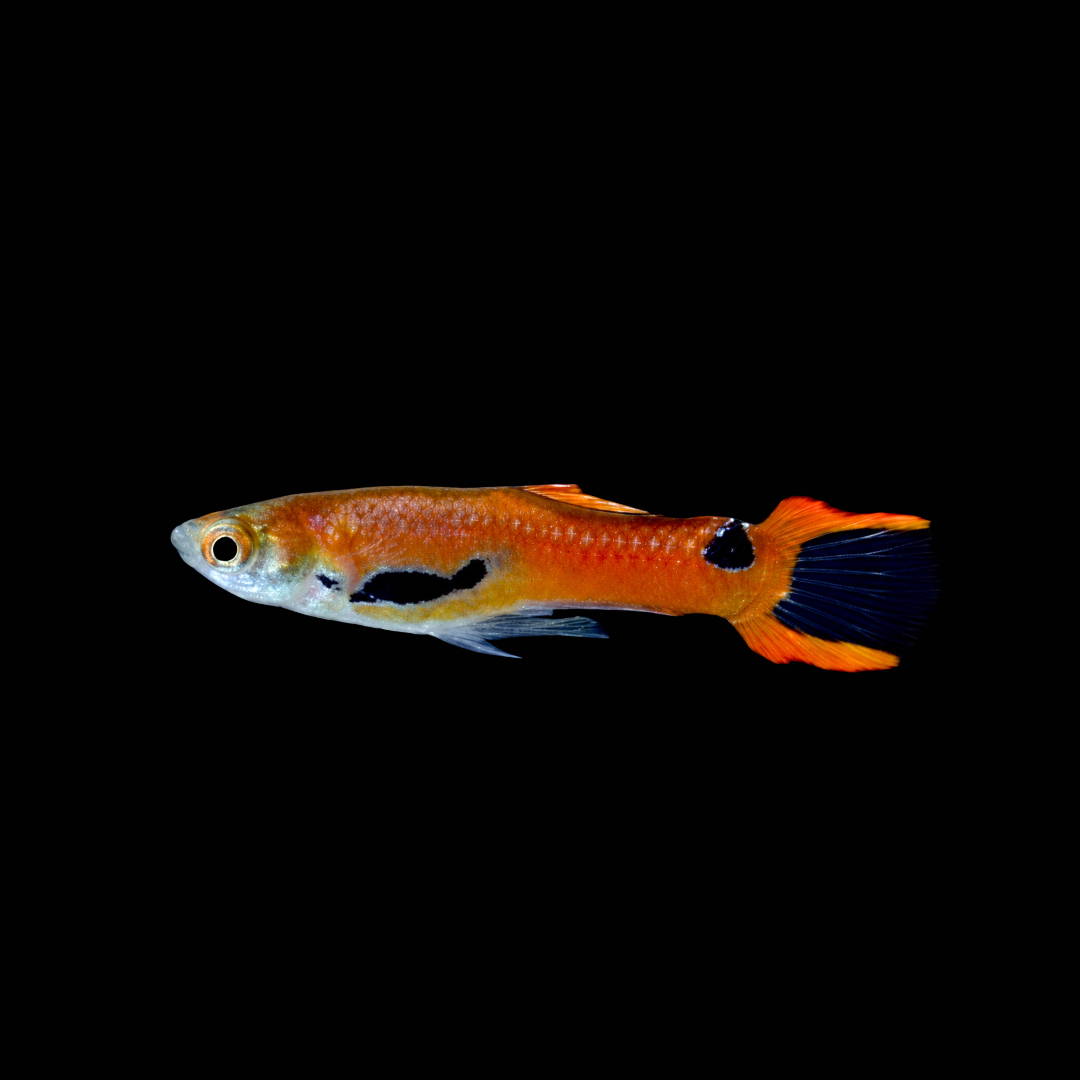
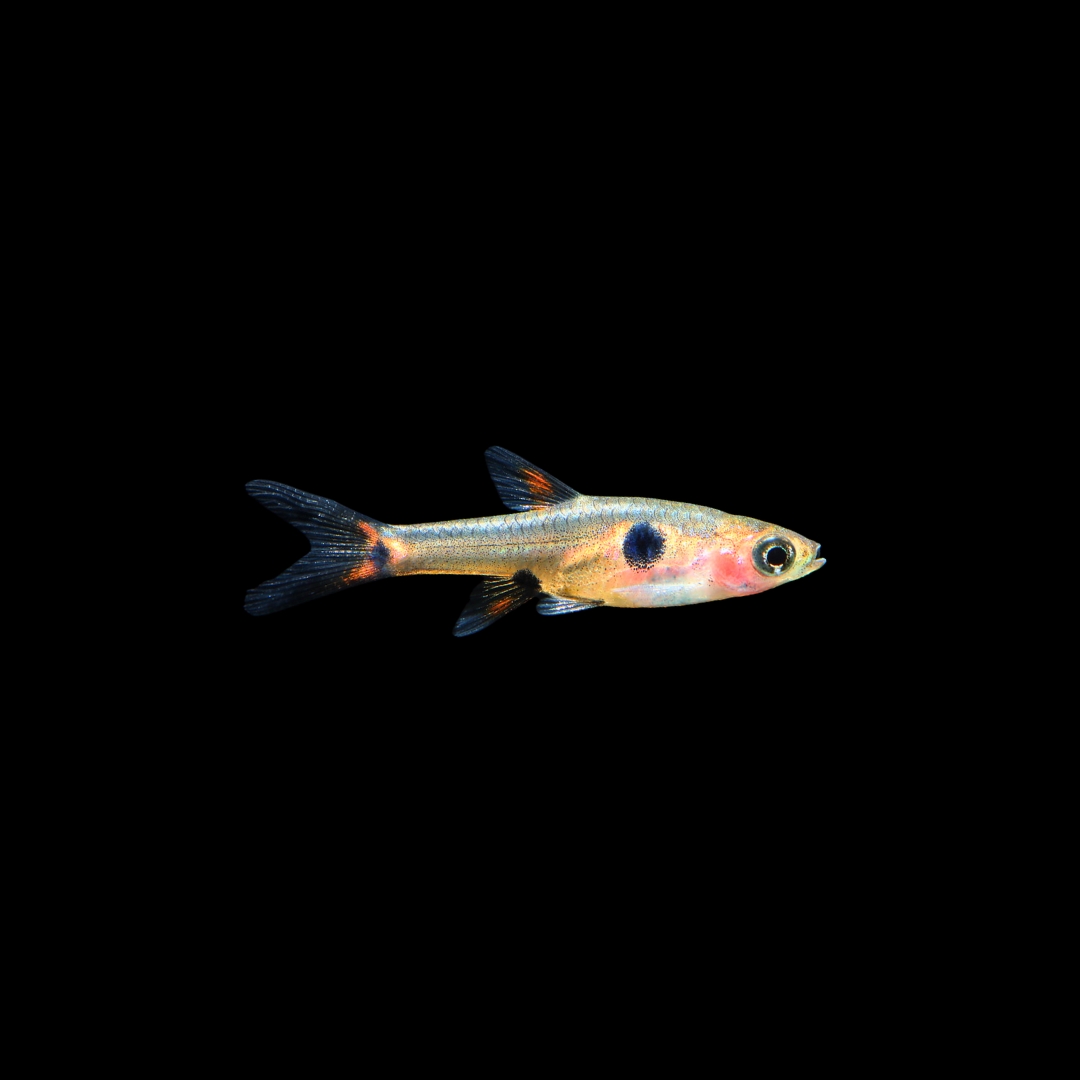
エンドラーズ・スカーレットは、南米ベネズエラ原産の小型卵胎生メダカ「エンドラーズ・ライブベアラー(Poecilia wingei)」と改良グッピー(Poecilia reticulata)を交配して生まれたハイブリッド系統です。海外ではレッドスカーレット・エンドラーズやチリ・エンドラーズの名で親しまれ、日本でもエンドラーズ系品種のなかで特に人気の高い定番品種として知られています。オスは体長2〜3cmほどの小さな体に、メタリックな朱色から深紅の赤をまとい、黒い斑紋やタキシード調の黒模様とのコントラストが鮮烈です。水草をほとんど食害しないため、明るい緑の水草を背景に群れで泳がせると、小型水槽でも主役になれるほどの存在感を発揮します。丈夫で日本の一般的な飼育環境にもよくなじむことから、初めて卵胎生メダカを飼う方から、系統の維持や選別に取り組む熟練のブリーダーまで、幅広い層に親しまれています。なお、国内のショップではスリランカなどから輸入されたオスのみの販売が中心で、同じ系統のメスやペアを見かける機会は多くありません。The Endler’s Scarlet is a hybrid strain created by crossing the Endler’s livebearer (Poecilia wingei), a small livebearer native to Venezuela, with fancy guppies (Poecilia reticulata). Known overseas as the Red Scarlet Endler or Chili Endler, it is also one of the most popular Endler strains in Japan. Males grow to only 2 to 3 cm, yet their bodies are washed in metallic vermilion to deep crimson, contrasting vividly with black blotches and tuxedo-like black markings. Because they rarely damage plants, a group swimming against bright green foliage can take center stage even in a small aquarium. Hardy and well suited to typical home setups in Japan, they are enjoyed by everyone from first-time livebearer keepers to experienced breeders working on line maintenance and selection. In Japanese shops, they are mostly sold as imported males only, often from Sri Lanka, and females or pairs of the same line are not often seen.
基本情報 / Basic Information
学名 / Scientific Name
Poecilia wingei × Poecilia reticulata
通称 / Common Name
エンドラーズ・スカーレット、レッドスカーレット、ピンクスカーレット(ピンク調の個体の流通名)Endler’s Scarlet, Red Scarlet, Pink Scarlet (trade name for pinkish individuals)
分類 / Family
カダヤシ目カダヤシ科ポエキリア属(交雑品種・Kクラス)Cyprinodontiformes, Poeciliidae, genus Poecilia (hybrid strain, Class K)
英名 / English Name
Red Scarlet Endler, Chili Endler
分布 / Distribution
人の手で作られた品種のため、自然分布はありません。交配のもとになった原種エンドラーズは、ベネズエラ北東部スクレ州の限られた水域にのみ分布し、クマナ周辺のラグナ・デ・ロス・パトスや、カンポマ周辺のラグーンとそこにつながる小川などで知られています。流通している個体は、スリランカなどアジアの養殖場で生産されたものが中心と考えられています。As a man-made strain, it has no natural range. Its parent species, the wild Endler’s livebearer, lives only in a limited set of waters in Sucre State, northeastern Venezuela, and is known from places such as Laguna de los Patos near Cumaná and the lagoons and connected streams around Campoma. Fish in the trade are thought to come mainly from farms in Asia, particularly Sri Lanka.
最大体長 / Max Size
オス約2〜3cm、メス約3〜4cmMales about 2 to 3 cm, females about 3 to 4 cm
寿命 / Lifespan
約2〜3年。高水温や過密飼育、出産の繰り返しは体力を消耗させ、寿命を縮める原因になります。About 2 to 3 years. High temperatures, overcrowding and repeated births drain their stamina and can shorten their lives.
飼育環境 / Aquarium Environment
水槽サイズ / Tank Size
ペアやトリオでの繁殖であれば、20〜30cmキューブ水槽や30cm規格水槽(約8〜25L)でも飼育できます。ただし上層から中層を活発に泳ぎ回る魚なので、群れで楽しむなら45cm規格水槽(約30L)から60cm規格水槽(約60L)のような横幅のある水槽が理想的です。繁殖させると数が増えやすいため、余裕のあるサイズを選んでおくと管理が楽になります。A pair or trio for breeding can be kept in a 20 to 30 cm cube or a standard 30 cm tank (about 8 to 25 L). However, since they swim actively in the upper and middle layers, a wider tank such as a standard 45 cm (about 30 L) to standard 60 cm tank (about 60 L) is ideal for a group. They multiply readily once breeding begins, so a roomier tank makes management easier.
水温 / Temperature
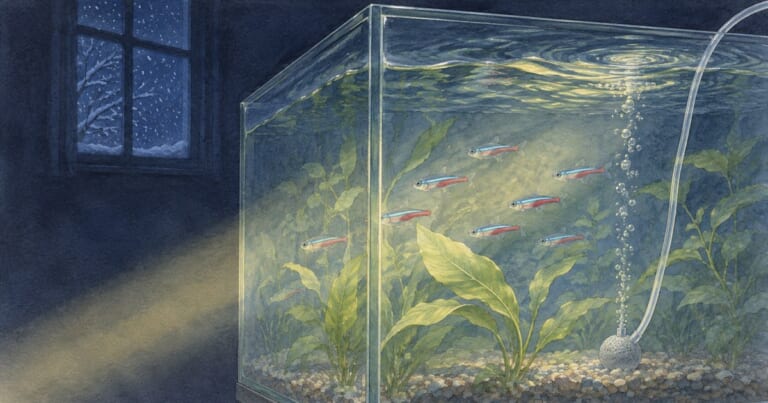
24〜28℃(最適は26℃前後)。18℃を下回ると活性と免疫力が大きく落ちるため、日本の冬場はヒーターで加温するのが確実です。反対に夏場は、28℃を超えるとカラムナリス症の原因菌が活発になりやすいとされるため、冷却ファンやエアコンで高水温を防ぎましょう。24 to 28°C (around 26°C is optimal). Below 18°C their activity and immunity drop sharply, so a heater is the reliable choice during Japanese winters. In summer, temperatures above 28°C are said to encourage the bacteria that cause Columnaris disease, so use a cooling fan or air conditioning to prevent overheating.
水質 / Water Quality
pH6.5〜8.0(最適は7.0〜7.5の中性〜弱アルカリ性)。本来はミネラル分を含む中硬水〜硬水を好みます。日本の水道水は全国的に軟水が多いものの、カルキ抜きをすればそのまま使用できます。大切なのは、硬度を無理に引き上げて水質を不安定にすることではなく、pHが6.0を下回るほどの極端な酸性化を防ぎ、水質を安定させることです。週1回、全水量の25〜30%程度を目安に換水し、古い水がたまらないようにしましょう。pH 6.5 to 8.0 (ideally 7.0 to 7.5, neutral to slightly alkaline). By nature they prefer moderately hard to hard, mineral-rich water. Japanese tap water is generally soft, but it can be used as is once dechlorinated. What matters is not forcing the hardness up and destabilizing the water, but preventing extreme acidification below pH 6.0 and keeping conditions stable. Change about 25 to 30% of the water once a week so that old water does not build up.
レイアウト / Layout
水草水槽との相性は抜群で、緑の有茎草やモスを背景にすると赤い体色がいっそう映えます。ウィローモスやマツモなどを多めに入れておけば、オスに追われるメスの逃げ場や稚魚の隠れ家にもなります。水を弱酸性に傾けるソイルでも飼育はできますが、系統維持や繁殖を主な目的とするなら、水質を酸性に傾けにくい大磯砂などの砂利や、底砂を敷かないベアタンクのほうが安定しやすいでしょう。水面近くを泳ぐ魚なので、飛び出し防止のフタも用意しておくと安心です。They pair beautifully with planted tanks, and their red bodies stand out even more against green stem plants and moss. Plenty of willow moss or hornwort gives females a refuge from pursuing males and provides hiding places for fry. They can be kept over soil that acidifies the water, but for line maintenance and breeding, gravel that does not acidify the water, such as Oiso sand, or a bare-bottom tank tends to be more stable. Since they swim near the surface, a lid to prevent jumping is also advisable.
注意点 / Precautions
エンドラーズとグッピーはどの品種どうしでも簡単に交雑するため、スカーレットの色彩を保ちたい場合は、他品種のグッピーや他系統のエンドラーズと同じ水槽に入れないことが基本です。スカーレットのメスは地味な体色で他系統のメスと見分けにくく、一度混ざってしまうと元の系統に戻すことは困難です。また、新しく迎えた個体は、輸入個体か国内ブリード個体かを問わず、1週間以上別の水槽で様子を見てから合流させましょう。繁殖力が旺盛な魚なので、増えすぎた個体を河川や池に放すことは絶対に避けてください。Endlers and guppies of any variety hybridize easily, so to preserve the Scarlet’s coloration, do not keep them in the same tank as other guppy varieties or other Endler lines. Scarlet females are plainly colored and hard to distinguish from females of other lines, and once lines are mixed it is very difficult to restore the original one. Quarantine any new fish, whether imported or domestically bred, in a separate tank for at least a week before adding them. Because they breed so prolifically, never release surplus fish into rivers or ponds.
餌と給餌 / Feeding
餌の種類 / Diet
雑食性で、人工飼料にもよく慣れます。口が小さいため、浮上性や緩沈下性の細かい顆粒フード、または細かくすりつぶしたフレークフードを主食にします。スピルリナなど植物質を含む餌を日常的に取り入れると、消化器の健康維持に役立ちます。さらに、アスタキサンチンを含む色揚げ飼料や、冷凍ブラインシュリンプ、冷凍赤虫、イサザアミなどの甲殻類系の餌を組み合わせると、赤の発色がいっそう引き立ちます。They are omnivorous and readily accept prepared foods. Because their mouths are small, fine floating or slow-sinking granules or finely crushed flakes make a good staple. Regularly including plant-based foods such as spirulina helps keep their digestion healthy. Adding color-enhancing foods containing astaxanthin, along with frozen brine shrimp, frozen bloodworms and mysis shrimp, brings out their red coloration even more.
給餌のポイント / Feeding Tips
1日2回、2分以内に食べきれる量を目安に与えます。赤い色のもとになる色素のうち、カロテノイド系の色素は魚が体内で作ることができず、餌から取り込むしかありません。そのため、色揚げ飼料や甲殻類系の餌を週3〜5回ほど計画的に取り入れると効果的です。食べ残しは水質悪化につながるので、与えすぎには注意しましょう。Feed twice a day, only as much as they can finish within two minutes. Among the pigments that produce red, carotenoids cannot be made by the fish themselves and can only be obtained from food. For this reason, offering color-enhancing or crustacean-based foods about three to five times a week is effective. Leftover food degrades water quality, so be careful not to overfeed.
性格と混泳 / Temperament and Tank Mates
性格 / Temperament
温和な性格で、他の魚に危害を加えることはほとんどありません。ただし、オスはメスへの求愛がとても熱心で、メスを追い回し続けることがあります。オスだけを複数飼育すると、互いにヒレを広げて見せ合うにぎやかな姿を楽しめます。They are peaceful and rarely harm other fish. Males, however, court females very eagerly and may chase them constantly. When several males are kept together, you can enjoy their lively displays as they spread their fins at one another.
混泳の相性 / Compatibility
性格が穏やかで体格差の少ない小型カラシン(テトラ類)、小型ラスボラ、ピグミーコリドラス、オトシンクルス、貝類のほか、ヤマトヌマエビやミナミヌマエビの仲間など成体のエビとも問題なく暮らせます。ただし、生まれたばかりの稚エビは食べられることがあります。ヒレをかじるバルブ類や、捕食のおそれがあるシクリッド類との混泳は避けましょう。繁殖させない観賞用の水槽であれば、オスだけを群泳させるのも、色彩を存分に楽しめる良い方法です。They live well with peaceful, similarly sized fish such as small characins (tetras), small rasboras, pygmy corydoras and otocinclus, as well as snails and adult shrimp such as Yamato shrimp and Neocaridina species. Newborn shrimplets, however, may be eaten. Avoid keeping them with fin-nipping barbs or predatory cichlids. In a display tank where breeding is not wanted, a group of males only is a great way to enjoy their colors to the fullest.
病気と対策 / Diseases and Prevention
かかりやすい病気 / Common Diseases
最も警戒したいのは、迎え入れた直後に起こりやすいカラムナリス症(尾ぐされ病・口ぐされ病・エラぐされ病)です。ヒレを畳む、ヒレの先が白く濁って裂ける、口の周りが白くなる、呼吸が速くなるといった症状が見られ、進行が非常に速いのが特徴です。産地の異なる魚どうしは、持っている菌の型や抵抗力が違うことがあり、検疫をせずに既存の水槽へ入れると一気に感染が広がる場合があります。このほか、体やヒレに小さな白い点が現れ、底砂に体をこすりつけるしぐさを見せる白点病にも注意が必要です。The greatest concern is Columnaris disease (fin rot, mouth rot and gill rot), which often appears soon after new fish are introduced. Signs include clamped fins, cloudy and ragged fin edges, whitening around the mouth and rapid breathing, and it progresses very quickly. Fish from different sources may carry different bacterial strains and differ in resistance, so adding them to an established tank without quarantine can cause an infection to spread rapidly. Also watch for white spot disease, which appears as small white dots on the body and fins and makes fish rub themselves against the substrate.
対策と予防 / Prevention
予防の基本は、新しい個体を1週間以上隔離して様子を見ることと、水温と水質を安定させることです。カラムナリス症を発症した場合は、エアレーションを備えた別の容器に移し、グリーンFゴールド顆粒(5〜7日)や観パラDで薬浴します。進行が速く重症の場合は、エルバージュエースも選択肢になります。原因菌は高めの水温で活発になるとされるため、白点病の治療のように水温を上げることは避けましょう。塩水浴だけでは菌を抑えられず、低い濃度ではかえって悪化を招くおそれも指摘されています。0.3〜0.5%の塩は、魚の体力を支える補助として薬と併用するのが安全です。白点病にはメチレンブルー水溶液やグリーンFクリアーなどを使い、白い点が見えなくなっても規定の日数まで薬浴を続けます。どの薬も本水槽に入れると水草やエビ、ろ過バクテリアに大きな害を与えるため、治療は必ず別の容器で行い、2日に1回程度の半量換水と規定量の追加投薬を行いましょう。The basics of prevention are quarantining new fish for at least a week and keeping temperature and water quality stable. If Columnaris appears, move the fish to a separate aerated container and treat with Green F Gold granules (5 to 7 days) or Kanpara D. For severe, fast-progressing cases, Elbaju Ace is another option. The bacteria are said to become more active at higher temperatures, so avoid raising the temperature as one might when treating white spot disease. Salt baths alone cannot control the bacteria, and low concentrations have been noted to possibly make things worse. It is safest to use 0.3 to 0.5% salt only as a supportive aid alongside medication to help the fish keep their strength. For white spot disease, use methylene blue solution or Green F Clear, and continue for the full treatment period even after the spots disappear. All of these medications seriously harm plants, shrimp and filter bacteria in the main tank, so always treat in a separate container, changing half the water about every two days and redosing as directed.
増やし方(繁殖) / Breeding
雌雄の判別 / Sexing
オスは小柄で細身、鮮やかな赤と黒の体色を持ち、尻ビレが細長く変化した交接器(ゴノポディウム)を備えています。メスはオスより一回り大きく、灰色がかった銀色の地味な体色で、尻ビレは扇形のままです。成熟したメスは、腹部の後方に黒っぽい妊娠斑が見られます。メスの外見は他系統のエンドラーズやグッピーのメスとよく似ているため、系統の確かな個体を選ぶことが大切です。Males are small and slender, with vivid red and black coloration and a gonopodium, an anal fin modified into a long, narrow mating organ. Females are noticeably larger, plain grayish-silver, and keep a fan-shaped anal fin. Mature females show a dark gravid spot toward the rear of the belly. Because females look very much like those of other Endler lines and guppies, it is important to choose fish from a reliable line.
繁殖形態 / Reproduction
卵胎生で、メスのおなかの中で育った稚魚が、泳げる姿で生まれてきます。妊娠期間は約23〜28日、1回に産む数はメスの体格や状態によって5〜30匹ほど(平均10〜20匹程度)です。メスは一度の交尾で受け取った精子を数か月間体内に蓄えておけるため、オスと離した後でも複数回出産することがあります。They are livebearers: fry develop inside the female and are born already able to swim. Gestation lasts about 23 to 28 days, and a brood numbers roughly 5 to 30 fry (typically 10 to 20) depending on the female’s size and condition. Females can store sperm from a single mating for several months, so they may give birth several more times even after being separated from males.
繁殖のポイント / Breeding Tips
オスの求愛はしつこいので、オス1匹に対してメス2〜4匹の組み合わせにすると、メス1匹あたりの負担を減らせます。出産が近づくと、メスの腹部は角張って見えるようになり、妊娠斑が濃くなって、水草の陰に隠れることが増えます。繁殖水槽ではスポンジフィルターを使うか、吸水口に目の細かいスポンジを取り付けて、稚魚が吸い込まれないようにしましょう。水草を多めに入れておけば、産卵箱を使わなくても稚魚が育ちやすくなります。稚魚には稚魚用のパウダーフードや孵化したてのブラインシュリンプを、1日4〜5回に分けて少しずつ与えます。系統を美しく保つには、体型ががっしりして赤の発色が濃いオスを種親として残し、色の薄い個体や体型の崩れた個体を別の水槽へ分ける選別が欠かせません。3〜4世代ごとに近親交配による弱りが出ていないかを確認し、必要に応じて別系統の良質なスカーレットを迎え入れましょう。Males court persistently, so keeping one male with two to four females reduces the burden on each female. As birth approaches, the female’s belly begins to look squarish, her gravid spot darkens and she spends more time hiding among plants. In a breeding tank, use a sponge filter or fit a fine sponge over the filter intake so fry are not sucked in. With plenty of plants, fry can be raised without a breeding box. Feed the fry powdered fry food or newly hatched brine shrimp in small portions four to five times a day. To keep the line beautiful, select sturdy males with deep red coloration as breeders and move pale or misshapen fish to a separate tank. Every three to four generations, check for weakness caused by inbreeding, and bring in quality Scarlets from another line when needed.
雑学と豆知識 / Trivia and Fun Facts
1. 約40年眠っていた標本と、原種エンドラーズ再発見の物語 / 1. A Specimen That Slept for 40 Years and the Rediscovery of the Wild Endler
スカーレットの母体となった原種エンドラーズの物語は、意外な人物から始まります。この魚を最初に採集したのは、名前の由来となったエンドラー博士ではなく、1937年にベネズエラで調査を行ったフランク・F・ボンドでした。ところが彼の標本はその後およそ40年ものあいだ、ほとんど注目されることがありませんでした。1975年、進化学者のジョン・A・エンドラー博士は、ボンドの記録を知らないままクマナ近郊のラグナ・デ・ロス・パトスでこの魚を再発見します。生きた魚はやがてニューヨーク水族館の遺伝学者クラウス・カルマン博士の手に渡り、カルマン博士が愛好家たちに「エンドラーズ・ライブベアラー」の名で広めたことで、観賞魚の世界へと歩み出しました。この名前は本人に知らされないまま付けられ、エンドラー博士は後になってから自分の名が魚の呼び名になっていると知ったと語っています。その後、飼育下での交雑などで血統が乱れてきたことから、アルマンド・ポウらが新たに野生の個体を採集し、純血の系統が改めて広められました。The story of the wild Endler, the parent of the Scarlet, begins with an unexpected figure. The first person to collect this fish was not Dr. Endler, for whom it is named, but Franklyn F. Bond, who surveyed Venezuela in 1937. His specimens, however, went largely unnoticed for about 40 years. In 1975, evolutionary biologist Dr. John A. Endler, unaware of Bond’s records, rediscovered the fish at Laguna de los Patos near Cumaná. Live fish eventually reached Dr. Klaus Kallman, a geneticist at the New York Aquarium, who spread them among hobbyists under the name Endler’s livebearer, launching the fish into the aquarium world. The name was given without Endler being told, and he has said that he only learned later that the fish had been named after him. Later, as captive lines became mixed through hybridization, Armando Pou and others collected new wild fish, and pure lines were spread anew.
2. 学名に刻まれたグッピー遺伝学の先駆者 / 2. A Pioneer of Guppy Genetics Immortalized in the Scientific Name
エンドラーズは長いあいだ学名のないまま愛好家のあいだで飼われてきましたが、2005年、フレッド・ポーザー、ミヒャエル・ケンプケス、イザーク・イスブリュッカーの3名によって、新種 Poecilia wingei として正式に記載されました。種小名の wingei は、グッピーの体色の遺伝を研究した先駆者であるデンマークの生物学者オユヴィント・ウィンゲにちなむものです。グッピーの色の遺伝の研究で名を残した人物の名前が、グッピーに最も近い仲間の魚に贈られたことは、両者の深い結びつきを象徴しているようにも感じられます。外見はグッピーとよく似ていても、体色や行動の違いが、別の種として扱う根拠のひとつに挙げられています。Endlers were kept by hobbyists for many years without a scientific name until 2005, when Fred Poeser, Michael Kempkes and Isaäc Isbrücker formally described them as a new species, Poecilia wingei. The species name honors Øjvind Winge, a Danish biologist who pioneered research on the inheritance of guppy coloration. That the name of a man remembered for guppy color genetics was given to the guppy’s closest relative seems to symbolize the deep bond between the two fish. Although they look very much like guppies, differences in coloration and behavior were cited among the reasons for treating them as a separate species.
3. N・P・Kクラスとスカーレットの立ち位置 / 3. The N, P and K Classes and Where the Scarlet Fits
海外のエンドラーズ愛好家のあいだでは、ヒレの形などの見た目の基準ではなく、血統の出どころと純度によって系統を3つのクラスに分ける習慣があります。ベネズエラでの採集地、採集年、採集者などの記録によって由来が証明された純血の個体はNクラス、見た目は原種らしくても由来の記録をたどれない個体はPクラス、そしてグッピーなどとの交雑で作られた系統はKクラスと呼ばれます。スカーレットはこのKクラスに属するハイブリッドです。販売時の表記では Poecilia wingei とだけ書かれることもありますが、専門のブリーダーからは、交雑品種に原種の学名だけを使うのは正確ではないと指摘されています。言い換えれば、スカーレットは原種そのものではなく、原種にはない鮮烈な赤を交雑によって手に入れた、人と魚の共同作品とも言える存在なのです。Among Endler enthusiasts abroad, lines are divided into three classes based on lineage and purity rather than on appearance standards such as fin shape. Pure fish whose origin is documented by collection site, year and collector in Venezuela are Class N; fish that look like the wild type but whose origin cannot be traced are Class P; and lines created by crossing with guppies or other fish are Class K. The Scarlet is a Class K hybrid. It is sometimes labeled simply as Poecilia wingei for sale, but specialist breeders point out that using only the wild species name for a hybrid is inaccurate. In other words, the Scarlet is not the wild species itself, but something like a joint creation of people and fish that gained, through hybridization, a vivid red the wild species lacks.
4. スカーレットはどこで生まれたのか / 4. Where Did the Scarlet Come From?
スカーレットを最初に作り出した人物や時期については、確かな記録が残されていません。日本の大手観賞魚問屋の資料では、マカリフ系と呼ばれるグッピーの系統から形質が取り入れられ、スリランカで作出されたと考えられているとしています。一方、ヨーロッパでは、オランダの専門ブリーダーが2005年の時点ですでにレッドスカーレットを飼育していたという記録も残されています。量販向けのグッピーやエンドラーズの多くがスリランカなどアジアの大規模な養殖場から届いていることを考えると、アジアでの大量生産と欧米のブリーダーによる選抜系統が並行して広まり、現在流通している個体群が形づくられたと考えるのが自然でしょう。There is no reliable record of who first created the Scarlet or when. Materials from a major Japanese aquarium wholesaler state that it is thought to have been developed in Sri Lanka, with traits introduced from a guppy line known as Micariff. Meanwhile, in Europe, there is also a record of a Dutch specialist breeder already keeping Red Scarlets in 2005. Given that most mass-market guppies and Endlers come from large farms in Asia, particularly Sri Lanka, it seems reasonable to think that mass production in Asia and lines selected by Western breeders spread side by side to form the fish in circulation today.
5. 「ピンク」や「コイ」と呼ばれる個体の正体 / 5. The Truth Behind “Pink” and “Koi” Endlers
ショップでは「ピンクスカーレット」、海外では「ピンク・エンドラーズ」や「コイ・エンドラーズ」といった名前の魚を見かけることがあります。まるで別の品種のようですが、長年スカーレットを繁殖させてきたオランダのブリーダーによると、これらはいずれも同じレッドスカーレットの系統から生まれる色の出方の違いだといいます。鍵を握るのは、グッピーとの交雑によって持ち込まれた、マゼンタ遺伝子とシュテルツバッハ遺伝子と呼ばれる2つの遺伝子です。そのブリーダーの水槽では、生まれるオスの約3〜4割がピンク調の発色を示したと報告されています。シュテルツバッハ遺伝子は体の赤や黄色の色素を抑える働きを持つと解説されており、この働きが強く出ると、体側の赤が薄れて淡いメタリックピンクになります。それでも、赤い色素細胞が多い背中のラインや頭の先には濃い赤が残るため、遠目には錦鯉の紅白模様のように見え、「コイ」の名で呼ばれるようになりました。つまり、ピンクやコイと呼ばれる個体は、スカーレットの中に隠れていた遺伝子が表に現れた姿なのです。どのように遺伝するかについては、愛好家の経験に基づく見方と専門的な解説とで説明が分かれており、まだ見解が一致していません。In shops you may come across fish called Pink Scarlet, and abroad, Pink Endlers or Koi Endlers. They seem like separate varieties, but according to a Dutch breeder who has bred Scarlets for many years, they are all different color expressions arising from the same Red Scarlet line. The key lies in two genes brought in through hybridization with guppies, known as the magenta gene and the Stoerzbach gene. In that breeder’s tanks, about 30 to 40 percent of males were reported to show pinkish coloration. The Stoerzbach gene is described as suppressing red and yellow pigments on the body, and when its effect is strong, the red on the flanks fades to a pale metallic pink. Even so, deep red remains along the back and at the tip of the head, where red pigment cells are dense, so from a distance the fish resembles the red-and-white pattern of a koi, which is how the name came about. In other words, the fish called pink or koi are Scarlets in which genes hidden within the line have come to the surface. Explanations of how these traits are inherited differ between hobbyists’ experience and specialist references, and there is not yet agreement.
6. 深紅の輝きは餌から生まれる / 6. Deep Red Brilliance Comes from Food
スカーレットの体色は、黒い斑紋をつくる黒色素胞、メタリックな光沢を生み出す虹色素胞、そして朱色から赤を生み出す黄色素胞と赤色素胞という、何種類もの色素細胞の働きが重なって生まれています。赤やオレンジの色には、魚が自分の体で作れるプテリジン系の色素と、自分では作れず餌から取り込むしかないカロテノイド系の色素の両方が関わっています。グッピーを使った進化の研究では、野生のメスがオスのオレンジ色の鮮やかさを手がかりに、相手を選んでいることが示されています。カロテノイドは餌から取るしかないため、色の鮮やかなオスは餌をしっかり見つけられる健康な個体である可能性が高いと考えられるのです。つまり魚たちにとって、鮮やかな赤は「健康の証明書」のような意味を持っています。水槽で色揚げ飼料や甲殻類の餌を与えると赤が深まるのは、こうした仕組みにかなった方法だと言えます。The Scarlet’s coloration arises from the combined work of several kinds of pigment cells: melanophores that form the black markings, iridophores that create the metallic sheen, and xanthophores and erythrophores that produce vermilion to red. Red and orange colors involve both pteridine pigments, which fish can make in their own bodies, and carotenoid pigments, which they cannot make and can only obtain from food. Evolutionary studies using guppies have shown that wild females choose mates using the brightness of a male’s orange as a cue. Because carotenoids come only from food, a brightly colored male is likely to be a healthy fish that is good at finding food. In other words, vivid red serves as a kind of health certificate among these fish. Feeding color-enhancing foods and crustaceans to deepen the red in an aquarium is a method that fits this mechanism well.
7. S字を描く求愛ダンスと、稚魚に優しい親たち / 7. The S-Shaped Courtship Dance and Fry-Friendly Parents
成熟したオスはメスの前に回り込み、体をS字にくねらせて背ビレを広げ、小さく跳ねるような動きを繰り返して自分の色を見せつけます。シグモイド・ディスプレイと呼ばれるこの求愛行動は、小さな水槽の中でも観察できる見どころのひとつです。メスが応じないときには、背後からすばやく交尾を試みることもあります。また、エンドラーズ系は親の口が小さいわりに生まれてくる稚魚が比較的大きいため、一般的な改良グッピーよりも親が稚魚を食べてしまうことが少ないと言われています。それでも、空腹時や過密な環境では稚魚が食べられることがあるので、水草を茂らせておくと安心です。さらに、水温が高いとオスが、低いとメスが多く生まれる傾向があるとも指摘されています。A mature male swims in front of a female, bends his body into an S shape, spreads his dorsal fin and repeatedly makes small hopping movements to show off his colors. This courtship behavior, called the sigmoid display, is one of the highlights you can observe even in a small tank. When the female does not respond, he may quickly attempt to mate from behind. Endlers are also said to eat their fry less often than typical fancy guppies, because the parents have small mouths while the fry are relatively large at birth. Fry may still be eaten when the adults are hungry or crowded, so dense plants offer peace of mind. It has also been noted that warmer water tends to produce more males and cooler water more females.
8. 日本の野外に根付いたグッピーという教訓 / 8. A Lesson from Guppies That Took Root in the Wild in Japan
スカーレットの交配親であるグッピーは、日本では1950年代ごろから温泉地や温かい排水が流れ込む水域で野生化が確認されるようになり、現在では沖縄・南西諸島や小笠原の河川や水路に広く定着しています。冬の寒さが厳しい北海道でさえ、温泉が湧き出す国の天然記念物「オンネトー湯の滝」にグッピーが定着し、1999年から長年にわたる駆除が続けられました。2019年にようやく根絶が確認されましたが、野外に定着したグッピーを駆除によって根絶できたのは全国で初めての例でした。こうした状況から、グッピーは環境省と農林水産省がまとめた「生態系被害防止外来種リスト」で総合対策外来種に選ばれています。エンドラーズやグッピーは特定外来生物ではないため飼育や販売に法的な制限はありませんが、繁殖力が旺盛な魚だからこそ、「入れない・捨てない・拡げない」という外来種被害予防の三原則を守り、最後まで責任を持って飼うことが大切です。Guppies, a parent of the Scarlet, have been found living wild in Japan since around the 1950s in hot spring areas and waters fed by warm discharge, and they are now widely established in rivers and channels in Okinawa, the Nansei Islands and the Ogasawara Islands. Even in Hokkaido, with its harsh winters, guppies became established at Onneto Yunotaki, a hot spring waterfall designated a national natural monument, and removal efforts continued there from 1999 for many years. Eradication was finally confirmed in 2019, the first case in Japan of wild-established guppies being eradicated by removal. Because of this situation, guppies are listed as a comprehensive countermeasure species on the List of Alien Species That May Damage Ecosystems compiled by the Ministry of the Environment and the Ministry of Agriculture, Forestry and Fisheries. Endlers and guppies are not designated invasive alien species, so there are no legal restrictions on keeping or selling them, but precisely because they breed so prolifically, it is important to follow the three principles of preventing alien species damage, namely do not introduce, do not release and do not spread, and to care for them responsibly for life.
まとめ / Conclusion
エンドラーズ・スカーレットは、わずか数センチの体に、ベネズエラの小さな原種とグッピーの改良の歴史をあわせ持つ魚です。メタリックな深紅の体をひるがえし、S字を描いて求愛するオスの姿は、小さな水槽にも驚くほどの躍動感をもたらします。丈夫で日本の水にもなじみやすく、安定した水温、定期的な換水、色を意識した餌選びという基本を守るだけで、その赤は日ごとに輝きを増していきます。The Endler’s Scarlet carries, in a body just a few centimeters long, both the story of a small wild species from Venezuela and the history of guppy breeding. Males flashing their metallic crimson bodies as they court in S-shaped curves bring remarkable energy to even a small tank. They are hardy and adapt well to Japanese water, and simply by keeping to the basics of a stable temperature, regular water changes and color-conscious feeding, their red grows more brilliant day by day.
世代を重ねながら濃い赤の個体を選び、系統を守り育てていくことには、この魚ならではの奥深い楽しみがあります。ときにはピンクやコイ模様の個体が生まれ、遺伝の不思議を目の前で感じることもあるでしょう。他の系統と混ぜず、野外に放さず、最後まで大切に向き合えば、スカーレットは水草の緑のなかで燃えるような赤を見せ続けてくれるはずです。Selecting deep red fish generation after generation and nurturing the line offers a depth of enjoyment unique to this fish. Now and then a pink or koi-patterned fish will appear, letting you sense the wonders of genetics right before your eyes. Kept apart from other lines, never released into the wild and cared for to the end, the Scarlet will keep glowing like fire among the green of the plants.
Poeser, F. N., Kempkes, M. & Isbrücker, I. J. H. (2005). Description of Poecilia (Acanthophacelus) wingei n. sp. from the Paría Peninsula, Venezuela, including notes on Acanthophacelus Eigenmann, 1907 and other subgenera of Poecilia Bloch and Schneider, 1801 (Teleostei, Cyprinodontiformes, Poeciliidae). Contributions to Zoology, 74(1/2), 97–115. https://repository.naturalis.nl/pub/214343/
Schories, S., Meyer, M. K. & Schartl, M. (2009). Description of Poecilia (Acanthophacelus) obscura n. sp. (Teleostei: Poeciliidae), a new guppy species from western Trinidad, with remarks on P. wingei and the status of the “Endler’s guppy”. Zootaxa, 2266, 35–50.
Winge, Ø. (1927). The location of eighteen genes in Lebistes reticulatus. Journal of Genetics, 18, 1–43.
体色・行動・繁殖
Grether, G. F., Hudon, J. & Endler, J. A. (2001). Carotenoid scarcity, synthetic pteridine pigments and the evolution of sexual coloration in guppies (Poecilia reticulata). Proceedings of the Royal Society B: Biological Sciences, 268(1473), 1245–1253. https://doi.org/10.1098/rspb.2001.1624
Grether, G. F., Kolluru, G. R., Rodd, F. H. et al. (2005). Carotenoid availability affects the development of a colour-based mate preference and the sensory bias to which it is genetically linked. Proceedings of the Royal Society B: Biological Sciences, 272(1577), 2181–2188. https://doi.org/10.1098/rspb.2005.3197
Houde, A. E. (1997). Sex, Color, and Mate Choice in Guppies. Princeton University Press.
病気
Declercq, A. M., Haesebrouck, F., Van den Broeck, W., Bossier, P. & Decostere, A. (2013). Columnaris disease in fish: a review with emphasis on bacterium-host interactions. Veterinary Research, 44, 27. https://doi.org/10.1186/1297-9716-44-27
Matthews, R. A. (2005). Ichthyophthirius multifiliis Fouquet and ichthyophthiriosis in freshwater teleosts. Advances in Parasitology, 59, 159–241.




コメント