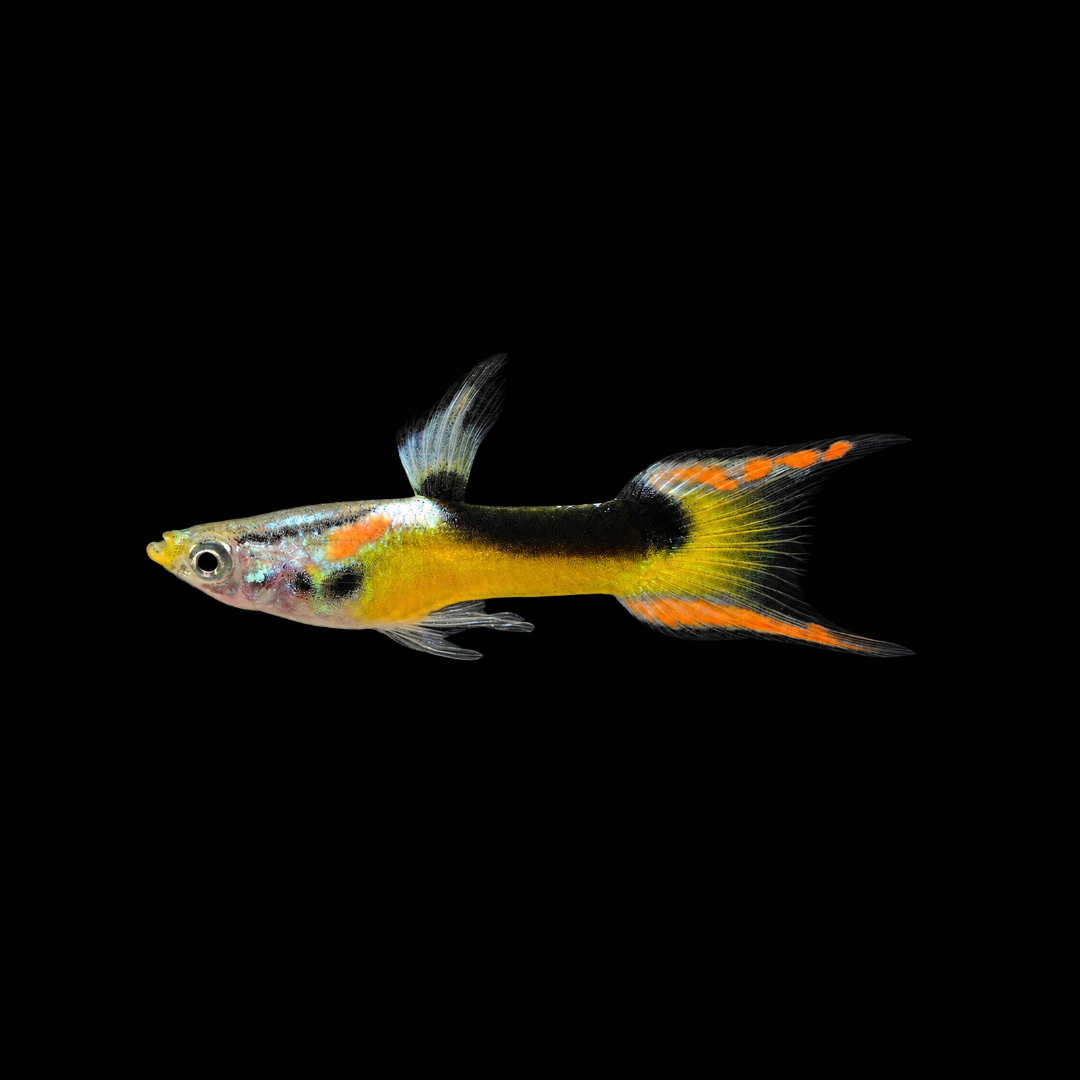
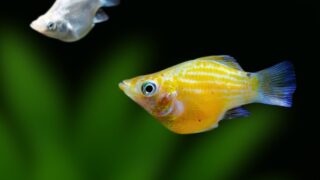
エンドラーズ・レッドチェストサドルバックは、エンドラーズ・ライブベアラー(Poecilia wingei)とグッピー(Poecilia reticulata)を掛け合わせて生み出された改良品種です。欧州では、日本のグッピー研究家・ブリーダーである杉野裕志氏が作出した系統として紹介されています。最大の見どころは、背ビレの付け根から背中、尾筒の上部にかけて馬の鞍のように乗る濃い黒色の模様(サドルバック)、胸元に灯る鮮やかな赤色斑(レッドチェスト)、そして体の下半分から尾ビレへ広がる明るい黄色の三色が生む強いコントラストです。野生型のエンドラーズに比べて尾ビレの色彩表現が豊かで、わずか数センチの体に改良品種ならではの華やかさが詰まっています。日本で生まれた系統がドイツやオランダで商業系統として磨かれ、現在は欧州やスリランカからの輸入便で再び日本に入ってくるという、少し珍しい経歴を持つ魚でもあります。グッピーとの交雑種らしく丈夫で日本の水道水にもよく馴染むため、初めて飼う卵胎生メダカとしても、系統維持にじっくり取り組む対象としても楽しめます。The Endler Red Chest Saddleback is a cultivated strain produced by crossing the Endler’s livebearer (Poecilia wingei) with the guppy (Poecilia reticulata). In Europe, it is introduced as a line developed by the Japanese guppy researcher and breeder Hiroshi Sugino. Its greatest appeal is the strong contrast of three colors: a dense black marking that sits like a horse’s saddle from the base of the dorsal fin across the back to the upper caudal peduncle (the saddleback), a vivid red patch glowing on the chest (the red chest), and a bright yellow spreading from the lower half of the body into the tail fin. Compared with wild-type Endlers, its tail coloration is richer, packing the showiness of a cultivated strain into a body only a few centimeters long. It also has a somewhat unusual history: a line born in Japan was refined into a commercial strain in Germany and the Netherlands, and today it returns to Japan on import shipments from Europe and Sri Lanka. Hardy as befits a guppy hybrid and well suited to Japanese tap water, it can be enjoyed both as a first livebearer and as a strain worth maintaining carefully over generations.
基本情報 / Basic Information
学名 / Scientific Name
Poecilia wingei × Poecilia reticulata
通称 / Common Name
エンドラーズ・レッドチェストサドルバック、レッドチェストサドルバック、エンドラーズ・ハイブリッド(クラスK)Endler Red Chest Saddleback, Red Chest Saddleback, Endler hybrid (Class K)
分類 / Family
カダヤシ目カダヤシ科ポエキリア属(アカントファケルス亜属)の交雑改良品種A hybrid cultivated strain of the genus Poecilia (subgenus Acanthophacelus), family Poeciliidae, order Cyprinodontiformes
英名 / English Name
Endler Guppy “Red Chest Saddleback”
分布 / Distribution
人の手で作出された改良品種のため、自然分布はありません。片親である原種エンドラーズは、ベネズエラ北東部スクレ州のクマナやカンポマ周辺に点在する沿岸ラグーンにのみ生息しています。観賞魚としては、ドイツなど欧州で繁殖された個体と、スリランカなどアジアで養殖された個体が流通しています。As a man-made cultivated strain, it has no natural range. Its parent species, the wild Endler’s livebearer, lives only in coastal lagoons scattered around Cumaná and Campoma in Sucre State, northeastern Venezuela. In the aquarium trade, fish bred in Europe, such as Germany, and fish farmed in Asia, such as Sri Lanka, are available.
最大体長 / Max Size
目安としてオスで約2.5〜3cm、メスで約4cm前後です。グッピーの血を引くため、純血のエンドラーズよりやや大きく育つ傾向があります。As a guideline, males reach about 2.5 to 3 cm and females about 4 cm. Because of its guppy ancestry, it tends to grow slightly larger than purebred Endlers.
寿命 / Lifespan
2〜3年程度です。水温をやや低めに保ち、落ち着いた環境で飼育すると、より長生きする場合もあります。About 2 to 3 years. When kept in a calm environment at somewhat lower temperatures, some individuals live longer.
飼育環境 / Aquarium Environment
水槽サイズ / Tank Size
少数飼育や繁殖管理用であれば、30cm規格水槽(約12L)〜45cm規格水槽(約35L)でも飼育できます。群泳の美しさを楽しみながら水質を安定させたい場合は、45cm規格水槽〜60cm規格水槽(約57L)が理想的です。For a small group or a breeding management tank, a standard 30 cm tank (about 12 L) to a standard 45 cm tank (about 35 L) is sufficient. To enjoy their schooling beauty while keeping water quality stable, a standard 45 cm tank to a standard 60 cm tank (about 57 L) is ideal.
水温 / Temperature
18〜29℃程度まで耐えますが、普段は24〜26℃、繁殖を促したいときは26〜28℃が目安です。日本の冬場はヒーターによる加温が欠かせません。高水温は稚魚の成長や出産のペースを早める一方で、親魚の寿命を縮める傾向があります。観賞と長期飼育が目的なら、24〜25℃前後に保つのがおすすめです。It tolerates roughly 18 to 29°C, but 24 to 26°C is a good guideline for everyday keeping, and 26 to 28°C when you want to encourage breeding. A heater is essential during Japanese winters. High temperatures speed up fry growth and the pace of births, but tend to shorten the lifespan of adult fish. When the goal is display and long-term keeping, around 24 to 25°C is recommended.
水質 / Water Quality
中性〜弱アルカリ性(pH7.0〜7.8前後)、総硬度5〜10°dGH程度が安定しやすい範囲です。欧州ではやや硬めの水が勧められることが多いものの、適応できる水質の幅が広いため、カルキを抜いた日本の水道水でも十分に飼育できます。日本の水道水は地域差があるものの多くが軟水で、全国平均はおよそ3°dGH前後です。ただし、北海道や東北などの特に硬度が低い地域の水や、吸着系ソイルによってpHと硬度がほぼゼロまで下がった状態が続くと、調子を崩しやすくなります。必要に応じてろ過器に少量のサンゴ砂を入れたり、ミネラル添加剤を使ったりして、穏やかに硬度を補うと安心です。アンモニアと亜硝酸が検出されない状態を保ち、硝酸塩は定期的な換水で50mg/L未満に抑えましょう。Neutral to slightly alkaline water (around pH 7.0 to 7.8) with a general hardness of about 5 to 10°dGH is the most stable range. Although slightly harder water is often recommended in Europe, its wide tolerance means it can be kept perfectly well in dechlorinated Japanese tap water. Japanese tap water varies by region but is mostly soft, with a national average of roughly 3°dGH. However, the fish are more likely to decline in water from areas with especially low hardness, such as Hokkaido and Tohoku, or when an adsorbing aqua soil keeps pH and hardness near zero. If needed, add a small amount of coral sand to the filter or use a mineral supplement to raise hardness gently. Keep ammonia and nitrite undetectable, and hold nitrate below 50 mg/L with regular water changes.
レイアウト / Layout
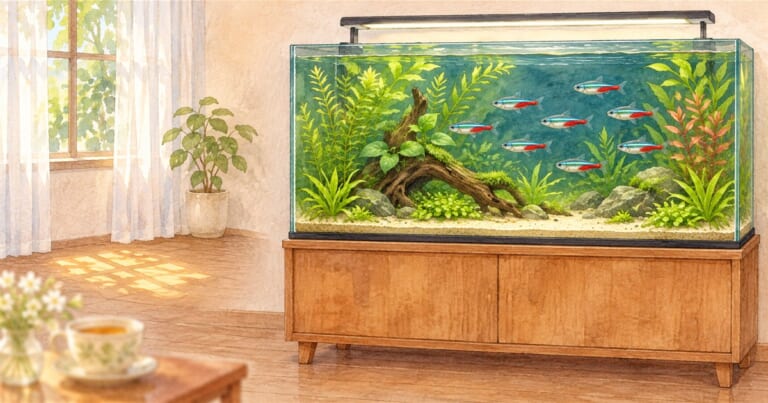
中層から上層を活発に泳ぐため、水槽の中央に広い遊泳スペースを確保し、周囲にウィローモスやグッピーグラス、有茎草などを密に植えるのが基本です。水草の茂みは、オスの求愛に疲れたメスの休み場や、生まれた稚魚の隠れ家になります。水流が強すぎると体力を消耗するため、スポンジフィルターや流れを弱めたフィルターが向いています。底床は大磯砂や田砂などpHを下げにくいものが扱いやすく、暗めの底床と黒いバックスクリーンを組み合わせると、黒いサドルと赤・黄色の対比がいっそう引き立ちます。Because it swims actively in the middle to upper layers, the basic approach is to leave a wide swimming space in the center of the tank and densely plant the surroundings with Java moss, guppy grass, stem plants, and the like. Thickets of plants serve as resting places for females tired of male courtship and as hiding places for newborn fry. Strong currents tire the fish, so a sponge filter or a filter with reduced flow is suitable. Substrates that do not lower pH, such as Oiso gravel or fine river sand, are easy to manage, and combining a dark substrate with a black background makes the contrast between the black saddle and the red and yellow stand out even more.
注意点 / Precautions
他のグッピーや別系統のエンドラーズとは非常に簡単に交雑し、一度混ざると系統の特徴が崩れてしまいます。系統を守りたい場合は品種ごとに水槽を分け、網やホースの使い回しで稚魚が紛れ込まないようにも気を配りましょう。また、グッピー類は日本でも温泉排水が流れ込む水域や沖縄の水路などで野生化しており、生態系への影響が心配されています。飼いきれなくなった場合でも、川や池などの野外へ放すことは絶対にやめてください。It hybridizes very easily with other guppies and other Endler lines, and once mixed, the characteristics of the strain break down. If you want to preserve the line, keep each strain in its own tank and take care that fry are not carried over by shared nets or hoses. Guppies have also become feral in Japan, for example in waters fed by hot spring outflows and in waterways in Okinawa, raising concerns about their effects on ecosystems. Even if you can no longer keep them, never release them into rivers, ponds, or other outdoor waters.
餌と給餌 / Feeding
餌の種類 / Diet
雑食性で、グッピー用やメダカ用の細かい粒の人工飼料をよく食べます。主食には、アスタキサンチンやカンタキサンチン、β-カロテン、スピルリナなどを配合した色揚げ用の細粒フードがおすすめです。補助的に、孵化させたブラインシュリンプや冷凍ミジンコ、細かく刻んだ冷凍赤虫を与えると、栄養のバランスが整い、食いつきも良くなります。It is omnivorous and readily eats fine-grained prepared foods for guppies or medaka. As a staple, a fine-grained color-enhancing food containing astaxanthin, canthaxanthin, beta-carotene, spirulina, and similar ingredients is recommended. As supplements, hatched brine shrimp, frozen daphnia, or finely chopped frozen bloodworms help balance nutrition and improve appetite.
給餌のポイント / Feeding Tips
胃袋が小さいため、一度にたくさん与えず、少量を1日2〜3回に分けて与えるのが基本です。餌粒は「魚の目の大きさ」を上限の目安にすると、食べ残しが出にくくなります。魚は赤やオレンジ色のもとになるカロテノイド色素を体内で作れないため、胸の赤色を濃く保つには餌から取り入れる必要があります。色揚げ用の餌は、2〜4週間ほど与え続けると発色に変化が見え始めるといわれています。Because its stomach is small, the basic rule is to avoid large meals and divide small amounts into two or three feedings a day. Using the size of the fish’s eye as the upper limit for food particle size helps prevent leftovers. Fish cannot produce the carotenoid pigments responsible for red and orange coloration, so they must obtain them from food to keep the chest red deep. Color-enhancing foods are said to start showing changes in coloration after about two to four weeks of continued feeding.
性格と混泳 / Temperament and Tank Mates
性格 / Temperament
とても温和で、他の魚を攻撃することはほとんどありません。ただしオスは一日中メスを追いかけて求愛を繰り返すため、オスが多すぎるとメスが疲れてしまいます。オス1匹に対してメス2〜4匹の割合にすると、群れ全体が落ち着きやすくなります。It is very peaceful and almost never attacks other fish. However, males chase females all day in repeated courtship, so too many males will exhaust the females. A ratio of two to four females per male helps the whole group settle down.
混泳の相性 / Compatibility
同じくらいの大きさで穏やかな小型カラシンやラスボラの仲間、コリドラスやオトシンクルスなどの小型ナマズ、石巻貝などの貝類とは問題なく混泳できます。ミナミヌマエビなどの小型エビとも成体同士なら共存できますが、生まれたばかりの稚エビは食べられることがあります。エビも殖やしたい場合は、モスを多めに入れて隠れ家を増やしましょう。口に入る大きさの魚を食べてしまう中・大型魚や、ヒレをかじる習性のある魚との混泳は避けてください。また、交雑を防ぐため、他のグッピーやエンドラーズとは同じ水槽に入れないのが原則です。観賞だけが目的なら、オスだけを集めて泳がせるのも一つの楽しみ方です。It can be kept without problems with peaceful fish of similar size such as small tetras and rasboras, small catfish such as Corydoras and Otocinclus, and snails such as nerite snails. It can coexist with small shrimp such as Neocaridina when both are adults, but newborn shrimplets may be eaten. If you also want to breed shrimp, add plenty of moss for extra hiding places. Avoid keeping it with medium to large fish that eat anything that fits in their mouths, or with fin-nipping species. As a rule, do not put other guppies or Endlers in the same tank, to prevent hybridization. If display is the only goal, keeping a male-only group is another way to enjoy them.
病気と対策 / Diseases and Prevention
かかりやすい病気 / Common Diseases
白点病や、カラムナリス菌による尾ぐされ病・口ぐされ病、体表や鰓につく寄生虫症に注意が必要です。また、グッピー類では「グッピーエイズ」と俗に呼ばれる、原因がはっきりしないまま急に痩せて弱っていく症状も知られています。特に輸入されて間もない個体は、長距離輸送のストレスで抵抗力が落ちていたり、輸出元の病原体を持ち込んでいたりすることがあります。尾ぐされ病はヒレが白く濁り、溶けるように欠けていくのが特徴で、進行が早いため早期発見が大切です。年をとったメスは、感染症をきっかけに急に痩せ細ることがあります。Watch for white spot disease, fin rot and mouth rot caused by Columnaris bacteria, and parasitic infections of the skin and gills. In guppies, a condition nicknamed “guppy AIDS” is also known, in which fish suddenly lose weight and weaken without a clear cause. Newly imported fish in particular may have lowered resistance from the stress of long-distance transport or may carry pathogens from the exporting country. Fin rot is characterized by fins turning cloudy white and wasting away as if dissolving, and because it progresses quickly, early detection is important. Older females may suddenly become emaciated after an infection.
対策と予防 / Prevention
購入した個体はすぐに本水槽へ入れず、別の水槽で1〜2週間ほど様子を見てから合流させると安心です。0.5%の塩水浴(水1Lに対して塩5g)は、体内の塩分濃度を保つ負担を軽くして体力を支える初期ケアとして役立ちますが、カラムナリス菌による尾ぐされ病は塩水浴だけでは治りきらず、悪化することもあります。ヒレの白濁や欠けが見られたら隔離し、グリーンFゴールド顆粒や観パラDなどの抗菌性の魚病薬で薬浴を行い、必要に応じて塩水浴を併用しましょう。日頃から過密飼育を避け、定期的に換水し、急な水温変化を防ぐことが何よりの予防になります。Rather than adding newly purchased fish straight to the main tank, it is safer to observe them in a separate tank for about one to two weeks before introducing them. A 0.5% salt bath (5 g of salt per liter of water) reduces the burden of maintaining the body’s salt balance and is useful as initial care to support the fish’s strength, but fin rot caused by Columnaris bacteria is often not cured by a salt bath alone and may even worsen. If cloudy or ragged fins appear, isolate the fish and treat it with an antibacterial fish medication such as Green F Gold Granules or Kanpara D, adding a salt bath as needed. Avoiding overcrowding, changing water regularly, and preventing sudden temperature shifts are the best everyday prevention.
増やし方(繁殖) / Breeding
雌雄の判別 / Sexing
オスは体が小さく、赤・黒・黄色の鮮やかな体色を持ち、尻ビレが細長い棒状の交接器(ゴノポディウム)に変化しています。メスは体が大きく、銀灰色〜ベージュの地味な色合いで、尻ビレは扇形のままです。エンドラーズのメスはどの系統のものかを見分けるのが非常に難しいのですが、サドルバック系統の「真のメス」には、尾ビレの付け根の上端に小さな黒い斑点が現れるとされています。繁殖用のメスを選ぶときの大切な目印になります。Males are smaller, display vivid red, black, and yellow coloration, and have an anal fin transformed into a slender rod-shaped copulatory organ (gonopodium). Females are larger, drab silver-gray to beige, and keep a fan-shaped anal fin. It is very difficult to tell which line an Endler female belongs to, but “true females” of the saddleback line are said to show a small black spot at the upper edge of the base of the tail fin. This is an important marker when choosing females for breeding.
繁殖形態 / Reproduction
卵胎生で、メスはお腹の中で卵をかえし、すでに泳げる状態の稚魚を産みます。妊娠期間はおよそ23〜28日(環境によって20〜30日程度)で、1回に5〜30匹ほどの稚魚が生まれます。稚魚は生まれた直後からブラインシュリンプや粉末状の餌を食べて育ち、生後2〜3か月で色づいて成熟し、約4か月で成魚の大きさになります。メスは交尾で受け取った精子を体内に蓄えることができるため、オスがいなくなっても数か月にわたって出産を続けることがあります。It is a livebearer: the female hatches eggs inside her body and gives birth to fry that can already swim. Gestation is about 23 to 28 days (about 20 to 30 days depending on conditions), and 5 to 30 fry are born at a time. The fry eat brine shrimp and powdered food right after birth, color up and mature at two to three months, and reach adult size at about four months. Because females can store sperm received during mating, they may keep giving birth for several months even after the male is gone.
繁殖のポイント / Breeding Tips
オスとメスを一緒に飼えば自然に殖えていきますが、グッピーの血を引く本品種はメスが大きく育つため、隠れ家の少ない水槽や餌が足りない環境では、親が稚魚を食べてしまうことがあります。水草を密に植えた水槽で自然に産ませるか、生まれた稚魚を別の水槽に移して育てると、稚魚の生存率が上がります。狭い産卵箱にメスを長く閉じ込めると、強いストレスで体調を崩すことがあるため、落ち着いた水草環境で出産させるほうが安全です。系統を純粋に保つには、メスが精子を蓄えられることを踏まえ、性成熟する前に雌雄を分けて、まだ交尾していないメスを育てておくことが基本になります。親魚には、胸の赤斑が鮮明で背中の黒いサドルが途切れず濃く、黄色と尾ビレの模様がはっきりしたオスと、尾ビレの付け根の上端に黒点を持つメスを選びましょう。同じ系統からでも胸が黄色いタイプが生まれることがあるため、根気強く選別を続けることが、三色の美しさを次の世代へつなぐ鍵になります。They will breed naturally if males and females are kept together, but because this strain carries guppy blood and its females grow large, parents may eat their fry in tanks with few hiding places or when food is scarce. Letting them give birth naturally in a densely planted tank, or moving newborn fry to a separate tank, improves the fry’s survival. Confining a female in a small breeding box for a long time can cause severe stress and illness, so it is safer to let her give birth in a calm planted environment. To keep the line pure, and given that females can store sperm, the basic approach is to separate the sexes before sexual maturity and raise females that have not yet mated. As breeders, choose males with a sharp red chest patch, a dense and unbroken black saddle on the back, and clear yellow and tail patterns, along with females that have a black spot at the upper edge of the tail fin base. Yellow-chested types can appear even within the same line, so patient, continued selection is the key to passing the beauty of the three colors on to the next generation.
雑学と豆知識 / Trivia and Fun Facts
1. 日本で生まれ、欧州で磨かれて里帰りした魚 / 1. A Fish Born in Japan, Polished in Europe, and Returned Home
日本は世界有数のグッピー育種の盛んな国として知られ、「ジャパンブルー」をはじめ、海外で人気を集めるエンドラーズの交雑品種にも日本発とされる系統が数多くあります。レッドチェストサドルバックもその一つで、欧州では杉野裕志氏が作出した系統として紹介されています。ドイツでは2010年に、背ビレの付け根から黒い模様が入る黄色と黒の系統が「イエロー・ハーフタキシード」の名で紹介されていました。さらに2013年には、ベルリンで開かれた国際エンドラーズ選手権で杉野氏のサドルバック系統の初期型が披露され、専門家の注目を集めたと伝えられています。その後、胸の赤と尾ビレの模様をさらに洗練させたタイプが「レッドチェストサドルバック」として確立され、2018年頃からオランダやドイツの卸売業者を通じて本格的に流通するようになりました。現在ではスリランカなどの大規模な養殖場でも生産され、日本の水槽へと里帰りしています。日本の繊細な育種技術と欧州の観賞魚流通が結びついて広まった、国際色豊かな品種といえるでしょう。Japan is known as one of the world’s most active countries in guppy breeding, and many of the Endler hybrid strains popular overseas, starting with “Japan Blue,” are said to have originated there. The Red Chest Saddleback is one of them, introduced in Europe as a line developed by Hiroshi Sugino. In Germany, a yellow-and-black line with a black marking starting at the dorsal fin base had already been introduced in 2010 under the name “Yellow Half Tuxedo.” Then in 2013, an early version of Sugino’s saddleback line is said to have been shown at the International Endler Championship in Berlin, drawing the attention of experts. Later, a type with a more refined red chest and tail pattern was established as the “Red Chest Saddleback,” and from around 2018 it began circulating in earnest through Dutch and German wholesalers. Today it is also produced at large farms in places such as Sri Lanka and has come home to Japanese aquariums. It is a truly international strain that spread through the union of Japan’s meticulous breeding skills and Europe’s ornamental fish trade.
2. 背中の「鞍」と胸の「赤」を生む遺伝のしくみ / 2. The Genetics Behind the Back “Saddle” and Chest “Red”
背中の黒い鞍模様は、グッピーの世界で「ハーフタキシード」とも呼ばれる形質です。黒い色素を持つ細胞が、背ビレの付近から尾筒の上半分にかけて帯状に集まることで生まれます。この形質は性染色体と結びついて受け継がれると考えられており、そのためオスに強く表れやすいとされています。また、白と黒を基本とするこの模様に黄色の色素の形質が重なることで、鮮やかな黄色のサドルバックが現れると説明されています。胸やヒレの赤色についても、グッピーの改良の歴史の中で性染色体上の遺伝子として受け継がれてきた例が多いと報告されています。本品種そのものを対象にした遺伝子レベルの研究は見当たりませんが、近縁のグッピーで得られた知見から考えると、黒・赤・黄色の三色がそろった姿を保つには、世代ごとの丁寧な選別が欠かせないといえます。The black saddle on the back is a trait also called “half tuxedo” in the guppy world. It forms when cells containing black pigment gather in a band from near the dorsal fin to the upper half of the caudal peduncle. This trait is thought to be inherited in connection with the sex chromosomes, which is why it is said to appear strongly in males. It is also explained that when a yellow pigment trait is added to this basically black-and-white pattern, a vivid yellow saddleback appears. As for the red of the chest and fins, it is reported that in the history of guppy breeding such red has often been inherited through genes on the sex chromosomes. No gene-level studies on this strain itself are known, but judging from what has been learned in closely related guppies, careful selection in every generation is essential to maintain the full combination of black, red, and yellow.
3. 名前は似ていても別物の「1997レッドチェスト」 / 3. The “1997 Red Chest”: A Similar Name, a Different Fish
エンドラーズには、レッドチェストサドルバックとよく似た名前の「1997レッドチェスト」という系統があります。こちらはベネズエラのラグーンで採集された野生個体に由来し、他の魚と交雑させずに維持されてきた原種の系統です。ずんぐりとした体つきで、背中に黒い鞍模様は持っていません。愛好家の間では、エンドラーズを血統の由来によって、野生由来の純血「クラスN」、純血と推定される「クラスP」、交雑種の「クラスK」に分けるECS(エンドラーズ分類システム)が使われています。1997レッドチェストはクラスN、レッドチェストサドルバックはクラスKにあたります。名前だけで判断せず、背中のサドルの有無を確かめることが、見分けるための近道です。Among Endlers there is a line called the “1997 Red Chest,” whose name closely resembles the Red Chest Saddleback. It descends from wild fish collected in Venezuelan lagoons and has been maintained as a wild-type line without crossing with other fish. It has a stocky body and lacks the black saddle on the back. Hobbyists use the ECS (Endler Classification System), which divides Endlers by lineage into Class N for purebreds of wild origin, Class P for presumed purebreds, and Class K for hybrids. The 1997 Red Chest belongs to Class N and the Red Chest Saddleback to Class K. Rather than judging by name alone, checking for the saddle on the back is the quickest way to tell them apart.
4. 学名の書き方に込められた原種への敬意 / 4. Respect for the Wild Species in How the Name Is Written
観賞魚の流通では、本品種が便宜的に Poecilia wingei と表記されることも少なくありません。しかし海外の専門ブリーダーの間では、この学名は本来、他種と交雑していない純血のエンドラーズにだけ使うべきだという考え方が広く共有されています。交雑系統には Poecilia endler sp. や Poecilia wingei cf. と記すべきだとする意見があるほか、日本の専門店では Poecilia reticulata × Poecilia wingei var. と表記されることもあります。こうした細かなこだわりは、野生では数を減らしつつある原種の血統を混ぜずに守りたいという、愛好家たちの思いの表れといえるでしょう。In the ornamental fish trade, this strain is often labeled as Poecilia wingei for convenience. Among specialist breeders abroad, however, there is a widely shared view that this scientific name should properly be used only for purebred Endlers that have not been crossed with other species. Some argue that hybrid lines should be written as Poecilia endler sp. or Poecilia wingei cf., and some Japanese specialty shops label them as Poecilia reticulata × Poecilia wingei var. This attention to detail reflects hobbyists’ wish to keep the bloodline of a wild species, whose numbers are declining in nature, from being mixed.
5. 40年間眠っていた標本と、自分の名前を後から知った博士 / 5. A Specimen Asleep for 40 Years, and a Scientist Who Learned of His Namesake Later
片親である原種エンドラーズの歴史は、1937年にフランクリン・ボンド氏がベネズエラ北東部のラグナ・デ・ロス・パトスで採集した標本から始まります。ところがこの標本は、グッピーの標本の一部としてミシガン大学の博物館に収められたまま、約40年もの間ほとんど注目されませんでした。転機となったのは1975年、進化生物学者のジョン・エンドラー博士が同じ場所でこの小さく鮮やかな魚を再発見したことです。博士から標本を託された遺伝学者クラウス・カルマン博士がこれを独自の種である可能性が高いとみて、「エンドラーズ・ライブベアラー」の名で愛好家に広めました。エンドラー博士自身は、1980年にドイツで開かれた会合の聴衆席で、自分の名前のついた魚が出回っていることを初めて知ったという逸話が伝えられています。正式な学名がついたのはさらに後の2005年で、デンマークの遺伝学者オィヴィン・ウィンゲにちなんで Poecilia wingei と名づけられました。The history of the wild Endler’s livebearer, one of this strain’s parents, begins with specimens collected by Franklyn Bond in 1937 at Laguna de los Patos in northeastern Venezuela. Those specimens, however, were stored at the University of Michigan museum as part of a guppy collection and drew almost no attention for about 40 years. The turning point came in 1975, when evolutionary biologist Dr. John Endler rediscovered this small, brilliant fish at the same site. Geneticist Dr. Klaus Kallman, to whom Endler entrusted specimens, judged that it was likely a distinct species and spread it among hobbyists under the name “Endler’s livebearer.” An anecdote relates that Dr. Endler himself first learned that a fish bearing his name was in circulation while sitting in the audience at a meeting in Germany in 1980. A formal scientific name came even later, in 2005, when it was named Poecilia wingei after the Danish geneticist Øjvind Winge.
6. 「進化の実験室」を教えてくれた小さな魚たち / 6. The Little Fish That Revealed a “Laboratory of Evolution”
エンドラー博士は、トリニダードの野生グッピーを使った研究で、進化生物学の教科書に名を残しています。オスの派手な体色はメスに選ばれやすくなる一方で、天敵にも見つかりやすくなるという、相反する事情を抱えています。博士は、天敵の多い川にすむ地味なグッピーを天敵の少ない場所へ移し、約2年後に再び調べました。すると、オスたちの体色がはっきりと派手になっていたのです。つまり、天敵という歯止めがゆるむと、メスに好まれる派手さがわずか十数世代のうちに広がることを、野外で実際に示したことになります。博士はさらに、水中の光の色合いや、グッピーと天敵との見え方の違いが、「メスには目立ち、天敵には気づかれにくい色」を進化させるという「感覚駆動」の考え方も提唱しました。原種エンドラーズのメタリックな輝きや赤と黒の強い対比も、植物プランクトンで緑色ににごったラグーンの中でメスにアピールするための適応と考えられています。水槽の中で揺れる三色の体色にも、こうした進化の物語が受け継がれているのです。Dr. Endler earned a place in evolutionary biology textbooks through his research on wild guppies in Trinidad. A male’s flashy coloration makes him more attractive to females but also easier for predators to spot, a conflict between opposing pressures. Endler moved drab guppies from a stream with many predators to a place with few, and examined them again about two years later. He found that the males’ coloration had become clearly flashier. In other words, he showed in the wild that once the brake imposed by predators is loosened, the showiness favored by females can spread within just a dozen or so generations. He also proposed the idea of “sensory drive,” in which the color of underwater light and differences in how guppies and their predators see lead to the evolution of colors that are conspicuous to females yet hard for predators to notice. The metallic sheen and strong red-and-black contrast of wild Endlers are likewise thought to be adaptations for attracting females in lagoons turned green by phytoplankton. That evolutionary story lives on in the three colors shimmering in the aquarium.
7. 後ろ向きに泳ぐ求愛ダンスと、グッピーとの細かな違い / 7. A Courtship Dance Swum Backward, and Subtle Differences from Guppies
オスを観察していると、メスの正面に回り込みながら器用に後ろ向きに泳ぐ姿が見られます。求愛中のオスは、体をS字に反らせるディスプレイや、後ろへ素早く跳ねるような動きを繰り返し、一瞬の隙にメスの横へ回り込んで交尾を試みます。よく似たグッピーと原種エンドラーズには細かな違いもあり、エンドラーズのオスのゴノポディウムには、先端を越えて伸びる小さな突起があることが特徴とされています。行動の面でも、グッピーのオスが広い範囲を動き回るのに対し、エンドラーズのオスは直径50〜70cmほどの比較的狭い範囲にとどまりやすいという野外での観察報告があります。両方の血を引く本品種がどちらに近いふるまいを見せるのか、水槽で観察してみるのも楽しみの一つです。When watching the males, you can see them swim skillfully backward while circling around to face a female. A courting male repeats displays such as bending his body into an S-shape and darting quickly backward, then slips to the female’s side in an instant to attempt mating. There are also subtle differences between the similar-looking guppy and the wild Endler: the male Endler’s gonopodium is said to be characterized by a small projection extending beyond its tip. Behaviorally, there are field reports that male guppies roam over wide areas, whereas male Endlers tend to stay within a relatively small area about 50 to 70 cm across. Watching in the aquarium to see which of these behaviors this strain, carrying both bloodlines, more closely resembles is another source of enjoyment.
8. 原種は絶滅危惧種、水槽が担う小さな保全 / 8. An Endangered Wild Species, and the Small Role of the Aquarium in Conservation
世界中の水槽で愛されているエンドラーズですが、野生の原種はベネズエラ北東部のごく限られた沿岸ラグーンにしか分布していません。生活排水やゴミ捨て場からの汚水の流入、外来種ティラピアの侵入、干ばつ、そして持ち込まれたグッピーとの交雑などによって生息地の環境は悪化しており、IUCNレッドリストでは絶滅危惧種(EN)に評価されています。現地での調査が難しい状況も続いているため、世界中の愛好家や研究施設が水槽の中で原種の系統を守り続けることの大切さが指摘されています。また近年は、殖やしやすさを生かして、体の模様ができるしくみの研究や、養殖場の排水から栄養分を取り除く研究などにも使われるようになっています。華やかな改良品種の背景には、こうした原種の厳しい現状と、それを支える人々の取り組みがあることも心に留めておきたいところです。Although Endlers are loved in aquariums worldwide, the wild species is found only in a very limited set of coastal lagoons in northeastern Venezuela. Its habitat has deteriorated due to inflows of household wastewater and runoff from garbage dumps, the invasion of introduced tilapia, droughts, and hybridization with guppies brought into the area, and it is assessed as Endangered (EN) on the IUCN Red List. Because field surveys remain difficult, the importance of hobbyists and research facilities around the world continuing to preserve wild lines in aquariums has been pointed out. In recent years, taking advantage of how easily it breeds, it has also come to be used in research on how body markings form and on removing nutrients from aquaculture wastewater. It is worth remembering that behind this showy cultivated strain lie the harsh realities facing its wild ancestor and the efforts of the people who support it.
まとめ / Conclusion
エンドラーズ・レッドチェストサドルバックは、背中の黒い鞍、胸に灯る赤、体を彩る黄色という三つの色を小さな体にまとった、日本生まれの改良エンドラーズです。丈夫で日本の水道水にもよく馴染み、水草の茂る水槽でオスが後ろ向きに泳ぎながらメスに求愛する姿は、いつまで眺めていても飽きることがありません。色揚げ用の餌や暗めの背景を工夫すれば、その色合いはさらに深みを増していきます。The Endler Red Chest Saddleback is a Japanese-born cultivated Endler that wears three colors on its small body: a black saddle on the back, a red glow on the chest, and yellow brightening its body. It is hardy and adapts well to Japanese tap water, and the sight of males swimming backward to court females in a lush planted tank never grows tiresome. With color-enhancing food and a darker backdrop, its colors deepen even further.
尾ビレの付け根に黒点を持つメスを見つけ、選び抜いた親から生まれた稚魚が少しずつ色づいていく様子には、系統をつなぐ人だけが味わえる喜びがあります。日本で生まれ、欧州で磨かれて再び日本の水槽へ戻ってきたこの小さな魚は、世代を重ねるたびに、飼い主とともに新しい物語を紡いでいくことでしょう。Finding a female with a black spot at the base of her tail fin, and watching fry born from carefully chosen parents gradually color up, brings a joy that only those who carry a line forward can know. Born in Japan, refined in Europe, and returned once more to Japanese aquariums, this little fish will go on writing new stories with its keeper with each passing generation.
Poeser, F. N., Kempkes, M. & Isbrücker, I. J. H. (2005). Description of Poecilia (Acanthophacelus) wingei n. sp. from the Paría Peninsula, Venezuela, including notes on Acanthophacelus Eigenmann, 1907 and other subgenera of Poecilia Bloch and Schneider, 1801 (Teleostei, Cyprinodontiformes, Poeciliidae). Contributions to Zoology, 74(1/2): 97–115.
Schories, S., Meyer, M. K. & Schartl, M. (2009). Description of Poecilia (Acanthophacelus) obscura n. sp., (Teleostei: Poeciliidae), a new guppy species from western Trinidad, with remarks on P. wingei and the status of the “Endler’s guppy”. Zootaxa, 2266: 35–50.
Alexander, H. J. & Breden, F. (2004). Sexual isolation and extreme morphological divergence in the Cumaná guppy: a possible case of incipient speciation. Journal of Evolutionary Biology, 17(6): 1238–1254.
IUCN. The IUCN Red List of Threatened Species: Poecilia wingei(Endangered, B1ab(iii,v)、2021年3月評価). https://www.iucnredlist.org/
Winge, Ö. (1922). One-sided masculine and sex-linked inheritance in Lebistes reticulatus. Journal of Genetics, 12: 145–162.
Endler, J. A. (1980). Natural selection on color patterns in Poecilia reticulata. Evolution, 34(1): 76–91.
Endler, J. A. (1992). Signals, signal conditions, and the direction of evolution. The American Naturalist, 139(Supplement): S125–S153.
繁殖・病気・飼育上の注意
López-Sepulcre, A., Gordon, S. P., Paterson, I. G., Bentzen, P. & Reznick, D. N. (2013). Beyond lifetime reproductive success: the posthumous reproductive dynamics of male Trinidadian guppies. Proceedings of the Royal Society B, 280: 20131116.
Declercq, A. M., Haesebrouck, F., Van den Broeck, W., Bossier, P. & Decostere, A. (2013). Columnaris disease in fish: a review with emphasis on bacterium-host interactions. Veterinary Research, 44: 27.



コメント