



解説 / Description
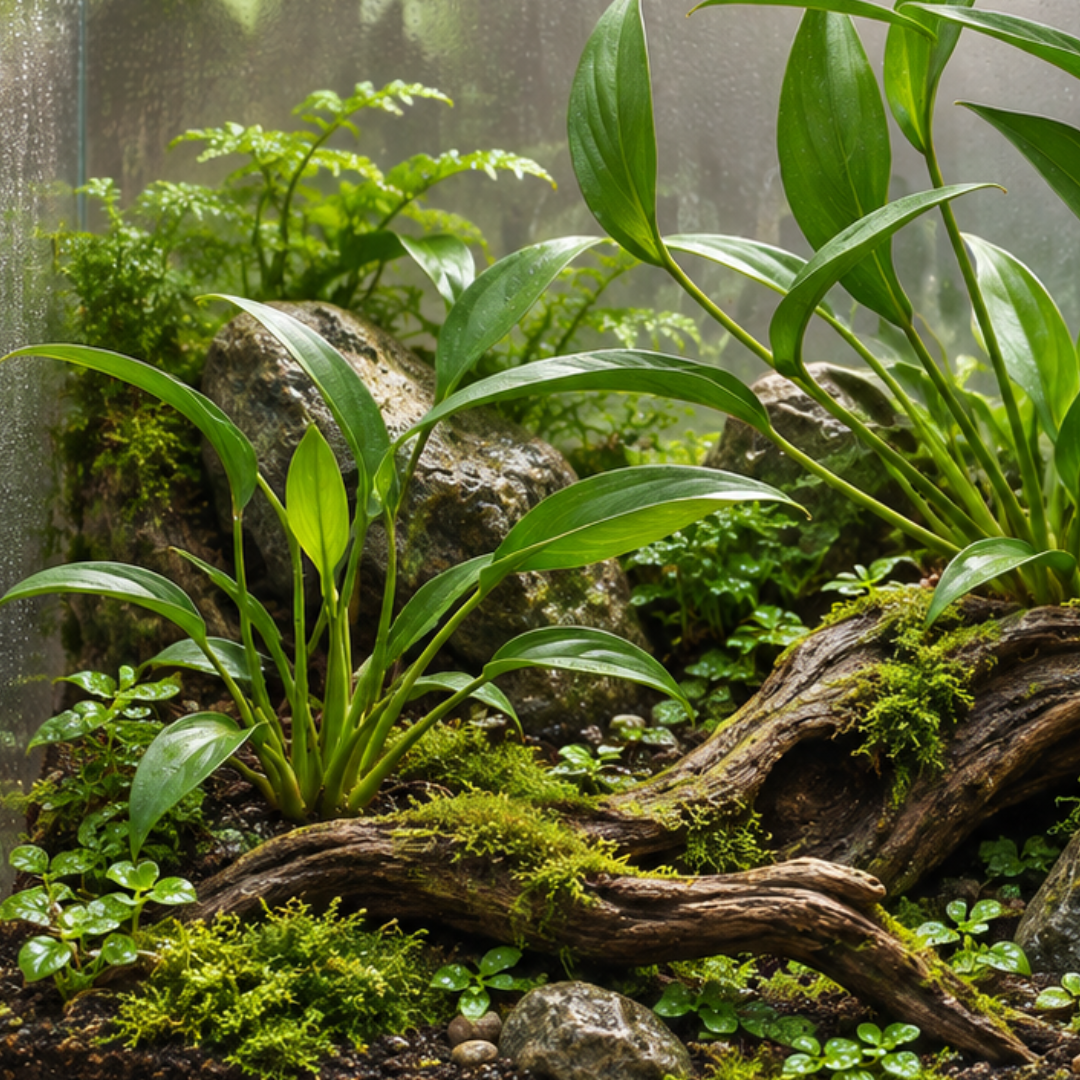
アグラオネマ・シンプレックスは、東南アジアの熱帯林の林床に自生するサトイモ科の原種です。艶のある濃い緑の葉には深く沈み込んだ葉脈が並び、派手な斑入りの園芸品種とはひと味違う、野趣にあふれた落ち着きがあります。直立する茎の先に葉を集めてつける、すっきりとした草姿もこの種の持ち味です。英語では「Malayan sword(マレーの剣)」と呼ばれ、細長い葉の形によく合った名前といえるでしょう。 Aglaonema simplex is a wild species of the arum family (Araceae) that grows on the forest floor of Southeast Asia’s tropical forests. Its glossy, deep-green leaves are lined with deeply impressed veins, giving it a calm, natural character quite different from the flashy variegated cultivars of the genus. An upright stem topped with a cluster of leaves gives the plant a clean, tidy silhouette. In English it is called the “Malayan sword,” a name that suits its long, slender leaves well.
湿り気の多い林床や淡水湿地林などに生え、アクアリウムでは水中で育てる水草というより、パルダリウムやテラリウム、リパリウムといった水辺を再現した環境で真価を発揮します。暗めの環境に強く、CO2添加も必要ないため、照明が控えめな水槽でも育てやすいのがうれしいところです。近年は組織培養のカップ苗が手軽に入手できるようになり、害虫やスネイルの心配が少ない状態から育て始められます。一方、長い年月をかけて太い茎を高く立ち上げた、いわゆる「幹上がり」の大株は見かける機会が少なく、愛好家に好まれる存在です。 It grows on moist forest floors and in freshwater swamp forests, and in the aquarium hobby it shines not as a submerged aquatic plant but in paludariums, terrariums and ripariums that recreate a waterside setting. It tolerates dim conditions well and needs no CO2 injection, making it easy to grow even under modest lighting. Tissue-culture cups are now readily available, letting hobbyists start with plants that carry little risk of pests or snails. Meanwhile, large specimens that have built up a thick, tall, trunk-like stem over many years are seldom seen and are prized by enthusiasts.
基本情報 / Basic Information
| 学名 / Scientific Name | Aglaonema simplex Blume 1823年にブルーメの目録に Caladium simplex の名で登場したのち、1837年にブルーメ自身の著書『Rumphia』でアグラオネマ属の種として発表されました。この経緯の解釈の違いから、著者名は「Blume」と「(Blume) Blume」の2通りの表記が見られます。葉の形の変異が大きく、かつて別種とされた Aglaonema angustifolium や Aglaonema nieuwenhuisii などは、現在では本種のシノニム(同物異名)として扱われています。The name Caladium simplex first appeared in Blume’s catalogue in 1823, and Blume later published the species under Aglaonema in his work Rumphia in 1837. Because this history is interpreted differently, the author citation appears both as “Blume” and “(Blume) Blume.” Leaf shape varies greatly, and names once treated as separate species, such as Aglaonema angustifolium and Aglaonema nieuwenhuisii, are now regarded as synonyms of this species. |
|---|---|
| 通称 / Common Name | アグラオネマ・シンプレックス、緑竹(リョクチク)。英名はマレーアン・ソード(Malayan sword)、ボルネオ・ソード(Borneo sword)。Malayan sword, Borneo sword. In Japan it is also sold as “Ryokuchiku” (green bamboo). |
| 分類 / Family | オモダカ目 サトイモ科 アグラオネマ属Order Alismatales, Family Araceae, Genus Aglaonema |
| 分布 / Distribution | バングラデシュからミャンマー、タイ、インドシナ半島、中国(雲南省南西部)、フィリピン、マレー半島、シンガポール、インドネシア(スマトラ島、ジャワ島、バリ島、ボルネオ島、スラウェシ島など)にかけて広く分布します。標高0〜1,500m付近の熱帯・亜熱帯の森林や淡水湿地林に自生し、樹冠の茂った薄暗い林床を好みます。Widely distributed from Bangladesh through Myanmar, Thailand, Indochina, China (southwestern Yunnan), the Philippines, the Malay Peninsula and Singapore to Indonesia (Sumatra, Java, Bali, Borneo, Sulawesi and elsewhere). It grows in tropical and subtropical forests and freshwater swamp forests from sea level to around 1,500 m, favoring dim forest floors beneath a dense canopy. |
| 育成難易度 / Difficulty | やさしい〜普通。暗さには強い一方で、寒さと長期間の完全水没は苦手です。冬の低温と、過湿による根腐れや軟腐病に気をつければ、長く楽しめる丈夫な植物です。Easy to moderate. It handles low light well but dislikes cold and long-term full submersion. As long as you guard against winter chill and the root rot or soft rot that overly wet conditions can cause, it is a hardy plant you can enjoy for years. |
育成環境 / Cultivation Environment
| 光量 / Light | 弱め〜中程度。自生地は樹冠の下の薄暗い林床で、低い照度に適応しています。直射日光や強すぎるライトは葉焼けの原因になるので避けましょう。水槽用のLEDライトで十分に育ちますが、暗すぎる状態が続くと茎が間延びして倒れやすくなり、葉の色つやも落ちてきます。Low to moderate. In the wild it grows on dim forest floors beneath the canopy and is adapted to low light. Avoid direct sunlight and overly strong lights, which can scorch the leaves. Standard aquarium LED lighting is plenty, but if the plant is kept too dark for long periods, the stem becomes leggy and prone to toppling, and the leaves lose their color and sheen. |
|---|---|
| CO2添加 / CO2 Injection | 不要です。葉を水上に出して育てるのが基本なので、空気中のCO2で十分に光合成できます。Not required. Since the leaves are normally kept above water, the plant photosynthesizes using CO2 from the air. |
| 水質 / Water Quality | 適温は22〜28℃です。15℃前後で成長がほぼ止まり、10℃を下回ると葉が黒く傷みやすくなるため、冬も最低15℃以上を保ってください。水質は弱酸性〜中性(目安としてpH6.0〜7.0程度)を好み、軟水〜中硬水まで幅広く対応します。葉の周りの湿度は高いほど調子がよく、50%以上、できれば70〜80%程度を保てると葉先の枯れ込みが起こりにくくなります。The ideal temperature is 22–28°C (72–82°F). Growth nearly stops around 15°C (59°F), and below 10°C (50°F) the leaves are prone to blackening, so keep it at 15°C or above even in winter. It prefers slightly acidic to neutral water (roughly pH 6.0–7.0) and adapts to soft through moderately hard water. The higher the humidity around the leaves, the better: keeping it at 50% or more, ideally around 70–80%, helps prevent brown leaf tips. |
| 底床 / Substrate | 湿り気を保ちつつ、通気性のよい底床が向いています。パルダリウムではソイルや軽石、小粒の赤玉土などに植え込むほか、水苔だけで育てる方法も広く使われています。水苔は保湿性に優れ発根も促しますが、肥料分がほとんどないため、長く育てる場合は薄めた液肥を時々与えるとよいでしょう。根元を水に浸ける場合は、根茎を深く沈めず、根の一部が水に触れる程度にとどめると安心です。Choose a substrate that stays moist yet remains well aerated. In paludariums it can be planted in aqua soil, pumice or small-grain akadama, and growing it in sphagnum moss alone is also widely practiced. Sphagnum holds moisture well and encourages rooting but contains almost no nutrients, so give diluted liquid fertilizer occasionally for long-term growth. If the base sits in water, avoid sinking the rhizome deep; letting only part of the roots touch the water is the safer approach. |
レイアウト / Layout
| 配置 / Positioning | パルダリウムやテラリウムでは、中景〜後景の主役として映えます。直立する茎と剣のような葉が縦のラインを作るので、苔やシダ類と組み合わせると熱帯の林床の雰囲気がぐっと高まります。小株なら30cmキューブ水槽(約27L)程度から楽しめ、背の高い大株には、45cm〜60cm規格水槽(約35〜57L)以上の高さに余裕のあるケージが向いています。オープンアクアリウムで水面から葉を立ち上げたり、リパリウムで水際に植えたりする使い方もおすすめです。In paludariums and terrariums it makes a striking midground-to-background centerpiece. Its upright stem and sword-like leaves create strong vertical lines, and pairing it with mosses and ferns brings out the feel of a tropical forest floor. Small plants can be enjoyed in a tank as small as a 30 cm cube (about 27 L), while tall specimens suit a 45–60 cm standard tank (about 35–57 L) or a larger enclosure with plenty of headroom. It also looks great rising above the surface of an open-top aquarium or planted along the waterline in a riparium. |
|---|---|
| 注意点 / Precautions | 水中に沈めてもしばらくは持ちこたえますが、長期間の完全水没では根茎が傷みやすく、徐々に弱ってしまうことが多いため、葉を水上に出して管理するのが基本です。また、全草にシュウ酸カルシウムの針状結晶を含み、かじると口の中に強い痛みや腫れを起こします。ペットや小さなお子さんの手が届かない場所に置き、植え替えや剪定の際は、樹液によるかぶれを防ぐために手袋を着けると安心です。It can hold on underwater for a while, but long-term full submersion tends to damage the rhizome and gradually weaken the plant, so the basic approach is to keep the leaves above water. The entire plant also contains needle-like calcium oxalate crystals, and chewing it causes intense pain and swelling in the mouth. Keep it out of reach of pets and small children, and wear gloves when repotting or pruning to avoid skin irritation from the sap. |
増やし方(トリミング) / Propagation & Trimming
| 増やし方 / Propagation | 茎の節から根を出す性質があるため、挿し木で増やせます。伸びすぎた株の先端を切って水苔に挿し、湿度を高く保っておくと、やがて節から根が伸びてきます。残った下の茎から新芽が出ることもあり、株元からわき芽が出た場合は、根が育ってから株分けしましょう。発根までの間は、フタ付きのケースなどで湿度を70〜80%程度に保つと成功しやすくなります。成長はゆっくりなので、焦らず気長に見守るのがコツです。Because roots form at the stem nodes, it can be propagated by cuttings. Cut the top of an overgrown plant, set it in sphagnum moss and keep the humidity high, and roots will eventually emerge from the nodes. The remaining lower stem may also produce new shoots, and any side shoots appearing at the base can be divided once their roots have developed. Keeping cuttings in a covered container at around 70–80% humidity until they root improves the success rate. Growth is slow, so patience is key. |
|---|---|
| トリミング / Trimming | 成長が遅いため、頻繁なトリミングは必要ありません。古くなって黄ばんだ下葉を、葉柄の付け根から取り除く程度で十分です。草丈が高くなりすぎたら、挿し木を兼ねて先端を切り戻すと仕立て直せます。切り口から細菌が入ると軟腐病の原因になるため、ハサミは使うたびにアルコールなどで消毒しておきましょう。Thanks to its slow growth, frequent trimming is unnecessary. Removing old, yellowing lower leaves at the base of the petiole is usually enough. If the plant grows too tall, cut back the top and use it as a cutting to reshape the plant. Bacteria entering through cuts can cause soft rot, so sterilize your scissors with alcohol or similar before each use. |
病気と対策(コケなど) / Pests & Algae
| かかりやすい病気 / Common Issues | 最も注意したいのは、細菌による軟腐病です。株元や葉の付け根が水っぽく変色し、溶けるように崩れて強い腐敗臭を放つのが特徴で、高温で過湿な状態が続くと発生しやすくなります。また、冬に水を与えすぎると根腐れを起こし、葉がしおれてきます。水上の葉では、乾燥時に増えるハダニや、節に付くカイガラムシにも注意が必要です。水面近くで水をかぶる葉は成長が遅いぶん、斑点状のコケや黒ひげ状のコケが付きやすくなります。The most serious threat is bacterial soft rot. The base of the stem or the leaf bases turn water-soaked and discolored, then collapse as if melting and give off a strong foul odor; it is most likely under warm, constantly overwet conditions. Overwatering in winter can also cause root rot, leading to wilting leaves. On emersed leaves, watch for spider mites, which multiply in dry air, and scale insects or mealybugs on the nodes. Leaves that sit at or below the waterline grow slowly, so they are prone to spot algae and black beard algae. |
|---|---|
| 対策と予防 / Prevention | 軟腐病は一度発症すると治すのが難しいため、見つけたらすぐに他の株から離し、傷んだ部分を切り取るか、進行していれば株ごと処分します。予防には風通しを確保し、株の上から水をかけず、根元に静かに注ぐことが大切です。冬は水やりの間隔を大きく空け、底床がいつもびしょ濡れにならないようにしましょう。ハダニはこまめな霧吹きやシャワーで葉裏を洗い流すと防げ、カイガラムシは綿棒や柔らかい歯ブラシでこすり落とします。魚やエビのいる水槽の近くでは、園芸用の殺虫剤は使わないでください。組織培養のカップ苗は、寒天培地をぬるま湯でていねいに洗い落とし、高湿度の環境で少しずつ慣らしてから植え込むと順調に育ち始めます。Soft rot is very hard to cure once it appears, so isolate the plant immediately and cut away the affected parts, or discard the whole plant if the rot has spread. To prevent it, ensure good air circulation and water gently at the base rather than pouring over the plant. In winter, water much less often so the substrate never stays soaking wet. Spider mites can be kept in check by regular misting or rinsing the leaf undersides in the shower, and scale insects can be scraped off with a cotton swab or soft toothbrush. Do not use garden insecticides near tanks that house fish or shrimp. For tissue-culture cups, rinse off the agar gel carefully with lukewarm water and acclimate the plantlets gradually in a humid environment before planting. |
雑学と豆知識 / Trivia and Fun Facts
| 1. 「輝く雄しべ」と「単一」の名前 / 1. A Name Meaning “Shining Stamen” and “Single” | 属名のアグラオネマは、ギリシャ語で「輝く・美しい」を意味する「aglaos」と、「糸」を意味する「nema」を組み合わせたもので、「輝く雄しべ」という意味とされています。糸のような雄しべの軸を指した名前です。一方、種小名の「simplex」はラテン語で「単一の」「単純な」という意味です。1本の茎がすっと立ち上がり、緑一色の葉をつける飾り気のない姿によく似合う名前といえるでしょう。The genus name Aglaonema combines the Greek “aglaos” (bright, beautiful) and “nema” (thread), and is understood to mean “shining stamen,” referring to the thread-like stalks of the stamens. The species name “simplex” is Latin for “single” or “simple.” It is a fitting name for a plant with an upright stem and plain, all-green leaves. |
|---|---|
| 2. 植物学者を悩ませた「変身上手」 / 2. A Shape-Shifter That Puzzled Botanists | 本種は、生える場所によって葉の幅や大きさが大きく変わる植物です。そのため、葉の細い個体や特定の島で採れた小型の個体などが次々と別種として記載され、アグラオネマ属には一時、76もの学名が乱立していました。この混乱を整理したのが、スミソニアン博物館の植物学者ダン・H・ニコルソンです。1969年に発表した研究で、彼は世界33の標本館に収められた1,500枚以上の標本を調べ、東南アジアで18か月にわたる現地調査も行いました。その結果、属内の種は当時21種に整理され、本種は「属の中で最も変異に富む種」と位置づけられました。細葉の A. angustifolium や、葉身が12cmほどしかないボルネオの A. nieuwenhuisii なども、つまりは同じ種の個性の幅だったということです。株ごとに葉の形が多少違っていても、それはこの種らしさの表れなのです。This species varies greatly in leaf width and size depending on where it grows. As a result, narrow-leaved plants and small forms from particular islands were described one after another as separate species, and at one point as many as 76 names had been published in the genus. The confusion was sorted out by Smithsonian botanist Dan H. Nicolson. In his 1969 revision, he examined more than 1,500 herbarium specimens held in 33 herbaria worldwide and carried out 18 months of fieldwork in Southeast Asia. The genus was reduced to 21 species at the time, and this one was described as the most variable species in the genus. In other words, the narrow-leaved A. angustifolium and the Bornean A. nieuwenhuisii, with leaf blades only about 12 cm long, simply fall within the natural range of one species. Some variation in leaf shape from plant to plant is just part of its character. |
| 3. 200ルクスの世界で生きる / 3. Living in a 200-Lux World | インドネシア・バリ島の保護林で行われた調査では、本種が生える場所の明るさはおよそ170〜225ルクスと記録されています。晴れた日の屋外が数万ルクスに達することを考えると、林床に届く光はそのごく一部にすぎません。同じ調査地は気温27〜28℃、空気の湿度80〜86%、土の湿り気も高く、一年中蒸し暑く湿った環境でした。また、タイ東北部の森林での調査では、粘土分が多く、交換性マグネシウムに富む土壌で、大きな木が多く茂る場所ほど本種がよく見られ、岩が露出した場所では少ないことがわかっています。暗さに強く、寒さと乾燥に弱いという栽培上の性格は、こうした林床の環境とよく重なります。A survey in a protected forest on Bali, Indonesia, recorded light levels of only about 170–225 lux where this species grows. Considering that outdoor light on a sunny day reaches tens of thousands of lux, only a tiny fraction reaches the forest floor. The same site had temperatures of 27–28°C, air humidity of 80–86% and moist soil, a warm, humid environment throughout. A study in a forest in northeastern Thailand found that the plant was more common on clay-rich soils high in exchangeable magnesium and in places with many large trees, and less common where rock was exposed. Its tolerance of darkness and its sensitivity to cold and dry air in cultivation closely mirror these forest-floor conditions. |
| 4. 葉の中に仕込まれた「針の矢」 / 4. Needle “Arrows” Hidden in the Leaves | サトイモ科の多くの植物と同じく、本種の葉や茎にはシュウ酸カルシウムの細い針状結晶(ラフィド)が多く含まれています。この結晶は異形細胞と呼ばれる特別な細胞の中に束になって収められていて、動物にかじられて細胞がつぶれると、結晶が勢いよく飛び出す仕組みになっています。針が口の中の粘膜に刺さり、さらに刺激性の成分も関わることで、激しい痛みや腫れが起こると考えられています。草食動物から身を守るための巧妙な防御装置ですが、家庭ではペットや小さなお子さんへの配慮が欠かせない理由でもあります。Like many members of the arum family, the leaves and stems of this species contain large numbers of fine, needle-shaped calcium oxalate crystals called raphides. They are bundled inside specialized cells known as idioblasts, and when an animal bites down and crushes the cells, the crystals are expelled with force. The needles pierce the lining of the mouth, and irritant substances are thought to contribute as well, causing intense pain and swelling. It is an ingenious defense against herbivores, and also the reason to take care around pets and small children at home. |
| 5. 光で働く成分と研究 / 5. Light-Activated Compounds and Research | 東南アジアでは、本種の伝統的な利用も記録されています。マレーシアでは根の煎じ汁が熱やむくみの手当てに使われ、葉をココナッツオイルとすりつぶして、お産を控えた女性の体に塗る使い方も伝えられています。現代の研究では、マレーシアの植物から新しい「光増感剤」を探す取り組みの中で、本種の葉と茎から、葉緑素が分解してできる「フェオフォルバイド」の仲間の化合物が5種類見つかりました。光増感剤とは、光を当てたときにだけ周りの細胞を傷つける働きをもつ物質のことです。実験室の細胞試験では、これらの化合物が光を当てた条件で、白血病や口腔がんの培養細胞に対して中程度から強い毒性を示しました。光を当てた部分だけをねらう「光線力学療法」という治療法の薬の候補になりうる、という意味です。ただし、あくまで基礎研究の段階であり、植物そのものを口にしてよいという意味ではありません。薄暗い林床で育つ植物が、光に反応する成分を秘めているというのは興味深い話です。Traditional uses of this plant have been recorded in Southeast Asia. In Malaysia, a decoction of the roots has been used for fever and swelling, and leaves ground with coconut oil were reportedly rubbed on women in labor. In modern research, a screening program searching Malaysian plants for new “photosensitizers” found five pheophorbide-related compounds, breakdown products of chlorophyll, in the leaves and stems of this species. A photosensitizer is a substance that damages nearby cells only when exposed to light. In laboratory cell tests, these compounds showed moderate to strong toxicity toward cultured leukemia and oral cancer cells under illumination. This means they could be candidates for photodynamic therapy, a treatment that targets only the illuminated area. However, this is basic research only, and it does not mean the plant is safe to ingest. It is intriguing that a plant thriving in the dim forest understory holds compounds that respond so strongly to light. |
まとめ / Conclusion
アグラオネマ・シンプレックスは、熱帯林の薄暗い林床に根ざした、静かな存在感をもつ原種です。深い葉脈が刻まれた艶やかな葉と、すっと立ち上がる草姿は、パルダリウムやテラリウムに植えるだけで、湿った森の空気を感じさせてくれます。暗さに強くCO2も必要としないため、照明が控えめな環境でもじっくり育ってくれるのが魅力です。 Aglaonema simplex is a wild species with a quiet presence, rooted in the dim floor of the tropical forest. Its glossy leaves etched with deep veins and its upright form bring the feel of a humid forest into any paludarium or terrarium. Tolerant of low light and needing no CO2, it grows steadily even under modest lighting.
育成のいちばんのコツは、冬の寒さと乾燥から守り、水を与えすぎないことです。この3つを押さえておけば、ゆっくりと茎を太らせながら、年を追うごとに風格を増していきます。時間をかけて自分だけの幹上がりの株に仕立てていく過程こそ、この植物と暮らす大きな楽しみといえるでしょう。 The key to success is protecting it from winter cold and dry air, and not overwatering. Get those three things right, and it will slowly thicken its stem and gain character year after year. Patiently shaping it into your own tall, trunk-like specimen is one of the great pleasures of living with this plant.

困りごとの解決から、用品えらび、水槽づくり、生き物えらびまで。飼育に役立つ案内です。
分布マップ
Aglaonema simplex は、バングラデシュからミャンマー、タイ、インドシナ半島、中国(雲南省南西部)、フィリピン、マレー半島、シンガポール、インドネシア(スマトラ島、ジャワ島、バリ島、ボルネオ島、スラウェシ島など)にかけて広く分布します。標高0〜1,500m付近の熱帯・亜熱帯の森林や淡水湿地林に自生し、樹冠の茂った薄暗い林床を好みます。
※地図は分布域全体の位置関係を示す概略表示です。実際の分布の境界や生育地を正確に示すものではありません。
※マーカーは表示用の代表地点(マレー半島中部)であり、実際の採集地点や確認記録の地点ではありません。
参考文献
- Nicolson, D. H. (1969). A Revision of the Genus Aglaonema (Araceae). Smithsonian Contributions to Botany, 1: 1–69. Smithsonian Institution Press. https://doi.org/10.5479/si.0081024X.1
- POWO (Plants of the World Online). Aglaonema simplex Blume. Royal Botanic Gardens, Kew. https://powo.science.kew.org/taxon/urn:lsid:ipni.org:names:84107-1
- National Parks Board, Singapore. Aglaonema simplex (Blume) Blume. Flora & Fauna Web. https://www.nparks.gov.sg/florafaunaweb/flora/3/7/3740
- Allen, D. J. (2011). Aglaonema simplex. The IUCN Red List of Threatened Species 2011: e.T194792A8902274. https://www.iucnredlist.org/species/194792/8902274
- Setyowati, F. M. (2003). Aglaonema Schott. In: Lemmens, R. H. M. J. & Bunyapraphatsara, N. (Eds.), Plant Resources of South-East Asia No. 12(3): Medicinal and Poisonous Plants 3. PROSEA Foundation, Bogor. https://prosea.prota4u.org/view.aspx?id=2359
- Lestari, D. & Asih, N. P. S. (2017). Population structure, distribution pattern and microhabitat characteristics of Aglaonema simplex in Pasatan Protected Forest, Jembrana, Bali, Indonesia. Biodiversitas, 18(4): 1663–1668. https://doi.org/10.13057/biodiv/d180446
- O-thong, N., Tasen, W., Marod, D., Thinkampheang, S. & Phumphuang, W. (2024). Spatial distribution of the ethnomedicinal plant Aglaonema simplex at the Sakaerat Environmental Research Station, Northeastern Thailand. Biodiversitas, 25: 3043–3050. https://smujo.id/biodiv/article/view/18176
- Chee, C. F., Lee, H. B., Ong, H. C. & Ho, A. S. H. (2005). Photocytotoxic pheophorbide-related compounds from Aglaonema simplex. Chemistry & Biodiversity, 2(12): 1648–1655. https://doi.org/10.1002/cbdv.200590134
- Henny, R. J., Chase, A. R. & Osborne, L. S. Aglaonema. CFREC-Apopka Foliage Plant Research Note RH-91-2. University of Florida, IFAS. https://mrec.ifas.ufl.edu/Foliage/folnotes/aglaonem.htm
- Graves, K., Wilber, W., Wichman, T. A., Lewis, C., Hansen, G. & Klein, R. Aglaonema spp.: Chinese Evergreen, Aglaonema. FPS25. UF/IFAS Extension. https://doi.org/10.32473/edis-fp025-1999
- ASPCA Animal Poison Control Center. Chinese Evergreen (Aglaonema modestum). Toxic and Non-Toxic Plant List. https://www.aspca.org/pet-care/aspca-poison-control/toxic-and-non-toxic-plants/chinese-evergreen





コメント