


解説 / Description
ストロギネ・ポルトベーリョは、ブラジルのアマゾン川流域から紹介されたキツネノマゴ科の水草です。水中では細く先の尖った葉を対にして付け、茎は底床の上を這うように横へ伸びていきます。葉は落ち着いた灰緑色で表面にわずかなしわがあり、強い光の下では紫やブロンズを帯びた光沢が出てきます。明るい緑の前景草が多いなかで、このシックな色合いと野性味のある草姿はひときわ個性的で、水景に深みと陰影を添えてくれます。 Staurogyne sp. ‘Porto Velho’ is an aquatic plant of the acanthus family introduced from the Amazon basin in Brazil. Underwater it bears narrow, pointed leaves in opposite pairs, while its stems creep along the substrate. The leaves are a subdued grey-green with a slightly wrinkled surface, and under strong light they take on a purplish or bronze sheen. Among the many bright green foreground plants, its muted color and wild, natural form are distinctive, adding depth and shadow to an aquascape.
同じ属のストロギネ・レペンスが丸みのある明るい緑の葉でこんもりとまとまるのに対し、ポルトベーリョは葉が細長く、茎にははっきりとした毛があり、地を這う性質もより強く現れます。成長はゆっくりで、草丈も数センチから十数センチほどに収まるため、前景の奥から中景へと景色をつなぐ役として重宝されます。日本では組織培養のカップ入り商品として流通するのが一般的で、害虫やコケを持ち込む心配が少ない状態で手に入れられます。 Compared with its relative Staurogyne repens, which forms neat mounds of rounded, bright green leaves, ‘Porto Velho’ has longer, narrower leaves, distinctly hairy stems and a stronger creeping habit. It grows slowly and stays only a few centimeters to around ten-odd centimeters tall, which makes it a valued plant for linking the rear of the foreground to the midground. In Japan it is usually sold as tissue-cultured plants in cups, so it can be obtained with little risk of introducing pests or algae.
基本情報 / Basic Information
| 学名 / Scientific Name | Staurogyne sp. ‘Porto Velho’ 正式な種名がまだ付いていない未記載種として扱われています。導入当初は Hygrophila sp. ‘Porto Velho’ の名で、ハイグロフィラ属の一種として流通していましたが、開花した株の花のつくりからスタウロギネ属であることがわかりました。Treated as an undescribed species that has not yet received a formal species name. It was first traded as Hygrophila sp. ‘Porto Velho’, but the structure of its flowers later showed that it belongs to the genus Staurogyne. |
|---|---|
| 通称 / Common Name | ストロギネ・ポルトベーリョ、スタウロギネ・ポルトベーリョ、ストロギネ sp. ポルトベーリョStaurogyne ‘Porto Velho’, Staurogyne sp. Porto Velho |
| 分類 / Family | キツネノマゴ科 スタウロギネ属(ストロギネ属)Acanthaceae, genus Staurogyne |
| 分布 / Distribution | 南米ブラジルのアマゾン川流域とされます。流通名は、アマゾン川の大支流マデイラ川沿いにあるロンドニア州の州都ポルト・ヴェーリョに由来します。野生でどのような環境に生えているのか、詳しい情報は多くありません。Reported from the Amazon basin in Brazil, South America. The trade name comes from Porto Velho, the capital of Rondônia state, on the Madeira River, a major tributary of the Amazon. Little detailed information is available on the conditions where it grows in the wild. |
| 育成難易度 / Difficulty | 普通〜やや難しい。CO2添加と栄養のあるソイルがあれば安定して育ちますが、成長が遅く、植えた直後は水中に慣れるまで時間がかかります。光が足りないと、横に這わずに上へ間延びしやすい点にも注意が必要です。Moderate to somewhat demanding. With CO2 injection and a nutrient-rich soil it grows steadily, but it is slow and takes time to adapt after planting. Note that in low light it tends to stretch upward instead of creeping. |
育成環境 / Cultivation Environment
| 光量 / Light | 中〜強めの光量が向いています。60cm規格水槽(約57L)なら、水草育成用のLED照明で十分な明るさを確保するのが目安です。光が弱いと茎が間延びして葉がまばらになり、地を這う性質も弱まります。強めの光を当てると、葉に紫がかった色合いが出やすくなります。点灯時間は1日7〜8時間ほどにすると管理しやすいでしょう。Medium to fairly high light suits it. For a standard 60 cm tank (about 57 L), the guideline is to provide ample brightness with an LED light designed for planted tanks. In weak light the stems stretch, the leaves become sparse and the creeping habit weakens. Stronger light helps bring out the purplish tint in the leaves. A photoperiod of around 7–8 hours a day is easy to manage. |
|---|---|
| CO2添加 / CO2 Injection | 添加を強くおすすめします。60cm規格水槽なら1秒に1〜2滴程度を目安に安定して添加すると、横へ広がる成長が促され、葉色も締まります。無添加でも枯れるわけではありませんが、成長がさらに遅くなり、コケに負けやすくなります。Strongly recommended. In a standard 60 cm tank, steady injection at around 1–2 bubbles per second encourages lateral growth and richer leaf color. It will not necessarily die without CO2, but growth becomes even slower and the plant is more easily overtaken by algae. |
| 水質 / Water Quality | 水温20〜28℃(22〜26℃前後が理想)、pH5.5〜7.5の弱酸性〜中性、軟水〜中硬水が適しています。急な水質の変化にはやや敏感なので、一度に大量の水を替えるよりも、定期的に適量ずつ換水するほうが安定します。Temperature 20–28°C (ideally around 22–26°C), pH 5.5–7.5 from slightly acidic to neutral, and soft to moderately hard water. It is somewhat sensitive to sudden changes, so regular moderate water changes keep it more stable than occasional large ones. |
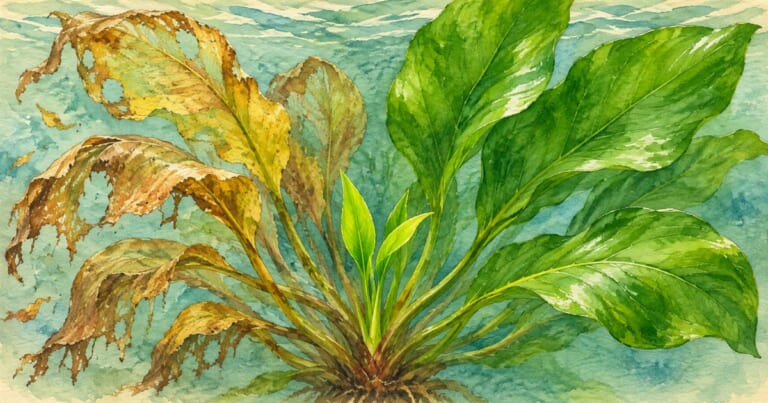
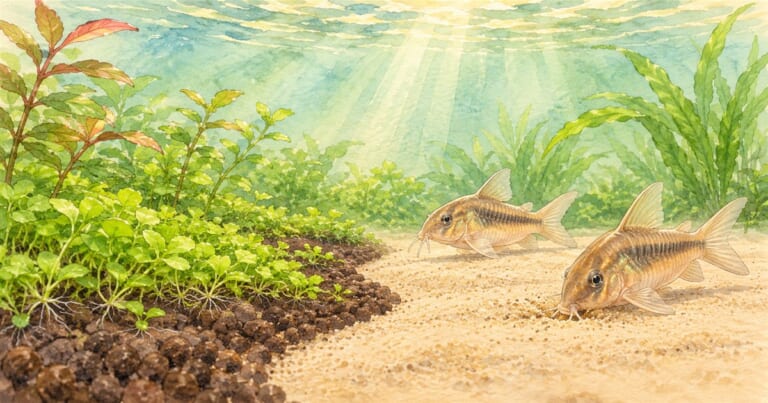
| 底床 / Substrate | しっかりと根を張るため、栄養系のソイルが最適です。ソイルの栄養が落ちてきたら根元に固形肥料を追加し、水中には鉄やカリウム、カルシウム、マグネシウムなどを含む液肥を補いましょう。古い葉に小さな穴が開く場合はカリウム不足、葉脈の緑を残して葉が黄ばむ場合は、古い葉ならマグネシウム、新芽なら鉄の不足が疑われます。It develops a strong root system, so a nutrient-rich aqua soil is ideal. As the soil becomes depleted, add root tabs near the base and dose a liquid fertilizer containing iron, potassium, calcium and magnesium. Small holes in older leaves suggest a potassium shortage. Yellowing between green veins points to a lack of magnesium when it appears on older leaves, or iron when it appears on new growth. |
レイアウト / Layout
| 配置 / Positioning | 前景の奥から中景にかけてのつなぎ役に最適です。キューバパールグラスやショートヘアグラスなど、明るい緑の前景草の後ろに植えると、色と葉の質感がはっきりと対比され、水景に奥行きが生まれます。流木の根元や石の際に這わせるように植えれば、硬い素材の輪郭が和らぎ、長い年月をかけて自然に生えたような雰囲気を演出できます。It is ideal for linking the rear of the foreground to the midground. Planted behind bright green carpeting plants such as Hemianthus callitrichoides ‘Cuba’ or dwarf hairgrass, it creates a clear contrast in color and leaf texture and adds depth. Allowed to creep along the base of driftwood or the edges of stones, it softens their hard outlines and gives the impression of plants that have grown there naturally over many years. |
|---|---|
| 注意点 / Precautions | 前景草としては葉が長めで草姿にボリュームがあるため、前面ガラスのすぐ際に植えると圧迫感が出やすくなります。最前列から数センチ奥を起点に植えると、自然な遠近感が得られます。組織培養株は培地をしっかり洗い流し、ピンセットで数本ずつ、少し間隔を空けて植えると横に広がりやすくなります。For a foreground plant its leaves are fairly long and its growth has some volume, so planting it right against the front glass can feel crowded. Starting a few centimeters back from the front edge gives a more natural sense of perspective. Rinse tissue-cultured plants thoroughly to remove the gel, then use tweezers to plant them in small bunches with some spacing so they can spread sideways. |
増やし方(トリミング) / Propagation & Trimming
| 増やし方 / Propagation | 差し戻しで増やせます。カットした先端の元気な茎(3〜5cmほど)から下葉を数枚取り除いてソイルに植え直せば、根を出して新しい株になります。茂みの根元が混み合って下葉が落ちてきたら、株ごと抜いて健康な先端だけを植え直すことで、群落全体を若返らせることができます。It propagates easily from cuttings. Take a healthy tip of about 3–5 cm, remove a few lower leaves and replant it in the soil, and it will root and form a new plant. When the base of a clump becomes crowded and loses its lower leaves, pull it out and replant only the healthy tops to rejuvenate the whole stand. |
|---|---|
| トリミング / Trimming | 上へ伸び始めた茎をハサミで切り詰めると、切り口のすぐ下の節から脇芽が出て、低く密な茂みになります。成長がゆっくりなのでトリミングの回数は多くありませんが、伸びた茎を放っておくと下葉に光が届かなくなります。こまめに形を整えることが、きれいな姿を保つコツです。Cutting back stems that start growing upward encourages side shoots from the nodes just below the cut, producing a lower, denser bush. Because it grows slowly it does not need frequent trimming, but neglected stems shade the lower leaves. Regular shaping is the key to keeping it looking neat. |
病気と対策(コケなど) / Pests & Algae
| かかりやすい病気 / Common Issues | 植えてから1〜2週間ほどで、水上や培養容器の中で育った葉が半透明になって溶けることがあります。これは水中の環境に慣れる過程で古い葉を落とす現象で、茎が緑色で張りを保っていれば、やがて新しい水中葉が出てきます。また、成長が遅く同じ葉が長く残るため、黒髭ゴケが付きやすいのが弱点です。光不足による間延びや、栄養不足による葉の黄ばみ・穴あきにも気をつけましょう。About one to two weeks after planting, leaves grown emersed or in the culture container may turn translucent and melt. This happens as the plant drops old leaves while adapting to life underwater; as long as the stems stay green and firm, new submerged leaves will follow. Because it grows slowly and keeps the same leaves for a long time, it is prone to black beard algae. Also watch for stretching in low light and for yellowing or holes caused by nutrient shortages. |
|---|---|
| 対策と予防 / Prevention | 組織培養株は、流水で培地を完全に洗い流してから植えましょう。培地が残っているとカビや水質悪化の原因になります。溶けた葉は早めにピンセットで取り除きます。黒髭ゴケを防ぐ基本は、底床掃除を兼ねた定期的な換水で、フンや食べ残しなどの汚れをためないことです。付いてしまった場合は、フィルターを止めて水流をなくし、木酢液や市販のコケ抑制剤をスポイトで患部に少量吹きかけます。数日でコケが赤っぽく変色して弱り、ヤマトヌマエビやサイアミーズ・フライングフォックスが食べやすくなります。薬剤はエビや水草の葉に影響することがあるため、少量から慎重に使ってください。Rinse tissue-cultured plants under running water to remove all of the gel before planting, as leftover medium can cause mold and poor water quality. Remove melting leaves promptly with tweezers. The basic way to prevent black beard algae is to avoid a buildup of waste such as fish droppings and leftover food, through regular water changes combined with substrate cleaning. If it does appear, turn off the filter to stop the flow and apply a small amount of wood vinegar or a commercial algae treatment directly to the spot with a pipette. Within a few days the algae turns reddish and weakens, making it easier for Amano shrimp and Siamese algae eaters to eat. These treatments can affect shrimp and plant leaves, so start with small amounts and use them carefully. |
雑学と豆知識 / Trivia and Fun Facts
| 1. 最初は「ハイグロフィラ」だった / 1. It Started Out as a “Hygrophila” | この水草は、日本や海外に入ってきた当初、ハイグロフィラ属の一種として売られていました。ハイグロフィラも同じキツネノマゴ科の仲間で、葉が対になって付く姿もよく似ているため、葉だけで見分けるのは簡単ではありません。決め手になったのは花でした。水上で咲いた花のつくりを詳しく調べたところ、スタウロギネ属の特徴と一致することがわかり、現在の名前に落ち着いたのです。植物の分類では、葉よりも花や果実のつくりが重視されることが多く、この水草はまさにその好例といえます。When it first arrived in Japan and overseas, this plant was sold as a species of Hygrophila. Hygrophila belongs to the same acanthus family and also bears its leaves in opposite pairs, so telling them apart by foliage alone is not easy. The deciding factor was the flower. When flowers produced above water were examined closely, their structure matched the features of Staurogyne, and the plant settled under its current name. Plant classification often relies more on flowers and fruits than on leaves, and this species is a fine example. |
|---|---|
| 2. 種を弾き飛ばすしくみを持たない仲間 / 2. A Relative Without the Seed-Launching Hooks | キツネノマゴ科の植物の多くは、果実の中に種を支える小さなフック状の突起を持っています。果実が乾いてはじけると、このフックがてこのように働いて種を遠くへ弾き飛ばします。ところが、スタウロギネ属を含むネルソニア亜科の仲間には、このフックがありません。つまり、見た目は似ていても種の散らばり方に違いがあり、これが科の中でグループを分ける大切な手がかりになっているのです。水槽ではなかなか目にしない部分ですが、身近な水草にもこうした植物学的な個性が隠れています。Most plants in the acanthus family have small hook-like structures inside their fruits that hold the seeds. When the fruit dries and splits open, these hooks act like levers and fling the seeds away. Members of the subfamily Nelsonioideae, which includes Staurogyne, lack these hooks. In other words, even when plants look alike, they differ in how they scatter their seeds, and this difference is an important clue for dividing the family into groups. It is rarely seen in the aquarium, but even familiar aquatic plants carry such botanical quirks. |
| 3. 水上と水中で姿を変える葉 / 3. Leaves That Change Between Air and Water | ポルトベーリョは、水上では幅のある葉を付けますが、水中で育つと細く尖った葉に変わり、まるで別の植物のような姿になります。このように、空気中と水中で異なる形の葉を使い分ける性質は、水位が上下する水辺に生える植物によく見られるものです。組織培養株や水上葉の株を水槽に植えると、最初の葉が溶けてから水中葉に置き換わっていくため、買ったときと数か月後とで印象が大きく変わるのも、この水草を育てる面白さのひとつです。‘Porto Velho’ bears broader leaves above water, but when grown submerged it switches to narrow, pointed leaves, looking almost like a different plant. Producing differently shaped leaves in air and underwater is a trait often seen in plants that grow along waters with rising and falling levels. When tissue-cultured or emersed plants are placed in a tank, the first leaves melt away and are replaced by submerged ones, so the plant can look very different a few months after purchase, which is part of the fun of growing it. |
| 4. 紫色は「日焼け止め」の色 / 4. The Purple Is a Kind of Sunscreen | 強い光の下でポルトベーリョの葉が紫やブロンズを帯びるのは、アントシアニンという色素によるものです。アントシアニンは、強すぎる光から葉の内部を守る「日焼け止め」のような役割を持つと考えられています。そのため光が強い水槽ほど色づきやすく、光が弱い水槽では同じ株でも穏やかな緑色にとどまります。葉の色の変化は、その株が置かれている環境を映すサインでもあるのです。The purple or bronze tint that ‘Porto Velho’ develops under strong light comes from pigments called anthocyanins. These are thought to act like a sunscreen, protecting the inner parts of the leaf from excessive light. As a result, the color appears more readily in brightly lit tanks, while in dimly lit tanks the same plant stays a softer green. The color of its leaves is, in a sense, a signal reflecting the conditions it is grown in. |
| 5. 同じ「ポルトベーリョ」でも別の水草 / 5. Same “Porto Velho,” Different Plant | ショップでは「ペルシカリア・ポルトベーリョ」という名前の水草を見かけることもあります。こちらはタデ科の有茎草で、赤みを帯びた細い葉を持つ、まったく別の植物です。同じ地名にちなんだ名前のため、名前だけで探すと取り違えやすく、購入の際は属名まで確かめると安心です。You may also see a plant called Persicaria sp. ‘Porto Velho’ in shops. It is a stem plant of the knotweed family with narrow, reddish leaves, and is an entirely different plant. Because both are named after the same place, they are easy to mix up when searching by name alone, so it is wise to check the genus name when buying. |
まとめ / Conclusion
ストロギネ・ポルトベーリョは、細く尖った葉と、灰緑色から紫を帯びる落ち着いた色合い、そして底床を這うしなやかな成長で、水景に独特の深みを与えてくれる水草です。明るい前景草との対比や、流木・石の足元を包み込むような使い方など、レイアウトでの表現の幅も広く、主役を引き立てる名脇役として活躍します。 With its narrow, pointed leaves, its calm grey-green color that shifts toward purple, and its supple creeping growth, Staurogyne sp. ‘Porto Velho’ brings a distinctive depth to an aquascape. Whether contrasting with bright carpeting plants or wrapping around the base of driftwood and stones, it offers a wide range of layout possibilities and shines as a supporting player that sets off the main features.
十分な光とCO2、栄養のあるソイルを用意したら、植えたあとは焦らず、水中に慣れるのを待つのが上手に育てるコツです。ゆっくりと広がりながら少しずつ色づいていく姿を見守る時間こそ、この水草ならではの楽しみといえるでしょう。手入れを重ねて落ち着いた群落ができあがれば、水槽の中に自然の水辺のような穏やかな景色が広がります。 Once you have provided ample light, CO2 and a nutrient-rich soil, the secret to success is to wait patiently for the plant to adapt after planting. Watching it spread slowly and gradually take on color is a pleasure unique to this plant. When careful maintenance has produced a settled, mature stand, it brings the calm feel of a natural waterside into the aquarium.

困りごとの解決から、用品えらび、水槽づくり、生き物えらびまで。飼育に役立つ案内です。
分布マップ / Distribution Map
Staurogyne sp. ‘Porto Velho’ は、南米ブラジルのアマゾン川流域に分布するとされる水草です。流通名は、アマゾン川の大支流マデイラ川沿いにあるロンドニア州の州都ポルト・ヴェーリョに由来します。野生での詳しい生育環境についての情報は多くありません。 Staurogyne sp. ‘Porto Velho’ is reported from the Amazon basin in Brazil, South America. Its trade name comes from Porto Velho, the capital of Rondônia state, on the Madeira River, a major tributary of the Amazon. Little detailed information is available on its habitat in the wild.
Google Earthで開くOpen in Google Earth
※地図はアマゾン川流域を中心とした概略表示で、正確な分布範囲を示すものではありません。マーカーは流通名の由来であるポルト・ヴェーリョ市付近に置いた代表地点であり、実際の採集地点ではありません。地図データ © OpenStreetMap contributors *This map gives an approximate view centered on the Amazon basin and does not show the exact range. The marker is a representative point placed near the city of Porto Velho, the origin of the trade name, and is not an actual collection site. Map data © OpenStreetMap contributors
参考文献 / References
- Allen, C. (2007) Hygrophila sp. ‘Porto Velho’. The Aquatic Gardener 20(2): 11–12.
- Braz, D. M. & Monteiro, R. (2017) Taxonomic revision of Staurogyne (Nelsonioideae, Acanthaceae) in the Neotropics. Phytotaxa 296(1): 1–40. https://doi.org/10.11646/phytotaxa.296.1.1
- Daniel, T. F. & McDade, L. A. (2014) Nelsonioideae (Lamiales: Acanthaceae): revision of genera and catalog of species. Aliso 32(1): 1–45. https://doi.org/10.5642/aliso.20143201.02
- Flowgrow. Staurogyne sp. “Porto Velho”. Flowgrow Aquatic Plant Database. https://www.flowgrow.de/db/aquaticplants/staurogyne-sp-porto-velho
- Gould, K. S. (2004) Nature’s Swiss army knife: the diverse protective roles of anthocyanins in leaves. Journal of Biomedicine and Biotechnology 2004(5): 314–320.
- Marschner, P. (ed.) (2012) Marschner’s Mineral Nutrition of Higher Plants, 3rd ed. Academic Press, London.
- McDade, L. A., Daniel, T. F., Kiel, C. A. & Borg, A. J. (2012) Phylogenetic placement, delimitation, and relationships among genera of the enigmatic Nelsonioideae (Lamiales: Acanthaceae). Taxon 61(3): 637–651. https://doi.org/10.1002/tax.613012
- Scotland, R. W. & Vollesen, K. (2000) Classification of Acanthaceae. Kew Bulletin 55(3): 513–589.
- Wells, C. L. & Pigliucci, M. (2000) Adaptive phenotypic plasticity: the case of heterophylly in aquatic plants. Perspectives in Plant Ecology, Evolution and Systematics 3(1): 1–18.





コメント