
解説 / Description
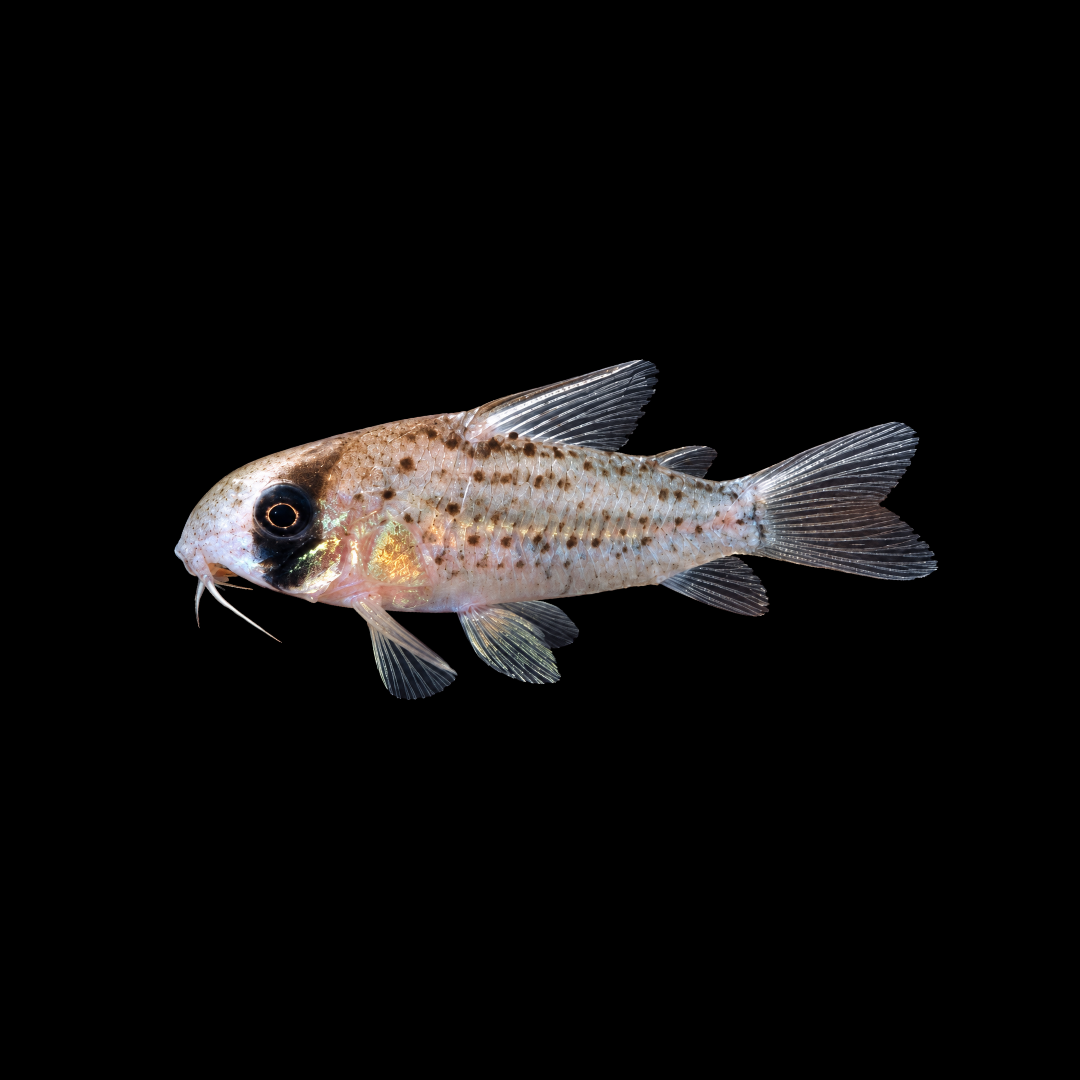
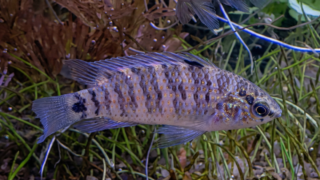
コリドラス・アトロペルソナータスは、南米アマゾン川上流域のエクアドルからペルー北部にかけての河川に暮らす、小型のナマズの仲間です。透き通るような白い地肌には細かな黒い斑点が散らばり、頭の上から眼を通ってエラ蓋へと伸びる黒い帯が、まるで仮面をかぶったような表情をつくっています。その可憐な姿から、海外では「フェアリー・コリドラス(妖精のコリドラス)」とも呼ばれています。1970年に記載されて以来、長くコリドラス属に分類されてきましたが、2024年に発表されたコリドラス亜科の大規模な分類の見直しにより、現在はホプリソマ属(Hoplisoma)に移されています。日本に入ってくるのは主にペルーから輸入される野生採集個体で、模様のよく似た別種と区別するために「アトロペルソナータス1」の名で流通することもあります。性格は温和で、仲間と群れて水槽の底を歩き回り、砂をついばみながら餌を探す姿は、コミュニティ水槽の底層にやさしい華やかさを添えてくれます。導入直後は水質の変化にやや敏感ですが、環境に慣れれば丈夫で、長く付き合える魚です。 Corydoras atropersonatus is a small catfish that inhabits rivers in the upper Amazon basin, from Ecuador to northern Peru. Its translucent white body is sprinkled with fine black spots, and a dark band running from the top of the head through the eye down to the gill cover gives it the look of wearing a mask. Thanks to this delicate appearance, it is sometimes called the “Fairy Cory” in the English-speaking hobby. Since its description in 1970, it had long been placed in the genus Corydoras, but following a major revision of the subfamily Corydoradinae published in 2024, it is now classified in the genus Hoplisoma. Most specimens available in Japan are wild-caught imports from Peru, and it is sometimes sold as “Atropersonatus 1” to distinguish it from a similarly patterned species. Peaceful by nature, it wanders the bottom of the tank with its companions, sifting through the sand for food, and adds gentle charm to the lower level of a community aquarium. It can be somewhat sensitive to changes in water quality right after introduction, but once settled, it is a hardy fish that can be enjoyed for many years.
基本情報 / Basic Information
| 学名 / Scientific Name | Hoplisoma atropersonatum (Weitzman & Nijssen, 1970) 旧学名:Corydoras atropersonatus |
|---|---|
| 通称 / Common Name | コリドラス・アトロペルソナータス、アトロペルソナータス1、ホプリソマ・アトロペルソナトゥムFairy Cory, Atropersonatus Cory, Atropersonatus 1 |
| 分類 / Family | ナマズ目 カリクティス科 コリドラス亜科 ホプリソマ属Siluriformes, Callichthyidae, Corydoradinae, Hoplisoma |
| 英名 / English Name | Fairy Catfish, Fairy Cory |
| 分布 / Distribution | 南米 アマゾン川上流域(エクアドル、ペルー北部)。基準産地はエクアドルのティグレ川水系コナンボ川で、ペルーのナナイ川水系などからも知られています。観賞魚として流通する個体は、ペルーのイキトス周辺から輸出されるものが中心です。落ち葉が積もった砂底の、タンニンで茶色く色づいた弱酸性の軟水域に生息しています。Upper Amazon basin in South America (Ecuador and northern Peru). The type locality is the Río Conambo in the Río Tigre drainage of Ecuador, and the species is also known from the Río Nanay system in Peru, among others. Specimens in the aquarium trade are mainly exported from around Iquitos, Peru. It inhabits soft, slightly acidic, tannin-stained waters with sandy bottoms covered in fallen leaves. |
| 最大体長 / Max Size | 約4.5〜5cm(メスはオスよりやや大きくなります)Approx. 4.5 to 5 cm (females grow slightly larger than males) |
| 寿命 / Lifespan | 3〜5年程度とされています。良好な環境で飼育すれば、さらに長く生きることもあります。Generally about 3 to 5 years. Under good conditions, it may live even longer. |
飼育環境 / Aquarium Environment
| 水槽サイズ / Tank Size | 5〜6匹以上の群れで飼うことを前提に、60cm規格水槽(約57L)以上がおすすめです。底面積が広いほど、群れで動き回る自然な姿を楽しめます。少数の群れなら45cm規格水槽(約35L)でも飼育できますが、水質を安定させやすい点では60cm規格水槽のほうが管理しやすいでしょう。Since it should be kept in a group of at least 5 to 6, a standard 60 cm aquarium (about 57 L) or larger is recommended. The wider the bottom area, the more you can enjoy their natural shoaling behavior. A small group can be kept in a standard 45 cm aquarium (about 35 L), but a 60 cm tank makes it easier to keep water quality stable. |
|---|---|
| 水温 / Temperature | 22〜24℃前後が適温で、おおむね21〜26℃の範囲で飼育できます。高水温がやや苦手なため、夏場は冷却ファンや水槽用クーラーで水温の上昇を抑えましょう。 Around 22 to 24°C is ideal, and it can generally be kept within about 21 to 26°C. As it is somewhat weak against high temperatures, use a cooling fan or aquarium chiller in summer to keep the water from overheating. |
| 水質 / Water Quality | 弱酸性〜中性(pH5.5〜7.0程度)の軟水を好みます。日本の水道水は軟水であることが多いため、カルキ抜きをすれば基本的にはそのまま使えます。古い水に溜まる硝酸塩を嫌うので、週に1回、水量の20〜30%程度を目安に定期的な水換えを行いましょう。It prefers soft water that is slightly acidic to neutral (around pH 5.5 to 7.0). Tap water in Japan is generally soft, so it can usually be used as is once dechlorinated. Since it dislikes the nitrates that build up in old water, change about 20 to 30 percent of the water once a week. |
| レイアウト / Layout | 口先を砂に潜らせて餌を探す習性があるため、底床には田砂のように粒が細かく、角の丸い砂が最適です。角の鋭い砂利は、口元のヒゲを傷める原因になります。また、真っ白な砂を敷くと周囲に合わせて体色が淡くなり、黒い斑点が目立ちにくくなる傾向があるため、やや落ち着いた色合いの砂を選ぶと模様が引き立ちます。流木や落ち葉、陰性水草で物陰をつくり、生息地のブラックウォーターの雰囲気に近づけると、魚も落ち着いて過ごせます。Because it digs its snout into the sand to search for food, fine, rounded sand such as Japanese “tasuna” river sand is ideal. Sharp gravel can damage the delicate barbels around its mouth. Very white sand also tends to make its body color fade to match the surroundings, making the black spots less visible, so choosing a somewhat darker sand helps the pattern stand out. Creating shaded areas with driftwood, leaf litter, and shade-tolerant plants to evoke its blackwater habitat will help the fish feel secure. |
| 注意点 / Precautions | 導入直後は水質の変化に敏感なため、点滴法などで1〜2時間ほどかけて丁寧に水合わせを行いましょう。ただし、届いた袋の水が白く濁っていたり、異常に泡立っていたりする場合は、輸送中のストレスで魚自身が毒性のある分泌物を出している可能性があります。その場合は水温合わせだけを手早く済ませ、袋の水を水槽に入れないようにして、魚だけを速やかに移してください。網ですくうなどの強いストレスでも同じ分泌物を出すことがあるため、取り扱いはできるだけ丁寧に行いましょう。また、群れ全体が頻繁に水面へ上がって空気を吸うようであれば、酸欠や水質悪化のサインです。ろ過装置やエアレーションを点検してください。As it is sensitive to water changes right after introduction, acclimate it carefully over 1 to 2 hours using the drip method or a similar technique. However, if the water in the shipping bag is cloudy or unusually foamy, the fish may have released a toxic secretion due to transport stress. In that case, quickly equalize only the temperature, and transfer the fish alone without letting any bag water into the tank. Strong stress, such as being netted, can also trigger this secretion, so handle the fish as gently as possible. If the whole group frequently rises to the surface to gulp air, it is a sign of oxygen shortage or deteriorating water quality, so check your filter and aeration. |
餌と給餌 / Feeding
| 餌の種類 / Diet | 雑食性で、餌の好き嫌いはほとんどありません。主食には底に沈むコリドラス用のタブレットや沈下性の人工飼料を与え、週に1〜2回、冷凍アカムシや冷凍ブラインシュリンプ、イトメなどの動物性の餌を加えると、栄養バランスが整い体調も安定します。自然下では、砂の中にいる小さなミミズの仲間や甲殻類、昆虫の幼虫、植物由来の有機物などを食べています。It is omnivorous and rarely picky. Feed sinking Corydoras tablets or other sinking prepared foods as the staple, and add animal-based foods such as frozen bloodworms, frozen brine shrimp, or tubifex worms once or twice a week to balance its nutrition and keep it in good condition. In the wild, it feeds on small worms, crustaceans, insect larvae, and plant-derived organic matter found in the sand. |
|---|---|
| 給餌のポイント / Feeding Tips | とてもおっとりした性格で、他の魚と餌を奪い合うことはほとんどありません。混泳水槽では、餌が底に届く前に上層や中層の魚に食べられてしまうことがあるため、消灯の前後など他の魚の動きが落ち着く時間帯に与えたり、水槽の数か所に分けて餌を落としたりする工夫をしましょう。食べ残しは底床を汚す原因になるので、十数分以内に食べきれる量を目安にしてください。It is very mild-mannered and rarely competes with other fish for food. In a community tank, food may be eaten by mid- and upper-level fish before it reaches the bottom, so try feeding around lights-out when other fish are less active, or drop food in several spots around the tank. Leftover food fouls the substrate, so give only as much as can be eaten within about ten minutes or so. |
性格と混泳 / Temperament and Tank Mates
| 性格 / Temperament | 非常に温和で、他の魚を攻撃することはありません。仲間と群れて行動することを好むため、単独で飼うとストレスを抱えやすく、体調を崩す原因になります。5〜6匹以上で飼育すると、そろって底を歩き回る愛らしい姿を見せてくれます。Extremely peaceful and never aggressive toward other fish. Because it prefers to live in a group, keeping it alone easily causes stress and can lead to poor health. When kept in a group of 5 to 6 or more, it shows the charming sight of the whole group wandering the bottom together. |
|---|---|
| 混泳の相性 / Compatibility | ネオンテトラやラミーノーズテトラなどの小型カラシン、ラスボラの仲間、アピストグラマなどの小型シクリッドとは相性が良好です。ヤマトヌマエビなどのエビ類とも共存できますが、生まれたばかりの稚エビは食べてしまうことがあります。一方で、攻撃的な中型・大型シクリッドや、ハサミで体を傷つける恐れのあるザリガニ、テナガエビなどとの混泳は避けてください。It does well with small characins such as Neon Tetras and Rummy-nose Tetras, rasboras, and small dwarf cichlids such as Apistogramma. It can coexist with shrimp such as Amano Shrimp, although newly hatched shrimplets may be eaten. On the other hand, avoid keeping it with aggressive medium or large cichlids, or with crayfish and long-armed prawns that could injure it with their claws. |
病気と対策 / Diseases and Prevention
| かかりやすい病気 / Common Diseases | 輸送や導入直後の水質変化によるストレスをきっかけに、ヒレが溶けたり体表が荒れたりする細菌感染症(エロモナス症やカラムナリス症など)を起こすことがあります。また、角の鋭い底砂や汚れた底床が原因で、ヒゲがすり減ったり溶けたりする症状もよく見られます。水温の急な変化による白点病にも注意が必要です。Stress from transport or from water changes after introduction can trigger bacterial infections that cause fin rot and skin damage (such as Aeromonas or Columnaris infections). Barbel erosion caused by sharp substrate or a dirty bottom is also common. Watch out for white spot disease caused by sudden temperature changes as well. |
|---|---|
| 対策と予防 / Prevention | 導入時は時間をかけて丁寧に水合わせを行い、可能であれば別の水槽でしばらく様子を見てから本水槽に移すと安心です。底床は角の丸い細かな砂を選び、底床の掃除と定期的な水換えで清潔な状態を保ちましょう。コリドラスの仲間は薬や塩分に比較的敏感とされるため、薬浴を行う場合は規定量より薄めの濃度から始め、魚の様子を見ながら慎重に進めることが大切です。Acclimate new fish slowly and carefully, and if possible, observe them in a separate tank for a while before moving them to the main tank. Choose fine, rounded sand, and keep the bottom clean through substrate cleaning and regular water changes. Corydoras are generally considered relatively sensitive to medications and salt, so when treating, start with a weaker concentration than recommended and proceed carefully while watching the fish’s condition. |
増やし方(繁殖) / Breeding
| 雌雄の判別 / Sexing | 十分に成熟した個体であれば、比較的簡単に見分けられます。メスはオスより一回り大きく体高があり、上から見ると卵を抱えたお腹が丸く幅広に見えます。オスは小柄で細身の体つきです。Sexing is relatively easy in fully mature individuals. Females are slightly larger and deeper-bodied than males, and when viewed from above, their egg-filled bellies look round and broad. Males are smaller and slimmer. |
|---|---|
| 繁殖形態 / Reproduction | 卵生で、粘着性のある卵を水槽のガラス面や水草の葉などに産み付けます。オスがメスを追いかけた後、メスがオスの腹部に口を当てる「Tポジション」と呼ばれる、コリドラスの仲間に特有の姿勢をとります。メスは腹ビレでつくったポケットに数個の卵を抱えて受精させ、それを1粒ずつ産み付けていきます。親が卵を守る習性はなく、一度の産卵で数十個ほどの卵を産むとされています。It is an egg layer that attaches adhesive eggs to aquarium glass or plant leaves. After the male chases the female, the pair takes up the “T-position” characteristic of Corydoras, in which the female places her mouth against the male’s belly. The female holds a few eggs in a pouch formed by her pelvic fins, fertilizes them, and attaches them one at a time. The parents do not guard the eggs, and a single spawning is said to produce several dozen eggs. |
| 繁殖のポイント / Breeding Tips | オス2〜3匹に対してメス1匹程度の割合で組み、産卵の2週間ほど前から冷凍アカムシなどの栄養価の高い餌を十分に与え、メスに卵を蓄えさせます。メスのお腹がふっくらしてきたら、普段より2〜3℃低い新しい水で水量の半分程度を換え、水流とエアレーションを強めます。これは原産地の雨季に訪れる大雨と増水を再現する方法で、数日続けることで産卵のきっかけになりやすいとされています。産み付けられた卵は親や同居魚に食べられてしまうため、指先などでやさしく剥がして別容器に移し、親の水槽と同じ水質・水温(24〜25℃前後)で弱めのエアレーションをかけて管理します。水カビを防ぐために、メチレンブルーをごく薄く加えたり、ヤシャブシの実を入れたりする方法がよく用いられています。卵は3〜5日ほどで孵化し、稚魚はお腹の栄養を2〜3日かけて吸収してから泳ぎ始めます。泳ぎ始めたら孵化したてのブラインシュリンプやインフゾリアを1日数回、少量ずつ与え、食べ残しをスポイトで取り除きながら毎日少量の水換えを続けることが、稚魚を無事に育てる秘訣です。体長1.5cmほどになれば砕いた人工飼料も食べられるようになり、生後2〜3か月で親と同じ水槽に合流させることができます。Set up a group with about 2 to 3 males per female, and feed nutritious foods such as frozen bloodworms generously for about two weeks before spawning so that the females build up eggs. Once the females’ bellies look full, replace about half of the water with fresh water 2 to 3°C cooler than usual, and increase the water flow and aeration. This method recreates the heavy rains and rising waters of the rainy season in their native habitat, and repeating it for several days is said to readily trigger spawning. Because the eggs will be eaten by the parents or tank mates, gently remove them with a fingertip and move them to a separate container, keeping them in the same water quality and temperature as the parents’ tank (around 24 to 25°C) with gentle aeration. To prevent fungus, adding a very small amount of methylene blue or some alder cones is a commonly used approach. The eggs hatch in about 3 to 5 days, and the fry start swimming after absorbing their yolk sacs over 2 to 3 days. Once they begin swimming, feed newly hatched brine shrimp or infusoria in small amounts several times a day, and keep removing leftovers with a pipette while doing small daily water changes; this is the key to raising the fry successfully. At about 1.5 cm, they will accept crushed prepared foods, and at 2 to 3 months old, they can join the adults in the same tank. |
雑学と豆知識 / Trivia and Fun Facts
| 1. 「黒い仮面」を意味する名前 / 1. A Name Meaning “Black Mask” | 本種は1970年、アメリカの魚類学者スタンレー・H・ワイツマン博士と、オランダの魚類学者ハン・ナイセン博士によって新種として記載されました。基準となった標本は、エクアドルのティグレ川水系にあるコナンボ川で採集されたものです。種小名の「アトロペルソナータス」は、ラテン語で「黒い」を意味する「ater」と、「仮面をかぶった」を意味する「personatus」を組み合わせた言葉です。つまり、眼を横切る黒い帯模様が、そのまま名前になっているのです。白い地肌の上でひときわ目立つこの帯を見れば、命名者たちがどこに目を留めたのかが自然と伝わってきます。This species was described in 1970 by American ichthyologist Dr. Stanley H. Weitzman and Dutch ichthyologist Dr. Han Nijssen. The type specimen was collected in the Río Conambo, part of the Río Tigre drainage in Ecuador. The species name “atropersonatus” combines the Latin “ater,” meaning black, and “personatus,” meaning masked. In other words, the dark band crossing the eye became the name itself. Looking at this band standing out so clearly against the white body, it is easy to see what caught the describers’ attention. |
|---|---|
| 2. コリドラスからホプリソマへ / 2. From Corydoras to Hoplisoma | かつてのコリドラス属は150種を超える大きなグループでしたが、研究者の間では、一つの共通の祖先から枝分かれした自然なまとまりとはいえない、いわば「寄せ集め」の状態にあることが長く問題とされてきました。2024年、ディアスらの研究チームは遺伝子と体のつくりの両面からコリドラス亜科を詳しく調べ、系統ごとに複数の属へ分ける大規模な再編を発表しました。この中で本種は、昔からあった属名を復活させたホプリソマ属に移され、学名もラテン語の文法に合わせて語尾が変わり「Hoplisoma atropersonatum」となりました。ホプリソマとは「よろいをまとった体」を意味し、体を覆う硬い骨板にちなんだ名前です。お店では今も「コリドラス」として親しまれていますが、その名前の変化には、魚の系統を正しく整理しようとする研究の積み重ねが表れているのです。The former genus Corydoras was a large group of more than 150 species, and researchers had long regarded it as an unnatural assemblage rather than a natural group descended from a single common ancestor. In 2024, a research team led by Dias examined the subfamily Corydoradinae in detail using both genetic and anatomical data and published a major reorganization that divided it into several genera by lineage. In this revision, this species was moved to Hoplisoma, a revived older genus name, and its scientific name changed its ending to “Hoplisoma atropersonatum” to follow Latin grammar. Hoplisoma means “armored body,” referring to the hard bony plates covering the fish. Although it is still affectionately called a “Corydoras” in shops, the change of name reflects years of research aimed at correctly sorting out the lineages of these fish. |
| 3. 「1」と「2」の物語 / 3. The Story of “1” and “2” | 日本の観賞魚市場では、よく似た模様をもつ魚が同じように流通していたため、本種を「アトロペルソナータス1」、もう一方を「アトロペルソナータス2」と呼び分けることがありました。この「2」と呼ばれていた魚は、現在ではコリドラス・カネイ(Hoplisoma kanei)とされています。カネイはブラジルのネグロ川水系に分布するとされる別種です。見分けるポイントは背ビレと斑点、そして尾ビレです。本種は背ビレや尾ビレが透明で、体の斑点が比較的大きくまばらに入るため、地肌の白さが際立ちます。一方のカネイは背ビレの前の部分が黒っぽく、尾ビレにも細かな点模様が入り、すりゴマをまぶしたような細かな斑点が全身を密に覆っています。飼育面では、カネイは丈夫で水質の変化にも強いといわれるのに対し、本種は導入初期にやや繊細な面を見せるとされています。また、口先が長く伸びたシクリも模様が似ていますが、シクリは本種より大きくなり、斑点も細かいため、口先の形と体の大きさを比べると区別しやすくなります。In the Japanese aquarium market, similarly patterned fish were sold side by side, so this species was sometimes called “Atropersonatus 1” and the other “Atropersonatus 2.” The fish once called “2” is now regarded as Corydoras kanei (Hoplisoma kanei), a separate species thought to be distributed in the Rio Negro basin of Brazil. The key differences lie in the dorsal fin, the spots, and the tail fin. This species has clear dorsal and tail fins and relatively large, sparse body spots, which make its white base color stand out. Kanei, by contrast, has a darkened front part of the dorsal fin, fine dotted markings on the tail fin, and small spots densely covering the body, as if dusted with ground sesame. In terms of care, kanei is said to be hardy and tolerant of water changes, while this species is said to be somewhat delicate when first introduced. Corydoras sychri, which has a long, pointed snout, also has a similar pattern, but it grows larger than this species and has finer spots, so comparing snout shape and body size makes them easier to tell apart. |
| 4. 小さな体に秘めた毒と「擬態の輪」 / 4. Hidden Venom and “Mimicry Rings” | コリドラスの仲間は、硬い骨板で体を守っているだけでなく、胸ビレの棘の付け根に毒を出す分泌腺をもっています。捕食者に襲われるなど強い危険を感じると、この腺から魚にとって有害な物質を出し、鋭い棘とあわせて身を守っていると考えられています。興味深いことに、南米の川では、別々の種類のコリドラスが同じ場所で驚くほどよく似た模様をもつ例が知られています。これは「ミュラー型擬態」によるものではないかと考えられています。毒をもつ種どうしが同じような模様をまとうことで、捕食者に「この模様の魚は危ない」と覚えさせ、どの種も襲われにくくなるというしくみです。一方で、この身を守るしくみは輸送用の小さな袋の中では裏目に出ることがあり、放出された毒が袋の中に溜まって、魚自身を弱らせる原因になるとされています。魚を迎え入れるときに袋の水の濁りに気を配るのは、こうした事情があるためです。Corydoras not only protect their bodies with hard bony plates, but also have venom glands at the base of their pectoral fin spines. When they sense serious danger, such as a predator attack, they are thought to release substances harmful to fish from these glands, defending themselves together with their sharp spines. Interestingly, in South American rivers, different Corydoras species living in the same place are known to share remarkably similar patterns. This is thought to be the result of “Müllerian mimicry”: by wearing similar patterns, venomous species teach predators that “fish with this pattern are dangerous,” so that all of them are less likely to be attacked. On the other hand, this defense can backfire inside a small shipping bag, where the released toxins are said to build up and weaken the fish themselves. That is why it is important to check the cloudiness of the bag water when welcoming new fish. |
| 5. 水面へのダッシュは腸で息をするため / 5. Dashing to the Surface to Breathe with the Gut | 水槽を眺めていると、底にいたコリドラスがふいに水面まで素早く泳ぎ上がり、すぐにまた底へ戻っていく姿を見かけることがあります。これは水面で空気を飲み込み、血管が発達した腸で酸素を取り込む「腸呼吸」という行動です。原産地では、雨季の氾濫原や小さな水たまりなど、水中の酸素が乏しくなる場面が少なくありません。腸呼吸は、そうした環境を生き抜くために備わった能力と考えられています。ときどき見られる程度なら自然な行動ですが、群れ全体が何度も繰り返すようであれば、水槽内の酸素不足や水質悪化を知らせるサインと考えましょう。While watching the aquarium, you may see a Corydoras suddenly dart from the bottom to the surface and quickly return. This behavior is called “intestinal breathing”: the fish gulps air at the surface and absorbs oxygen through its gut, which is rich in blood vessels. In its native habitat, oxygen often becomes scarce in floodplains and small pools during the rainy season, and this ability is thought to help it survive such conditions. Occasional surfacing is natural, but if the whole group does it repeatedly, take it as a sign of oxygen shortage or deteriorating water quality in the tank. |
| 6. 落ち葉の森が育んだ「妖精」の暮らし / 6. The “Fairy” Life Nurtured by a Forest of Fallen Leaves | 本種が暮らすペルーのナナイ川周辺は、周囲の森から落ちた葉や枝が水中で分解され、溶け出したタンニンなどによって紅茶のような色に染まったブラックウォーターの川として知られています。雨季になると川の水位は大きく上がり、周りの森は広く水に沈みます。水底には細かな砂と厚く積もった落ち葉、沈んだ木の根が広がり、小型のテトラやアピストグラマ、エンゼルフィッシュ、ディスカスなども暮らしています。本種はそんな水底で群れをつくり、砂をかき分けながら小さな生き物を探して過ごしていると考えられています。水槽に落ち葉や流木を添えて水をほんのり茶色に染めると、こうした故郷の景色を少しだけ身近に感じられるでしょう。The area around Peru’s Río Nanay, where this species lives, is known for blackwater rivers stained the color of tea by tannins that leach from leaves and branches falling from the surrounding forest. In the rainy season, the river rises sharply and floods the forest far and wide. The bottom is covered with fine sand, thick layers of fallen leaves, and submerged tree roots, and small tetras, Apistogramma, angelfish, and discus also live there. This species is thought to form shoals on such bottoms, sifting through the sand in search of tiny creatures. Adding leaves and driftwood to tint the aquarium water slightly brown lets you feel a little closer to its home landscape. |
まとめ / Conclusion
コリドラス・アトロペルソナータスは、白い肌に散る黒い斑点と、眼を覆う仮面のような帯模様が印象的な、アマゾン上流の落ち葉の森で暮らす小さなナマズです。導入直後こそ水質の変化に気を配る必要がありますが、柔らかな砂と安定した水を用意すれば、やがて仲間と寄り添って底を歩き回る、穏やかで丈夫な一面を見せてくれます。 Corydoras atropersonatus is a small catfish from the leaf-littered forests of the upper Amazon, striking for the black spots scattered across its white skin and the mask-like band over its eyes. It needs some care with water quality right after introduction, but given soft sand and stable water, it soon reveals its gentle, hardy side, wandering the bottom alongside its companions.
身を守るための毒や腸で息をする力、雨季の訪れに合わせて命をつなぐ繁殖のしくみなど、その小さな体には南米の川で生き抜くための工夫が詰まっています。群れで砂をついばむ何気ない仕草を眺めていると、遠いアマゾンの水辺に思いを馳せたくなるはずです。水槽の底で静かに輝き続ける、長く付き合いたくなる魚です。 From its defensive venom and its ability to breathe through its gut to breeding habits timed to the arrival of the rainy season, its small body is packed with adaptations for surviving in South American rivers. Watching the group casually sifting through the sand, you will likely find your thoughts drifting to the distant waters of the Amazon. It is a fish that shines quietly at the bottom of the tank and is well worth keeping for years to come.
気になる道具や飼い方を見つけてみませんか?
 アイのアクアグッズ案内おとひめ物語|養殖生まれの餌を、わが家の魚に合う一粒へ道具の特徴や使い方、選ぶときのポイントをアイが紹介します。記事はコチラ →
 アイのアクアグッズ案内水槽用浄水器の選び方|水換えを楽にするタイプとROの違い道具の特徴や使い方、選ぶときのポイントをアイが紹介します。記事はコチラ →
さまざまな飼育テーマをご紹介。リンク先の記事には広告・商品紹介が含まれます。
案内・紹介記事一覧へ →分布マップ / Distribution Map
Hoplisoma atropersonatum は、南米アマゾン川上流域のエクアドルからペルー北部にかけて分布しています。エクアドルのティグレ川水系コナンボ川が基準産地で、ペルーのナナイ川水系などからも知られています。 Hoplisoma atropersonatum is distributed in the upper Amazon basin of South America, from Ecuador to northern Peru. Its type locality is the Río Conambo in the Río Tigre drainage of Ecuador, and it is also known from the Río Nanay system in Peru, among others.
Google Earthで開くOpen in Google Earth
※地図は分布域のおおよその範囲を示した概略表示です。マーカーは分布域の目安として設定した代表地点であり、実際の採集地点や正確な生息地を示すものではありません。 Note: This map is an approximate representation of the distribution range. The marker indicates a representative point set as a general reference and does not show an actual collection site or exact habitat.
参考文献 / References
- Weitzman, S. H. & Nijssen, H. (1970). Four new species and one new subspecies of the catfish genus Corydoras from Ecuador, Colombia and Brazil (Pisces, Siluriformes, Callichthyidae). Beaufortia, 18(233), 119–132.
https://repository.naturalis.nl/pub/504794
原記載・学名の由来・基準産地 - Dias, A. C., Tencatt, L. F. C., Roxo, F. F., Silva, G. S. C., Santos, S. A., Britto, M. R., Taylor, M. I. & Oliveira, C. (2024). Phylogenomic analyses in the complex Neotropical subfamily Corydoradinae (Siluriformes: Callichthyidae) with a new classification based on morphological and molecular data. Zoological Journal of the Linnean Society, zlae053.
https://doi.org/10.1093/zoolinnean/zlae053
分類・ホプリソマ属への移行 - Fricke, R., Eschmeyer, W. N. & Van der Laan, R. (eds.). Eschmeyer’s Catalog of Fishes: Genera, Species, References. California Academy of Sciences. Electronic version (Corydoras atropersonatus).
https://researcharchive.calacademy.org/research/ichthyology/catalog/fishcatget.asp?spid=4822
有効学名・基準産地・分布 - Fricke, R., Eschmeyer, W. N. & Van der Laan, R. (eds.). Eschmeyer’s Catalog of Fishes: Genera, Species, References. California Academy of Sciences. Electronic version (Corydoras kanei).
https://researcharchive.calacademy.org/research/ichthyology/catalog/fishcatget.asp?spid=64961
類似種カネイの学名・分布 - Grant, S. (1997). Descriptions of two new species of Corydoras Lacepède, 1803 (Pisces, Siluriformes, Callichthyidae). The Aquarist and Pondkeeper, 62(10), 41–45.
類似種カネイの原記載 - Froese, R. & Pauly, D. (eds.). FishBase. World Wide Web electronic publication (Corydoras atropersonatus).
https://www.fishbase.se/summary/SpeciesSummary.php?genusname=Corydoras&speciesname=atropersonatus
体長・生息環境・水質 - Wright, J. J. (2009). Diversity, phylogenetic distribution, and origins of venomous catfishes. BMC Evolutionary Biology, 9, 282.
https://doi.org/10.1186/1471-2148-9-282
胸ビレ棘の毒腺 - Alexandrou, M. A., Oliveira, C., Maillard, M., McGill, R. A. R., Newton, J., Creer, S. & Taylor, M. I. (2011). Competition and phylogeny determine community structure in Müllerian co-mimics. Nature, 469, 84–88.
https://doi.org/10.1038/nature09660
ミュラー型擬態 - Plaul, S. E., Pastor, R., Díaz, A. O. & Barbeito, C. G. (2016). Immunohistochemical and ultrastructural evidence of functional organization along the Corydoras paleatus intestine. Microscopy Research and Technique, 79(3), 140–148.
https://ri.conicet.gov.ar/handle/11336/54300
腸呼吸 - Kohda, M., Tanimura, M., Kikue-Nakamura, M. & Yamagishi, S. (1995). Sperm drinking by female catfishes: a novel mode of insemination. Environmental Biology of Fishes, 42, 1–6.
繁殖行動(Tポジション) - Noga, E. J. (2010). Fish Disease: Diagnosis and Treatment (2nd ed.). Wiley-Blackwell.
病気と対策



コメント