

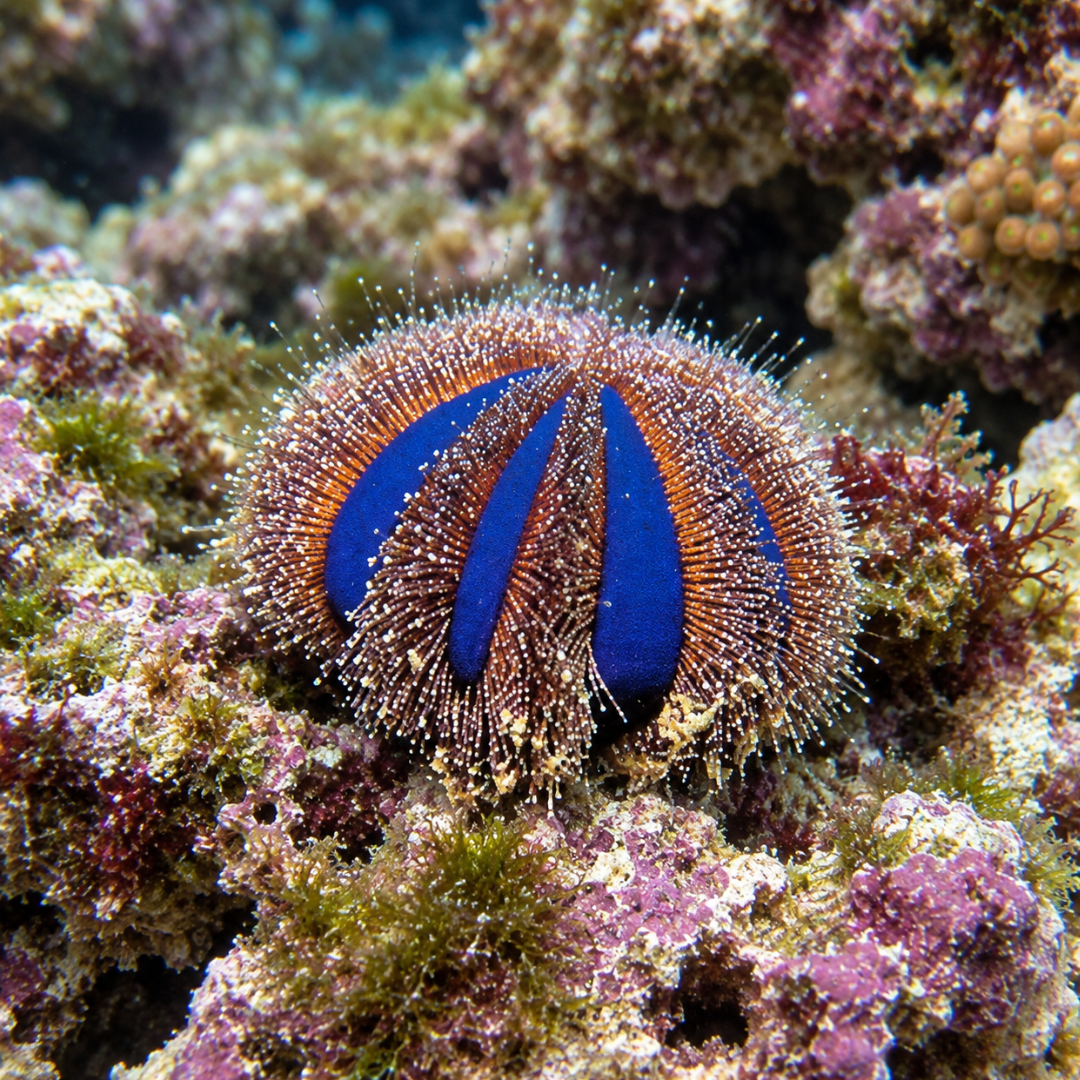
解説 / Description
コシダカウニは、インド太平洋の熱帯・亜熱帯域に広く分布する小型のウニです。丸みのある殻には短い棘が密生し、その間を走る青、緑、赤、黒などの無棘帯が鮮やかな縞模様をつくります。この整った模様が礼服を思わせることから、海外では「Tuxedo Urchin」の名で親しまれています。水槽ではライブロックやガラス面を歩きながら、珪藻、フィルム状の藻類、糸状藻類などを削り取って食べるため、リーフタンクのコケ取り役として高い人気があります。一方で、海水の比重やpHの急変に弱く、十分に成熟した安定水槽へ導入することが長期飼育の基本です。周囲の貝殻や小石、海藻片などを背中に載せる「被覆行動」も有名で、実用的なコケ取り能力と観察の面白さを兼ね備えた海水無脊椎動物です。 Mespilia globulus is a small sea urchin widely distributed through tropical and subtropical Indo-Pacific waters. Its rounded test is covered with short spines separated by vivid bare bands that may appear blue, green, red, or black. The neat pattern resembles formal evening wear, giving rise to the popular aquarium name “Tuxedo Urchin.” In aquaria it grazes across live rock and glass, scraping diatoms, film algae, and filamentous algae, which makes it a valued member of reef-tank clean-up crews. However, it is sensitive to rapid changes in salinity and pH, so long-term success depends on introducing it only to a mature and stable marine system. Its well-known habit of carrying shells, pebbles, algae, and other loose objects on its upper surface also makes it especially interesting to observe.
基本情報 / Basic Information
| 学名 / Scientific Name | Mespilia globulus (Linnaeus, 1758) |
|---|---|
| 通称 / Common Name | コシダカウニ、タキシード・アーチン、グローブ・アーチンTuxedo Urchin, Globe Urchin, Sphere Urchin |
| 分類 / Family | 棘皮動物門・ウニ綱・カマロドント目・サンショウウニ科(Temnopleuridae)・コシダカウニ属(Mespilia)Phylum Echinodermata, Class Echinoidea, Order Camarodonta, Family Temnopleuridae, Genus Mespilia |
| 英名 / English Name | Tuxedo Urchin / Globe Urchin / Sphere Urchin |
| 分布 / Distribution | インド太平洋の熱帯・亜熱帯域に分布します。日本では、近年の国内資料で南西諸島以南の個体をコシダカウニ Mespilia globulus とし、本州側で従来同種とされてきた個体群をニッポンコシダカウニ Mespilia levituberculatus と区別する扱いがあります。一方、国際的な分類データベースでは M. levituberculatus を M. globulus のシノニムとする扱いもあり、国内外で分類上の整理が一致していません。M. globulus は浅い岩礁、サンゴ礁、サンゴ瓦礫帯、海草藻場などで見られ、おおむね潮間帯から水深60m程度まで生息します。Tropical and subtropical Indo-Pacific. Recent Japanese references may distinguish populations from the main islands that were formerly identified as Mespilia globulus as Mespilia levituberculatus, while treating M. globulus as occurring from the Nansei Islands southward. Some international taxonomic databases, however, continue to treat M. levituberculatus as a synonym of M. globulus, so the taxonomic treatment is not fully consistent among sources. M. globulus occurs on shallow rocky and coral reefs, coral-rubble areas, and seagrass habitats, generally from the intertidal zone to about 60 m depth. |
| 最大体長 / Max Size | 最大殻径は約5cmが一つの目安です。小型のウニで、流通個体ではさらに小さいサイズも多く見られます。A maximum test diameter of about 5 cm is a practical reference value. It is a relatively small sea urchin, and aquarium specimens are often sold at smaller sizes. |
| 寿命 / Lifespan | 本種に限定した信頼性の高い寿命データは十分に確立されていません。飼育情報では数年単位で維持される例がありますが、「3〜5年」を本種の確定的な寿命として扱う根拠は限定的です。Reliable species-specific lifespan data are limited. Aquarium references sometimes describe survival over several years, but a fixed lifespan such as “3–5 years” should not be treated as a well-established biological value for this species. |
飼育環境 / Aquarium Environment
| 水槽サイズ / Tank Size | 本種について科学的に確立された最低水量はありません。飼育上は60cmワイド水槽(約100〜120L)前後以上を一つの実用的な目安とし、水量そのものよりも水質の安定性と、藻類やバイオフィルムが育つ十分なライブロック面積を重視します。立ち上げ直後の小型水槽より、成熟した余裕のある水槽が向いています。No scientifically established minimum tank volume is available specifically for this species. As a practical aquarium guideline, a Japanese 60 cm wide tank of roughly 100–120 L or larger provides useful stability, but mature grazing surface and stable water chemistry are more important than volume alone. A well-established reef system is preferable to a newly started small tank. |
|---|---|
| 水温 / Temperature | 24〜27℃を目安に安定させます。日本の夏季は上限を超えやすいため、室温だけで維持できない場合は水槽用クーラーを使用します。 Keep the temperature stable at approximately 24–27°C. In hot Japanese summers, an aquarium chiller may be necessary if room temperature control cannot prevent overheating. |
| 水質 / Water Quality | 比重1.023〜1.026、pH 8.1〜8.4程度の安定した海水環境を目安にします。カルシウム420〜450ppm、マグネシウム1280〜1350ppm前後という数値は一般的なリーフタンク管理の目安であり、本種だけについて必須値として検証された閾値ではありません。アンモニアと亜硝酸は検出されない状態を保ち、蒸発による比重変動もできるだけ小さくします。Aim for a stable marine environment around a specific gravity of 1.023–1.026 and pH 8.1–8.4. Calcium around 420–450 ppm and magnesium around 1280–1350 ppm are general reef-aquarium management targets rather than experimentally established species-specific thresholds for Mespilia globulus. Ammonia and nitrite should remain undetectable, and evaporation-driven salinity swings should be minimized. |
| レイアウト / Layout | 表面に自然な藻類やバイオフィルムが育ったライブロックを十分に配置し、ウニが連続して移動できる面を確保します。倒れやすい岩や固定の甘いサンゴ片は、移動中に押したり被覆物として持ち上げたりすることがあるため、接着剤などで確実に固定します。強すぎる直射光だけにさらされる場所より、明暗のあるレイアウトの方が行動を観察しやすくなります。Provide plenty of mature live rock with natural algal and biofilm growth, arranged so the urchin can move continuously across grazing surfaces. Secure unstable rocks and loose coral frags because the urchin may push them or pick them up as covering material. A layout with both illuminated and shaded areas allows more natural movement and behavior. |
| 注意点 / Precautions | 急激な比重やpHの変化は避け、購入時の水と飼育水の差が大きい場合は点滴法などでゆっくり水合わせします。水合わせ時間を一律に決めるより、温度・比重・pHの差を小さくすることが重要です。移送時は乾燥や温度変化を避け、できるだけ水中で丁寧に扱います。ウニ類は銅に敏感なため、銅を含む魚病薬は同じ水槽で使用しません。また、コケやバイオフィルムがほとんどない新規水槽への早期導入は餌不足につながりやすいため避けます。Avoid rapid changes in salinity and pH. When the purchase water differs substantially from the aquarium, acclimate gradually, using a drip method when appropriate. Rather than following one fixed acclimation time, the goal is to minimize differences in temperature, salinity, and pH. During transfer, avoid drying and abrupt temperature changes and handle the animal gently, preferably underwater. Sea urchins are sensitive to copper, so copper-based fish medications should not be used in the same system. Avoid adding the animal too early to a new aquarium with little established algal or biofilm growth. |
餌と給餌 / Feeding
| 餌の種類 / Diet | ガラス面やライブロックに付着する珪藻、フィルム状藻類、糸状藻類、バイオフィルムなどを主に食べます。紫色などの石灰藻も削り取るため、石灰藻を景観として残したい水槽では食害痕が目立つ場合があります。自然発生の藻類が不足したら、無添加の焼き海苔や海藻シート、スピルリナ配合の植物食性向け人工飼料を補助食として利用できます。It mainly grazes diatoms, film algae, filamentous algae, and biofilms from glass and live rock. It also scrapes coralline algae, so pale grazing marks may appear where purple or other coralline growth was present. If natural algae become scarce, supplement with plain dried nori or marine algae sheets and herbivore foods containing spirulina. |
|---|---|
| 給餌のポイント / Feeding Tips | 「コケ取り生体だから餌は不要」と考えないことが重要です。水槽内の藻類が減ってきたら、夜間に海藻シートをクリップや小石で固定し、食べた痕跡を確認します。活動量の低下や棘の脱落は、餌不足や水質悪化など複数の原因で起こるため、給餌量だけでなく比重、pH、水温、アンモニアなども同時に確認します。Do not assume that an algae-grazing animal never needs supplemental food. When visible algae decline, offer algae sheets at night and secure them with a clip or small rock so feeding can be confirmed. Reduced activity or spine loss can result from several problems, including starvation and poor water quality, so check salinity, pH, temperature, ammonia, and food availability together. |
性格と混泳 / Temperament and Tank Mates
| 性格 / Temperament | 攻撃性はなく、魚やエビを捕食する生体ではありません。日中も活動しますが、照明が落ちてから移動が目立つこともあります。一般にリーフタンクのコケ取り生体として飼育されますが、移動やグレージングの際に固定の弱いサンゴ片を押したり、被覆物として持ち上げたりすることがあるため、「サンゴへ一切影響しない」という意味でのリーフセーフではありません。It is non-aggressive and does not prey on fish or shrimp. It may move during the day and can also become more conspicuous after the lights dim. It is commonly kept as an algae grazer in reef aquaria, but “reef-safe” should not be taken to mean that it has no physical effect on corals: while moving and grazing, it may push unsecured frags or carry small objects on its back. |
|---|---|
| 混泳の相性 / Compatibility | 温和な海水魚、エビ、貝類、多くのサンゴとは同居しやすい生体です。一方、ウニを捕食する可能性があるモンガラカワハギ類、フグ類、大型ベラ類、一部の大型ヤッコ類との混泳は避けた方が安全です。同種を複数入れる場合は争いよりも餌の競合が問題になりやすいため、水槽容積と藻類の供給量に余裕を持たせます。It is generally compatible with peaceful marine fish, shrimp, snails, and many corals. Avoid predators that may bite or consume sea urchins, including many triggerfish, puffers, large wrasses, and some large angelfish. When keeping more than one, food competition is usually a greater concern than aggression, so provide sufficient aquarium volume and grazing resources. |
病気と対策 / Diseases and Prevention
| かかりやすい病気 / Common Diseases | 魚類の白点病のような代表的な感染症よりも、水質急変、長期的な餌不足、高水温、薬剤暴露などによる衰弱が問題になりやすく、活動低下や棘の脱落として現れることがあります。また、コシダカウニにはハナゴウナ科(Eulimidae)の寄生性巻貝が寄生する記録があります。Rather than showing a single characteristic disease comparable to marine ich in fish, sea urchins more often suffer from stress related to rapid water changes, prolonged food shortage, excessive temperature, or medication exposure, sometimes expressed as lethargy or spine loss. Parasitic gastropods in the family Eulimidae have also been recorded from Mespilia globulus. |
|---|---|
| 対策と予防 / Prevention | 安定した比重、水温、pHを維持し、自然発生の藻類が不足する前に補助給餌を始めることが基本です。購入時には棘が広範囲に抜けていないか、管足でしっかり付着できているか、体表や棘の間に不自然な付着生物がないかを確認します。寄生性巻貝が確認できた場合は、宿主を傷つけないよう慎重に物理除去します。銅系薬剤は使用せず、治療が必要な魚は別容器で扱います。Prevention centers on stable salinity, temperature, and pH, together with supplemental feeding before natural algae are exhausted. At purchase, check for extensive spine loss, confirm that the tube feet can grip firmly, and inspect the body surface and spaces among the spines for unusual attached organisms. If a parasitic snail is confirmed, remove it carefully without injuring the urchin. Do not treat the display tank with copper; fish requiring medication should be treated separately. |
増やし方(繁殖) / Breeding
| 雌雄の判別 / Sexing | 雌雄異体ですが、通常の外見からオスとメスを確実に見分けるのは困難です。研究や種苗生産では放卵・放精時の配偶子を確認して判別する方法が確実です。The sexes are separate, but males and females are difficult to distinguish reliably from ordinary external appearance. In research and culture settings, sex is most confidently identified by examining the released gametes during spawning. |
|---|---|
| 繁殖形態 / Reproduction | 放卵放精による体外受精を行います。受精卵から浮遊性のプルテウス幼生へ発生し、浮遊生活を経て着底・変態し、稚ウニになります。2019年の飼育研究では受精後21日以降に変態・着底が確認され、2026年に公開されたプレプリントでは人工海水設備内で世代を完結させる飼育系が報告されています。It is a broadcast spawner with external fertilization. Fertilized eggs develop into planktonic pluteus larvae and later settle and metamorphose into juvenile urchins. A 2019 culture study observed metamorphosis and settlement from 21 days after fertilization, while a 2026 preprint reported a laboratory culture system that closed the life cycle in artificial seawater. |
| 繁殖のポイント / Breeding Tips | 家庭水槽で成体が放卵・放精することはあっても、浮遊幼生を稚ウニまで育てるには専用の幼生飼育環境と微細藻類の管理が必要で、一般的なリーフタンク内での自然増殖は容易ではありません。2019年の研究では受精後21日以降に着底が始まり、2026年のプレプリントでは約2週間で変態し、管理条件下で4〜6か月ほどで性成熟する例が報告されました。条件によって発生速度は変わるため、これらは家庭水槽でそのまま再現できる標準値ではなく、研究飼育下で得られた結果として捉えるのが適切です。Adults may occasionally spawn in home aquaria, but raising planktonic larvae to juvenile urchins requires dedicated larval-culture equipment and carefully managed microalgal foods, so spontaneous recruitment in an ordinary reef tank is uncommon. A 2019 study reported settlement beginning from 21 days after fertilization, and a 2026 preprint reported metamorphosis at about two weeks and sexual maturity in roughly four to six months under controlled culture. These are research-culture results rather than standard values that can be assumed for ordinary home aquaria. |
雑学と豆知識 / Trivia and Fun Facts
| 1. 「小さな球」を意味する学名 / 1. A Scientific Name Meaning “Little Ball” | コシダカウニは1758年、リンネによって当初「Echinus globulus」として記載されました。種小名のglobulusはラテン語で「小さな球」を意味し、横から見ても高さのある丸い殻を持つ姿に実によく似合う名前です。その後、19世紀に設けられたMespilia属へ移され、現在はMespilia globulusとして扱われています。日本名の「コシダカ」も、殻高が比較的高い「腰高」の姿を表したもので、和名と学名が別々の言語から同じ丸みを捉えているのが興味深いところです。The species was described by Linnaeus in 1758 under the name Echinus globulus. The specific epithet globulus is Latin for a “little ball,” an apt description of its rounded, relatively high test. It was later transferred to the genus Mespilia, established in the nineteenth century, and is now recognized as Mespilia globulus. The Japanese name “Koshidaka-uni” likewise refers to its comparatively high-bodied shape, so both the Japanese and scientific names independently emphasize the same spherical character. |
|---|---|
| 2. タキシード模様は「棘がない帯」がつくる / 2. The Tuxedo Pattern Comes from Bare Bands | 目を引く縞模様は、単純に棘の色が塗り分けられているわけではありません。殻には棘の密な部分と、棘が少なく滑らかに見える帯状部分が交互に並び、そのコントラストが整然とした「タキシード」模様を生みます。個体によって青、緑、赤、暗色など印象が異なるため、同じ種でも水槽内で見せる雰囲気にはかなり幅があります。小型でありながら存在感が強い理由は、この規則正しい放射相称と色彩の対比にあります。Its striking stripes are not simply bands of differently colored spines. The test alternates between densely spined areas and smoother-looking, relatively bare zones, and this contrast produces the neat “tuxedo” appearance. Individuals can differ substantially in blue, green, red, and dark tones, so members of the same species may look surprisingly different in an aquarium. The strong visual impact comes from the combination of orderly radial symmetry and contrasting surface textures. |
| 3. 背中に物を載せる被覆行動 / 3. The Famous Covering Behavior | コシダカウニは管足を器用に使い、貝殻、サンゴ片、小石、海藻などを拾って背中側に載せます。ウニ類の被覆行動には、強い光や紫外線を避ける、波や漂流物から身を守る、捕食者から目立ちにくくするなど複数の機能が提案されています。ただし、コシダカウニそのものについて各要因を個別に実験検証した研究はまだ限られており、一つの理由だけで説明できる行動とは考えない方が自然です。水槽では軽いサンゴ片まで持ち上げることがあるため、この愛嬌ある習性がレイアウト崩れの原因になることもあります。Mespilia globulus skillfully uses its tube feet to pick up shells, coral fragments, pebbles, algae, and other loose objects and place them on its upper surface. Across sea urchins, covering has been linked to several possible functions, including protection from intense light and ultraviolet radiation, buffering against physical disturbance, and visual concealment from predators. Direct experimental testing of each proposed function specifically in Mespilia remains limited, so the behavior is best viewed as potentially multifunctional rather than having one proven explanation. In aquaria, the same charming habit can become a practical nuisance when the urchin lifts unsecured coral frags. |
| 4. 目がなくても光を感じるウニの世界 / 4. Sensing Light Without Eyes | ウニには魚のような「目」はありません。それでも多くのウニは光の方向や影に反応し、明るい場所を避ける行動を示します。ウニ類の研究では、管足に光受容に関わる細胞やオプシンが存在し、殻そのものが光を遮る構造として働くことで、体全体を使って光の方向を読み取る仕組みが提案されています。小さなコシダカウニが照明の変化に合わせて動き方を変える様子は、眼球を持たない棘皮動物が環境情報を受け取る独特な方法を想像させてくれます。Sea urchins do not possess eyes like those of fish, yet many species respond clearly to light direction and shadows and may move away from intense illumination. Research on sea urchins has identified photoreceptive cells and opsins associated with the tube feet, while the opaque calcified test has been proposed to act as a screening structure that helps the whole body extract directional light information. Watching a small tuxedo urchin change its movement as lighting conditions shift offers a glimpse into a very different way of sensing the environment without conventional eyeballs. |
| 5. 「アリストテレスの提灯」で岩を削る / 5. Scraping Rock with Aristotle’s Lantern | ウニの口には5本の歯を中心とした複雑な咀嚼器官があり、「アリストテレスの提灯」と呼ばれています。コシダカウニはこの器官を使い、岩やガラスに密着した藻類を削り取ります。歯は先端が摩耗しても基部側から成長を続けるため、日々のグレージングに対応できる構造になっています。さらに殻や棘は高マグネシウム方解石を主体とする生体鉱物でできており、見た目以上に精密な「削る道具」と「身を守る骨格」を同時に備えた生物です。The mouth of a sea urchin contains a complex feeding apparatus centered on five teeth, traditionally called “Aristotle’s lantern.” Mespilia globulus uses this system to scrape tightly attached algae from rock and glass. The teeth continue growing from their bases as their tips wear down, an adaptation suited to constant grazing. Its test and spines are also biomineral structures rich in high-magnesium calcite, combining a remarkably precise scraping mechanism with a protective skeleton. |
| 6. 2026年のプレプリントで示されたゲノム研究とCRISPR / 6. Genomics and CRISPR in a 2026 Preprint | コシダカウニは、発生生物学の新しいモデル候補としても研究されています。2026年にbioRxivで公開されたプレプリントでは、21本の染色体に対応する染色体スケールのゲノムアセンブリが作成され、HCRによる遺伝子発現の可視化とCRISPR/Cas9による遺伝子ノックアウトが示されました。色素形成に関わる遺伝子を操作すると色素を欠く幼生が生じたことから、遺伝子の働きを実際の形質と結び付けて調べられる可能性が示されています。ただし、現時点では査読前のプレプリントであるため、確立した知見としてではなく新しい研究基盤の報告として受け取るのが適切です。Mespilia globulus is also being developed as a candidate model for developmental biology. A preprint posted to bioRxiv in 2026 reported chromosome-scale genome assemblies corresponding to its 21 chromosomes and demonstrated HCR-based gene-expression imaging and CRISPR/Cas9 gene knockout. Targeting a pigmentation gene produced larvae lacking normal pigment, showing how gene function may be linked to observable traits in this species. Because the work is currently a preprint, it is best regarded as a report of a promising research platform rather than as fully peer-reviewed, settled evidence. |
| 7. サンゴの赤ちゃんを助ける「小さな草食者」 / 7. A Tiny Grazer That Can Help Young Corals | 2019年の共培養実験では、ミドリイシ属のAcropora milleporaの幼いサンゴとコシダカウニの稚ウニを同じ環境で育て、ウニの密度を変えて成長と生残を比較しました。高密度区では180日後のサンゴ生残率が約39.7%となり、ウニを入れない区より高い生残が得られました。重要なのは「大きなウニを大量に入れればよい」という話ではなく、ごく小さな稚ウニが競合藻類を抑える微小草食者として働いた点です。家庭のコケ取り生体として知られるコシダカウニが、サンゴ種苗生産や礁再生の研究でも役割を持つという、飼育趣味と保全科学がつながる好例です。A 2019 co-culture experiment raised juvenile Mespilia globulus alongside young Acropora millepora corals at different urchin densities. After 180 days, coral survival in the highest-density treatment reached about 39.7%, significantly higher than in the ungrazed control. The important point is not that large numbers of adult urchins should simply be added to coral systems, but that very small juveniles can function as “microherbivores,” suppressing competing algae around newly settled corals. A species familiar to aquarists as an algae grazer therefore also has a documented role in research on coral propagation and reef restoration. |
| 8. 海洋酸性化とウニの骨格 / 8. Sea Urchin Skeletons and Ocean Acidification | ウニの殻や棘は炭酸カルシウムを主体とする生体鉱物で、海水の炭酸塩化学と深く関わっています。二酸化炭素の増加によって海水のpHが低下すると、石灰化生物が骨格をつくる環境条件も変化します。そのためウニ類は海洋酸性化研究の対象になっていますが、種によって応答は異なり、他種の実験結果をそのままコシダカウニに当てはめることはできません。コシダカウニについて考える場合も、「石灰化するウニ類に共通する研究課題」として理解するのが適切です。Sea-urchin tests and spines are calcified biomineral structures closely linked to seawater carbonate chemistry. As increasing carbon dioxide lowers ocean pH, the chemical conditions for skeletal formation also change. Sea urchins are therefore widely studied in ocean-acidification research, but responses vary among species, so results from other urchins should not automatically be assigned to Mespilia globulus. For this species, the most accurate interpretation is that it shares the broader calcification questions faced by sea urchins rather than that every reported acidification effect has been demonstrated specifically in M. globulus. |
まとめ / Conclusion
コシダカウニは、タキシードを思わせる整った模様と、背中に物を載せる独特の被覆行動、そして岩やガラス面を削りながら藻類を食べるグレージングを併せ持つ小型のウニです。リーフタンクのコケ取り役として飼育しやすい面はありますが、安定した比重やpH、適切な水温、十分な餌が必要で、単に「コケを食べてくれる丈夫な生体」として扱うのは適切ではありません。 Mespilia globulus combines a crisp tuxedo-like pattern, distinctive covering behavior, and a grazing habit that removes algae from rock and glass. It can be a useful reef-aquarium grazer, but stable salinity and pH, appropriate temperature, and a dependable food supply remain essential. It should not be treated simply as a hardy animal that can be added whenever algae need to be removed.
成熟した海水水槽で餌切れを防ぎ、固定の弱いサンゴ片をあらかじめ安定させておけば、コシダカウニは日々のグレージングと被覆行動をじっくり観察できる存在になります。ゆっくり岩肌を進む姿の背景には、精巧な咀嚼器官や光を感じ取るウニ類独特の仕組みがあり、さらに繁殖研究やサンゴ種苗との共培養研究にもつながっています。飼育生体としての実用性だけでなく、ウニという動物そのものの生物学を身近に感じさせてくれる種です。 In a mature marine aquarium, with continuous access to food and securely fixed coral frags, this urchin offers engaging daily observations of grazing and covering behavior. Its slow movement across the rock reflects specialized feeding mechanics and the unusual sensory biology shared by sea urchins, while research on its reproduction and co-culture with young corals connects the species with broader biological and conservation questions. Its appeal lies not only in algae control but also in the biology of the animal itself.
気になる道具や飼い方を見つけてみませんか?
 アイのアクアグッズ案内アカヒレの仲間に合わせる飼育用品|無加温・混泳・繁殖の水槽とろ過道具の特徴や使い方、選ぶときのポイントをアイが紹介します。記事はコチラ →
 アイのアクアグッズ案内水草の肥料の選び方|底床用・液肥・メネデールの使い分け道具の特徴や使い方、選ぶときのポイントをアイが紹介します。記事はコチラ →
 アイのアクアグッズ案内水槽の底砂の選び方|砂・砂利の違いとおすすめ商品道具の特徴や使い方、選ぶときのポイントをアイが紹介します。記事はコチラ →
 アイのアクアグッズ案内水槽ライトの選び方|魚の見え方・水草・海水で選ぶおすすめ照明道具の特徴や使い方、選ぶときのポイントをアイが紹介します。記事はコチラ →
さまざまな飼育テーマをご紹介。リンク先の記事には広告・商品紹介が含まれます。
案内・紹介記事一覧へ →分布マップ
コシダカウニ(Mespilia globulus)は、インド太平洋の熱帯・亜熱帯域に分布します。日本では近年、南西諸島以南の個体を本種として扱い、本州側で従来コシダカウニとされてきた個体群をニッポンコシダカウニとして区別する見解があります。
この地図は分布域を把握するための概略表示です。表示範囲はインド太平洋の熱帯・亜熱帯域を大まかに示しており、実際の生息域を厳密に示す境界線ではありません。マーカーは地図上の目安として南西諸島付近に設定した代表地点であり、実際の採集地点や個体の確認地点を示すものではありません。
参考文献
- WoRMS Editorial Board. Mespilia globulus (Linnaeus, 1758). World Register of Marine Species. 学名、命名者、分類階級、国際的な分類上の扱いの確認に使用。 World Register of Marine Species
- 海洋研究開発機構(JAMSTEC). Mespilia globulus コシダカウニ. Biological Information System for Marine Life(BISMaL). 日本語での分類体系、国内の生物出現記録、既往文献の確認に使用。 BISMaL
- 田中颯・大作晃一・幸塚久典. 2019. ウニハンドブック. 文一総合出版. 日本産ウニ類の識別と分類、とくにコシダカウニとニッポンコシダカウニの国内での扱いを確認するための資料。 国立国会図書館サーチ
- SeaLifeBase. Mespilia globulus (Linnaeus, 1758). インド太平洋での分布、浅海のサンゴ礁・サンゴ瓦礫帯・海草藻場という生息環境、深度、最大サイズ、被覆行動の確認に使用。 SeaLifeBase
- Craggs, J., Guest, J., Bulling, M. et al. 2019. Ex situ co culturing of the sea urchin, Mespilia globulus and the coral Acropora millepora enhances early post-settlement survivorship. Scientific Reports 9: 12984. 本種成体の飼育水温・塩分、海藻を用いた給餌、産卵誘発、幼生・稚ウニ飼育、およびサンゴとの共培養条件の確認に使用。 https://doi.org/10.1038/s41598-019-49447-9
- Wang, B., Zhang, W., Hu, F., Zheng, Q., Ni, W., Huang, Y. & Chang, Y. 2019. Embryonic and larval development of sea urchin Mespilia globulus. Journal of Dalian Ocean University 34(4): 526–530. 人工催熟・受精、プルテウス幼生から稚ウニまでの発生過程、25〜26℃での幼生飼育と変態時期の確認に使用。 https://doi.org/10.16535/j.cnki.dlhyxb.2019.04.010
- Warén, A. 1980. Descriptions of New Taxa of Eulimidae (Mollusca, Prosobranchia), with Notes on Some Previously Described Genera. Zoologica Scripta 9: 283–306. ハナゴウナ科の寄生性巻貝 Vitreobalcis holdsworthi が Mespilia globulus を宿主とする記録の確認に使用。 https://doi.org/10.1111/j.1463-6409.1980.tb00668.x
- Bielmyer, G.K., Brix, K.V., Capo, T.R. & Grosell, M. 2005. The effects of metals on embryo-larval and adult life stages of the sea urchin, Diadema antillarum. Aquatic Toxicology 74(3): 254–263. ウニ類に対する銅の毒性を示す実験研究として、銅を含む薬剤を避けるという注意点の根拠に使用。本研究の対象種はコシダカウニではなく Diadema antillarum。 https://doi.org/10.1016/j.aquatox.2005.05.016




コメント