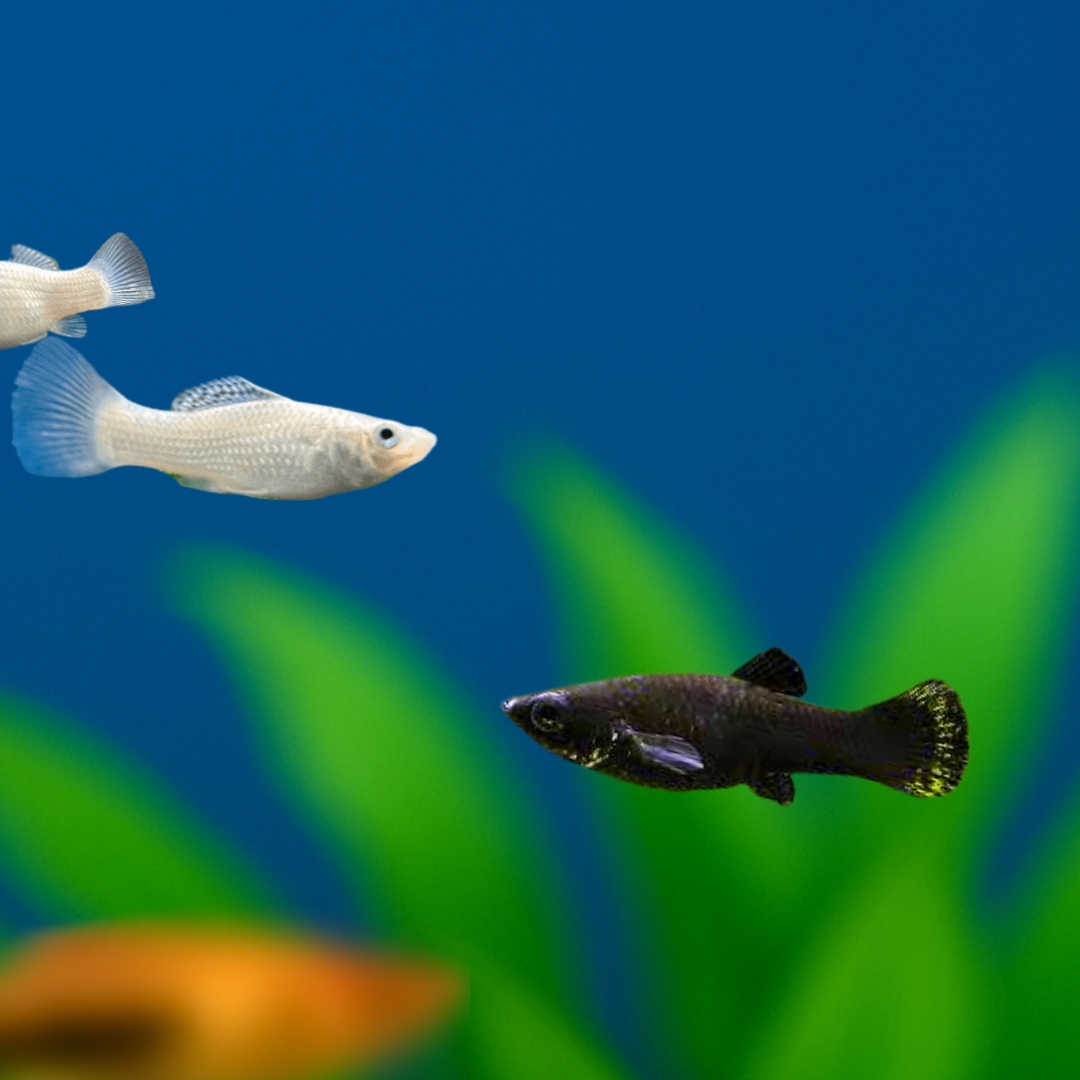
モーリーは、カダヤシ科ポエシリア属に含まれる卵胎生魚の総称として親しまれている熱帯魚です。日本の観賞魚店で見られるブラックモーリー、セイルフィンモーリー、バルーンモーリー、ダルメシアンモーリーなどは、ショートフィン・モーリー、セイルフィン・モーリー、ユカタン・モーリーなどの近縁種を背景に、交雑と選別が重ねられてきた改良品種群として扱われることが多い魚です。丈夫で繁殖しやすく、水草水槽では油膜や一部の糸状コケをついばむ「お掃除役の魚」としても親しまれていますが、本来は中性から弱アルカリ性寄りでミネラル分のある水を好むため、弱酸性の水草水槽では長期維持に注意が必要です。Mollies are popular livebearing tropical fish in the family Poeciliidae and genus Poecilia. The black mollies, sailfin mollies, balloon mollies, and dalmatian mollies commonly sold in Japanese aquarium shops are often treated as selectively bred strains with backgrounds involving shortfin mollies, sailfin mollies, Yucatan mollies, and related forms. They are hardy, prolific, and valued in planted aquariums as helpful fish that graze on surface film and some filamentous algae. However, they naturally prefer neutral to slightly alkaline, mineral-rich water, so long-term care in soft, acidic planted tanks requires attention.
野生種・近縁種は、種によって分布が異なります。ショートフィン系の Poecilia sphenops はメキシコからコロンビアにかけて、セイルフィン・モーリー Poecilia latipinna は米国南東部からメキシコ湾岸周辺にかけて、ユカタン・モーリー Poecilia velifera はメキシコのユカタン半島周辺に分布します。淡水、汽水、塩性湿地、沿岸の浅い水域、石灰岩質の水域など、種や地域により多様な環境に適応しています。観賞魚として流通する個体の多くは、東南アジアなどで養殖された改良品種です。Wild species and close relatives vary in distribution. Shortfin-type Poecilia sphenops occurs from Mexico to Colombia, the sailfin molly Poecilia latipinna is native to the southeastern United States and Gulf of Mexico region, and the Yucatan molly Poecilia velifera is associated with Mexico’s Yucatan Peninsula. Depending on species and locality, they inhabit freshwater, brackish water, salt marshes, shallow coastal habitats, and mineral-rich limestone waters. Most aquarium-trade mollies are farm-bred strains produced in regions such as Southeast Asia.
最大体長 / Max Size
一般的なショートフィン系の改良品種は約5〜8cm前後で流通することが多く、飼育下でさらに大きくなる個体もいます。セイルフィン系やユカタン・モーリー由来の大型個体では10〜15cm前後に達することがあります。Common shortfin-type aquarium strains are often around 5–8 cm, though some individuals may grow larger in captivity. Sailfin-type and Yucatan molly-derived forms may reach around 10–15 cm.
寿命 / Lifespan
一般的には約2〜5年です。バルーン体形の品種は体形上の負担から、通常体形の個体より短命になる傾向があります。Typically about 2–5 years. Balloon-bodied strains may have shorter lifespans than normal-bodied fish because of their body structure.
飼育環境 / Aquarium Environment
水槽サイズ / Tank Size
小型のショートフィン系を少数飼育する場合は45cm規格水槽、繁殖や複数匹の群れでの飼育には60cm規格水槽以上が安心です。セイルフィン系や大型化する個体、オス同士のディスプレイを楽しむ場合は90cm規格水槽以上を推奨します。水量の目安としては45cm水槽で約35L、60cm規格水槽で約57L、90cm規格水槽で約157Lです。A 45 cm standard tank is suitable for a small group of shortfin-type mollies, while a 60 cm standard tank or larger is safer for breeding or keeping a group. Sailfin-type or larger individuals, especially males displaying to one another, are best kept in a 90 cm standard tank or larger. Approximate volumes are 35 L for a 45 cm tank, 57 L for a 60 cm standard tank, and 157 L for a 90 cm standard tank.
水温 / Temperature
24〜28℃前後が扱いやすい適温です。種や系統によってはより広い温度に耐える記録がありますが、水槽では急変を避けることが大切です。病気の治療時には28〜30℃程度まで徐々に上げることがありますが、急な昇温は避けます。20℃を下回ると体調を崩しやすいため、年間を通してヒーターで安定させます。Around 24–28°C is an easy and practical range for aquarium care. Some species or strains have records of tolerating broader temperatures, but sudden changes should be avoided in aquariums. During treatment, the temperature may be gradually raised to around 28–30°C, but abrupt warming should be avoided. Below 20°C, condition may decline, so stable year-round heating is recommended.
水質 / Water Quality
中性から弱アルカリ性、目安としてpH7.0〜8.2前後を保つと調子を維持しやすい魚です。軟水よりも適度に硬度のある水が向いています。ソイル中心の水草水槽ではpHが下がりやすいため、大磯砂、サンゴ砂、カキ殻などを少量利用して水質を安定させると扱いやすくなります。淡水飼育は可能ですが、状態維持を目的に0.1〜0.3%程度のごく薄い塩分を使う飼育法もあります。ただし、水草や混泳魚との相性を必ず確認してください。They are easiest to maintain in neutral to slightly alkaline water, roughly around pH 7.0–8.2. Moderately hard, mineral-rich water suits them better than very soft water. In soil-based planted aquariums, pH often drops, so small amounts of crushed coral, oyster shell, or similar buffering materials can help stabilize conditions. Freshwater care is possible, but some keepers use very light salinity of about 0.1–0.3% to support condition. Always consider the tolerance of plants and tank mates.
レイアウト / Layout
遊泳スペースを広く取りつつ、稚魚やメスが逃げ込める水草、流木、石組みを配置します。底床は大磯砂や中性から弱アルカリ性を保ちやすい素材が扱いやすく、セイルフィン系ではヒレを広げて泳げる開けた空間があると魅力がよく出ます。強すぎる水流はバルーン体形の個体に負担となるため、ろ過は十分に行いながらも流れはやや穏やかにします。Provide open swimming space along with plants, driftwood, and stones where fry and females can hide. Gravel or substrates that help maintain neutral to slightly alkaline water are practical. Sailfin types show best when they have open areas to spread their fins. Strong current can stress balloon-bodied fish, so filtration should be efficient but the flow should remain moderate.
注意点 / Precautions
弱酸性の軟水に長期間置くと、痩せ、ヒレを閉じる、体を震わせるシミー現象、白点病やコショウ病などが出やすくなります。食欲旺盛で排泄量も多いため、ろ過能力と定期的な換水が重要です。また、モーリー類は一部地域で野外定着の報告がある外来魚です。飼育できなくなった場合でも、川、池、水路、排水溝へ絶対に放してはいけません。Long-term exposure to soft, acidic water can lead to weight loss, clamped fins, shimmying, ich, or velvet disease. They eat heavily and produce considerable waste, so strong filtration and regular water changes are essential. Mollies can become invasive where conditions allow. Never release them into rivers, ponds, waterways, or drains.
餌と給餌 / Feeding
餌の種類 / Diet
雑食性ですが、植物質をよく利用します。スピルリナ配合フレーク、植物質の多い顆粒フード、冷凍赤虫、ブラインシュリンプ、イトミミズ、ゆでたホウレンソウやズッキーニなどを組み合わせます。水槽内では油膜、食べ残し、一部の糸状コケ、藍藻をついばむこともあります。They are omnivorous but make good use of plant matter. Suitable foods include spirulina flakes, vegetable-rich granules, frozen bloodworms, brine shrimp, tubifex, and blanched spinach or zucchini. In aquariums, they may also graze on surface film, leftovers, some filamentous algae, and cyanobacterial growth.
給餌のポイント / Feeding Tips
1日1〜2回、数分で食べ切れる量を与えます。食欲が強いため与えすぎると水質悪化と肥満を招きます。植物質を不足させないことが、消化の安定や体表粘膜の維持に役立ちます。繁殖を狙う場合は、少量をこまめに与え、親魚の体力を保つことが大切です。Feed once or twice daily, only as much as they can finish within a few minutes. Overfeeding easily causes water pollution and obesity. Adequate plant matter supports digestion and healthy mucus membranes. For breeding, offer small meals more frequently to maintain adult condition.
性格と混泳 / Temperament and Tank Mates
性格 / Temperament
基本的には活発で人慣れしやすい魚です。オスはメスを追いかけたり、オス同士でヒレを広げて競い合ったりするため、過密やオスばかりの組み合わせではストレスが増えます。メスを多めにし、隠れ場所を用意すると落ち着きます。They are generally active and responsive fish. Males may chase females or display toward other males, so crowding or male-heavy groups can increase stress. Keeping more females than males and providing cover helps create a calmer group.
混泳の相性 / Compatibility
同じく中性から弱アルカリ性寄りの水質に適応しやすいグッピー、プラティ、ソードテール、レインボーフィッシュ類などと相性がよい傾向があります。コリドラス類と混泳させる場合は、種類ごとの好む水質と塩分耐性を確認してください。弱酸性を好む小型カラシンやエビ中心の水槽では、水質条件の違いに注意します。ヒレをかじる魚、非常に臆病な魚、肉食性の強い魚との混泳は避けた方が無難です。They are often compatible with fish that adapt well to neutral to slightly alkaline water, such as guppies, platies, swordtails, and rainbowfish. If keeping them with Corydoras, check the preferred water chemistry and salt tolerance of the particular species. In tanks focused on soft-water tetras or shrimp, water chemistry differences require caution. Avoid fin nippers, extremely timid species, and predatory fish.
病気と対策 / Diseases and Prevention
かかりやすい病気 / Common Diseases
白点病、コショウ病、尾ぐされ病、カラムナリス病、輸送直後のスレによる細菌感染、低水温や不適切な水質に伴うシミー現象が見られます。特に輸入直後や購入直後は、急なpH低下、水温差、過密によって体調を崩しやすい時期です。Common problems include ich, velvet disease, fin rot, columnaris, bacterial infections after shipping damage, and shimmying linked to low temperature or unsuitable water chemistry. Newly imported or newly purchased fish are especially vulnerable to sudden pH drops, temperature differences, and crowding.
対策と予防 / Prevention
予防の基本は、23〜28℃の安定した水温、中性から弱アルカリ性の水質、十分なろ過、定期的な換水、購入後のトリートメントです。白点病やコショウ病が疑われる場合は、隔離水槽で水温を少しずつ28〜30℃へ上げ、メチレンブルー系やマラカイトグリーン系の魚病薬を規定量で使用します。塩水浴を併用する場合は0.5%前後から慎重に行い、水草や薬剤との相性を確認します。症状が消えても原虫の生活環が残ることがあるため、数日で治療を打ち切らず、説明書に従って継続します。Prevention depends on stable 23–28°C temperatures, neutral to slightly alkaline water, adequate filtration, regular water changes, and quarantine after purchase. If ich or velvet is suspected, treat in a hospital tank by gradually raising the temperature to 28–30°C and using methylene blue or malachite green medication as directed. Salt baths may be used carefully from around 0.5%, while considering plants and medication compatibility. Because parasite life stages can remain after visible spots disappear, treatment should be continued according to the product instructions.
増やし方(繁殖) / Breeding
雌雄の判別 / Sexing
オスは尻ビレが棒状に変化したゴノポディウムを持ち、成熟するとメスよりスリムで、品種によっては背ビレや尾ビレが大きく発達します。メスは腹部に丸みがあり、成熟個体では妊娠斑が見えることがあります。Males have a modified anal fin called a gonopodium. Mature males are often slimmer, and in some strains develop larger dorsal or caudal fins. Females have rounder bodies, and gravid spots may be visible in mature individuals.
繁殖形態 / Reproduction
卵胎生です。メスは体内で受精卵を発育させ、稚魚の形で出産します。一度の交尾で受け取った精子を一定期間体内に保持し、交尾後しばらく経ってから複数回出産することがあります。条件がよいと約4〜6週間間隔で出産し、品種や体格によって十数匹から100匹前後の稚魚を産むことがあります。They are livebearers. Females develop fertilized eggs internally and give birth to free-swimming fry. They can store sperm for some time, allowing multiple births after a single mating. Under good conditions, births may occur every 4–6 weeks, with brood sizes ranging from a dozen to around 100 fry depending on strain and female size.
繁殖のポイント / Breeding Tips
親魚は稚魚を食べることがあるため、ウィローモス、マツモ、浮草などを多めに入れるか、出産直前のメスを産卵箱や別水槽へ移します。ただし、狭い産卵箱に長時間入れるとメスの負担になるため、様子を見ながら使います。稚魚には細かく砕いた人工飼料、ブラインシュリンプ幼生、稚魚用フードを少量ずつ与え、成長差が出たらサイズ別に分けると歩留まりが上がります。Adults may eat fry, so provide plenty of Java moss, hornwort, floating plants, or move a near-term female to a breeder box or separate tank. However, long confinement in a small breeder box can stress the female, so use it carefully. Fry accept finely crushed prepared foods, baby brine shrimp, and fry foods. Separating them by size improves survival when growth rates differ.
雑学と豆知識 / Trivia and Fun Facts
1. 「モーリー」という名前の奥にある分類の歴史 / 1. The taxonomic history behind the name “molly”
モーリーという呼び名は、かつてポエシリア属内で扱われていた旧Mollienesiaの名残を感じさせる通称です。現在の観賞魚店で「モーリー」として並ぶ魚は、単一の野生種ではなく、ショートフィン・モーリー、セイルフィン・モーリー、ユカタン・モーリーなどの特徴が長い品種改良の中で混ざり合ったものが多く見られます。そのため、同じブラックモーリーでも背ビレが小さい個体、大きく帆のように広がる個体、体つきが丸い個体などが現れます。これは飼育者にとって少し複雑ですが、同時にモーリーという魚が観賞魚文化の中で人の手とともに歩んできた歴史そのものでもあります。The name “molly” reflects the historical use of Mollienesia within what is now treated as Poecilia. Many aquarium mollies are not pure wild species but long-established hybrid and selected strains involving shortfin, sailfin, and Yucatan mollies. This is why one black molly may have a small dorsal fin, another may spread a sail-like fin, and another may have a rounded body. For keepers this can be confusing, but it is also a living record of how mollies have developed alongside aquarium culture.
2. 弱酸性よりも「石灰岩の水」を思い出す魚 / 2. Fish that remember limestone water
日本のアクアリウムでは、テトラや水草の影響で「熱帯魚には弱酸性の軟水」という印象が強くなりがちです。しかしモーリーの仲間の多くは、石灰岩質の水域、汽水域、塩性湿地など、ミネラル分が多くpHの高い環境と深い関係を持っています。水槽内でサンゴ砂や大磯砂を使うと調子が上がることがあるのは、単なる経験則ではなく、彼らの進化的な背景に沿った管理といえます。モーリー飼育は、見た目の可愛らしさに反して、水質化学を学ぶよい入口にもなります。In Japanese aquariums, tropical fish are often associated with soft, acidic water because of tetras and planted tanks. Many mollies, however, are closely tied to mineral-rich, higher-pH environments such as limestone waters, brackish areas, and salt marshes. The fact that crushed coral or mineral-rich gravel can improve their condition is not merely a keeper’s trick; it matches their evolutionary background. Despite their cute appearance, mollies are an excellent gateway to learning aquarium water chemistry.
3. アマゾンモーリーが見せるクローン繁殖の不思議 / 3. The strange clonal reproduction of the Amazon molly
ポエシリア属の近縁種には、アマゾンモーリーという非常に特異な魚がいます。この魚は基本的にメスだけで構成され、近縁種のオスと交尾しても、通常はオスの遺伝情報を子に取り込まず、卵の発生を始める刺激として精子を利用します。生まれる子は母親に非常に近いクローンです。長期的には遺伝的多様性を失いやすいはずの戦略ですが、研究ではごくまれに父方由来の遺伝物質が微小染色体として残ったり、精子核の排除が完全に失敗したりする例が知られています。こうした例外は頻繁なものではありませんが、アマゾンモーリーが進化生物学で注目され続ける理由の一つです。日本のギンブナにも似た雌性発生が知られており、遠く離れた魚たちが似た解決策にたどり着く進化の面白さを教えてくれます。A close relative within Poecilia, the Amazon molly, is famous for an unusual reproductive strategy. Its populations are essentially female, and although females mate with males of related species, the male’s DNA is usually not incorporated into the offspring. The sperm mainly triggers egg development, producing offspring very close to clones of the mother. Such a strategy should normally reduce genetic diversity over time, yet studies have found rare exceptions in which paternal genetic material may remain as microchromosomes or sperm exclusion may fail completely. These exceptions are not common, but they are one reason the Amazon molly remains important in evolutionary biology. A similar form of gynogenesis is known in Japan’s ginbuna crucian carp, showing how distant fish lineages can arrive at comparable evolutionary solutions.
4. バルーン体形の可愛さと、考えておきたい動物福祉 / 4. Balloon mollies and animal welfare
バルーンモーリーは丸く愛嬌のある姿で人気ですが、その体形は背骨が短く曲がる遺伝的な形質を選別して固定したものです。内臓の空間が限られ、通常体形の個体に比べて泳ぎにくかったり、強い水流や過密に弱かったりすることがあります。飼育そのものを否定する必要はありませんが、選ぶのであれば、水流を弱め、餌を控えめにし、転覆や消化不良の兆候を早く見つけるなど、通常体形のモーリー以上に丁寧な管理を心がけたい品種です。可愛さを楽しむことと、魚の負担を減らすことは、同じ水槽の中で両立させていくべき大切な視点です。Balloon mollies are popular for their round and charming appearance, but that body form results from selecting and fixing a genetic trait involving a shortened, curved spine. Their internal space is limited, and compared with normal-bodied mollies they may swim less efficiently and be more vulnerable to strong current or crowding. Keeping them does not need to be dismissed outright, but they deserve extra care: gentle flow, controlled feeding, and early attention to buoyancy or digestive problems. Enjoying their appearance and reducing physical burden should be treated as parts of the same responsibility.
5. 水槽の外では「強さ」が問題になる / 5. Outside the aquarium, hardiness becomes a problem
モーリーの丈夫さ、塩分への強さ、低酸素への耐性、繁殖力は、水槽内では魅力です。しかし自然界に放されると、その同じ能力が在来生物を圧迫する力に変わる可能性があります。日本でも温泉排水が流れ込む水路や温暖な地域では、モーリーや近縁のカダヤシ類の定着が問題視される例があります。観賞魚として迎えた命は、最後まで水槽の中で責任を持つことが基本です。放流は「逃がしてあげる」行為ではなく、地域の生態系へ新たな負担を持ち込む行為になってしまいます。A molly’s hardiness, salt tolerance, low-oxygen tolerance, and reproductive ability are attractive in an aquarium. Once released outdoors, however, those same traits may pressure native organisms. In Japan, mollies and related livebearers have been reported as concerns in warm-water channels and regions influenced by hot spring drainage or mild climates. Fish brought home as aquarium animals should remain under human care. Releasing them is not an act of kindness; it can introduce a new burden into local ecosystems.
まとめ / Conclusion
モーリーは、初心者にも親しみやすい丈夫な卵胎生メダカでありながら、分類、進化、繁殖、外来種問題まで多くの学びを与えてくれる奥深い魚です。飼育の中心となるポイントは、水温を安定させること、中性から弱アルカリ性でミネラル分のある水を意識すること、そして食欲旺盛な魚に合わせてろ過と換水をしっかり行うことです。Mollies are approachable, hardy livebearers, yet they also offer deep lessons in taxonomy, evolution, reproduction, and invasive species issues. The key points in keeping them are stable temperature, neutral to slightly alkaline mineral-rich water, and strong filtration with regular water changes to match their hearty appetite.
ブラック、セイルフィン、バルーン、ダルメシアンなど、多彩な品種から好みの個体を選ぶ楽しみも大きな魅力です。一方で、品種による体形の負担や、野外放流が生態系に与える影響にも目を向けながら、魚にとって無理の少ない環境を整えて飼育することが、モーリーの美しさを長く楽しむ一番の近道です。Their many strains, including black, sailfin, balloon, and dalmatian forms, make them highly enjoyable to choose and observe. At the same time, thoughtful keepers should consider the physical burden of some body forms and the ecological risks of release. Providing a low-stress environment is the best way to enjoy the beauty of mollies for many years.
Cerepaka, C. & Schlupp, I. 2023. Sperm specificity and potential paternal effects in gynogenesis in the Amazon Molly Poecilia formosa. PeerJ 11:e16118.
アマゾンモーリーの雌性発生、精子が発生開始の刺激として働くこと、近縁種オスとの関係の確認に使用。https://doi.org/10.7717/peerj.16118
Lamatsch, D. K., Nanda, I., Epplen, J. T., Schmid, M. & Schartl, M. 2000. Unusual triploid males in a microchromosome-carrying clone of the Amazon molly Poecilia formosa. Cytogenetics and Cell Genetics 91:148-156.
アマゾンモーリーにおける父方由来遺伝物質の例外的な残存、微小染色体、三倍体化に関する記述の確認に使用。https://doi.org/10.1159/000056833
Tobler, M. 2018. Adaptation and speciation in sulphide spring fishes. Molecular Ecology 27:843-859.
硫化水素を含む極限環境へ適応したポエシリア類の進化、生理・形態・遺伝的適応に関する補助確認に使用。https://doi.org/10.1111/mec.14497
Parzefall, J. 2001. A review of morphological and behavioural changes in the cave molly Poecilia mexicana from Tabasco, Mexico. Environmental Biology of Fishes 62:263-275.
洞窟性モーリーにおける眼、色素、群れ行動などの変化に関する雑学部分の補助確認に使用。https://doi.org/10.1023/A:1011899817764
University of Florida IFAS Extension. Ichthyophthirius multifiliis (White Spot) Infections in Fish.
白点病の病原体、生活環、導入経路、予防としての隔離管理に関する記述の確認に使用。https://ask.ifas.ufl.edu/publication/FA006
Stevens, C. H., Croft, D. P., Paull, G. C. & Tyler, C. R. 2017. Stress and welfare in ornamental fishes: what can be learned from aquaculture? Journal of Fish Biology 91:409-428.
観賞魚における水質、輸送、過密、取り扱いなどのストレス要因と福祉上の配慮の確認に使用。https://doi.org/10.1111/jfb.13377



 アイのアクアグッズ案内水草トリミングの道具とやり方|ハサミ・ピンセットを水草に合わせて選ぼう伸びすぎた水草は切っていい? 有茎草の差し戻し、前景草の絨毯、流木のモスを整える場面から、水草用ハサミ・ピンセット・ゴミ取りネットの選び方と片付けを紹介します。記事はコチラ →
 アイのアクアグッズ案内コケを食べるコイの仲間に合わせる飼育用品|フライングフォックス・アルジイーター・ガラ道具の特徴や使い方、選ぶときのポイントをアイが紹介します。記事はコチラ →



コメント