

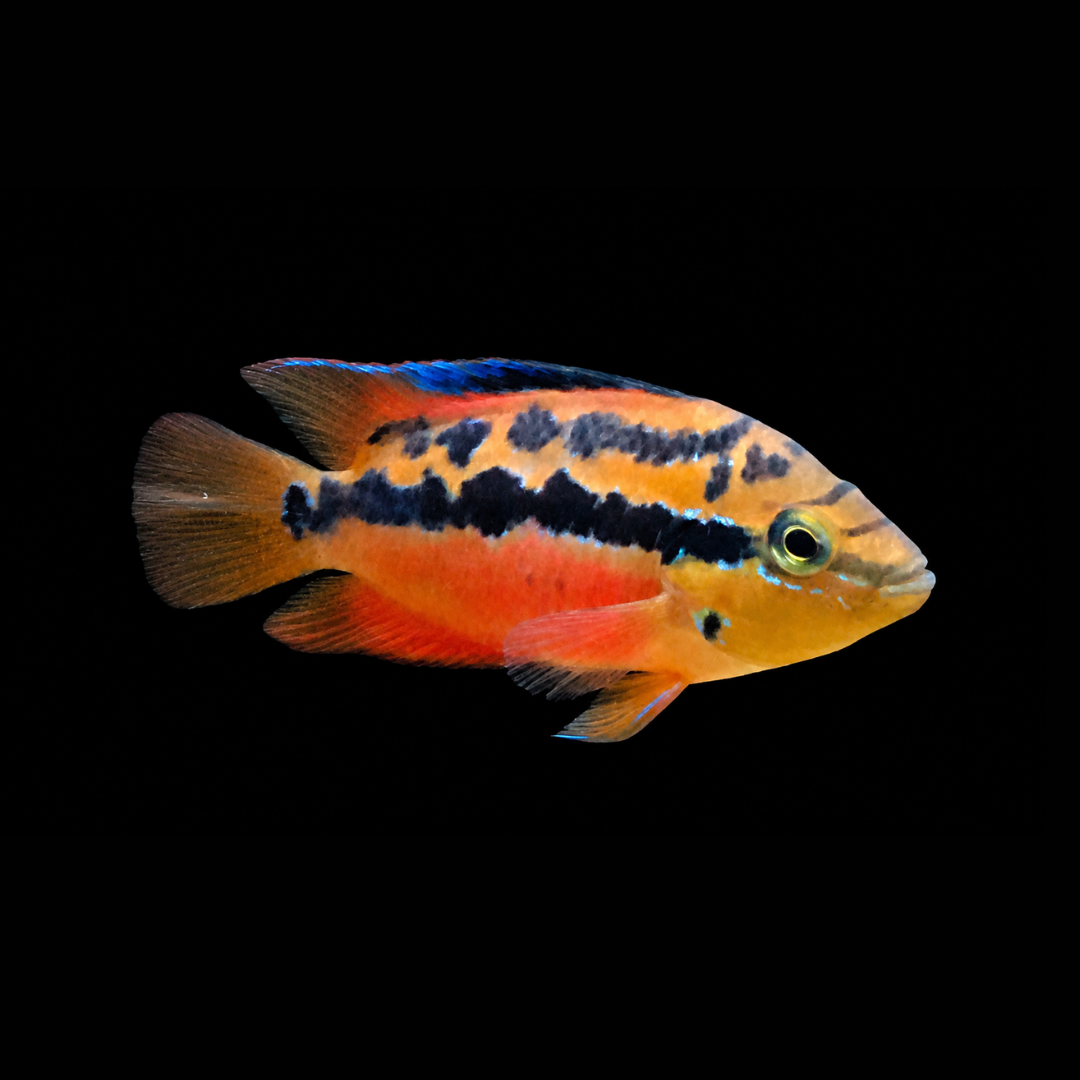
解説 / Description
サルヴィニー・シクリッドは、メキシコ南部、グアテマラ、ベリーズの大西洋側水系に分布する中米産シクリッドです。鮮やかな黄色を基調とした体に黒い斑紋と青みを帯びた輝点が重なり、繁殖期には腹部の赤色がいっそう際立ちます。縄張り意識が強く、とくに繁殖期には周囲の魚を激しく追うことがあるため、その美しさだけでなく行動の力強さも大きな個性です。野生では水生昆虫などの無脊椎動物や魚を主な餌とし、捕食に関わる顎の形態にも特徴があります。また、形成されたペアが卵や稚魚を守る親魚保護も見どころの一つです。飼育では十分な遊泳空間と隠れ家、安定した水質、そして無理のない混泳管理が重要になります。 The Salvini cichlid is a Central American cichlid distributed in Atlantic drainages of southern Mexico, Guatemala, and Belize. Its vivid yellow body is marked with dark blotches and bluish iridescent highlights, while the red coloration of the belly becomes especially conspicuous during the breeding season. It is strongly territorial and may chase other fish aggressively, particularly when breeding, so its powerful behavior is as characteristic as its appearance. In the wild it feeds mainly on aquatic invertebrates, including insect larvae, as well as fish, and its jaw morphology is associated with this predatory feeding ecology. Established pairs also show parental care of eggs and fry. Successful aquarium keeping depends on adequate swimming space, shelters, stable water conditions, and cautious management of tank mates.
基本情報 / Basic Information
| 学名 / Scientific Name | Trichromis salvini |
|---|---|
| 通称 / Common Name | サルヴィニー・シクリッドSalvini cichlid |
| 分類 / Family | シクリッド目・シクリッド科・シクリナエ亜科・ヘロイン族・トリクロミス属Order Cichliformes, Family Cichlidae, Subfamily Cichlinae, Tribe Heroini, Genus Trichromis |
| 英名 / English Name | Salvini Cichlid |
| 分布 / Distribution | メキシコ南部、グアテマラ、ベリーズの大西洋側水系。河川や湖沼に生息し、ウスマシンタ川水系などにも分布します。Atlantic drainages of southern Mexico, Guatemala, and Belize. It inhabits rivers and lakes, including the Usumacinta drainage. |
| 最大体長 / Max Size | 標準体長(SL)で最大22cmの記録があります。オスはメスより大型になる傾向があります。A maximum standard length (SL) of 22 cm has been reported. Males tend to grow larger than females. |
| 寿命 / Lifespan | 明確な最大寿命の目安は十分に確立されていません。長期飼育を前提に、安定した環境を維持することが大切です。A clear maximum lifespan has not been well established. It is best kept with long-term care and stable conditions in mind. |
飼育環境 / Aquarium Environment
| 水槽サイズ / Tank Size | 長期飼育では90cm規格水槽(水量約150L前後)以上を目安にすると管理しやすくなります。ペア飼育や他種との混泳を試みる場合は、120cm水槽(水量200L以上を目安)など、縄張りを分けられる十分な底面積と逃げ場を確保できる環境が望まれます。For long-term care, a standard 90 cm aquarium of roughly 150 L or more provides a more manageable baseline. For a pair or any attempt at mixed-species keeping, a 120 cm aquarium of around 200 L or larger is preferable so that territories, visual barriers, and escape areas can be established. |
|---|---|
| 水温 / Temperature | 22〜30℃を目安に管理します。特定の温度へ急に合わせるよりも、日々の急変を避けて安定させることが重要です。夏季は高水温による酸欠や水質悪化にも注意します。 Maintain approximately 22–30°C. Avoid sudden temperature changes rather than forcing the aquarium rapidly toward a particular value. During hot weather, also watch for reduced dissolved oxygen and deterioration of water quality. |
| 水質 / Water Quality | 中性〜弱アルカリ性を基本に、数値を大きく変動させないことを優先します。原産地にはミネラル分の多い水域もありますが、日本の飼育環境では特定の硬度へ急に調整するより、導入時の水質に合わせながら安定させる方が安全です。ろ過と酸素供給を十分に行い、定期的な換水と底床清掃で汚れをためないようにします。水流は弱すぎない環境が適します。Neutral to mildly alkaline water is a practical baseline, with stability taking priority over chasing a precise value. Some native habitats are mineral-rich, but in aquaria it is safer to acclimate the fish gradually and keep conditions stable rather than rapidly altering hardness. Provide adequate filtration and oxygenation, use regular water changes and substrate cleaning to prevent waste accumulation, and avoid overly stagnant water. |
| レイアウト / Layout | 底床には角のない細かな砂を使い、掘り返しても傷つきにくい環境にします。大型の流木、岩、素焼きの土管などを組み合わせ、互いの姿が見えなくなる隠れ家と視線の遮断を作ることが重要です。底床を掘ることがあるため、根張りの弱い水草は維持しにくい場合があります。植物を使うなら、流木や石に活着させたミクロソリウムやアヌビアスなどが扱いやすいでしょう。Use fine, smooth sand that is unlikely to cause injury when the fish digs. Combine driftwood, rocks, and ceramic shelters to create hiding places and visual barriers. Because the species may disturb the substrate, weakly rooted plants can be difficult to maintain; hardy epiphytes such as Microsorum or Anubias attached to wood or stone are easier to manage. |
| 注意点 / Precautions | 強い縄張り性があるため、同種間やペア内でも追尾や攻撃が続く場合があります。とくに繁殖期は防衛行動が強くなるので、混泳やペア飼育では隔離用の予備水槽や仕切りを用意し、弱い個体が逃げられない状態を作らないことが重要です。また、底床を動かすことがあるため、不安定な石組みは崩れないよう確実に固定します。Strong territoriality can lead to persistent chasing or aggression between conspecifics and even within a pair. Defensive behavior becomes stronger during breeding, so a divider or spare aquarium should be available and no weaker fish should be left without an escape route. Because the fish may move the substrate, unstable rockwork should be secured against collapse. |
餌と給餌 / Feeding
| 餌の種類 / Diet | 肉食傾向が強く、野生では水生昆虫などの無脊椎動物と魚を主な餌とします。飼育下ではシクリッド用の人工飼料を主食とし、冷凍アカムシ、クリル、冷凍ブラインシュリンプ、細かくしたエビなどを補助的に与えます。The species is strongly carnivorous in feeding tendency. Wild dietary studies show a diet dominated by aquatic invertebrates, especially insect larvae, together with fish. In captivity, cichlid pellets can be used as the staple and supplemented with foods such as frozen bloodworms, krill, frozen brine shrimp, and small pieces of shrimp. |
|---|---|
| 給餌のポイント / Feeding Tips | 人工飼料を中心に、冷凍餌などを補助として組み合わせると管理しやすくなります。食欲が強くても与えすぎず、短時間で食べ切れる量を基準にして、食べ残しによる水質悪化を防ぎます。A prepared staple diet supplemented with frozen foods is straightforward to manage. Even when appetite is strong, avoid overfeeding and offer only an amount that can be consumed promptly so uneaten food does not degrade water quality. |
性格と混泳 / Temperament and Tank Mates
| 性格 / Temperament | 縄張り意識が強く、とくに繁殖期には卵や稚魚の周囲へ近づく魚を激しく追い払います。一方で、ペアが成立すると両親が繁殖に関わり、卵や稚魚を守ります。つまり、普段の縄張り性と繁殖時の親魚保護が連続して現れるタイプのシクリッドです。The species is strongly territorial, and during breeding it may vigorously drive away fish that approach the eggs or fry. An established pair, however, also cooperates in reproduction and parental defense. In practical terms, its everyday territorial behavior becomes especially pronounced when parental care begins. |
|---|---|
| 混泳の相性 / Compatibility | 混泳の難易度は高く、単独飼育または相性の確認できたペア飼育が管理しやすい方法です。他種と混泳する場合は、十分な広さと視線を遮るレイアウトを用意し、相手が一方的に追われていないか継続して観察します。小型魚やおとなしい魚は捕食・攻撃の対象になりやすいため避け、問題が出た場合はすぐに隔離します。Community keeping is difficult, and solitary housing or a confirmed compatible pair is generally easier to manage. If other species are included, provide substantial space and visual barriers and continue to watch for one-sided chasing. Small or timid fish should be avoided because they are more likely to be attacked or treated as prey, and any problematic combination should be separated promptly. |
病気と対策 / Diseases and Prevention
| かかりやすい病気 / Common Diseases | 本種に特有の、特に発症しやすい病気については明確な情報がありません。飼育では、過密や縄張り争いによる外傷、水質悪化に伴う体調低下を起こさないよう管理することが重要です。There is no clear information identifying a disease to which this species is uniquely or especially prone. In aquarium care, attention should instead be focused on preventing injuries from territorial conflict and deterioration in condition caused by poor water quality. |
|---|---|
| 対策と予防 / Prevention | 強力なろ過と十分な酸素供給を確保し、週1回を目安に20〜30%程度の換水と底床清掃を行います。攻撃を受けた個体は傷が深くなる前に隔離し、隠れ家と視線を遮るレイアウトを増やしてストレスを抑えます。水温やpH、硬度を急変させず、安定した環境を維持することが予防の基本です。Provide strong filtration and good oxygenation, and perform weekly water changes of roughly 20–30% together with substrate cleaning. Any fish receiving persistent attacks should be isolated before injuries worsen, while additional shelters and visual barriers can reduce stress. Avoid abrupt changes in temperature, pH, or hardness and prioritize stable conditions. |
増やし方(繁殖) / Breeding
| 雌雄の判別 / Sexing | オスはメスより大型になりやすく、背鰭と尻鰭の先端が長く伸びる傾向があります。メスでは背鰭中央部の黒斑とエラ蓋下部の黒斑が判別の目印になりやすく、繁殖期には腹部の赤色も強くなります。雌雄ともに発色しますが、メスの赤と黒のコントラストがとくに目立つことがあります。Males tend to grow larger and often develop more elongated tips to the dorsal and anal fins. In females, a dark patch in the middle of the dorsal fin and another below the gill cover are useful identifying features, while the belly becomes redder during breeding. Both sexes can be colorful, but the female’s red-and-black contrast may be especially conspicuous. |
|---|---|
| 繁殖形態 / Reproduction | 基質産卵型で、形成されたペアが卵と稚魚を守ります。平らな石などの産卵面を使い、1回の産卵数は約500〜600個とされています。産卵後は親魚が産卵場所の周囲を防衛し、孵化後も稚魚の保護を続けます。This is a substrate-spawning cichlid in which an established pair guards the eggs and fry. Spawning takes place on a suitable surface such as a flat stone, and clutches of about 500–600 eggs have been reported. After spawning, the parents defend the breeding site and continue parental care after hatching. |
| 繁殖のポイント / Breeding Tips | 成魚同士を無理に組み合わせるより、若魚を複数飼育して相性を見ながら自然に形成されたペアを残す方法が現実的です。ペアが成立すると他個体への攻撃が強まることがあるため、速やかに分けられる準備をしておきます。稚魚が自由遊泳を始めたら、孵化直後のブラインシュリンプや細かくした人工飼料など、口に入る大きさの餌を与えます。親魚の行動が変化し、稚魚を追い始めた場合には隔離します。Rather than forcing unfamiliar adults together, a practical approach is to raise several juveniles and retain a naturally compatible pair. Once a pair forms, aggression toward the remaining fish may increase, so be prepared to separate them promptly. When the fry become free-swimming, offer suitably small foods such as newly hatched brine shrimp or finely crushed prepared food. If parental behavior changes and the adults begin chasing the fry, separate them. |
雑学と豆知識 / Trivia and Fun Facts
| 1. 学名に刻まれた19世紀の中米探検 / 1. A Name Rooted in 19th-Century Exploration | サルヴィニー・シクリッドは1862年、魚類学者アルベルト・ギュンターによってHeros salviniとして記載されました。種小名 salvini は、イギリスの博物学者オズバート・サルヴィンへの献名です。タイプ産地としては、現在のグアテマラにあるサンタ・イサベル川とペテン湖が記録されています。学名をたどると、現在の水槽魚としての姿から19世紀の中米博物学調査へと歴史がつながります。The Salvini cichlid was described in 1862 by ichthyologist Albert Günther as Heros salvini. The species name salvini honors the British naturalist Osbert Salvin. The type localities were recorded as the Río de Santa Isabel and Lake Petén in present-day Guatemala. Its scientific name therefore connects a familiar aquarium fish directly with the history of 19th-century natural history exploration in Central America. |
|---|---|
| 2. 長く「シクラソマ」と呼ばれた魚が単型属になった理由 / 2. From “Cichlasoma” to a Monotypic Genus | 本種は長いあいだCichlasoma salviniの名で広く知られていましたが、中米産シクリッドの系統研究が進むにつれて分類は何度も見直されました。2015年の分類学的再検討でTrichromis属が新設され、本種はその唯一の種としてTrichromis salviniに整理されました。近年の系統解析でもTrichromisとThorichthysは近縁な系統として扱われています。つまり、名前が変わったのは単なる呼び替えではなく、DNAを含む系統研究によって、この魚が中米産シクリッドの中でどこに位置するのかを整理し直した結果です。For many years this species was widely known as Cichlasoma salvini, but its classification changed repeatedly as research on Middle American cichlid relationships progressed. In a 2015 taxonomic revision, the genus Trichromis was established and this fish was placed as its sole species, Trichromis salvini. More recent phylogenetic work also treats Trichromis and Thorichthys as closely related lineages. In other words, the name change was not merely cosmetic; it reflected a reassessment of where this species belongs in the cichlid family tree using modern phylogenetic evidence, including DNA data. |
| 3. 雌雄で異なる色彩と体つき / 3. Sex Differences in Color and Form | サルヴィニー・シクリッドでは、雌雄の違いが単純な「オスの方が派手」という形では現れません。メスでは背鰭中央とエラ蓋下部の黒斑が目立ちやすく、繁殖期には腹部の赤色が強まります。オスは大型になりやすく、背鰭や尻鰭の先端がより伸びる傾向があります。色だけで判別せず、黒斑、体格、鰭の形を合わせて見ると、本種の性的二型が分かりやすくなります。Sexual differences in the Salvini cichlid are not simply a matter of the male being more colorful. Females tend to show conspicuous dark marks in the middle of the dorsal fin and below the gill cover, and the belly becomes redder during breeding. Males tend to grow larger and develop more elongated dorsal and anal fin tips. Rather than relying on color alone, the combination of dark markings, body size, and fin shape gives a clearer picture of the species’ sexual dimorphism. |
| 4. 捕食に結びつく顎の形態 / 4. Jaw Morphology Linked to Predatory Feeding | サルヴィニー・シクリッドの頭部形態は、食べ物の取り方と結びついています。野生個体の調査では、水生昆虫の幼生と魚が主要な餌として確認され、顎の突出量や下顎の長さなど、捕食に関係する形質も肉食性の強いシクリッドに共通する傾向を示しました。ここでいう顎の特徴は、単に珍しい形をしているという意味ではありません。動く獲物を捉える食生活と、頭部のつくりが結びついていることを示しています。The head morphology of the Salvini cichlid is closely connected with how it obtains food. Studies of wild fish found aquatic insect larvae and fish to be major dietary items, while traits such as jaw protrusion and mandibular length followed patterns associated with more carnivorous cichlids. In practical terms, these jaw features are not simply unusual shapes; they show that the structure of the head is linked to a feeding ecology centered on capturing animal prey. |
| 5. 一種の中に隠れているかもしれない地域ごとの歴史 / 5. Hidden Regional Histories Within One Species | Trichromis属は現在1属1種として扱われていますが、2026年に公開された系統ゲノム研究のプレプリントでは、Trichromis salviniの内部にこれまで十分に認識されていなかった遺伝的多様性がある可能性が示されています。同じ研究では、現存しない、または未採集の近縁系統との過去の交雑を示す「ゴースト・イントログレッション」の可能性も報告されました。これは、同じ種名で呼ばれている地域個体群でも、進化の歴史が一様とは限らないことを意味します。ただし、この研究は現時点では査読前のプレプリントであり、分類学上は引き続きTrichromis salvini一種として扱われています。Trichromis is currently treated as a genus containing a single species, but a phylogenomic preprint released in 2026 reported evidence that Trichromis salvini may contain previously unrecognized genetic diversity. The same study also reported a possible signal of “ghost introgression,” meaning ancient gene flow from a related lineage that is extinct or was not sampled. In simpler terms, geographically separated populations carrying the same species name may not all share exactly the same evolutionary history. The work is currently a preprint rather than a peer-reviewed publication, and the accepted taxonomy still treats Trichromis salvini as a single species. |
| 6. 飼育魚を野外へ放さない / 6. Never Release Aquarium Fish Into the Wild | 本来の分布域外では、アメリカ・フロリダ州で本種の採集記録や分布拡大が確認されています。観賞魚として飼育できることと、野外へ放してよいことはまったく別の問題です。飼いきれなくなった個体を河川や池へ放流せず、最後まで飼育するか、適切な引き取り先を探すことが重要です。Outside its native range, the species has been recorded in Florida, where expansion of introduced populations has also been documented. Suitability for aquarium keeping does not mean that release into the wild is acceptable. Unwanted fish should never be released into rivers or ponds; they should be kept responsibly or transferred to an appropriate new keeper. |
まとめ / Conclusion
サルヴィニー・シクリッドは、黄色を基調とした鮮やかな体色と黒斑、青い輝点、繁殖期に目立つ赤色が重なり、中型シクリッドらしい力強い存在感を見せる魚です。水生無脊椎動物や魚を主な餌とする食性、形成されたペアによる親魚保護など、外見と行動の両方に観察する面白さがあります。 The Salvini cichlid combines a vivid yellow ground color with dark markings, blue iridescent highlights, and conspicuous red during breeding, giving it the powerful presence typical of a medium-sized Central American cichlid. Its feeding ecology, centered on aquatic invertebrates and fish, and the parental care shown by established pairs make both its appearance and behavior rewarding to observe.
一方で、強い縄張り性を無視して混泳やペア飼育を進めると、相手を追い詰めてしまうことがあります。十分な水槽サイズ、視線を遮るレイアウト、安定した水質、必要ならすぐに隔離できる準備を整えることが大切です。環境と相性を丁寧に見ながら飼育すれば、鮮やかな発色とシクリッドらしい親魚保護を落ち着いて観察できる魅力的な存在になります。 At the same time, its strong territoriality can cause serious problems if a pair or community is managed without enough space or escape options. Adequate tank size, visual barriers, stable water conditions, and the ability to separate fish promptly are therefore important. With careful attention to environment and compatibility, the species offers the chance to observe both vivid coloration and characteristic cichlid parental behavior.

気になる道具や飼い方を見つけてみませんか?
 アイのアクアグッズ案内アフリカンシクリッドの飼育用品|水槽・ろ過・底砂・岩組み・餌の選び方道具の特徴や使い方、選ぶときのポイントをアイが紹介します。記事はコチラ →
 アイのアクアグッズ案内旅行中、お魚のごはんはどうする? 自動給餌器・使える餌・スマート水槽の選び方旅行中の魚の餌やりを助ける自動給餌器を、アイとコタロウが紹介。時間指定、おかわり給餌、対応するフレークや顆粒、設置台、スマホ管理、一体型水槽、留守番フードまで、使いどころと選び方を案内します。記事はコチラ →
 アイのアクアグッズ案内コケを食べるコイの仲間に合わせる飼育用品|フライングフォックス・アルジイーター・ガラ道具の特徴や使い方、選ぶときのポイントをアイが紹介します。記事はコチラ →
 アイのアクアグッズ案内水槽フィルターの選び方|外掛け・外部・上部から小型オーバーフローまで道具の特徴や使い方、選ぶときのポイントをアイが紹介します。記事はコチラ →
さまざまな飼育テーマをご紹介。リンク先の記事には広告・商品紹介が含まれます。
案内・紹介記事一覧へ →分布マップ
サルヴィニー・シクリッド(Trichromis salvini)は、メキシコ南部からグアテマラ、ベリーズにかけての大西洋側水系に分布し、ウスマシンタ川水系などの河川や湖沼に生息します。
※この地図は記事に記載された分布地域をもとにした概略表示です。マーカーは分布域を把握しやすくするための代表地点であり、実際の採集地点や特定の生息地点を示すものではありません。
参考文献
-
Fricke, R., Eschmeyer, W. N. & Van der Laan, R. (eds.). Eschmeyer’s Catalog of Fishes: Genera, Species, References. California Academy of Sciences. Online version updated 7 July 2026.
参照範囲:有効学名、分類、原記載情報、分布。
California Academy of Sciences -
McMahan, C. D., Matamoros, W. A., Piller, K. R. & Chakrabarty, P. (2015). Taxonomy and systematics of the herichthyins (Cichlidae: Tribe Heroini), with the description of eight new Middle American genera. Zootaxa, 3999(2), 211–234. https://doi.org/10.11646/zootaxa.3999.2.3
参照範囲:Trichromis属の設立を含む中米産ヘロイン族の分類体系。
Zootaxa / DOI -
Froese, R. & Pauly, D. (eds.). FishBase: Trichromis salvini (Günther, 1862). FishBase. Accessed 11 August 2026.
参照範囲:分布、最大体長、生息環境、水温・水質の目安、食性、産卵数。
FishBase -
Soria-Barreto, M., Rodiles-Hernández, R. & Winemiller, K. O. (2019). Trophic ecomorphology of cichlid fishes of Selva Lacandona, Usumacinta, Mexico. Environmental Biology of Fishes, 102, 985–996. https://doi.org/10.1007/s10641-019-00884-5
参照範囲:野生下の食性、生息場所、捕食に関係する顎・頭部形態。
Environmental Biology of Fishes / DOI -
Hulsey, C. D. & García de León, F. J. (2005). Cichlid jaw mechanics: linking morphology to feeding specialization. Functional Ecology, 19(3), 487–494. https://doi.org/10.1111/j.1365-2435.2005.00987.x
参照範囲:シクリッド類における顎の機能形態と摂餌特性の関係。
Functional Ecology / DOI -
Buege, E. A., Esselman, P. C. & Praskievicz, S. J. (2021). Hydrogeomorphological controls on reach-scale distributions of cichlid nest sites in a small neotropical river. Ecology of Freshwater Fish, 30(2), 244–255. https://doi.org/10.1111/eff.12580
参照範囲:ベリーズの河川におけるシクリッド類の営巣場所と流速、水深、底質、カバーなどの物理環境。
Ecology of Freshwater Fish / DOI -
Petty, B. D., Francis-Floyd, R. & Yanong, R. P. E. (2024). Bacterial Diseases of Fish. Merck Veterinary Manual. Last updated September 2024.
参照範囲:観賞魚の疾病リスク、水質悪化、低酸素、急な温度変化、輸送・取扱いなどのストレス要因と予防管理。
Merck Veterinary Manual -
Livengood, E. J. & Chapman, F. A. The Ornamental Fish Trade: An Introduction with Perspectives for Responsible Aquarium Fish Ownership. UF/IFAS Extension, FA124.
参照範囲:ろ過と水質管理、導入時の順応、検疫、衛生・栄養管理、観賞魚を野外へ放流しないための責任ある飼育。
UF/IFAS Extension




コメント