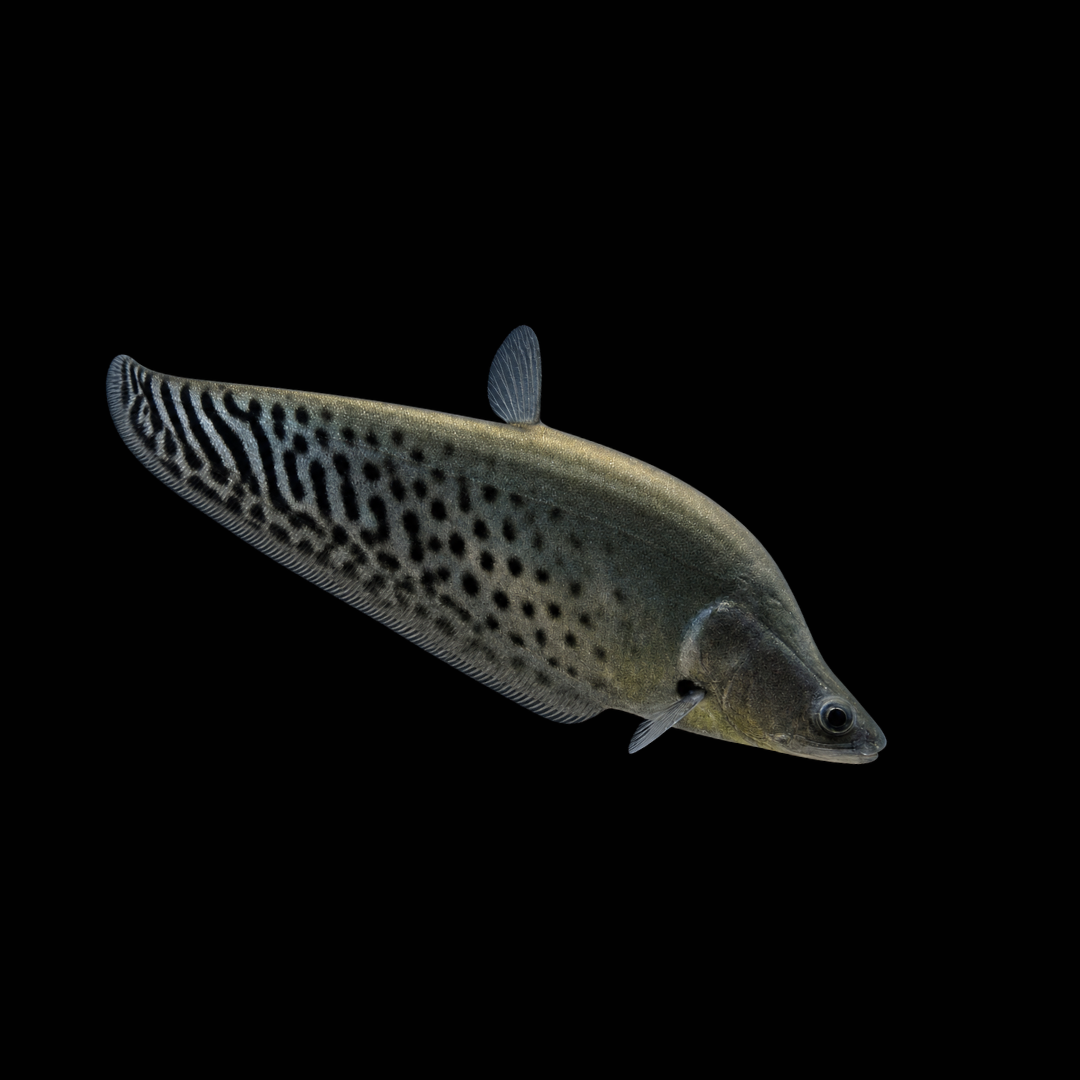
ロイヤルナイフは、メコン川水系に生息するナギナタナマズ科の大型淡水魚です。左右に強く側扁したナイフのような体と、体の後半から臀鰭・尾鰭へ流れる不規則な斜め模様が大きな魅力です。長く連続するリボン状の臀鰭を波打たせることで、前進だけでなく後退や静止に近いホバリングまで滑らかにこなします。幼魚は比較的入手しやすいことがありますが、野生では最大120cmに達する記録がある大型種で、終生飼育には大型水槽と強力な濾過、飛び出し対策が欠かせません。The Royal Knifefish is a large freshwater featherback native to the Mekong River system. Its strongly compressed, knife-shaped body and irregular oblique markings that extend toward the anal and caudal fins give it a distinctive appearance. By undulating its long ribbon-like anal fin, it can move forward, reverse, and hover with remarkable control. Juveniles may appear manageable, but the species has a recorded maximum length of 120 cm in the wild, so long-term care requires a very large aquarium, powerful filtration, and secure escape prevention.
アロワナ目・ナギナタナマズ科・チタラ属Order Osteoglossiformes, Family Notopteridae, Genus Chitala
英名 / English Name
Indochina featherback
分布 / Distribution
メコン川水系。主にタイ、ラオス、カンボジアの本流と一部の支流で知られ、流れのある岩場や深い淵、急流域を好みます。Mekong River system, especially the mainstream in Thailand, Laos, and Cambodia and parts of some tributaries. It is associated with flowing water, rocky habitats, deep pools, and rapids.
最大体長 / Max Size
野生では最大120cmの記録があります。飼育下では45〜60cm前後で成長が緩やかになる個体もいますが、大型化を前提に設備を用意します。Recorded up to 120 cm in the wild. Some captive individuals may slow in growth around 45–60 cm, but the aquarium should always be planned for a very large adult.
寿命 / Lifespan
適切な管理下で10〜15年以上が目安とされています。Approximately 10–15 years or longer under appropriate long-term care.
飼育環境 / Aquarium Environment
水槽サイズ / Tank Size
最低でも120×60×60cmクラスの120cmワイド水槽を目安とし、理想は150cm〜180cmクラス以上です。成長後の方向転換を考えると、水槽幅だけでなく60〜90cm程度の十分な奥行きが重要です。A 120 × 60 × 60 cm class tank should be regarded as a practical minimum, with 150–180 cm class aquariums or larger being preferable. Adequate front-to-back depth, roughly 60–90 cm for large adults, is especially important for turning comfortably.
水温 / Temperature
24〜28℃を基本とし、急激な温度変化を避けて安定させます。Maintain approximately 24–28°C and avoid sudden temperature fluctuations.
水質 / Water Quality
pH 6.0〜8.0に適応し、6.5〜7.5前後の中性域が扱いやすい目安です。総硬度は5〜15 dGH程度が目安です。肉食魚らしく排泄量が多いため、定期的な換水と強力な生物濾過でアンモニアや亜硝酸の蓄積を防ぎます。It can adapt to roughly pH 6.0–8.0, with around pH 6.5–7.5 being a practical target. General hardness of about 5–15 dGH is suitable. Because this carnivorous fish produces a heavy waste load, strong biological filtration and regular water changes are essential.
レイアウト / Layout
岩や流木、太めの塩ビ管などで身を隠せる場所を用意しつつ、体を傷つけないよう遊泳空間を広く確保します。自然下では流れのある岩場や深い淵を利用するため、強すぎない範囲で適度な水流と十分なエアレーションを与えます。夜行性なので照明はやや暗めが向きます。Provide secure shelters with rocks, driftwood, or large smooth pipes while leaving broad open swimming space to prevent body injuries. Moderate current and strong aeration suit its natural association with flowing rocky habitats and deep pools. Dimmer lighting is preferable for this largely nocturnal species.
注意点 / Precautions
飛び出す力が強いため、蓋は隙間なく固定します。幼魚の印象だけで水槽を選ばず、成魚サイズを想定して飼育を始めることが重要です。空気呼吸を補助的に行うため水面へのアクセスも確保し、過密飼育は避けます。The fish can jump powerfully, so the lid must be securely fitted with no gaps. Do not choose the aquarium based only on juvenile size; plan from the beginning for a very large adult. Keep access to the surface available because the species can supplement aquatic respiration with atmospheric air, and avoid overcrowding.
餌と給餌 / Feeding
餌の種類 / Diet
野生では小魚、エビなどの甲殻類、水生昆虫、環形動物などを捕食します。飼育下では冷凍赤虫、エビ、乾燥クリルなどを導入時の餌として使い、最終的には大型肉食魚用の栄養バランスのよい人工飼料を主食にするのが管理しやすい方法です。In the wild it preys on fishes, crustaceans such as shrimp, aquatic insects, and worms. In captivity, frozen bloodworms, shrimp, and krill can be useful during acclimation, followed by a gradual transition to nutritionally balanced pellets formulated for large carnivorous fishes.
給餌のポイント / Feeding Tips
消灯後や薄暗い時間帯に与えると本来の摂食行動を引き出しやすくなります。人工飼料へ切り替える際は、嗜好性の高い冷凍餌から乾燥クリル、ペレットへ段階的に慣らします。生餌だけに偏ると栄養の偏りや病原体持ち込みのリスクがあるため、長期飼育では食餌内容を安定させます。哺乳類や鳥類の肉を常食にすることは避けます。Feeding after lights-out or in dim conditions often produces a more natural feeding response. When training onto prepared food, move gradually from highly palatable frozen foods to krill and then pellets. Avoid relying exclusively on live feeder fish because of nutritional imbalance and pathogen risk, and do not use mammal or poultry meat as a routine staple.
性格と混泳 / Temperament and Tank Mates
性格 / Temperament
夜行性で、日中は物陰に隠れて過ごすことが多い魚です。自分の口に入らない大型魚には比較的無関心なことがありますが、同種や体形の似たナイフフィッシュに対しては強い縄張り意識を示すことがあります。It is primarily nocturnal and often rests in shelter during the day. It may ignore many large fishes that cannot be swallowed, but it can become strongly territorial toward its own species and other similarly shaped knifefishes.
混泳の相性 / Compatibility
基本は単独飼育が安全です。異種混泳を行う場合は、口に入らない大きさで極端に攻撃的ではない大型魚を選びます。大型ポリプテルス、大型プレコ、一部の大型ナマズ、温和な大型上層魚などが候補になりますが、個体差があります。餌取りが速すぎる魚と組み合わせるとロイヤルナイフが痩せることがあるため、給餌状況を必ず確認します。Keeping a single specimen is the safest approach. For mixed-species displays, choose large, non-aggressive tank mates that cannot be swallowed. Large bichirs, some large plecos and catfishes, and peaceful large surface-dwelling fishes may work, but individual behavior varies. Watch feeding closely because very fast competitors can leave the knifefish underfed.
病気と対策 / Diseases and Prevention
かかりやすい病気 / Common Diseases
導入直後や水質悪化時には白点病が問題になりやすいとされています。体表の白い点、体を物にこすりつける行動、呼吸の乱れ、食欲低下などを早期に確認します。Ich, or white spot disease, can become a problem after transport stress or deterioration in water quality. Watch for white spots, flashing or rubbing behavior, abnormal respiration, and loss of appetite.
対策と予防 / Prevention
新規導入魚の隔離、水温と水質の安定、十分な濾過、定期的な換水が基本です。ロイヤルナイフは非常に細かい鱗とデリケートな体表を持つため、薬剤治療は製品の適用対象と用量を確認し、魚の反応を見ながら慎重に行います。症状が重い場合は、自己判断で薬剤濃度を上げず、魚病に詳しい専門店や獣医師へ相談するのが安全です。Quarantine new arrivals and keep temperature, water quality, filtration, and water-change routines stable. Because this species has very small scales and a delicate body surface, medications should be used cautiously and only after checking the product’s stated suitability and dosage. For severe cases, avoid increasing medication strength on your own and seek advice from an experienced aquatic specialist or veterinarian.
増やし方(繁殖) / Breeding
雌雄の判別 / Sexing
外見だけで確実に雌雄を判別する方法は、提示されている情報では明確ではありません。A reliable external method for distinguishing males from females is not clearly established in the available information.
繁殖形態 / Reproduction
雨季の水位上昇に合わせて繁殖場所へ移動し、浸水した木や岩などの基質に産卵するとされています。オスは産卵後の卵と孵化直後の稚魚を守る強い保護行動を示します。Breeding is associated with seasonal water-level rise. Eggs are deposited on submerged woody or rocky substrates, and the male is reported to guard the eggs and newly hatched young.
繁殖のポイント / Breeding Tips
家庭水槽での繁殖は高難度です。大型の繁殖スペース、ペア形成、産卵基質、季節的な水位変化を意識した環境づくりが必要になると考えられますが、安定した人工繁殖条件の詳細は限られています。親魚同士の攻撃にも十分な注意が必要です。Breeding in a home aquarium is difficult. A very large breeding space, compatible pair formation, suitable spawning substrate, and environmental cues resembling seasonal water-level changes are likely to be important, but detailed and consistently repeatable captive-breeding protocols remain limited. Aggression between brood fish must also be monitored carefully.
雑学と豆知識 / Trivia and Fun Facts
1. 波打つ臀鰭が生む独特の遊泳 / 1. Ribbon-fin swimming
ロイヤルナイフの下半身には、非常に長い臀鰭が尾鰭へ連続するように伸びています。この鰭を前から後ろへ、あるいは逆方向へ細かく波打たせることで、体を大きくくねらせずに前進・後退・静止を切り替えられます。岩や流木が複雑に入り組むメコンの環境では、この精密な機動性が獲物を追うときにも、狭い場所へ身を寄せるときにも役立っていると考えられます。A long anal fin runs along much of the underside of the body and continues toward the tail. By sending fine waves forward or backward along this fin, the fish can switch between forward motion, reverse motion, and hovering without strongly flexing the whole body. In structurally complex Mekong habitats filled with rocks and submerged wood, this precise maneuverability is likely valuable both for hunting and for moving through confined spaces.
2. 暗闇で獲物を探す受動的な電気受容 / 2. Passive electroreception in darkness
ナギナタナマズ科の魚には、周囲の生物が発するごく弱い電気信号を感じ取る受動的な電気受容能力が知られています。自ら強い電場を作って探査するデンキウナギ類とは異なり、外部から生じる低周波の電気的変化を感覚情報として利用します。濁った水や夜間でも、小魚や甲殻類の動きを補足する感覚の一つとして働くと考えられており、見た目の優雅さの裏に古い魚類系統ならではの感覚世界が隠れています。Members of the featherback family are known to possess passive electroreception, allowing them to detect extremely weak electrical signals produced by other organisms. Unlike strongly electric fishes that generate an active electric field, featherbacks use naturally occurring low-frequency electrical changes as sensory information. This sense is thought to complement vision and the lateral line when locating fishes and crustaceans in turbid water or darkness.
3. 水面の空気も利用できる補助呼吸 / 3. Supplemental air breathing
ロイヤルナイフは浮き袋を利用した補助的な空気呼吸能力を持つとされ、水中の酸素が少ない状況でも水面から空気を取り込むことができます。ただし、これは低酸素の水槽で飼えるという意味ではありません。飼育下では十分なエアレーションと水流を確保し、その能力はあくまで自然環境への適応として捉えるのが適切です。The Royal Knifefish is reported to use its swim bladder for supplemental air breathing, allowing it to take atmospheric oxygen at the surface when dissolved oxygen is low. This does not mean it should be kept in poorly oxygenated aquarium water. Strong aeration and good circulation remain important, while the air-breathing ability is best understood as an ecological adaptation.
4. 1965年に記載されたメコンの固有系統 / 4. A Mekong species described in 1965
本種は1965年にフランソワ・ドーベントンによって記載され、当初はNotopterus blanciという学名が用いられました。その後、分類の整理に伴ってChitala属へ移され、現在のChitala blanciとなっています。属名Chitalaは南アジアでこの仲間を指す呼び名に由来し、種小名blanciは魚類学者モーリス・ブランに献名されたものとされています。学名には、メコンの魚類相を記録してきた研究史そのものが刻まれています。The species was described in 1965 by François d’Aubenton and was originally named Notopterus blanci. It was later placed in the genus Chitala as featherback classification was revised. The genus name Chitala derives from a South Asian local name for these fishes, while the species name blanci is an eponym honoring ichthyologist Maurice Blanc. Its scientific name therefore preserves part of the history of ichthyological exploration in the Mekong region.
5. 観賞魚であると同時に食文化を支える魚 / 5. Both an aquarium fish and a food fish
日本では美しい大型観賞魚として知られますが、原産地ではナイフフィッシュ類は重要な食用魚でもあります。肉には細かな骨が多いため、身を骨から削ぎ取ってすり身にし、タイ風さつま揚げのトードマン・プラーやフィッシュボールなどに利用する文化があります。水槽の中で見る姿と、メコン流域の暮らしを支えてきた存在としての姿が重なることで、この魚の背景はさらに立体的に見えてきます。In Japan it is known primarily as a striking large aquarium fish, but featherbacks are also important food fishes in parts of their native range. Because the flesh contains many fine bones, the meat is traditionally scraped from the skeleton and processed into fish paste for dishes such as Thai fish cakes and fish balls. Seeing the species in this cultural context reveals a second identity beyond its role in the aquarium trade.
6. メコンの環境変化と保全 / 6. Mekong habitat change and conservation
FishBaseではIUCNレッドリストの2011年評価として準絶滅危惧(NT)が掲載されています。本種は流れのある岩場、深い淵、季節的に浸水する繁殖場所など、メコンの水位変動と河川構造に結びついた生態を持ちます。そのため、ダム建設や流況の変化、漁獲圧などが長期的な個体群へ与える影響には注意が必要です。飼育個体を野外へ放さず、最後まで責任を持って飼育することも、アクアリストができる基本的な配慮です。FishBase lists the species as Near Threatened (NT) based on an IUCN assessment dated 2011. Its ecology is closely tied to flowing rocky habitats, deep pools, seasonal water-level changes, and flooded spawning areas in the Mekong system. Long-term impacts from dams, altered flow regimes, and fishing pressure therefore deserve attention. Aquarium specimens should never be released, and responsible lifelong care is a basic contribution every aquarist can make.
まとめ / Conclusion
ロイヤルナイフは、金属光沢のある体に流れる不規則な斜め模様と、長い臀鰭を波打たせる静かな遊泳が印象的な大型魚です。夜行性の捕食者としての生態、受動的な電気受容、補助的な空気呼吸など、外見だけでは分からない独特の適応も大きな魅力です。The Royal Knifefish combines metallic coloration, irregular diagonal markings, and the quiet, flowing movement of its long anal fin. Its ecology as a nocturnal predator, together with passive electroreception and supplemental air breathing, gives the species a depth of interest that goes far beyond appearance alone.
一方で、幼魚からは想像しにくいほど大きく成長し、広い遊泳空間、強力な濾過、安定した給餌、飛び出し対策を長年維持する必要があります。その条件を理解したうえで迎えれば、メコンの大河を感じさせる存在感と、古い魚類系統ならではの個性をじっくり楽しめる一匹です。At the same time, it grows far larger than its juvenile appearance suggests and requires years of commitment to spacious housing, powerful filtration, reliable feeding, and secure escape prevention. For an aquarist prepared for those demands, it can become an extraordinary long-term centerpiece that evokes the ecology and evolutionary history of the Mekong River.
Lim, P., Lek, S., Touch, S. T., Mao, S.-O. & Chhouk, B. (1999). Diversity and spatial distribution of freshwater fish in Great Lake and Tonle Sap river (Cambodia, Southeast Asia).
Aquatic Living Resources, 12(6), 379–386. DOI: 10.1016/S0990-7440(99)00107-2.
Kaczmarek, E. B. & Brainerd, E. L. (2025). Buoyancy control and air breathing in royal knifefish (Chitala blanci) and a new hypothesis for the early evolution of vertebrate air-breathing behaviors.
The Anatomical Record, 308(4), 1164–1178. DOI: 10.1002/ar.25460.






コメント