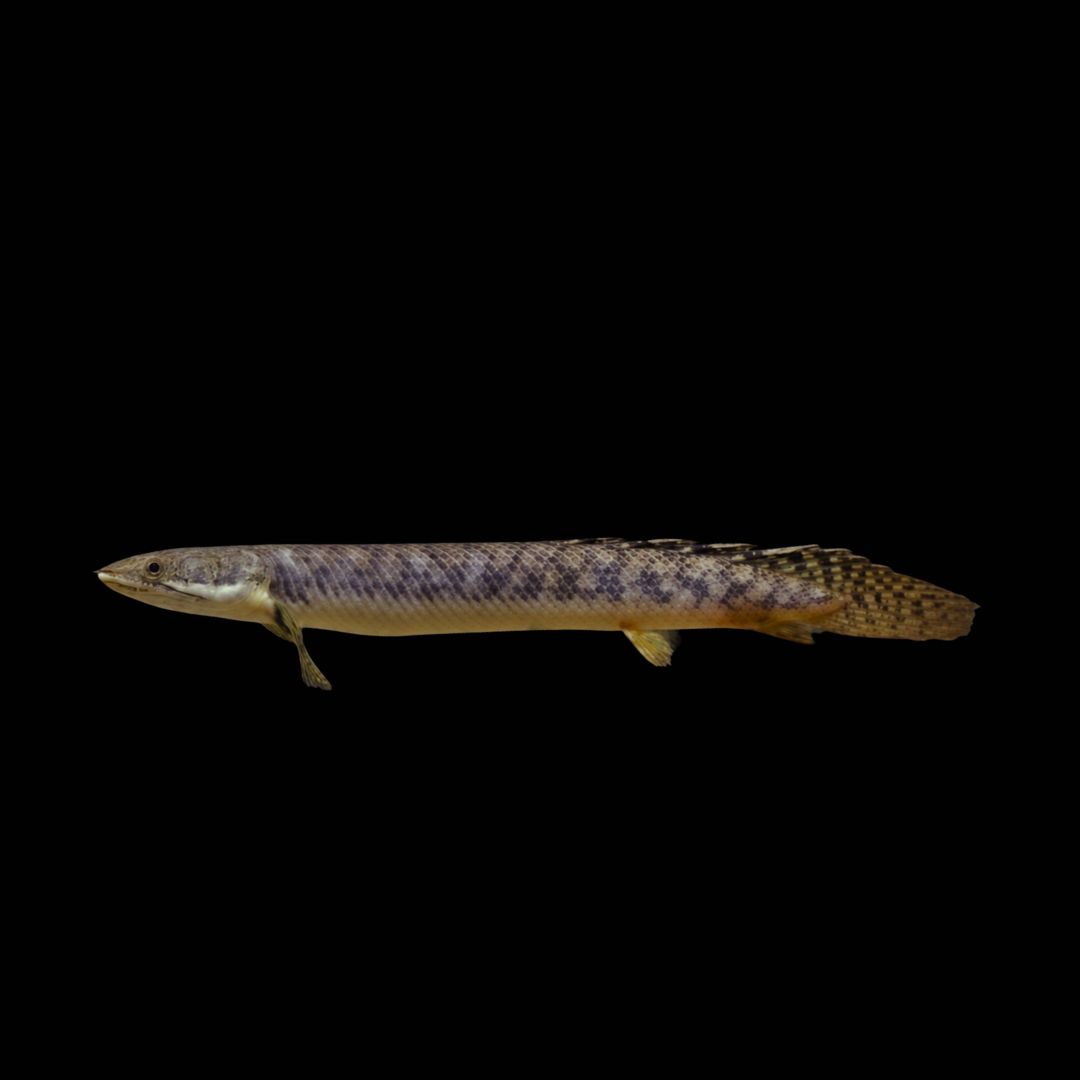
ポリプテルス・レトロピニスは、中央アフリカのコンゴ川水系とオゴウェ川水系に分布するポリプテルス科の淡水魚です。細長い体にはオリーブ褐色から褐色の地色が広がり、暗色の不規則な模様が重なります。背鰭の始まりが体の比較的後方に位置すること、胸鰭基部に大きな黒斑があること、胸鰭の軟条数が多いことなどが、本種を見分ける重要な手掛かりです。底層を中心に行動する肉食魚で、ポリプテルス類に特徴的な肺を備え、水面の空気を取り込んで呼吸します。落ち着いた佇まいと独特の体つきに加え、分類学や呼吸生理、発音行動まで興味深い特徴を備えた種です。Polypterus retropinnis is a freshwater bichir distributed in the Congo and Ogooué river basins of Central Africa. Its slender body is olive-brown to brown with irregular darker markings. Useful identification features include the relatively posterior origin of the dorsal fin, a large dark blotch at the base of the pectoral fin, and a comparatively high pectoral-fin ray count. It is a bottom-oriented carnivore and, like other polypterids, possesses lungs and regularly breathes atmospheric air at the surface. Beyond its distinctive appearance, the species is notable for its taxonomic history, respiratory biology and documented sound production.
ポリプテルス目・ポリプテルス科・ポリプテルス属Order Polypteriformes, Family Polypteridae, Genus Polypterus
英名 / English Name
West African bichir
分布 / Distribution
中央アフリカのコンゴ川水系およびオゴウェ川水系。小河川、湿地、氾濫域などで確認されています。かつて西アフリカから本種として報告された記録の一部は、現在では別種のポリプテルス・パルマスに整理されています。The Congo and Ogooué river basins of Central Africa. The species is associated with small rivers, swamps and flooded areas. Some historical records from West Africa that were once assigned to this species are now referred to Polypterus palmas.
最大体長 / Max Size
標準体長で約34cm。標準体長は尾鰭を含まない測定値のため、全長ではこれより長くなります。About 34 cm standard length. Standard length excludes the caudal fin, so total length can be somewhat greater.
寿命 / Lifespan
本種に限定した信頼性の高い寿命データは乏しく、明確な年数は定めにくいと考えられます。長期飼育を前提に、成魚サイズに対応できる設備を用意してください。Reliable species-specific lifespan data are scarce, so a precise figure is difficult to give. Husbandry should be planned for long-term care with permanent accommodation suitable for an adult fish.
飼育環境 / Aquarium Environment
水槽サイズ / Tank Size
幼魚は60cm規格水槽で一時的に育成できますが、成魚では底面積と旋回スペースを優先します。終生飼育では120cmクラスの水槽が扱いやすく、少なくとも奥行45cm以上を確保すると安心です。高さよりも、水槽の長さと奥行を重視します。Juveniles can be grown temporarily in a standard 60 cm aquarium, but adults require ample floor area and turning space. A tank around 120 cm in length is a practical long-term choice, preferably with a front-to-back depth of at least 45 cm. Length and floor area matter more than excessive height.
水温 / Temperature
25〜28℃を目安に、急変を避けて安定させます。冬季はヒーターとサーモスタットを使用し、夏季は高水温が長く続かないように管理します。Maintain approximately 25–28°C and avoid sudden changes. Use thermostatically controlled heating in winter and prevent prolonged excessive temperatures during summer.
水質 / Water Quality
弱酸性から中性付近を目安にします。極端な数値を追うより、アンモニアと亜硝酸を検出させず、硝酸塩の蓄積を抑えた安定した水質を維持することが重要です。肉食魚で排泄量も少なくないため、十分な濾過能力と定期的な換水を確保します。Slightly acidic to near-neutral water is a practical target. Stability is more important than chasing an exact value: ammonia and nitrite should remain undetectable and nitrate accumulation should be controlled. As a carnivorous fish with a substantial waste load, it benefits from strong biological filtration and regular water changes.
レイアウト / Layout
底層を広く使えるよう、流木や丈夫なシェルターを配置しつつ、移動できる空間を残します。細かな砂や角の取れた底砂は体表を傷つけにくく、落ち着いた環境を作りやすい素材です。暗めの底床や背景では体色が濃く見えることがありますが、色だけを目的に環境を極端に暗くする必要はありません。Provide driftwood or sturdy shelters while preserving open floor space for movement. Fine sand or smooth substrate reduces the risk of abrasion. Darker substrate and backgrounds may make the fish appear more strongly colored, but there is no need to keep the aquarium unnaturally dark solely for coloration.
注意点 / Precautions
飛び出し対策と水面へのアクセスは必須です。ポリプテルス類は空気呼吸を行うため、水面上に呼吸できる空間を残したうえで、蓋を確実に固定し、配管やコード周りの隙間も塞ぎます。水面を浮草で完全に覆うことも避けてください。Both escape prevention and access to atmospheric air are essential. Polypterids breathe air, so leave an accessible air space above the water while securing the lid firmly and closing gaps around pipes and cables. Do not allow floating plants to completely seal the water surface.
餌と給餌 / Feeding
餌の種類 / Diet
肉食性です。主食には沈下性の肉食魚用人工飼料を使い、冷凍アカムシ、エビ類、魚肉、昆虫類などを補助的に組み合わせます。導入直後の個体が人工飼料を警戒する場合は、匂いの強い冷凍餌などから始め、少しずつ人工飼料へ慣らすと管理しやすくなります。This species is carnivorous. Sinking prepared foods for predatory fish can form the staple diet, supplemented with items such as frozen bloodworms, shrimp, pieces of fish and suitable insects. Newly imported individuals that hesitate to accept pellets can be started on strongly scented frozen foods and gradually transitioned to prepared diets.
給餌のポイント / Feeding Tips
底層で嗅覚を使って餌を探すため、沈む餌との相性が良い魚です。夕方から消灯前に与えると反応しやすいことがあります。成魚では毎日大量に与える必要はなく、体型と腹部の張りを見ながら過給餌を避けます。食べ残しは早めに取り除き、水質悪化を防ぎます。Because it searches near the bottom largely by smell, sinking foods are especially suitable. Feeding in the evening or shortly before lights-out often produces a good response. Adults do not require heavy daily feeding; adjust portions according to body condition and avoid overfeeding. Remove leftovers promptly to protect water quality.
性格と混泳 / Temperament and Tank Mates
性格 / Temperament
大型肉食魚としては比較的落ち着いた性格で、日中は物陰で休み、薄暗くなると動きが増える傾向があります。ただし捕食者であることに変わりはなく、口に入る大きさの魚や甲殻類は餌と認識する可能性があります。For a predatory fish of its size, it is generally rather calm. It often rests under cover during the day and becomes more active in dimmer conditions. It remains a predator, however, and fish or crustaceans small enough to swallow may be treated as food.
混泳の相性 / Compatibility
口に入らない大きさで、過度に攻撃的ではない魚が候補になります。同程度のサイズのポリプテルス類や、中層から上層を泳ぐ温和な中大型魚とは生活圏を分けやすい傾向があります。小型魚や小型エビは捕食されやすく、体表を繰り返しつつく魚や、餌を独占するほど気の強い魚との混泳は避けます。Suitable tank mates are too large to swallow and not excessively aggressive. Similar-sized bichirs and peaceful medium-to-large fishes that occupy the middle or upper water layers can work well. Small fish and shrimp are vulnerable to predation, while persistent fin- or body-pickers and highly aggressive feeders should be avoided.
病気と対策 / Diseases and Prevention
かかりやすい病気 / Common Diseases
ポリプテルス類では、体表に寄生する単生類のMacrogyrodactylus polypteriなどが知られています。ただし、P. retropinnisの野生個体にどの程度の頻度で寄生するかを示す十分な資料は確認されていません。体を物にこすりつける、皮膚に異常が見られる、呼吸や摂餌が乱れるといった変化があれば、寄生虫だけでなく外傷や水質悪化、細菌感染なども含めて原因を切り分ける必要があります。Polypterids are known to host skin monogeneans such as Macrogyrodactylus polypteri. However, reliable evidence defining how frequently this parasite occurs specifically in wild P. retropinnis is lacking. Flashing, skin abnormalities, altered breathing or reduced feeding can have multiple causes, including parasites, injury, poor water quality and bacterial infection, so diagnosis should not be based on a single sign.
対策と予防 / Prevention
新規導入魚は本水槽へ入れる前に隔離し、体表、呼吸、糞、摂餌を観察します。単生類に対してプラジカンテルが用いられることはありますが、薬剤は病原体の同定、製品濃度、水温、水量、魚の状態によって適切な使い方が変わります。症状が強い場合や薬浴が必要な場合は、魚類を診療できる獣医師や十分な知識を持つ専門家へ相談してください。日常管理では、安定した水質、外傷の予防、過密回避が最も重要です。Quarantine new arrivals before introduction to the display tank and observe the skin, respiration, feces and feeding response. Praziquantel is used against some monogeneans in ornamental fish, but appropriate treatment depends on diagnosis, product concentration, water temperature, actual water volume and the condition of the fish. Severe cases or medication should be discussed with a veterinarian experienced in fish medicine or another appropriately qualified aquatic-health professional. Stable water quality, injury prevention and avoidance of overcrowding remain the core preventive measures.
増やし方(繁殖) / Breeding
雌雄の判別 / Sexing
成熟したポリプテルス類では、尻鰭が重要な判別材料になります。オスは尻鰭が厚く幅広く発達し、メスは比較的細い形を保ちます。若魚では差が分かりにくいため、ある程度成長してから判断する方が確実です。In mature polypterids, the anal fin is an important sexing feature. Males develop a thicker and broader anal fin, whereas females retain a comparatively narrower fin. Juveniles can be difficult to sex reliably, so identification becomes easier with maturity.
繁殖形態 / Reproduction
ポリプテルス類は、水草などの間に卵を散らす産卵形態をとります。繁殖時にはオスが発達した尻鰭を使ってメスの総排泄腔付近を包むような動作を見せ、放出された卵の受精を助けます。親魚による卵の保護は期待できず、卵を食べることもあります。Polypterids scatter eggs among aquatic vegetation or similar spawning material. During spawning, the male uses the enlarged anal fin around the female’s vent region while the eggs are released and fertilized. There is no parental guarding of the eggs, and adults may consume them.
繁殖のポイント / Breeding Tips
P. retropinnisに限定した飼育下繁殖の詳細な報告は多くありません。ポリプテルス類では環境変化が繁殖のきっかけになると考えられていますが、水温や気圧の変化だけで確実に産卵を誘発できるとは限りません。産卵を確認したら卵を親魚から分け、清潔な育成環境を用意します。仔魚にはポリプテルス類に特徴的な外鰓が現れ、初期にはブラインシュリンプ幼生など、口に合う微小な生き餌が必要になります。Detailed captive-breeding information specific to P. retropinnis remains limited. Environmental change is thought to contribute to spawning in polypterids, but changes in temperature or atmospheric pressure alone should not be treated as reliable triggers. Once spawning occurs, separate the eggs from the adults and maintain them in clean rearing conditions. Larvae develop the characteristic external gills of young polypterids and initially require suitably small live foods such as newly hatched brine shrimp.
雑学と豆知識 / Trivia and Fun Facts
1. 学名が示す「後方の鰭」 / 1. A Name Pointing to a Rearward Fin
Polypterusという属名は、ギリシャ語で「多い」を表すpolyと、「翼・鰭」を表すpteronに由来し、背中に小さな背鰭がいくつも独立して並ぶ姿を表しています。retropinnisという種小名も、背鰭の起点が比較的後方にある本種の特徴と結びつけて理解できます。名前を知ってから魚体を見ると、学名が形態観察の案内役になっていることが分かります。The genus name Polypterus combines Greek roots referring to “many” and “wing” or “fin,” reflecting the series of separate dorsal finlets. The specific name retropinnis can likewise be understood in relation to the relatively rearward position of the dorsal-fin origin. In this case, the scientific name itself points the observer toward a useful anatomical feature.
2. 記載年に1886年と1899年の二つの表記がある / 2. Why Both 1886 and 1899 Appear as the Description Year
本種の学名には、資料によってVaillant, 1886とVaillant, 1899の二つの著者年が見られます。現在のEschmeyer’s Catalog of Fishesでは、1886年に公表された短い記述を学名の有効な初出として扱い、1899年の論文はより詳しい再記載として整理しています。一方で、FishBaseやITISなどには1899年表記も残っています。魚そのものが変わったのではなく、どの出版物を命名上の起点とみなすかという文献整理の違いです。The species can be encountered with either Vaillant, 1886 or Vaillant, 1899 as the author date. The current Eschmeyer’s Catalog of Fishes treats a brief 1886 publication as the valid original appearance of the name and the 1899 paper as a more detailed description. Other databases, including FishBase and ITIS, still display 1899. This is a nomenclatural and bibliographic issue rather than a biological difference in the fish.
3. モケーレムベンベとの混同が分類を動かした / 3. Confusion with P. mokelembembe Reshaped the Taxonomy
レトロピニスの歴史で特に興味深いのが、ポリプテルス・モケーレムベンベとの混同です。2006年の分類学的再検討では、古いレトロピニスのタイプ標本群に二つの種が含まれていたことが整理され、真のP. retropinnisを固定するためにレクトタイプが指定されました。そのうえで、別の形態を持つ個体群がP. mokelembembeとして新種記載されています。現在でも流通名や古い資料を見る際には、この歴史を知っていると混乱を避けやすくなります。One of the most interesting parts of the species’ history is its long confusion with Polypterus mokelembembe. A 2006 taxonomic revision clarified that the historical type series associated with P. retropinnis contained two species. A lectotype was designated to fix the identity of true P. retropinnis, while specimens representing the other form contributed to the description of P. mokelembembe as a new species. This history still matters when interpreting older aquarium names and literature.
4. 英名と実際の分布には少しずれがある / 4. The English Common Name Is Geographically Misleading
英名はWest African bichirですが、現在確実視されている分布の中心は中央アフリカのコンゴ川水系とオゴウェ川水系です。かつて西アフリカでレトロピニスとして報告された一部の魚は、現在ではP. palmasに整理されています。長く使われてきた英名が、分類の更新後もそのまま残った例といえます。Despite the common name “West African bichir,” the currently accepted distribution is centered on the Congo and Ogooué basins of Central Africa. Some historical West African records formerly identified as P. retropinnis are now assigned to P. palmas. It is a good example of a common name persisting even after taxonomic understanding has changed.
5. 胸鰭基部の黒斑だけではなく「数」も見る / 5. Identification Depends on Counts as Well as Pattern
本種では胸鰭基部の大きな黒斑が目立ちますが、近縁種を正確に見分けるには模様だけでなく計数形質も重要です。P. retropinnisの胸鰭軟条は30〜34本、側線鱗は56〜59枚、背鰭は7〜9枚と報告されています。特にP. mokelembembeは胸鰭軟条が23〜29本と少なく、外見が似ていても数を確認すると重要な差が見えてきます。The large dark blotch at the pectoral-fin base is conspicuous, but accurate identification also depends on meristic characters. P. retropinnis has been reported with 30–34 pectoral-fin rays, 56–59 lateral-line scales and 7–9 dorsal finlets. P. mokelembembe, for example, has fewer pectoral-fin rays, typically 23–29, showing why counts can matter when external patterns look similar.
6. 水面の空気を吸うための「反動吸引」 / 6. Recoil Aspiration for Air Breathing
ポリプテルス類は鰓だけでなく肺も使う空気呼吸魚です。呼気で肺を縮めたあと、硬いガノイン鱗に支えられた体壁が元へ戻る力によって体腔内に負圧が生じ、空気を吸い込む「反動吸引」が知られています。さらに頭頂部の噴水孔から空気を取り込むことも確認されており、浅い水域でも口を大きく水上へ出さずに呼吸できる仕組みとして注目されています。Polypterids use lungs as well as gills. After air is expelled from the lungs, recoil of the stiff body wall supported by ganoid scales helps generate negative pressure that draws new air inward, a mechanism known as recoil aspiration. Research has also confirmed inhalation through the paired spiracles on top of the head, an efficient way to breathe in shallow water without lifting the entire mouth far above the surface.
7. レトロピニスは二種類の音を出す / 7. P. retropinnis Produces Two Types of Sound
1988年の研究では、P. retropinnisが同種個体との接近時に短い「thump」と、驚いたり急速に離れたりする際に長い「moan」を発することが報告されました。短い音は約67ミリ秒で主なエネルギーが100〜200Hz付近、長い音は約290ミリ秒で50〜150Hz付近が中心とされています。ポリプテルスを静かな魚だと思っていると意外ですが、目立たない低周波の音も彼らの行動の一部です。A 1988 study documented two sound types in P. retropinnis: short “thumps” during close encounters with conspecifics and longer “moans” associated with rapid withdrawal or startling. The thumps lasted about 67 milliseconds with dominant energy around 100–200 Hz, while moans averaged about 290 milliseconds with dominant energy around 50–150 Hz. These low-frequency signals reveal a less obvious side of bichir social behavior.
8. 仔魚だけが持つ羽毛状の外鰓 / 8. Feathery External Gills in the Larval Stage
ポリプテルス類の仔魚には、頭部の後ろから伸びる羽毛状の外鰓が現れます。成魚の重厚な姿からは想像しにくい形ですが、成長とともに縮小し、やがて見えなくなります。肺を使う成魚と外鰓を持つ仔魚という大きな変化は、ポリプテルス類の個体発生を象徴する特徴の一つです。Young polypterids develop conspicuous feathery external gills behind the head. They look remarkably different from the robust adult fish, then gradually regress as development proceeds. The contrast between an externally gilled larva and a lung-breathing adult is one of the most striking aspects of polypterid development.
まとめ / Conclusion
ポリプテルス・レトロピニスは、細身の体に重なる暗色模様と、体の後方に並ぶ背鰭が印象的なポリプテルスです。胸鰭基部の黒斑や鰭条・鱗の数には近縁種を見分ける手掛かりが隠されており、姿を眺めるだけでなく、分類の面から観察する楽しさも持っています。水面へ静かに浮上して空気を吸う行動や、薄暗い時間に底層を探る動きからは、この魚がアフリカの湿地や氾濫域に適応してきた暮らしぶりを感じ取ることができます。Polypterus retropinnis is a slender bichir distinguished by dark body markings and a dorsal fin that begins relatively far back on the body. The pectoral-fin blotch and counts of fin rays and scales provide useful clues for separating it from similar species, making careful observation rewarding from a taxonomic as well as an aesthetic perspective. Its quiet trips to the surface for air and deliberate bottom-searching behavior reflect adaptations to the swamps, small rivers and flooded habitats of Central Africa.
飼育では、十分な底面積、確実な飛び出し対策、水面の空気へ自由にアクセスできる環境、そして安定した水質が土台になります。派手に泳ぎ続ける魚ではありませんが、流木の陰から姿を現し、独特の体つきでゆっくりと水槽内を進む姿には、ほかの熱帯魚とは異なる存在感があります。分類史や呼吸、発音行動まで知ったうえで向き合うと、レトロピニスは長く観察するほど新しい魅力が見つかる一種です。Successful care depends on generous floor space, reliable escape prevention, unrestricted access to atmospheric air and consistently good water quality. It is not a fish that spends all day swimming in the open, yet its slow emergence from driftwood and deliberate movement across the aquarium give it a presence unlike most tropical fishes. Understanding its taxonomic history, respiratory biology and acoustic behavior adds further depth to keeping and observing this distinctive bichir.
Moritz, T. & Britz, R. (2019). Revision of the extant Polypteridae (Actinopterygii: Cladistia). Ichthyological Exploration of Freshwaters, 29(2), 97–192. DOI: 10.23788/IEF-1094.
Schliewen, U. K. & Schäfer, F. (2006). Polypterus mokelembembe, a new species of bichir from the central Congo River basin (Actinopterygii: Cladistia: Polypteridae). Zootaxa, 1129(1), 23–36. DOI: 10.11646/zootaxa.1129.1.2.
Fricke, R., Eschmeyer, W. N. & van der Laan, R. (eds.) (2026). Eschmeyer’s Catalog of Fishes: Genera, Species, References. California Academy of Sciences. Electronic version accessed 25 July 2026.
Britz, R. (2007). Polypteridae. In M. L. J. Stiassny, G. G. Teugels & C. D. Hopkins (eds.), The Fresh and Brackish Water Fishes of Lower Guinea, West-Central Africa, Vol. 1, pp. 168–173. IRD, MNHN & MRAC.
Graham, J. B., Wegner, N. C., Miller, L. A., Jew, C. J., Lai, N. C., Berquist, R. M., Frank, L. R. & Long, J. A. (2014). Spiracular air breathing in polypterid fishes and its implications for aerial respiration in stem tetrapods. Nature Communications, 5, 3022. DOI: 10.1038/ncomms4022.
Petty, B. D. & Francis-Floyd, R. (2004). Pet fish care and husbandry. Veterinary Clinics of North America: Exotic Animal Practice, 7(2), 397–419. DOI: 10.1016/j.cvex.2004.02.003.
Holden, M. J. (1971). Significance of sexual dimorphism of the anal fin of Polypteridae. Nature, 232, 135–136. DOI: 10.1038/232135b0.
主に支える内容:成熟オスで幅広く発達する尻鰭、雌雄差、産卵時にオスの尻鰭が卵の受精に関与する行動。
Britz, R. & Bartsch, P. (1998). On the reproduction and early development of Erpetoichthys calabaricus, Polypterus senegalus, and Polypterus ornatipinnis (Actinopterygii: Polypteridae). Ichthyological Exploration of Freshwaters, 9(4), 325–334.
Khalil, L. F. (1964). On the biology of Macrogyrodactylus polypteri Malmberg, 1956, a monogenetic trematode on Polypterus senegalus in the Sudan. Journal of Helminthology, 38(3–4), 219–222. DOI: 10.1017/S0022149X00033800.
P. retropinnisについて、家庭飼育における「120cm水槽」「25〜28℃」などの具体的な設備寸法・管理幅を直接規定した査読済みの種別飼育基準は確認できませんでした。そのため、これらは本種の成魚サイズ、熱帯性の生息環境、ポリプテルス類の生理、一般的な観賞魚獣医学を組み合わせた実務上の目安として扱い、学術論文がその数値を直接保証しているような引用は避けています。また、繁殖と寄生虫については、P. retropinnis固有の研究が限られる項目ではポリプテルス科・属内の研究を補助的に用いています。






コメント